
DHI vs FUE Hair Transplant: Which Is Right for You?

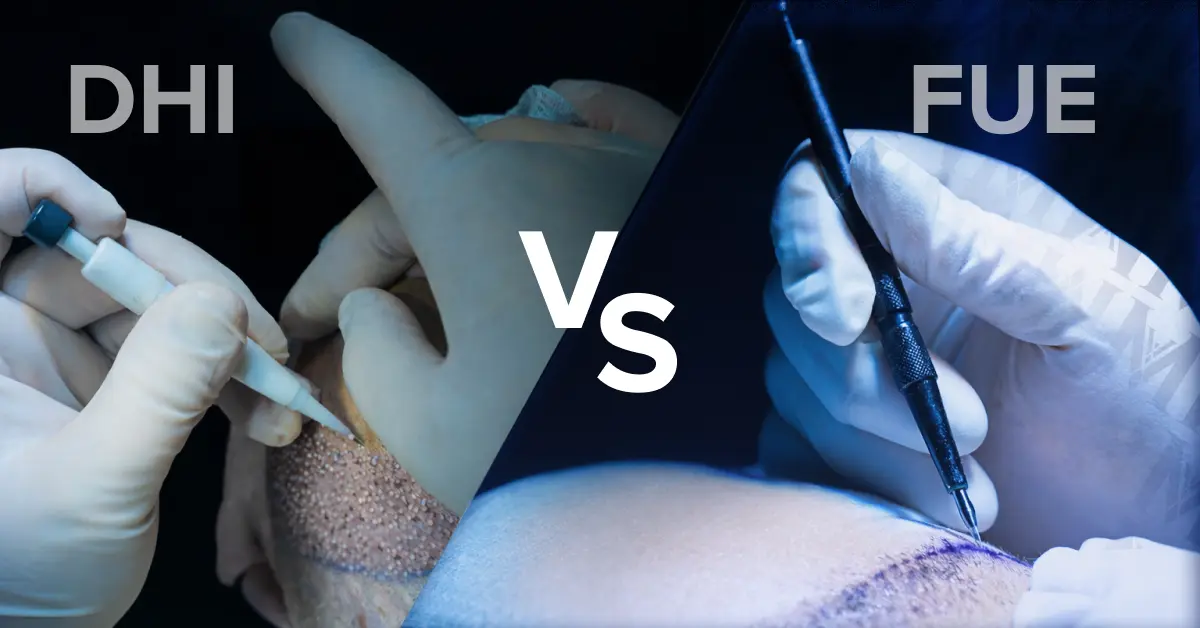
DHI and FUE are two advanced hair transplant techniques that use individual follicle extraction, but they differ in how the grafts are implanted. In FUE (Follicular Unit Extraction), the surgeon first creates tiny channels in the scalp and then places the grafts into these openings. In DHI (Direct Hair Implantation), the grafts are implanted directly using a special implanter pen, allowing for precise control of angle, depth, and direction.
Dhi vs. fue which treatment right for you?

Table of Contents

You've watched the procedure videos. You've scrolled through hundreds of before-and-after photos. You've probably received a quote or two from clinics — maybe more. And yet here you are, still stuck on the same question: DHI or FUE?

Every clinic seems to answer it differently. One tells you DHI is "the latest technology." Another insists FUE delivers "identical results at a lower cost." The marketing claims pile up. The real differences get buried. And the more you research, the less certain you feel.

That ends here.

This article isn't another side-by-side feature list. It's a decision-making guide — built to help you match the right technique to your specific hair loss pattern, aesthetic goals, and budget. By the time you finish reading, you'll know exactly which approach fits your situation, what questions to ask during consultations, and what to expect from the process.

Here's the key insight most DHI vs FUE comparisons miss: these aren't competing techniques — they're complementary tools. The best choice depends on your individual case, and many top clinics in Turkey — the global hub for hair transplant procedures — routinely combine both methods in a single session for optimal results.

Let's break it all down so you can decide with confidence.

This article is for informational purposes and does not replace professional medical advice. Individual results vary. We recommend consulting with a qualified hair restoration specialist for your specific situation.

Get a Free Consultation!

Talk to an experienced patient coordinator for your hair transplant in Turkey.
Please enter a valid phone number.

Quick Overview — What Are FUE and DHI?

Before you can compare these two techniques, you need a clear picture of how each one actually works. Surface-level understanding leads to surface-level decisions. This section gives you the foundation for everything that follows.

What Is FUE (Follicular Unit Extraction)?

FUE is the foundation of modern hair transplantation. It replaced the older FUT strip method — which involved removing an entire strip of scalp from the back of the head — and became the gold standard because it leaves no linear scar.

The FUE hair transplant process follows three distinct stages:

  • 1. Extraction: The surgeon uses a micro-punch tool (typically 0.6–1.0mm in diameter) to remove individual hair grafts — small clusters of 1–4 hairs — from your donor area, usually the back and sides of your head.
  • 2. Channel Creation: The surgeon uses a fine blade — often a Sapphire blade — to create tiny, precise incisions in the thinning or balding zone.
  • 3. Implantation: The extracted grafts are carefully placed into these pre-made channels using specialized forceps.

Between extraction and implantation, grafts are stored in a chilled holding solution to keep them viable. This three-stage process gives the surgeon flexibility to plan graft placement strategically across large areas.

What Is DHI (Direct Hair Implantation)?

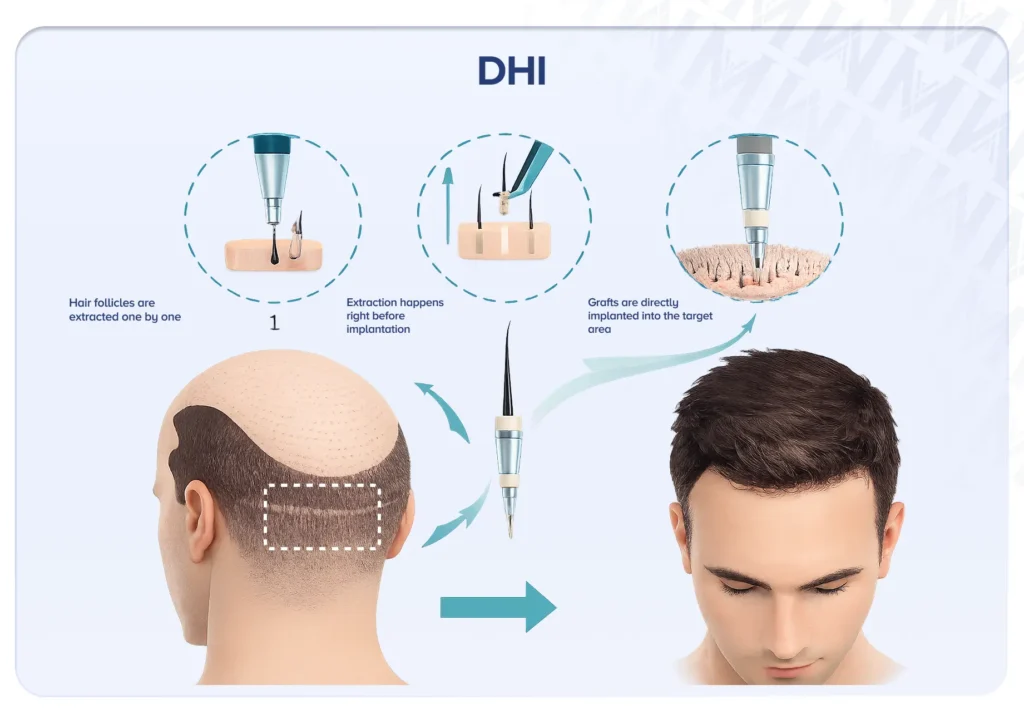
DHI is a specialized refinement of FUE — not a completely separate technology. The extraction step is identical. The difference lies entirely in how grafts are implanted.

In a DHI hair transplant, the surgeon uses a Choi Implanter Pen — a pen-shaped instrument with a hollow needle at the tip that simultaneously creates the channel and places the graft in a single motion. It combines steps two and three of the FUE process into one.

The DHI process follows two stages:

  • 4. Extraction: Identical to FUE — individual grafts are removed using a micro-punch.
  • 5. Direct Implantation: Each graft is loaded into the Choi Implanter Pen and implanted directly into the scalp. No pre-made channels needed.

The result? Grafts spend less time outside the body. And the surgeon controls the angle, depth, and direction of each graft at the exact moment of placement.

The Core Difference in One Sentence

In FUE, grafts are extracted, channels are created, then grafts are placed. In DHI, the Choi pen combines channel creation and placement into one step.

Think of FUE as a two-step planting process — first you dig the holes, then you plant the seeds. DHI is like using a tool that digs and plants in a single motion.

Key Insight: DHI is not a replacement for FUE — it's a specialized refinement. Understanding this changes how you evaluate your options.

This distinction is essential. When a clinic tells you DHI is "newer and better," they're giving you an incomplete picture. When another says FUE is "just as good in every case," that's not the full story either. The truth is more nuanced — and that nuance is what helps you choose wisely.

Now let's examine that nuance across every factor that matters.

DHI hair transplant
fue hair transplant

DHI vs FUE — The Complete Side-by-Side Comparison

This is the section you've been scanning for. With the fundamentals clear, let's compare DHI and FUE across every factor that affects your decision — and, more importantly, what each difference actually means for you.

Procedure Process and Technique

During an FUE procedure, the surgeon first extracts all necessary grafts and stores them in a chilled holding solution. A second team member then creates recipient channels across the target area using a micro blade. Finally, each graft is placed into the pre-made channels using fine forceps.

During DHI, extraction happens the same way. But implantation begins almost immediately. An assistant loads each graft into a Choi Implanter Pen, and the surgeon implants it directly — creating the channel and placing the graft simultaneously. Multiple Choi pens are typically loaded in rotation to maintain a steady workflow.

What this means for you: DHI requires more hands-on involvement from the surgeon during implantation. FUE allows a more distributed workflow, which can be an advantage for very large sessions.

Graft Survival Rate

The graft survival rate — the percentage of transplanted hairs that successfully take root and grow — is one of the most important numbers in your results.

  • FUE: Typically 85–95% survival rate in experienced hands
  • DHI: Often reported at 90–95%+ due to reduced time grafts spend outside the body

Here's the critical caveat: graft survival depends more on the surgeon's skill, graft handling protocols, and your aftercare compliance than on the technique itself. A highly skilled FUE surgeon can achieve survival rates that match or exceed those of an average DHI procedure. The tool matters. The hands holding it matter more.

Natural-Looking Results

Both techniques produce natural-looking results when performed by experienced surgeons. The difference lies in where each technique excels.

  • DHI advantage: The Choi pen gives the surgeon precise control over the angle (typically 40–45 degrees), depth, and direction of each graft at the moment of implantation. This precision is especially valuable for replicating natural hair growth patterns.
  • FUE advantage: For covering large areas — the crown or mid-scalp — FUE's efficiency allows consistent results across a bigger surface.

What this means for you: If your top priority is a natural, undetectable hairline, DHI's precision offers a clear edge. If you need broad coverage across a wide area, FUE handles volume effectively.

Number of Grafts and Coverage Area

This is a critical distinction that many comparison articles gloss over.

  • FUE: Can efficiently handle large sessions of 5,000–6,000+ grafts in a single procedure.
  • DHI: Typically recommended for sessions of up to 3,000–4,000 grafts because the Choi pen process is more labor-intensive.

What this means for you: If you have advanced hair loss and need maximum coverage, FUE or a hybrid approach is likely more practical. If your hair loss is early to moderate and you need fewer grafts, DHI's precision becomes a stronger advantage.

Procedure Duration

  • FUE: Typically 6–8 hours for a full session.
  • DHI: Often 7–10+ hours due to the meticulous nature of Choi pen implantation.

Both are performed under local anesthesia, so pain isn't the concern — but comfort and fatigue can become factors during extended sessions. Longer procedures also demand more endurance from the surgical team, which is why DHI requires a highly experienced crew.

Recovery and Downtime

Both DHI and FUE are outpatient procedures performed under local anesthesia. Their recovery timelines are broadly similar.

  • Initial healing: 7–14 days for both techniques.
  • DHI difference: The recipient area may show slightly less post-operative redness and scabbing because no separate channels are pre-made.
  • Donor area: Recovery is identical — the same micro-punch extraction is used.

Most patients return to non-strenuous work within 7–10 days with either technique. You can explore our complete hair transplant recovery guide for detailed aftercare instructions.

Shaving Requirements

This factor matters more than many patients initially expect.

  • FUE: Typically requires shaving the full head, or at minimum the donor area.
  • DHI: Can be performed as an unshaven hair transplant, where only small sections of the donor area are trimmed.

What this means for you: If discretion matters — perhaps you don't want colleagues or friends to know about your procedure — unshaven DHI offers a significant advantage. Keep in mind that unshaven procedures may limit the total number of grafts your surgeon can transplant in one session.

Cost Comparison

Cost is often the deciding factor. Here's what you can typically expect when comparing the DHI vs FUE price in Turkey and internationally:

  • FUE in Turkey: Approximately $1,500–$3,500.
  • DHI in Turkey: Approximately $2,500–$5,000.

For context, the same procedures in the UK or US typically cost $8,000–$15,000+ for FUE and $10,000–$20,000+ for DHI. Turkey's lower operating costs — not lower quality — drive this difference at reputable clinics.

DHI costs more because it requires more surgical time, specialized Choi Implanter Pens (which are single-use), and a higher level of surgeon involvement during implantation. You can find a detailed breakdown of hair transplant costs in Turkey to help plan your budget.

When evaluating pricing, look for transparency about what's included — surgeon involvement during implantation, quality of graft storage solutions, and the experience level of the team. Prices that fall significantly below typical ranges should prompt questions, not excitement.

Remember: The technique matters, but the surgeon's skill and experience matter more.

The table below summarizes everything covered in this section at a glance:

Comparison Factor FUE DHI
Procedure process 3 stages: extract → create channels → implant 2 stages: extract → direct implant via Choi pen
Graft survival rate Typically 85–95% Typically 90–95%+
Natural-looking results Excellent for large-area coverage Superior precision for hairline and density work
Max grafts per session 5,000–6,000+ 3,000–4,000 (more labor-intensive)
Procedure duration 6–8 hours typical 7–10+ hours typical
Recovery / downtime 7–14 days initial healing 7–14 days; slightly faster recipient-area healing
Shaving required Usually full or donor-area shaving Can be performed unshaven
Cost in Turkey $1,500–$3,500 $2,500–$5,000
Cost in UK/US/EU $8,000–$15,000+ $10,000–$20,000+

This table summarizes typical ranges. Your individual case may vary based on graft count, clinic, and surgeon experience.

Want to know exactly how many grafts you need and which technique suits your hair loss? Book a free online consultation for a personalized assessment.

Before you do, there's one area of your transplant that deserves its own spotlight — your hairline.

Learn Which Treatment is Right for You!

Talk to an experienced patient coordinator for your hair transplant in Turkey.
Please enter a valid phone number.

Which Technique Is Better for Your Hairline?

Your hairline is the single most visible element of your transplant. It frames your face. It's what people see first. And it's where technique choice has the most dramatic impact on whether your results look natural — or not.

A well-designed hairline hair transplant requires far more than placing grafts in a line. Think of hairline design like arranging individual brushstrokes in a painting — each one must sit at precisely the right angle and spacing to create a natural-looking whole. At the hairline, hairs typically grow at very acute angles — almost flat against the skin — and they fan outward in a subtle, irregular pattern.

This is where DHI shows its strongest advantage. The Choi Implanter Pen allows the surgeon to control all three critical variables — angle, depth, and direction — at the exact moment of placement. There's no guesswork about whether a graft will sit correctly in a pre-made channel. The surgeon places it exactly where and how it needs to go.

DHI also excels at implanting between existing hairs without damaging them. If you still have hair in your frontal zone but it's thinning, DHI can add density precisely where it's needed — making it particularly effective for DHI vs FUE for thinning hair scenarios. FUE's pre-made channels carry a slightly higher risk of disturbing surrounding follicles in areas with existing hair.

That said, FUE produces excellent hairlines in skilled hands. An experienced surgeon who understands hairline artistry can achieve beautiful, natural results with FUE — especially using sapphire blades that create smaller, more precise channels.

Consider a 32-year-old man with a receding hairline classified as Norwood 3 on the Norwood scale — which classifies male pattern hair loss from Stage 1 (minimal recession) to Stage 7 (extensive loss). His primary concern is a natural-looking hairline that blends seamlessly with his existing hair. He has good donor density and needs approximately 2,500 grafts. For his situation, DHI's precision with the Choi pen offers a clear advantage for achieving the undetectable, dense hairline he wants.
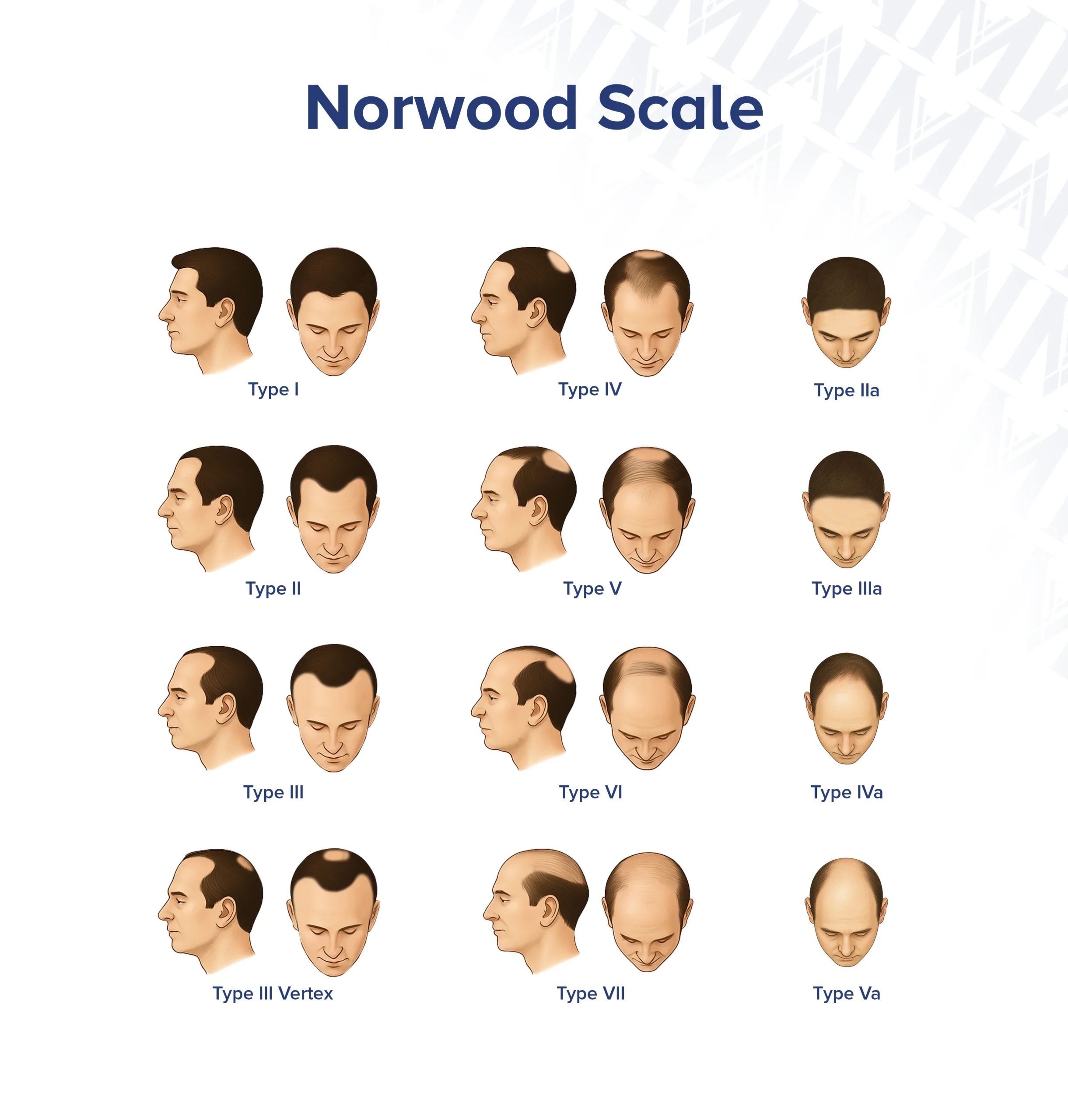
Norwood scale classifying male pattern hair loss from stage 1 to stage 7

So is DHI better than FUE for the hairline? In most cases, yes — DHI holds a technical edge for hairline work. But the surgeon's artistic eye matters just as much as the instrument in their hand.

And for many patients, the ideal approach combines both techniques — which brings us to the most important section of this article.

DHI vs FUE — Which Is Better for YOUR Situation?

You understand the technical differences. Now the real question: which ones matter most for your specific case? This section gives you a clear framework to answer that. Read through each pathway and identify which one matches your situation.

Choose FUE If…

  • You need a large graft count: 4,000+ grafts? FUE handles high-volume sessions more efficiently, making it the practical choice for extensive coverage.
  • You have advanced hair loss (Norwood 5–7): Significant thinning across the crown and mid-scalp demands maximum graft placement — FUE's capacity advantage matters here.
  • Budget is a primary concern: FUE's lower cost in Turkey ($1,500–$3,500) makes it more accessible, especially for large sessions.
  • You're comfortable with head shaving: If shaving isn't an issue, FUE's standard approach is straightforward and efficient.
  • Maximum coverage is the priority: When broad-area restoration matters more than ultra-precise density in one specific zone, FUE delivers.

Consider a 45-year-old teacher with significant hair loss across the crown and mid-scalp, classified as Norwood 5. He's been losing hair for over a decade and wants comprehensive restoration during his summer break. He needs approximately 5,500 grafts for meaningful coverage and wants the most cost-effective approach. FUE's ability to handle high-volume sessions makes it the clear choice for his level of hair loss.

Choose DHI If…

DHI is likely your best option if:

  • Hairline precision is your top priority: DHI's angle and depth control create the most natural-looking hairlines.
  • You prefer an unshaven procedure: Unshaven DHI lets you maintain your current hair length — ideal if discretion matters.
  • You have early to moderate hair loss (Norwood 2–4): With fewer grafts needed, DHI's precision becomes your biggest advantage.
  • You're adding density between existing hairs: The Choi pen implants grafts without damaging surrounding follicles.
  • You're willing to invest more for precision: The higher cost reflects more surgical time and specialized tools — not a marketing premium.

Consider a Hybrid Approach If…

A Hybrid hair transplant offers unique benefits:

  • You want the best of both worlds: A hybrid hair transplant uses DHI for the hairline and FUE for the crown and mid-scalp — combining precision where it matters most with efficiency where volume is needed.
  • You need a large session with a refined hairline: This is increasingly the most common scenario at top clinics.
  • Your surgeon recommends it for your pattern: The best clinics assess your case individually rather than defaulting to one technique.
  • You want to maximize donor hair value: Using each technique where it performs best ensures optimal use of your finite donor supply.

Consider a 38-year-old professional with Norwood 4 hair loss. He has a wedding in three months and doesn't want to shave his head. He needs approximately 3,500 grafts — a refined hairline is his top priority, but he also wants to address thinning in the crown. The hybrid approach gives him the best outcome: unshaven DHI for a precise, dense hairline and FUE for efficient crown coverage.

The best clinics don't push one technique — they recommend the right technique for YOUR specific case.

Decision Checklist

Use these questions to clarify your priorities before your consultation:

  • How many grafts do you estimate you need? (Under 3,000? Over 4,000? Not sure?)
  • Is an unshaven procedure important to you?
  • What is your primary concern — coverage area or hairline density?
  • What is your Norwood scale level? (Your clinic can help determine this.)
  • What is your budget range?
  • Are you open to a hybrid approach if your surgeon recommends it?
  • Do you have concerns about your donor area density?

Bring these answers to your consultation. They'll help your surgical team recommend the approach that fits your goals. A personalized consultation will confirm which approach is right for your specific hair loss pattern and goals — far more accurately than any self-assessment alone.

If the hybrid approach caught your attention, the next section explains exactly how it works in practice.

Can You Combine DHI and FUE in One Procedure?

Yes — and many top clinics in Turkey do exactly this, every day. The hybrid approach isn't experimental. It's increasingly the gold standard at experienced clinics that prioritize results over marketing a single technique.

Here's how a hybrid hair transplant works. Your surgeon uses DHI for the areas that demand the most precision — typically the hairline and frontal zone — and FUE for the areas that need efficient, broad coverage — typically the mid-scalp and crown.

The logic is straightforward. The hairline requires meticulous angle control and the ability to implant between existing hairs. The Choi pen excels here. The crown and mid-scalp need consistent coverage across a larger surface. FUE's three-stage process handles this volume more efficiently.

Since the extraction method is identical for both techniques, the only difference is how grafts are implanted in different zones of your scalp. A skilled surgical team transitions between tools seamlessly. From your perspective as a patient, the experience feels continuous — you're under local anesthesia throughout, and the switch between instruments happens without any interruption to your comfort.

When evaluating clinics, ask whether they offer a combined approach and how they decide which zones receive which technique. A clinic that only offers one method — or defaults to one technique for every patient — may not be tailoring the plan to your needs. If a clinic recommends a sapphire FUE hair transplant for your crown combined with DHI for your hairline, that's a strong signal they're thinking about your results individually.

If Turkey is on your shortlist for this procedure — and for most readers, it is — here's what you need to know.

DHI and FUE in Turkey — What You Need to Know

Turkey isn't just an option for hair transplants — it's where the majority of the world's procedures happen. Understanding the Turkey-specific context will help you make a more informed decision about not just technique, but where and with whom to trust your results.

Why Turkey Is the Global Leader in Hair Transplants

Turkey performs an estimated 700,000+ hair transplant procedures annually, according to industry reports. That volume translates into something money can't buy: depth of experience. Turkish surgical teams perform these procedures daily, developing a level of specialization that's difficult to match in countries where hair transplantation represents a smaller fraction of the medical landscape.

The cost advantage is real and legitimate. Lower operating costs, a favorable exchange rate, and intense competition among clinics keep prices 60–70% lower than in the UK, US, or EU — without compromising quality at reputable clinics. A hair transplant in Turkey often costs a fraction of what the same procedure would run in London or New York, performed by an equally qualified team.

Medical tourism infrastructure adds further value. Most reputable clinics offer all-inclusive packages that simplify the entire experience for international patients.

How to Choose Between DHI and FUE Clinics in Turkey

Not all clinics are equally skilled in both techniques. Here's what to look for:

  • Ask about the surgical team structure: Who performs each step — extraction, channel creation, implantation? Understanding the surgeon's direct involvement at each stage is one of the strongest quality signals available to you.
  • Request technique-specific before-and-after photos: Look for results that match your hair loss pattern and type. Generic galleries tell you little.
  • Ask about the hybrid approach: Clinics that offer and recommend combined procedures demonstrate nuanced expertise.
  • Look for tailored recommendations: Clinics that customize their approach to your specific case — rather than defaulting to a single technique for every patient — are more likely to prioritize your results.

A personalized assessment based on your photos and medical history will tell you far more than any website. Our surgical team performs both DHI and FUE daily and will recommend the approach that best fits your specific case.

A lower price doesn't mean lower quality — but a suspiciously low price should raise questions.

What's Included in a Typical Turkey Hair Transplant Package

Most reputable clinics in Turkey offer all-inclusive packages covering:

  • Airport transfers: Arrival and departure
  • Hotel accommodation: Typically 2–3 nights
  • The procedure itself: Including all medical supplies and anesthesia
  • Post-operative medications: Includes all necessary care products
  • PRP treatment: Platelet-rich plasma therapy to support healing and graft survival
  • Follow-up consultations: Often remote, via video call after you return home

Packages may differ slightly between DHI and FUE procedures, mainly due to the cost difference in the procedure itself. Confirm exactly what's included before booking — and verify whether aftercare support extends beyond your stay in Turkey.

Explore our all-inclusive hair transplant packages covering both DHI and FUE procedures with airport transfers, accommodation, and full aftercare.

Plan for a minimum of 3–5 days in Turkey for either procedure. This covers your consultation day, the procedure itself, a follow-up appointment, and a buffer day for rest before traveling home.

With the logistics covered, let's clear away some persistent misconceptions that could cloud your decision.

Common Myths About DHI and FUE — Debunked

Misinformation is everywhere in the hair transplant industry — and it can steer you toward the wrong decision. These are the myths we encounter most often, along with the reality behind each one.

  • Myth 1: "DHI is a completely different technology from FUE." DHI is a variation of FUE. Both extract grafts the same way using a micro-punch. The only difference is the implantation method. Recognizing that DHI is a refinement — not a revolution — helps you evaluate marketing claims more critically.
  • Myth 2: "FUE leaves visible scars, but DHI doesn't." Both techniques use the same extraction process, leaving tiny dot scars (under 1mm) in the donor area. These are virtually invisible once surrounding hair grows over them. Neither technique leaves the linear scar associated with the older FUT strip method.
  • Myth 3: "DHI guarantees a higher graft survival rate." DHI's shorter out-of-body time for grafts may contribute to slightly higher survival rates. But no technique guarantees a specific outcome. Surgeon skill, graft handling, and your aftercare compliance are equal or greater factors in how many grafts survive.
  • Myth 4: "You can get unlimited grafts with FUE." Your donor area contains a finite number of healthy hair follicles — regardless of technique. Both DHI and FUE are limited by your donor supply. A responsible surgeon will assess your donor density and set realistic expectations.
  • Myth 5: "DHI is always more expensive because it's always better." DHI costs more because it requires more surgical time, single-use Choi pens, and greater surgeon involvement. The higher price reflects the complexity of the procedure, not inherent superiority. For large-area coverage, FUE may actually deliver better value.
  • Myth 6: "You can tell the difference between DHI and FUE results." In experienced hands, the final results of both techniques can be virtually indistinguishable. Browse any reputable clinic's before-and-after gallery — you'd be hard-pressed to identify which technique was used based on the outcome alone.

Now let's turn to what happens after the procedure — because recovery is where your role as a patient matters most.

What to Expect — Recovery Timeline for Both Techniques

Choosing the right technique is half the equation. The other half is what happens in the weeks and months that follow. Regardless of whether you choose DHI or FUE, following aftercare instructions carefully is essential for the best possible outcome.

Week-by-Week Recovery Comparison

  • Days 1–3: Expect mild swelling, tenderness, and redness in both the donor and recipient areas. Your clinic will provide pain medication, antibiotics, and a care routine. Sleep with your head elevated and avoid touching the grafts.
  • Days 4–7: Small scabs form around each transplanted graft. Your clinic will instruct you on gentle washing techniques to begin removing them. Most swelling subsides by day 5.
  • Weeks 2–4: This is when "shock loss" occurs — a normal phase where many transplanted hairs fall out. It can feel alarming, but it's expected. The follicles remain alive beneath the surface and will produce new growth.
  • Months 3–6: New hair growth begins. Hairs emerge thin and fine at first, gradually thickening over time. You'll start seeing early signs of your results.
  • Months 9–12: Significant improvement becomes visible. Most patients see near-final density and coverage. Hair continues to thicken and mature.
  • Months 12–18: Full final results. Hair reaches its mature thickness, texture, and growth pattern. This is when you can truly evaluate your transplant.
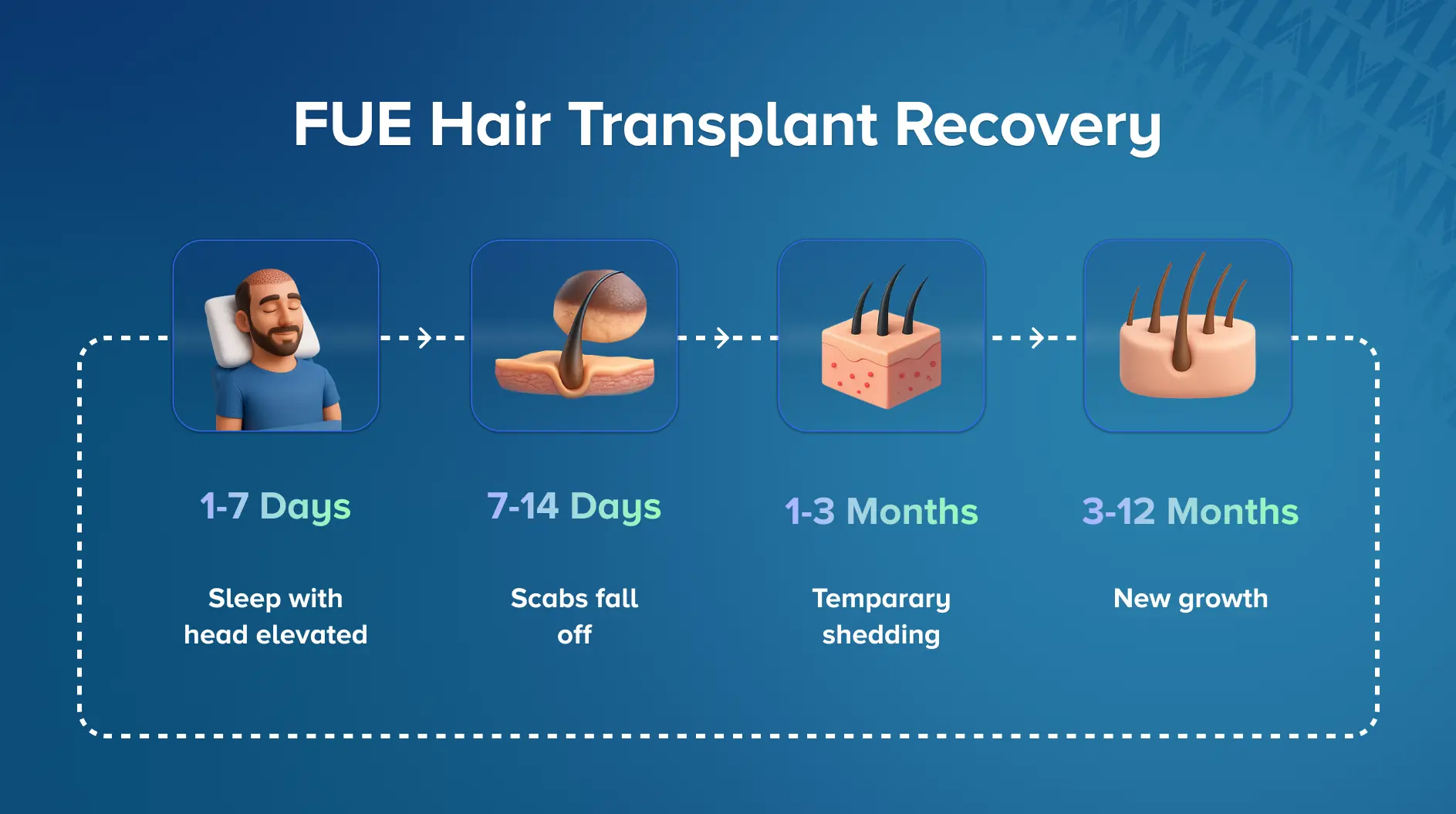
Hair transplant recovery timeline from day one through eighteen months

Key Recovery Differences Between DHI and FUE

  • Recipient area: DHI may heal slightly faster because the Choi pen creates smaller entry points than pre-made channels. Some patients report less scabbing and redness in the first week.
  • Donor area: Recovery is identical. Both techniques use the same micro-punch extraction.
  • Overall: The differences are minimal. Both are outpatient procedures, and most patients resume normal activities within 10–14 days.

The DHI vs FUE recovery time difference is marginal. Your commitment to aftercare — protecting the grafts, avoiding sun exposure, following medication schedules — has a far greater impact on your results than the technique used.

Still have specific questions? The FAQ below covers the most common ones.

Frequently Asked Questions — DHI vs FUE

These are the questions patients ask most often. If yours isn't answered here, a personalized consultation can address it directly.

Is DHI more painful than FUE?
Both procedures are performed under local anesthesia, so you won't feel pain during either one. Post-operative discomfort is similar — mild tenderness and tightness that typically resolves within a few days. Most patients describe the experience as uncomfortable rather than painful, regardless of technique.
How long does a DHI procedure take compared to FUE?
DHI typically takes 7–10+ hours, while FUE usually takes 6–8 hours for a comparable session. DHI takes longer because the Choi Implanter Pen requires meticulous, graft-by-graft placement. Both procedures include breaks, and you'll be comfortable under local anesthesia throughout.
Can I get a DHI hair transplant without shaving my head?
Yes. DHI can be performed as an unshaven procedure — one of its most appealing advantages. Only small sections of the donor area need trimming. This makes DHI ideal if you want to keep your procedure discreet. However, unshaven DHI may limit the total number of grafts that can be transplanted in a single session.
Which technique is better for beard or eyebrow transplants?
DHI is generally preferred for beard transplants and eyebrow transplants because these areas require extremely precise angle control and the ability to place grafts between existing hairs. The Choi pen's precision makes it well-suited for the fine detail work these procedures demand.
How many grafts can be transplanted with DHI vs FUE?
FUE can typically handle 5,000–6,000+ grafts per session, while DHI is usually recommended for up to 3,000–4,000 grafts. If you need a high graft count, FUE or a hybrid approach is generally more practical. Your surgeon will recommend the right approach based on your donor availability and coverage goals.
Is DHI or FUE better for African or Afro-textured hair types?
Afro-textured hair has a curved follicle structure that requires extra care during extraction. Both techniques can work effectively, but the surgeon's experience with your specific hair type matters more than the technique itself. Look for clinics with documented experience and before-and-after photos of patients with similar hair texture.
Do DHI and FUE results last the same amount of time?
Yes. Both techniques transplant permanent hair from the donor area — hair that is genetically resistant to the hormones that cause pattern hair loss. Results from both DHI and FUE are considered permanent. However, natural aging may affect surrounding non-transplanted hair over time, which is why some patients plan for future sessions.
Can I have a second hair transplant using a different technique?
Absolutely. If you previously had FUE and want to add density or refine your hairline with DHI — or vice versa — this is entirely possible. Your surgeon will assess your remaining donor supply and recommend the best approach for your follow-up session.
What is the success rate of DHI vs FUE in Turkey?
At reputable Turkish clinics with experienced surgical teams, both techniques achieve high success rates. FUE graft survival typically ranges from 85–95%, while DHI is often reported at 90–95%+. The clinic's protocols, the surgeon's expertise, and your aftercare adherence are the most significant factors in your individual outcome.

Making Your Decision — Next Steps

You now have something most patients don't at this stage: a clear, honest understanding of how DHI and FUE compare — and a framework for deciding which one fits your life.

Here's the short version. If you need large-area coverage and value efficiency, FUE is likely your best path. If hairline precision, density between existing hairs, or an unshaven procedure are your priorities, DHI offers distinct advantages. And if you want the best of both worlds — which many patients do — the hybrid approach combines each technique's strengths where they matter most.

But here's the most important takeaway from this entire DHI vs FUE comparison: the technique is only as good as the surgical team performing it. The difference between a good result and a great one comes down to the surgeon's experience, artistic judgment, and the quality of care at every stage — from your first consultation through your final follow-up.

You've done the research. You understand the trade-offs. The next step is getting a personalized recommendation based on your unique hair loss pattern, donor area, and goals — not a one-size-fits-all answer from a website.

Send us your photos for a free, personalized assessment. Our surgical team will analyze your hair loss pattern, evaluate your donor area, and recommend the technique — or combination of techniques — that will give you the best possible result. No pressure, no obligation. Just an honest, expert evaluation to help you move forward with clarity.

Book your free consultation here— and take the step from researching to results.

Contact with Us!

Please enter a valid phone number.
WhatsApp
Graft Calculator WhatsApp WhatsApp