Key Takeaways
● FUE is an excision method, not a guarantee of any particular density or coverage.
● FUE is not scarless, and your donor hair is a finite resource.
● Sapphire FUE and DHI describe different tools or procedural stages, not superior "levels" of surgery.
● Verify who performs every surgical step before you pay a deposit.
● Compare total care, safety, and follow-up—not only the package price.
The most important question about an FUE transplant in Turkey is not "How many grafts can I get?" It is "How many grafts can be removed safely while protecting my donor area for the future?" That distinction changes everything, because diagnosis, design, surgical execution, and follow-up all shape the result too.
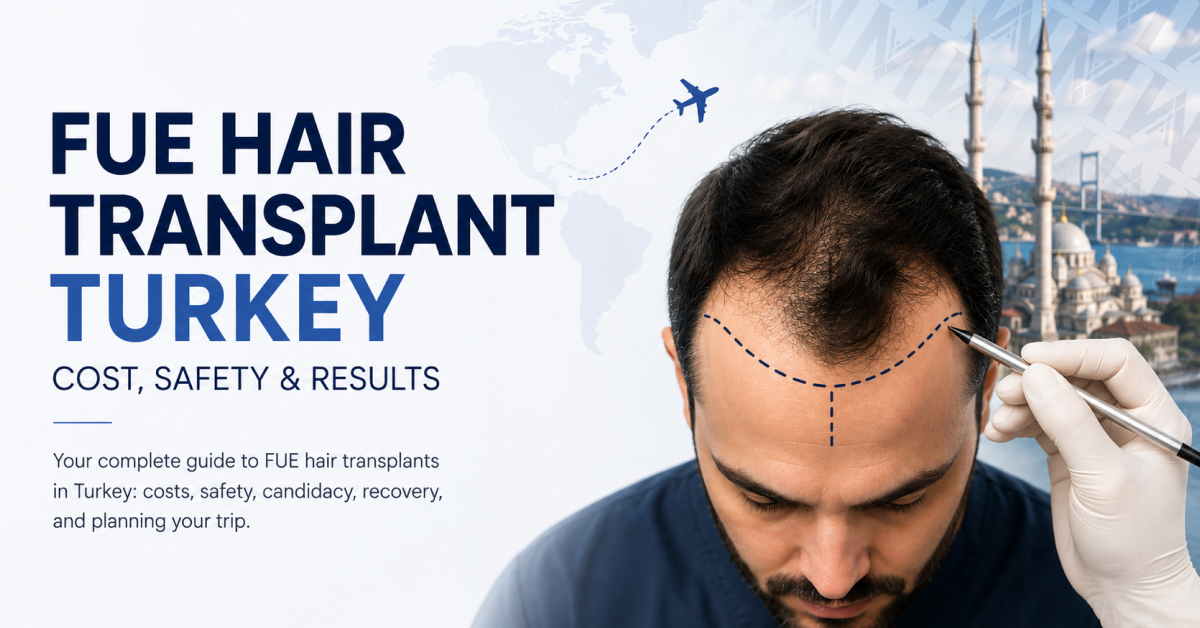
This FUE hair transplant Turkey guide explains how to judge candidacy, clinical responsibility, total cost, and aftercare. Medart Hair Transplant is an Istanbul clinic and the publisher of this guide, so its commercial interest is disclosed upfront. The article supports your decision. It cannot replace a diagnosis or an in-person surgical assessment.
This article provides general educational information and does not replace an individual diagnosis or medical consultation. Hair transplantation is surgery and carries risks. Suitability, graft planning, recovery, and results vary between patients.
Quick Quote in 5 Minutes
Talk to an experienced patient coordinator for your hair transplant in Turkey.Is an FUE Hair Transplant Turkey Trip Worth It?
FUE in Turkey can be worthwhile for the right candidate, but value depends on clinical standards, donor planning, follow-up, and total cost rather than the destination alone. Building on that donor-preservation question above, this section shows how to judge whether travelling adds value or avoidable risk.
Turkey combines experienced providers, a large medical-tourism industry, and lower operating costs. Those lower costs can reduce the quoted price. They do not tell you whether diagnosis, physician involvement, infection control, graft handling, or follow-up are adequate. The country name on its own proves nothing about the surgeon who will actually treat you.
A low headline package is not a diagnosis. Some readers should investigate their hair loss before considering surgery at all. The real value calculation includes your long-term result, revision risk, travel, aftercare, and any future procedure.
A treatment may be worth it when:
● You have a confirmed diagnosis and a usable donor area without significant diffuse miniaturization.
● Your expectations match what your donor supply can realistically cover.
● The clinic gives you a physician-led plan and names who performs each stage.
● Follow-up and complication support are documented in writing.
● The total cost, including travel and possible revision, still compares well.
It may not be worth it when:
● Your diagnosis is uncertain or your loss is still actively progressing.
● No local complication pathway or aftercare is arranged for your return home.
● Your coverage goals clearly exceed your donor supply.
The International Society of Hair Restoration Surgery (ISHRS) consistently emphasises that patient safety depends on qualified surgical planning and oversight rather than geography. Keep that in mind whenever a price looks unusually low.
What Is FUE, and How Does It Work?
FUE is a hair-transplant harvesting method in which follicular units are individually excised from a donor area before being placed into recipient sites. Having weighed whether Turkey is worth it, you now need to understand exactly what the procedure involves, so no clinic can blur the details.
FUE stands for follicular unit excision. The older term "follicular unit extraction" remains widely used, but excision is now the preferred technical description, because a small circular cut—not a simple pull—removes each unit.
The donor area is usually taken from scalp regions with greater resistance to androgenetic alopecia (genetically driven, hormone-related hair loss). That resistance is not absolute. Clinicians should assess density, miniaturization, and the safe harvesting zone before surgery. A surgeon or trained team then removes individual follicular units, the natural groupings in which hair grows, one at a time using a small punch.
Follicular unit excision versus extraction terminology
Both terms describe the same technique. "Excision" reflects that a tiny punch cuts around each follicular unit. When a clinic still says "extraction," that is not wrong. It is older language.
FUE is not scarless. It does not create a linear strip scar the way FUT surgery does, but it leaves many tiny extraction sites that can produce small, dot-like scars. These often blend into surrounding hair. Yet they exist, and they can become visible if the donor is harvested too aggressively.
Grafts versus hairs
Grafts vs hairs: why the numbers are not interchangeable. A graft is one follicular unit. A follicular unit can contain one, two, three, or occasionally four hairs. So 3,000 grafts is not the same as 3,000 hairs. It usually represents more hairs, because many units hold more than one. Picture a graft as a seedling cluster: one cluster, several shoots. When a clinic quotes "grafts," ask what average hair-per-graft count they assume.
FUE involves three separate surgical stages, and it matters who performs each one:
1. Extraction (harvesting) of follicular units from the donor area.
2. Recipient-site creation, where tiny openings are made in the thinning area.
3. Implantation, where each graft is placed into a recipient site.
Donor capacity is worth defining here. It is the total number of follicular units that can be removed while keeping the donor area looking acceptable and preserving reserve for future surgery. It is finite, and it cannot be topped up later.
Graft growth refers to whether transplanted follicles produce visible hair after healing and maturation. It varies with diagnosis, harvesting, handling, placement, and follow-up, so no honest clinic can guarantee a universal percentage.
FUE versus FUT
FUT, or strip surgery, removes a narrow strip of donor scalp and closes the area as a line. It may suit selected patients, particularly when donor strategy, hairstyle preference, scarring priorities, and lifetime graft needs favour strip harvesting. FUE removes units individually and avoids that single line. Neither method makes your donor supply unlimited, and neither stops your untreated native hair from continuing to thin.
That final point is critical. A transplant redistributes hair. It does not switch off progressive hair loss. Native hair around your transplant can keep thinning, which is exactly why long-term planning beats a one-off maximum session.
Why Is Turkey Popular for FUE Hair Transplants?
Turkey is popular for FUE because it combines lower operating costs with extensive medical-tourism infrastructure, but clinical quality varies widely between providers. Now that you understand the procedure, it helps to know why so many patients specifically fly to Istanbul.
Istanbul sits at a global travel crossroads with strong international flight connections. Many clinics bundle accommodation, airport transfers, and interpretation into a single package, which removes friction for overseas patients.
Why treatment may cost less
Lower staffing, facility, and living costs in Turkey reduce overheads compared with the UK, US, or Western Europe. High patient volume can also give some teams considerable hands-on familiarity. That familiarity is an opportunity, not a guarantee of competence.
Volume alone does not prove quality. A busy clinic can still under-supervise surgery or overharvest donor areas.
The difference between accessibility and quality
Turkey's genuine advantages |
The limitations you must check |
|---|---|
Lower operating costs reduce price |
A low price can hide technician-led, unsupervised surgery |
Strong flight and hotel infrastructure |
Convenient logistics say nothing about surgical skill |
Bundled packages simplify travel |
Bundles can obscure medical fees and exclusions |
High procedure volume may increase team familiarity |
Volume does not establish training, oversight, complication rates, or outcomes |
Health-tourism authorization exists for many facilities |
Applicable authorization must be independently verified through the official Turkish route before payment |
Source: general medical-tourism guidance from the Centers for Disease Control and Prevention (CDC) and the Republic of Türkiye Ministry of Health; verify the current authorization route immediately before publishing.
Medical tourism is a continuity-of-care issue, not just a travel-and-price decision. When you fly home, someone still has to manage a complication. According to CDC travel-health guidance, travellers seeking surgery abroad should confirm follow-up and emergency arrangements before departure. Turkey as a destination does not, by itself, establish physician involvement, diagnostic quality, or outcome quality.
Who Is a Good Candidate for FUE?
A suitable FUE candidate needs a confirmed diagnosis, usable donor hair, realistic expectations, and a plan for future hair loss. Having seen why Turkey attracts patients, you now need to check whether surgery is the right next step for you, because for some readers it is not.
Most male hair loss is androgenetic alopecia, a genetically driven pattern in which follicles gradually shrink under hormonal influence. This is a common indication for transplantation after diagnosis, because donor hair at the back and sides is often more resistant to it.
Doctors often describe male-pattern loss using the Norwood–Hamilton scale and female-pattern loss using the Ludwig or Sinclair scale. These scales describe patterns. They cannot produce an exact graft plan. Two people at the same Norwood stage can need very different surgery.
The candidate matrix
May be suitable |
Needs further assessment |
May need to delay or avoid surgery |
|---|---|---|
Diagnosed androgenetic alopecia |
Diffuse thinning or unclear donor stability |
Active scarring or inflammatory alopecia |
Adequate donor capacity |
Sudden, patchy, postpartum, or rapid loss |
Uncontrolled medical or bleeding risk |
Realistic coverage goals |
Previous transplant needing repair |
Expectations exceeding donor supply |
Good general health |
Uncertain diagnosis |
Unrealistic density expectations |
Reasons to delay or avoid surgery
Some scalp conditions need medical assessment first. Alopecia areata (patchy, often autoimmune loss), scarring alopecia (which destroys follicles), telogen effluvium (temporary shedding, often after stress or illness), and diffuse unpatterned alopecia can all be worsened, or simply wasted, by surgery performed too early.
Trichoscopy or dermoscopy, which examine the scalp under magnification, help assess miniaturization (the progressive shrinking of follicles into finer, shorter hairs) and donor quality. If your donor area is already miniaturizing diffusely, safe harvesting is limited.
You should seek medical assessment before surgery if you have:
● Sudden, rapid, or patchy hair loss.
● Scalp pain, scaling, inflammation, or scarring.
● Diffuse thinning across the donor area.
● A previous poorly planned transplant.
● Significant bleeding risk, diabetes, or wound-healing concerns.
● Current anticoagulant or antiplatelet medication.
● Postpartum or pregnancy-related shedding.
● Density expectations that exceed the available donor supply.
● Any uncertainty about your diagnosis.
Hairline design is a lifetime decision
A hairline is not just a cosmetic preference. It is a lifetime planning decision. Age appropriateness, likely future recession, frontal density, temporal points, facial proportions, and remaining donor reserve all shape a natural, durable design. A hairline placed too low or too dense at 24, ignoring future thinning, can look unnatural at 40. Age alone does not decide suitability, but younger patients with active loss need especially cautious planning.
Female-pattern and diffuse hair loss considerations
Women can be suitable candidates, though female-pattern loss is more often diffuse, which can reduce reliable donor density. Suitability depends on diagnosis and donor stability, so careful assessment matters even more before any surgical decision.
Smoking, diabetes, anticoagulants, antiplatelet medication, allergies, and healing history all affect planning. Medications such as minoxidil, finasteride, or dutasteride may support your result, but their availability and licensed uses differ by jurisdiction, and dutasteride's hair-loss use in particular varies between countries. Any medication decision requires your own prescribing clinician. Do not start, stop, or change any medication based on this article.
Dr. Busra Yakupoglu, MD, notes: "We postpone assessment when the loss pattern is unclear, the donor area shows diffuse miniaturization, or the requested density exceeds the available donor supply. Saying 'not yet' protects the patient more than a booking does."
Not sure whether FUE fits your hair-loss pattern? Tap the WhatsApp button in the bottom-right corner to share clear photographs and relevant medical history for a free preliminary assessment. A remote review is not a diagnosis or final surgical plan.
FUE vs Sapphire FUE vs DHI: What Is the Difference?
FUE describes follicle harvesting, Sapphire usually describes the blade used for recipient sites, and DHI usually describes implantation with an implanter device. Because clinics market these as competing "levels" of surgery, understanding the overlap protects you from paying more for a label.
Think of a single FUE procedure as a workflow with different stages and tools. "Sapphire FUE" and "DHI" often describe parts of that same workflow, not entirely separate operations.
FUE primarily describes how follicular units are harvested. Sapphire FUE usually refers to sapphire blades used during recipient-site creation, and it is not a different harvesting method. DHI commonly refers to implantation using an implanter pen. An implanter pen can enter the skin and place the graft in one action, or it may be used with pre-made recipient sites, depending on the workflow. Either way, the skin is still entered.
Term |
What it actually describes |
Potential advantage |
Limitation |
Best considered when |
Common marketing misconception |
|---|---|---|---|---|---|
FUE |
The harvesting method (individual follicular-unit excision) |
Avoids a linear strip scar; individual unit selection |
Leaves small dot scars; donor still finite |
Most pattern hair-loss cases with adequate donor |
"FUE is scarless" |
Sapphire FUE |
Sapphire blades used to make recipient sites |
A blade option with selected dimensions for recipient-site creation |
Blade material does not replace surgeon skill or planning |
When precise recipient-site creation supports the design |
"Sapphire is a separate, superior extraction technique" |
DHI |
Implantation using an implanter pen |
May allow controlled graft insertion; can suit selected shaven or partially shaven workflows |
Evidence does not establish universal superiority; skin still entered |
Selected cases, e.g. some unshaven or precise-angle work |
"DHI is incision-free and always denser" |
Source: ISHRS terminology guidance and peer-reviewed hair-transplant surgical reviews; evidence does not establish universal superiority in growth, density, healing, or naturalness for any single instrument.
These labels can overlap within one procedure. A surgeon might harvest by FUE, create sites with a sapphire blade, and implant with a pen, all in the same operation. No branded device, blade, or implanter is universally best for every patient.
If you specifically want to understand the blade approach in depth, read more about how Sapphire FUE is performed in Turkey.
What drives your result is surgeon planning, graft handling, team coordination, and conservative donor management. Be wary of any clinic that sells a technique label as if it were the whole decision.
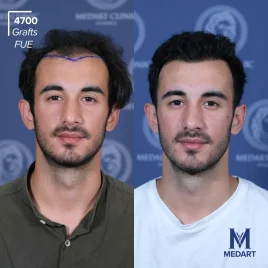
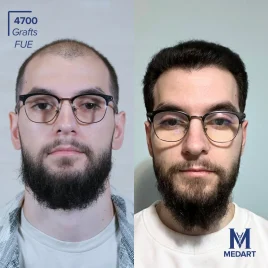
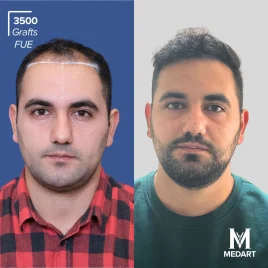
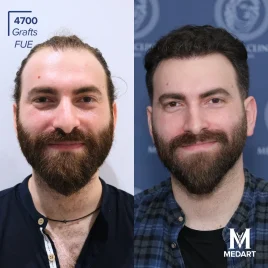
FUE Hair Transplant Turkey, Before & After
Turkey is the hair transplant capital of the world. You can be assured that your hair transplant in Turkey will be performed by highly experienced surgeons who adopt the newest hair technologies quickly and offer their expertise at affordable prices.


What Happens Before, During, and After FUE in Turkey?
An FUE transplant involves assessment, donor harvesting, recipient-site planning, implantation, and structured aftercare, with responsibilities confirmed before surgery. After clearing up the technique confusion, here is the realistic journey from first message to boarding your flight home.
Remote assessment and photographs
Most Turkey journeys start online. You send photographs, and the clinic gives a preliminary estimate. Treat this as provisional. A remote assessment cannot reliably establish donor density or rule out scarring or inflammatory scalp disease.
In-person examination and consent
On arrival, an in-person examination may change the hairline, the graft estimate, or even the recommendation to proceed. The care team should confirm your identity, medical history, and informed consent, and tell you exactly who performs each stage. Where consent is delivered in a second language, the quality of translation matters, so ask how consent is explained and confirmed.
The recipient-site stage strongly influences angle, density, and how natural the final growth looks. Fine channels, often created using Sapphire recipient-site creation in Turkey, work together with graft selection, handling, and implantation to shape the outcome.
Questions to ask any clinic about who does what:
Procedural stage |
Question to ask |
|---|---|
Diagnosis and candidacy assessment |
Which physician makes the diagnosis? |
Hairline and recipient design |
Who designs the hairline, and do I agree it first? |
Local anaesthesia |
Who administers and supervises anaesthesia? |
Donor harvesting |
Who harvests, and under whose supervision? |
Recipient-site creation |
Who creates the recipient sites? |
Graft implantation |
Who implants, and who supervises the team? |
Postoperative review and first wash |
Who reviews me and performs the first wash? |
Complication escalation |
Which named physician handles complications? |
How Medart approaches this — operational details verified by Medart's clinical lead on 12 August 2026. At Medart Hair Transplant, the treating surgeon leads diagnosis, hairline design, and recipient-site creation. Donor harvesting and implantation are carried out by a trained surgical team working under the surgeon's supervision, consistent with Turkish scope-of-practice requirements. A named clinician handles postoperative review and complication escalation, and every patient receives written emergency guidance. We confirm these roles in writing before you travel.
Procedure-day stages
Local anaesthesia is commonly used, so you stay awake while the scalp is numbed. The day typically includes donor trimming, harvesting, recipient-site creation, implantation, dressing, and aftercare instructions, often across several hours with breaks.
Discomfort varies. Local-anaesthetic injections can sting briefly, and postoperative soreness can occur. Clinics should explain their pain-control approach honestly rather than promising you will feel nothing.
First wash and departure instructions
Before you leave Istanbul, the team should perform or demonstrate the first wash and give you individualized washing, activity, and medication instructions. You should also leave with a written follow-up schedule and an emergency contact. Do not depart without knowing who to reach and how.
FUE Recovery and Results Timeline
Most patients see a gradual process rather than an instant result: early crusting and shedding are followed by new growth and maturation over several months. Having walked through the procedure, you need honest expectations for the FUE recovery timeline, because impatience causes needless panic.
Timelines vary between individuals, and no clinic should guarantee an exact result date. The pattern below reflects general clinical experience, not a promise, and your treating clinic's written instructions always take priority.
Interval |
What may happen |
Typical care priority |
When to contact the clinic |
|---|---|---|---|
Procedure day |
Numbness fading, mild soreness, dressing on donor |
Rest and follow the clinic's written aftercare |
Heavy bleeding not settling with gentle pressure |
Days 1–3 |
Swelling (oedema), redness, crusting, tenderness |
Follow prescribed care and sleeping-position advice |
Fever, spreading redness, pus, worsening pain |
Days 4–10 |
Crusts loosen with careful washing, swelling settles |
Follow the clinic's washing routine exactly |
Persistent pain, signs of infection |
Weeks 2–8 |
Transplanted hair shafts commonly shed |
Reassurance; protect the scalp as advised |
Heavy shedding of native hair, or inflammation |
Months 3–4 |
Early, often uneven regrowth begins |
Patience; gentle scalp care |
Persistent redness, folliculitis (inflamed follicles) |
Months 5–8 |
Noticeable thickening across grafted area |
Resume normal haircare as advised |
Marked asymmetry or persistent inflammation |
Months 9–12 |
Fuller coverage; hair matures |
Assess result against the original plan |
A concern identified in your follow-up plan |
Months 12–18 |
Final maturation, especially in the crown |
Long-term maintenance discussion |
Any new, unexplained thinning |
Two ideas often get confused, so separate them clearly:
Expected shaft shedding. The transplanted hair shafts commonly shed during early recovery. The visible shafts often fall out even when the transplanted follicles remain in place. Shedding alone does not tell you whether every graft will grow.
Shock loss. Surgery-related shedding can also affect native or transplanted hair. Shock loss means temporary shedding that can occur after surgery, often followed by regrowth. It is usually temporary, but assessment is appropriate if shedding is extensive or comes with scalp inflammation.
Crown (vertex) maturation can take longer than the frontal area, sometimes running towards 18 months. Judging your crown at month six is premature. In our clinic, patients who follow their written washing and protection instructions during early healing tend to avoid the avoidable trauma that undermines results—which is exactly why skipping instructions is risky.
What Are the Risks and Possible Complications?
FUE avoids a linear strip scar but can still cause infection, visible dot scarring, shock loss, poor growth, overharvesting, and other surgical complications. Now that you know the healing timeline, you deserve a clear-eyed view of what can go wrong, because no surgery is risk-free.
Common short-term effects
These are expected and usually settle: tenderness, crusting, temporary swelling (oedema), short-lived redness, temporary altered sensation, and shedding of transplanted shafts. They are part of normal healing, not signs of failure.
Complications requiring clinical review
Possible complications include infection, folliculitis (inflamed hair follicles), bleeding, poor growth, visible hypopigmented dot scars (small pale marks at extraction sites), shock loss, and unnatural design. In people with a history of keloid or abnormal scarring, keloid formation is a risk that warrants individualized assessment beforehand.
Transection, the accidental cutting or damage of a follicular unit during harvesting, can reduce graft survival. Transection risk varies with punch selection, hair characteristics, tissue behaviour, visibility, technique, and operator experience.
Donor overharvesting
This is the risk clinics rarely advertise. Your donor area is a finite resource, like a bank account you cannot refill. Overharvesting removes too many grafts too aggressively, leaving the donor thin, patchy, or "moth-eaten." Because donor grafts cannot be spent twice, a single overambitious session can permanently limit future surgery.
Dr. Busra Yakupoglu, MD, notes: "The donor is the one part of the scalp we cannot rebuild. A conservative harvest that leaves reserve is usually the wiser long-term decision, even when a patient is pushing for the fullest possible coverage in one visit."
When to seek urgent medical help
Necrosis (tissue death) is a rare but serious complication that requires prompt medical assessment. So do several other warning signs.
Seek prompt local medical care if you experience: worsening pain, spreading redness, pus, fever, persistent bleeding, blackened skin, marked swelling affecting your vision or breathing, persistent or worsening altered sensation, or any symptom your treating team flagged as urgent. Urgent symptoms need in-person medical care where you are, not a WhatsApp message alone.
Expected short-term effects |
Warning signs needing medical review |
|---|---|
Mild soreness and tenderness |
Worsening or severe pain |
Localized redness |
Spreading or intense redness |
Crusting at graft sites |
Pus or foul discharge |
Temporary swelling |
Marked swelling affecting vision or breathing |
Minor pinpoint spotting |
Persistent or heavy bleeding |
Numbness that gradually fades |
Persistent or worsening sensory change |
Shedding of transplanted shafts |
Blackened skin (possible necrosis) |
According to NHS guidance on hair transplants, the procedure carries recognised risks including infection, scarring, and unnatural-looking results—another reason clinic quality and aftercare outrank price.
How to Choose a Safe FUE Clinic in Turkey
A safe clinic should disclose the treating physician, each team member's role, facility authorization, patient volume, complication pathway, and follow-up arrangements. After weighing the risks, this due-diligence framework is your strongest protection, and it works for any clinic, not just ours.
The most useful skill here is verification. Do not accept marketing. Ask for proof. To compare two proposals objectively, use the numbered block further down.
12 questions to ask before paying
Use this printable checklist. Copy it, and do not pay a deposit until the clinic answers all twelve questions in writing.
Turkey FUE Clinic Checklist:
1. Who is the treating physician, and can I verify their identity?
2. What are the surgeon's credentials and registration?
3. Is the facility authorized through the official Turkish health-tourism route, and can I verify it myself?
4. Who performs diagnosis, hairline design, anaesthesia, harvesting, site creation, and implantation?
5. How many patients does the surgical team treat at the same time?
6. Who administers and supervises local anaesthesia?
7. What is the exact complication-management pathway?
8. What does follow-up look like after I return home, and will my records come in a language my local doctor can read?
9. How are informed consent and interpretation handled if I do not speak Turkish?
10. What are the cancellation and refund terms in writing?
11. What exactly is included and excluded in the quote?
12. Can I see standardized, dated before-and-after documentation with graft counts?
Red flags to avoid
Certain patterns should make you pause: high-pressure sales, refusal to name the surgeon, unexplained very high graft counts, and identical "results" images reused across profiles. Run a reverse-image search on before-and-after photos, and ask the clinic to verify them. A quote promising the highest possible graft count in one session, without discussing donor limits, is a warning sign, not a bargain.
Avoid choosing on social-media reach alone. A large following is a marketing metric, not a surgical credential.
How to assess before-and-after photographs
Review standardized results, not edited social posts. Credible photos share a comparable angle, similar lighting, stated hair status (wet or dry), the time since surgery, the graft count, and disclosure of any concealer, fibres, or editing. If those details are missing, the photo tells you little.
You may also hear about platelet-rich plasma (PRP) as an add-on. Evidence remains limited and protocols vary for PRP as an adjunct to hair transplantation, so it should not be presented as a substitute for diagnosis, surgical planning, or established medical treatment.
How to compare two FUE clinic proposals:
1. Line up both proposals and confirm each names the treating physician and their role.
2. Compare who performs each surgical stage, and whether the surgeon leads harvesting and site creation.
3. Match the graft plans against your donor capacity, treating unusually high numbers with caution.
4. List every inclusion and exclusion, then add travel, medication, and possible revision to each total.
5. Check the complication pathway and follow-up in writing, and choose the safer system even if it costs slightly more.
On the "best FUE clinic in Turkey" question: there is no single best clinic for everyone. The genuinely best choice for you is the one that performs strongest against verifiable criteria—surgeon involvement, safety systems, conservative planning, and documented follow-up.
The Medart Clinical Planning File
The Medart Clinical Planning File shows how a physician-led clinic documents real cases and a repeatable planning protocol, so you can see what transparent evidence should look like. Building on the clinic checklist, this section moves from theory to how careful planning appears in practice.
The anonymized cases below are illustrative summaries prepared to demonstrate documentation standards. They are described in ranges and general terms rather than as marketing "results," and each states its limitation and whether further surgery may be needed. Any published case must carry patient consent, standardized imaging, and full disclosure before it appears.
How we document a case
General clinical evidence: peer-reviewed hair-transplant literature stresses that outcomes depend on diagnosis, donor management, and graft handling, and that no single graft-survival percentage applies to all patients.
How Medart approaches this: each case card records age range, hair-loss pattern, donor-area assessment, planned and actual graft count, treated areas, technique and reason, surgery date, review dates, any concurrent medication (or "status unknown"), the result's limitation, and whether future surgery may be needed.
Case card A (documentation template — awaiting final consented imaging).
Age range: early 30s. Pattern: frontal recession (Norwood III). Donor assessment: good density, no significant diffuse miniaturization. Planned grafts: conservative frontal-third plan. Actual grafts: within plan. Areas treated: frontal hairline and temples. Technique: FUE harvesting with sapphire recipient sites, chosen for fine angle control. Surgery date and review dates: recorded. Medication: individualized, under prescribing clinician. Limitation: crown untreated by design to preserve donor reserve. Future surgery: possible if native loss progresses.
Case card B (documentation template — awaiting final consented imaging).
Age range: late 30s. Pattern: mid-scalp thinning with early crown involvement. Donor assessment: moderate density. Planned grafts: staged plan prioritizing mid-scalp. Actual grafts: within plan. Areas treated: mid-scalp. Technique: FUE with implanter-pen placement in selected zones. Medication: status disclosed at consultation. Limitation: crown deferred to a possible second stage. Future surgery: likely staged.
Case card C (documentation template — awaiting final consented imaging).
Age range: 40s. Pattern: stable Norwood IV after diagnosis. Donor assessment: adequate with reserve protected. Planned grafts: frontal reconstruction. Actual grafts: within plan. Areas treated: frontal and mid-scalp. Technique: FUE with sapphire recipient sites. Limitation: density set to a natural, maintainable level rather than maximal. Future surgery: not currently anticipated.
Each case image, when published, will state: patient consent obtained, comparable angle, similar lighting, dry or wet hair status, hair length where relevant, time since surgery, graft count, area treated, medication context, and confirmation of no undisclosed fibres, concealers, or image enhancement.
Fictional composite example; not a real patient case. "Daniel," 29, has frontal recession and early crown thinning. One clinic recommends the largest possible session immediately, covering everything at once. Another prioritizes the frontal third, assesses miniaturization, discusses his diagnosis and possible medical management under a prescribing clinician, and preserves donor reserve. The second plan accepts less coverage now to protect Daniel's options at 40, because his loss is still progressing. The lesson: with finite donor hair, a bigger session is not automatically a better decision.
FUE Hair Transplant Turkey Cost: What You Are Actually Paying For
The cost of an FUE hair transplant in Turkey varies with case complexity, clinician involvement, graft plan, facility, aftercare, and package inclusions. Having built a clinic checklist and seen how cases are documented, you now need to read a quote intelligently, so a low number does not cost you more later.
We do not publish a fixed headline price here, because an undated, one-size figure misleads more than it helps. Any price you rely on should carry a visible "checked on" date and a clear list of what it does and does not include. For current figures, see our page on detailed hair transplant costs in Turkey, and verify its own dated inclusions on the day you read it.
Pricing information checked on: 12 August 2026. Verify the linked pricing page on the same day you rely on it.
What changes the price
Case complexity, the number and quality of grafts, how involved the physician is, the technique, the facility, and aftercare all move the price. A per-graft quote can mislead if graft counting and clinical responsibilities are unclear.
What packages may include
Many Turkey offers bundle medical fees with hotel, transfers, medication, and translation. To understand exactly what a bundle covers, review what a Turkey hair transplant package may include and compare it line by line against another clinic.
Cost component |
Included in this quote? |
Questions to ask |
Possible extra cost |
|---|---|---|---|
Surgical procedure |
Varies—confirm in writing |
Which surgeon performs which stage? |
Complex or physician-led cases |
Anaesthesia |
Varies—confirm in writing |
Who administers and supervises it? |
Rarely itemized separately |
Hotel accommodation |
Varies—confirm in writing |
How many nights, what standard? |
Extra nights if healing is slow |
Airport transfers |
Varies—confirm in writing |
Both directions? |
Additional trips |
Post-op medication |
Varies—confirm in writing |
What exactly is provided? |
Ongoing prescriptions at home |
Blood tests / screening |
Varies—confirm in writing |
Included before surgery? |
May be billed separately |
Aftercare kit and first wash |
Varies—confirm in writing |
Is a follow-up wash included? |
Add-on services |
Follow-up and revision |
Varies—confirm in writing |
Is revision covered, on what terms? |
Often a separate cost |
Flights |
Rarely included |
Not usually part of the package |
Paid by patient |
Costs that may be excluded
Flights, travel insurance, extra hotel nights, medication at home, and any local follow-up in your own country are commonly excluded. Build these into your comparison.
Why the cheapest quote may cost more later
A higher graft number is not automatically a better plan, and the lowest quote can cost more if it skips supervision, aftercare, or revision. All pricing should be dated, itemized, and personalized after assessment, not lifted from a directory.
How Many Grafts Might You Need?
A graft estimate depends on the recipient area, desired coverage, hair characteristics, donor capacity, and expected future loss—not on a hair-loss scale alone. After learning how pricing works, understanding graft planning stops you from chasing a bigger number than your scalp can support.
Factors affecting graft estimates
A useful estimate weighs several factors together:
● Recipient area size.
● Existing density in the thinning zone.
● Hair calibre (thickness) and curl.
● Hair-to-scalp colour contrast.
● Follicular-unit composition (singles, doubles, triples).
● Donor density and any miniaturization.
● Likely future loss pattern.
● Hairline versus crown priorities.
Coarse, curly, low-contrast hair gives more visual coverage per graft than fine, straight, high-contrast hair, though this affects appearance rather than biological survival. Norwood and Ludwig classifications describe patterns but cannot generate an exact surgical plan on their own. Online tools are a starting point only. You can estimate a preliminary graft range to get a rough sense of scale.
This calculator can provide a preliminary range, not a diagnosis, safe extraction limit, or final surgical plan.
Hairline versus crown planning
Your donor supply is finite, and the frontal area and crown compete for it. Crown (vertex) coverage can consume large numbers of grafts because of its spiral pattern and area. Spending heavily on the crown early may leave too little for the frontal third later.
Why maximum graft numbers can be a warning sign
Coverage matters, but so does reserve. A conservative plan is often wiser when future loss is likely, because you cannot regenerate donor grafts once spent. When a clinic pushes the highest possible number, ask what it costs your long-term supply.
Want a graft estimate that considers your donor area and treatment goals? Message the Medart team using the WhatsApp button in the bottom-right corner for a free preliminary review. Final graft planning is confirmed only after an in-person examination.
Planning Your Trip to Istanbul
Plan your travel around the clinic's examination and follow-up schedule, and make sure you have medical support after returning home. With a graft plan in mind, practical trip logistics come next, kept strictly relevant.
Before booking flights
Confirm your arrival timing, procedure date, first-wash appointment, and departure clearance before you book flights. Stay length should follow the clinic's schedule rather than a generic rule. Ask about fit-to-fly timing after surgery; the clinic can advise medically, but the airline sets its own carriage requirements.
Verify passport, visa, travel insurance, medication transport, and airline requirements independently through official sources, not the clinic's marketing. According to CDC travel-health guidance, arranging follow-up and understanding your medications before departure reduces avoidable problems abroad.
What to pack
● A button-up shirt so you avoid pulling clothing over grafts.
● A loose, brimmed hat only when your clinic confirms you may wear one.
● Your regular medications and a written list of them.
● Copies of consent forms, aftercare instructions, and contacts.
Follow-up after returning home
Know who supports you once you are home, and how your records can be shared with a local doctor if a complication arises. Treat the journey primarily as medical travel. Avoid strenuous sightseeing, heat, prolonged sun exposure, or activities that conflict with the treating team's written instructions.
How to Get a Personalized FUE Assessment
A remote photo assessment can provide a preliminary estimate, but the final surgical plan requires an in-person examination and informed consent. After the practical planning, here is what any clinic genuinely needs from you to give a useful preliminary opinion.
Photographs and medical history both matter. Neither alone is enough. Below is how Medart approaches a preliminary review, using only details we can confirm operationally.
How Medart approaches this. For a useful preliminary review, we ask for:
- Six views: front, temples, top, crown, and both sides, plus donor close-ups at the back.
- Dry hair under neutral, even lighting against a plain background.
- Your hair-loss history and family history of hair loss.
- Any scalp symptoms such as pain, scaling, or inflammation.
- Previous procedures or prior transplant records.
- Current medications, allergies, smoking status, diabetes, bleeding risk, and healing history.
From this we give a provisional donor review and an honest view of whether surgery is appropriate yet. A remote estimate is always preliminary. The final plan follows an in-person examination and informed consent, and we explain the limitations and alternatives, including simply waiting.
Frequently Asked Questions
Decision Recap
Before the final word, here is the framework in five checkable steps:
● Confirm your diagnosis and candidacy before committing to surgery.
● Verify surgical responsibility, so you know who performs each stage.
● Protect the donor area through conservative, long-term planning.
● Compare written, like-for-like proposals, including total cost and follow-up.
● Request an individualized assessment without treating a remote estimate as a guarantee.
The Bottom Line
An FUE hair transplant Turkey decision rests on six things you can verify: a confirmed diagnosis, conservative donor preservation, clear surgical responsibility, documented safety systems, verifiable outcomes, and honest total cost. The FAQ above answers the common booking and recovery worries, and this section pulls those threads into a plan.
Your practical next step is simple. Confirm your diagnosis and candidacy first. Then compare written, like-for-like proposals, checking who performs each stage and how the graft plan protects your finite donor supply. Add travel, medication, and possible revision to each total, so you compare real costs, not headline numbers. If anything is unclear, or your loss is still active, it is entirely reasonable to delay surgery and seek assessment rather than rush.
Strong clinical planning can make travel a reasonable option. It cannot remove surgical uncertainty or the practical limits of cross-border follow-up.
Compare your options before making a travel decision. Tap the WhatsApp button in the bottom-right corner for a free consultation and an itemized explanation of the proposed plan, likely inclusions, and next steps.
Choose an FUE provider by diagnosis, donor preservation, surgical responsibility, and verifiable outcomes—not by price or graft count alone.
Medart Hair Transplant is an Istanbul clinic and the publisher of this guide. This article is educational content, not a guarantee of eligibility, graft count, cost, growth, density, or outcome. A remote assessment is preliminary. Final suitability and surgical planning require an in-person examination, informed consent, and review of medical history. Surgery carries risks. Ongoing native-hair loss can continue after transplantation. Urgent postoperative symptoms require local medical care. Medication decisions require your prescribing clinician. Travel insurance, medication transport, visa, and airline requirements must be verified independently.