
Key Takeaways
● Afro-textured follicles may curve beneath the skin, making extraction more demanding and operator skill more important.
● Diagnosis comes first, especially when traction alopecia or central centrifugal cicatricial alopecia is possible.
● FUE, sapphire blades and DHI describe different parts of one transplant process.
● Judge cost alongside physician involvement, safety standards and the follow-up you receive at home.
● Documented comparable cases and verified credentials matter more than package marketing or graft-count claims.
A low package price cannot compensate for an incorrect diagnosis. Traction alopecia and central centrifugal cicatricial alopecia (CCCA), a scarring hair loss that often begins around the crown, can both look like ordinary thinning in a photograph. They are not. Each needs a different assessment, and sometimes different treatment, before surgery is discussed at all.
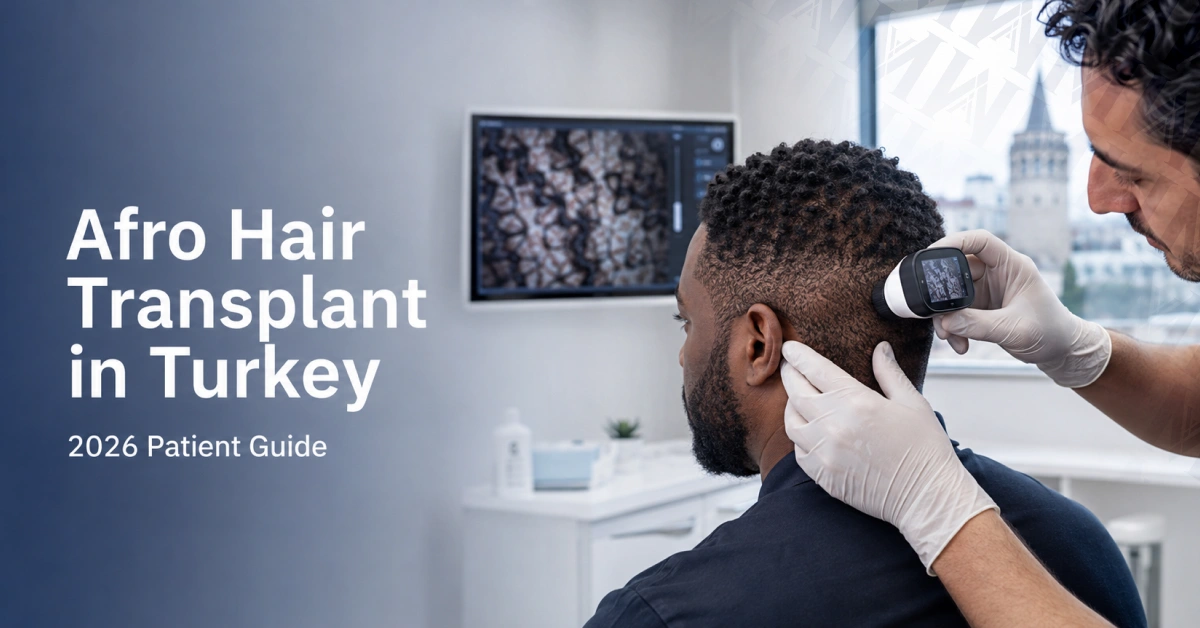
That principle shapes this guide to Afro hair transplant in Turkey. A successful Afro hair transplant depends less on a technique's brand name than on accurate diagnosis, careful management of curved follicles and a surgical team with documented experience in Afro-textured hair. Medart Hair Transplant is a licensed clinic in Istanbul, and this guide exists to help you make a clinical decision rather than a shopping decision.
This article provides general educational information and does not replace an assessment by a qualified medical professional. Hair-transplant suitability, technique, graft requirements, risks and results vary by diagnosis, donor characteristics and medical history.
Get a Free Consultation
Talk to an experienced patient coordinator for your hair transplant in Turkey.What Is an Afro Hair Transplant?
An Afro hair transplant moves healthy follicles from a stable donor area into thinning areas, while accounting for the curl, calibre and below-skin curvature of Afro-textured hair. The surgical principle is the same as any other transplant. The differences sit in anatomy, planning and technique.
Definition: Afro-textured hair transplant. A procedure in which follicular units are taken from a genetically stable donor area, usually the back and sides of the scalp, and placed into a thinning or bald recipient area, using extraction, handling and design methods adapted to tightly curled shafts and follicular units that may follow a curved path beneath the scalp.
"Afro hair transplant" is a search term. In clinical notes and consultations, "Afro-textured hair" or "tightly curled hair" is the more precise description, because it describes the hair rather than a person's ancestry. Phrases such as "African hair transplant Turkey" and "Black hair transplant Turkey" are common in search, but ethnicity is not a diagnosis and skin tone is not a curl pattern.
What "Afro-textured hair" means
Afro-textured hair forms tight coils or waves, and the individual hair follicle often sits in a curved channel within the scalp. Two structural features are worth separating. The hair shaft itself tends to have a flattened, elliptical cross-section, while the follicular unit below the surface may follow a curved or S-shaped path. The American Academy of Dermatology's hair-care guidance for tightly curled hair notes that this hair type is more prone to dryness and breakage.
How curl and hair calibre affect visual coverage
Curl creates visual coverage. A coiled fibre occupies more visible space than a straight one, so a given number of grafts can look fuller across the same area. Treat that as an optical planning principle, not a promise of fewer grafts. Hair density in the recipient area is still limited by what your donor area can safely supply.
Not everyone of African ancestry has the same curl pattern, hair shaft calibre or scalp characteristics. That variation is exactly why the next question matters: what does this anatomy demand from the surgical team?
Why Afro-Textured Hair Requires Specialized Experience
Afro-textured follicles can curve beneath the scalp, making accurate extraction more technically demanding and increasing the importance of surgeon experience. Because the anatomy differs, the skill required differs too. This section shows exactly where that skill is tested, so you know what to ask about.
Technical issue |
Why it matters in tightly curled hair |
|---|---|
The visible shaft is not a map |
Hair leaving the scalp may point one way while the follicle curves another way below the surface |
Punch alignment is unforgiving |
A punch angled to the shaft rather than the true follicle path can cut through the graft |
Design must follow curl behaviour |
Angle and direction have to work with how the hair coils and how you style it |
Curved follicles and transection risk
Follicle transection means cutting or damaging a follicle during extraction, so the graft is partly or completely destroyed. Peer-reviewed hair-restoration literature searchable through PubMed discusses follicular curvature as one reason clean extraction is harder in tightly curled hair, and links it to a higher transection rate. The practical consequence is simple: fewer usable grafts from the same donor sacrifice.
Surgeons manage this by scoring more slowly, adjusting punch angle and depth, and sometimes selecting a slightly wider punch diameter. That choice is a trade-off, because larger punches can leave more visible donor marks. Both manual FUE and motorized FUE can be appropriate, and calibration matters more than the motor.
"Donor mapping for tightly curled follicles usually starts with a small test extraction. The visible shaft direction and the probable path below the skin are not always the same. We adjust punch diameter and scoring depth after that test, not before it. This reflects our clinical experience rather than a universal protocol."
— Dr. Busra Yakupoglu, hair transplant surgeon and responsible physician at Medart
Donor management and punch selection
Donor density varies widely between patients, and so does the number of hairs in each follicular unit. A responsible hair transplant surgeon measures donor density with trichoscopy, a magnified scalp examination, before agreeing any graft number. Donor miniaturization, meaning progressively finer hairs at the back and sides, can quietly reduce what the donor area will support.
Overharvesting is the risk that matters most. Taking too many grafts, or taking them unevenly, can leave visible thinning or patchy marks in the donor area that are difficult to correct later.
Hairline design for tightly curled hair
Hairline design should reproduce your own transition, irregularity, angle and styling pattern, rather than apply a standard ethnicity-based template. Temporal points and the front line need to suit your face, your age and the way your hairline recession is likely to continue. Curl can soften small design irregularities. It cannot hide a hairline placed too low or drawn too straight.
Composite scenario: stable receding hairline. A man in his mid-thirties has a stable frontal recession and good donor density. Planning centres on a conservative, irregular hairline and careful angle control, with a reserve of donor grafts held back in case of later crown loss. This is a teaching example built from common clinical patterns, not an individual patient.
Design and extraction skill only help if the underlying condition is suitable for surgery, which is the next thing to establish.
Who Is a Suitable Candidate?
A suitable candidate has a confirmed hair loss diagnosis, stable hair loss, an adequate donor area and no uncontrolled inflammatory or scarring scalp disease. Surgical skill cannot compensate for operating on the wrong condition. Candidacy is a medical judgement, and this section explains how that judgement is reached.
Conditions that may be transplantable
Androgenetic alopecia is the most common reason for surgery. Clinicians often describe its pattern using the Norwood–Hamilton scale, and the Ludwig scale for female-pattern hair loss, although not every patient fits neatly into either. Traction alopecia, caused by repeated pulling from tight braids, weaves or extensions, may be transplantable once the traction has stopped and the area has been stable for a period your clinician judges sufficient. The American Academy of Dermatology warns that hairstyles which pull on the scalp can cause lasting loss when the pulling continues.
When surgery should be postponed
Surgery is usually postponed when the underlying condition is active, undiagnosed or changing quickly. Scarring alopecia, meaning hair loss caused by inflammation that damages follicles and can leave permanent scar tissue, must be assessed and controlled first. Grafts placed into actively inflamed, scarred skin can fail.
Clinical picture |
Typical assessment |
Practical next step |
|---|---|---|
Stable patterned recession, good donor density |
Often suitable for surgical planning |
Proceed to in-person candidate assessment and design |
Traction alopecia, traction stopped, no symptoms |
May be suitable once stability is confirmed |
Document donor supply, plan conservatively |
Traction alopecia with ongoing tight styling |
Postpone and investigate |
Stop the traction, review with a clinician before planning |
Central thinning with itching, tenderness, burning or pustules |
Postpone and investigate (possible CCCA) |
Dermatology assessment, trichoscopy, sometimes a scalp biopsy |
Sudden, patchy or diffuse shedding |
Postpone and investigate |
Exclude alopecia areata, telogen effluvium and medical causes |
Personal or family history of keloids or thick raised scars |
Individual risk assessment |
Discuss scar history in detail before any surgical plan |
Rapid loss in the late teens or early twenties |
Usually postpone |
Focus on stabilization of hair loss and long-term donor planning |
Signs you need a dermatologist first
The NHS advises seeing a doctor when hair loss is sudden, patchy or accompanied by scalp symptoms such as pain, scaling or irritation. Speak to a dermatologist before booking surgery if any of the following apply to you.
● Scalp pain, burning, itching, pustules, scaling, or smooth shiny patches at the crown.
● Rapid, patchy or diffuse shedding, which may point to alopecia areata or telogen effluvium.
● Suspected CCCA, frontal fibrosing alopecia or another scarring alopecia; the British Association of Dermatologists publishes patient information on these conditions.
● Previous scalp surgery, a previous transplant with poor growth, or a personal or family history of abnormal scarring.
● Bleeding disorders, anticoagulant use, previous anaesthetic reactions, or uncontrolled medical conditions that affect surgery and healing.
Medical therapy is a separate decision. Cochrane systematic reviews of treatments for pattern hair loss have examined minoxidil and finasteride, and suitability depends on diagnosis, sex, medical history and contraindications. Any change to these medicines must be discussed with the clinician who prescribes them, not decided from an article.
Composite scenario: long-term traction alopecia. A woman has temple hairline loss after years of tight braiding. She stopped the styling well over a year ago and the area has not changed since. Surgery is considered only after stability is documented, with a conservative graft plan and an explicit agreement that heavy tension styling will not return. This scenario is composite, not a specific patient.
If your diagnosis is settled, the next decision is technique.
Not sure whether your hair loss is suitable for transplantation?
Use the WhatsApp button in the bottom-right corner to share your history and clear scalp photographs for a free preliminary assessment. An online review is not a final diagnosis, but it can help identify the most appropriate next step.
FUE, Sapphire FUE, DHI or FUT: Which Is Best?
No single technique is best for every Afro-textured hair transplant; the appropriate method depends on follicle curvature, donor characteristics, graft needs and scar preferences. Once diagnosis and candidacy are settled, technique becomes the practical decision. Most of the confusion here is linguistic rather than surgical.
Marketing often presents four terms as four separate operations. In reality, two describe donor harvesting, one describes recipient-site creation, and one describes a placement tool.
Method |
What the term actually describes |
Potential advantages |
Limitations |
When it may be considered |
|---|---|---|---|---|
FUE |
Follicular-unit extraction (also called excision): removing individual grafts from the donor area with a small punch |
No linear donor scar; donor hair can be worn short |
Leaves small round donor marks; curved follicles raise extraction difficulty |
Most Afro-textured cases with adequate donor density |
Sapphire FUE |
Sapphire-tipped blades used to create recipient sites; it does not change donor extraction |
Fine, consistent incisions that can support controlled angle and site density |
Does not affect how grafts are extracted or handled; not superior for every patient |
When the surgeon prefers blade-made sites for the planned angle and density |
DHI |
Implantation using an implanter pen; extraction is still performed by FUE |
Site creation and placement combined in one movement |
Workflow depends heavily on loading and placement skill; rough loading damages grafts |
Hairline refinement, smaller areas, or agreed partial-shave plans |
FUT |
Follicular-unit transplantation: removing a donor strip and dissecting grafts under magnification |
Harvests many units without spreading punch marks across the donor area |
Leaves a linear donor scar; unsuitable if you want very short hair at the back |
Selected cases with high graft demand or limited FUE donor supply |
FUE for curved follicles
An Afro FUE hair transplant is the most commonly offered approach. FUE avoids a linear scar, but it is not free of scarring, because every punch leaves a small round mark that usually fades to a faint dot. In tightly curled hair, punch choice and scoring depth carry far more weight than the equipment brand.
What sapphire FUE means
Sapphire refers to the blade material used to open recipient channels, so it changes the incision rather than the harvest. Blade-made sites can help control depth, angle and spacing across a dense area, which matters in tightly curled hair because the exit angle influences how each coil sits.
Our article on how sapphire FUE recipient-site creation works explains the tooling in more detail. For the planning side, including how site direction and follicular-unit density are mapped across a treatment area, see sapphire FUE recipient-site planning.
What DHI means
DHI means implantation with an implanter pen, and it is not a donor-extraction method. Grafts are still taken by FUE, then loaded into a pen that opens the site and places the graft in one action. You can read how DHI hair transplantation in Turkey is typically organised, including session sizes and shaving options.
In our practice, DHI for Afro hair is often chosen for hairline work and smaller sessions, where angle control matters most. Loading a curved graft into a pen takes practised hands, and that is a workflow judgement rather than a proven survival advantage. Medart's DHI hair-transplant guide compares implanter-pen placement with blade-made sites, while Medart's guide to sapphire FUE hair transplantation sets out where blades have limits.
When FUT may be considered
FUT remains reasonable in selected cases, particularly when a large graft number is needed and FUE donor supply is limited. It does not expand your finite donor supply, and it leaves a linear scar. Where there is a history of thick or raised scars, that trade-off needs open discussion before you commit.
Some patients also ask about how implanter-pen DHI is used in Turkey as a partial alternative for smaller staged sessions.
The International Society of Hair Restoration Surgery describes FUE and FUT as harvesting methods, with site creation and implantation as separate steps of the same operation. One honest limitation applies to all of this. Research specific to Afro-textured hair transplantation is more limited than the general hair-transplant literature, so technique decisions should combine published evidence with individualized clinical assessment. No clinic can claim settled proof that one tool suits every tightly curled scalp.
Once the method is agreed, the next thing to understand is the pathway itself.
What Happens Before, During and After Surgery?
An Afro hair transplant usually involves diagnosis, donor planning, extraction, recipient-site design, implantation and structured postoperative follow-up. Knowing the sequence helps you judge whether a clinic's plan is thorough or rushed. Here is the pathway most patients follow in Istanbul.
1. Remote review. You send front, side, crown and donor photographs plus a brief history. This stage is preliminary only.
2. In-person assessment. The responsible physician examines your scalp, measures donor density with trichoscopy, and confirms or revises the diagnosis.
3. Hairline and design planning. The surgeon draws the hairline with you, awake and sitting upright, before anything is shaved.
4. Shaving or trimming. Most Afro-textured cases need the donor area trimmed short so follicle direction is visible.
5. Local anaesthesia. The scalp is numbed under physician oversight using local anaesthesia, and you stay awake throughout.
6. Extraction. Grafts are removed one at a time, with punch settings adjusted for follicular curvature beneath the skin.
7. Graft inspection and handling. Grafts are sorted under magnification. Careful graft handling and graft hydration limit drying and unnecessary time out of the body, which supports graft survival.
8. Recipient-site creation. Sites are opened at the planned angle, direction and density, by blade or by implanter pen.
9. Implantation. Grafts are placed, and session length depends on graft number and case complexity.
10. First wash. The clinic performs or supervises your first postoperative washing and teaches you the home routine.
11. Remote follow-up. You send standardised photographs at agreed intervals after returning home.
Remote and in-person assessment
An online photo review cannot confirm diagnosis or candidacy. Photographs miss scalp texture, follicular openings, tenderness and early scarring changes. Treat any online graft number as provisional until a physician has examined your scalp in person.
The day of surgery
Ask, in writing, which stages the responsible physician performs personally and which trained technicians perform under supervision. At Medart, I carry out the assessment, diagnosis, hairline design and anaesthesia, and I perform or directly supervise extraction, recipient-site creation and implantation. Postoperative follow-up remains my responsibility. The ISHRS campaigns on exactly this point, warning patients to confirm that a licensed physician is genuinely involved in their surgery. Clinics differ, and you are entitled to that answer before you travel.
The first 10–14 days
Expect crusting, redness and some tenderness. Washing usually begins within a few days, following your clinic's written protocol, and sleeping with the head slightly raised is a standard instruction to limit swelling. Avoid heavy exercise, saunas, swimming and direct pressure on the grafts until your clinician clears them.
Pain differs between patients, partly because extraction area, session length and individual pain response all vary. Most people describe soreness rather than severe pain, and forehead swelling is common in the first days. Nobody can promise you a pain-free experience.
Remote follow-up after returning home
Our protocol schedules photographic review at roughly one, three, six and twelve months, and other clinics set their own intervals. Before you fly home, confirm who to contact, how to send photographs and what counts as an emergency. Save those contact details in more than one place, and ask how the clinic coordinates with a doctor in your own country if a problem develops.
That plan only works if the graft number behind it was measured rather than guessed.
How Many Grafts Will I Need?
Graft requirements are determined by the treatment area, donor supply, existing density, curl, hair calibre and your long-term hair-loss plan, not by ethnicity alone. No clinic can give you a firm number from a single photograph. The variables below explain why estimates move.
A graft is not the same as a hair. The same graft total can represent very different hair counts, because follicular units contain different numbers of hairs from patient to patient.
Treatment area |
Planning considerations |
Why estimates vary |
|---|---|---|
Frontal hairline and temporal points |
Needs the finest single-hair grafts at the front edge, with irregular placement and precise angles |
Face shape, age, planned hairline height and expected future recession |
Mid-scalp |
Often the most efficient area for visual coverage per graft |
Existing native hair, hair shaft calibre and how far the curl bridges gaps |
Crown and whorl |
The crown whorl needs radial direction planning, and its circular geometry demands grafts across a wide angle range |
Crown size expands as loss progresses, so staging is frequently discussed |
Traction-affected or previously scarred areas |
Blood supply and scar quality influence how many grafts can be placed safely |
Scar thickness, disease activity and whether a small test session is advisable |
Curl helps here, because a coiled hair covers more visible scalp than a straight one at the same numeric density. Treat that as a planning principle rather than a discount. Be cautious if a clinic uses it to justify an unusually low graft count over a large bald area.
More grafts are not automatically better. Taking too many in one session can permanently weaken the donor area, and a weak donor limits every future option you have. Ask the clinic to show how the proposed total relates to your measured donor density, the treatment area and the reserve they plan to keep for later.
Recovery and Results Timeline
Most patients pass through early healing and a shedding phase before visible growth begins, and maturation of transplanted hair usually continues for many months afterwards. Graft numbers set the plan; the results timeline sets your expectations. The stages below reflect our physician-reviewed protocol and the general pattern described in hair-restoration literature, and they are typical rather than guaranteed.
Stage |
What typically happens |
What usually helps |
|---|---|---|
First 72 hours |
Redness, small crusts, tenderness, possible forehead swelling |
Sleep with the head raised and follow the clinic's spray and rest instructions |
Days 4–14 |
Crusts loosen and clear with gentle washing; the donor area settles |
Follow the written washing protocol and avoid picking or scratching |
Weeks 2–8 |
Transplanted shafts commonly shed; some shock loss of native hair can occur |
Report unusual pain or pustules, and avoid judging progress yet |
Months 3–4 |
Early regrowth begins, often thin, uneven and different in texture |
Continue prescribed medication and take monthly photographs |
Months 6–9 |
Coverage improves visibly and texture starts to match surrounding hair |
Review progress with standardised clinical photography |
Months 12–18 |
Grafts thicken further; crown areas often mature last |
Assess final density and discuss whether a second stage helps |
Shedding between weeks two and eight alarms many patients. It is expected. The hair shaft falls while the follicle stays in place and re-enters its growth cycle. Early growth is not a reliable measure of final coverage, because new shafts are still emerging, thickening and entering different phases of the hair cycle.
Crown growth can mature more slowly, because the whorl needs wider coverage per graft and hair-cycle timing differs across the scalp. Shaft texture may also become more similar to your surrounding hair as maturation continues, rather than matching it from the start.
Skin tone matters for one specific reason. In deeper skin tones, healing redness may be less obvious, while post-inflammatory hyperpigmentation, meaning temporary darkening where skin has been irritated, can be more visible and slower to fade. Dermatology guidance on skin of colour recommends consistent sun protection while pigmented areas settle. Ask your clinic when you may safely cover or protect the recipient area.
Knowing the timeline is useful only if you also know which signs mean something is wrong.
Risks, Side Effects and Safety Considerations
Afro hair transplantation is generally a surgical option for appropriately selected patients, but it can cause poor growth, infection, scarring, pigment changes or donor damage. The recovery timeline covers what should happen. This section covers the complications and risks that sometimes do.
Common temporary effects
Swelling, tenderness, crusting, itching, temporary numbness and shedding are common, and they usually settle within days to weeks. Numbness in the donor area can persist longer in some patients before gradually improving, because small sensory nerves take time to recover.
Less common complications
Infection and folliculitis, meaning inflamed bumps around individual follicles, can occur and usually respond to prompt treatment. Poor growth may follow high follicle transection, rough graft handling, grafts drying out, or an undiagnosed scalp condition. Unnatural design and overharvesting are avoidable outcomes, which is why surgeon selection matters more than package inclusions.
Category |
What it can look like |
What to do |
|---|---|---|
Common temporary effects |
Swelling, tenderness, crusting, itching, numbness, shedding at weeks 2–8 |
Follow the written aftercare plan and report anything that worsens |
Slower-developing issues |
Patchy growth, visible donor thinning, ridged or pitted recipient sites |
Raise it at the three- and six-month follow-up with photographs |
Scar and pigment changes |
Raised scars, darkened or lightened marks in the donor or recipient area |
Contact the clinic early so treatment options can be reviewed |
Urgent warning signs |
Increasing pain, spreading redness, fever, pus or discharge, significant bleeding, or any red flag your surgeon specified |
Contact the clinic immediately and seek local medical care without delay |
Keloids, hypertrophic scars and pigmentation
A hypertrophic scar is a raised scar that stays within the boundary of the original wound and often flattens over time. A true keloid grows beyond the original wound edge and does not usually settle on its own. The distinction matters, because the two behave differently and are managed differently.
Skin colour alone does not determine keloid risk. Your keloid history, your family's scar history, previous scar behaviour, the wound site and the planned harvesting method all inform the assessment. The American Academy of Dermatology notes that keloids often recur after treatment, which is why individual history carries weight, and the British Association of Dermatologists publishes patient information on keloid scars worth reading beforehand. A keloid history is not an automatic exclusion, although a small test site gives limited information and cannot predict how a full procedure will heal.
Composite scenario: central thinning with symptoms suggesting CCCA. A patient reports crown thinning with tenderness and itching, and parts of the scalp look smooth and shiny. Surgery is not booked. We refer for dermatology assessment, trichoscopy and possibly a biopsy, because active scarring alopecia can keep progressing and can reduce graft survival. This composite illustrates a deferral decision rather than a specific patient.
When to contact the clinic urgently
Contact your clinic or a local doctor immediately if pain increases instead of easing, redness spreads, you develop fever, pus or foul-smelling discharge, bleeding does not stop with gentle pressure, or any warning sign your surgeon listed appears. Do not wait for a scheduled follow-up.
No clinic can guarantee graft survival, density or a complication-free outcome. If a quotation promises one, treat that promise as information about the clinic, then look closely at what the price actually covers.
Afro Hair Transplant Cost in Turkey in 2026
The 2026 cost of an Afro hair transplant in Turkey depends on case complexity, graft planning, technique, physician involvement and what the package includes. Risk and price are linked, because some quotes are lower simply because fewer services sit inside them. Understanding the variables protects you better than any headline figure.
This guide does not publish a fixed price or a country-by-country comparison, because a credible comparison needs a dated market audit and matched case complexity. A clinic may give an indicative range remotely. That range stays provisional until a physician examines your donor area.
Cost factor |
Why it changes the quote |
Question to ask |
|---|---|---|
Graft number and area |
Larger areas need more grafts, longer sessions and more staff time |
How many grafts are planned, and how was that number measured? |
Case complexity |
Curved follicles, previous surgery and scarred or traction-affected areas take longer |
Has this team treated comparable Afro-textured cases? |
Technique and tools |
Implanter pens, sapphire blades and session length affect cost differently |
Which method is proposed for extraction, sites and implantation, and why? |
Physician involvement |
A surgeon performing key stages costs more than a technician-led model |
Which stages does the responsible physician perform personally? |
Package inclusions |
Consultation, blood tests, medication, hotel, airport transfer and aftercare kit vary |
Can I see an itemized written quotation before payment? |
Follow-up and revisions |
Long-term review and any revision policy carry real cost |
What follow-up is included, and what happens if growth is poor? |
Travel costs outside the package |
Flights, food, insurance and extra nights are usually separate |
What is excluded from this price entirely? |
Afro hair transplant Turkey cost questions often focus on the clinic fee alone. Budget separately for flights, meals, travel insurance and any extra accommodation nights your surgeon recommends, because a lower headline figure can end up costing more once those are added.
A quote is only useful when it names the responsible clinician, describes the proposed procedure, lists included services and exclusions, and states the follow-up arrangements. Ask for that in writing, then compare quotes on those terms rather than on the number at the bottom.
Want a graft estimate and itemized quote based on your donor area and treatment goals? Send clear front, side, crown and donor-area photographs through the WhatsApp button in the bottom-right corner. Medart can explain the factors affecting your proposed plan and what the quotation includes.
How to Choose a Clinic in Turkey
The safest choice for an Afro hair transplant in Turkey rests on verified credentials, named physician responsibility and documented results in comparable Afro-textured cases, not the lowest package price. Price alone tells you nothing about who is holding the punch. Use the verification steps below before you pay a deposit.
Verify the licence and the physician
Health facilities in Türkiye are authorised and inspected by the Ministry of Health, which publishes the regulatory framework covering private health institutions. Clinics treating international patients also work within the country's health-tourism arrangements, and USHAŞ, Türkiye's international health services company, publishes information for foreign patients. Ask separately for the facility authorisation, the responsible physician's medical registration and any health-tourism authorisation, then verify each through official sources rather than a brochure.
Ask who does what
Ask who performs diagnosis, hairline design, anaesthesia, extraction, recipient-site creation and implantation. Trained technicians assist in most licensed clinic settings, and that can be entirely appropriate when a physician is genuinely responsible and present. The ISHRS advises patients to confirm the surgeon's involvement directly, because delegation practices differ widely between clinics.
Judge the case portfolio properly
Request cases with a similar curl pattern, a similar diagnosis and a similar treatment area. Check that photographs use consistent angles, lighting, distance and hair length, and that the follow-up date is stated. A gallery of flattering wet-hair shots taken at unknown intervals proves very little.
Printable clinic-vetting checklist:
● Licensing verified through official Turkish Ministry of Health sources, not only the clinic website.
● Named responsible physician identified, with verifiable registration and a defined role in your surgery.
● Comparable case portfolio showing Afro-textured hair, similar diagnosis and similar treatment area.
● Clear diagnosis documented, including how suspected CCCA or scarring alopecia would be handled.
● Written treatment plan stating graft number, technique, areas treated and any staging.
● Itemized quotation listing exactly what is and is not included.
● Emergency protocol covering infection-control standards, after-hours contact and care abroad.
● Long-term follow-up schedule with named contacts and photograph intervals.
● No outcome guarantee, because no clinic can promise graft survival or a fixed density.
Treat these as warning signs: time-limited discounts, guaranteed survival percentages, vague answers about surgeon involvement, high graft numbers offered without a donor examination, and pressure to pay before a physician has assessed you. A high graft count is a sales figure, not a quality measure.
Once you have chosen a clinic, build the trip around clinical milestones instead of flight prices.
Planning Your Hair Transplant Trip to Istanbul
Travel plans should allow time for an in-person assessment before surgery, the procedure itself, initial aftercare and your surgeon's clearance to fly home. Clinic verification settles who treats you; scheduling settles when. Your clinic should issue a personalized itinerary covering arrival, assessment, surgery day, first wash and departure.
Do not accept a generic schedule. Complexity, graft number and your own healing determine when you are fit to fly, and that judgement belongs to the surgeon who examined you. Book flexible travel where possible, because your departure date should follow the clinic's individualized advice.
Istanbul travel checklist:
● Confirm your assessment appointment is scheduled before surgery day, not on the same morning.
● Prepare a written medical history covering medicines, supplements, allergies, bleeding problems and previous scalp procedures.
● Bring documentation for prescription medicines, including any letter required at customs.
● Check whether your travel insurance covers planned medical treatment abroad, since many policies exclude it.
● Save the clinic's emergency contact and the address of a nearby hospital.
● Pack a loose button-front shirt so nothing is pulled over your head.
● Leave hair products, gels and oils at home until the clinic clears them.
● Agree your follow-up photograph schedule before you leave Istanbul.
Flying after the procedure
Ask for written fit-to-fly advice rather than assuming a fixed number of nights. On the journey, sit so the headrest does not press on the grafts, keep the scalp out of direct sun during transfers, and follow your clinic's instructions on head covering. Travel timing must follow individualized clinical advice, so avoid a rigid return booking until the plan is confirmed.
Follow-up from abroad
Standardised photographs make remote consultation genuinely useful, so take them in similar lighting and from the same angles each time. Ask what happens if a problem develops at home and whether the clinic will liaise with a local doctor. With logistics settled, the last question is what a realistic result actually looks like.
Realistic Afro Hair Transplant Results
A realistic result improves coverage within the limits of your donor supply and cannot guarantee the density you had before hair loss. Logistics are solved with a calendar; expectations are solved with honest case data. This section shows how to read the evidence a clinic puts in front of you.
How to judge before-and-after photographs
When you review Afro hair transplant before and after galleries, check consistency first and the result second. Look for the same lighting, angles, distance and hair length in both frames. A wet-to-dry comparison, or a fringe styled forward in the "after" image, is presentation rather than evidence.
Case detail to look for |
Why it matters |
|---|---|
Approximate age range |
Indicates how much future loss is still likely |
Diagnosed cause of hair loss |
Separates patterned loss from traction or scarring alopecia |
Area treated |
A hairline case tells you little about a crown case |
Graft count |
Lets you judge coverage per graft honestly |
Extraction and implantation approach |
Clarifies what was done, not what was advertised |
Follow-up interval |
A four-month photograph is not a final result |
Single-stage or staged |
Shows whether one session was genuinely enough |
Applying those seven checks to any gallery, including ours, is the fastest way to tell documented outcomes from marketing. It is also the standard we hold ourselves to when discussing results from an Afro hair transplant in Turkey during consultation.
Medart Afro-Textured Hair Transplant Clinical Insights
The observations below come from routine surgical case review at Medart Hair Transplant and describe practice-based experience, not published evidence. We deliberately do not publish internal transection, graft-survival or success percentages, because those figures require standardised, audited measurement that we can substantiate rather than estimate. Consented, standardised case photographs with diagnosis, graft count, technique and follow-up interval are reviewed with patients during consultation.
"Curl pattern is rarely uniform across one scalp. The nape often behaves differently from the sides. A punch setting that works in one zone can transect grafts in another, so we recalibrate as we move across the donor area."
— Dr. Busra Yakupoglu, hair transplant surgeon and responsible physician
"Four situations account for most of the cases we defer. Ongoing traction from styling. Central thinning with symptoms that suggest scarring alopecia. Rapid, unstable loss in younger patients. And donor density that will not support the coverage the patient hopes for. This is our clinical experience, not a universal rule."
— Dr. Busra Yakupoglu
Why some patients need staged treatment
Staging is discussed when the treatment area is large, donor density is limited, or hair loss is still progressing. Splitting treatment across two sessions protects the donor area and lets the surgeon see how your grafts actually grow before committing more. Another patient's outcome does not predict yours, so ask how your own plan handles the loss you have not lost yet.
Frequently Asked Questions
These answers condense the decisions covered above into the questions patients ask most often before booking an assessment. Each one gives a direct answer plus the limitation that usually applies.
If one of these questions matches your situation, the next step is straightforward. The final section lists exactly what to send for a preliminary review.
Next Steps: Get a Personalized Assessment
The most useful first step is a personalized review of your hair-loss history, scalp symptoms, donor area and clear photographs. You now know what to verify, what to ask and when to slow down.
Photographs to prepare:
● Front view, hair dry and pushed back from the hairline.
● Both side views at the same distance and lighting.
● Crown from above, taken in good overhead light.
● Donor area at the back and sides, close enough to show density.
Alongside the photographs, note when the loss started, any scalp pain or itching, your styling history, current medicines including minoxidil or finasteride, and any previous scalp surgery or scar problems.
A preliminary review starts with that history and those photographs, although final candidacy may require in-person or dermatological examination. It may end with a recommendation to see a dermatologist rather than book surgery. That is a useful outcome, and it is how Medart Hair Transplant handles cases where scarring alopecia is possible.
Get a personalized Afro-textured hair assessment. Use the WhatsApp button in the bottom-right corner to discuss your hair-loss pattern, donor area, scar history and Istanbul travel questions with the Medart team.
The right plan for an Afro hair transplant in Turkey starts with diagnosis and surgical judgement, not a technique label or a package price. Get the diagnosis right, and every decision after it becomes easier.
References
- American Academy of Dermatology. Patient guidance on hair loss types and diagnosis, hair care for tightly curled hair, hairstyles that pull, keloid scars, and skin-of-colour pigmentation care. https://www.aad.org
- US National Library of Medicine (PubMed). Searchable peer-reviewed dermatology and hair-restoration literature, including reviews of follicular unit excision, follicular curvature and transection, graft handling, and the postoperative course after transplantation. https://pubmed.ncbi.nlm.nih.gov
- NHS. Hair loss: causes, assessment and when to see a doctor. https://www.nhs.uk
- National Institute of Arthritis and Musculoskeletal and Skin Diseases (NIH). Patient information on alopecia areata. https://www.niams.nih.gov
- British Association of Dermatologists. Patient information leaflets on hair loss, scarring alopecia including frontal fibrosing alopecia, and keloid scars. https://www.bad.org.uk
- Cochrane Library. Systematic reviews of interventions for pattern hair loss, including minoxidil and finasteride. https://www.cochranelibrary.com
- International Society of Hair Restoration Surgery. Patient information on surgical hair restoration, FUE and FUT terminology, and guidance on confirming that a licensed physician performs your surgery. https://ishrs.org
- Republic of Türkiye Ministry of Health. Regulation and authorisation of private health institutions. https://www.saglik.gov.tr
- USHAŞ, Türkiye's International Health Services. Information for international patients and health-tourism arrangements. https://www.ushas.com.tr