
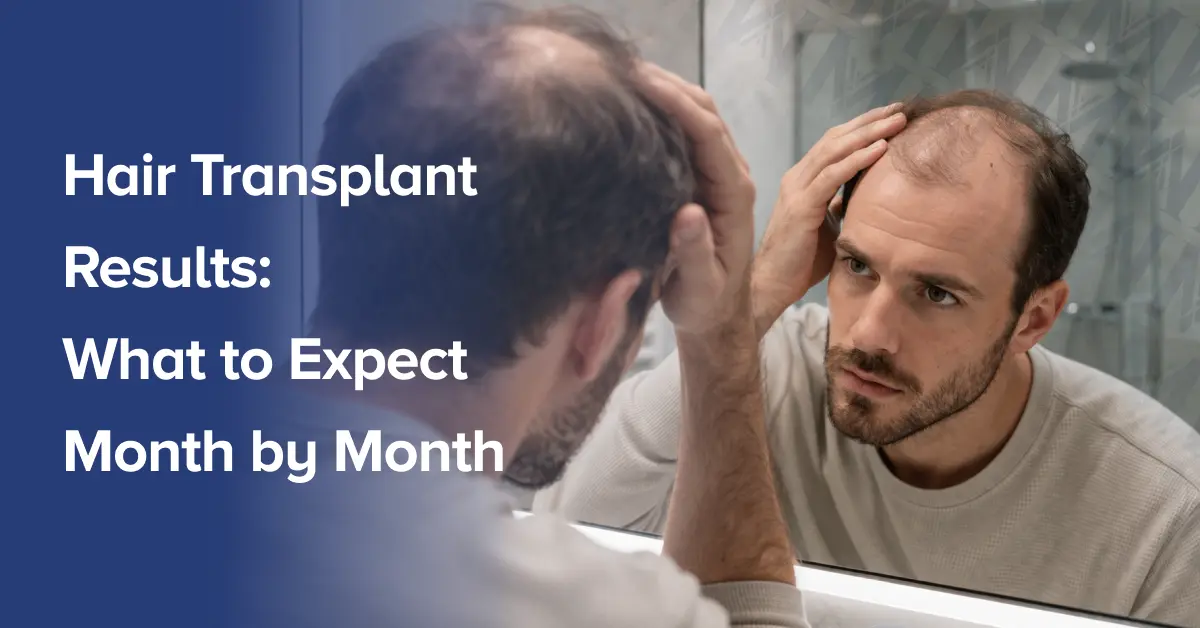
It's 2 AM. You're standing in front of the bathroom mirror, tilting your head under the light, searching for even one new hair sprouting from your scalp. It's been ten weeks since your hair transplant — and doubt is starting to win.
If this sounds familiar, you're not alone. This is the exact moment in the journey that nearly every hair transplant patient faces.
Understanding your hair transplant results month by month is the single most important thing you can do to protect your mental wellbeing during recovery. When you know what's coming — including the difficult stages — the waiting transforms from anxiety into patience.
This guide is built on clinical experience with thousands of hair transplant in Turkey patients. We've watched this timeline unfold again and again. The process is predictable. The phases are well-documented. And for the vast majority of patients, the results are worth every difficult moment.
We'll cover every stage from Day 1 through Month 18 — the growth percentages you can expect, the emotional highs and lows you'll face, and specific care tips to maximize your outcome. This timeline applies whether you've had Follicular Unit Extraction (FUE), Direct Hair Implantation (DHI), or Sapphire FUE.
Let's follow a typical patient journey — we'll call him Ahmed, a 34-year-old who traveled from the UK to Istanbul for a 3,500-graft FUE procedure (a composite based on thousands of real patient experiences). While Ahmed is our example, this timeline applies equally to patients of all genders.
Now, let's walk through every stage so you know exactly what to expect.
Get a Free Consultation!
Talk to an experienced patient coordinator for your hair transplant in Turkey.Hair Transplant Growth Chart: Visual Overview
Before diving into the details, let's start with the big picture. This hair transplant growth chart shows the approximate percentage of new hair growth most patients can expect at each milestone — a clear, bookmarkable snapshot of hair transplant results month by month.
Hair Transplant Growth Percentage by Month
The table below summarizes the typical hair transplant timeline based on clinical experience and published literature. These are averages — your individual results may vary.
| Month | Growth Percentage Range | Key Milestone / Note |
|---|---|---|
| Month 1 | 0% new growth | Healing phase; scabs fall off |
| Month 2 | 0% new growth | Shock loss — transplanted hairs shed |
| Month 3 | 5–15% | First fine "baby hairs" begin to emerge |
| Month 4 | 20–30% | First signs of real, visible growth |
| Month 5 | 30–40% | Noticeable improvement in coverage |
| Month 6 | 45–55% | Halfway point — meaningful density |
| Month 7 | 55–65% | Accelerated growth and thickening |
| Month 8 | 65–75% | Dramatic improvement continues |
| Month 9 | 75–80% | Approaching final density |
| Month 10 | 80–85% | Hair texture normalizing |
| Month 11 | 85–90% | Near-final results |
| Month 12 | 90–95% | Most patients highly satisfied |
| Month 14–18 | 95–100% | Full maturation and final result |
Key takeaway: The growth curve isn't linear — it follows an S-shape. Growth starts slowly, accelerates sharply between months 4 and 8, then gradually levels off as you approach your final result.
How to Read This Growth Chart
The hair transplant growth percentage by month figures above refer to visible new hair emerging from transplanted follicles. In the early months, these hairs are thin and wispy. They thicken and mature over months 8–14, so even 90% growth at month 12 will look noticeably fuller by month 15 as individual strands gain diameter. Once in the active growth phase, hair grows approximately 1–1.5 cm per month.
This chart represents transplanted hairs only — not your existing native hair. Your overall appearance will be a combination of both.
Want to see how these percentages translate to real transformations? Browse our hair transplant before and after results to see patients at every stage of this timeline.
![Hair transplant growth chart infographic showing the S-curve of growth from Month 1 to Month 18]](https://www.medarthair.com/wp-content/uploads/2026/04/Hair-Transplant-Growth-Curve_-Why-Results-Take-Time-scaled.webp)
The Complete Hair Transplant Timeline: Month by Month
Now that you've seen the big picture, let's zoom in on what each stage actually looks and feels like. Each phase below covers the biology, the visible changes, what's normal versus concerning, and specific care tips to guide you through.
Week 1 (Days 1–7): Immediate Post-Op Recovery
Your transplanted follicles are at their most fragile. The grafts are settling into their new channels while your body launches its natural healing response. During this first week, expect redness and swelling in the recipient area (where the grafts were placed). Swelling often peaks between days 2 and 5, sometimes migrating down to the forehead. This looks alarming but is completely normal. Tiny scabs form around each graft. The donor area (the back and sides of your head) will feel sore and tight. This is all expected. The only things that should concern you are signs of infection — increasing redness with warmth, pus, or fever. These are rare but require immediate medical attention. Ahmed flew home to London on day 3 after his procedure in Istanbul. For patients traveling after surgery, flying is safe within the first few days. Keep your head elevated during the flight and avoid bumping the recipient area. Protect your scalp from direct sun — your clinic should provide a travel kit with saline spray and a loose-fitting hat.
Your transplanted follicles are at their most fragile. The grafts are settling into their new channels while your body launches its natural healing response.
During this first week, expect redness and swelling in the recipient area (where the grafts were placed). Swelling often peaks between days 2 and 5, sometimes migrating down to the forehead. This looks alarming but is completely normal. Tiny scabs form around each graft. The donor area (the back and sides of your head) will feel sore and tight.
This is all expected. The only things that should concern you are signs of infection — increasing redness with warmth, pus, or fever. These are rare but require immediate medical attention.
Ahmed flew home to London on day 3 after his procedure in Istanbul. For patients traveling after surgery, flying is safe within the first few days. Keep your head elevated during the flight and avoid bumping the recipient area. Protect your scalp from direct sun — your clinic should provide a travel kit with saline spray and a loose-fitting hat.
Care tips for Week 1:
- Sleep at a 45-degree angle using extra pillows or a travel pillow
- Apply saline spray as directed by your clinic
- Do not touch, scratch, or pick at the grafts
- Follow your clinic's post-operative care instructions precisely — the washing protocol typically begins on day 2 or 3
As the first week ends, you'll notice the initial swelling subsiding. Week 2 brings the next phase of healing.
Week 2 (Days 8–14): Scab Removal and Early Healing
The tiny scabs around each graft are beginning to loosen. Your body is securing the follicles into their new position, and surface healing is progressing steadily. You'll see scabs flaking away during gentle washing. Redness is fading but still visible — your scalp has a pinkish tone. Transplanted hairs remain in place at this point. Most patients can return to desk work or office jobs by days 8–10, as long as they avoid dusty or physically demanding environments. What's normal: Itching. Your scalp will itch as it heals, and resisting the urge to scratch is critical. Minor numbness in the donor area is also common and typically resolves over weeks to months. What's concerning: Significant bleeding from scabs, or increasing swelling after day 7, should prompt a call to your clinic.
The tiny scabs around each graft are beginning to loosen. Your body is securing the follicles into their new position, and surface healing is progressing steadily.
You'll see scabs flaking away during gentle washing. Redness is fading but still visible — your scalp has a pinkish tone. Transplanted hairs remain in place at this point. Most patients can return to desk work or office jobs by days 8–10, as long as they avoid dusty or physically demanding environments.
What's normal: Itching. Your scalp will itch as it heals, and resisting the urge to scratch is critical. Minor numbness in the donor area is also common and typically resolves over weeks to months.
What's concerning: Significant bleeding from scabs, or increasing swelling after day 7, should prompt a call to your clinic.
Care tips for Week 2:
- Perform your first full hair wash per your clinic's instructions — use lukewarm water and a gentle patting motion
- Never rub or scrub the recipient area
- The donor area can be washed more normally but still gently
- If itching is severe, ask your clinic about approved soothing sprays
By the end of week 2, most scabs will be gone. Your scalp is entering a quieter phase — but don't let the calm fool you.

Weeks 3–4 (Days 15–30): The Calm Before the Storm
Surface healing is nearly complete. Beneath the skin, transplanted follicles are establishing their blood supply and preparing for the next phase of the hair growth cycle. Your scalp looks pink but noticeably improved from week 1. Most scabs are gone. Some transplanted hairs are still visible, giving a brief preview of your future hairline. You might feel cautiously optimistic — and you should. What's normal: Some transplanted hairs may begin to shed. This is the very beginning of shock loss, and it's not a sign of failure. We'll cover this in detail in the next section. What's concerning: Persistent scabbing or crusting beyond day 21 is unusual. Contact your clinic for guidance if this occurs.
Surface healing is nearly complete. Beneath the skin, transplanted follicles are establishing their blood supply and preparing for the next phase of the hair growth cycle.
Your scalp looks pink but noticeably improved from week 1. Most scabs are gone. Some transplanted hairs are still visible, giving a brief preview of your future hairline. You might feel cautiously optimistic — and you should.
What's normal: Some transplanted hairs may begin to shed. This is the very beginning of shock loss, and it's not a sign of failure. We'll cover this in detail in the next section.
What's concerning: Persistent scabbing or crusting beyond day 21 is unusual. Contact your clinic for guidance if this occurs.
Care tips for Weeks 3–4:
- You can begin wearing a loose hat or cap for social situations — avoid anything tight that presses on the grafts
- Avoid direct sun exposure on the recipient area
- Light walking is fine; avoid strenuous exercise, swimming, and saunas
- Continue any prescribed medications as directed by your surgeon
Enjoy this calm window while it lasts. Month 2 is where the emotional rollercoaster truly begins.
Month 2: Shock Loss and the Shedding Phase
This is the stage we need to talk about honestly — because it causes more anxiety than any other part of the hair transplant recovery timeline.
Here's what's happening: the transplanted follicles are entering the telogen phase (the resting phase of the hair growth cycle). The hair shafts detach and fall out. This is called shock loss, and it occurs in approximately 90–95% of patients, based on our clinical experience and published literature.
Your transplanted hairs will fall out. Your scalp may look worse than it did before surgery. You might feel a wave of regret.
This is completely normal and expected.
Think of the transplanted follicle like a seed replanted in new soil. The visible hair shaft is the old stem — it falls away. But the root system is alive beneath the surface, quietly preparing to produce new growth in the coming months.
Shock loss typically peaks between weeks 3 and 8. In some cases, existing native hairs near the transplant zone may also shed temporarily — this is called telogen effluvium (temporary, stress-related hair shedding). These native hairs almost always regrow within 3–6 months.
What's normal: Transplanted hairs on your pillow, in the shower, or when you touch your head. Feeling anxious and questioning your decision. All of this is part of the process.
What's concerning: Signs of infection (persistent redness, warmth, pus, fever) require immediate attention. But the shedding itself? That's your follicles doing exactly what they're supposed to do.
Pro Tip: Don't obsessively check your scalp multiple times a day. Take one progress photo per week — same lighting, same angle — then step away from the mirror. If you need reassurance, contact your clinic.
Ahmed sent a worried message to his clinic at week 6: "All my transplanted hairs have fallen out — is this normal?" The answer was a calm, confident yes. For a deeper understanding of this phase, read our dedicated guide on shock loss after hair transplant.
Care tip: This is the hardest month emotionally. Lean on your clinic's support team. Stay off social media comparison threads. Focus on the science: your follicles are alive, and new growth is coming.
The shedding phase passes. And what comes next is the beginning of your transformation.

Month 3: The Ugly Duckling Phase Begins
The shedding is complete — or nearly so. Beneath the surface, follicles are transitioning from telogen into early anagen (the active growth phase, which lasts 2–7 years). There's also a brief transitional stage called catagen (a short regression phase lasting 2–3 weeks) that occurs between these cycles. The rebuilding has begun. At hair transplant 3 months, you may spot the first fine "baby hairs" emerging — thin, wispy, and nearly invisible except under bright light. Approximately 5–15% of new growth is appearing. This is the ugly duckling phase, and it typically lasts from approximately month 2 through month 5. Your scalp doesn't look like it did before surgery, and it doesn't yet show the results you're hoping for. You're caught in between — and it's uncomfortable. What's normal: Minimal visible growth. Tiny, colorless hairs. A scalp that still looks sparse. Feeling impatient. What's concerning: Nothing at this stage warrants alarm. Even seeing zero visible growth at month 3 is within the normal range. Care tip: Some clinics recommend Platelet-Rich Plasma (PRP) therapy or minoxidil at this stage to support growth. Always follow your surgeon's specific guidance — do not start any medication without consulting your doctor. If your clinic offers PRP therapy for hair growth, ask whether it's appropriate for your case. The good news? Month 4 is where things start to change.
The shedding is complete — or nearly so. Beneath the surface, follicles are transitioning from telogen into early anagen (the active growth phase, which lasts 2–7 years). There's also a brief transitional stage called catagen (a short regression phase lasting 2–3 weeks) that occurs between these cycles. The rebuilding has begun.
At hair transplant 3 months, you may spot the first fine "baby hairs" emerging — thin, wispy, and nearly invisible except under bright light. Approximately 5–15% of new growth is appearing.
This is the ugly duckling phase, and it typically lasts from approximately month 2 through month 5. Your scalp doesn't look like it did before surgery, and it doesn't yet show the results you're hoping for. You're caught in between — and it's uncomfortable.
What's normal: Minimal visible growth. Tiny, colorless hairs. A scalp that still looks sparse. Feeling impatient.
What's concerning: Nothing at this stage warrants alarm. Even seeing zero visible growth at month 3 is within the normal range.
Care tip: Some clinics recommend Platelet-Rich Plasma (PRP) therapy or minoxidil at this stage to support growth. Always follow your surgeon's specific guidance — do not start any medication without consulting your doctor. If your clinic offers PRP therapy for hair growth, ask whether it's appropriate for your case.
The good news? Month 4 is where things start to change.
Quick Quote in 5 Minutes
Talk to an experienced patient coordinator for your hair transplant in Turkey.Month 4: First Signs of Real Growth
The anagen phase is gaining momentum. More follicles are activating and pushing new hairs through the skin's surface. Your blood supply to the transplanted area is well-established.
At month 4, approximately 20–30% of transplanted hairs are visible. These aren't the wispy baby hairs of month 3 — they have more substance, more color, more presence.
Here's something that catches many patients off guard: new hairs may look different from your existing hair. They might be curly, wiry, or coarser than expected. This is temporary. The follicle has been through trauma during extraction and reimplantation. By months 8–12, the texture typically matches your natural hair.
What's normal: Uneven growth (one side may appear ahead of the other). Altered hair texture. Thin coverage that's visible but not yet cosmetically significant.
What's concerning: There's still no cause for alarm at month 4, even if your growth seems slower than the averages.
Care tip: You can typically resume light exercise at this point. Continue using gentle, sulfate-free hair care products. Avoid harsh chemical treatments on the transplanted area.
Ahmed noticed his first real hairs at month 4 — dark, slightly curly strands along his new hairline. "It's actually happening," he messaged his clinic. That first glimpse of visible proof changes everything.
Month 5 builds on this momentum in a meaningful way.
Month 5: Noticeable Progress
Growth is accelerating. More follicles are entering the active anagen phase each week, and existing new hairs are gaining length and thickness.
At month 5, approximately 30–40% of transplanted hairs are visible. Coverage is starting to improve in tangible ways. You may notice your hair looks better from certain angles, or that you need less creative styling to cover thin areas. Friends and family may start to comment.
What's normal: Continued variation in growth speed across different areas of the scalp. The hairline may fill in before the crown, or vice versa. Hairs are still thinner than their final diameter.
What's concerning: If you're seeing less than 15–20% growth at month 5, it's worth sending progress photos to your clinic for reassurance. This is still within the normal range, but a check-in provides peace of mind.
Care tip: You can now resume all normal physical activities, including gym workouts and swimming in chlorinated pools. Protect your scalp from direct sun for at least another month — wear a hat outdoors, especially in sunny climates.
The halfway point is just around the corner — and it's a milestone worth celebrating.
Month 6: The Halfway Point
This is a major milestone in the hair transplant timeline. Your follicles have been in the active growth phase for several months now, and the cumulative effect is unmistakable.
At hair transplant 6 months, approximately 45–55% of growth is achieved. Hair is longer, providing real coverage. Texture is beginning to normalize. This is typically the point where patients start to genuinely smile when they look in the mirror.
Take a progress photo and compare it to your pre-operative image. The difference should be striking — and motivating. You're halfway to your final result, and the most dramatic improvements are still ahead.
When to Contact Your Clinic: If you see less than 30% growth at month 6, reach out to your clinic for evaluation. While some patients are slower growers, this threshold warrants a professional assessment.
What's normal: Visible improvement that you can feel confident about. Hair that can be styled to some degree. Continued thin spots that haven't fully filled in yet.
What's concerning: Less than 30% visible growth, or patches with zero growth surrounded by areas of healthy growth. These patterns deserve clinical review.
Care tip: A first careful haircut may be possible — consult your clinic. A skilled barber can shape and blend your transplanted hair with native hair for a more polished look.
Already had your hair transplant and have questions about your progress? Send us your progress photos for a free assessment from our medical team. Here's where things get exciting. Months 7 and 8 are where the transformation accelerates dramatically.

Months 7–8: The Accelerated Growth Phase
This is the period our patients look forward to most — and it delivers. The growth curve is at its steepest point, and changes from week to week are visible.
Between months 7 and 8, approximately 55–75% of transplanted hairs are growing. Hair is thickening in two ways: more hairs are emerging, and each individual strand is gaining diameter. Styling becomes effective. You can use normal hair products, gentle blow-drying, and standard brushes.
Many patients report this is the phase where they "stop worrying." The ugly duckling phase is firmly behind you. The donor area is fully healed and, for FUE and DHI patients, virtually undetectable.
What's normal: Rapid, visible improvement. Compliments from people who may not know about your procedure. A growing sense of confidence.
What's concerning: Significant patches of no growth surrounded by healthy growth could indicate localized graft issues. This is rare but worth mentioning to your clinic.
Care tip: You can now use normal styling tools. Avoid extreme heat from straighteners directly on the transplanted area — moderate heat settings are fine. Regular trims help shape the result as it fills in.
The finish line is coming into view. Let's look at what the final stretch brings.
Months 9–10: Approaching Final Density
Your follicles are mature and producing hair at full capacity. The remaining growth is about filling in the last gaps and adding final thickness.
At months 9–10, approximately 75–85% of growth is achieved. Hair texture has largely normalized — those early curly or wiry hairs have settled into your natural pattern. The cosmetic improvement is significant, and many patients consider this "close enough" to their final result.
But there's more to come. The last 15–20% of maturation makes a noticeable difference in overall density and fullness.
What's normal: A result you're genuinely happy with, even knowing it will improve further. Occasional thin spots still filling in. Hair that blends naturally with your native hair.
What's concerning: If you have persistent concerns about density at this stage, it's an appropriate time to discuss them with your surgeon.
Care tip: Regular haircuts are encouraged to shape and blend your transplanted hair. This is also a good time to establish a long-term hair care routine with your surgeon's guidance.
You're in the home stretch now. Months 11 and 12 bring near-final results.
Months 11–12: Near-Final Results
The growth phase is reaching its plateau. Your transplanted follicles have produced the vast majority of their new hair, and each strand continues to gain thickness and maturity.
At hair transplant 12 months, approximately 85–95% of growth is achieved. Hair is thicker, longer, and blends seamlessly with existing hair. Most patients are highly satisfied at this point. Clinics typically schedule a 12-month follow-up — for patients who had their procedure in Turkey, many clinics offer complimentary check-ups. Some patients choose to return to Istanbul for an in-person evaluation.
What's normal: A result that closely resembles your final outcome. Minor continued thickening over the coming months. A deep sense of satisfaction and renewed confidence.
What's concerning: If you're significantly dissatisfied with density at month 12, have an honest conversation with your surgeon. Give the full 18-month window before making any decisions about supplementary sessions.
Care tip: Take comprehensive progress photos at month 12 — then plan another set at months 15–18 for a true final comparison, as maturation continues.
Ahmed placed his 12-month photos side by side with his pre-op images. The difference was striking — a full, natural-looking hairline he could style with confidence. But his surgeon reminded him: a few more months of refinement still lay ahead.
Months 12–18: Full Maturation and Final Result
The final chapter. Your transplanted hair is completing its maturation process — individual hairs reaching their full diameter, overall density settling into its permanent state.
Between months 14 and 18, you achieve 95–100% of your final result. The transplanted hair is now permanent. It comes from the DHT-resistant donor zone — the area at the back and sides of the head genetically programmed to resist the hormone that causes pattern hair loss. This hair will continue to grow naturally for life.
What's normal: Subtle continued improvement visible only in side-by-side photo comparisons. Full, natural-looking hair you can cut, style, and color just like the rest of your hair.
What's concerning: Nothing, in most cases. If you have specific questions about density, your surgeon can advise whether your result falls within the expected range for your graft count.
A small percentage of patients — especially those who received 4,000 or more grafts — may see continued improvement up to 24 months. The hair growth cycle operates on its own schedule.
Care tip: Continue any maintenance medications (finasteride, minoxidil) as recommended by your doctor to protect your native, non-transplanted hair. The transplanted hair is permanent, but your existing hair still benefits from ongoing care.
What Affects Your Hair Transplant Growth Timeline?
The month-by-month timeline above represents the typical experience — but "typical" doesn't mean "universal." Several factors influence how quickly or slowly your results develop. Understanding them helps you set expectations that match your unique situation.
Individual Factors
Your body's biology plays the largest role. Age, genetics, overall health, and nutritional status all influence how efficiently your follicles produce new hair. Smoking restricts blood flow to the scalp and is one of the strongest modifiable risk factors for slower growth. Hair type and ethnicity also matter. Curly or coarse hair may appear to grow more slowly in the early months, but it often provides better visual coverage per graft due to its volume. Straight, fine hair may show growth earlier but require more grafts for the same visual density. The extent of your hair loss also influences how quickly you perceive visual improvement.
Technique Used: FUE vs. DHI vs. Sapphire FUE
The FUE hair transplant technique follows the standard timeline described in this article. The DHI hair transplant method may show slightly faster initial healing due to smaller, more precise incisions — but the overall growth trajectory remains the same. Sapphire FUE hair transplant uses sapphire-tipped blades that may reduce initial scabbing and healing time.
The key point: All three techniques converge to similar results by months 12–18. We'll compare them in detail in a dedicated section below.
Graft Count and Area Covered
Larger sessions (3,000–5,000+ grafts) may take slightly longer to reach full density — your scalp is healing and nourishing a greater number of follicles simultaneously. Crown transplants often take 2–3 months longer to show visible results compared to hairline work. The crown's blood supply and the angle at which hair grows make early growth less immediately noticeable.
Post-Op Care Compliance
This is the factor you control most directly. Following your clinic's washing protocols, medication regimens, and activity restrictions impacts graft survival and growth speed. In our clinical experience, patients who follow post-operative instructions carefully see consistently stronger outcomes.
Smoking, excessive alcohol, poor nutrition, unprotected sun exposure, and physical trauma to the scalp can all delay or diminish results.
Common Concerns at Each Stage (And When to Actually Worry)
Now that you understand the full timeline and the factors that influence it, let's tackle the anxieties that surface at each hair transplant growth stage. Knowing the difference between normal variation and genuine red flags can save you weeks of unnecessary worry.
"It's Month 3 and I See Nothing — Is My Transplant Failing?"
You're at month 3. You've been checking every morning, angling your head under the bathroom light, and you're convinced nothing is growing. You start searching "hair transplant failure" at midnight. Here's what's actually happening: month 3 is too early to judge. In our experience with thousands of patients, up to 15–20% are "late bloomers" who don't see meaningful growth until month 5 or even 6. The follicles are working beneath the surface — you just can't see the progress yet. When to contact your clinic: If you see zero visible growth by month 6, request an evaluation. Before that, patience is your most important tool.
"My Transplanted Hair Is Curly or Wiry — Will It Stay Like This?"
Early transplanted hairs frequently emerge with altered texture. They may be curly when your natural hair is straight, or wiry and coarse. This happens because the follicle experienced trauma during extraction and reimplantation.
This is temporary. As the follicle matures through additional growth cycles, the texture normalizes. Most patients see their hair return to its natural pattern between months 8 and 14.
"I'm Losing My Existing Hair After the Transplant"
Shock loss can affect not only transplanted hairs but also native hairs in the surrounding area. This is a temporary response to surgical trauma. The native hairs almost always regrow within 3–6 months.
If you're concerned about ongoing native hair loss beyond the shock loss window, discuss medications like finasteride or minoxidil with your doctor. These can help protect existing hair from continued thinning. Always consult your doctor before starting any medication.
"My Results Look Uneven — One Side Is Growing Faster"
You notice the left side of your hairline filling in faster than the right. This is one of the most common observations between months 3 and 8. It happens because individual follicles enter the growth cycle at different times — not because something went wrong.
This is not a sign of a problem. Growth typically evens out by months 10–12. Only if significant asymmetry persists past month 12 should you raise it with your surgeon.
Red Flags: When You Should Contact Your Clinic
While most concerns during the hair transplant recovery timeline are normal, certain symptoms require prompt attention:
Signs of infection in the first two weeks: persistent or increasing redness, warmth, pus, or fever
- Signs of infection in the first two weeks: persistent or increasing redness, warmth, pus, or fever
- Zero visible growth by month 6: while rare, this warrants professional evaluation
- Significant, unusual pain at any stage: mild discomfort is normal early on, but sharp or increasing pain is not
- Dramatic ongoing hair loss well beyond the expected shock loss period (past months 3–4)
When to Contact Your Clinic: When in doubt, reach out. A quick progress photo sent to your clinic can provide reassurance or catch issues early. For medical tourists managing recovery remotely, your Turkish clinic should have a clear communication channel for post-op follow-up — use it.
Tips to Maximize Your Hair Transplant Results
You know what to expect. You know what not to worry about. Now let's focus on what you can actively do to give your follicles the best possible environment to thrive. Your surgeon's skill sets the foundation — your post-operative care builds on it.
Lifestyle and Health Tips
- Follow your clinic's post-op instructions to the letter. Washing protocols, sleeping positions, activity restrictions — every instruction exists for a reason.
- Maintain a nutrient-rich diet. Focus on protein, iron, zinc, biotin, and vitamins A, D, and E. Consult your doctor before starting any new supplement regimen.
- Stay well-hydrated. Adequate water intake supports circulation and scalp health.
- Avoid smoking for at least one month before and after surgery. Smoking constricts blood vessels and starves healing follicles of oxygen. Quitting permanently provides the strongest long-term benefit.
- Limit alcohol for at least the first two weeks. Alcohol thins the blood and can increase swelling.
Hair Care and Monitoring Tips
- Protect your scalp from direct sun for 3–6 months. UV exposure can damage healing skin and affect pigmentation. Wear a loose hat when outdoors.
- Discuss finasteride and minoxidil with your doctor. These medications can help protect native hair from future thinning. Always consult your doctor before starting any medication, including finasteride or minoxidil.
- Consider PRP therapy if recommended by your surgeon. Some clinics report that PRP therapy for hair growth can support the growth phase, though research on its effectiveness is still evolving. Discuss with your surgeon whether PRP is appropriate for your case.
- Take consistent monthly progress photos. Use the same lighting, the same angles, and photograph both wet and dry hair. Stand in the same spot each time. These photos are invaluable for tracking your progress — and for remote follow-ups with your Turkish clinic. Send them via your clinic's communication channel for professional feedback.
- Do not compare your results to social media posts. These are often cherry-picked, filtered, and represent different graft counts and hair types. Your timeline is your own.
- Be patient. This is the hardest tip — and the most important one. The timeline is predictable. The results are coming. Give your body the time it needs.
Hair Transplant Results Timeline: FUE vs. DHI vs. Sapphire FUE
Beyond daily care, patients frequently ask whether their choice of technique affects the growth timeline. Let's compare the three most popular methods side by side so you can see exactly where they differ — and where they don't.
How Technique Affects the Timeline
The table below summarizes the key timeline differences based on clinical observations. These are general patterns, not guarantees.
| Factor | FUE | DHI | Sapphire FUE |
|---|---|---|---|
| Initial Healing Speed | Standard (7–14 days for scabs to clear) | Slightly faster (smaller, more precise incisions) | Faster (sapphire blades create cleaner channels) |
| Early Growth (Months 3–4) | Standard timeline | May show marginally earlier emergence | Similar to standard FUE |
| Final Results Timeline | 12–18 months | 12–18 months | 12–18 months |
| Best For | Most hair loss patterns; highly versatile | Hairline refinement; no-shave procedures | Patients seeking faster initial healing; dense packing |
What Matters More Than Technique
The honest takeaway: the differences between these techniques in terms of growth timeline are marginal. FUE hair transplant results, DHI hair transplant results, and Sapphire FUE results all converge to comparable outcomes by months 12–18.
In our experience performing all three techniques, what matters far more is the surgeon's skill, the quality of graft handling, and your post-operative care. Don't choose a technique based on growth speed. Choose based on your specific hair loss pattern, your surgeon's recommendation, and the approach that best suits your individual needs. When does hair transplant start growing? At the same pace regardless of technique — typically months 3–4.
Frequently Asked Questions About Hair Transplant Results
Conclusion
The hair transplant journey is a marathon, not a sprint — but it's a marathon with a clear, predictable route. Now you have the map.
Here are the milestones that matter most:
- Months 1–2: Healing and shock loss. Your transplanted hairs will shed. This is normal — your follicles are alive beneath the surface.
- Months 3–5: The ugly duckling phase. First baby hairs emerge, but patience is required.
- Months 6–8: The turning point. Dramatic improvement as growth accelerates rapidly.
- Months 9–12: Near-final density. The result you've been waiting for takes shape.
- Months 12–18: Full maturation. Your permanent, natural-looking final result.
Thousands of patients have walked this exact path — through the anxiety of shock loss, through the frustration of the ugly duckling phase, and into the confidence of their final result. Understanding hair transplant results month by month doesn't change the timeline. But it transforms the experience from uncertainty into informed patience.
If you're considering a hair transplant in Turkey and want to understand what your personal timeline and results might look like, our medical team is here to guide you. Every transformation starts with a conversation.
