
If you're an American researching hair transplants in Turkey, you probably have two feelings right now: excitement about the price and anxiety about everything else. This guide was written to address both — every cost, every logistic, every concern, filtered through the lens of what an American patient actually needs to know in 2026.
Consider this: according to industry estimates, more than 50,000 Americans traveled to Istanbul for hair restoration last year alone. They didn't go for the Hagia Sophia or the Grand Bazaar. They went because the math made sense, the quality matched their expectations, and they came home with natural-looking results that spoke for themselves.
Take Mike, a 38-year-old software engineer from Austin who'd been watching his hairline creep backward since his early 30s. After getting quoted $16,000 at a clinic in Dallas, Mike started researching alternatives. What he found led him to a surgeon-led clinic in Istanbul — a $4,200 all-inclusive package and a hairline he hadn't seen since his twenties.
This guide covers everything from USD cost breakdowns and flight logistics to clinic vetting strategies, recovery timelines, and how to plan your time off work. By the time you finish reading, you'll have a clear, actionable roadmap from your front door to a full head of hair — and back.
Medical Disclaimer: This article is for informational purposes only and does not constitute medical advice. Always consult with a qualified medical professional before making decisions about hair restoration procedures. Individual results vary.
Why Are So Many Americans Flying to Turkey for Hair Transplants?
You're not the first American to type this search into Google. The trend of flying to Turkey for hair restoration has shifted from niche to mainstream — and the data explains why.
The Numbers Behind the Trend
Turkey is the global leader in hair transplant volume. According to the Turkish Healthcare Travel Council, the country performs an estimated 700,000 to over 1,000,000 hair transplant procedures annually. Istanbul alone has more than 350 clinics dedicated to hair restoration.
The International Society of Hair Restoration Surgery (ISHRS) has documented a steady rise in Americans seeking procedures abroad, with Turkey consistently ranking as the top destination. This is a segment of medical tourism Turkey hair transplant patients have relied on for over a decade — and it's accelerating.
Turkey's dominance didn't happen by accident. The Turkish government has invested heavily in medical tourism infrastructure, including hospital accreditation programs, tourism incentives, and training pipelines for surgeons specializing in hair restoration.
What's Driving Americans Specifically
Four forces are pulling Americans toward Istanbul:
- The cost gap is staggering. Average US pricing runs $10,000–$20,000 or more, while comparable procedures in Turkey cost $2,500–$6,000 — often with hotel, transfers, and aftercare included.
- All-inclusive packages simplify everything. In the US, you'd piece together separate charges for consultations, procedure fees, medications, and follow-ups. Turkish clinics bundle it all into a single transparent price.
- Hair transplants are culturally normalized now. Social media, celebrity openness, and a growing comfort with investing in appearance have stripped away much of the old stigma.
- The trip itself becomes part of the story. You're not just getting a procedure — you're spending a few days in one of the world's most captivating cities.
The cost savings alone are compelling. But the numbers become even more striking when you break them down line by line.
Get a Free Consultation!
Talk to an experienced patient coordinator for your hair transplant in Turkey.Hair Transplant Cost: Turkey vs. the United States (2026 Breakdown)
You've probably already done some mental math. The first question most Americans ask is straightforward: how much is a hair transplant in Turkey in USD when you factor in every expense? Let's make it precise.
What You'd Pay in the US
Hair transplant pricing in the United States varies significantly by city, surgeon reputation, and graft count. Here's what you can expect as of 2025–2026 estimates:
- Average FUE procedure cost: $8,000–$20,000+
- Per-graft pricing model: Most US clinics charge $4–$10 per graft, meaning a 3,000-graft procedure could run $12,000–$30,000
- Insurance coverage: Standard health insurance does not cover cosmetic hair transplants
- Additional costs: Separate charges for consultations ($100–$300), prescription medications, and follow-up visits
A 2023 ISHRS practice census confirmed that average procedure fees in North America remain among the highest globally.
What You'd Pay in Turkey (All-In)
Turkish clinics operate on a fundamentally different pricing model. Most reputable clinics offer all-inclusive packages ranging from $2,500 to $6,000 (2025–2026 estimates). Here’s what that typically covers:
- The procedure itself (FUE, Sapphire FUE, or DHI)
- 2–3 nights at a 4- or 5-star hotel
- Airport-to-hotel and hotel-to-clinic transfers
- Pre-operative blood tests and post-operative medications
- A first wash at the clinic and post-op consultation
What’s typically NOT included: international flights, travel insurance, meals outside the hotel, optional PRP treatments, and any future touch-up sessions.
Some clinics use per-graft pricing (typically $1–$2 per graft), while others offer flat-rate packages regardless of graft count. Flat-rate packages are more common and often more cost-effective for patients needing higher graft counts.
So why is it cheaper? Not because of lower quality. Turkey's lower cost of living, government healthcare subsidies for medical tourism, intense market competition, and sheer procedure volume all drive prices down while keeping standards high. For a full breakdown of hair transplant costs in Turkey , including what's included at various price points, the details are worth exploring.
While standard insurance won’t cover the procedure, some patients have successfully used HSA or FSA funds. Consult your plan administrator to determine eligibility, as hair transplants are generally classified as cosmetic.
The True Total Cost for an American (Including Travel)
Here's what your total investment looks like when you add everything up:
[VISUAL: Cost comparison table — Turkey all-inclusive vs. US clinic pricing with travel costs]
| Expense | Turkey (All-In) | United States |
|---|---|---|
| Procedure (FUE/DHI, 2,500–4,000 grafts) | $2,500–$6,000 (included in package) | $8,000–$20,000+ |
| Hotel (3–5 nights) | Included in package | N/A (local procedure) |
| Round-trip flights from US | $500–$1,200 | N/A |
| Airport transfers | Included in package | N/A |
| Medications & aftercare kit | Included in package | $200–$500 |
| Spending money & incidentals | $300–$600 | $100–$200 |
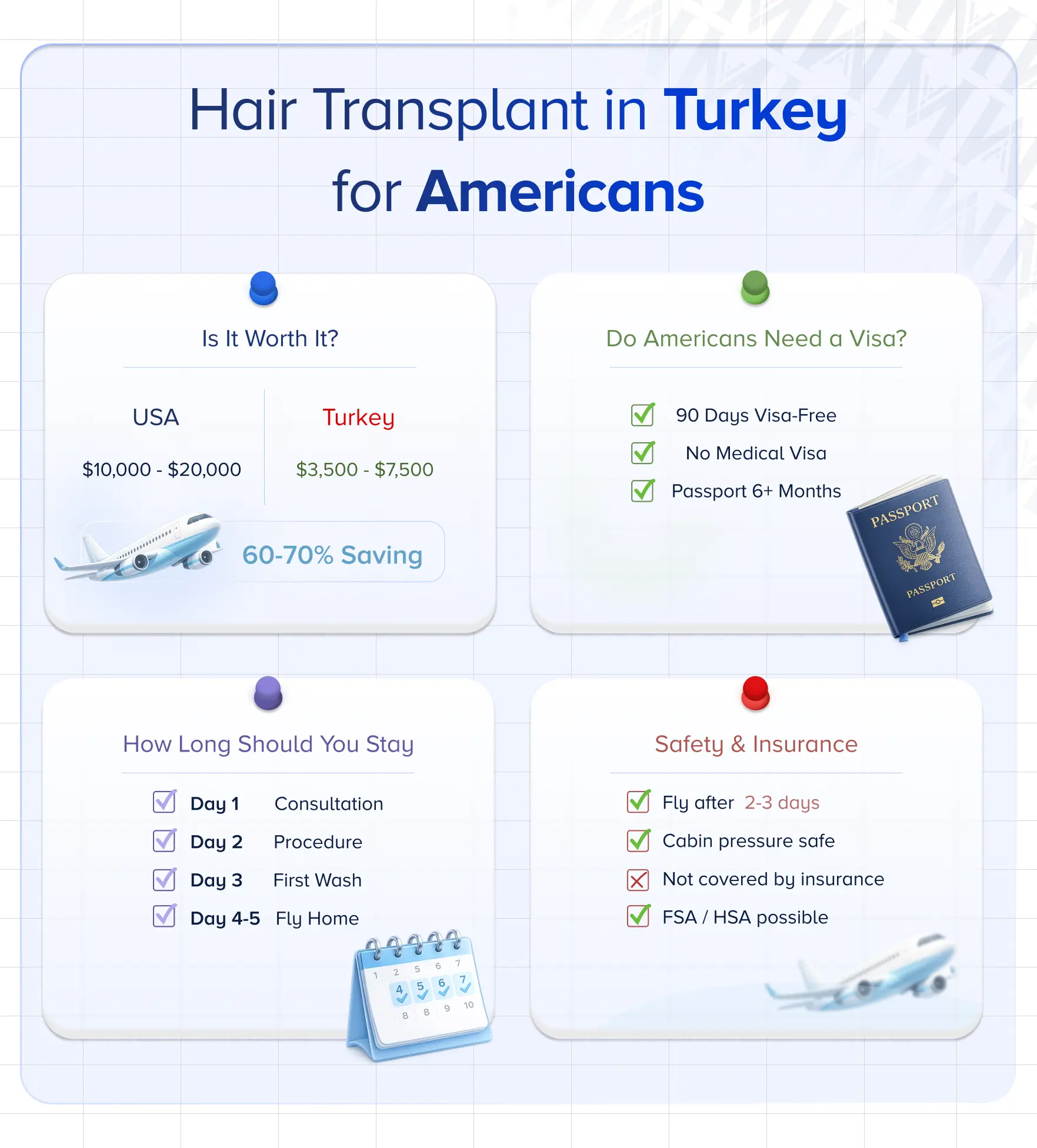
| Total Estimated Cost | $3,500–$7,500 | $10,000–$20,000+ |
Prices are estimates based on 2025–2026 market data and may vary by clinic, graft count, and technique.
Even after flights, hotel, and spending money, most Americans save $6,000–$14,000 compared to having the same procedure at home.
For a detailed comparison of hair transplant costs in Turkey vs. the USA , the savings hold up across every graft count and technique.
Want a personalized estimate? Use the free graft calculator
Safety and Quality Standards in Turkish Hair Transplant Clinics
Your skepticism here is healthy. When you're weighing a medical procedure thousands of miles from home, you deserve straight answers about safety and regulation — not marketing spin.
Turkey’s Medical Regulatory Framework
Turkey’s Ministry of Health regulates all hair transplant clinics operating in the country. Key requirements include:
- All procedures must be performed in licensed medical facilities
- A licensed physician must perform or directly supervise every procedure
- Clinics must meet specific equipment, hygiene, and staffing standards
- Regular inspections and compliance audits are conducted
Turkey also holds a distinction many Americans don't expect: it has more JCI-accredited hospitals than any country outside the United States, according to Joint Commission International data. JCI accreditation — the international gold standard for healthcare quality and patient safety — is the same benchmark used to evaluate top US hospitals. Think of it as the healthcare equivalent of a AAA Five Diamond rating: it signals that a facility meets the highest international standards.
This regulatory framework is comparable in scope to US state medical board oversight, though the systems differ in structure.
How to Separate Elite Clinics from Hair Mills
Here's where your research matters most. A hair mill is a high-volume clinic that prioritizes quantity over quality — processing as many patients as possible per day, often with undertrained technicians performing the procedure while a surgeon is nominally "on staff." It's the difference between a fast-food chain and a restaurant with a named chef. Both serve food. The experience, care, and outcome are fundamentally different.
What you might think: "All Turkish clinics are basically the same — just find the cheapest one."
What actually happens: The gap between a top-tier, surgeon-led clinic and a hair mill is enormous — in technique, in results, and in patient safety.
Red Flags to Watch For
- No named surgeon on the clinic's website or in your consultation
- Technicians perform the entire procedure without surgeon involvement
- Unrealistic promises ("We can do 7,000 grafts in one session")
- Prices significantly below $2,000 for an all-inclusive package
- No pre-procedure video consultation offered
- High-pressure tactics to book immediately with limited information
Green flags that signal quality:
- A board-certified surgeon who performs or directly supervises your procedure
- JCI accreditation or affiliation with an accredited hospital
- Transparent before-and-after gallery with cases similar to your hair loss pattern
- Verifiable reviews from American and international patients on independent platforms
- A clear, written treatment plan specifying graft count, technique, and pricing
- Pre-procedure video consultation as standard practice
- A dedicated international patient coordinator who speaks fluent English
For a deeper dive, read this guide on how to spot hair mill red flags and ghost clinics before you book anything.
Realistic Expectations — What Americans Should Know
At reputable, surgeon-led clinics, graft survival rates typically range from 90–95%, according to industry data from the ISHRS. That's consistent with outcomes at top US practices.
But results aren't instant. Visible growth typically begins at 3–6 months, with final results emerging at 12–18 months. Not every candidate is a good fit, either — a qualified surgeon should assess your hair loss pattern, donor area, and overall health before recommending treatment. A reputable clinic will turn you away if your expectations aren't realistic. An honest assessment matters more than a sale.
With safety concerns addressed, let's walk through exactly what your trip looks like — step by step.
Step-by-Step: How the Process Works for Americans
You know the cost. You understand the quality landscape. Now let's map out the entire journey from your couch to the clinic and back home again.
Step 1 — Research and Initial Consultation (From Home)
Everything starts with a free online consultation, completed entirely from your phone or computer:
- Submit photos of your hair loss (front, top, sides, and donor area) along with a brief medical history form
- A medical team reviews your case and schedules a video consultation
- During the video call, a surgeon or medical consultant assesses your hair loss pattern, discusses technique options, and recommends a graft count
- You receive a personalized treatment plan and quote — usually within 24–48 hours
Mike submitted his photos through an online form on a Tuesday evening. By Thursday, he had a video call with a medical consultant who walked him through a personalized plan: 3,200 grafts using Sapphire FUE, all-inclusive package at $4,200.
Step 2 — Booking and Pre-Travel Preparation
Once you've chosen your clinic and confirmed your procedure date, preparation is straightforward:
- Book your flights. Turkish Airlines offers direct flights from 13+ US cities. More on routes and timing in the travel section below.
- Follow pre-operative instructions. Most clinics ask you to stop blood-thinning medications (aspirin, ibuprofen) and supplements (vitamin E, fish oil) 7–10 days before the procedure. Avoid alcohol for at least 3 days prior.
- Arrange travel insurance. A comprehensive policy covering medical complications abroad is a smart investment. Policies designed for medical tourism typically start around $50–$100.
- Confirm your package details in writing. Ensure you have documentation of what's included before you pay any deposit.
Step 3 — Arrival in Istanbul
Most all-inclusive packages include airport pickup:
- A driver meets you at Istanbul Airport (IST) and takes you directly to your hotel
- You check in, rest, and adjust to the time difference
- Later that day or the next morning, you visit the clinic for a pre-operative consultation
- Blood tests and a detailed scalp analysis are performed on-site
- You sit down with the surgeon to finalize your hairline design and confirm the graft count
Step 4 — Procedure Day
Procedure day is long but entirely manageable:
- Morning: You arrive at the clinic and the surgical team preps your scalp
- Anesthesia: Local anesthesia is administered. Most patients report mild discomfort during the injections, with little to no pain during the procedure itself.
- Extraction phase (2–3 hours): Individual hair follicles — called grafts — are removed one by one from the donor area at the back of your head
- Break: Most clinics offer a lunch break between extraction and implantation
- Implantation phase (3–4 hours): Grafts are placed into the recipient area — the thinning or balding zone — following the agreed-upon hairline design
- Total duration: Typically 6–8 hours depending on graft count
You'll be awake throughout. Most patients watch movies, listen to podcasts, or scroll their phones. For a day-by-day breakdown of a hair transplant trip to Turkey, including what each stage feels like, the details are worth reviewing.
Step 5 — Recovery Days in Istanbul (Days 2–3)
The first 48 hours after your procedure are critical for graft survival:
- Day 2: You return to the clinic for your first hair wash. The medical team gently cleans the transplanted area and demonstrates the proper washing technique to use at home.
- Post-op check: The surgeon examines the transplanted area and provides detailed aftercare instructions.
- Activity level: You can walk around, eat at restaurants, and do light sightseeing. Avoid direct sun exposure and strenuous activity.
- What's realistic for sightseeing: A gentle stroll through the Sultanahmet district or a seated Bosphorus cruise — yes. A full-day walking tour — not yet.
Step 6 — Flying Home and Aftercare in the US
Most patients fly home 2–3 days after the procedure. Here's how to make the journey comfortable:
- Bring a travel neck pillow to keep your head upright and avoid pressing the transplanted area against the headrest.
- Wear a loose, button-down shirt to avoid pulling anything over your head.
- Stay hydrated — cabin air is dry, and hydration supports healing.
- A loose hat or cap is fine for the airport, but avoid tight-fitting headwear.
Once home, aftercare continues remotely. Reputable clinics provide scheduled video check-ins, photo-based progress monitoring, and direct access to the medical team (often via WhatsApp). You'll receive a full aftercare kit with specialized shampoo, medications, and written instructions.
You've seen the complete journey from consultation to landing back at your home airport. Now let's nail down the travel logistics so you can plan every detail with confidence.

Get Your Free Hair Analysis
Talk to an experienced patient coordinator for your hair transplant in Turkey.Travel Logistics: Everything Americans Need to Know
If you're planning a hair transplant Istanbul from USA, the logistics are simpler than you might expect. Consider this section your hair transplant Turkey travel guide for every practical detail.
Passport and Visa Requirements
Good news: US citizens can enter Turkey visa-free for up to 90 days for tourism and medical purposes (as of 2025). No special medical visa is required. You can also obtain an e-Visa online before your trip if you prefer having documentation in hand — the process takes about 5 minutes and costs approximately $50.
Your passport must be valid for at least 6 months beyond your planned travel date. If yours is expiring soon, renew it well in advance.
(Entry requirements may change. Verify current visa policies at travel.state.gov before booking travel.)
Flights from the US to Istanbul
Turkish Airlines operates direct flights to Istanbul (IST) from more than 13 US cities, including:
- New York (JFK)
- Los Angeles (LAX)
- Chicago (ORD)
- Houston (IAH)
- Miami (MIA)
- Atlanta (ATL)
- San Francisco (SFO)
- Washington, D.C. (IAD)
- Boston (BOS)
- Dallas (DFW)
- Seattle (SEA)
Flight times: 10–12 hours from the East Coast, 12–14 hours from the West Coast. Round-trip economy tickets typically range from $500–$1,200, depending on season and how far in advance you book.
Booking tips: Book 6–8 weeks ahead for the best fares. Tuesday and Wednesday departures tend to run cheaper. If you can travel during shoulder season (October–November or February–April), you’ll find better airfares and hotel rates.
How Long Should You Plan to Stay?
- Minimum recommended: 4–5 nights
- Ideal: 6–7 nights for a more relaxed recovery and time to enjoy Istanbul
Here's a sample itinerary:
[VISUAL: Sample trip timeline infographic for Americans getting a hair transplant in Istanbul]
| Day | Activity |
|---|---|
| Day 1 (e.g., Thursday) | Arrive in Istanbul, airport pickup, hotel check-in, rest |
| Day 2 (Friday) | Pre-op consultation, blood tests, hairline design, procedure |
| Day 3 (Saturday) | First wash at clinic, post-op check, light rest |
| Day 4 (Sunday) | Recovery day, gentle sightseeing (optional) |
| Day 5 (Monday) | Recovery continues, explore Istanbul at a relaxed pace |
| Day 6 (Tuesday) | Final clinic check (if needed), departure |
Practical Tips for Your Stay
- Currency: Turkey uses the Turkish Lira, but most clinics accept USD and major credit cards.
- Carry: Carry a small amount of Lira for taxis and small purchases.
- Language: English is widely spoken in Istanbul's medical tourism sector, hotels, and tourist areas. You won't face a meaningful language barrier at your clinic or hotel.
- Time difference: Turkey is 7–8 hours ahead of Eastern Time and 10–11 hours ahead of Pacific Time, depending on Daylight Saving Time in the US. Turkey does not observe DST. Plan for jet lag — arriving a day before your procedure gives you time to adjust.
- Cell phone and data: Purchase an eSIM before departure for reliable data throughout your trip. Hotel and clinic Wi-Fi is standard.
- Tipping: Not expected at medical facilities. At restaurants, 5–10% is customary.
- Patient data privacy: Turkish clinics handling international patients follow strict privacy protocols. Turkey's data protection framework (KVKK) governs how personal data is collected and stored, and reputable clinics maintain rigorous patient confidentiality.
[VISUAL: Packing checklist infographic for Americans traveling to Turkey for a hair transplant]
What to pack for your hair transplant trip:
- Travel neck pillow (essential for the flight home)
- Button-down or zip-up shirts (avoid pulling anything over your head for 2 weeks)
- Loose-fitting hat or cap for sun protection
- Comfortable slip-on shoes
- Phone charger and power adapter (Turkey uses Type F outlets)
- Any prescription medications you currently take
- Entertainment for procedure day (headphones, downloaded shows)
With your travel details locked in, the next critical step is making sure you choose the right clinic.
How to Choose the Right Clinic as an American Patient
You've seen the price tags. You understand the logistics. Now comes the decision that matters most: choosing the best hair transplant clinic in Turkey for Americans — one that delivers real results with genuine medical oversight.
The Clinic Vetting Checklist
When evaluating any Istanbul hair clinic, use this checklist as your non-negotiable screening tool:
- Board-certified surgeon performs or directly supervises your procedure — verify credentials on the clinic's website
- JCI accreditation or equivalent hospital affiliation (a JCI accredited clinic Turkey patients can trust meets international safety standards)
- Transparent before-and-after gallery with cases matching your hair loss pattern and hair type
- Verifiable reviews from American and international patients on independent platforms
- Written treatment plan specifying graft count, technique, total price, and what's included
- Pre-procedure video consultation offered as standard — not just a photo review
- Dedicated international patient coordinator who speaks fluent English and manages your entire experience
If a clinic can't satisfy all seven criteria, keep looking. Plenty of clinics can.
Questions Every American Should Ask Before Booking
Before you commit a single dollar, ask these questions during your consultation. The answers will tell you everything:
- 1. "Who will actually perform my procedure — the surgeon or technicians?"
- 2. "What is your graft survival guarantee or revision policy?"
- 3. "How does your remote aftercare program work for patients in the US?"
- 4. "Can I see before-and-after photos of American patients with similar hair loss patterns to mine?"
- 5. "What happens if I experience complications after I return home?"
- 6. "What specific technique do you recommend for my case, and why?"
- 7. "Can I speak directly with the surgeon before my procedure day?"
A confident, reputable clinic will answer every one of these without hesitation. For a complete list of questions to ask a hair transplant clinic, you can prepare an even more thorough vetting process.
Why Medart Hair Clinic is a Trusted Choice for Americans
Medart Hair Clinic offers surgeon-led procedures with a medical team experienced in treating international patients, including a significant number of Americans. The clinic provides an English-speaking patient coordination team, comprehensive all-inclusive hair transplant packages, and a structured remote aftercare program designed for patients returning to the US. Verified patient experiences and before-and-after results are available for review.
See what American patients are saying about their experience through verified patient reviews on Medart Hair Clinic.
With your clinic criteria defined, let's look at the techniques available — and which one might be right for you.
Hair Transplant Techniques Available in Turkey
You'll encounter three primary techniques when researching clinics. Each has distinct advantages, and the right choice depends on your individual hair loss pattern, goals, and hair type.
FUE (Follicular Unit Extraction)
FUE is the most widely performed hair transplant technique globally. Individual hair follicles are extracted one by one from the donor area using a micro-punch tool (typically 0.6–0.9mm in diameter), then implanted into thinning or balding areas. FUE leaves no linear scar, offers a relatively quick recovery, and works well for most hair loss patterns. Most patients return to normal activities within 7–10 days.
Sapphire FUE
Sapphire FUE follows the same extraction process as standard FUE but uses blades made from sapphire crystal — rather than steel — to create the recipient channels where grafts are placed. The sapphire blades allow for smaller, more precise incisions. This typically results in less tissue trauma, faster healing, reduced scabbing, and higher achievable graft density. It's increasingly the preferred technique at top-tier clinics.
DHI (Direct Hair Implantation)
DHI uses a specialized tool called a Choi implanter pen — a pen-shaped device that creates a channel and inserts the follicle in a single motion, without pre-made incisions. This gives the surgeon exceptional control over implantation angle, depth, and direction. DHI Turkey clinics have refined this technique to achieve remarkable hairline precision. It's also the technique most commonly used in no-shave procedures. Recovery is similar to FUE.
Which Technique Is Right for You?
The right technique depends on several factors:
- Your hair loss classification (early-stage vs. advanced)
- The number of grafts needed
- Your hair type and texture
- Whether you prefer a no-shave option
- Your specific aesthetic goals (hairline refinement vs. overall density)
A reputable clinic won't push you toward the most expensive technique. The surgeon will recommend based on your individual assessment during the consultation. The right technique is the one that matches your anatomy and goals — not the one with the best marketing.
With your technique options clear, let's look at what happens after you return to the US and what the road to your final results actually looks like.
What to Expect After You Return to the US: Recovery and Results Timeline
You're home, you're healing, and now you're watching your scalp like a hawk. Here's your complete hair transplant recovery timeline — what to expect, when to expect it, and when to stop worrying.
Week 1–2: Immediate Recovery
The first two weeks are the most visually dramatic phase:
- Redness and swelling around the transplanted area and forehead are normal, typically subsiding within 5–7 days
- Scabbing forms around each transplanted graft and naturally falls off within 10–14 days with proper washing
- Sleep on your back with your head elevated at a 45-degree angle for the first week to minimize swelling
- Mild numbness or tightness in the donor area is common and temporary
- Infection is rare at reputable clinics but possible — watch for unusual warmth, increasing redness, or discharge, and contact your clinic immediately if these occur
Avoid strenuous exercise, direct sun exposure, and swimming for at least 2–3 weeks. Most Americans find they can return to desk work within 7–10 days of the procedure.
Month 1–3: The Shedding Phase
This is the phase that causes the most anxiety — and it's completely normal.
Between weeks 2 and 8, most transplanted hairs fall out. This is called shock loss — the shedding of transplanted hair shafts while the follicles remain alive beneath the skin. Think of it like a garden: the transplanted seeds need to shed their initial growth before putting down roots and growing back stronger.
Your donor area continues healing during this time. The emotional challenge of this phase is real — but knowing it's coming makes it manageable.
Month 4–8: New Growth Begins
This is when patience starts paying off:
- Visible new growth typically appears around month 3–4
- Early growth may look finer or slightly different in texture — this normalizes over time
- By month 6, most patients see meaningful coverage and density improvement
[VISUAL: Hair transplant recovery progression showing growth from month 1 to month 18]
Month 9–18: Final Results
- Full density is typically achieved between month 12 and 18
- This is the appropriate time to assess your final outcome
- In rare cases, a small touch-up session may be recommended to refine density
- Hair transplant before and after comparisons are most meaningful at the 12-month mark
At reputable clinics, graft survival rates typically reach 90–95%, but individual results vary based on factors like donor hair quality and aftercare compliance.
Mike noticed his first new hairs sprouting around month 3. By month 8, his barber commented that his hair looked thicker than it had in years. At the 14-month mark, Mike's hairline looked completely natural — and he'd nearly forgotten there was a time it didn't.
Managing Aftercare from the US
You won't be left on your own once your plane lands. Here's how remote aftercare works after a hair transplant in Turkey at reputable clinics:
- Scheduled video consultations at key milestones (1 week, 1 month, 3 months, 6 months, 12 months)
- Photo-based progress monitoring — you send photos, the medical team reviews them and provides feedback
- Direct communication with the clinic via WhatsApp or email for questions between scheduled check-ins
Medications commonly recommended post-procedure — minoxidil (available over-the-counter in the US) and finasteride (available via US prescription) — can be obtained through your regular doctor or a US-based dermatologist. Speak with your doctor before starting or stopping any medication.
If you experience unusual pain, excessive swelling, or signs of infection after returning home, contact your clinic's medical team immediately and seek local medical attention.
Now let's tackle one of the most practical concerns for Americans: how to plan your time off work without burning through your entire PTO balance.
Planning Your Time Off Work: A Realistic Guide for Americans
You probably don't have unlimited vacation days. The good news: you don't need them. With strategic scheduling, a hair transplant in Turkey from USA is entirely doable within a standard American work schedule.
Minimum vs. Ideal Time Off
- Minimum: 4 PTO days. Fly out Thursday evening after work. Procedure on Friday (PTO day 1). Recover over the weekend. Monday and Tuesday for recovery in Istanbul (PTO days 2–3). Fly home Wednesday (PTO day 4). Work from home Thursday and Friday.
- Ideal: 7–10 business days. This gives you a buffer for jet lag before the procedure, more comfortable healing time in Istanbul, and a few days at home before returning to the office.
- Pro tip: Schedule your trip around a federal holiday or long weekend to stretch your PTO further. A procedure timed around Memorial Day, Labor Day, or Thanksgiving can save you 1–2 vacation days.
- Remote work option: Many Americans work remotely from their Istanbul hotel during recovery days. As long as you have reliable Wi-Fi (standard at most hotels) and can manage the time difference, this is a practical option starting around day 3–4 post-procedure.
What Will You Look Like When You Go Back?
This is the question behind the question. Here's an honest timeline:
- Days 1–5: Visible redness, swelling, and scabbing. You would not want to be in an office.
- Days 7–10: Redness fades significantly. Scabs are mostly gone. A loose hat covers any remaining signs.
- Days 10–14: Most people look normal to casual observers. Slight pinkness in the recipient area may linger.
- Week 3+: Virtually undetectable to anyone who doesn't know.
Handling coworkers: Many patients wear a loose cap for the first week or two back at work. If you work remotely, this isn't even a concern. If someone asks, "I had a minor procedure" is a perfectly sufficient answer. Or you can be open about it — hair transplants carry far less stigma than they did even five years ago.
[VISUAL: Infographic showing minimum versus ideal time off work schedule for Americans getting a hair transplant in Turkey]
One more thing before you're fully prepared: let's address the most common remaining questions.
Frequently Asked Questions
Important: The information in this guide is intended to help you make an informed decision. It is not a substitute for a personalized medical consultation. Results vary based on individual factors including hair loss pattern, donor hair availability, and overall health.
Your Next Step — Start Your Free Consultation
You now have a complete, honest picture of what getting a hair transplant in Turkey for Americans actually involves — the real costs, the logistics, the vetting process, and the recovery road ahead. The difference between researching this and doing it comes down to one step.
Submit a few photos of your current hair loss, share some basic medical history, and a medical team will provide a customized treatment plan — including your recommended technique, estimated graft count, and an all-in price in USD.
There's no cost and no obligation. Most patients receive their personalized assessment within 24 hours.
Request your free consultation with Medart Hair Clinic and get the clarity you need to move forward with confidence. Send us a few photos, and let's build your personalized plan — no cost, no commitment, just clarity.
