
You counted down the months. You followed every aftercare instruction to the letter. You waited patiently through the shedding phase, telling yourself it would all be worth it. But now, twelve months later, you're staring in the mirror at patchy, uneven growth — or worse, almost no growth at all. The hairline looks nothing like what you were promised. And the confidence you were supposed to gain? It feels further away than ever.
If this sounds like a failed hair transplant, you're not alone. And more importantly, you're not out of options.
Turkey performs an estimated 500,000+ hair transplant procedures every year, according to Turkish Health Tourism data. The vast majority deliver life-changing results. But for a significant minority — an estimated 5 to 15 percent, based on International Society of Hair Restoration Surgery (ISHRS) figures — the outcome falls short of expectations. Some fall dramatically short.
A botched hair transplant doesn't just affect your appearance. It shakes your trust, drains your finances, and can leave you feeling embarrassed and isolated — reluctant to talk about it, unsure where to turn. That emotional weight is real, and it deserves to be acknowledged.
This guide exists to answer your questions honestly.
By the end of this article, you'll understand whether your transplant has truly failed or is still within normal healing, why hair transplants go wrong, and exactly what steps you can take to fix the problem. At Medart Hair, led by Dr. Fatih Koroğlu, hair transplant repair is a core part of our practice. We've helped patients navigate nearly every type of failure — and we've written this guide to share that knowledge with you.
The first step? Understanding what "failure" actually means.
Get a Free Consultation!
Talk to an experienced patient coordinator for your hair transplant in Turkey.
What Counts as a Failed Hair Transplant?
Not every disappointing result is a true failure. And not every failure looks the same. Understanding the difference matters — because the type of problem you're facing determines the type of solution you need.
Many patients aren't sure whether their result is genuinely poor or simply part of the normal healing process. That uncertainty is stressful. So let's bring some clarity by breaking down the four distinct categories of hair transplant failure.
Defining Failure vs. Suboptimal Results
A failed hair transplant generally falls into one of these categories:
True failure (no growth): Minimal to no new hair growth after 12–15 months. The transplanted grafts simply didn't survive. In well-performed FUE (Follicular Unit Extraction) procedures, graft survival rates — the percentage of transplanted follicles that successfully take root and grow — range from 85 to 95 percent. In poorly performed procedures, estimates suggest survival can drop below 50 percent.
Partial failure (gaps and uneven density): Some hair grows, but significant gaps, thin patches, or noticeably uneven density remain across the transplanted area. The result doesn't match what was planned or promised.
Aesthetic failure (unnatural appearance): Hair grows, but it looks wrong. The hairline is too low, too straight, or asymmetrical. Hair emerges at unnatural angles, creating a "pluggy" or doll-like appearance.
Medical complications: Scarring, necrosis (tissue death due to poor blood supply), persistent infection, or other complications that damaged the grafts or surrounding tissue. These cases often overlap with the categories above.
Some patients experience a combination of these issues. A single procedure can produce partial growth, an unnatural hairline, and donor area scarring — all at once.
The Emotional Impact of a Bad Hair Transplant
If you're reading this because you're living with a result that didn't meet your expectations, we want you to know something: seeking correction is a sign of strength, not failure.
The frustration, embarrassment, and sense of betrayal you may be feeling are completely valid. Many patients we see have been through exactly this. They trusted a clinic, invested their money and hope, and were let down.
That's not your fault.
This article is a judgment-free resource. Our goal is to help you understand what happened, assess where you stand, and show you a clear path forward. The first step in that assessment? Learning what's normal after surgery — and what isn't.
Normal Healing vs. Warning Signs — A Month-by-Month Timeline
Now that you know the four types of failure, the pressing question is: are you actually experiencing one?
One of the most common concerns patients raise is: "Is what I'm seeing normal, or has something gone wrong?" The truth is, hair transplant recovery involves phases that can look alarming even when everything is on track. The following timeline will help you separate expected healing from genuine red flags.
Time Period |
What's Normal |
What's Concerning |
|---|---|---|
Weeks 1–4 |
Redness, swelling, scabbing, initial shedding of transplanted hair |
Signs of infection (fever, pus, severe swelling), large areas of graft loss |
Months 2–4 |
Transplanted hair falls out; scalp may look worse than before |
Persistent pain, ongoing inflammation, unusual skin discoloration |
Months 6–9 |
Fine, wispy new hairs begin appearing; gradual thickening |
No visible new growth at all by month 8–9 |
Months 12–18 |
Full density becoming apparent; hair thickening and maturing |
Clearly poor density, patchy growth, or unnatural appearance persisting |
Weeks 1–4: What's Normal After Surgery
In the first month, your scalp will go through a lot. Redness, mild swelling, scabbing around the graft sites, and some initial shedding are all expected. Many patients also experience shock loss after hair transplant — a temporary shedding of existing hair surrounding the transplanted area. Shock loss occurs in approximately 5 to 20 percent of patients, according to clinical estimates, and typically resolves on its own within a few months.
This early shedding is not a sign of failure. It's your scalp's natural response to the trauma of surgery.
⚠️ Warning: If you experience fever, pus, or severe pain during this phase, seek immediate medical attention. These may be signs of infection that require urgent treatment.
Months 2–4: The "Ugly Duckling" Phase
This is the phase that tests your patience. The transplanted hairs fall out — and this is completely expected. Your scalp may actually look worse than it did before surgery. Thin, bare patches where the grafts were placed can feel deeply discouraging.
But here's what's happening beneath the surface: the follicles are still alive. They've entered a resting phase before new growth begins. This is normal biology, not a sign that your hair transplant has gone wrong.
Months 6–9: Early Growth Assessment
By month six, you should start seeing fine, wispy new hairs emerging. They'll be thin at first and gradually thicken over the following months. Growth is rarely uniform — some areas may fill in faster than others.
However, if you've reached month eight or nine with no visible new growth at all, this is a red flag. It doesn't automatically confirm total failure, but it warrants evaluation by a board-certified hair transplant surgeon.
Months 12–18: Final Results and the Failure Verdict
Full density should be apparent by 12 to 15 months post-surgery. Some patients see continued improvement up to 18 months. If your results are clearly poor at the 12-month mark — sparse growth, visible gaps, unnatural appearance — it's time to consult with a specialist.
💡 When to Seek a Second Opinion: If you're past the 12-month mark and your results don't match what was discussed during your pre-surgery consultation, schedule an assessment with a repair specialist. Bring your original surgical plan, pre-op photos, and any documentation from your first clinic.
Before exploring solutions, though, it helps to understand exactly what went wrong — and why.
8 Common Causes of a Hair Transplant Gone Wron
If you're wondering what caused your poor result, you're asking exactly the right question. Understanding why your transplant failed isn't just about assigning blame — it's about ensuring the same mistakes aren't repeated if you pursue a corrective procedure.
While large-scale studies on hair transplant failure rates are limited, experienced surgeons and professional bodies like the ISHRS have identified consistent patterns. These are the eight most common causes.
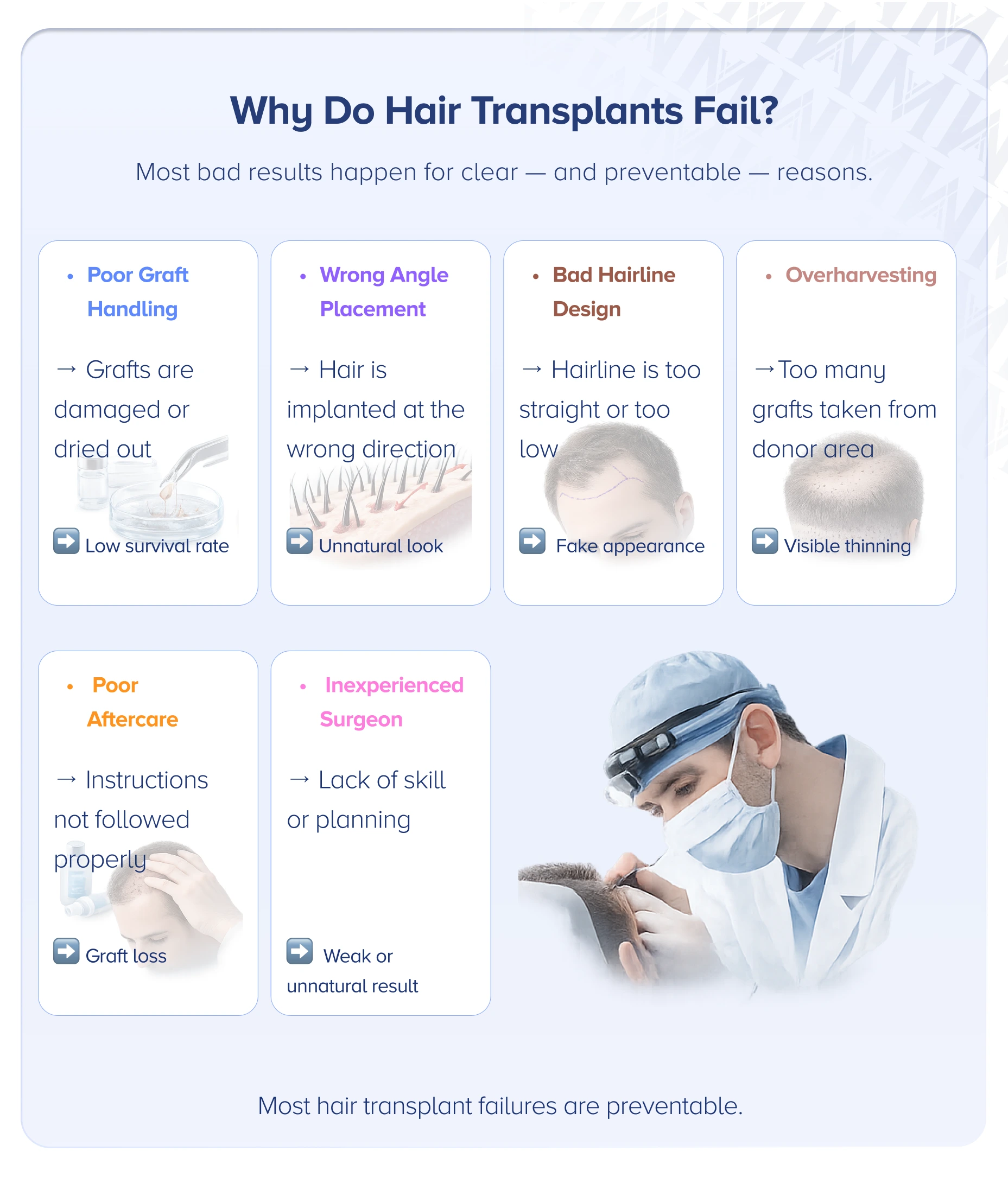
1. Inexperienced or Unqualified Surgeon
This is among the most frequently cited factors behind a bad hair transplant. In many high-volume clinics, the actual surgery is performed by technicians with limited training — not by a board-certified surgeon. These so-called ghost surgeons (unlicensed practitioners operating in place of the advertised doctor) lack the skill to handle the nuanced decisions that arise mid-surgery: where to place grafts, how deep to implant, how to design a natural hairline.
The result? Poor graft placement, low survival rates, and unnatural outcomes.
2. Poor Graft Handling and Storage
Think of each graft like a small plant being transplanted to new soil. If it's left out of the ground too long or handled roughly, it won't take root. Grafts are living tissue. When they're kept outside the body for extended periods, stored at incorrect temperatures, or allowed to dehydrate during the procedure, their survival rate plummets.
Mechanical damage during extraction or implantation — crushing, bending, or drying out the follicles — is another common culprit, particularly in rushed, high-volume settings.
3. Wrong Technique for the Patient's Hair Type
Not every technique suits every patient. FUE, DHI (Direct Hair Implantation), and Sapphire FUE (a variation using sapphire-tipped blades to create recipient channels) each have strengths and limitations. A patient with Afro-textured hair, for example, requires a different extraction approach than someone with straight, fine hair. Curly follicles sit at sharper angles beneath the skin, demanding specialized tools and experience.
When a clinic applies a one-size-fits-all approach — using the same technique regardless of hair type, scalp laxity, or loss pattern — the results suffer.
4. Overharvesting the Donor Area
Your donor area (typically the back and sides of the head) has a finite supply of hair follicles — much like a savings account. Overharvesting is like withdrawing too much too fast. Eventually, there's nothing left.
Some clinics promise extremely high graft counts to attract patients, then extract far more than the donor area can safely yield. This leads to visible thinning, scarring, and a "moth-eaten" appearance in the donor zone. Worse, it limits options for future procedures — including repair work.
The "more grafts equals better results" myth is one of the most damaging misconceptions in this industry.
But what about cases where the grafts survived — yet the result still looks wrong?
5. Unnatural Hairline Design
Hairline design is where medicine meets art. A well-designed hairline looks effortless — slightly irregular, age-appropriate, and proportional to the face. A poorly designed one is immediately noticeable: too low, too straight, too symmetrical, or placed without considering future hair loss progression.
A patient we'll call Ahmed came to a repair clinic after a procedure at a high-volume clinic in Istanbul. He'd been promised 4,500 grafts and a youthful hairline. What he received was a ruler-straight line across his forehead that looked artificial from every angle.
His existing hair continued to thin behind the transplanted zone, creating an obvious "island" of transplanted hair disconnected from the rest. His case required a full hairline redesign and strategic density work to create a natural transition.
6. Implanting Grafts at Wrong Angle or Depth
Natural hair doesn't grow straight up from the scalp. It emerges at specific angles that vary across different zones of the head. When grafts are implanted too shallowly, they produce a raised, bumpy texture known as cobblestoning after hair transplant. When implanted at the wrong angle, hair grows in unnatural directions — sticking out rather than lying flat.
This type of error requires meticulous manual skill to correct and is a hallmark of technician-led procedures where speed takes priority over precision.
7. Post-Operative Neglect or Poor Aftercare Instructions
Graft survival doesn't end when you leave the operating room. The first two weeks after surgery are critical. If a clinic provides vague or contradictory aftercare instructions, patients may unknowingly damage their grafts — through improper washing, premature sun exposure, or accidental physical trauma to the scalp.
In our clinical experience, many patients who seek repair received minimal aftercare guidance from their original clinic — and no follow-up protocol at all.
8. Underlying Medical Conditions
Sometimes the issue isn't the surgery — it's an undiagnosed condition working against the grafts. Alopecia areata (an autoimmune condition causing patchy hair loss), scarring alopecia (a group of conditions that destroy follicles and replace them with scar tissue), hormonal imbalances, or poor scalp blood supply can all undermine graft survival.
Certain medications and lifestyle factors — including smoking, which restricts blood flow — also affect outcomes. A thorough pre-operative assessment should screen for these factors. When it doesn't, the transplant is set up to fail before it begins.
Now that you understand what can go wrong, the next step is recognizing whether it's happened to you.

Signs Your Hair Transplant Has Failed
So how do you know if your transplant has truly failed?
Before reviewing the checklist below, take time to examine your scalp carefully. Use good, natural lighting and a handheld mirror to see the crown and donor area. Take photos from consistent angles — front, sides, top, and back — for comparison against your pre-operative images. This documentation will also prove invaluable if you decide to seek a professional evaluation.
The following checklist covers the most common hair transplant failure signs. Review it honestly — but remember, this is a starting point, not a diagnosis. Only a qualified surgeon can provide a definitive assessment.
Visual Signs
Look for the following when evaluating your results after 12 or more months:
No visible growth in transplanted areas — the clearest sign of hair transplant no growth
Patchy, uneven density with obvious gaps between grafts
"Pluggy" or doll-like appearance — clusters of hair that look inserted in bunches rather than as individual follicles
Cobblestone texture — small, raised bumps across the transplanted zone
Unnatural hairline — too low, too straight, asymmetrical, or disconnected from surrounding hair
Visible scarring in the donor area — thinning, white dots, or a strip scar wider than expected
Physical Signs
Beyond what you can see, pay attention to what you feel:
Persistent numbness or pain beyond the normal 3–6 month healing window
Ongoing inflammation or redness that doesn't resolve
Skin texture changes — pitting, ridging, or areas that feel hard or raised to the touch
Tightness or pulling sensation in the scalp that persists after full healing
Reduced or altered sensation in the transplanted or donor area
Self-Assessment Note: If you're experiencing two or more of these signs, consider scheduling a consultation with a board-certified hair transplant surgeon who specializes in repair procedures. This checklist is a preliminary guide — a professional evaluation will give you a clear, accurate picture of your situation.
Not sure if your transplant has failed? Send your photos to the Medart Hair team for a free, confidential preliminary assessment. There's no obligation — just honest feedback Contact us here .
The Turkey Factor — Why Some Hair Transplants in Turkey Go Wrong
If you recognized your experience in the signs above, you may already suspect where things went wrong. Let's address something directly: if your original procedure was performed in Turkey, you may be wondering whether the country itself was the problem.
It wasn't. But the industry's structure in Turkey creates specific risks that deserve a candid look.
The Hair Mill Problem
Turkey's popularity as a hair transplant destination has created a booming market — and with it, a wave of hair mills and ghost clinics in Turkey that prioritize volume over quality.
These clinics operate on an assembly-line model:
Multiple patients processed per day — sometimes five or more in a single operating room
Technicians with limited training performing the extraction and implantation
The advertised surgeon present for only a few minutes, if at all
Prices kept artificially low, with corners cut on equipment, graft handling, and aftercare
The result is a high rate of suboptimal outcomes, particularly among clinics competing on price alone.
Ghost Surgeons and Bait-and-Switch Tactics
One of the most troubling patterns involves ghost surgeons — practitioners who aren't the doctor you were promised. You research a clinic, review a specific surgeon's credentials and results, and book your procedure. But on the day of surgery, a different person — sometimes an unlicensed technician — performs the operation.
This bait-and-switch tactic is more common than many patients realize. It's a primary driver of unnatural hair transplant results and poor graft survival.
Regulatory Gaps and How to Navigate Them
The Turkish Ministry of Health requires hair transplants to be performed in licensed medical facilities under physician supervision. However, enforcement varies significantly, and the gap between regulation and practice can be wide — particularly in clinics operating outside hospital settings.
To protect yourself, take these concrete steps:
Verify that any clinic you're considering operates within a licensed hospital or medical center
Confirm the surgeon's credentials through Turkey's Central Physician Registration System (accessible via the Ministry of Health's online portal)
Request written confirmation of who will perform your surgery, including the surgeon's full name and license number
Why Turkey Is Still a Top Destination — When Done Right
Here's what matters: Turkey is home to some of the world's most experienced hair transplant surgeons. The country's high procedure volume has created a deep, exceptional talent pool. The problem isn't Turkey — it's the unregulated clinics that exploit Turkey's reputation.
Choosing the right clinic in Turkey can deliver outstanding results at a fraction of what you'd pay in Western Europe or North America. And for patients seeking hair transplant repair in Turkey, the country offers some of the most experienced corrective specialists anywhere.
The key is knowing how to choose wisely — something we'll cover shortly. But first, the question you're most likely asking right now.

Can a Failed Hair Transplant Be Fixed?
Whether your original procedure was in Turkey or elsewhere, the core question remains: can a failed hair transplant actually be corrected?
If you've confirmed that your transplant didn't deliver the results you expected, here's the honest answer.
The Good News — Most Cases Can Be Improved
In the majority of cases, it is possible to fix a failed hair transplant — though the approach depends entirely on the type and severity of the problem. Some cases can be brought close to the result the patient originally hoped for. Others — particularly those involving severe donor area depletion — have real limitations.
The key variables are:
How much usable donor hair remains
The extent and type of damage from the first procedure
Your overall health and hair characteristics
The skill and experience of the repair surgeon
Repair surgery demands a different skillset than first-time transplants. It requires more precise artistic judgment, a deeper understanding of scar tissue behavior, and the ability to work with compromised anatomy. This is why choosing a surgeon with specific repair experience is critical.
Types of Hair Transplant Repair Procedures
Hair transplant correction isn't a single procedure — it's a category that includes several distinct approaches, often used in combination:
Corrective transplant: Adding new grafts to fill gaps, increase density, and address areas where the original grafts didn't survive. This is the most common repair approach.
Hairline redesign: Correcting an unnatural hairline by adding grafts to soften edges, adjust shape, or create a more age-appropriate position.
Scar revision: Camouflaging or reducing hair transplant scarring in the donor area using techniques like transplanting FUE grafts into scar tissue or SMP (Scalp Micropigmentation — a tattooing technique that replicates the appearance of hair follicles).
Density enhancement: Implanting additional grafts between existing transplanted hairs to create a fuller, more natural appearance. This requires exceptional precision to avoid damaging surviving grafts.
Removal and re-implantation: In severe cases — such as a pluggy hair transplant with large grafts placed in visible clusters — individual grafts may need to be extracted, separated, and re-implanted at correct angles.
The following table can help you gauge where your case might fall:
Severity |
Typical Issues |
Likely Repair Approach |
Expected Sessions |
|---|---|---|---|
Mild |
Minor density gaps, slightly uneven growth |
Density enhancement, minor graft addition |
1 session |
Moderate |
Unnatural hairline, patchy coverage, visible scarring |
Hairline redesign, corrective transplant, scar revision |
1–2 sessions |
Severe |
Minimal growth, pluggy appearance, depleted donor area |
Multi-technique correction, possible BHT supplementation |
2–3 sessions |
A patient we'll call Maria sought repair after a procedure that left her with sparse, uneven growth and a hairline that sat unnaturally high on one side. Assessment revealed that roughly 40 percent of her grafts had survived, but they were unevenly distributed. Her donor area, fortunately, was largely intact.
The repair plan combined density enhancement across the transplanted zone with a partial hairline correction on the asymmetric side. Fourteen months later, she saw significant improvement — not perfection, but a natural, balanced appearance she felt genuinely confident about.
What Makes Repair Surgery More Complex Than a First Transplant
Hair transplant revision is inherently more challenging than a first procedure. Here's why:
Scar tissue in the recipient area from the first surgery can reduce blood supply and affect graft survival
Limited donor supply — especially if the first clinic overharvested — restricts how many hair transplants you can have and how many grafts are available for correction
Greater artistic precision is needed to work around existing grafts, scars, and uneven growth patterns
Some repairs require multiple sessions, spaced 12 or more months apart, to achieve the desired outcome
The consultation and planning phase is longer and more detailed than for a first-time procedure
None of this means repair is impossible. It means you need a surgeon who has done it before — many times.
💡 Want to see what's possible? Browse real repair case results from our clinic at our before and after gallery.
What to Expect During a Hair Transplant Repair Procedure
You've seen what repair can achieve. So what does the process actually look like?
If the idea of another surgery feels daunting, that's completely understandable. Knowing what the repair journey involves — step by step — can help ease that anxiety and set realistic expectations.
Step 1 — Comprehensive Assessment
Every repair case begins with a thorough evaluation:
Scalp analysis: Examining the transplanted area, assessing graft survival, identifying scar tissue, and evaluating skin quality
Donor area evaluation: Determining how much usable donor hair remains and whether the donor zone can support another extraction
Discussion of realistic goals: An honest conversation about what can and cannot be achieved, based on your specific anatomy and the extent of the original damage
For international patients, this assessment can begin remotely through detailed photos and video consultation — though an in-person evaluation is typically needed before finalizing a surgical plan.
💡 Tip: Before your consultation, gather your original surgical plan, pre-operative photos, and any post-operative records from your first clinic. This documentation helps your repair surgeon assess your case far more accurately.
Step 2 — Custom Repair Plan
Based on the assessment, your surgeon creates a tailored repair strategy addressing:
The specific type of failure (aesthetic, density, scarring, or a combination)
The technique or combination of techniques best suited to your case — FUE repair, DHI, Sapphire FUE, or a hybrid approach
Whether the repair can be completed in a single session or requires staged procedures
A realistic timeline for results
Step 3 — The Repair Procedure
On surgery day, the process resembles a first-time transplant — but with greater precision required at every step. The procedure is performed under local anesthesia, typically lasting four to eight hours depending on complexity.
You'll be awake but comfortable throughout. Most patients describe the experience as similar to their first transplant, though the surgeon works more slowly and deliberately in areas with scar tissue — placing each follicle at precise angles and depths to blend seamlessly with your natural growth pattern. Hair transplant repair surgery demands patience and meticulous technique above all.
Step 4 — Recovery and Aftercare
Post-operative care for repair patients is often more detailed than for first-time procedures. The scalp has already been through one surgery, and the tissue may respond differently.
You'll receive a comprehensive aftercare protocol covering washing, prescribed medication, activity restrictions, and sun protection. Follow-up appointments — including remote check-ins for international patients — are scheduled at regular intervals throughout the first year.
The expected growth timeline for repair grafts mirrors the original: shedding in weeks two through four, the resting phase through month four, early growth from months six through nine, and full results by months 12 to 18.
How do you make sure this second experience goes better than the first? That starts with choosing the right clinic.
How to Choose the Right Clinic for Hair Transplant Repair
You've already been let down once. Choosing a clinic for your correction is understandably fraught with anxiety. Here's how to protect yourself and make a truly informed decision this time.
Look for Repair-Specific Experience
Not every hair transplant clinic is equipped to handle repair cases. Ask directly: how many corrective procedures does this clinic perform each year? Request before-and-after photos specifically from repair patients — not first-time transplants. A clinic that primarily does first-time procedures may lack the specialized skill that correction demands.
Verify the Surgeon's Credentials
Confirm that the surgeon is board-certified and has specific experience with hair transplant revision cases. Check their credentials through official medical registries. Ask how many years they've been performing repairs and whether they'll personally handle the critical stages of your surgery.
At Medart Hair, our medical team includes Dr. Fatih Koroğlu, who has extensive experience in corrective hair transplant procedures. We offer comprehensive consultations — including remote assessments for international patients — to evaluate your case before you commit to anything.
Assess the Consultation Process
A thorough, unhurried consultation is one of the strongest green flags. The surgeon should examine your scalp (in person or through detailed imaging), review your surgical history, and discuss realistic outcomes — including limitations.
Be cautious of any clinic that promises specific results without examining your scalp, or that immediately quotes a high graft count before assessing your donor area. These are red flags.
Check Reviews and Patient Testimonials
Look for reviews that specifically mention repair or corrective procedures. Independent review platforms carry more weight than testimonials curated on a clinic's own website. Pay attention to how the clinic responds to negative reviews — defensiveness is a red flag; transparency is a green one.
Aftercare and Follow-Up Protocol
For international patients especially, aftercare capability is essential. Ask whether the clinic offers remote follow-up consultations, how long the aftercare protocol lasts, and what happens if complications arise after you've returned home.
A clinic that considers its responsibility ended when you leave the operating room is not the right choice for repair work.
And if you're preparing for a first-time procedure — or want to ensure your repair goes smoothly — there are steps you can take to protect yourself from the start.
How to Prevent a Failed Hair Transplant
Choosing the right clinic is half the equation. The other half? Going in prepared. Whether you're planning a repair procedure or researching your first transplant, these steps can significantly reduce your risk.
Research Thoroughly Before Booking
Price should never be your primary selection criterion. A failed cheap procedure costs more — financially and emotionally — than a properly performed one at a higher price point. The problem isn't that you wanted affordable care. It's that some clinics exploit that desire.
Verify credentials. Read independent reviews. Ask for case studies relevant to your hair type and loss pattern.
Ask the Right Questions During Consultation
Walk into every consultation with these questions to ask your hair transplant clinic:
"Who will actually perform my surgery — and will they be present for the entire procedure?"
"How many procedures does this clinic perform per day?"
"What is your approach if the transplant doesn't meet expectations?"
"What aftercare and follow-up do you provide for international patients?"
The answers — and how willingly they're given — tell you everything you need to know about a clinic's integrity.
Understand Your Own Hair Loss Pattern
A responsible surgeon will assess your hair loss stage using the Norwood Scale (a classification system that grades male pattern hair loss from Stage 1 to Stage 7) before recommending a procedure. If your hair loss isn't yet stabilized, a transplant may be premature.
Medication such as finasteride or minoxidil — as prescribed by your doctor — can help stabilize ongoing loss and protect your investment in transplanted hair.
Document Your Case Thoroughly
Whether you're preparing for a first procedure or considering repair, thorough documentation protects you:
Take consistent, well-lit photos of your scalp from multiple angles — front, sides, top, and donor area — every three months
Keep a written timeline of your healing process, noting any changes or concerns
If you've already had a procedure, request your medical records from your original clinic — you're entitled to them, and they provide your repair surgeon with critical information about graft count, technique used, and any complications noted during surgery
Follow Post-Operative Instructions Meticulously
Aftercare compliance is one of the most controllable factors in graft survival. Follow your clinic's washing protocol exactly. Avoid sun exposure during the critical healing window. Don't skip follow-up appointments. Your grafts are at their most vulnerable in the first two weeks — treat them accordingly.
Frequently Asked Questions About Failed Hair Transplants
Estimates from the ISHRS suggest that 5 to 15 percent of hair transplants produce suboptimal results. The wide range reflects differences in how "failure" is defined and the enormous variation in clinic quality. At high-volume, unregulated clinics, failure rates are likely higher. At reputable, surgeon-led clinics with proper technique and aftercare, failure is uncommon. Large-scale studies on this topic remain limited, so most figures are based on professional estimates and clinical experience.
This depends on the clinic's policy and local consumer protection laws. Most reputable clinics offer revision procedures rather than monetary refunds. Before booking any procedure, read the contract carefully — look for clauses about unsatisfactory outcomes, revision policies, and dispute resolution. If your original clinic is unresponsive, a repair specialist at a different clinic may be your best path forward.
You should wait a minimum of 12 months after the original procedure before undergoing repair surgery. Your scalp needs time to fully heal, scar tissue needs to mature, and the final results of the first transplant need to become visible. Rushing into a correction too early can compromise the outcome. Some repair specialists recommend waiting up to 18 months for complex cases involving significant scarring or donor area recovery.
Repair procedures can be comparable in cost to a first-time transplant, and in some cases slightly higher due to added complexity. The cost depends on the extent of correction needed, the number of grafts required, whether multiple sessions are necessary, and the techniques involved. A repair specialist can provide a personalized estimate based on your specific case after a thorough assessment.
BHT (Body Hair Transplant) — harvesting follicles from the chest, beard, or other body areas — is sometimes used as a supplementary source when the scalp donor area is depleted. However, body hair has different growth characteristics: it is often finer, curlier, and has a shorter growth cycle than scalp hair. BHT can be effective for adding density in certain areas, but it has meaningful limitations. A thorough assessment by a board-certified surgeon is essential to determine whether it is suitable for your case.
When performed by an experienced repair specialist, corrective procedures have a high rate of meaningful improvement. Most patients see significant enhancement in density, hairline appearance, or both. However, success in repair work means realistic improvement — not necessarily perfection. Outcomes depend on available donor supply, the extent of scarring, and the type of original failure. Setting honest expectations during the consultation phase is essential for long-term satisfaction.
Shock loss is temporary and typically begins two to four weeks after surgery. It usually resolves within three to six months as the hair follicles re-enter their growth cycle. A failed transplant, by contrast, shows no meaningful improvement after 12 or more months. If you are in the first six months after surgery and experiencing shedding, it is almost certainly shock loss rather than failure. If no new growth appears by month eight or nine, consulting a specialist is recommended.
A Failed Hair Transplant Is Not the End of Your Story
A hair transplant that didn't deliver what you were promised is a painful experience. The frustration is real. The disappointment is valid.
But it's not where your story has to end.
You've already taken the hardest step — acknowledging the problem and seeking answers. That takes courage. And it puts you in a far stronger position than before, because now you know what to look for, what questions to ask, and what standards to demand.
With the right diagnosis, an experienced repair specialist, and a realistic plan, most failed hair transplants can be significantly improved — and many can be brought close to the result you originally hoped for. The critical factor? Choosing the right clinic the second time is even more important than the first.
If you're dealing with a hair transplant that didn't meet your expectations, the Medart Hair team is here to help. Contact us for a confidential, no-obligation consultation to assess your case, understand your options, and decide — on your terms — what comes next.
You deserve results you can feel confident about.
