
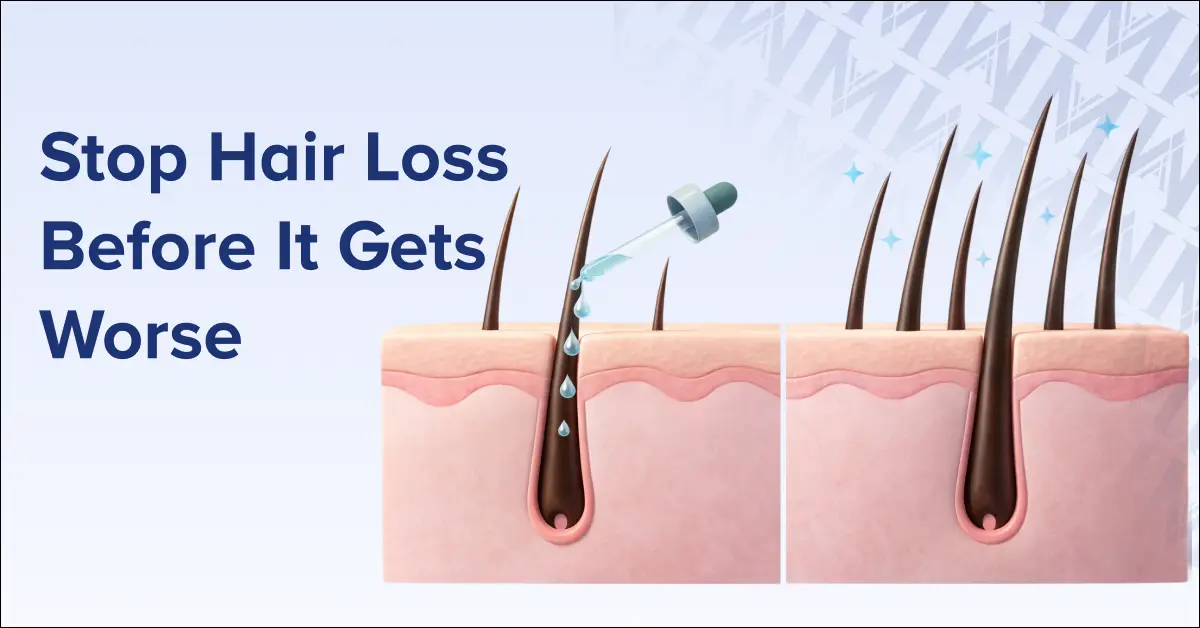

Understanding Hair Loss — Why Medication Matters
Hair loss follows a biological script. Understanding that script reveals exactly why these medications work, when they work best, and when they can't help.
The Science of Androgenetic Alopecia
Androgenetic alopecia — commonly called male pattern baldness or female pattern hair loss — is the most prevalent form of hair loss worldwide. It affects approximately 50% of men over the age of 50 and up to 40% of women by the same age (Gan & Sinclair, Journal of Investigative Dermatology Symposium Proceedings, 2005). The driving force behind it is a hormone called dihydrotestosterone (DHT), a byproduct of testosterone.
Here's how the process unfolds. An enzyme called 5-alpha-reductase converts testosterone into DHT. In people genetically predisposed to hair loss, DHT binds to androgen receptors in certain hair follicles and triggers miniaturization — the gradual shrinking of follicles over successive growth cycles. Each cycle produces thinner, shorter, lighter hair until the follicle stops producing visible hair altogether.
This pattern is classified using the Norwood-Hamilton scale for men, which ranges from Stage 1 (no significant loss) to Stage 7 (extensive loss). Women's hair loss follows a different distribution, classified by the Ludwig scale, which measures progressive thinning across the crown. Understanding your stage helps determine which treatments are most appropriate.

Why Early Treatment Changes Everything
Here's the critical insight: finasteride and minoxidil work best on follicles that are miniaturizing, not on follicles that have already died. Think of a miniaturizing follicle like a dimming lightbulb — medication can restore brightness, but once the filament burns out, only a replacement can fix it. In biological terms, medication can reverse the shrinking process while follicles remain active, but it cannot resurrect follicles that have permanently shut down.
This creates a window of opportunity. The earlier you intervene, the more follicles remain viable for treatment. Patients who start medication at the first signs of thinning consistently achieve better outcomes than those who wait years.
That doesn't mean medication is useless for advanced hair loss — it still plays a vital role in preserving remaining hair. But its capacity to reverse loss diminishes as more follicles reach the point of no return. That's precisely where hair transplant surgery enters the picture.
How Effective Is Finasteride?
The clinical evidence is robust, drawn from large-scale, long-term studies:
83% of men maintained or increased their hair count after 2 years of use (Kaufman et al., Journal of the American Academy of Dermatology, 1998)
66% of men showed visible hair regrowth after 2 years in the same study
Five-year follow-up data demonstrated sustained effectiveness, with continued improvement or maintenance in the majority of participants (Kaufman et al., European Journal of Dermatology, 2002)
Finasteride tends to be most effective on the vertex (crown) of the scalp, with moderate effectiveness on the mid-scalp. Results along the frontal hairline are less pronounced, though some patients do see improvement there.
Here's what this means in practical terms: finasteride is better at stopping further hair loss than regrowing what's already gone. If your primary goal is to hold the line and preserve what you have — with the possibility of some regrowth — finasteride is highly effective. If you're expecting full restoration in areas that are already significantly thinned, medication alone may not be sufficient.
How long does finasteride take to work? Expect an initial shedding phase at 1–3 months (alarming but normal), visible improvement at 3–6 months, and full results at 12–24 months. Most patients need a minimum of six months before judging results, with the complete picture emerging closer to one to two years.

Finasteride Dosage and How to Take It
The standard finasteride dosage for hair loss is 1mg taken once daily. It can be taken with or without food, at any time of day — though taking it at the same time each day builds consistency.
Consistency matters enormously. Missing doses reduces the medication's ability to suppress DHT effectively. Many patients who report that finasteride "didn't work" were taking it inconsistently.
Long-term safety data spanning over five years shows no significant increase in adverse events compared to shorter-term use. Finasteride is generally considered safe for ongoing use under medical supervision, with regular check-ups recommended.
Some patients ask about splitting 5mg Proscar tablets into quarters as a cost-saving measure. While common, this is technically an off-label use — the 5mg tablet is approved for prostate treatment, not hair loss, and split doses may be slightly uneven. This is an off-label use. Discuss with your doctor before considering this approach.
Minoxidil for Hair Loss — Everything You Need to Know
While finasteride works from the inside by reducing DHT, minoxidil stimulates growth directly at the scalp through an entirely separate mechanism. Each has distinct strengths, limitations, and practical considerations worth understanding on its own.
What Is Minoxidil (Rogaine)?
Minoxidil shares a similar origin story with finasteride. Originally developed as an oral blood pressure medication called Loniten, patients taking it noticed significant hair growth as a side effect — prompting development of a topical formulation.
The FDA approved the 2% topical solution in 1988, the 5% solution for men in 1991, and the 5% foam for women in 2014. Unlike finasteride, minoxidil is available over-the-counter — no prescription required. It's sold under the brand name Rogaine and as numerous generic alternatives containing the same active ingredient at the same concentration.
How Minoxidil Works
The exact mechanism by which minoxidil stimulates hair growth is not fully understood — though its effects are well-documented. Research suggests it works through several interconnected pathways. It promotes vasodilation (widening of blood vessels) around hair follicles, increasing nutrient and oxygen delivery. Evidence also suggests it opens potassium channels, stimulating cellular activity in the follicle. Most importantly, it appears to extend the anagen (growth) phase of the hair cycle, allowing hairs to grow longer and thicker while stimulating resting follicles to re-enter active growth.
A critical distinction: minoxidil does not affect DHT levels. It doesn't address the underlying hormonal cause of androgenetic alopecia. Instead, it works locally to invigorate follicle activity — a completely different and complementary mechanism to finasteride.
One common misconception deserves correction: minoxidil does not create new hair follicles. It revitalizes miniaturizing ones and extends their productive lifespan. You cannot grow hair where no follicles exist.
How Effective Is Minoxidil?
Does minoxidil work? For many patients, yes — though results vary more widely than with finasteride:
● Approximately 40% of men experience moderate to dense regrowth with the 5% solution (Olsen et al., Journal of the American Academy of Dermatology, 2002)
● The 5% formulation is approximately 45% more effective than the 2% in men (Olsen et al., 2002)
● Women show good response to both 2% and 5% formulations
Like finasteride, minoxidil works best on the vertex and crown area. It is less effective on the frontal hairline and temples — important to know when setting expectations. Minoxidil before and after comparisons in clinical photography typically show the most striking improvement on the crown, with measurable density increases after 6–12 months of consistent use.
An initial shedding phase at 2–8 weeks is common and actually indicates the medication is working — it's pushing resting hairs out to make room for new growth. This is not worsening hair loss. Visible improvement typically appears at 3–4 months, with full results at 6–12 months.
Key Takeaway: Not everyone responds to minoxidil. Some patients are non-responders, and there's currently no reliable way to predict who will respond before trying it. A minimum 6-month trial is recommended before evaluating effectiveness.
Minoxidil Forms — Liquid vs. Foam vs. Oral
Choosing between minoxidil formulations is a common decision point. Here's how the minoxidil foam vs. liquid comparison breaks down:
● Liquid (topical solution): The original formulation. More affordable, applied with a dropper. Contains propylene glycol, which can cause scalp irritation, itching, or flaking in some users. Requires time to dry before sleeping.
● Foam: Propylene glycol-free. Dries faster, causes less irritation, and is generally easier to apply. Slightly more expensive. For most men, foam is the preferred choice due to ease of use and fewer irritation issues.
● Oral minoxidil (low-dose): A growing trend in hair loss treatment, prescribed off-label at doses of 1.25–5mg daily. Because it works systemically, it can cause increased body hair growth, fluid retention, and cardiovascular effects. This is an off-label use. Discuss with your doctor before considering this approach. It must be prescribed and monitored by a physician.
How to Apply Minoxidil Correctly
Proper application directly affects results. Many patients unknowingly reduce minoxidil's effectiveness through incorrect technique. Apply twice daily — morning and evening — following these steps:

1. Ensure your scalp is clean and completely dry. Applying to wet hair dilutes the solution and reduces absorption.
2. Measure the correct dose — 1ml of solution or half a capful of foam per application.
3. Apply directly to the thinning areas of your scalp, not to the hair itself. Part your hair to expose the scalp and use your fingertips to spread the medication evenly.
4. Leave it undisturbed for at least 4 hours before washing your hair, swimming, or going to bed. This allows adequate absorption.
5. Wash your hands thoroughly immediately after application to prevent unwanted hair growth on your fingers or other areas you touch.
Common mistakes that undermine results: applying to damp hair, using too little product, not allowing sufficient absorption time, and — most critically — inconsistent use.
Minoxidil Side Effects
Minoxidil is generally well tolerated. The most commonly reported side effects include:
● Scalp irritation, dryness, and flaking — more common with the liquid formulation due to propylene glycol
● Initial shedding — temporary, typically resolving within 2–4 weeks; this signals the medication is transitioning follicles into a new growth cycle, not worsening hair loss
● Unwanted facial or body hair growth — particularly relevant for women; careful application helps minimize this
● Rare systemic effects: dizziness, rapid heartbeat, or swelling — more common with the oral formulation
For the vast majority of users, side effects are mild and manageable. If you experience chest pain, rapid heartbeat, sudden unexplained weight gain, or swelling of the hands or feet, stop using minoxidil and contact your doctor immediately.
What Happens If You Stop Using Minoxidil?
The answer mirrors finasteride: hair gained through minoxidil will be lost within 3–6 months of discontinuation. The follicles that were being stimulated return to their previous miniaturizing state.
Many patients find this discouraging. It's essential to understand this reality before starting. If you want to maintain results from medication alone, minoxidil is a lifelong commitment. This is one reason some patients ultimately combine medication with a hair transplant — the transplanted hair is permanent, while medication preserves the native hair surrounding it.
Both medications tackle the same problem through fundamentally different pathways — which raises the obvious next question: how do they compare, and do you need both?
Finasteride vs. Minoxidil — A Direct Comparison
They both treat hair loss. They do so in fundamentally different ways. Understanding these differences is essential for choosing the right approach — or recognizing why many specialists recommend both.

Head-to-Head Comparison Table
Finasteride vs. Minoxidil: A Complete Comparison
Feature |
Finasteride |
Minoxidil |
|---|---|---|
Mechanism of action |
Blocks DHT by inhibiting 5-alpha-reductase |
Stimulates follicles via vasodilation and growth phase extension |
FDA approval status |
Approved for male pattern hair loss (1997) |
Approved for male and female pattern hair loss (1988/1991/2014) |
Prescription required? |
Yes |
No (topical); Yes (oral) |
Effectiveness rate |
83% maintain or increase hair count at 2 years |
~40% achieve moderate to dense regrowth (5% solution) |
Best scalp area |
Vertex (crown) and mid-scalp |
Vertex (crown) |
Administration method |
Oral tablet, once daily |
Topical liquid or foam, twice daily (or oral, off-label) |
Time to see results |
3–6 months; full results at 12–24 months |
3–4 months; full results at 6–12 months |
Major side effects |
Sexual side effects in 2–4% of users; rare mood changes |
Scalp irritation; initial shedding; unwanted body hair |
Approximate monthly cost |
$10–$30 (generic) |
$15–$45 (topical, varies by form) |
Suitable for women? |
No — Pregnancy Category X; not FDA-approved for women |
Yes — FDA-approved for women (2% and 5%) |
Which One Should You Choose?
The choice depends on your individual circumstances:
● Finasteride is generally stronger at stopping progression because it addresses the root hormonal cause. If preventing further loss is your primary concern, finasteride is typically the more powerful option.
● Minoxidil is generally better at stimulating visible regrowth in the crown area. If improving density in a thinning zone matters most, minoxidil may deliver more noticeable cosmetic improvement.
● Gender matters. Women cannot use finasteride unless specifically prescribed off-label by a specialist for post-menopausal patients, which is uncommon. This is an off-label use. Discuss with your doctor before considering this approach. Minoxidil remains the primary pharmaceutical option for female pattern hair loss.
● Side effect tolerance varies. Some men prefer to avoid the systemic effects of finasteride and opt for topical minoxidil only. Others prefer the simplicity of a daily pill over twice-daily scalp applications.

The reality is that many doctors don't recommend choosing between them at all. They recommend both.
Not sure which approach fits your situation? Every hair loss pattern is different. A specialist consultation — including scalp analysis, Norwood staging, and a personalized treatment plan — can provide clarity based on your specific needs. Get a free assessment →
Using Finasteride and Minoxidil Together — The Combination Approach
Because finasteride and minoxidil target hair loss through entirely separate mechanisms, combining them creates a two-pronged strategy that outperforms either medication alone. Finasteride protects. Minoxidil promotes. Together, they address both sides of the equation.
Why Combining Them Is More Effective
The logic is straightforward. Finasteride reduces DHT, slowing or stopping the miniaturization that drives hair loss. Minoxidil stimulates growth activity at the follicle level, encouraging thicker, longer hair production. One defends. The other attacks.
Clinical evidence strongly supports this approach. A meta-analysis by Hu et al. (2015) found that combination therapy with finasteride and minoxidil together produced significantly greater increases in hair count than either medication alone. Patients using both showed improvements in hair density and thickness that exceeded what monotherapy could achieve.

Many patients who've tried one medication with partial results find that adding the second makes a meaningful difference. In clinical practice, we see this pattern regularly: a patient begins finasteride at the first signs of crown thinning and successfully halts further loss over 12 months, but wants more visible density. Adding minoxidil often provides the growth stimulation needed to transform "I stopped losing hair" into "I can see real improvement."
The combination is now widely regarded as the gold standard in pharmaceutical hair loss treatment for androgenetic alopecia.
How to Start a Combination Regimen
There are two common approaches, and your doctor can help determine which is more appropriate:
● Sequential start: Begin with one medication (typically finasteride) and use it alone for 3–6 months. This allows you to assess effectiveness and identify any side effects before adding the second. After the initial period, add minoxidil. This approach makes it easier to pinpoint which medication is responsible for results or side effects.
● Simultaneous start: Begin both at the same time. This may deliver results faster but makes isolating individual effects harder.
A typical combination regimen: finasteride 1mg orally once daily plus minoxidil 5% topically twice daily. Medical supervision is important — not because the medications interact negatively, but because your doctor should monitor progress and adjust the plan as needed.
Combination therapy represents the strongest pharmaceutical approach available. But for many patients, the question extends beyond medication. It's about whether surgery should be part of the plan.
Hair Loss Medication and Hair Transplants — How They Work Together
Medication and surgery aren't competing options. They're complementary tools in a comprehensive hair restoration strategy. Understanding how they work together helps you make the most informed decision about your treatment path.
Using Medication Before a Hair Transplant
Starting finasteride and minoxidil before a transplant offers several strategic advantages:
● Stabilizing hair loss helps your surgeon assess your true pattern, leading to a more accurate and future-proof transplant design
● Strengthening existing hair improves overall density, so transplanted hair blends more naturally with native hair
● Reducing the total number of grafts needed by preserving hair that might otherwise have been lost by surgery day
Most reputable clinics recommend starting medication 3–6 months before a planned transplant. This gives the medication time to take effect and provides a clearer picture of baseline density.
We see the impact of this approach consistently in our clinic. A patient at Norwood Stage 4 who begins finasteride and minoxidil six months before a scheduled procedure arrives with stabilized, thicker existing hair — giving the surgeon a stronger foundation and creating a more natural-looking final result.
Using Medication After a Hair Transplant
Here's a fact that surprises many patients: transplanted hair follicles are typically resistant to DHT because they're harvested from the donor area (usually the back and sides of the scalp), which is genetically programmed to resist miniaturization. Your existing native hair in other areas, however, remains vulnerable.
Without medication, you may achieve excellent density in the transplanted zone while continuing to lose native hair around it — eventually creating an unnatural-looking pattern.

Post-transplant medication serves several critical purposes:
● Protects remaining native hair from ongoing DHT-driven miniaturization
● Maintains overall density in non-transplanted areas
● Minoxidil specifically may accelerate the growth of newly transplanted grafts during the early recovery months
Most reputable clinics include medication as a standard part of their post-transplant medication protocol. It's not an optional add-on — it's a core component of achieving and maintaining the best possible outcome.
Want to understand how medication fits into a hair transplant plan? Learn about our medication use after a hair transplant for a detailed look at what to expect after surgery.
Can Medication Replace a Hair Transplant?
This depends entirely on the stage of your hair loss.
For early-stage hair loss (Norwood 1–3 on the Norwood-Hamilton scale), medication alone may be sufficient. If miniaturization is caught early and follicles are still viable, finasteride and minoxidil can slow progression and even restore some density without surgery.
For moderate-to-advanced hair loss (Norwood 4 and above), medication alone typically cannot restore the density that's been lost. Too many follicles have passed the point where pharmaceutical treatment can revive them. In these cases, a transplant is needed to restore hair in areas where follicles are no longer functional.
The ideal approach for most patients with progressive hair loss combines both: a transplant to restore density where it's been lost, and medication to preserve the hair that remains. Neither approach alone delivers what both can achieve together.