FUT vs FUE Hair Transplant: Key Differences (2026)

A clear comparison of FUT and FUE hair transplant techniques, explaining how each method works, their pros and cons, and key differences in scarring, recovery, and graft extraction. Learn which approach is best suited to your hair loss pattern, donor capacity, and desired results.
FUT vs FUE Hair transplant

Table of Contents

Why This Comparison Matters

Twenty years ago, virtually every hair transplant in the world was performed using the FUT strip method. Today, according to the International Society of Hair Restoration Surgery (ISHRS 2022 Practice Census), more than 90% of procedures globally use FUE.

That is not a gradual shift. It is a near-complete transformation of an entire surgical field — and the reasons behind it matter if you are about to make one of the most personal decisions of your life.

If you keep running into the acronyms FUT and FUE and want more than a vague summary, you are in the right place. This guide breaks down what each method involves, how they compare on every factor that matters — scarring, pain, recovery, cost, results — and why the global standard has moved so decisively in one direction. The fact that you are researching this thoroughly is exactly the right approach.

As a surgical team that performs thousands of FUE hair transplant procedures annually, we will walk you through both techniques with clinical honesty. FUT will get a fair hearing. We will also explain why FUE has earned its place as the preferred method for the vast majority of patients — men and women alike.

By the end, you will understand exactly how these two methods differ and which one fits your situation. You will also have a practical checklist of questions to bring to any surgeon consultation, so you can make this decision with genuine confidence.
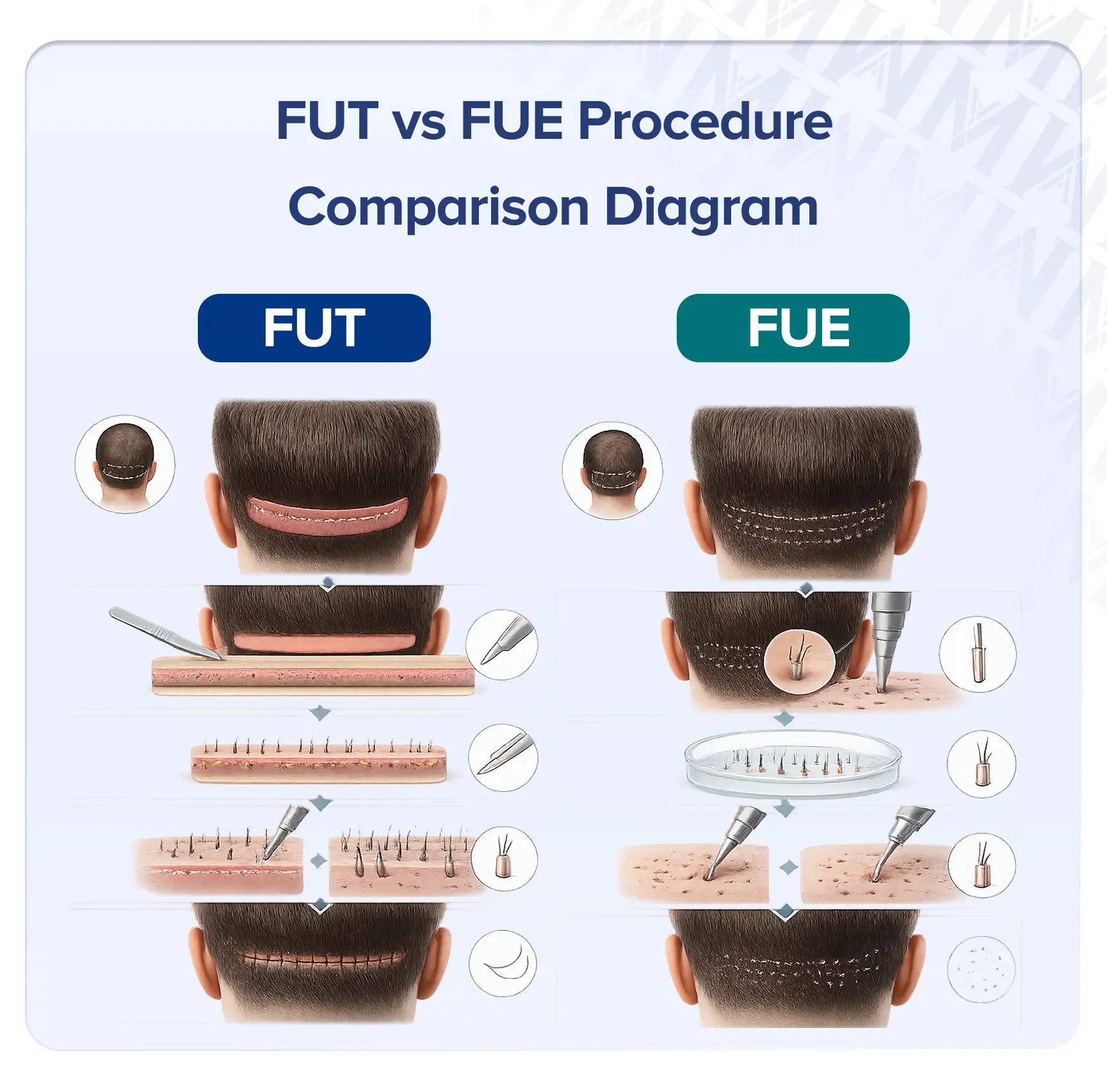
Side-by-side illustration showing how FUT strip removal and FUE individual extraction differ in approach.

What Is a FUT Hair Transplant?

Before comparing the two methods, it helps to understand each one on its own terms. The FUT hair transplant — formally called Follicular Unit Transplantation, and sometimes known as the strip method — was the technique that moved hair restoration from the era of obvious, unnatural "hair plugs" into something capable of producing genuinely natural results.

How the FUT Strip Method Works

The FUT procedure follows a straightforward sequence:

  • 1.  Strip removal. The surgeon uses a scalpel to remove a strip of skin from the donor area (the back and sides of the scalp, where hair follicles are genetically resistant to thinning). This strip is typically 15–25 cm long and 1–2 cm wide — roughly the length of a standard pencil and the width of your little finger.

  • 2.  Microscopic dissection. A team of technicians dissects the strip under high-powered microscopes, separating it into individual follicular units (natural groupings of 1–4 hair follicles).

  • 3.  Recipient site creation. The surgeon creates tiny channels in the recipient area (the thinning or balding zone), controlling angle and direction to mimic natural growth.

  • 4.  Implantation. Each follicular unit is carefully placed into its designated channel.

  • 5.  Wound closure. The donor area is closed with stitches or staples, which are typically removed after 10–14 days.

A single FUT session typically yields 2,000–4,000 grafts, depending on the surgeon's technique and the patient's donor characteristics. The procedure takes approximately 4–8 hours.

When FUT Was the Standard

Follicular unit transplantation dominated hair restoration from the 1990s through the mid-2000s. It represented a genuine leap forward — for the first time, surgeons could transplant hair in its natural groupings rather than large, conspicuous plugs. The results were dramatically more natural than anything that came before.

FUT hair transplant procedures are still offered in some Western clinics today, though the number of surgeons performing them continues to decline each year. The technique's historical significance is real, but it has been largely overtaken by a less invasive successor.

What Is FUE (Follicular Unit Extraction)?

Understanding the difference between the strip method and FUE begins with a fundamental shift in philosophy. Where FUT removes a single large section of tissue, FUE takes a one-by-one approach — harvesting individual follicular units directly from the scalp without any scalpel incision.

How the FUE Extraction Process Works

The FUE procedure follows these steps:

1. Individual extraction. The surgeon uses a micro-punch — a tiny circular extraction tool, typically 0.6–1.0 mm in diameter (smaller than the tip of a ballpoint pen) — to loosen and remove individual follicular units from the donor area.

2. Graft preparation. Extracted grafts are sorted, inspected, and kept in a specialized holding solution to maintain viability.

3. Channel creation. The surgeon creates precise recipient channels in the thinning area, controlling the angle, depth, and direction of each one.

4. Implantation. Grafts are placed into the channels one by one, following the natural growth pattern of the surrounding hair.

No scalpel incision. No strip of tissue removed. No stitches required. The tiny extraction points in the donor area heal on their own within 7–10 days, leaving dot scars that are virtually invisible — each one smaller than the head of a pin.

A single FUE session can yield 2,000–5,000+ grafts depending on the patient's donor density and the surgical team's experience, though sessions above 5,000 grafts are at the upper extreme and require careful donor management. Procedure duration is typically 6–8 hours for a full session.

The Evolution of FUE Technology

FUE has not stood still since its introduction. The technique has evolved through several generations:

  • ●  Manual FUE involved hand-held punches and demanded exceptional surgeon skill

  • ●  Motorized FUE introduced powered extraction tools that improved speed and consistency

  • ●  Sapphire FUE uses blades made from synthetic sapphire (a precision-cut material harder than steel) for channel opening, promoting faster healing and denser graft packing

  • ●  DHI (Direct Hair Implantation) is an FUE variant where grafts are loaded into a specialized pen-like tool called a Choi implanter and placed directly without pre-made channels

These advanced hair transplant techniques have been refined extensively in Turkey, where high patient volume has driven continuous innovation. Robotic-assisted FUE also exists, though many leading clinics still prefer skilled surgeons using motorized or manual tools, citing greater tactile control and adaptability during the procedure.

Quick Quote in 5 Minutes

Talk to an experienced patient coordinator for your hair transplant in Turkey.
Please enter a valid phone number.

FUT vs FUE — A Side-by-Side Comparison

Now that you understand how each procedure works, the real question is: how do they compare on the factors that actually shape your experience and results? This section breaks down every meaningful difference — not just what is different, but why it matters to you.

One important point first: neither FUT nor FUE creates new hair. Both methods redistribute existing healthy follicles from the donor area to thinning zones. The difference lies in how those follicles are harvested — and the consequences of each approach for your body, your recovery, and your future options.

Scarring — The Most Visible Difference

This is often the deciding factor, and for good reason.

FUT leaves a linear scar across the back of the head, stretching 15–25 cm in length. While some patients heal with a thin, faint line, others develop scars that widen to 5–10 mm or more over time. The final result depends on genetics, skin type, and surgical technique — and you cannot predict with certainty how your body will heal.

FUE leaves tiny, scattered dot scars across the donor area. Each one is less than 1 mm in diameter. Once healed, they are virtually undetectable — even with very short hairstyles.

What does this mean in daily life? If you want the freedom to wear your hair at a grade 2 buzz cut, go swimming without a second thought, or sit in a barber's chair without worrying about what is visible — the FUT scar becomes a serious consideration. Imagine choosing any hairstyle you want with no visible evidence of a procedure. That is the practical reality FUE offers most patients.

Pain and Comfort During the Procedure

Both methods are performed under local anesthesia, so you should not feel sharp pain during surgery itself. The difference emerges afterward.

FUT involves a surgical wound sutured closed under tension. Many patients report post-operative tightness, pulling sensations, and discomfort along the suture line. Numbness around the scar can persist for weeks or even months.

FUE involves no suture line and no wound closure. Most patients describe minimal discomfort in the days following the procedure — manageable with standard over-the-counter medication. Pain tolerance varies between individuals, but the majority of FUE patients report a notably more comfortable recovery.

Recovery Time and Downtime

When comparing FUT vs FUE recovery timelines, the gap is substantial.

FUT recovery requires 14–21 days for full donor area healing. Sutures or staples are removed after 10–14 days. Strenuous activity is typically restricted for 2–4 weeks, and the scar area may remain tender for months.

FUE recovery is considerably faster. Most patients return to light daily activities within 3–5 days. The donor area heals within 7–10 days. This shorter window is one reason FUE aligns so well with medical tourism — if you are traveling to Turkey for your procedure, you can realistically plan for 7–10 days before returning home.

Graft Survival and Results Quality

Here is something important: both methods can produce excellent, natural-looking results when performed by a skilled surgeon. The transplanted follicles come from the same donor zone and are equally permanent regardless of how they were harvested.

That said, FUE allows more precise selection of individual grafts — choosing the strongest, healthiest follicular units one by one. With FUT, dissection of the strip can sometimes damage follicles at the edges.

FUE carries its own risk. During punch extraction, some follicles can be transected — partially cut and rendered non-viable. Transection rates typically range from 3–8% in experienced hands, though they can climb higher with less skilled operators. This is why surgeon experience matters enormously.

Looking at FUT vs FUE results overall, the quality gap has narrowed considerably. Modern FUE graft survival rates (the percentage of transplanted follicles that successfully take root and grow) reach 90–95% when performed by an experienced surgical team, according to data published in peer-reviewed journals including the Journal of Cutaneous and Aesthetic Surgery.

Results Timeline — What to Expect After Either Method

Regardless of which technique you choose, the growth timeline follows the same biological pattern:

Weeks 2–6: Transplanted hairs shed (this is normal and expected — the follicles remain alive beneath the surface)

Months 2–4: A dormant phase where little visible change occurs; patience is essential during this period

Months 4–6: New growth begins to emerge, with fine hairs gradually thickening

Months 8–10: Significant visible improvement; most patients notice a meaningful difference

Months 12–18: Final results become apparent as hair reaches full length, thickness, and density

This timeline applies equally to FUT and FUE. The extraction method does not change how quickly your transplanted follicles grow.

Number of Grafts Per Session

A persistent misconception holds that FUT allows more grafts per session than FUE. This was true 15 years ago. It no longer reflects modern capabilities.

FUT typically yields 2,000–4,000 grafts per session

FUE can achieve 4,000–5,000+ grafts in a single mega-session, depending on donor density and surgical team experience

For patients with advanced hair loss — Norwood scale stages 5–7 (a classification system for male pattern hair loss, ranging from stage 1 to stage 7) or Ludwig scale stages for female pattern hair loss — FUE's higher per-session capacity is a meaningful advantage.

Donor Area Preservation

FUT permanently removes a strip of tissue from the donor area. Once that strip is gone, it cannot be used again. This limits your options if you need future procedures.

FUE distributes extraction across a wider zone, taking individual follicles rather than a concentrated strip. This preserves more of the hair transplant donor area for potential future sessions. In select cases, FUE can also harvest grafts from body hair — beard or chest — though body hair grafts typically have lower survival rates than scalp hair and are considered supplementary rather than a primary donor source.

Cost Comparison

Cost is one of the most common questions patients ask, and the answer depends heavily on where you have the procedure performed.

  • ●  In the US and UK, FUT may be slightly less expensive than FUE because it requires less surgical time. FUE procedures in Western clinics typically range from the equivalent of several thousand to well over ten thousand dollars.

  • ●  In Turkey, where clinics specialize in high-volume FUE, the cost difference between methods has largely disappeared. FUE in Turkey is significantly more affordable than either method in the US or UK — often a fraction of the price — without compromising quality. This is driven by specialization, volume, and lower operating costs, not by cutting corners.

Specific prices vary by clinic, graft count, and technique (Sapphire FUE and DHI may carry different pricing), so always request a detailed quote based on your individual assessment.

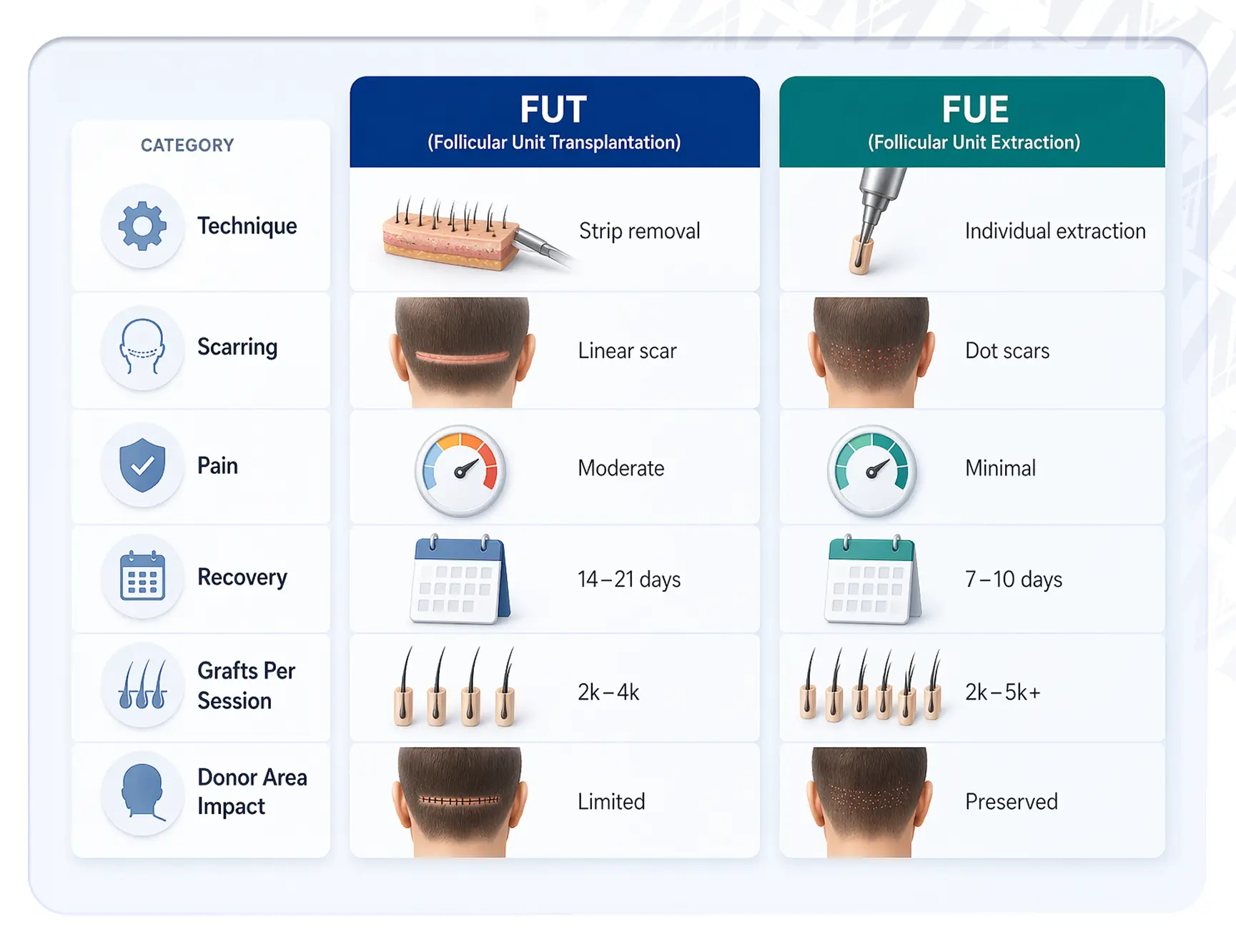
Factor

FUT

FUE

Technique

Strip of skin removed surgically

Individual follicles extracted one by one

Scarring

Linear scar (15–25 cm long)

Tiny dot scars (virtually invisible)

Pain Level

Moderate; suture-line discomfort

Minimal post-operative discomfort

Recovery Time

14–21 days for full healing

7–10 days for donor area healing

Grafts Per Session

2,000–4,000 typically

2,000–5,000+ in mega-sessions

Donor Preservation

Strip removed permanently

Distributed extraction; preserves donor

Cost

Similar in Turkey; higher in Western clinics

Cost-effective in high-volume Turkish clinics

Best For

Selected cases per surgeon recommendation

Most patients seeking modern, minimally invasive results

Visual summary of key differences between FUT strip method and FUE individual extraction.

Risks and Limitations to Consider

Any honest comparison of FUT vs FUE must address the risks that apply to both methods. Hair transplantation is surgery. Understanding these risks helps you make a fully informed decision and ask the right questions during your consultation.

Risks Common to Both Methods

  • ●  Infection is rare when proper sterile protocols are followed, but it remains a possibility with any surgical procedure

  • ●  Shock loss — temporary shedding of existing hair near the transplant area — affects some patients in the weeks following surgery and typically resolves within 3–6 months

  • ●  Poor graft survival can occur if grafts are handled improperly, kept outside the body too long, or placed in poorly prepared recipient sites

  • ●  Numbness in the donor or recipient area is common in the short term and usually resolves, though it can occasionally persist for several months

  • ●  Folliculitis (inflammation of hair follicles) can develop in the recipient area during healing and is typically treatable

Risks Specific to Each Method

FUT carries the additional risk of wound healing complications at the suture line, including widened scars, hypertrophic scarring (raised, thickened scars that extend beyond the original wound line), or keloid formation. Nerve damage along the incision can also cause prolonged numbness.

FUE carries the risk of follicle transection during extraction, as well as donor area overharvesting — particularly in mega-sessions exceeding 5,000 grafts. Overharvesting can leave the donor area visibly thin, which is why careful planning by an experienced surgeon is essential.

Patients with very limited donor hair may not be ideal candidates for either method. A qualified surgeon will assess your donor density before recommending any procedure. Research on long-term graft survival rates continues to evolve, and individual results vary between patients and surgical teams.

Want to see real FUE results from patients with hair loss similar to yours? Request a free hair analysis to explore your options.

The FUT Scar — What Patients Need to Know

Of all the differences between these two methods, the FUT scar generates the most questions — and the most regret from patients who did not fully understand it before their procedure.

What Does a FUT Scar Look Like?

A FUT scar is a horizontal linear scar running across the back of the head, typically from ear to ear. In the best cases, it heals as a thin white or pink line, roughly 1–2 mm wide, concealable under longer hair.

The reality, however, varies considerably. Several factors influence the final appearance:

  • ●  Skin type and genetics play a major role in how the wound heals

  • ●  Surgical technique during closure directly affects scar width

  • ●  Tension on the wound — if the strip removed was too wide, the scar stretches over time

  • ●  Some patients develop hypertrophic or keloid scarring regardless of technique

Over time, some FUT scars widen to 5–10 mm or more. The scar is permanent, and its visibility varies significantly based on these individual factors. For patients who prefer short hairstyles, it can become a lasting cosmetic concern.

The misconception that "the FUT scar is barely noticeable" does not hold true for many patients. Some heal well. Others do not. You cannot know in advance which group you will fall into.

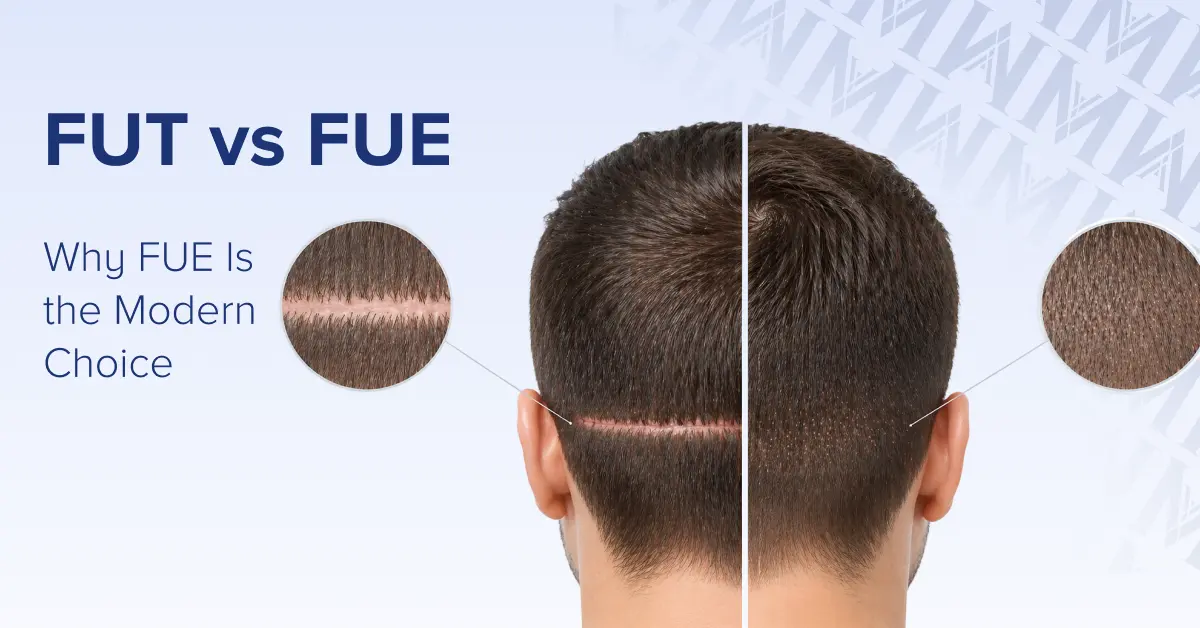
Comparison showing a healed FUT linear scar across the donor area versus barely visible FUE dot scars.

Can a FUT Scar Be Fixed or Concealed?

If you have a FUT scar from a previous procedure and are unhappy with its appearance, there are real options:

  • ●  FUE scar repair — Individual follicles are transplanted directly into and around the scar tissue, allowing hair to grow through and camouflage the line. This is one of the most effective approaches available.

  • ●  Scalp micropigmentation (SMP) — Tiny pigment deposits are tattooed into the scar to mimic the appearance of hair follicles, reducing the visual contrast between the scar and surrounding scalp.

  • ●  Tricopigmentation — A temporary form of scalp micropigmentation that fades over time and can be refreshed periodically.

A common scenario we see is a patient who had a FUT hair transplant at a clinic in the UK or US several years ago and now wants to address the visible scar while adding density to thinning areas. In one recent case, a 38-year-old patient at Norwood stage 4 came to us with a widened FUT scar measuring approximately 8 mm across. Our team performed FUE scar repair — transplanting roughly 600 grafts directly into the scar tissue — alongside an additional 2,500-graft session to restore density at the crown. Once the transplanted hair grew in, the scar became virtually undetectable. The patient reported being able to wear his hair short for the first time in years.

This type of combined procedure is a service many Turkish clinics offer specifically for patients who had the strip method performed elsewhere.

Healing & Recovery Timeline

Why Most Turkish Clinics Offer FUE (Not FUT)

If you have been researching hair transplant options in Turkey, you have likely noticed something: the vast majority of Turkish clinics offer FUE exclusively. This is not a limitation. It is a reflection of deep, deliberate specialization.

There are several distinct reasons:

  • ●  Turkey's hair transplant industry grew alongside FUE technology. Unlike Western clinics that had to transition from FUT, many Turkish clinics were built around FUE from the start. Their infrastructure, training, and workflows are purpose-designed for this technique.

  • ●  Unmatched surgical volume creates unmatched expertise. Turkey performs an estimated 500,000–700,000 hair transplant procedures per year, according to data reported by the Turkish Healthcare Travel Council. That volume has produced surgical teams with extraordinary experience — measured in thousands of procedures, not hundreds.

  • ●  International patients overwhelmingly prefer the scarless option. Patients traveling from the US, UK, Europe, and the Middle East consistently choose FUE. Clinics have responded by specializing further.

  • ●  FUE aligns with the medical tourism model. A 7–10 day recovery timeline is far more practical for international travelers than a 2–4 week FUT recovery.

  • ●  Regulatory oversight has strengthened. Turkey's Ministry of Health requires hair transplant procedures to be performed in licensed facilities under the supervision of qualified medical professionals, raising the quality bar across the industry.

A persistent misconception holds that FUE in Turkey is "just a marketing gimmick" — a way to attract tourists with buzzwords. The reality is quite different. Our clinical experience, supported by global trends and ISHRS data, leads us to recommend FUE for the majority of patients because it delivers comparable or superior results with significantly less impact on the body and daily life.

Which Method Is Right for You?

Understanding the procedures and their differences is essential — but what matters most is how those differences apply to your specific situation. A qualified hair transplant surgeon who can assess your donor area, hair characteristics, and degree of hair loss is the best person to make a final recommendation. That said, here is practical guidance to help you think through the decision.

FUE May Be the Better Choice If…

  • ●  You want to wear your hair short or shaved without a visible scar

  • ●  You prioritize a minimally invasive approach with faster recovery

  • ●  You are traveling for the procedure and need to return home within 7–10 days

  • ●  You may need additional transplant sessions in the future

  • ●  You have moderate to advanced hair loss requiring high graft counts

  • ●  You want the flexibility of body hair harvesting if needed

For the vast majority of patients researching their options today, FUE is the stronger choice. You can learn more about what to expect from FUE in our detailed guide.

FUT Might Still Be Considered If…

  • ●  You have very limited donor density and a surgeon specifically recommends maximizing yield from a small area

  • ●  You have already had multiple FUE sessions and the donor area is significantly depleted

  • ●  A surgeon with expertise in both methods evaluates your anatomy and recommends FUT for a specific clinical reason

These situations are increasingly uncommon. A small number of surgeons still advocate for FUT in specific clinical scenarios, but the overwhelming global trend favors FUE.

The Honest Answer

For the vast majority of patients considering a hair transplant in 2025, FUE is the superior choice. The technique has matured to the point where its historical disadvantages — longer procedure times, higher cost — have been largely eliminated, particularly in Turkey's high-volume specialized clinics.

FUT is not a bad procedure. It played an important role in the history of hair restoration. But it is a legacy technique that has been surpassed by a method offering comparable results with less scarring, faster recovery, and greater long-term flexibility.

It is also worth noting that hair transplants — whether FUT or FUE — are often most effective as part of a broader approach. Your surgeon may recommend complementary treatments such as medication to stabilize ongoing hair loss or supportive therapies to optimize graft health. Discuss this during your consultation.

The best hair transplant method is the one that gives you natural results with the least impact on your body, your recovery, and your future options. For most patients today, that method is FUE.

What to Ask Your Surgeon Before Choosing a Method

You now have a clear picture of how these two methods compare. The next step is preparing for a consultation. Walking into that conversation with the right questions puts you in control of the decision.

Here are the questions our surgical team recommends every patient ask:

  • 1.  What technique do you recommend for my specific hair loss pattern, and why?

  • 2.  How many grafts do I need, and can that number be achieved in one FUE session?

  • 3.  What will my donor area look like after the procedure?

  • 4.  Can I see before-and-after photos of patients with a similar degree of hair loss to mine?

  • 5.  What is your graft survival rate, and how do you measure it?

  • 6.  If I need a future session, how will this procedure affect my remaining donor supply?

  • 7.  What does my recovery timeline look like, and when can I return to normal activities?

A surgeon who is confident in their work will welcome these questions and answer them transparently. If you receive vague or evasive responses, consider it a signal to seek a second opinion.

Not sure where to start? Our team is happy to walk you through these questions during a no-obligation consultation.

Frequently Asked Questions

Is FUE more painful than FUT?

FUE is generally associated with less post-operative discomfort than FUT. Because there is no surgical wound or suture line, most FUE patients report only mild soreness for a few days. FUT patients often experience tightness and prolonged tenderness along the sutured incision. Pain tolerance varies, but the majority of patients find FUE recovery significantly more comfortable.

Which method gives more natural-looking results?

Both FUT and FUE can produce natural-looking results when performed by an experienced surgeon. The naturalness depends more on the surgeon's skill in designing the hairline and placing grafts at the correct angle and density than on the extraction method itself. FUE may allow more precise individual graft selection, which can contribute to refined results.

Can you have FUE after a previous FUT procedure?

FUE can absolutely be performed after a previous FUT hair transplant. Many patients who had FUT years ago choose FUE for additional density or to repair a visible FUT scar. The surgeon will assess your remaining donor supply to determine how many grafts are available. FUE scar repair — transplanting follicles directly into scar tissue — is a common and effective procedure.

How long does a FUT scar take to heal?

The initial wound typically takes 10–14 days to heal enough for suture removal. However, the scar continues to mature over 6–12 months and may remain pink, raised, or tender during that period. The final appearance — including width and visibility — is not fully apparent until approximately one year after the procedure.

Is FUT cheaper than FUE?

In some Western clinics, FUT may be slightly less expensive because it requires less surgical time. However, in Turkey, where clinics specialize in high-volume FUE, the cost difference has largely disappeared. FUE in Turkey is significantly more affordable than either method in the US or UK, making cost a less relevant factor in the FUT vs FUE decision for patients considering medical tourism.

How many grafts can be transplanted with FUE vs FUT?

FUT typically yields 2,000–4,000 grafts per session. FUE can achieve 2,000–5,000 or more in a single mega-session, depending on donor density and surgical team experience. The idea that FUT provides more grafts is a misconception that no longer reflects modern capabilities.

Does FUE leave any scars at all?

FUE does leave tiny dot scars at each extraction point, each less than 1 mm in diameter. These heal to become virtually invisible — even with very short hairstyles. They are not comparable in visibility or impact to the linear FUT scar, which is why many patients consider FUE effectively "scarless."

Why is FUE more popular than FUT now?

According to ISHRS data, FUE now accounts for over 90% of hair transplant procedures worldwide. The shift reflects FUE's clear advantages in scarring, recovery time, patient comfort, and donor area preservation. Advances in technology have eliminated its earlier limitations around graft yield and speed. The best hair transplant method for most patients is now widely considered to be FUE.

Final Thoughts — Making a Confident Decision

Choosing a hair transplant method is a deeply personal decision. The research you have done to reach this point matters — and it puts you in a far stronger position than most patients who walk into a consultation for the first time.

Both FUT and FUE achieve the same fundamental goal: moving healthy, permanent follicles to areas where your hair has thinned. But FUE has become the global standard for compelling reasons — less scarring, faster recovery, greater flexibility, and results that match or exceed what the strip method can deliver. For patients considering a procedure in Turkey, FUE is the standard because it represents the strongest combination of outcomes and patient experience available today.

The next step is a conversation with a specialist who can evaluate your individual situation. Every patient's hair characteristics, donor density, and goals are different — and no article, however thorough, can replace a personalized assessment by a qualified surgeon.

Ready to find out which approach is right for your hair loss? Book a free consultation with our surgical team — we will assess your donor area, recommend a personalized plan, and answer every question you have. The right method, performed by the right team, can give you results that look and feel completely natural.

This article is for informational purposes and does not constitute medical advice. Individual results vary based on hair characteristics, donor density, and overall health. A qualified surgeon's assessment is essential before making any treatment decision.

Contact with Us!

Please enter a valid phone number.
WhatsApp
Graft Calculator WhatsApp WhatsApp