
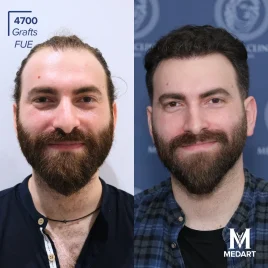
Hair Transplant for Receding Hairline: Techniques, Grafts & What to Realistically Expect

A comprehensive guide to hair transplant solutions for a receding hairline, covering modern techniques like FUE and DHI, how natural hairlines are designed, and what results to expect. Learn how advanced methods restore frontal density with precise graft placement and long-lasting, natural-looking outcomes.
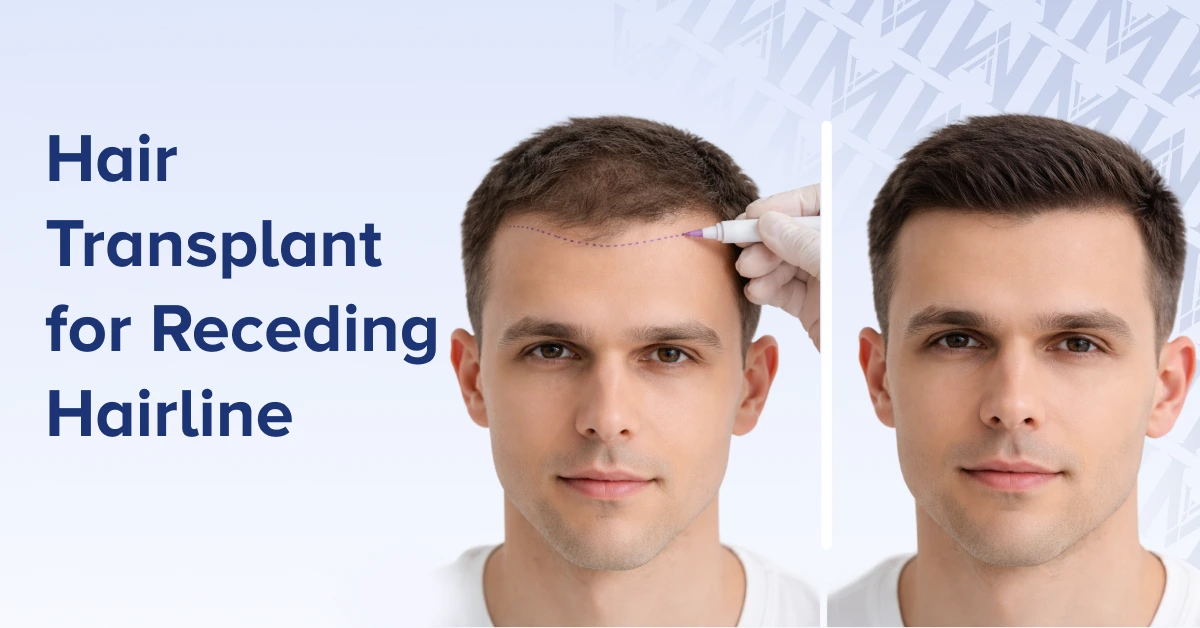
Hair Transplant for Receding Hairline

Table of Contents

It usually starts the same way. You catch your reflection under harsh bathroom lighting, and for the first time, you notice your forehead looks bigger. Your temples have crept back — quietly, gradually, maybe over months, maybe over years. The hairline you never gave a second thought to is suddenly all you can think about.

You're far from alone. A receding hairline is the single most common reason people walk into a hair transplant clinic, accounting for an estimated seven in ten consultations worldwide. Yet many people spend months researching before taking action, often because one question lingers: will it actually look natural?

With modern techniques and an experienced surgeon, the answer is yes. Today's FUE and DHI procedures can reconstruct a hairline so precise that even your barber won't suspect a thing. But natural-looking results from a hair transplant for a receding hairline depend on far more than technique alone. They require artistry, meticulous graft selection, and realistic planning.

**Disclaimer:** This article is for informational purposes only and does not constitute medical advice. Hair transplant outcomes vary based on individual factors. Consult a qualified hair restoration surgeon for a personalized assessment of your candidacy and expected results.

In this guide, you'll learn how receding hairline restoration actually works — techniques compared head to head, graft counts broken down by Norwood stage, the design process most articles skip over, a detailed recovery timeline, risks worth understanding, and the realistic results you can expect.

Quick Quote in 5 Minutes

Talk to an experienced patient coordinator for your hair transplant in Turkey.
Please enter a valid phone number.

Why the Receding Hairline Is the #1 Reason People Get Hair Transplants

Before diving into techniques and graft counts, it helps to understand why the hairline — specifically — drives so many people toward restoration, and why timing your decision matters more than you might think.

How Hairline Recession Progresses (and When to Act)

A receding hairline is typically the earliest visible sign of androgenetic alopecia — the medical term for genetic pattern hair loss. It affects approximately 50 million men and 30 million women in the United States alone (American Academy of Dermatology). The process usually begins at the temples, gradually carving an M-shaped or V-shaped recession pattern that deepens over time.

Hair loss specialists classify this progression using the Norwood Scale stages of hair loss, which ranges from Stage 1 through Stage 7. Stages 2 through 4 are primarily defined by frontal recession, making them the most common presentation at transplant consultations.

The ideal window for a frontal hair transplant is during early-to-moderate recession — typically Norwood 2 through 3A. At these stages, fewer grafts are needed, more donor hair remains available, and results blend seamlessly with existing hair. That said, not everyone with a receding hairline needs surgery. Some patients respond well to medical treatments like minoxidil or finasteride, and a qualified surgeon can help determine which approach fits your situation.

The Psychological Impact of a Receding Hairline

Hair loss carries measurable psychological weight. According to the American Hair Loss Association, 85% of men experience significantly thinner hair by age 50. Published clinical research consistently links hair loss with decreased self-esteem, heightened social anxiety, and reduced confidence in professional settings.

Think of your hairline as the frame of a painting. It shapes how others perceive your face — your age, your vitality, your expression. When that frame shifts, the entire picture feels different. This is precisely why hairline work demands a level of precision that other transplant zones simply don't require.

Are You a Good Candidate for a Hairline Transplant?

Not everyone experiencing recession is an ideal candidate for surgery. Most surgeons recommend meeting these baseline criteria:

  • ●  Age 25 or older, since hair loss patterns become more established and predictable by this point

  • ●  Stable recession trajectory, meaning your hair loss has followed a consistent pattern for at least one to two years

  • ●  Adequate donor density, with enough healthy follicles at the back and sides of the scalp to supply the transplant

  • ●  Good general health, with no uncontrolled conditions that impair healing

Certain conditions may disqualify or delay candidacy, including uncontrolled diabetes, blood clotting disorders, active scalp infections, and diffuse unpatterned alopecia. Unrealistic expectations are also a significant concern — a qualified hair restoration surgeon will assess both your physical suitability and your goals during consultation.

For patients with very early recession who aren't yet surgical candidates, non-surgical options deserve serious consideration. Minoxidil can slow loss and stimulate regrowth in some patients. Finasteride blocks DHT — dihydrotestosterone, the hormone responsible for follicle shrinkage — and can stabilize recession. PRP (platelet-rich plasma) therapy offers another avenue. Discuss the potential benefits and side effects of any medication with your doctor before starting treatment.

This visibility and emotional significance is exactly what makes hairline work fundamentally different from transplanting any other zone on the scalp.

Diagram showing Norwood Scale stages 1 through 4 with progressive frontal hairline recession patterns highlighted

What Makes a Hairline Transplant Different from Other Hair Transplants

A receding hairline sits at the front and center of your face. Restoring it requires a fundamentally different approach than filling in the crown or mid-scalp. A hairline transplant is a specialized discipline — one that demands a unique fusion of surgical precision and artistic judgment.

The Frontal Hairline as the "Showcase Zone"

The hairline is the most visible, most scrutinized part of any hair restoration procedure. When you face someone in conversation, their eyes naturally register your frontal hairline first. It's the area where unnatural results are most immediately obvious — and most unforgivable.

Consider a patient we'll call Mark: a 33-year-old with Norwood 3 recession who has watched his temples recede steadily over three years. He's been applying minoxidil with modest results, but his frontal hairline has continued to thin. For Mark, restoring the crown would be invisible to most people. Restoring his hairline changes how every person he meets perceives him.

This visibility is why the frontier line — the very front edge of the hairline — requires the finest, single-hair follicular units (natural groupings of one to four hairs). Only single-hair grafts create the soft, feathered edge that nature intended.

Artistry vs. Surgery — Why Design Matters More Than Technique

A great hairline transplant is equal parts surgical skill and artistic vision. The surgeon must account for your facial proportions, bone structure, age-appropriateness, and the natural irregularity that makes a hairline look real rather than drawn on.

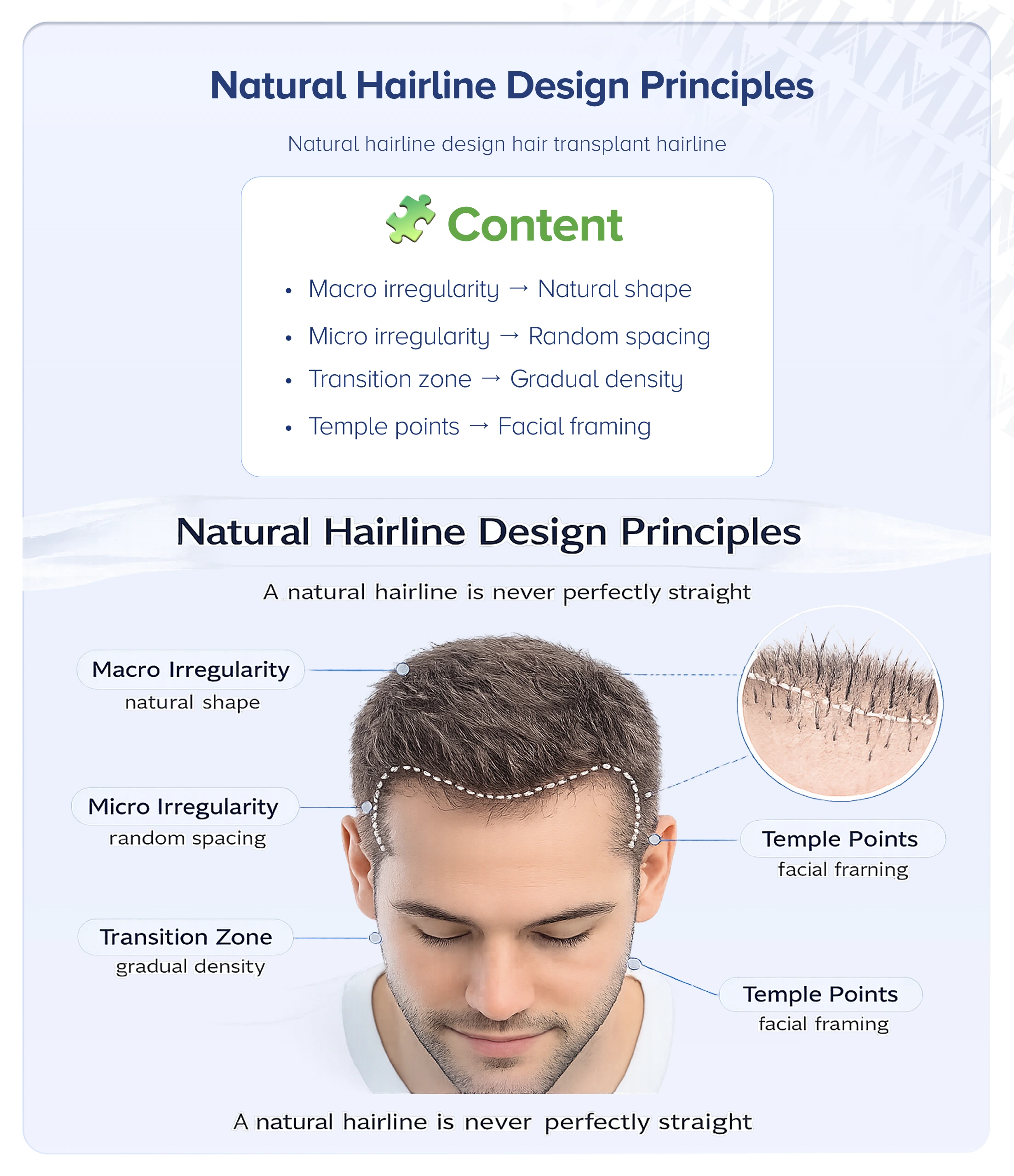
Here's what most people don't realize: a perfectly straight hairline looks fake. Natural hairlines have what surgeons call macro-irregularity — the overall shape features subtle peaks and valleys — and micro-irregularity — individual hairs at the edge are randomly spaced, never lined up in neat rows. Recreating this randomness is an art form that separates exceptional results from merely adequate ones.

Temple point reconstruction — rebuilding the small triangular points of hair at the sides of the forehead — is another critical element that less experienced surgeons often overlook. Without well-designed temple points, even a beautifully crafted central hairline looks incomplete. Poor hairline design cannot be rescued by excellent surgical technique.

Graft Selection for the Hairline Zone

Natural hair doesn't grow in uniform rows. It follows a graduated pattern, and your surgeon should replicate this precisely using a layered graft strategy:

  • ●  Single-hair grafts (1-grafts) at the frontier line, creating a soft, natural leading edge

  • ●  Two-hair grafts placed just behind the frontier, building initial density

  • ●  Three- to four-hair grafts further back in the transition zone, delivering fullness and coverage

Think of the hairline frontier like the edge of a forest. In nature, tree lines are never perfectly straight — they have random spacing, varied heights, and gradual thinning at the edges. Your transplanted hairline should follow the same graduated principle, moving from sparse and fine at the front to dense and full behind it.

Illustration showing layered graft placement strategy with single-hair grafts at hairline frontier and multi-hair grafts in transition zone

FUE vs. DHI — Which Is the Best Technique for Hairline Transplant Work?

With the artistic principles established, the next decision is technical: which method will your surgeon use to place those carefully selected grafts? The two dominant modern techniques — FUE and DHI — each bring distinct advantages to frontal hairline work.

FUE for Hairline Restoration

Follicular Unit Extraction (FUE) is the most widely performed hair transplant technique worldwide. The surgeon uses a micro-punch tool (typically 0.6–0.9 mm in diameter) to extract individual follicular units from the donor area — the back and sides of the scalp, where hair is genetically resistant to thinning.

For an FUE hairline procedure, the technique offers clear advantages:

  • ●  Flexibility in graft placement across both large and small recipient areas

  • ●  Minimal scarring — tiny dot scars that remain virtually invisible, even with short hairstyles

  • ●  Extensive global adoption, meaning a large pool of experienced surgeons have refined this approach

The primary limitation for FUE at the hairline is that it requires pre-made incisions (called channels) before grafts are implanted. This two-step process means the surgeon predicts the exact angle and direction of each channel in advance, offering slightly less real-time control at the delicate frontier line compared to direct implantation methods.

DHI for Hairline Restoration

Direct Hair Implantation (DHI) uses a specialized instrument called the Choi implanter pen — a pen-like tool that implants each graft directly into the scalp without pre-made channels. The surgeon loads a graft into the pen and simultaneously creates the incision and places the graft in a single motion.

For the DHI hairline zone specifically, the benefits are compelling:

  • ●  Precise control over angle, depth, and direction of each individual graft — particularly valuable at the frontier line

  • ●  No pre-made channels required, allowing real-time adjustments during implantation

  • ●  Higher density achievable in compact areas, which matters for the narrow hairline zone

The Choi pen allows control of the implantation angle to approximately 40–45 degrees, closely mimicking the natural direction of hair growth at the frontal hairline. This precision is why many surgeons prefer DHI specifically for the first one to two centimeters of the hairline.

Limitations include a slower implantation process, the need for a highly trained surgical team, and potentially higher cost compared to standard FUE.

The Hybrid Approach — Combining FUE and DHI

Increasingly, experienced clinics employ a combined strategy: DHI for the hairline zone and FUE for the areas behind it. This hybrid approach leverages the precision of DHI where it matters most — at the visible frontier — while using the efficiency of FUE for broader coverage.

For Mark with his Norwood 3 recession, a hybrid approach might mean DHI for the first 500–800 grafts along the hairline and temple points, with FUE handling the remaining grafts in the mid-scalp transition zone. Many surgeons now consider this hybrid method the gold standard for frontal hairline restoration.

The following table summarizes how the two techniques compare for hairline work specifically:

Feature

FUE

DHI

Channel creation

Pre-made incisions before graft placement

No channels — simultaneous incision and placement

Angle control at frontier

Good, but predetermined

Excellent, with real-time adjustment

Density in small areas

Standard density achievable

Higher density achievable

Speed

Faster for large areas

Slower, more labor-intensive

Ideal use case

Broad coverage behind the hairline

Precise frontier-line and temple work

Relative cost

Standard

Typically higher due to time and training

Both techniques produce excellent results when performed by experienced surgeons. The best technique for hairline transplant work is ultimately the one your surgeon is most skilled and experienced with.

Which Should You Choose?

Your decision should weigh these factors:

  • ●  Extent of recession: DHI shines for focused hairline work; FUE is more efficient for larger areas

  • ●  Desired frontier density: If maximum density at the hairline edge is your priority, DHI may offer an advantage

  • ●  Budget: DHI-only procedures may cost more due to the time-intensive process

  • ●  Surgeon recommendation: An experienced surgeon using FUE will outperform a novice using DHI — skill always matters more than the technique name

Be cautious of any clinic that pushes one technique for every patient regardless of their individual case. This is a red flag suggesting a one-size-fits-all approach rather than personalized care.

Comparison illustration of FUE micro-punch extraction and channel creation versus DHI Choi implanter pen direct implantation for hairline transplantation

How Many Grafts Do You Need for a Receding Hairline?

Understanding how the techniques differ is essential — but the next question is equally pressing: how many grafts will your hairline actually need? This is often the first thing patients ask, and the answer depends on several measurable factors.

Graft Estimates by Norwood Stage for Frontal Recession

The following table provides general graft ranges for frontal hairline restoration based on the Norwood classification. These estimates cover the hairline and temple area specifically — not the crown or vertex.

Norwood Stage

Recession Pattern

Typical Graft Range

Norwood 2

Minor temple recession

800–1,500 grafts

Norwood 2A

More defined frontal recession

1,000–1,800 grafts

Norwood 3

Significant frontal and temple recession

1,500–2,500 grafts

Norwood 3A

Frontal recession extending further back

2,000–3,000 grafts

Norwood 4 (frontal portion)

Frontal recession plus early crown thinning

2,500–3,500+ grafts

Important: These are general estimates, not prescriptions. Your actual graft count depends on head size, hair characteristics, desired density, and the surgeon's clinical assessment. Results vary based on individual factors including hair type, extent of recession, and overall health. A professional evaluation is essential for an accurate count.

For a personalized projection, use our free graft calculator for a personalized estimate. It factors in your recession pattern and provides a clearer starting point before your consultation.

For context, the average hairline-only transplant typically falls in the 1,500–2,500 graft range. For Mark with his Norwood 3 recession, his surgeon would likely recommend approximately 1,800–2,200 grafts to rebuild a natural frontal hairline with adequate density.

Factors That Affect Your Graft Count

Beyond Norwood stage, several individual characteristics influence how many grafts you'll need:

  • ●  Size of the recession area measured in square centimeters — a larger forehead requires more grafts to achieve the same density

  • ●  Desired density level — standard density runs 30–50 grafts per cm², while high-density work exceeds 50 grafts per cm². A natural, unthinned hairline typically has 60–80 follicular units per cm², but transplants aim for enough density to look natural, not to replicate original density exactly.

  • ●  Hair characteristics — thick, coarse, or curly hair provides significantly more visual coverage per graft than fine, straight hair

  • ●  Hair-to-skin color contrast — dark hair on light skin creates more visible contrast at the scalp, sometimes requiring higher density for a seamless look

  • ●  Temple point needs — a hair transplant for temples can add 200–400 grafts to the total when both temple points require reconstruction

Why "More Grafts" Isn't Always Better

Many patients assume that requesting the maximum number of grafts will produce the best result. In reality, the opposite can be true.

Your donor area — the back and sides of your scalp — is a finite resource. Think of it like a savings account that needs to last your lifetime. Overharvesting can cause visible thinning at the back of your head, trading one cosmetic problem for another.

Packing too many grafts too densely into the recipient area can also reduce the graft survival rate. Grafts compete for blood supply during the critical healing phase, and overcrowding can compromise the outcome. A skilled surgeon maximizes the appearance of density through strategic placement and proper angulation — not just raw numbers.

Future hair loss must also factor into the plan. If your recession is likely to progress, your surgeon should reserve donor capacity for potential future sessions. Responsible planning today protects your options tomorrow.

**Ready for a personalized assessment?** Try our free graft calculator for an initial estimate, or book a consultation with our surgical team to receive a tailored treatment plan based on your specific recession pattern and goals.

The Hairline Design Process — What Happens Before Your Transplant

The graft count gets you into the operating room. But the hairline design — the artistic blueprint drawn before a single graft is extracted — determines whether you'll love what you see in the mirror twelve months from now. This step is the most important, and the least discussed.

The Consultation — Mapping Your New Hairline

During the pre-surgical consultation, your surgeon assesses your current hairline, facial bone structure, recession pattern, and skin laxity (how tight or loose your scalp skin is, which affects graft placement). This evaluation typically follows the "rule of thirds" — a principle from classical art and facial aesthetics that divides the face into three equal vertical sections: forehead to brow, brow to nose base, and nose base to chin.

A well-designed hairline respects these proportions. It also respects your age. A 45-year-old should not receive a 20-year-old's hairline — an overly aggressive, low-set hairline looks unnatural on a mature face and depletes donor supply that may be needed later.

Your input matters in this process. Communicate your goals and preferences openly. But trust your surgeon's experience when they recommend adjustments. The best hairline design hair transplant outcomes emerge from a collaborative conversation, not a unilateral demand.
Surgeon drawing a hairline design on a patient forehead during pre-surgical consultation with marking pen

Natural Hairline Characteristics Your Surgeon Will Recreate

A natural-looking hairline has four defining characteristics that your surgeon should deliberately engineer:

  • ●  Macro-irregularity: The overall shape isn't a perfect arc — it features subtle peaks, valleys, and asymmetries unique to each person

  • ●  Micro-irregularity: Individual hairs along the frontier are randomly spaced with slight variations in angle, never planted in neat, detectable rows

  • ●  Transition zone: Hair density increases gradually from the very front edge to two or three centimeters behind the hairline, creating a natural fade from sparse to full

  • ●  Temple points: The small triangular points of hair at the lateral edges of the forehead frame the face and complete the hairline's visual architecture

Red Flags in Hairline Design

Not every surgeon approaches design with the same rigor. Watch for these warning signs during your consultation:

  • ●  A perfectly straight, ruler-drawn line marked on your forehead — natural hairlines are never geometrically straight

  • ●  A hairline placed too low without discussion of aging or future recession — this looks increasingly odd as you mature and wastes precious donor grafts

  • ●  No conversation about future hair loss — a responsible surgeon plans for where your recession is heading, not just where it is today

  • ●  A refusal to show you the drawn design before surgery begins — you should see and approve the proposed hairline on your forehead before any extraction starts

The design consultation should take 30–60 minutes minimum. If it takes five minutes, that's a significant red flag. And the surgeon's portfolio of previous hairline cases is the single best predictor of what your results will look like — ask to see it.

What to Expect on Hairline Transplant Surgery Day

With the design approved and the plan finalized, the actual procedure day is often less daunting than patients anticipate. Knowing what happens step by step removes the mystery and replaces anxiety with clarity.

Pre-Procedure Preparation

Your day typically begins with final photographs, a review of the drawn hairline design, and preparation of the donor and recipient areas. Depending on the technique, your head may be fully shaved or only partially shaved — some DHI approaches allow minimal shaving in certain cases.

Local anesthesia is administered to numb both zones. Many clinics in Turkey now offer needle-free anesthesia options that use pressurized air to deliver the numbing agent, significantly reducing initial discomfort. The total procedure duration ranges from four to eight hours depending on your graft count.

Step-by-Step: Extraction and Implantation

The procedure follows a clear sequence:

  • 1.  Donor area extraction: The surgeon harvests individual follicular units from the back and sides of the scalp using micro-punch tools (FUE) or extracts them for loading into Choi pens (DHI).

  • 2.  Graft sorting and preparation: The team carefully sorts extracted grafts under magnification — single-hair units separated from multi-hair units for precise placement in the correct zones.

  • 3.  Channel creation and implantation: The surgeon creates tiny channels in the recipient area before placing grafts (FUE), or uses the Choi pen to create channels and implant simultaneously (DHI). The hairline frontier receives single-hair grafts at precise 40–45 degree angles.

  • 4.  Completion and post-op care: The team gently cleans the transplanted area, bandages the donor zone, and provides detailed aftercare instructions for the days ahead.

You're awake throughout the entire procedure. Most patients watch movies, listen to podcasts, or simply rest. A lunch break is typically provided mid-procedure.

Pain and Comfort — What It Actually Feels Like

Many patients worry that the procedure will be painful. The most uncomfortable moment is the initial anesthesia administration, which lasts approximately two to five minutes. Once the numbing takes full effect, the procedure itself is virtually painless.

Some patients report a mild pressure or tugging sensation during extraction, but describe it as noticeable rather than painful. Post-operatively, most people experience mild soreness for two to three days, easily managed with basic over-the-counter pain relief. The procedure is outpatient — you return to your hotel the same day.

Recovery Timeline and Aftercare for Hairline Transplants

The procedure itself is just the beginning. What follows is a recovery journey that demands patience, disciplined care, and realistic expectations about the timeline ahead.

Week-by-Week Recovery During the First Month

The first four weeks follow a predictable pattern for most patients:

  • ●  Days 1–3: Swelling around the forehead and eyes is common, sometimes extending to the bridge of the nose. The transplanted area appears red with tiny crusts forming around each graft. Sleeping in an elevated position (at roughly 45 degrees) helps minimize swelling.

  • ●  Days 4–7: Scabbing over the implanted grafts becomes more defined. The donor area shows noticeable healing. Gentle washing — typically beginning on day two or three per your clinic's protocol — continues with careful technique.

  • ●  Days 7–14: Scabs gradually release during careful washing, revealing pink skin in the recipient area. The donor area shows minimal visible signs of extraction. Most patients feel comfortable returning to non-physical work.

  • ●  Weeks 2–4: Shock loss — the temporary shedding of transplanted hairs as follicles enter a resting phase — occurs during this period. The transplanted area may look similar to its pre-surgery state, or even slightly thinner.

It's completely normal to feel discouraged when the hairs you just watched being placed start falling out. Many patients find shock loss alarming. But this shedding is a standard, expected part of the hair growth cycle. The follicles remain alive beneath the surface, preparing to produce new, permanent growth. Shock loss is not a sign of failure — it's a sign the process is working exactly as it should.

The Growth Timeline — When You'll Actually See Results

Patience is non-negotiable. Hair growth after transplantation follows a gradual, predictable arc:

  • 1.  Months 1–3: The dormant phase. Very little visible growth occurs as transplanted follicles establish blood supply beneath the skin. This is the stage that tests your patience most.

  • 2.  Months 3–6: New hairs begin emerging — initially thin and wispy. You'll notice the first encouraging signs of your new hairline taking shape.

  • 3.  Months 6–9: Significant growth becomes visible. Density increases noticeably, and individual hairs begin to thicken in caliber.

  • 4.  Months 9–12: Near-final results appear. Hairs continue to thicken and mature in texture, blending naturally with surrounding native hair.

  • 5.  Months 12–18: Full, final results. Hair reaches its mature thickness, and the transplanted area integrates completely with your natural growth pattern.

For Mark, month three felt discouraging — his hairline looked almost unchanged. By month seven, distinct new growth had appeared along his temples. At twelve months, his Norwood 3 recession had been replaced by a natural, full frontal hairline. Colleagues told him he "looked great" but couldn't pinpoint what had changed. That invisible transformation is the hallmark of a well-executed procedure.

Aftercare Tips Specific to Hairline Transplants

The frontal hairline requires particular attention during recovery because of its exposed position on the face:

  • ●  Protect from sun exposure — the forehead receives more direct sunlight than any other scalp area, so apply SPF 50 or wear a loose hat after the initial two-week healing period

  • ●  Avoid tight hats or headbands that press directly on the hairline for at least three weeks, as pressure can dislodge healing grafts

  • ●  Sleep on your back for the first seven to ten nights — frontal grafts are vulnerable to friction against pillows during side sleeping

  • ●  Follow the clinic's washing protocol precisely — the hairline area is delicate, and improper technique is a common cause of preventable graft loss

When performed by an experienced surgeon with proper aftercare, modern FUE and DHI procedures achieve a graft survival rate of 90–95% (International Society of Hair Restoration Surgery). Final judgment of your results should not be made before the twelve-month mark.

Infographic showing hair transplant recovery and growth timeline from day one through eighteen months with visual progression of hairline density

Risks, Complications, and How to Minimize Them

Every surgical procedure carries some degree of risk, and a hairline transplant is no exception. Understanding potential complications — and knowing how they're prevented — helps you make a fully informed decision.

Potential Risks Specific to Hairline Work

Most complications are uncommon when the procedure is performed by an experienced surgeon in an accredited facility. However, patients should be aware of these possibilities:

  • ●  Infection: Rare with proper sterile technique and aftercare compliance, but any surgical site carries a small risk. Following your clinic's post-operative hygiene instructions significantly reduces this.

  • ●  Poor graft survival: Causes include overcrowding of grafts, inadequate blood supply to the recipient area, and failure to follow aftercare protocols. An experienced surgeon manages density carefully to maximize survival.

  • ●  Unnatural appearance: The most feared complication — and the one most directly tied to surgeon skill. Poor angle control, incorrect graft selection, or a badly designed hairline can produce visible, artificial-looking results.

  • ●  Folliculitis: Temporary inflammation of transplanted follicles can occur during the growth phase. It's typically mild, treatable, and resolves without lasting impact.

  • ●  Temporary numbness: Some patients experience reduced sensation in the donor or recipient area for several weeks. Feeling generally returns fully as nerves heal.

  • ●  Cobblestoning: A slightly raised, bumpy texture at the transplant site caused by grafts placed too shallowly. Proper depth control during implantation prevents this.

How a Qualified Surgeon Mitigates These Risks

The single most effective way to minimize complications is choosing the right surgeon. Look for demonstrated experience with frontal hairline cases specifically — not just general transplant volume. A surgeon who manages graft density responsibly, uses precise angulation, and follows strict sterile protocols dramatically reduces every risk listed above.

If results don't meet expectations, revision procedures are possible. However, revision work is more complex than initial surgery. Making the right choice the first time — through thorough research and realistic expectations — is always the better path. Consult a qualified hair restoration surgeon to discuss your individual risk profile before proceeding.

Hairline Transplant Results — What "Natural" Actually Looks Like

The recovery timeline tells you when you'll see results. But what should those results actually look like — and what separates a good outcome from a great one?

What Natural Hairline Transplant Results Look Like

A well-executed natural hairline transplant should be virtually undetectable. Not to your friends. Not to your barber. Not to a dermatologist in casual conversation.

This level of naturalness depends on several elements working together: sufficient graft count, proper single-hair placement at the frontier, correct angulation mimicking your native growth pattern, and a design that suits your face and age. Patients with curly or wavy hair typically achieve more visual coverage per graft than those with straight, fine hair. Similarly, low contrast between hair color and skin color creates a more seamless appearance.

The improvement is obvious, but the method is invisible. That's the goal.

Evaluating Before and After Photos

When researching hairline hair transplant results — whether from a specific clinic or across the internet — apply these critical evaluation criteria:

  • ●  Consistent lighting and angle between the before and after images

  • ●  A minimum of 12 months between the procedure and the "after" photo

  • ●  Multiple cases shown, not just the single most dramatic transformation

  • ●  Cases similar to your Norwood stage and hair type, giving you a realistic comparison

Be cautious of clinics that showcase only their most spectacular outcomes. A trustworthy portfolio includes a range of results across different recession patterns and hair characteristics.

Want to see results from patients with recession patterns similar to yours? Browse our complete before and after gallery featuring hairline transplant cases across every Norwood stage.

Factors That Can Affect Your Results

Results vary based on individual factors, and honest acknowledgment of this builds realistic expectations:

  • ●  Age and ongoing hair loss: Native hair behind the transplanted hairline may continue to thin over time, potentially requiring medical maintenance or a future session

  • ●  Donor hair quality: Fine, sparse donor hair produces less dramatic results than thick, dense donor hair — your surgeon should assess this thoroughly during consultation

  • ●  Lifestyle factors: Smoking reduces blood flow to the scalp and can impair graft survival. Poor nutrition and chronic stress may slow healing.

  • ●  Aftercare compliance: Patients who follow post-operative instructions precisely achieve better outcomes than those who cut corners

  • ●  Unrealistic expectations: A transplant restores a natural-looking hairline — it does not recreate the density you had at sixteen

For patients at Norwood 4 or beyond, a second session is sometimes planned from the start to achieve optimal density. These staged procedures are typically scheduled 12–18 months after the initial transplant, allowing full growth before assessing whether additional grafts are needed. This approach protects donor supply while maximizing the final result. Consulting a qualified hair restoration surgeon before setting expectations is essential.

Why Turkey for Your Hairline Transplant?

If you've been researching hairline transplant Turkey options, you've likely noticed that the country dominates the global conversation around hair restoration. There are concrete reasons for this — and important caveats worth understanding.

Cost Advantage Without Compromising Quality

The cost difference is substantial. A hairline transplant in Turkey typically ranges from $2,000 to $4,500, compared to $8,000 to $15,000 or more in the United States or United Kingdom for a comparable procedure. These figures represent market averages, not specific clinic pricing.

This difference is driven by Turkey's lower operating costs, favorable exchange rates, and the sheer volume of procedures performed — not by inferior materials or training. Most Turkish clinics offer all-inclusive packages covering the procedure, hotel accommodation, airport transfers, and aftercare products.

Surgeon Experience and Procedure Volume

Turkey performs an estimated 500,000 or more hair transplant procedures annually (International Society of Hair Restoration Surgery), making it the world's highest-volume destination for hair restoration. Volume at this scale translates directly into refined expertise.

Turkish surgeons and their teams encounter a wider range of recession patterns, hair types, and challenging cases than practitioners in lower-volume markets. For hairline work specifically — where the nuanced skills of frontier-line placement and temple point reconstruction are honed through repetition — this experience matters enormously. Istanbul alone is home to hundreds of clinics, many holding JCI (Joint Commission International) accreditation.

How to Choose the Right Clinic

Volume creates opportunity for excellence, but it also creates room for inexperienced operators. Not all clinics deliver the same quality. Evaluate your options against these criteria:

  • ●  Confirm surgeon-led procedures: Verify that a qualified surgeon performs the critical steps — particularly hairline design and implantation — not just technicians

  • ●  Request a hairline-specific portfolio: Ask to see before/after cases of frontal hairline work specifically, not just general transplant results

  • ●  Verify transparent pricing: Ensure all costs are clearly outlined before you commit, with no hidden fees or pressure to upgrade

  • ●  Evaluate the post-operative support plan: Confirm that the clinic provides follow-up consultations — often virtual — at regular intervals for the first twelve months

Watch for these red flags:

  • ●  Prices dramatically below the $2,000–$4,500 market range — quality has a floor

  • ●  No direct surgeon consultation before booking or on procedure day

  • ●  Pressure tactics or urgency-based sales language pushing you to commit immediately

Thorough research is non-negotiable. The right clinic makes the difference between a life-changing result and a costly disappointment.

Frequently Asked Questions About Hair Transplants for Receding Hairlines

Is a hair transplant worth it for a slightly receding hairline?

Yes. Early intervention at Norwood 2 or 3 often produces the most natural-looking results. Fewer grafts are needed, blending with existing hair is easier, and more donor supply remains available for the future. A consultation with a qualified hair restoration surgeon can confirm whether your recession warrants surgery or whether medical treatment is sufficient for now.

How long does a hairline transplant last?

Transplanted hairs are permanent because they come from the DHT-resistant donor area — the back and sides of the scalp where hair is genetically programmed to resist thinning. However, non-transplanted native hair may continue to recede over time, which is why many surgeons recommend complementary medical therapy to maintain overall density.

Can a hair transplant create a completely new hairline?

Yes. Even patients with significant recession can have a full, natural-looking hairline reconstructed from scratch. The surgeon designs the position, shape, and density based on your facial proportions and age. Results depend on adequate donor supply and realistic density goals — consult a qualified hair restoration surgeon for an honest assessment of what's achievable in your case.

Will my hair transplant hairline look natural?

With proper technique — single-graft placement at the frontier line, correct angulation, and a design incorporating natural irregularity — modern hairline transplants are virtually undetectable. The key is choosing a surgeon with demonstrated expertise in frontal hairline work specifically, not just general transplant volume.

What is the best age to get a hairline transplant?

Most surgeons recommend waiting until at least age 25, when hair loss patterns are more established. Transplanting too early risks creating a hairline that looks unnatural as recession continues behind it, potentially requiring multiple corrective procedures. Your doctor can assess whether your hair loss has stabilized sufficiently to proceed.

What happens if I don't treat the rest of my hair loss?

The transplanted hairline remains permanent, but native hair behind it may continue to thin. Over time, this can create an unnatural contrast between the dense transplanted zone and thinning areas behind it. A comprehensive plan — combining transplantation with medical maintenance such as finasteride or minoxidil, as recommended by your doctor — produces the most lasting, cohesive appearance.

Can women get a hairline transplant?

Yes. While this article focuses primarily on male pattern recession, women also experience frontal hairline thinning. Female hairline restoration follows different design principles and requires careful evaluation of the underlying cause. Women considering this procedure should consult a surgeon experienced in female-pattern hair loss specifically.

How soon after a hairline transplant can I return to work?

Most patients return to non-physical desk work within five to seven days. Some redness or pinkness at the hairline may remain visible for two to four weeks but is easily concealed with a loose hat. Strenuous exercise and heavy lifting should typically be avoided for three to four weeks to protect healing grafts.

Contact with Us!

Please enter a valid phone number.
WhatsApp
Graft Calculator WhatsApp WhatsApp