
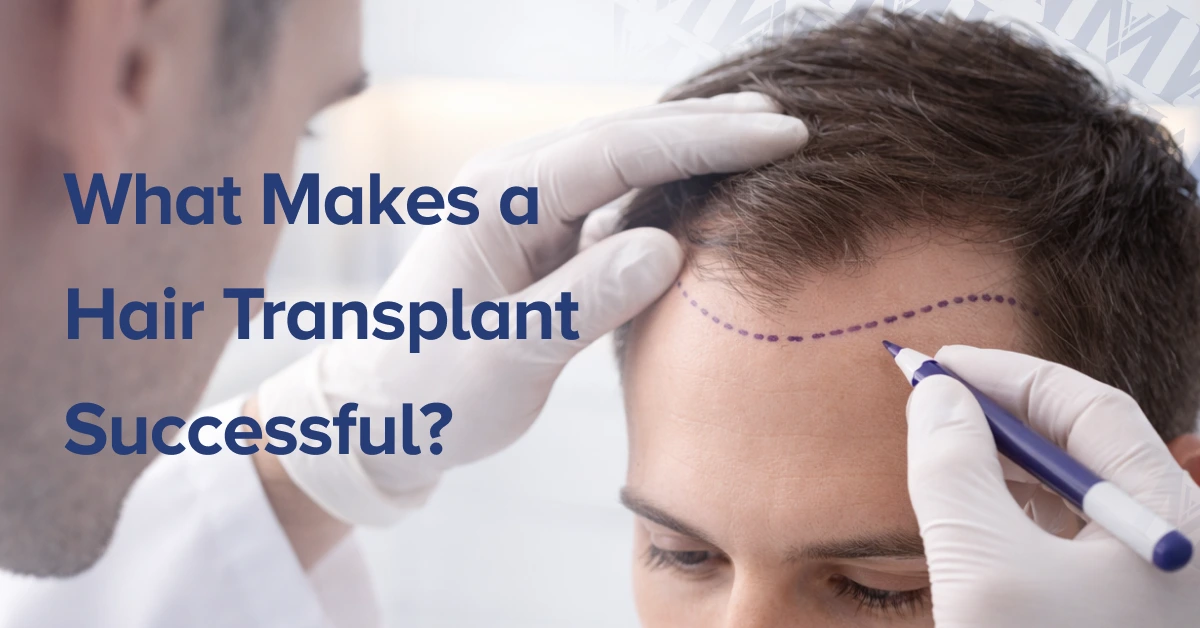
"Hair transplants have a 95% success rate."
You've seen that number on a dozen clinic websites. But what does it actually measure — graft survival? Patient satisfaction? Aesthetic quality? The answer matters, because those are three very different things with three very different numbers.
Search for the hair transplant success rate online, and you'll find clinics claiming 98%, forums overflowing with regret stories, and almost no published data in between. If you're researching whether a hair transplant really works — and whether it's worth the investment — you deserve more than marketing claims dressed up as medical facts.
So we went to the studies. This article breaks down what peer-reviewed research, clinical data from the International Society of Hair Restoration Surgery (ISHRS), and published outcome analyses actually reveal about how often hair transplants succeed, how often they fail, and what determines which category you fall into. Does hair transplant work reliably enough to justify the cost, the travel, and the recovery? The evidence gives a clear answer — but it comes with important nuance.
The single biggest variable in your outcome isn't the technique. It's not even the country. It's something more specific, and more within your control than you might expect.
But first, we need to define what "success" actually means.
Get a Free Consultation!
Talk to an experienced patient coordinator for your hair transplant in Turkey.What Does "Hair Transplant Success Rate" Actually Mean?
Before examining any numbers, you need a framework for interpreting them. Most articles throw out a single percentage and move on. That approach is misleading — because "success" in hair transplantation isn't one measurement. It's at least four.
Graft Survival Rate vs. Overall Outcome
The most commonly cited metric is the hair transplant graft survival rate — the percentage of transplanted hair follicles that take root and produce new growth. When a clinic advertises a "95% success rate," this is almost always what they mean.
But here's the critical distinction: a transplant can have excellent graft survival and still produce a disappointing result. If the hairline was designed too low, the angle of implantation was unnatural, or the density distribution was uneven, the follicles "survived" — but the outcome doesn't look right.
Think of it like having all the right ingredients but following a flawed recipe. The raw materials are fine. The dish still falls flat.
The Four Dimensions of Hair Transplant Success
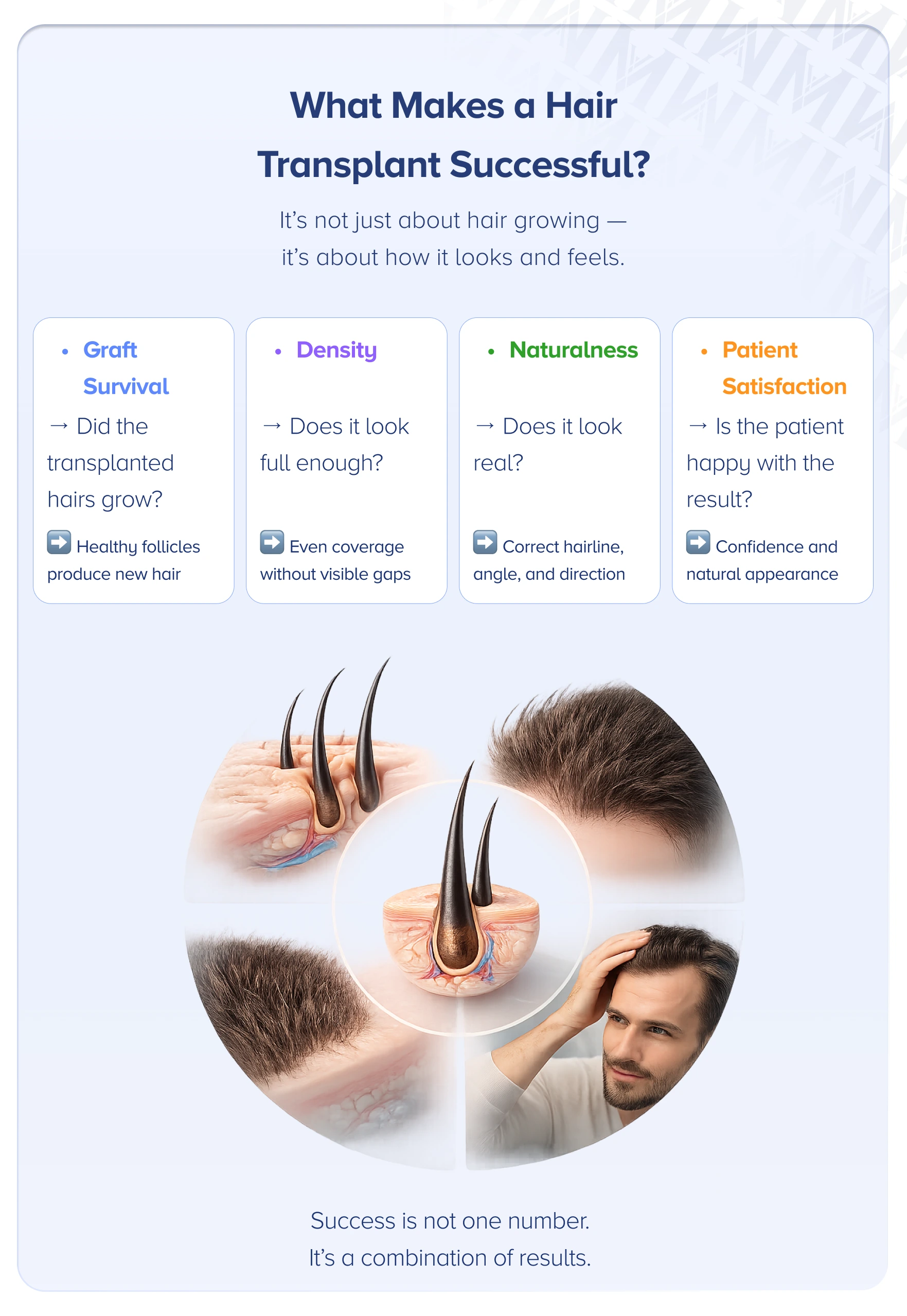
Published research and clinical practice evaluate hair transplant outcomes across four distinct dimensions:
Graft survival rate — Did the transplanted follicles take root and grow? Measured as a percentage, typically assessed at 12 months post-procedure.
Density achievement — Does the transplanted area look full enough? Measured in follicular units (natural groupings of 1–4 hairs) per square centimeter.
Aesthetic naturalness — Do the hairline, growth angle, and direction look like real, unplanted hair? Assessed visually by both surgeon and patient.
Patient satisfaction — Does the patient feel the result meets their expectations? Measured through surveys and self-reporting.
Different studies prioritize different dimensions. A clinical study might report 92% graft survival but never ask the patient whether they're happy. A satisfaction survey might show 95% approval without measuring actual density. This is why you see different numbers everywhere — and why context matters more than any single statistic.
Why You See Different Numbers Everywhere
The inconsistency across sources isn't random. Several specific factors explain it:
Clinics self-report outcomes with no standardized methodology
Studies use different follow-up periods — some assess results at 9 months, others at 18 months
Sample sizes range from 30 patients to over 1,000
Some studies count every surviving follicle under magnification, while others rely on patient-reported outcomes
None of this means the data is useless. It means you need to read it critically — and understanding these measurement differences is the first step toward interpreting the numbers that follow.
Hair Transplant Success Rate by the Numbers: What Published Studies Show
With a clear definition of success established, the real question becomes: what does the published research actually report? The numbers are reassuring — but they come with caveats that every prospective patient should understand.
FUE Success Rates in Clinical Literature
Follicular unit extraction (FUE) is the most widely studied modern technique. Published data on the FUE success rate consistently falls within a specific range:
A 2005 study by Rassman and colleagues, published in Dermatologic Surgery, documented graft survival rates of approximately 90–95% in FUE procedures performed by experienced surgeons — among the first large-scale analyses of FUE outcomes.
Research published in the Journal of Cutaneous and Aesthetic Surgery (Sethi, 2012) reported graft survival rates of 86–95% across a multi-center patient cohort, with variation linked primarily to surgeon experience and graft handling protocols.
A 2017 review in Aesthetic Surgery Journal analyzing outcomes from multiple centers found patient satisfaction rates of 87–97%, depending on study methodology and follow-up duration.
ISHRS practice census data consistently shows FUE as the dominant technique globally, with member-reported outcomes aligning with the 85–95% graft survival range found in independent studies.
Consider a typical case: a 35-year-old patient, Norwood 3, with thick donor hair and good scalp laxity. In published literature, a patient with this profile undergoing FUE would be expected to achieve graft survival at the higher end of the 85–95% range — assuming an experienced surgeon and proper graft handling.
The range exists because outcomes depend on variables beyond the technique itself. Surgeon skill, graft handling, patient health, and aftercare compliance all shift the final number.
DHI Success Rates
Direct Hair Implantation (DHI), which uses a Choi implanter pen to simultaneously create the recipient channel and place the graft, has a growing but thinner evidence base compared to FUE.
Available comparative data suggests the DHI success rate is comparable to conventional FUE, with some studies indicating a potential advantage. A 2020 comparative study published in the Journal of Cosmetic Dermatology found graft survival rates of 90–96% in DHI procedures, possibly due to reduced out-of-body time for grafts and less mechanical handling during implantation.
The honest assessment: fewer large-scale, long-term studies have examined DHI-specific outcomes compared to FUE. The available evidence is promising but not yet as robust. DHI's advantages may be most relevant in specific scenarios — such as implanting into areas with existing hair, where the precision of the Choi pen allows placement without shaving the recipient zone.
Sapphire FUE and Technique Variations
Sapphire FUE uses blades made from synthetic sapphire crystal rather than steel to create recipient channels. The sapphire blade produces a slightly smaller, V-shaped incision compared to steel's U-shaped cut. Published data from a 2021 study in Dermatologic Therapy suggests this leads to:
Faster healing of recipient sites
Reduced post-operative crusting and edema
Potentially tighter packing of grafts (higher density per cm²)
However, the graft survival rate itself doesn't appear dramatically different from standard FUE when performed by equally skilled surgeons. The benefit of sapphire is primarily in healing quality and density potential — not in whether individual follicles survive.
The evidence base for sapphire-specific outcomes is still developing, with fewer controlled trials than conventional FUE. The takeaway: technique matters, but it matters less than the hands performing it. A skilled surgeon using standard steel FUE will outperform an inexperienced one using sapphire blades every time.
How Success Rates Have Improved Over Time
Context helps. Modern hair transplant techniques represent decades of refinement. In the 1990s, older "hair plug" methods produced visible, doll-like results with satisfaction rates as low as 50–70% (Bernstein & Rassman, Dermatologic Surgery, 2000). The shift to follicular unit transplantation — and later to FUE, DHI, and sapphire FUE — dramatically improved both graft survival and aesthetic outcomes.
Today's graft survival rates of 85–95% reflect a mature surgical discipline, not an experimental procedure.
Technique |
Typical Graft Survival Range |
Key Studies / Sources |
Notes |
|---|---|---|---|
FUE |
85–95% |
Rassman et al. (2005); Sethi (2012); ISHRS census data |
Most extensively studied; widest evidence base |
DHI |
90–96% |
Journal of Cosmetic Dermatology (2020) |
Potentially reduced graft handling damage; fewer large studies |
Sapphire FUE |
85–95% |
Dermatologic Therapy (2021) |
Healing and density benefits; survival rates similar to standard FUE |
Older methods (plugs/strip) |
70–90% (survival); 50–70% (satisfaction) |
Bernstein & Rassman (2000) |
Historical comparison; largely obsolete |
Key finding: Modern FUE, DHI, and Sapphire FUE all achieve graft survival rates of 85–95% in published literature. The differences between techniques are smaller than the differences between surgeons.

Hair Transplant Failure Rate: How Often Do Things Go Wrong?
If graft survival runs 85–95%, what accounts for the cases that don't go as planned? Understanding the hair transplant failure rate requires distinguishing between different types and degrees of poor outcomes — because "failure" isn't a single thing.
Defining "Failure" — Partial vs. Total
Not all disappointing results are equal. Clinical literature distinguishes between three categories:
Complete graft failure: Near-zero growth from transplanted follicles. The grafts simply didn't take. This is the scenario patients fear most.
Partial failure: Grafts survived, but density is patchy, coverage is uneven, or overall results fall short of what was planned. The transplant "worked" — just not well enough.
Expectation mismatch: The clinical outcome falls within normal parameters, but the patient expected more. The transplant succeeded medically but fell short psychologically.
Each has different causes, different frequencies, and different solutions.
The Most Common Reasons Hair Transplants Fail
When outcomes disappoint, the cause almost always traces back to one or more of these factors:
Poor graft handling — Follicles left outside the body too long, allowed to dry out (desiccation), or damaged by rough mechanical extraction. Graft survival drops measurably when out-of-body time exceeds 4–6 hours without proper storage solutions.
Inexperienced surgeon or technician — Particularly in high-volume settings where undertrained staff perform critical steps. Published analyses cite this as the single most common factor in poor outcomes.
Poor candidate selection — Operating on patients with insufficient donor supply, unstabilized hair loss, or conditions like scarring alopecia misdiagnosed as androgenetic alopecia (pattern hair loss).
Overharvesting the donor area — Extracting too many grafts from the donor zone, leading to visible thinning or scarring at the back and sides of the head.
Infection or poor aftercare compliance — Patients who don't follow post-operative protocols risk damaging newly placed grafts during the critical first 14 days.
Underlying medical conditions — Autoimmune disorders, uncontrolled thyroid disease, or nutritional deficiencies can impair healing and graft survival.
Hair transplantation also carries standard surgical risks including infection, scarring, and temporary numbness in the donor or recipient area. These complications are generally minor and manageable when the procedure is performed in an accredited clinical setting.
Many of these factors are avoidable — which is why recognizing the red flags of hair mills and ghost clinics matters so much during the research phase.
How Common Is Complete Transplant Failure?
Here's the reassuring part: complete transplant failure — where zero or near-zero growth occurs — is rare. Published data suggests it happens in fewer than 1–3% of cases at qualified clinical settings, according to analyses published in Dermatologic Surgery (Avram, 2009).
The more common "failure" is a result that's underwhelming, not catastrophic. Estimates for partial dissatisfaction — where growth occurs but density, distribution, or appearance falls short — range from 5–15%, depending on how the study defines dissatisfaction and the quality of clinics included in the sample.
Perspective check:
A 5–15% partial dissatisfaction rate means the vast majority of patients — 85–95% — report outcomes that meet or exceed their expectations. But it also means roughly 1 in 7 to 1 in 20 patients wishes their result were better. That's not a number to ignore.
Factors That Directly Affect Your Hair Transplant Success Rate
The numbers above tell a clinical story. Your personal success rate depends on a different set of variables — some within your control, others inherent to your biology.
Surgeon Experience and Clinic Quality
Published data consistently identifies this as the single most influential factor. A 2018 analysis published in Aesthetic Plastic Surgery found that surgeon case volume correlated directly with both graft survival rates and patient satisfaction scores. Surgeons who had performed over 1,000 procedures achieved measurably better outcomes than those earlier in their careers.
What to look for specifically:
Board certification in dermatology or plastic surgery
Verifiable case volume (years of experience alone isn't sufficient)
Whether the surgeon personally performs the critical steps — hairline design, recipient site creation — or delegates them to technicians
Membership in recognized bodies like the ISHRS
Your Hair Loss Stage and Pattern
Your position on the Norwood Scale — the standard classification system for male pattern hair loss — directly affects what's achievable. The data below primarily covers androgenetic alopecia in males, though female pattern hair loss involves different considerations and candidacy criteria.
Norwood 2–4: Generally the strongest candidates. Sufficient donor supply relative to the area needing coverage. Single-session results are often excellent.
Norwood 5–6: Achievable results, but may require careful planning, multiple sessions, or adjusted expectations regarding total coverage.
Norwood 7: The most challenging. Limited donor supply must cover the largest area. A skilled surgeon will prioritize strategic coverage rather than attempting full density everywhere.
Donor Hair Quality
Not all donor hair is equal. Several characteristics affect perceived density and aesthetic outcome:
Hair caliber (thickness): Thicker individual hairs provide more coverage per graft. Patients with fine hair may need more grafts to achieve the same visual density.
Curl and wave pattern: Curly or wavy hair covers more scalp area per strand. Patients with Afro-textured hair often achieve higher perceived density per graft, though surgical extraction requires specific expertise.
Color contrast: Dark hair against light skin shows more scalp between hairs. Lower contrast (blond hair on fair skin, dark hair on darker skin) is more forgiving.
Age and Hair Loss Stability
Consider a patient who is 23, Norwood 3, with a family history of extensive hair loss. A transplant today might look excellent — but if hair loss progresses to Norwood 6 over the next decade, the transplanted hairline could end up as an island of hair surrounded by thinning.
Patients under 25 face the highest risk of future loss making their transplant look incomplete. Stabilized hair loss — ideally confirmed over 1–2 years of observation — leads to more predictable, lasting outcomes.
A board-certified surgeon can evaluate your donor area and hair loss trajectory to give you a realistic success estimate. That assessment determines whether the timing is right, or whether waiting produces a better long-term result.
Post-Operative Care and Medication Compliance
The first 14 days after surgery are critical. Transplanted grafts haven't yet established a blood supply in their new location. During this window, physical trauma, infection, and sun exposure can all reduce graft survival.
Following aftercare protocols isn't optional — it's a direct input to your success rate. Beyond immediate recovery, medications like finasteride and minoxidil play a role in maintaining non-transplanted native hair. The transplanted hair is permanent, but the hair surrounding it may continue to thin without treatment.
Realistic Expectations
Research published in Aesthetic Surgery Journal (2017) found that patients who received thorough pre-operative counseling reported significantly higher satisfaction — even when their clinical outcomes were identical to patients who hadn't received that counseling.
Now consider two hypothetical patients. Patient A, age 35, Norwood 3, receives a detailed consultation explaining that 3,000 grafts will provide natural density but not the hairline of a 20-year-old. Patient B, same profile, is told by a different clinic that they'll get "full coverage."
Both receive identical procedures. Patient A reports satisfaction. Patient B feels let down. The surgery didn't fail. The expectation-setting did.
A good clinic sets expectations before surgery, not after — and that conversation is one of the clearest indicators of a clinic that prioritizes outcomes over sales.
Hair Transplant Success Rates in Turkey: What the Data Shows
The clinical data above applies globally. But if you're reading this article, there's a reasonable chance you're specifically evaluating Turkey as a destination — and wondering whether the hair transplant Turkey success rate matches what's reported in the literature.
Why Turkey Became a Global Hub for Hair Transplants
Turkey performs more hair transplant procedures than any other country. ISHRS global practice survey data estimates over 500,000 procedures annually, making it the world's largest market by volume. Several factors drove this growth:
Cost efficiency — Lower operating costs, real estate, and labor costs allow Turkish clinics to offer procedures at a fraction of US or European pricing without necessarily sacrificing quality at top-tier facilities.
Surgical volume — Surgeons at leading Turkish clinics may perform 300–500+ procedures per year, building steep experience curves that directly correlate with better outcomes.
Infrastructure — Istanbul in particular has developed a medical tourism ecosystem with dedicated facilities, multilingual staff, and streamlined patient logistics.
The Range of Quality in Turkish Clinics
Here's where honesty matters most. The Turkish hair transplant market ranges from genuinely excellent to dangerously substandard — and the gap between the two is wider than in most countries.
At one end: clinics that limit surgical volume to 1–2 patients per day, employ board-certified surgeons who perform all critical steps personally, and follow international protocols for graft handling and storage.
At the other end: high-volume operations that process 8–10+ patients per day per surgeon, delegate most of the procedure to undertrained technicians, and prioritize throughput over outcomes. The Turkish Ministry of Health regulates medical tourism, and regulatory frameworks exist — but enforcement varies across the market.
The difference in outcomes between these two extremes is not subtle.
Published Outcomes from Turkish Clinics
Peer-reviewed data specifically from Turkish institutions is growing. A 2019 retrospective study analyzing outcomes from accredited Istanbul clinics, published in the Journal of Cosmetic Dermatology, reported graft survival rates consistent with global averages (88–94%) and patient satisfaction rates above 90%.
However, these studies typically come from high-quality academic or accredited private centers — not from the full spectrum of the market. Patient satisfaction data from review aggregators should be interpreted with caution due to selection bias, as satisfied patients are more likely to leave reviews.
How to Evaluate a Turkish Clinic's Real Success Rate
Rather than trusting a clinic's self-reported number, apply these evaluation criteria:
Ask for before-and-after galleries with consistent lighting, angles, and timeframes — ideally 12+ months post-procedure
Look for cases that match your specific hair loss pattern and stage
Verify the surgeon's credentials independently, not just the clinic's marketing materials
Ask directly: who will perform the hairline design, the incisions, and the graft placement?
Request to speak with previous patients whose cases are similar to yours
When evaluating before-and-after photos, pay attention to details that reveal honesty: consistent natural lighting versus flash, dry hair versus wet hair (wet hair always looks thinner), and similar styling in both photos. Clinics that show results under unflattering, consistent conditions are demonstrating confidence in their outcomes.
The Turkey takeaway:
Top Turkish clinics achieve outcomes matching global averages of 88–94% graft survival. But the quality gap between the best and worst clinics is wider here than in most countries. Your choice of surgeon matters more than your choice of country.

Does Hair Transplant Work Long-Term? Longevity of Results
Knowing that grafts survive the first year is reassuring. But do hair transplants last for decades? The answer draws on one of the most well-established principles in hair restoration science.
Why Transplanted Hair Is (Mostly) Permanent
Donor dominance — the principle that hair follicles retain the genetic characteristics of the area they were taken from, even after relocation — is the biological foundation of hair transplantation. Think of it like transplanting a plant from one garden bed to another. The plant keeps its original DNA regardless of where you put it.
Hair follicles harvested from the "safe zone" at the back and sides of the scalp are genetically resistant to dihydrotestosterone (DHT), the hormone responsible for androgenetic alopecia. Once transplanted to a thinning area, these follicles continue to grow — typically for life.
What Can Change Over Time
The transplanted hair is permanent. The hair around it is not. This is the critical distinction that many patients miss.
Several factors can affect the long-term appearance of your hair transplant results:
Progressive thinning of non-transplanted native hair over years or decades
Gradual changes in hair caliber or texture that occur naturally with aging
Shifts in the overall pattern if hair loss wasn't fully stabilized before the original surgery
Without a long-term plan, a patient can end up with a well-preserved transplanted zone surrounded by progressive thinning — creating an unnatural appearance that wasn't present at the 12-month mark. This is why medications like finasteride and minoxidil are often recommended alongside transplantation. They don't affect the transplanted hair. They protect the native hair that completes the overall picture.
5-Year and 10-Year Outcome Data
Long-term follow-up data, while less abundant than 12-month studies, supports the durability of hair transplant long-term results. A 10-year retrospective analysis presented at the 2018 ISHRS World Congress found that transplanted follicles in the frontal and mid-scalp zones maintained over 90% of their original density at the decade mark. While conference-presented data carries less weight than peer-reviewed publications, these findings align with the broader clinical consensus on transplant longevity.
Patients who reported the highest long-term satisfaction shared a common approach:
Combined transplantation with ongoing medical maintenance for native hair
Planned for a potential second session to address progressive loss if needed
Scheduled periodic assessments to monitor changes in non-transplanted areas
Hair transplant results are permanent — but the strategy around them should be ongoing.
Month-by-Month: When Can You Actually Judge Your Results?
Understanding the growth timeline prevents the most common source of unnecessary anxiety: judging your transplant too early. Many patients who believe their procedure failed at month 3 are actually right on schedule.
The Growth Timeline (Month 0–18)
Timeframe |
What to Expect Physically |
What to Expect Emotionally |
|---|---|---|
Week 1–2 |
Redness, crusting, mild swelling. Grafts are fragile. |
Excitement mixed with nervousness. Careful adherence to aftercare. |
Week 2–6 |
Shock loss begins — transplanted hairs shed. The follicles remain alive beneath the skin. |
Anxiety peaks. "Did it work?" is the most common concern. |
Month 2–3 |
Minimal visible growth. Scalp may look similar to pre-transplant. |
Patience is tested. Many patients search for reassurance online. |
Month 4–6 |
New growth emerges — thin, wispy hairs that gradually thicken. |
Cautious optimism. First signs of change are encouraging but incomplete. |
Month 8–10 |
Significant visible improvement. Hair thickens, density increases. |
Growing confidence. The result starts to take shape. |
Month 12–18 |
Final result. Full thickness, mature density, natural texture. |
Satisfaction assessment is now valid. This is when to evaluate your outcome. |
For a deeper understanding of the shedding phase, our guide on shock loss after hair transplant explains why this happens and what to watch for.
Why Judging Too Early Is the Biggest Mistake
The growth cycle of transplanted hair is biologically fixed. Follicles must re-enter the active growth phase (anagen) after being transplanted, and this process takes months. Published data confirms that final results should not be assessed before 12 months, with some patients seeing continued improvement up to 18 months.
Signs that your transplant is progressing normally — even if it doesn't feel like it:
Transplanted hairs shed within the first 2–6 weeks (this is shock loss — expected and healthy)
Minimal visible change at months 2–3 (the "ugly duckling phase")
Thin, wispy new growth beginning around month 4
Gradual thickening and density increase from month 6 onward
A patient who panics at month 3 and concludes their transplant failed is making a judgment with incomplete data. A qualified surgeon will schedule follow-up assessments at strategic intervals to track progress and provide reassurance based on clinical observation — not anxiety.
The bottom line:
If your grafts were placed correctly and you followed aftercare protocols, month 3 tells you almost nothing. Month 12 tells you almost everything.

What to Do If Your Hair Transplant Doesn't Meet Expectations
Even with the best planning, some patients feel their results fall short. Knowing the difference between normal healing and a genuine problem — and understanding your options — matters more than hoping for the best.
When to Be Concerned vs. When to Be Patient
Patience is appropriate when growth is slow but progressive. Concern is warranted when:
There is zero visible new growth by month 8–10
You observe signs of infection — persistent redness, pus, or pain beyond the first few weeks
Visible scarring develops in the recipient or donor area
Growth is extremely patchy in a pattern that doesn't match normal growth cycles
If any of these occur, consult your surgeon — or seek a second opinion from a board-certified hair restoration specialist. Early intervention can sometimes address issues before they become permanent.
Revision Procedures and Corrective Options
Second transplant sessions are more common than many patients realize. According to ISHRS survey data, an estimated 20–30% of patients undergo a second procedure — often not because the first failed, but because hair loss progressed and they wanted additional coverage.
Corrective options for genuinely suboptimal results include:
Additional grafting sessions to increase density in thin areas
Hairline redesign to correct an unnatural shape or placement
Scar revision in the donor or recipient area
Medical therapy to support growth in underperforming grafts
These corrective procedures are possible but more complex than a first-time transplant. Understanding how many hair transplants you can have depends on your remaining donor supply and scalp laxity.
The Importance of Choosing Right the First Time
Every procedure uses donor hair — a finite resource. A poorly executed first transplant doesn't just produce a bad result. It wastes grafts that can never be recovered and may create scarring that complicates future work.
Corrective surgery is harder, more expensive, and draws from an already-depleted donor area. Your first procedure carries the most weight. Investing the time to choose the right surgeon isn't caution — it's the highest-leverage decision you'll make in this entire process.
How to Maximize Your Hair Transplant Success Rate
The data is clear: outcomes are not random. Specific actions before, during, and after your procedure directly influence your personal hair transplant success rate.
Before Your Procedure
Preparation begins weeks or months before surgery day:
Research the surgeon, not just the clinic. Verify credentials, review case photos, and confirm who performs each step of the procedure.
Get a personalized assessment based on your hair loss pattern, donor capacity, and goals — not a one-size-fits-all graft package.
Stabilize active hair loss if possible. Your surgeon may recommend medication or a waiting period.
Stop smoking at least 2–4 weeks before surgery. Nicotine impairs blood flow and reduces graft survival.
Follow all pre-operative instructions provided by your surgical team.
During Your Procedure
You have less control during surgery, but informed patients make better decisions:
Confirm the surgeon is present for hairline design and recipient site creation — the two steps that most determine your aesthetic outcome.
Ask about graft storage protocols. Solutions like hypothermosol or ATP-supplemented media maintain cell viability better than plain saline during longer procedures.
Don't push for a maximum graft count if your surgeon recommends fewer. Overharvesting the donor area creates problems that are difficult to reverse.
After Your Procedure
The first two weeks are a direct input to your graft survival rate:
Follow aftercare instructions precisely — sleeping position, washing technique, activity restrictions. These protocols exist because they're backed by clinical evidence.
Protect grafts from direct sun exposure, physical trauma, and submersion in water.
Consider maintenance medication (finasteride or minoxidil) for non-transplanted areas, as discussed with your surgeon.
Attend all follow-up appointments, whether in-person or through remote consultations with your surgical team.
Be patient. The timeline is 12–18 months. Trust the biology.
FAQ — Hair Transplant Success Rate
Still have questions about your specific case? Use our graft calculator for an initial estimate, or reach out to our medical team directly for a personalized consultation.
