
You've spent weeks researching hair transplants. You've compared clinics in your home city, winced at the prices, and noticed that half the before-and-after photos you admire online seem to come from Istanbul. You're seriously considering travelling from the UK, Germany, France, or elsewhere in Europe for a hair transplant in Turkey — but you still have questions. Real ones. How does it actually work? Is it safe? What does the trip look like from start to finish?
You're far from alone. According to widely cited industry data, Turkey now performs an estimated 500,000–700,000+ hair transplant procedures every year. European patients — men and women from London, Berlin, Paris, Amsterdam, Stockholm, and dozens of other cities — make up the largest international segment. This isn't a fringe decision. It's a well-worn path taken by hundreds of thousands of people annually.
Hair loss is deeply personal. It shapes how you see yourself and how you feel others see you. That's precisely why this decision deserves thorough, honest information — not a sales pitch.
But here's the point that too often gets buried beneath the enthusiasm: the destination matters far less than the clinic you choose. Turkey's sheer scale means the gap between an outstanding clinic and a dangerous one is vast. Your job is to know the difference.
This guide covers everything European patients need to know — from country-specific logistics and real cost breakdowns to aftercare back home and how to identify a clinic you can trust. Whether you're flying from Manchester or Marseille, consider this your complete playbook.
"Travelling from Europe to Turkey for a hair transplant is a well-established, logistically simple process — but the quality of your outcome depends entirely on the clinic you choose, not the country you fly from."
This article is for informational purposes only and does not constitute medical advice. Hair transplant results vary based on individual factors including hair type, donor area density, extent of hair loss, and adherence to aftercare protocols. Always consult a qualified medical professional before making decisions about surgical procedures.
Why Hundreds of Thousands of Europeans Choose Turkey for Hair Transplants
Turkey didn't become the global capital of hair restoration by accident. Over two decades, Istanbul built an entire ecosystem around hair transplantation — fuelled by surgical specialisation, fierce competition that drives innovation, and active government support for health tourism. The result: an estimated 350+ clinics dedicated to hair restoration in a single city. More than anywhere else on earth.
For European patients specifically, the appeal is straightforward:
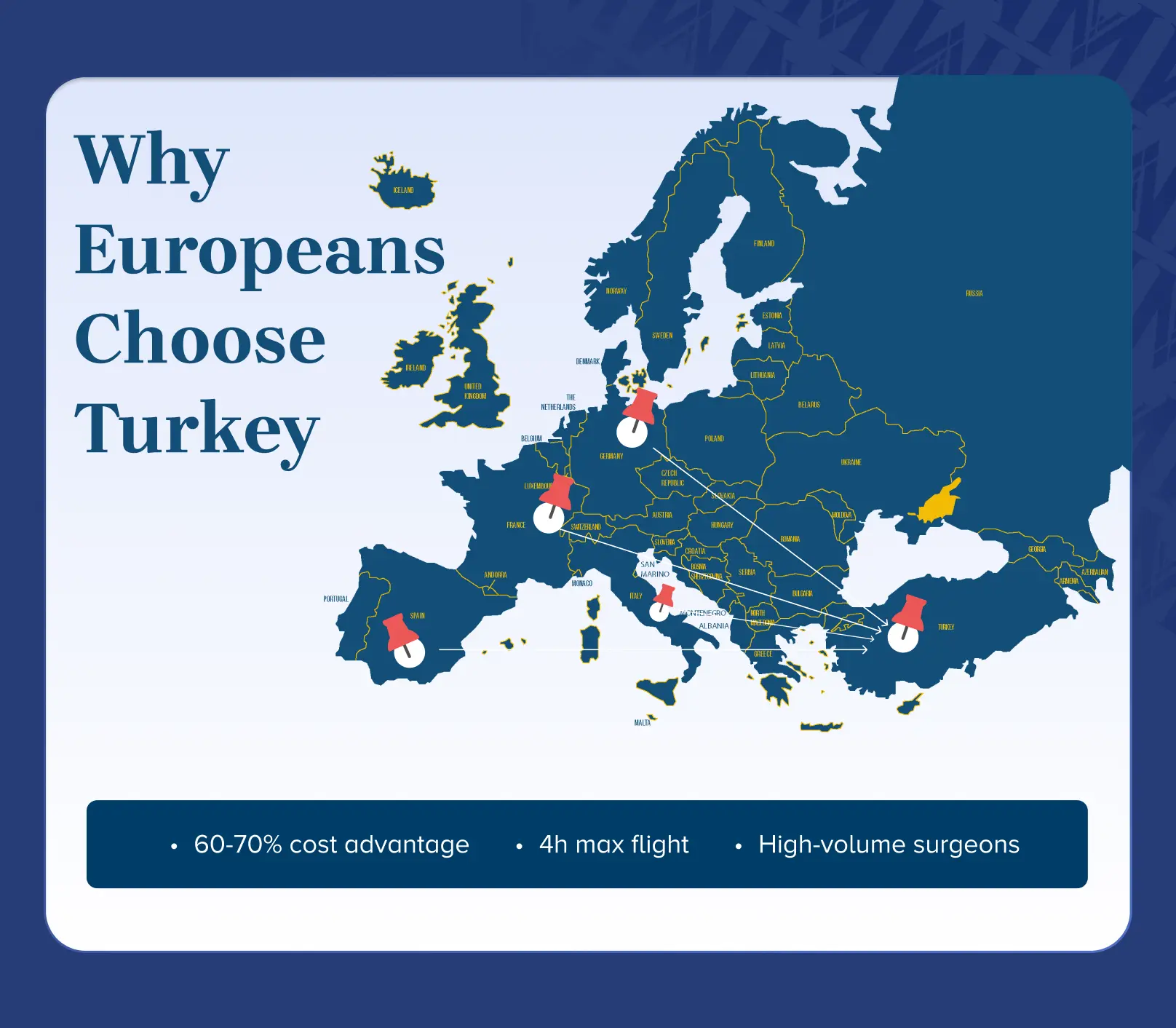
- Significant cost savings — typically 60–70% less than equivalent procedures at home, even after factoring in flights and accommodation
- Access to highly experienced surgeons who perform procedures at volumes most European clinics simply cannot match
- All-inclusive packages that bundle the procedure, hotel, airport transfers, medications, and aftercare into one transparent price
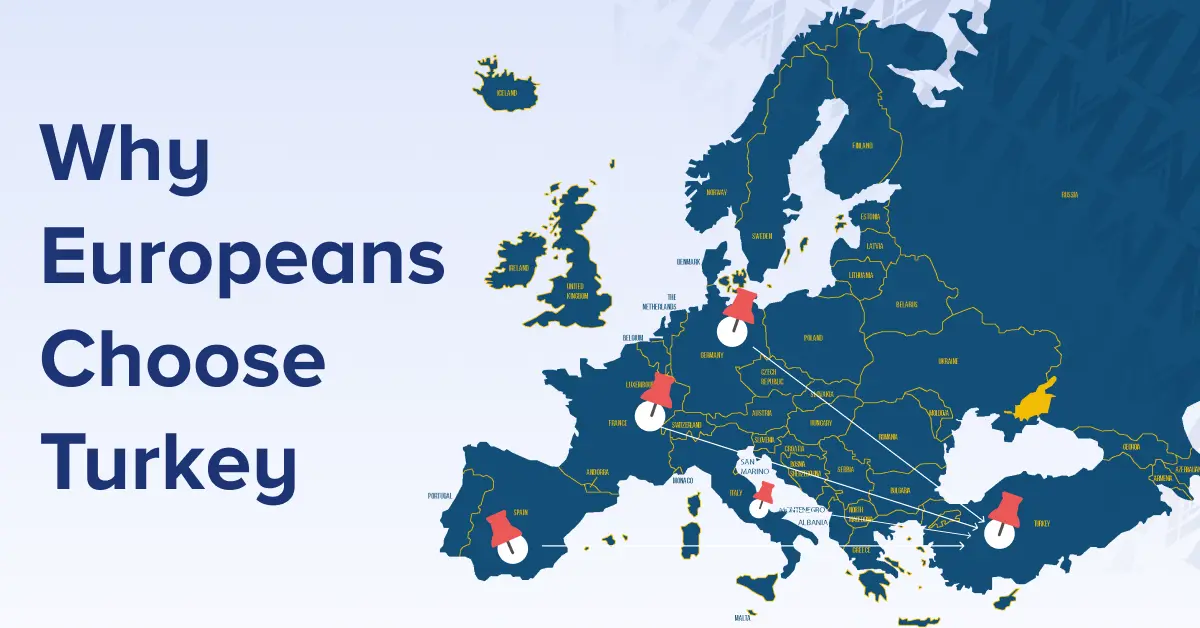
- Short travel times — no European capital is more than roughly four hours from Istanbul by air
- Growing normalisation — medical tourism for hair transplants in Turkey has shifted from niche curiosity to mainstream European option
According to Turkey's Ministry of Health, the country's health tourism revenue exceeded $2 billion in recent years, with hair transplants representing a significant share. That scale benefits patients directly. High demand has created a competitive market where clinics invest in the latest techniques, equipment, and patient experience to differentiate themselves.
What's Driving the Trend?
The primary driver is a combination of cost, quality, and convenience that no European country currently matches. A hair transplant in Istanbul from Europe often costs less in total — including flights and hotel — than the procedure fee alone at a private clinic in London, Frankfurt, or Paris.
Word of mouth has been powerful too. When a colleague returns from Istanbul with natural-looking results and a story about a surprisingly smooth experience, it rewrites assumptions. And the infrastructure makes it easy — Istanbul's position as a global hub means direct flights depart daily from virtually every major European city.
It's worth noting that results typically take 12–18 months to fully materialise. But the value proposition is compelling enough that hundreds of thousands of Europeans make the trip every year — and that number continues to climb.
Get a Free Consultation!
Talk to an experienced patient coordinator for your hair transplant in Turkey.Country-by-Country Breakdown: Travelling from the UK, Germany, France & Beyond
The numbers explain why so many Europeans choose Turkey. But what does the trip actually look like from your specific country? This section breaks down the practical details for Europe's largest patient markets.
Hair Transplant Turkey from the UK
The UK sends more patients to Istanbul for hair transplants than any other European country. The route is well-established, the logistics are simple, and the savings are among the most dramatic anywhere in Europe.
- Flight time: ~3.5–4 hours from London (Gatwick, Heathrow, Stansted, Luton). Direct flights also operate from Manchester, Birmingham, Edinburgh, Leeds Bradford, and Bristol
- Cost comparison: Private hair transplant clinics in the UK typically charge £8,000–£15,000+ for an FUE procedure. In Turkey, all-inclusive packages at reputable clinics range from £1,500–£3,500 — covering the procedure, hotel, transfers, and medications
- Visa: UK passport holders can obtain an e-visa online before travel. The process takes minutes and costs a small fee
- Language: English is widely spoken at Istanbul's top clinics. UK patients are the largest European demographic, so clinics are well-practised in catering to British expectations
- Practical tip: Many UK patients fly out Thursday evening, have the procedure on Friday, attend the aftercare briefing on Saturday, and fly home Sunday or Monday — requiring as little as one day off work beyond a normal weekend
The NHS does not cover cosmetic hair transplants. Private UK clinics rank among the most expensive in Europe, which makes the contrast with Turkey particularly stark. Here's a comparison that often surprises first-time researchers: the flight from London to Istanbul is actually shorter than the flight from London to the Canary Islands.
Hair Transplant Turkey from Germany
Germany is typically the second-largest European source market for hair transplants in Turkey. Direct daily flights, German-speaking clinic staff, and significant cost savings make it a natural choice.
- Flight time: ~3 hours from Frankfurt, Berlin, or Munich. Direct flights also operate from Düsseldorf, Hamburg, Stuttgart, Cologne, and Hannover
- Cost comparison: Hair transplant procedures in Germany generally cost €6,000–€12,000+ at established clinics. In Turkey, all-inclusive packages range from €1,800–€3,500
- Visa: German passport holders enjoy visa-free entry to Turkey for stays under 90 days. No advance paperwork required
- Language: Many Istanbul clinics employ dedicated German-speaking patient coordinators. Consultations, pre-operative briefings, and aftercare instructions are commonly available in German
- Cultural note: German patients often prioritise thorough documentation, detailed treatment plans, and verifiable clinical certifications. Reputable Turkish clinics are well-accustomed to this expectation and typically provide comprehensive written records of the procedure, graft count, and aftercare protocol
German private health insurance (PKV) rarely covers hair transplants, as they are classified as cosmetic. Public insurance (GKV) does not cover them at all. The full cost falls on the patient regardless — making Turkey's pricing especially relevant.
A typical German patient's trip might look like this: fly from Frankfurt on Friday morning, have the procedure that afternoon, attend the aftercare session on Saturday, and be back home by Sunday evening. Away for barely more than a long weekend.
Hair Transplant Turkey from France
France is a rapidly growing market for hair transplants in Turkey. Historically, there has been more cultural hesitation around cosmetic procedures for men in France, but attitudes have shifted significantly in the past five years.
- Flight time: ~3.5 hours from Paris (Charles de Gaulle, Orly). Direct flights also operate from Lyon, Marseille, Nice, and Toulouse
- Cost comparison: French clinics typically charge €5,000–€10,000+ for hair transplant procedures. Turkey's all-inclusive packages range from €1,800–€3,500
- Visa: French passport holders enter Turkey visa-free for stays under 90 days
- Language: French-speaking coordinators are available at many leading clinics, though less universally than English or German-speaking staff. Confirm French-language support during your initial consultation
- Healthcare note: France's public healthcare system (Assurance Maladie) does not cover cosmetic hair transplants. Private supplementary insurance (mutuelle) typically excludes them as well
- Practical tip: Budget carriers like Pegasus and Transavia offer competitive direct routes from several French cities, keeping flight costs low
Other European Countries: Netherlands, Scandinavia, Spain, Italy & More
The UK, Germany, and France represent the largest European patient groups — but they're far from the only ones. Patients from across the continent follow a similar path.
- Netherlands & Belgium: Flight times of 3–3.5 hours from Amsterdam, Rotterdam, or Brussels. Domestic costs are comparable to Germany (€6,000–€12,000+). Dutch and Belgian patients are an increasingly common presence at Istanbul clinics, and high English proficiency means language is rarely a barrier
- Scandinavia (Sweden, Norway, Denmark): Flights of 3.5–4 hours from Stockholm, Oslo, or Copenhagen. Domestic hair transplant costs in Scandinavia are among Europe's highest — €8,000–€15,000+ — making Turkey's savings especially compelling
- Spain & Italy: Flight times of 3–3.5 hours from Madrid, Barcelona, Rome, or Milan. Both are growing markets, and Spanish- and Italian-speaking support is increasingly available at leading clinics
- Eastern Europe (Poland, Hungary, Czech Republic): Shorter flights of 2–2.5 hours. Domestic costs are lower than in Western Europe but still notably higher than Turkey. These countries are medical tourism destinations in their own right, yet Turkey's specialisation and volume in hair transplantation specifically remains unmatched
- Visa note for all EU/EEA countries: Citizens of EU and EEA member states enter Turkey visa-free for tourist stays of up to 90 days
The universal point: no European country is more than approximately four hours from Istanbul by air. For most patients, the travel involved is less than a typical Mediterranean holiday.
Cost Comparison — What European Patients Actually Pay
Cost is the single biggest factor driving European patients to Turkey. But the headline procedure price doesn't tell the whole story. Understanding the Turkey hair transplant cost for Europeans means examining the complete picture — flights, accommodation, and time away from work included.
The All-Inclusive Package Model
Most reputable Turkish clinics offer all-inclusive packages. This hair transplant cost in Turkey model is fundamentally different from how clinics operate in most European countries, where you pay separately for the procedure, consultations, medications, and every follow-up appointment.
A typical hair transplant Turkey package covers:
- The hair transplant procedure itself
- Pre-operative blood tests
- Hotel accommodation (typically 4–5 star) for 2–3 nights
- Airport-to-hotel and hotel-to-clinic transfers
- Post-operative medications and aftercare kit
- A PRP (Platelet-Rich Plasma) session — a treatment that uses your own blood to support healing
- Washing demonstration and aftercare briefing
At reputable clinics, these packages typically range from €1,800–€4,000, depending on the technique used, the number of grafts (individual hair follicle units), and the clinic's tier. Prices are approximate and based on market data at time of writing. Actual costs may vary by clinic, technique, and individual treatment plan.
Total Cost Breakdown: Procedure, Travel & Extras
Here's what the full trip typically costs for European patients, set against the price of having the procedure at home:
| Cost Element | UK Patient (£) | German Patient (€) | French Patient (€) |
|---|---|---|---|
| Domestic procedure cost | £8,000–£15,000+ | €6,000–€12,000+ | €5,000–€10,000+ |
| Turkey procedure (all-inclusive) | £1,500–£3,500 | €1,800–€3,500 | €1,800–€3,500 |
| Flights (return) | £50–£250 | €50–€250 | €50–€250 |
| Spending money/extras | £80–£250 | €100–€300 | €100–€300 |
| Total Turkey trip | £1,630–£4,000 | €1,950–€4,050 | €1,950–€4,050 |
| Estimated savings | £4,000–£11,000+ | €1,950–€7,950+ | €950–€5,950+ |
The numbers are hard to argue with. For the price of a single procedure at a London clinic, you could fly to Istanbul, stay in a 5-star hotel, have the transplant, enjoy a meal overlooking the Bosphorus, and still have thousands of pounds left over.
Hidden Costs to Watch For
Transparency is everything — and not every clinic operates honestly. Be alert to these potential hidden costs:
- Low-ball quotes with day-of upselling — some clinics advertise a low price, then pressure you into paying more once you've arrived and feel committed
- Additional PRP sessions marketed as essential when they may not be necessary for your case
- Revision procedures — choosing a low-quality clinic to save a few hundred euros can lead to a second procedure costing thousands. Investing in a reputable clinic upfront is the most cost-effective decision you can make
- Time off work — though Turkey trips typically require only 2–4 days away, factor this into your planning
The best protection against hidden costs? A detailed, written quote before you travel, with a clear breakdown of what's included and what isn't. If a clinic won't provide one, that tells you everything you need to know.
Want to see exactly what's included in a transparent, all-inclusive package? Explore our hair transplant Turkey packages.
What European Patients Should Expect — The Hair Transplant Journey
Costs and logistics are one thing. But what does the experience actually feel like — from your first enquiry to the flight home? Walking through the process step by step removes the uncertainty and replaces it with a clear picture you can plan around.
Before You Fly — Remote Consultation & Planning
Your journey starts weeks before you board a plane:
- Initial enquiry: You send photos of your hair (top, sides, back, hairline) to the clinic via their website, email, or WhatsApp
- Remote assessment: A qualified medical professional evaluates your hair loss pattern using the Norwood Scale (which classifies the stages of male pattern hair loss), assesses your donor area (typically the back and sides of the head, where hair is genetically resistant to thinning), and discusses realistic expectations. Female patients may be assessed using different classification systems such as the Ludwig Scale
- Treatment plan: You receive a personalised plan detailing the recommended technique, estimated graft count, and a transparent quote
- Booking: Most patients book 2–8 weeks in advance, though some clinics accommodate shorter timescales
- Pre-procedure instructions: Your clinic will advise you on which medications to pause, along with guidelines on alcohol and other preparation steps
One critical rule of thumb: any reputable clinic will offer a video consultation before you commit. If a clinic refuses this — or pushes you to book without a personalised assessment — treat it as a serious warning sign.
Arrival in Istanbul — Day-by-Day Overview
A typical European patient's trip might look like this. For a more granular walkthrough, see our day-by-day breakdown of a hair transplant trip to Turkey.
Day 1: Arrival — You land in Istanbul and are met by a clinic driver at the airport. You're transferred to your hotel — usually a 4- or 5-star property near the clinic. If you arrive in the evening, your in-person consultation and blood tests take place the following morning
Day 2: Procedure Day — The transplant itself typically takes 6–8 hours, depending on the number of grafts. You're awake throughout under local anaesthesia, with breaks for food and rest. Many patients watch films, listen to podcasts, or simply doze. By evening, you're back at your hotel — tired, but with the hard part behind you
Day 3: Aftercare & Departure — The clinic provides a washing demonstration, showing you exactly how to care for the transplanted area. You receive a full aftercare briefing, your medications, and an aftercare kit. Some patients have an optional PRP session. By the afternoon, many are heading to the airport
Picture this: a UK patient flies from Gatwick on Thursday evening, has the procedure on Friday, completes aftercare on Saturday morning, and is back home by Saturday evening. Total time away from home: roughly 48 hours.
The Procedure Itself — What Happens in the Clinic
On procedure day, the focus is on your comfort and the precision of the work:
- Local anaesthesia is administered to numb both the donor and recipient areas. Some patients report mild discomfort during the initial injections, but the procedure itself is typically painless
- Extraction phase: Individual grafts are extracted from the donor area
- Implantation phase: Grafts are placed into carefully created channels in the thinning or balding areas
- Breaks: You'll have pauses for food, water, and rest throughout the day
Different hair transplant techniques are available — including FUE (Follicular Unit Extraction, the most common modern technique where individual follicles are extracted one by one), Sapphire FUE (a refinement using sapphire-tipped blades for the incision channels), and DHI (Direct Hair Implantation, where grafts are implanted using a specialised pen tool). Your surgeon will recommend the most suitable approach during your consultation.
One important note: the procedure is identical regardless of where you fly from. Your nationality doesn't change the medical process. What matters is the skill of the surgeon and the standards of the clinic. Ask directly: "Will the surgeon personally perform the extraction and implantation, or will technicians handle parts of the procedure?" The answer reveals more about a clinic's standards than anything on its website.
Get Your Free Hair Analysis
Talk to an experienced patient coordinator for your hair transplant in Turkey.Aftercare When You're Back Home in Europe
For many European patients, the biggest concern isn't the procedure itself — it's what happens after. You're back home, thousands of miles from the clinic, with a freshly transplanted scalp. This is where the quality of your chosen clinic truly reveals itself.
Remote Aftercare & Follow-Up
Leading clinics have built robust systems for managing post-operative care across borders. Modern technology makes this more seamless than most patients expect. Here's what remote aftercare after a hair transplant in Turkey looks like at a reputable clinic:
- Dedicated patient coordinator assigned to you before, during, and after your trip
- WhatsApp or video call follow-ups at scheduled intervals — typically Day 3, Week 1, Month 1, Month 3, Month 6, and Month 12
- Photo monitoring — you send progress photos at each milestone, and the medical team reviews them with personalised guidance
- Direct communication line for any concerns that arise between scheduled check-ins
If you experience an unexpected symptom after returning home, contact your clinic directly as a first step. For urgent medical concerns, visit a local GP or dermatologist. Your clinic should provide comprehensive documentation of the procedure, which any European doctor can review for continuity of care. Reputable clinics also typically offer revision procedures at no additional cost if results don't meet the agreed treatment plan.
Recovery Timeline for European Patients
Understanding what to expect — and when — helps you plan your life around the procedure:
- Week 1: Redness, scabbing, and mild swelling in the recipient area. Most patients return to office work within 5–7 days. The appearance is noticeable up close but manageable with a hat
- Month 1–3: The shedding phase (sometimes called shock loss) — a normal period where transplanted hairs fall out before regrowing. This is expected and temporary, but it can be psychologically unsettling if you're not prepared for it. Knowing it's coming makes all the difference
- Month 6–8: Visible new growth becomes apparent. This is the turning point — when most patients start seeing meaningful changes in the mirror
- Month 12–18: Final results typically emerge. Hair continues to thicken and mature throughout this period
Here's a reassuring detail most patients don't expect: colleagues rarely notice anything unusual within a week or two of your return. The real comments tend to come months later — "Have you changed something with your hair?" — when new growth quietly fills in.
Practical tip: Many European patients time their procedure around bank holidays, annual leave, or quieter work periods. A long weekend is usually sufficient for the trip itself, but you may want an additional few days at home before returning to the office if discretion matters to you. And bring a hat for the journey home — it provides sun protection and privacy during the initial healing phase.
Quality & Safety — Choosing a Reputable Clinic as a European Patient
Aftercare protocols are only as good as the clinic behind them. That brings us to the most consequential decision in this entire process: choosing where to have your procedure.
Here's the honest truth. Turkey's dominance in hair transplantation means there are outstanding clinics and terrible ones operating in the same city, sometimes on the same street. The enormous variation in quality is the single most important thing for European patients to understand — and the single biggest determinant of your outcome.
Turkish Regulations & Clinic Standards
Turkey has a formal regulatory framework for medical tourism, overseen by the Turkish Ministry of Health:
- Licensing requirements: Hair transplant procedures must legally be performed under the supervision of a licensed physician. Clinics must hold valid operating licences
- JCI accreditation: JCI (Joint Commission International) accreditation is the gold standard for international hospital quality. While not all clinics hold it, those that do have met rigorous standards for patient safety, facility quality, and clinical protocols
- Health tourism authorisation: The Ministry of Health issues specific authorisations for clinics serving international patients, requiring compliance with additional standards
Turkey's regulatory framework is robust on paper. However, enforcement varies, and the sheer number of clinics means not every facility meets the same standards. This is precisely why your own due diligence is non-negotiable.
Red Flags European Patients Should Watch For
Protect yourself by learning to spot the warning signs of hair mills and ghost clinics in Turkey:
- Assembly-line operations that process dozens of patients daily, with unlicensed technicians performing the extraction and implantation instead of the named surgeon
- Unrealistically low prices — if a quote comes in under €1,000, ask yourself what's being cut to reach that number
- No doctor involvement in the consultation — if you can't speak to or video-call the surgeon before committing, that's a serious concern
- High-pressure sales tactics — demands to book immediately, "limited time" pricing, or refusal to give you time to consider
- No verifiable before-and-after photos or patient reviews — or images that appear stock or stolen from other clinics
- Vague answers about who will perform the procedure, what technique will be used, or what's included in the price
Green Flags — What a Quality Clinic Looks Like
Conversely, here's what you should see when evaluating the best hair transplant clinic in Turkey for European patients:
- A named, qualified surgeon who leads the procedure and is available for your consultation — not just a logo on the website
- Transparent, all-inclusive pricing with a written breakdown of exactly what's included. No surprises on the day
- Genuine, verifiable patient reviews on independent platforms. Browse verified hair transplant Turkey reviews to see what real patients report
- A clear aftercare protocol including scheduled remote follow-ups for up to 12 months
- Willingness to say no — a reputable surgeon will recommend fewer grafts if that's what your case requires, or advise against the procedure entirely if you're not a suitable candidate
- A hospital-grade facility with proper sterilisation, modern equipment, and a professional clinical environment — not a converted apartment or shopfront
Still weighing your options? Browse our before-and-after gallery to see real results from European patients who've made the journey.
Frequently Asked Questions from European Patients
Making Your Decision — Is a Hair Transplant in Turkey Right for You?
You've read the logistics, studied the costs, and understand what separates a quality clinic from a risky one. Now the question becomes personal: is Turkey the right choice for you?
Turkey is typically ideal for European patients who:
- Are experiencing stable hair loss and have been assessed as suitable candidates for transplantation
- Want access to experienced, high-volume surgeons at a fraction of domestic European costs
- Are comfortable with short-haul travel and a 2–4 day trip
- Are willing to invest time in researching and selecting a reputable clinic
- Understand that results take 12–18 months to fully materialise and have the patience that timeline requires
You might want to reconsider if:
- You have undiagnosed or rapidly progressing hair loss that hasn't been evaluated by a medical professional
- You're drawn primarily to the cheapest possible option without regard for clinic quality
- You have medical conditions that make travel or surgery inadvisable — consult your GP first
- You expect immediate, dramatic results and aren't prepared for the gradual growth timeline
A personalised assessment by a qualified surgeon is the only reliable way to determine whether you're a suitable candidate. No article — however thorough — can replace that conversation.
The essential truth hasn't changed since the first paragraph of this guide: the clinic you choose matters infinitely more than the country you fly from. A well-researched decision leads to a well-executed procedure. A rushed one, driven by price alone, is where regret lives.
Hundreds of thousands of European patients — from Birmingham to Bergen, Lyon to Leipzig — have made this journey and come back with results they're genuinely happy with. They didn't succeed because Turkey is a magic destination. They succeeded because they chose carefully, asked the hard questions, and partnered with a clinic that put their results ahead of its revenue.
The information is here. The next step is yours.
Ready to take it? Request a free, no-obligation consultation with our medical team. Send us a few photos of your hair, and we'll provide a personalised assessment, graft estimate, and transparent quote — typically within 24 hours. Get your free assessment here.