
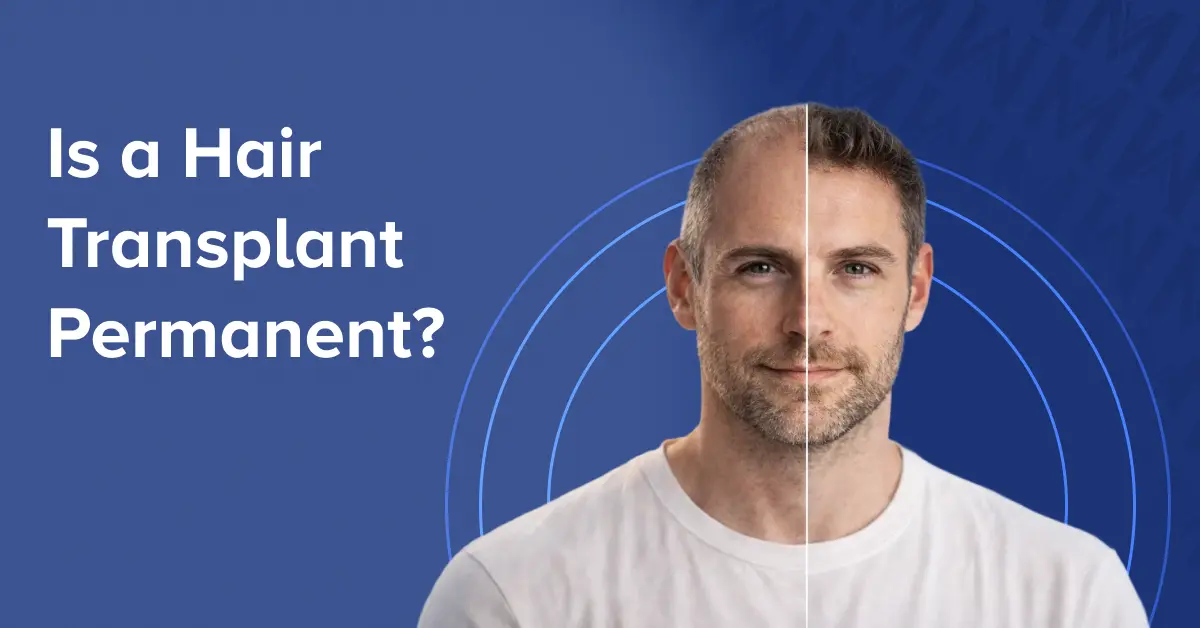
Search "is hair transplant permanent" and you'll find dozens of articles giving you a confident "yes!" before moving on. But that one-word answer is incomplete — and the missing nuance is exactly what separates patients who love their results 10 years later from those who wish they'd known more.
So let's set the record straight. Yes, transplanted hair follicles are permanent. They will continue growing hair for the rest of your life. However — and this is the part most clinics gloss over — your existing non-transplanted hair can continue to thin over time due to ongoing pattern hair loss. The transplant itself is permanent. The overall result depends on a broader strategy.
That distinction matters more than almost anything else you'll read about hair restoration.
In this guide, you'll get the full picture: the science behind why transplanted hair lasts a lifetime, a realistic timeline from month one through year 10 and beyond, the factors that influence long-term results, and a concrete plan for keeping your hair looking its best for decades. No hype. No sales pitch. Just honest, evidence-based answers.
The Short Answer — Yes, Hair Transplants Are Permanent (But Here's the Catch)
You came here for a clear answer, so here it is — before we unpack the science and details behind it.
What "permanent" actually means in hair restoration
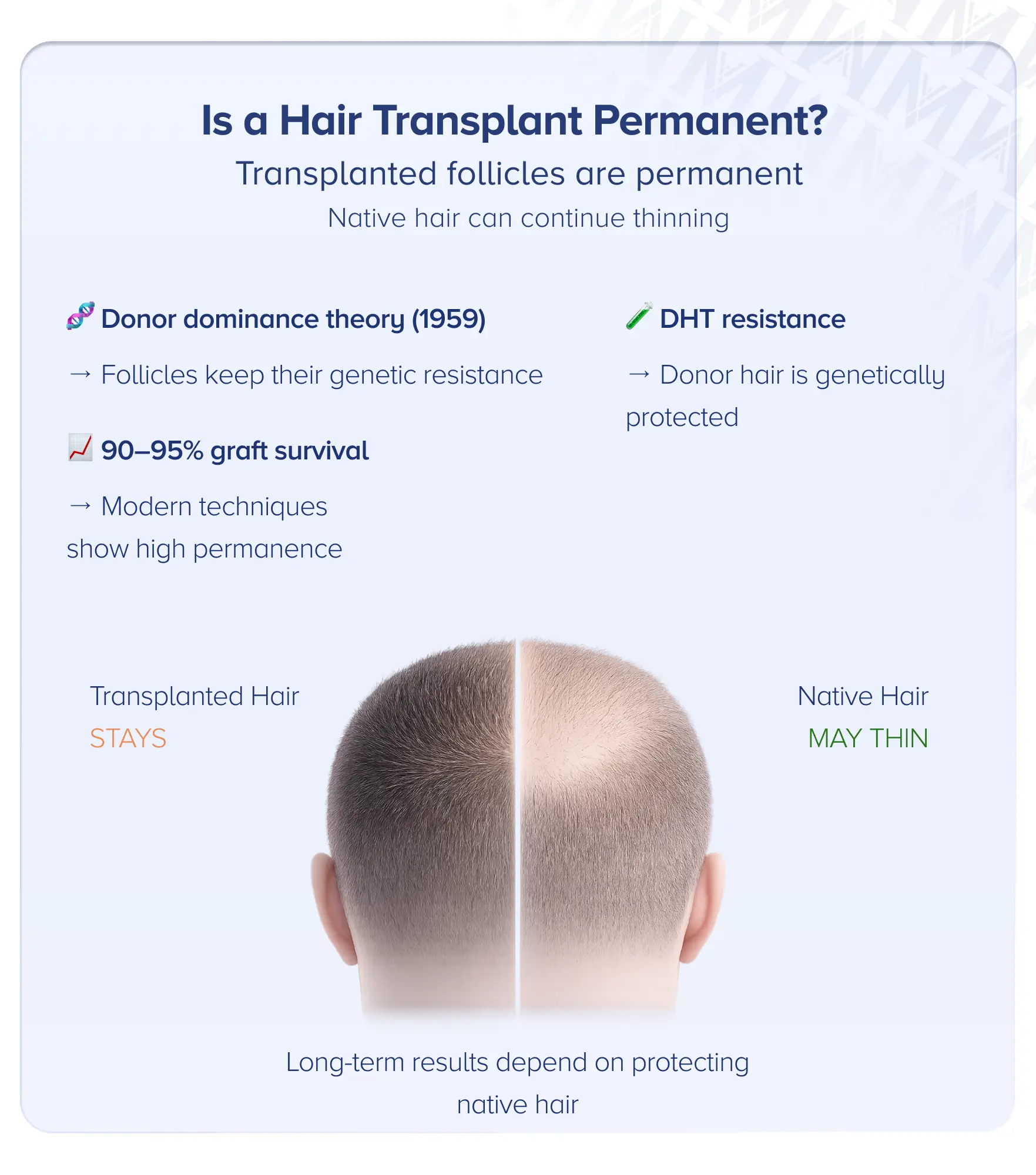
When hair restoration specialists say a hair transplant is permanent, they're referring to the transplanted follicles specifically. These follicles are harvested from a donor area on your scalp — typically the back and sides of your head — where hair is genetically programmed to resist balding. Once moved to a thinning or bald area, they keep that genetic resistance. They don't "expire" after a set number of years.
So do hair transplants last forever? For the transplanted follicles themselves, yes. But here's the catch: a hair transplant doesn't freeze your body's natural pattern of hair loss in place. The native hair surrounding your transplanted follicles can continue to thin over time. This means:
- Transplanted follicles — permanent, will keep growing hair for life
- Non-transplanted native hair — still vulnerable to ongoing thinning
- Overall aesthetic result — depends on protecting both
Think of transplanted hair as a permanent foundation. The foundation isn't going anywhere. But the house still needs upkeep to look its best over the years.
The most common misconception about hair transplant permanence
The belief that a hair transplant "stops" all future hair loss is the single biggest source of frustration among patients who didn't get the full picture upfront. It doesn't stop anything. It restores hair in specific areas using follicles that won't be affected by the same process that caused your original loss.
Understanding your current stage on the Norwood scale of hair loss — and where it's likely headed — is a key part of planning a transplant that looks natural for decades, not just months.
Key fact: With modern techniques and experienced surgeons, graft survival rates are typically 90–95%, meaning the vast majority of transplanted follicles successfully establish themselves and produce hair permanently.
The Science Behind Hair Transplant Permanence
Understanding why transplanted hair is permanent isn't just interesting — it's reassuring. When you know the science, the concept of lifelong results stops sounding like a marketing claim and starts making biological sense.
Donor dominance theory — why transplanted hair doesn't fall out
In 1959, dermatologist Dr. Norman Orentreich published research that would become the foundation of modern hair transplantation. He discovered a principle called donor dominance: hair follicles retain the characteristics of the area they came from, even after being moved to a completely different part of the scalp.
Here's what that means in practice. The follicles on the back and sides of your head are genetically different from the ones on top. They're programmed to keep growing regardless of what's happening elsewhere on your scalp. When a surgeon extracts these follicles and implants them into a balding area, they bring their genetic blueprint with them.
Think of it like planting drought-resistant trees in a new part of your garden. Moving them doesn't change their DNA. They keep thriving while other plants around them might struggle.
The key takeaways from donor dominance:
- Donor area follicles are genetically resistant to the hormone that causes pattern baldness
- Transplanted follicles retain their original genetic properties in their new location
- This principle has been validated by over 60 years of clinical evidence
- Careful donor area selection by an experienced surgeon is critical to lasting results
The role of DHT in pattern hair loss
To fully grasp donor dominance, you need to know what causes pattern hair loss in the first place.
The culprit is a hormone called dihydrotestosterone (DHT) — a byproduct of testosterone. In people with androgenetic alopecia (the medical term for genetic pattern hair loss), DHT binds to receptors in susceptible hair follicles. Over time, it causes those follicles to gradually shrink, producing thinner and shorter hairs until they stop producing visible hair altogether.
Here's the critical detail: not all follicles are susceptible. The follicles in your donor area have a genetic makeup that makes them DHT-resistant. That's why even people with significant hair loss typically retain a horseshoe-shaped band of hair around the back and sides.
When these DHT-resistant follicles are transplanted to a balding area, they continue to resist DHT in their new location. The hormone that destroyed your original hair in that zone has no effect on the transplanted follicles.
It's worth noting that hair transplants aren't effective for all types of hair loss. Conditions like alopecia areata (an autoimmune disorder) or scarring alopecia involve different mechanisms entirely, and donor dominance doesn't apply in the same way. Hair transplants work for both men and women with androgenetic alopecia, though evaluation criteria differ. A qualified specialist can determine whether your hair loss pattern is suitable for transplantation.
Want to see if a hair transplant is the right solution for you?
Get a personalized hair analysis and treatment plan from the MedArt Hair medical team. Our specialists will evaluate your hair loss pattern, donor area, and long-term goals to determine the best approach for natural, permanent results.How Long Does a Hair Transplant Last? A Realistic Timeline
The science is one thing. But what does this actually look like in real life — month by month, year by year? Here's a realistic hair transplant results timeline based on what surgeons consistently observe in clinical practice.
The following table gives you a quick overview before we break down each stage:| Stage | Timeframe | What to Expect |
|---|---|---|
| Shedding phase | Months 1–3 | Transplanted hairs fall out (normal); follicle roots remain alive |
| Early growth | Months 4–8 | Fine, wispy new hairs begin emerging |
| Visible results | Months 9–12 | 80–90% of transplanted hairs growing; noticeable improvement |
| Peak results | Years 1–5 | Full maturation, natural blending, peak density |
| Long-term stability | Year 10+ | Transplanted hair still growing; native hair may need attention |
| Lifetime evidence | Years 15–20+ | Science validated for 60+ years; transplanted follicles endure |
Months 1–3: The shedding phase (don't panic)
Here's a scenario that catches almost every patient off guard. It's week three after your transplant. You're in the shower, and you notice transplanted hairs falling out. Your stomach drops. Did something go wrong?
Nothing went wrong. This is called shock loss, and it's a completely normal part of the process. It's similar to pruning a plant — cutting back the visible growth actually stimulates stronger regrowth from the roots.
- The transplanted hair shafts fall out as follicles enter a temporary resting phase
- The follicle root remains alive and intact beneath the skin's surface
- This shedding typically occurs between weeks 2 and 6 after the procedure
- Your scalp may look similar to its pre-transplant state during this phase
The key thing to remember: you didn't lose your transplant. The follicles are resetting before they begin their new growth cycle.
Months 4–8: New growth begins
Patience becomes your most important asset during this phase. New hair starts to emerge, but it won't look like your final result yet.
- Fine, wispy hairs begin breaking through the surface
- New growth may appear thinner, lighter, or curlier than your existing hair initially
- Growth is often uneven — some areas show progress before others
- By month 6, most patients can see clear signs of new hair coming in
This is a gradual process. Don't compare your progress to final photos you've seen online. Those patients were once exactly where you are now.
Months 9–12: Significant results become visible
This is when the transformation starts to feel real.
- Approximately 80–90% of transplanted hairs are actively growing
- Hair shafts thicken and mature, blending more naturally with surrounding hair
- Overall density and coverage improve noticeably each month
- Most patients feel genuinely pleased with their appearance during this window
Results disclaimer: Individual results vary based on factors including genetics, hair characteristics, extent of hair loss, surgical technique, and compliance with aftercare protocols.
Full maturation can take up to 18 months for some patients. If you're at month 12 and feel your results aren't quite where you expected, give it a few more months before drawing conclusions.
Years 1–5: Peak results and stability
Your transplanted hair is now fully mature and blending naturally with the rest of your hair. This is the peak period for hair transplant permanent results.
- Transplanted hair can be cut, styled, colored, and treated like any other hair
- Results are at their highest density and most natural appearance
- You may begin to notice some thinning of native hair around the edges of the transplanted zone
- Patients who use maintenance medications for native hair typically maintain the most consistent overall appearance
Hair transplant 10 years later — what to realistically expect
This is the question that weighs most heavily on prospective patients. What does a hair transplant look like a decade down the road?
The honest answer: your transplanted follicles are still producing hair. The science of donor dominance doesn't have an expiration date. The grafts that survived the initial healing period continue to cycle through growth phases like any healthy hair.
The main variable at the 10-year mark isn't the transplanted hair — it's what has happened to the surrounding native hair. Patients who maintained a proactive approach typically still have excellent results. Those who didn't address ongoing native hair loss may notice a contrast between the transplanted zone (still dense) and adjacent areas (thinner).
Some patients choose a small touch-up session at this point — not because the original transplant failed, but to address new areas of thinning that developed over the decade. To see how results hold up over time, explore real patient before and after results.
15–20+ years: Long-term evidence
Modern FUE (Follicular Unit Extraction) and DHI (Direct Hair Implantation) techniques haven't existed long enough for 20-year clinical studies. That's an honest limitation worth acknowledging.
However, the underlying science — donor dominance — has been validated for over 60 years. Patients who received transplants using older techniques in the 1980s and 1990s still have surviving grafts decades later. Today's techniques produce more natural-looking results with improved graft handling and higher survival rates, meaning modern results should age even better.
Curious what your hair could look like after a transplant?
Get a free, personalized hair restoration assessment from the MedArt Hair medical team. We'll evaluate your hair loss pattern, donor area, and long-term outlook to help you understand what kind of natural, long-lasting results are realistically possible.
5 Factors That Affect How Long Your Hair Transplant Lasts
Your transplanted follicles are permanent — that part is settled. But the overall quality of your long-term results depends on several factors within and outside your control. Understanding them gives you the power to protect your investment.
Imagine two patients, both 32 years old, both receiving 3,000 grafts from skilled surgeons. Patient A follows aftercare instructions, takes prescribed medication for native hair preservation, and schedules annual check-ins. Patient B does none of that. At year 10, both still have their transplanted hair. But their overall results look dramatically different — because Patient B's untreated native hair continued to thin, creating an uneven appearance that Patient A avoided entirely.
That's the difference these factors make.
1. Surgeon skill and clinic quality
This is the single most important factor you can control. Hair transplant graft survival — the percentage of transplanted follicles that successfully establish themselves — is directly tied to surgical technique and graft handling.
- Proper extraction angles prevent follicle damage during harvesting
- Careful implantation depth and direction determine natural-looking growth patterns
- Graft storage temperature and time outside the body affect viability
- A poorly performed procedure can result in significantly lower graft survival
Choosing a skilled surgeon isn't only a cosmetic decision. It's a longevity decision.
2. Transplant technique used
Whether you receive FUE, Sapphire FUE, or DHI, all modern techniques produce permanent results when performed correctly. The differences relate more to healing time, potential density, and scarring than to hair transplant longevity itself.
That said, technique does influence graft handling. Some methods minimize the time follicles spend outside the body, which can support higher survival rates. Your surgeon's experience with the specific technique matters more than the technique's name. We'll compare these methods in detail later in this guide.
3. Your ongoing pattern of hair loss (Norwood stage)
Your current stage of hair loss — measured on the Norwood scale of hair loss — plays a significant role in your long-term outlook.
- A patient at Norwood 2 at age 25 typically has decades of progressive loss ahead
- A patient at Norwood 4 at age 45 may have a more stable, predictable pattern
- This doesn't affect transplanted hair, but it affects how the overall result evolves
- A strategic surgeon plans for your future loss trajectory, not only your current state
4. Post-operative care and aftercare compliance
The first two weeks after your transplant are critical for graft survival. Following your clinic's detailed hair transplant aftercare guide can make a measurable difference in how many grafts successfully take root.
Beyond the initial healing period, long-term care matters too:
- Maintenance medications can preserve native hair for years
- Supportive treatments like PRP can strengthen existing follicles
- Regular follow-ups help catch new thinning early
5. Overall health and lifestyle factors
Your body's overall health influences your hair — transplanted and native alike.
- Smoking may reduce blood flow to the scalp, which can negatively affect graft survival and overall hair health
- Poor nutrition (low protein, iron, or zinc) can weaken hair growth
- Chronic stress can trigger temporary shedding conditions
- Certain medications may affect hair growth cycles
None of these factors will "undo" a successful transplant, but they can influence the overall quality and thickness of your hair over time.
Not sure where you fall on the hair loss scale? Use the Graft Calculator to get a preliminary estimate of what your restoration might involve.
Can You Lose Transplanted Hair? Honest Scenarios to Know About
It's completely natural to wonder whether something could go wrong after investing in a hair transplant. This is one of the most common concerns prospective patients raise — and it deserves a transparent answer.
Scenarios where transplanted hair could be affected
While transplanted follicles are permanent under normal circumstances, rare situations can affect them:
- Physical trauma or injury to the scalp (burns, deep lacerations) can damage any follicle, including transplanted ones
- Autoimmune conditions like alopecia areata target follicles through a different mechanism than pattern baldness — transplanted hair isn't immune to autoimmune attacks
- Severe systemic illness or chemotherapy can cause widespread hair loss, though transplanted hair may regrow once treatment ends (individual experiences vary)
- Poor surgical technique leading to low initial graft survival — if follicles weren't implanted properly, some may never establish themselves
These scenarios are uncommon. For the vast majority of patients, transplanted hair loss after the initial shock loss phase simply isn't something they'll experience.
Scenarios that do NOT affect transplanted hair
There's a long list of everyday concerns that have zero impact on your transplanted follicles:
- Normal aging — transplanted hair ages like donor area hair, which naturally thins slightly but doesn't bald
- Continued DHT-driven pattern baldness — transplanted follicles remain resistant
- Wearing hats, helmets, or headbands (after full healing)
- Swimming, exercise, or sun exposure (after the initial recovery period)
- Hair styling products, coloring, or heat tools (used reasonably)
- Day-to-day stress — while severe stress can cause temporary shedding of native hair, it doesn't selectively target transplanted follicles
Myth busted: "Hair transplants only last 10 years." This is false. Transplanted follicles don't have an expiration date. This myth likely stems from confusion about native hair continuing to thin around the transplanted area.
How to Make Your Hair Transplant Results Last a Lifetime
Now that you understand what affects hair transplant longevity, here's your actionable plan for protecting your results. This is where you shift from passive patient to active participant in your outcome.
Follow your post-op care instructions to the letter
The first 14 days after your procedure are the most critical window for graft survival. During this time:
- Follow your surgeon's specific washing technique and schedule
- Sleep in the recommended elevated position to minimize swelling
- Avoid strenuous physical activity, direct sun exposure, and swimming
- Don't touch, scratch, or pick at the transplanted area
Every detail matters during this fragile establishment period. For a complete walkthrough, refer to your clinic's comprehensive aftercare instructions.
Consider maintenance medications
This is one of the most impactful steps you can take — and it's often misunderstood. Medications like finasteride and minoxidil aren't for your transplanted hair. Your transplanted follicles don't need protection. These medications protect your native hair from continued DHT-driven thinning.
Finasteride (oral) works by blocking the conversion of testosterone to DHT, slowing or stopping the gradual shrinking of vulnerable follicles. It is FDA-approved for male pattern hair loss.
Minoxidil (topical) stimulates blood flow to the scalp and can promote thicker growth in thinning areas. It is FDA-approved for hair loss in both men and women.
Finasteride is not recommended for women of childbearing age. Speak with your doctor about which options are appropriate for your situation. You can learn more about post-transplant medications and how they work.
Medication disclaimer: Finasteride and minoxidil may cause side effects in some individuals. Discuss the risks and benefits with your doctor before starting any medication.
Explore supportive treatments (PRP, mesotherapy)
PRP (platelet-rich plasma) therapy and mesotherapy (delivering vitamins and nutrients directly to the scalp through micro-injections) are complementary options that can strengthen your existing native hair.
- PRP uses growth factors from your own blood to stimulate follicle health
- Sessions are typically recommended every 3–6 months during the first year, then annually
- These treatments won't make transplanted hair "more permanent" — it already is
They can, however, help maintain the density and health of your native hair, which contributes to your overall result.
Adopt a hair-healthy lifestyle
Your daily habits influence your hair more than you might expect:
- Nutrition: Prioritize protein, iron, biotin, and zinc — the building blocks of healthy hair
- Stress management: Chronic stress can trigger temporary shedding conditions
- Avoid smoking: Reduced circulation can compromise scalp health
- Scalp care: Keep your scalp clean and healthy; treat dandruff or inflammation promptly
Plan for the future with your surgeon
A skilled surgeon doesn't just plan for your hair today. They plan for your hair in 10, 15, and 20 years.
- Your initial transplant should account for your likely future hair loss pattern
- Strategic graft placement ensures results look natural as surrounding hair changes
- Choosing a clinic that offers long-term follow-up makes ongoing management easier
A well-planned first procedure significantly reduces the likelihood of needing extensive future work.
Does the Transplant Technique Affect Longevity? FUE vs. DHI vs. Sapphire FUE
Does the technique my surgeon uses affect whether my results last? It's a fair question, and the answer is straightforward.
All three major modern techniques — FUE, Sapphire FUE, and DHI — produce permanent results when performed by skilled surgeons. The differences between them relate to the surgical approach, healing characteristics, and density potential — not permanence.
Here's how each technique works at a high level:
- FUE (Follicular Unit Extraction): Individual follicle units are extracted from the donor area and implanted into recipient sites created by the surgeon
- Sapphire FUE: Uses the same extraction method as FUE, but recipient channels are created with sapphire-tipped blades for finer incisions and potentially faster healing
- DHI (Direct Hair Implantation): Uses a specialized pen (Choi implanter) to extract and implant follicles in one step, reducing the time grafts spend outside the body
Here's a comparison focused on long-term outcome factors:
| Factor | FUE | Sapphire FUE | DHI |
|---|---|---|---|
| Graft permanence | Permanent | Permanent | Permanent |
| Typical graft survival | 90–95% | 90–95% | 90–95% |
| Healing speed | Moderate | Faster (smaller incisions) | Moderate |
| Density potential | High | High | Higher in targeted areas |
| Scarring | Minimal dot scars | Minimal (finer incisions) | Minimal dot scars |
| Best suited for | Large areas | Large areas, refined results | Hairline work, smaller areas |
The honest takeaway: the surgeon's skill matters more than the specific technique. A masterful FUE procedure will outperform a poorly executed DHI every time. Technique selection should be based on your specific hair loss pattern, goals, and your surgeon's recommendation. To understand the nuances of each approach, compare hair transplant techniques in detail.
Do You Need a Second Hair Transplant? When and Why
The natural next question is: will I end up needing to do this all over again?
Let's be clear about something first. A second hair transplant is not a sign that the first one failed. Transplanted follicles don't die off and need replacing. The reasons for a second procedure are entirely different.
Common reasons for an additional session
- Progressive native hair loss creates new thinning areas that weren't present during the first transplant
- Desire for greater density in the originally transplanted area
- Extensive baldness that required a staged approach from the beginning
- Evolving personal goals — some patients decide they want a lower hairline or fuller coverage than initially planned
If a second procedure is appropriate, surgeons typically recommend waiting a minimum of 12–18 months between sessions. This allows the first transplant to fully mature and gives your surgeon an accurate picture of your current state.
Understanding donor area limitations
There's one important constraint: your donor supply is finite. You have a limited number of DHT-resistant follicles available for harvesting. This is why strategic planning at the initial transplant is so critical — and why overharvesting the donor area is a red flag.
A thorough donor assessment during your initial consultation helps predict whether a second session might be needed down the road. For a deeper look at donor limitations and planning, read about how many hair transplants you can have over a lifetime.
Why Clinic Choice Matters for Long-Term Results (Especially in Turkey)
There's one more decision that directly affects your long-term outcome — and it's the one you make before you ever sit in the surgeon's chair: choosing the right clinic.
Red flags that can compromise your results
Turkey performs more hair transplant procedures than almost anywhere else in the world. That volume means you'll find both outstanding clinics and concerning ones. Here's why this matters for permanence: a hair transplant is only as permanent as the grafts that survive. And graft survival depends directly on the care taken during surgery.
Watch for these warning signs:
- Assembly-line procedures where a surgeon oversees multiple patients simultaneously
- Unlicensed technicians performing the extraction or implantation
- Unrealistic graft promises (e.g., 6,000+ grafts in a single session without assessing donor capacity)
- No personalized treatment plan — every patient gets the same approach
- Lack of transparent before-and-after documentation
Green flags that support lasting outcomes
A hair transplant performed at a reputable clinic in Turkey produces results every bit as permanent as one performed anywhere else — because the science of donor dominance doesn't change based on geography. Look for these positive indicators:
- Board-certified surgeons who personally perform or directly supervise the procedure
- A thorough consultation assessing your hair loss pattern, donor area, and future trajectory
- Transparent before-and-after galleries showing a range of patients and timeframes
- A comprehensive aftercare program that extends well beyond the day of surgery
- Willingness to say "no" or recommend a conservative approach when appropriate
This isn't the decision to make based on the lowest price. Quality surgical care is a hair transplant longevity factor — not a luxury.
Frequently Asked Questions
Conclusion
So, is hair transplant permanent? The answer is clear: transplanted hair follicles are permanent because they carry genetic resistance to DHT, the hormone responsible for pattern hair loss. This isn't marketing — it's biology validated by over 60 years of clinical evidence, starting with Dr. Norman Orentreich's donor dominance research in 1959.
But here's the complete picture. Maintaining a full, natural-looking result over 10, 15, or 20+ years isn't about the transplant alone. It requires protecting your remaining native hair, following a proper aftercare protocol, and choosing a surgeon who plans for your future — not only your present.
The most important decision you'll make isn't which technique to choose or how many grafts to request. It's choosing a clinic and surgeon you trust to be honest with you, plan strategically, and deliver the kind of careful work that holds up decade after decade.
You now have the knowledge to evaluate your options with confidence. The next step is yours.
Ready to see what permanent, natural-looking results could look like for you? Explore patient before and after results or connect with a medical team to discuss your personalized hair restoration plan. Your future hair is worth getting this right.
