
Last updated: June 2026
Every year, thousands of men fly to Istanbul for a "2000 graft" hair transplant. Most of them have no idea what that number actually means for their hairline, their coverage, or the donor reserves they will still need ten years from now.
You may already be collecting quotes. You may even have a clinic in mind. But "2000 grafts" on a price list and "2000 grafts" on your scalp are two very different things — and that gap is where regret usually lives.
This guide gives you a clinically grounded look at what a 2000 grafts hair transplant can really cover, what it typically costs in Turkey versus other countries, and what realistic results look like over a full year. You will also learn when 2000 grafts are enough, when they are not, and how to decide on your own ideal graft count with evidence-based expectations.
Last updated: June 2026
Every year, thousands of men fly to Istanbul for a "2000 graft" hair transplant. Most of them have no idea what that number actually means for their hairline, their coverage, or the donor reserves they will still need ten years from now.
You may already be collecting quotes. You may even have a clinic in mind. But "2000 grafts" on a price list and "2000 grafts" on your scalp are two very different things — and that gap is where regret usually lives.
This guide gives you a clinically grounded look at what a 2000 grafts hair transplant can really cover, what it typically costs in Turkey versus other countries, and what realistic results look like over a full year. You will also learn when 2000 grafts are enough, when they are not, and how to decide on your own ideal graft count with evidence-based expectations.
Is a 2000 Graft Hair Transplant Right for You?
A 2000 graft hair transplant typically restores a natural-looking hairline and frontal density for men with early to moderate hair loss, at a lower cost in Turkey than in Western Europe or the US, with final results visible around 9–12 months. The sections below go deeper, but this overview lets you quickly decide whether 2000 grafts sound close to your situation.
If you mainly notice recession at the temples and thinning across the front, 2000 grafts will often give you enough coverage to frame your face again. If your hair loss is more advanced, 2000 grafts are usually one step in a staged plan — not a one-time fix for every area.
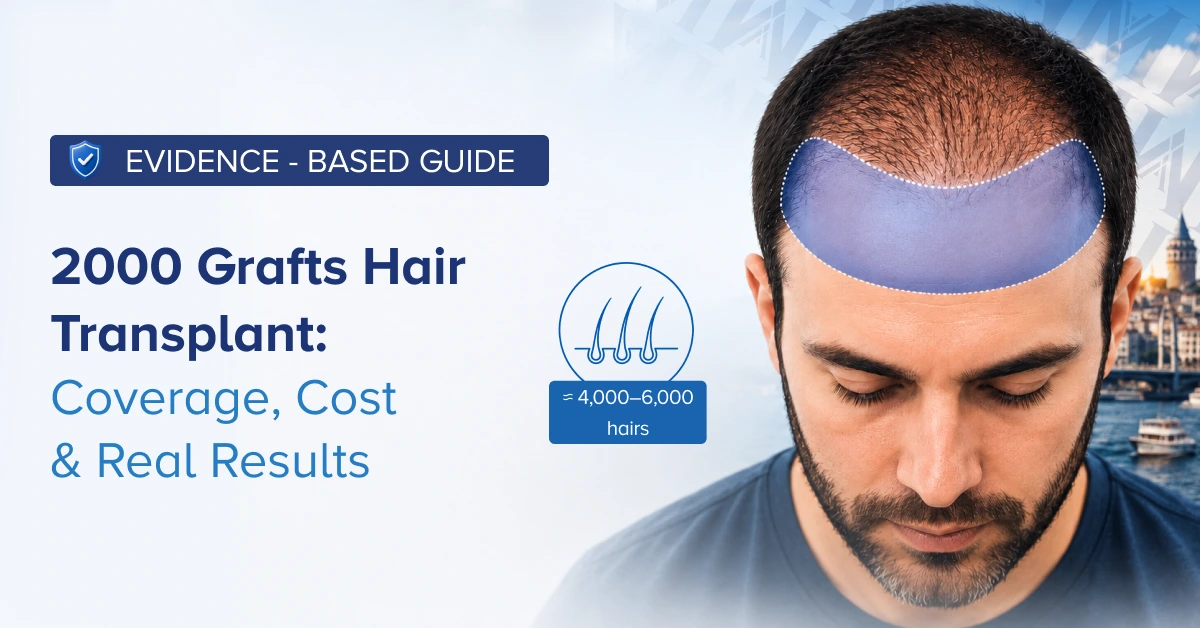
2000 grafts ≈ 4,000–6,000 hairs
Best for hairline + frontal third
Final result matures around 9–12 months
According to the International Society of Hair Restoration Surgery (ISHRS), modern FUE techniques routinely achieve high graft survival rates when performed by experienced teams — high enough that most transplanted hairs in healthy patients should regrow. That is why surgeon skill and clinic quality matter far more than chasing the largest possible graft number.
What Does "2000 Grafts" Actually Mean?
"2000 grafts" refers to transplanting approximately 2000 follicular units from your donor area, which usually equates to about 4,000–6,000 individual hairs depending on how many hairs sit in each graft. Before you compare quotes, it helps to understand what one of those grafts actually is — because that is what you are really paying for.
A hair graft, also called a follicular unit, is a natural bundle of 1–4 hairs that grows from the scalp as a group. According to the ISHRS, most scalp follicular units contain between one and four hairs, with two-hair grafts being the most common pattern. So graft count and hair count are related, but they are not the same.
When a clinic offers "2000 grafts FUE," it means about 2000 of these follicular units are removed from the donor area at the back and sides of your head (the occipital scalp) and implanted into the recipient area where you are thinning. The same 2000 grafts can look very different on two people, because hair caliber (thickness), curl, and the contrast between your hair and your scalp colour all change how much "coverage" those hairs create.
Thick, wavy, dark hair on light skin creates a strong coverage illusion with fewer grafts. Thin, straight, light-coloured hair usually needs more grafts to reach similar visual density. So simply buying the highest graft number you can afford can still disappoint you, while a carefully designed individualized graft plan can look fuller with fewer grafts.
Definition: A 2000 graft hair transplant moves 2,000 follicular units — usually about 4,000–6,000 hairs — from the donor area to thinning zones on the scalp.
2000 Grafts in Hairs: Rough Calculations
You have probably asked yourself how many hairs is 2000 grafts. The honest answer is always a range, not a fixed figure.
Most clinics assume an average of 2–3 hairs per graft:
Grafts |
Average hairs per graft |
Approx. total hairs |
|---|---|---|
2000 |
2–3 |
4,000–6,000 |
If your donor area is rich in 3-hair and 4-hair units, your 2,000 grafts will yield more total hairs than someone whose donor produces mostly 1-hair and 2-hair grafts. During consultation, a surgeon assesses your donor density and hair characteristics to estimate this more accurately for you.
Clinics quote graft numbers rather than hair numbers because grafts are what they physically extract and implant. So focus on surgeon expertise, hairline design and density planning — not on whichever clinic advertises the biggest number for the lowest price.
Get a Free Hair Analysis
Talk to an experienced patient coordinator for your hair transplant in Turkey.What Area Can 2000 Grafts Cover? (By Norwood Stage)
In most men, 2,000 grafts are enough to rebuild a receding hairline and add density to the frontal third of the scalp, but they rarely provide full coverage of both the front and crown in advanced baldness. Now that you know what a graft is, the next question is what 2000 hair grafts coverage really looks like on different baldness patterns.
Doctors use the Norwood scale to classify male pattern baldness (androgenetic alopecia). Norwood 2–5 describes progressive recession at the hairline and temples, then thinning across the mid-scalp, then balding at the crown. Where you fall on this scale strongly influences whether 2,000 grafts will be enough for your cosmetic goals.
Norwood stage |
Typical 2000-graft coverage |
|---|---|
2–3 |
Hairline + frontal third |
3–4 |
Hairline + part of mid-scalp |
5+ |
Partial front only (staged plan) |
Clinical guidance shared by hair transplant societies suggests that 30–40 grafts per cm² in the frontal hairline produce a cosmetically dense look, while 15–20 grafts per cm² often suffice in less visible areas. Think of grafts as paint on a wall: spread the same tin across a bigger wall and the colour starts showing through.
Hairline and Frontal Third Restoration
For Norwood 2–3 patients with mainly temple recession and some frontal thinning, a 2000 grafts hairline transplant can usually:
● Rebuild a natural-looking hairline that fits your age and face shape.
● Fill the frontal third with functional, styleable density.
● Blend into native hair behind, especially if you also use medical therapy.
The aim is not to draw a teenager's dead-straight hairline on a 40-year-old. A good hairline restoration sits slightly higher, looks mature, and ages well as your face continues to change. The American Academy of Dermatology (AAD) emphasises that conservative, age-appropriate hairline planning improves long-term satisfaction for men with male pattern baldness.
At Medart Hair Transplant in Istanbul, a carefully planned 2000 grafts hairline case on a Norwood 3 patient typically creates strong frontal framing and allows real styling flexibility, including lift and volume. Surgeons commonly observe that patients in this category say they finally "look like themselves again" once the front is rebuilt.
When 2000 Grafts May Not Be Enough
For Norwood 3–4 patients, 2,000 grafts can rebuild the hairline and reach part of the mid-scalp, but the crown is usually left for a later stage. For Norwood 5 or higher, 2,000 grafts typically address only the front as part of a planned sequence rather than covering everything at once.
Scenarios where you often need 2,500–3,500+ grafts include:
● Significant recession plus visible mid-scalp thinning.
● A goal to cover both front and crown with clear density in one session.
● Very fine, straight hair combined with strong contrast between hair and scalp colour.
One anonymised example from our Istanbul clinic: a 35-year-old man with Norwood 4 loss asked for "2,000 grafts to fix everything." After examining his donor area and pattern, we recommended about 2,800 grafts concentrated on the hairline and mid-scalp, deliberately leaving the crown for a possible future session. That approach protected his long-term donor management and prevented spreading grafts so thin that the result looked see-through.
Public health services like the UK's NHS also caution patients about cosmetic surgery providers who promise complete correction of advanced hair loss with very limited graft numbers. If a clinic claims "full coverage" of extensive baldness with 2,000 grafts, ask detailed questions before you commit.
What Area Can 2000 Grafts Cover? (By Norwood Stage)
In most men, 2,000 grafts are enough to rebuild a receding hairline and add density to the frontal third of the scalp, but they rarely provide full coverage of both the front and crown in advanced baldness. Now that you know what a graft is, the next question is what 2000 hair grafts coverage really looks like on different baldness patterns.
Doctors use the Norwood scale to classify male pattern baldness (androgenetic alopecia). Norwood 2–5 describes progressive recession at the hairline and temples, then thinning across the mid-scalp, then balding at the crown. Where you fall on this scale strongly influences whether 2,000 grafts will be enough for your cosmetic goals.
Norwood stage |
Typical 2000-graft coverage |
|---|---|
2–3 |
Hairline + frontal third |
3–4 |
Hairline + part of mid-scalp |
5+ |
Partial front only (staged plan) |
Clinical guidance shared by hair transplant societies suggests that 30–40 grafts per cm² in the frontal hairline produce a cosmetically dense look, while 15–20 grafts per cm² often suffice in less visible areas. Think of grafts as paint on a wall: spread the same tin across a bigger wall and the colour starts showing through.
Hairline and Frontal Third Restoration
For Norwood 2–3 patients with mainly temple recession and some frontal thinning, a 2000 grafts hairline transplant can usually:
● Rebuild a natural-looking hairline that fits your age and face shape.
● Fill the frontal third with functional, styleable density.
● Blend into native hair behind, especially if you also use medical therapy.
The aim is not to draw a teenager's dead-straight hairline on a 40-year-old. A good hairline restoration sits slightly higher, looks mature, and ages well as your face continues to change. The American Academy of Dermatology (AAD) emphasises that conservative, age-appropriate hairline planning improves long-term satisfaction for men with male pattern baldness.
At Medart Hair Transplant in Istanbul, a carefully planned 2000 grafts hairline case on a Norwood 3 patient typically creates strong frontal framing and allows real styling flexibility, including lift and volume. Surgeons commonly observe that patients in this category say they finally "look like themselves again" once the front is rebuilt.
When 2000 Grafts May Not Be Enough
For Norwood 3–4 patients, 2,000 grafts can rebuild the hairline and reach part of the mid-scalp, but the crown is usually left for a later stage. For Norwood 5 or higher, 2,000 grafts typically address only the front as part of a planned sequence rather than covering everything at once.
Scenarios where you often need 2,500–3,500+ grafts include:
● Significant recession plus visible mid-scalp thinning.
● A goal to cover both front and crown with clear density in one session.
● Very fine, straight hair combined with strong contrast between hair and scalp colour.
One anonymised example from our Istanbul clinic: a 35-year-old man with Norwood 4 loss asked for "2,000 grafts to fix everything." After examining his donor area and pattern, we recommended about 2,800 grafts concentrated on the hairline and mid-scalp, deliberately leaving the crown for a possible future session. That approach protected his long-term donor management and prevented spreading grafts so thin that the result looked see-through.
Public health services like the UK's NHS also caution patients about cosmetic surgery providers who promise complete correction of advanced hair loss with very limited graft numbers. If a clinic claims "full coverage" of extensive baldness with 2,000 grafts, ask detailed questions before you commit.
How Much Does a 2000 Graft Hair Transplant Cost? (Turkey vs Other Countries)
The cost of a 2000 graft hair transplant varies widely, but Turkey typically offers significantly lower total prices than the US or Western Europe while reputable clinics still use the same modern FUE techniques. After the timeline, this is the next question almost everyone asks — especially if you are considering travel to Istanbul.
Hair transplant cost is shaped by several main factors:
● Country and city, which determine wages and clinic overheads.
● Surgeon experience, reputation, and personal involvement in your case.
● Technique used (FUE vs FUT, manual vs motorised tools, optional PRP add-ons).
● Clinic model (doctor-led with low daily volume vs high-volume "hair mills").
● Package inclusions such as hotel, airport transfers, and basic aftercare.
Here is a relative comparison for 2,000 grafts:
Region |
Typical pricing model |
Relative cost for 2000 grafts* |
|---|---|---|
Turkey |
Package or per-graft |
Low–moderate |
Western Europe/UK |
Mostly per-graft |
Moderate–high |
US/Canada |
Per-graft |
High |
\*These are qualitative ranges, not exact prices for any specific clinic.
Turkey is widely recognised as a major medical tourism hub for hair transplant, with industry reports indicating the country performs an enormous number of FUE procedures each year. Lower general living costs and high procedure volumes tend to keep prices below the UK or US — without automatically meaning lower quality, provided you choose a reputable clinic.
All-inclusive hair transplant packages in Turkey typically include:
● Airport transfers and hotel accommodation.
● The surgery itself and local anesthesia.
● Basic medications and the first post-op washes.
● A translator or patient host for international visitors.
They usually do not include:
● Long-term medications such as finasteride or minoxidil once you go home.
● In-person follow-up care in your own country.
● Management of rare complications back home (beyond remote advice).
The NHS reminds anyone considering cosmetic surgery abroad to check quality standards, surgeon credentials, and aftercare policies before booking. The same logic applies when comparing 2000 grafts in Turkey cost-wise: the lowest sticker price is not always the best value if donor safety or follow-up support is weak.
Per-Graft Pricing vs Package Deals
You will see both per-graft pricing and flat-rate packages advertised for 2,000 graft procedures.
Per-graft pricing:
● You pay a set amount for each graft transplanted.
● Useful when you need a smaller or staged session.
● Relies on accurate counting and honest reporting by the clinic.
Package deals:
● One fixed price for "up to 2,000 grafts."
● Simple to understand, especially for international patients.
● Risk: some clinics fit every patient into the same graft number to match the package, instead of planning individually.
If you want a deeper breakdown of pricing models, read our internal guide on how hair transplant cost per graft is calculated. For travellers specifically considering Istanbul, our detailed guide to hair transplant costs in Turkey explains typical inclusions and realistic price ranges in greater depth.
If an offer for a 2,000 graft procedure seems unrealistically cheap, ask how many patients the team operates on per day, who actually performs extractions and incisions, and how they avoid overharvesting your donor area. Public guidance from bodies like the NHS warns that very low-cost cosmetic surgery abroad can carry higher risks when safety standards, staffing, and follow-up are unclear.
Are You a Good Candidate for 2000 Grafts?
You are more likely to be a good candidate for a 2000 graft transplant if your hair loss is mainly at the hairline and frontal third, you have strong donor density, and your pattern of balding appears relatively stable. With cost out of the way, the real question is whether 2,000 is actually the right number for your own head.
Surgeons weigh several factors when deciding on graft numbers:
● Age and stability of hair loss: Younger men with rapidly progressing baldness usually need a more conservative hairline and a staged plan.
● Donor density: How many follicular units per cm² are available across the occipital and parietal donor area.
● Hair characteristics: Thickness, curl, and the colour contrast between your hair and your scalp all change how much coverage 2,000 grafts will deliver.
● Family history: A strong family history of Norwood 5–7 hair loss suggests you should plan for future recession too.
● Willingness to use medical therapy: Finasteride and minoxidil can help stabilise native hair, but both can cause side effects and must be prescribed and monitored by a doctor.
● General health and lifestyle: Conditions like diabetes or heavy smoking can impair healing and must be discussed honestly with your surgeon.
The ISHRS stresses that responsible hair transplant planning starts with evaluating donor supply, hair characteristics, and long-term balding risk — not with picking a fixed graft count. In some cases, a surgeon might recommend fewer than 2,000 grafts if your loss is mild, or more if your goals and pattern demand broader coverage.
Quick Self-Check: Could 2000 Grafts Be Enough?
Use this checklist as an initial guide before a formal consultation:
● Your main concern is receding temples and frontal thinning, not a large bald crown.
● You appear to be around Norwood 2–3, possibly early 4, but not 5–7.
● Hair at the back and sides looks thick, with no obvious thinning patches.
● Your hair is at least medium thickness, or slightly wavy, which improves coverage.
● Your hair loss pattern has been relatively stable for at least a year.
● You are open to discussing finasteride or minoxidil with a doctor to protect existing hair.
If most of these fit you, 2,000 grafts may be in the right ballpark — though only an experienced surgeon can confirm. For a rough numerical estimate of your needs, try our online hair transplant graft calculator to gauge a likely graft range based on your pattern.
Still unsure whether 2,000 grafts are enough for you? Send clear photos of your hairline, mid-scalp, and crown via the WhatsApp button in the bottom-right corner. The Medart team will give you a personalised estimate and an honest opinion on a suitable graft range — with no obligation to book.
Procedure, Recovery, and Risks with a 2000 Graft FUE
A 2000 graft FUE procedure usually takes one full day under local anesthesia, with most patients returning to desk work within a few days and seeing the donor and recipient areas largely healed by 10–14 days. After clarifying candidacy, you need a realistic picture of what surgery day and recovery actually look like.
For a typical 2,000 grafts FUE session in Istanbul:
1. You arrive in the morning, review the plan, and draw the hairline with your surgeon.
2. The team injects local anesthesia into the donor and recipient areas so you stay awake but comfortable.
3. Follicular Unit Extraction (FUE) is performed, removing individual grafts with tiny punches from the donor area.
4. Your surgeon creates recipient sites (small incisions) in the thinning area, setting angle, direction, and target density.
5. Technicians and/or the surgeon carefully place grafts into these sites.
For 2,000 grafts, the whole process usually takes 5–8 hours, often with a break in the middle. ISHRS educational materials describe FUE under local anaesthetic as a standard global approach, which avoids the risks of general anesthesia for most healthy patients.
Early recovery typically includes:
● Mild soreness or tightness in the donor area for a few days, often eased with simple painkillers.
● Sleeping on your back with your head elevated for several nights to protect grafts.
● Redness and small scabs in the recipient area that usually settle over 7–14 days.
● Most desk-job patients feeling able to work — often remotely — within about 3–7 days, though some prefer a longer break for social reasons.
Common short-term side effects include forehead swelling, temporary numbness or tingling in the donor or recipient areas, and itching as the scalp heals. The AAD notes that serious complications such as infection, prominent scarring, or tissue damage are uncommon in qualified centres — but all surgery carries risks, so careful hygiene and adherence to aftercare instructions are essential.
Potential problems that can affect any graft count, including 2,000, include:
● Infection or delayed healing in the donor or recipient areas.
● Visible scarring, particularly if too many grafts are taken from a small zone.
● Lower-than-expected hair growth if the graft survival rate is reduced by technical or patient factors.
● An unnatural hairline if design and graft placement are poorly planned.
Your surgeon should provide a detailed written aftercare plan — including washing techniques, how long to avoid hats or helmets, and when you can return to the gym. Following those instructions closely gives your grafts the best chance to thrive.
FUE vs FUT for 2000 Grafts
Both FUE and FUT (Follicular Unit Transplantation) can be used to move 2,000 grafts. They differ in how grafts are harvested and in the scarring pattern.
In FUT, the surgeon removes a strip of scalp from the donor area and then dissects it into individual grafts under a microscope. This method usually leaves a single linear scar along the back of the head, which can show with very short hair. In FUE, individual follicular units are taken with tiny punches, leaving many small dot scars spread across the donor zone.
For patients travelling to Turkey, a 2000 grafts FUE transplant is the more common choice because:
● There is no long linear incision requiring suture removal before flying home.
● Donor discomfort is often lower than with a strip, once initial soreness settles.
● Extractions can be spread across a wider area for better long-term donor management.
International hair restoration organisations recognise that both FUE and FUT can deliver excellent results in the right hands. But FUE has become the dominant option for medical tourists because recovery is more convenient when travelling, and short hairstyles are easier to keep without a visible linear scar.
How to Choose a Clinic for a 2000 Graft Transplant in Turkey
In Turkey, the key to a safe and successful 2000 graft transplant is choosing a clinic where a qualified hair transplant doctor personally designs your hairline, plans your graft number, and supervises the entire medical team. Once you understand the procedure itself, the last step is picking a safe and competent provider in Istanbul's busy market.
Turkey hosts everything from small, doctor-led centres to high-volume "hair mills." Reputable clinics in Istanbul can deliver excellent outcomes using modern FUE techniques, while other providers rely heavily on technicians with limited oversight. Choosing carefully matters for both results and safety.
Red flags to watch for:
● One-price-fits-all packages with no real individual graft planning.
● Unclear who the doctor is, or minimal doctor involvement in the key steps.
● Advertising "guaranteed results" or "no scars," when surgery always leaves some kind of mark.
● No discussion of your long-term pattern or donor preservation.
● No clear plan for medical follow-up or for dealing with complications.
Green flags that suggest higher standards:
● Transparent information about the board-certified surgeon responsible for your case.
● A proper consultation (in person or via detailed photos/video) including Norwood classification and donor density assessment.
● An honest discussion of the limits of 2,000 grafts, not just the benefits.
● Written consent forms and aftercare instructions in a language you fully understand.
● Realistic before-and-after results, not only extreme "miracle" transformations.
Useful questions to ask any clinic in Turkey:
● Who will design my hairline and decide how many grafts I need?
● Who will perform the extractions, incisions, and implantation on the day?
● How many patients does your team treat per day?
● How do you plan long-term donor management for me if my hair loss continues?
● What happens if graft growth is significantly lower than expected?
"At Medart Hair Transplant in Istanbul, we never decide on '2,000 grafts' just because it fits a package. We first assess your donor supply, long-term balding risk, and cosmetic goals — then tailor the graft count to you." — Dr. Busra Yakupoglu, MD, Hair Transplant Surgeon.
Choosing a clinic using these criteria does more than improve your cosmetic result. It protects your donor area so you still have options if your androgenetic alopecia continues to progress over the years.