
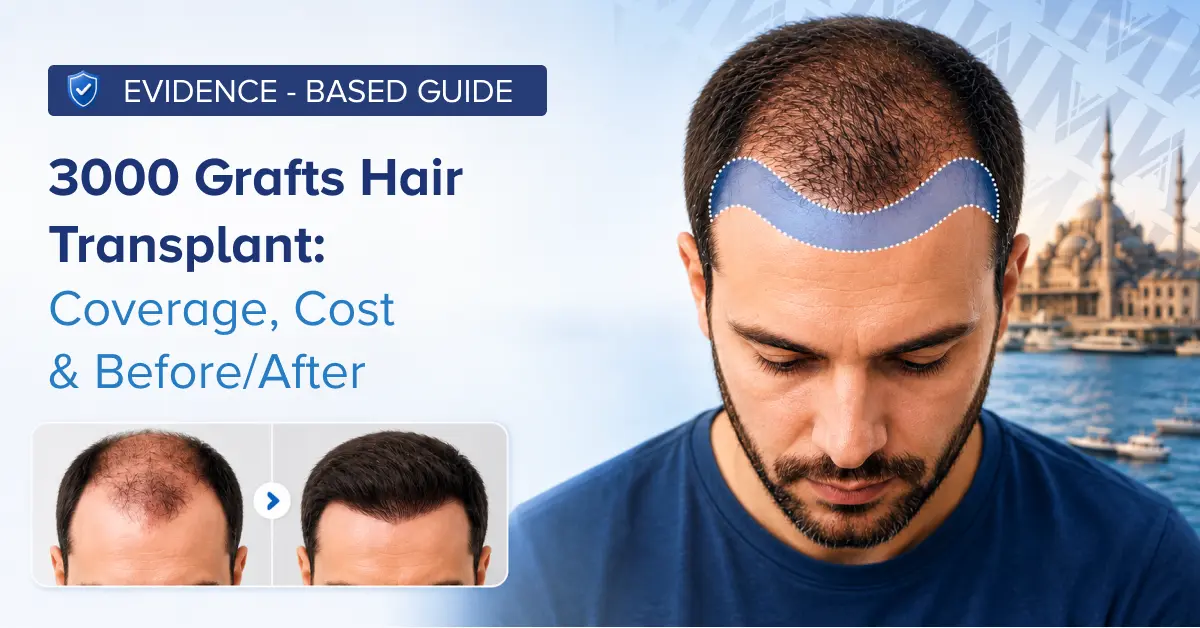
Two men walk into the same clinic on the same day. Both receive 3,000 grafts. A year later, one has a hairline he can run his hand through; the other feels short-changed. The number on the invoice was identical. The plan behind it was not.
That gap is what this guide is about. If you are considering a 3000 grafts hair transplant, you need to know what that figure can really deliver for your hairline, your donor area, and your long-term options. The team at Medart Hair Transplant in Istanbul wrote this guide to turn a marketing number into something you can actually use to make a safe, informed decision.

Is a 3,000 Grafts Hair Transplant Right for You?
A 3,000 grafts hair transplant typically restores the hairline and frontal area in men with moderate hair loss, but the ideal graft count for you depends on your pattern of baldness, donor quality, and long-term hair-loss plan.
What 3,000 grafts usually means
● Around 6,000–7,500 transplanted hairs.
● Good coverage for hairline and front in Norwood 3–4, sometimes 5.
● One full surgery day (6–8 hours) with 12–18 months to final results.
Hair restoration surgeons commonly aim for around 30–40 grafts per cm² in the frontal scalp to achieve cosmetically satisfying density — roughly half of native density, which helps preserve the limited donor supply. This target appears in standard hair restoration teaching and educational materials from the International Society of Hair Restoration Surgery (ISHRS).
Let us look more closely at what a graft actually is — and why "3,000" can look very different from one person to another.
What Is a Graft, and What Does 3,000 Grafts Actually Mean?
A graft is a natural group of 1–4 hairs called a follicular unit, so 3,000 grafts usually represent roughly 6,000–7,500 individual hairs moved from your donor area to thinning zones.
A graft (or follicular unit) is a tiny piece of scalp tissue containing one, two, three, or sometimes four hair roots. According to ISHRS patient education, follicular units naturally contain between 1 and 4 terminal hairs, with an average of around 2–2.5 hairs per unit in most people.
When you hear "3000 grafts hair transplant," think in terms of total hairs, not just the graft number. For many men, 3,000 grafts deliver enough hairs to rebuild the hairline and fill a significant part of the frontal scalp.
Grafts vs hairs: approximate translation
Grafts |
Avg. hairs per graft |
Approx. total hairs |
|---|---|---|
2,000 |
2.0–2.5 |
4,000–5,000 |
3,000 |
2.0–2.5 |
6,000–7,500 |
4,000 |
2.0–2.5 |
8,000–10,000 |
Surgeons also plan in terms of density. Native scalp typically carries around 80–100 follicular units per cm², a figure widely cited in dermatology literature on scalp anatomy. Transplants usually aim for roughly 30–40 grafts per cm² in key cosmetic areas — enough to look full while protecting the donor.

Two patients can both receive 3,000 grafts and walk away with very different 3000 grafts hair transplant results.
Key factors include:
● Hair thickness (calibre): Thick, coarse hairs cast more "shadow" and give better coverage than fine hairs.
● Curl: Wavy or curly hair spreads and overlaps, so it often looks fuller than straight hair at the same graft count.
● Colour contrast: Dark hair on fair skin reveals the scalp more easily than light hair on light skin.
Picture a field of trees. The number of trees (grafts) matters, but how wide they grow (hair thickness) and how their branches spread (curl and direction) change how dense the field looks from a distance.
Now that you understand what a graft is and how many hairs 3,000 grafts represent, the next step is to see what that number can realistically cover at different stages of hair loss.
What Can 3,000 Grafts Cover? (By Norwood Stage & Area)
In most men, 3,000 grafts can create a strong hairline and fill the frontal and mid-scalp regions, but it is usually not enough to completely restore a large bald crown in advanced Norwood stages.
The Norwood scale is a standard map of male pattern baldness, running from Norwood 1 (minimal recession) to Norwood 7 (only a narrow horseshoe of hair at the sides and back). It helps surgeons decide where limited grafts will produce the greatest visual impact.
For diagrams of each stage, see our Norwood scale for male pattern baldness.
Typical 3,000-graft coverage by Norwood
● Norwood 3–3V: hairline + temples + some mid-scalp, often with high cosmetic impact.
● Norwood 4–5: hairline + frontal + partial mid-scalp, with strategic density.
● Norwood 6–7: the front can be improved, but all bald areas cannot be fully covered.
Dermatology sources put native densities at around 80–100 follicular units per cm², but hair transplant planning often targets about 35–50 follicular units per cm² in the most visible areas to balance natural appearance and donor preservation.
Norwood 3–3V: Hairline and Temples
For Norwood 3–3V patients, 3,000 grafts can usually rebuild an age-appropriate hairline, restore the temples, and add density behind the hairline.
Norwood 3 hair loss features clear temple recession with a reasonably intact mid-scalp and crown. In these cases, 2,000–3,000 grafts often deliver very visible improvement. Surgeons typically place higher density right at the front to frame the face — sometimes approaching 40 grafts per cm² — then blend this softly backward.
Case example (Norwood 3, mid-30s):
A man in his mid-30s with Norwood 3 recession and strong donor density had 3,000 grafts placed mainly in the frontal third. Around 2,300 grafts rebuilt the hairline and temples; the remaining 700 were spread behind for a soft transition. At one year, his hairline looked natural and full, and his donor still had plenty of reserve for any future change.
Norwood 4–5: Front and Mid-Scalp Strategy
For Norwood 4–5, 3,000 grafts can usually cover the front and mid-scalp, but not the entire bald crown at high density.
Norwood 4–5 patterns show clear frontal and mid-scalp thinning plus a growing bald spot at the crown. Surgeons normally prioritise the front, because it frames your face and dominates how others perceive your hair.
A common 3,000-graft strategy is:
● 2,000–2,300 grafts for hairline and frontal third.
● 700–1,000 grafts for the mid-scalp.
● Crown either left for later or softened lightly with smaller numbers.
Case example (Norwood 5, early-40s):
A man in his early 40s with Norwood 5 loss came to Medart Hair Transplant in Istanbul for a 3000 grafts FUE session. We focused 2,200 grafts on creating a natural 3000 grafts hairline and frontal density, then used 800 grafts to strengthen the mid-scalp. The crown was left for a possible second procedure. At 12 months, he could style his hair forward with good coverage in the front — the crown remained thinner, but far less noticeable.
Crown-Focused Transplants: When 3,000 Grafts Go to the Back
Three thousand grafts can be directed mainly at the crown, but expectations must be realistic.
The crown (vertex) is a large, circular area, and recreating its natural swirl needs many grafts. Because native density is often high there, a 3,000 grafts hair transplant focused only on the crown may noticeably reduce the bald spot, but it rarely matches the density of untouched hair — particularly in bigger Norwood 4–5 crowns.
Case example (Crown-focused, late-30s):
A late-30s patient with a stable front but a large Norwood 3V–4 crown chose to direct all 3,000 grafts to the back. We targeted around 30 grafts per cm², enough to soften the obvious bald patch. At one year, the crown no longer drew the eye and he stopped using concealers, though it still looked slightly thinner than his native frontal hair.
For Norwood 6–7, even a well-planned 3,000-graft procedure cannot recreate a "full head of hair." The realistic goal is a flattering, natural front and mid-scalp, while accepting thinner coverage — or even visible baldness — further back.

Are You a Good Candidate for 3,000 Grafts?
You are a good candidate for a 3,000-graft transplant if your donor area is strong, your pattern of loss can be framed with that number of grafts, and a surgeon confirms the plan fits your age and future hair-loss risk.
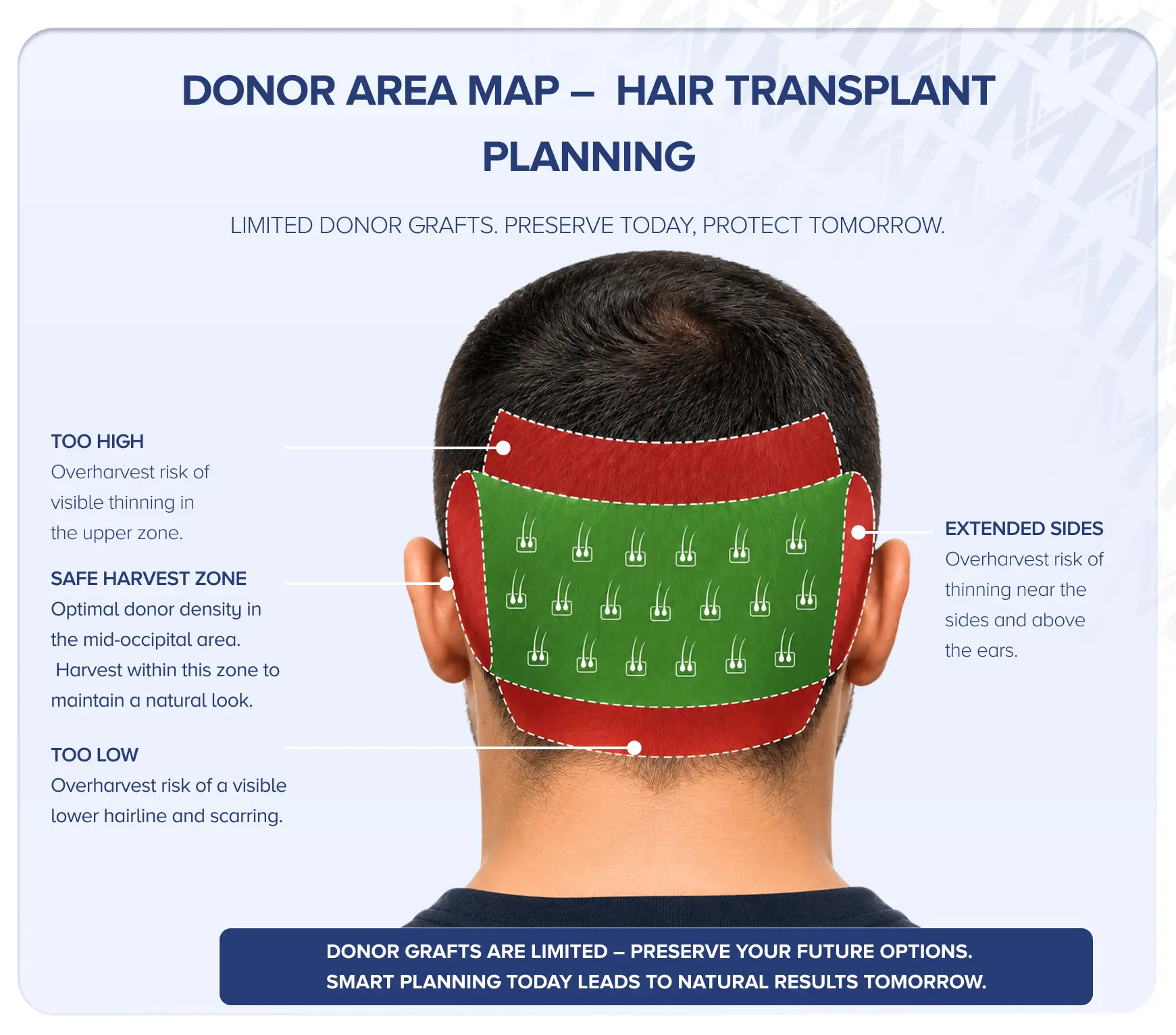
The donor area is the permanent hair on the back and sides of your head. These follicles are largely resistant to male pattern baldness. Your donor density (how many follicular units per cm²) and hair calibre determine how many grafts can be removed safely without leaving the donor looking thin.
Donor Area Quality and Safety
Think of your donor as a finite supply of "spare parts." Once grafts are taken, they do not grow back at the donor site.
Surgeons assess donor safety by looking at:
● How dense the hair looks when trimmed short.
● Hair thickness and curl pattern.
● Scalp health, scars, or previous surgery.
If the donor is strong, 3,000 grafts can usually be harvested safely with FUE (Follicular Unit Extraction) or DHI (Direct Hair Implantation). If density is low, pushing for 3,000 in one go risks overharvesting — where the back and sides start to look patchy or see-through.
Planning for Future Hair Loss and Second Sessions
Age and family history matter as much as your current photos.
Hair restoration societies such as the ISHRS encourage surgeons to assess family history and progression risk, especially in men under 30, before planning large sessions. For younger patients, we often choose a slightly higher, more conservative hairline and may recommend fewer grafts (for example, 2,000–2,500) to protect long-term donor preservation.
Quick 3,000-graft candidacy check
● Your main concern is hairline and front, not an entirely bald scalp.
● Donor hair at the back and sides still looks dense when cut short.
● Your surgeon expects your hair loss to be stable or medically controlled.
● You understand that future procedures may be needed if hair loss progresses.
Case example (young patient, conservative plan):
A 26-year-old with Norwood 2–3 recession and a strong family history of advanced baldness asked for a low, dense hairline and 3,000 grafts. After assessment at Medart, we agreed on 2,000 grafts with a more conservative, age-appropriate hairline, and started evidence-based medical therapy (finasteride and minoxidil) to slow further loss, in line with American Academy of Dermatology guidance for pattern hair loss. The result looked natural at his current age — and his donor stayed protected for the future.
If you want a rough idea of your own graft needs before speaking to a surgeon, our online hair transplant graft calculator is a good starting point, which you can then refine in consultation.
Exact graft numbers and suitability can only be determined after an individual medical assessment with a qualified hair transplant surgeon. Only a professional can properly assess your donor area, hair characteristics, and risk of future loss.
Not sure whether 3,000 grafts is too many or too few for your case? Tap the WhatsApp button in the bottom-right corner to send the Medart team clear photos of your hair — you will receive a free, honest graft estimate and a long-term hair-loss plan, not a hard sell.
With candidacy clearer, let us walk through what actually happens during a 3,000 grafts hair transplant procedure.
3,000 Grafts Hair Transplant Procedure: Step-by-Step
A 3,000 grafts hair transplant is usually performed in a single full day under local anaesthesia, with follicular units extracted from the donor area and implanted into thinning zones according to a pre-agreed design.
Most modern 3000 grafts FUE procedures use FUE (Follicular Unit Extraction) or DHI (Direct Hair Implantation). In FUE, individual grafts are removed from the donor using tiny punches and placed into small channels. In DHI, extraction is similar, but grafts are loaded into implanter pens and placed directly in one step.
For a deeper technical explanation of the technique, read more about how FUE hair transplant works.
Timeline of the Surgery Day
Here is a typical day for a 3,000 grafts FUE or DHI transplant:
1. 0–1 hour: Planning and anaesthesia
● Final photos, hairline design, and confirmation of the graft plan.
● Shaving (full or partial, depending on technique and case).
● Local anaesthesia injected into donor and recipient areas. Some clinics also offer mild sedation to help you relax.
2. 1–4 hours: Graft extraction
● FUE: tiny circular punches remove follicular units one by one from the donor area.
● DHI: similar extraction, with careful technique to reduce the transection rate (the rate at which hair roots are cut during removal).
● Grafts are stored in special solutions and sorted under magnification into 1-hair, 2-hair, and 3-hair units for strategic placement.
3. 4–8 hours: Site creation and implantation
● The surgeon creates recipient sites (small slits) at precise angles and directions, or loads implanter pens in DHI.
● Grafts are placed into these sites: single-hair grafts in the front for a natural hairline, multi-hair grafts behind for density.
● Dressings are applied to the donor and you receive detailed aftercare instructions.

Clinical case series and teaching material in hair restoration report average surgery times of around 6–8 hours for 2,500–3,500 grafts, depending on team size and technique. Local anaesthesia means you stay awake but comfortable; most patients describe the sensation as odd rather than painful once the numbing has taken effect.
You now know what happens on surgery day. The next question is what you will look like afterwards — and how a 3000 grafts hair transplant result develops over time.
3,000 Grafts Before and After: What Results to Expect and When
After a 3,000-graft transplant, most patients see the first noticeable thickening from month 3–4, a major cosmetic change by month 6–9, and full maturation of the hairline and density by 12–18 months.
Right after surgery, the transplanted area looks dotted with tiny scabs and the donor region is usually red and tender. Mild swelling on the forehead and around the eyes in the first few days is very common and settles quickly with standard care.
Clinical experience and reviews in dermatologic surgery suggest that most transplanted follicles that will grow typically emerge by around 12 months, with further thickening and texture changes continuing into the second year.
Recovery Timeline Month by Month
A typical healing and growth timeline:
● Week 1–2: Scabs, redness, and mild swelling; scabs usually fall off between days 7–10.
● Weeks 3–8: Most transplanted hairs shed; temporary thinning is common (the "ugly duckling" phase).
● Months 3–6: New hairs start to sprout and slowly thicken; early cosmetic change appears.
● Months 6–12: Density and texture improve significantly; hairstyle options expand.
● Months 12–18: Final refinement of hairline and overall density.
This pattern reflects how hair follicles cycle. After transplantation, hair shafts often shed while the roots rest, then re-enter a growth phase over several months.
Your clinic should provide full hair transplant aftercare instructions covering washing, sleeping position, and activity limits. These steps directly affect how well grafts survive in the first days and weeks.
Styling and Haircut Options After 3,000 Grafts
Most patients can:
● Return to desk work after about 3–5 days.
● Wear loose, clean hats a few days after surgery, once the surgeon approves.
● Start gentle haircuts on the donor within 2–3 weeks.
● Cut or style the transplanted area more freely after 4–6 weeks, once the skin has healed.
Shock loss, a temporary shedding of nearby native hairs caused by surgical stress, can occur in both donor and recipient areas. It can be unsettling to see more hair fall in the weeks after surgery, but these native hairs usually regrow over several months as the follicles recover.
Case example (3,000 grafts, Norwood 3, hairline focus):
A 37-year-old man received 3,000 grafts mainly for hairline and frontal restoration. At 1 week, he had visible scabs and redness but little pain. By 2 months, most transplanted hairs had shed, and he felt anxious watching thinner areas appear. From month 4, new growth became noticeable; by months 6–9, his 3000 grafts before and after photos showed a clear, natural-looking change. At 12 months, his hairline framed his face well and styling felt easy again.

3,000 Grafts Turkey Cost: What Affects the Price?
In Turkey, a 3,000 grafts hair transplant typically costs significantly less than in Western Europe or the US, but prices vary depending on the clinic's experience, technique, and what is included in the package.
Turkey is widely recognised as a major global destination for hair transplantation, with health tourism reports noting large numbers of procedures performed each year at prices lower than many Western countries. The reason is lower living and staffing costs, not lower medical standards.
Typical cost ranges for a 3,000-graft procedure
(approximate ranges based on commonly reported industry averages and clinic data):
Location |
Typical range for 3,000 grafts* |
Notes |
|---|---|---|
Turkey |
~€1,500–€3,000 (package) |
Often includes hotel, transfers |
UK / Europe |
~€6,000–€9,000 |
Usually per-graft pricing |
USA / Canada |
~$8,000–$14,000 |
Higher labour and overhead costs |
Approximate ranges based on widely reported industry averages; not specific to any single clinic.

In Istanbul, many reputable clinics offer package pricing that may cover:
- The surgery itself (FUE or DHI) and the medical team.
- Airport transfers and hotel accommodation.
- Basic medications and an aftercare kit.
- Translation support for international patients.
Other centres use per-graft pricing, more similar to UK or US models. If you want to understand per-graft cost calculations in detail, see our detailed guide to hair transplant cost per graft for worked examples.
Extremely cheap "unlimited grafts" offers — in Turkey or elsewhere — should be treated with caution. They often involve limited surgeon involvement, very high daily patient numbers, and inexperienced technicians, all of which can increase the risk of poor growth, unnatural results, or donor overharvesting.
When comparing hair transplant 3000 grafts price offers in Turkey, ask:
● Who designs the hairline and supervises the operation?
● How many patients are treated per day?
● What exactly is included in the package?
● Is there clear follow-up and aftercare?
Comparing 3000 grafts Turkey cost options and want clarity? Tap the WhatsApp icon in the bottom-right corner to message Medart for a transparent, no-obligation quote based on your photos and a realistic, personalised graft plan.
Cost is only one half of the picture. It is just as important to understand the risks of a large 3,000-graft session — and how to protect your results over the long term.