
Should You Have a 4000 Grafts Hair Transplant?
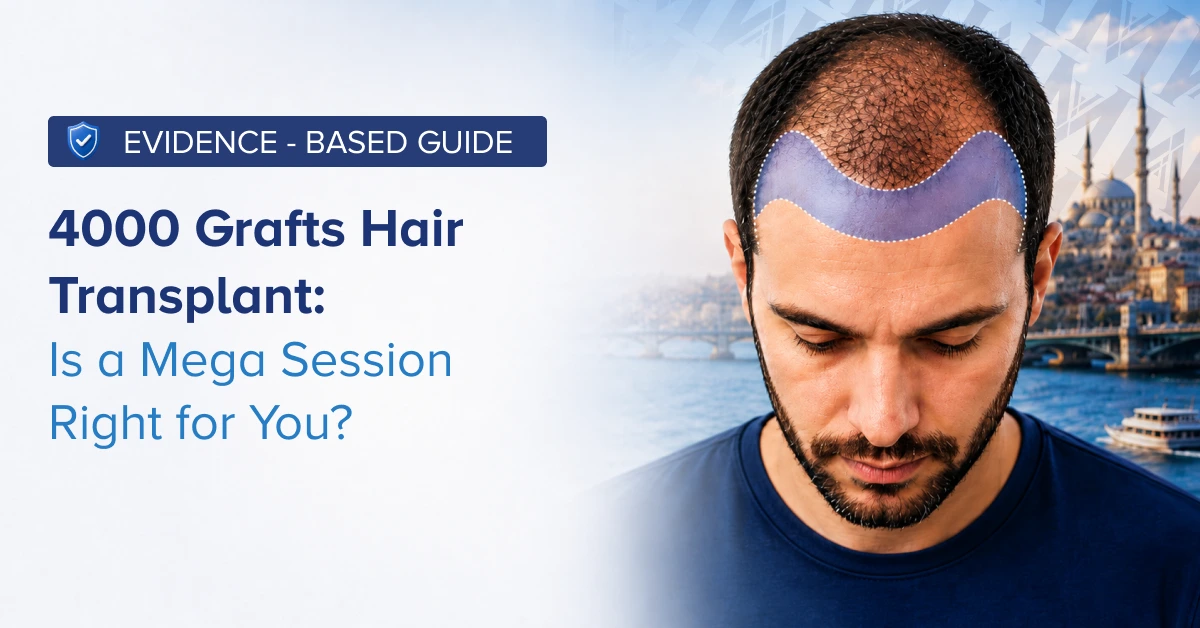
A 4000 grafts hair transplant can restore major coverage in advanced hair loss, but it is only suitable if your donor area, hair characteristics, and balding pattern are carefully assessed by an experienced surgeon.
In practice, this graft count is typically used for Norwood 4–6 patterns, where the front and mid-scalp, and sometimes the crown, are affected. For most patients, 4,000 grafts translate to around 8,000–10,000 hairs, based on an average of 2–2.5 hairs per graft as described by the International Society of Hair Restoration Surgery (ISHRS). In Turkey, including Istanbul, you usually pay a fraction of UK or US prices for this size of procedure, largely because of lower operating costs rather than lower medical standards.
Whether a 4000 grafts hair transplant is right for you depends on three things: your safe graft range, your Norwood stage, and your long-term hair loss planning. We will unpack each, starting with the basics.
What Does "4000 Grafts" Actually Mean?
In hair transplant surgery, 4,000 grafts usually means transplanting around 8,000 to 10,000 individual hairs, because each graft contains an average of two to three hairs.
A hair graft (also called a follicular unit) is a natural bundle of 1–4 hair follicles that grow together from the scalp. According to the ISHRS, most people average about 2.0–2.5 hairs per graft, though this varies with ethnicity and hair type. That is why 4,000 grafts roughly equals 8,000–10,000 hairs — sometimes more if your hair is naturally very dense.
Grafts vs Hairs – Why the Difference Matters
The distinction between grafts and hairs matters because two patients with "4,000 grafts" can end up with very different visual results.
● Single-hair grafts are usually placed at the hairline to keep it soft and natural.
● Multi-hair grafts (2–4 hairs) sit behind the hairline to build density.
Here is a simple overview of the terminology:
Term |
Typical range |
Notes |
|---|---|---|
Graft |
1–4 hairs |
Natural follicular unit |
4,000 grafts |
≈ 8,000–10,000 hairs |
Varies by patient and hair characteristics |
People with thick, dark, slightly wavy hair and high hairs-per-graft counts often achieve more coverage and visual fullness than someone with fine, light, straight hair using the same 4,000 grafts. The American Academy of Dermatology (AAD) notes that hair calibre (thickness) and colour contrast with the scalp both affect how dense hair appears, even at identical graft counts.

How Much Area Can 4000 Grafts Cover?
Four thousand grafts are considered a large-session hair transplant and can cover a significant area of scalp when placed carefully.
Teaching materials from professional societies such as the ISHRS suggest that cosmetic density (what looks full to the eye) often requires around 30–40 grafts per cm², though the exact number depends on hair thickness and colour. Using that range:
● With 4,000 grafts, a surgeon can typically cover roughly 80–120 cm² at cosmetic density.
● That might correspond to the frontal third and mid-scalp, with partial crown coverage in some patients.
Think of your scalp like a garden and grafts like plants per square metre. Plant them closely and the ground looks lush; space them out and you see soil. Your surgeon decides how to distribute those "plants" across the hairline, mid-scalp, and crown to balance coverage and density.
If you want to explore a rough estimate for your own pattern, try our online hair transplant graft calculator, then compare the result with what an experienced surgeon recommends for you.
Whether 4,000 grafts is realistic also depends on your Norwood stage and donor area — which is where things get personal.
Who Is (and Isn't) a Good Candidate for a 4000 Graft Mega Session?
You are generally a good candidate for a 4,000 graft transplant if you have advanced hair loss, a strong donor area, and a stable pattern of balding.
A hair transplant mega session is usually defined as placing more than 3,500–4,000 grafts in one sitting. This size of procedure is most often used in men with extensive thinning — typically Norwood 4–6 on the Norwood scale, the standard chart used to classify male pattern baldness.
Guidance from the AAD explains that androgenetic alopecia (male pattern hair loss) is progressive and often continues for many years. Long-term hair loss planning is therefore as important as what happens in a single surgery.
Key candidacy factors for a 4000 grafts hair transplant include:
● Norwood stage 4–6 pattern (front, mid-scalp, often crown affected).
● A strong donor area on the back and sides with good density.
● Medium to thick hair calibre rather than extremely fine hair.
● A relatively stable hair loss pattern, sometimes supported by medical treatment.
● Realistic expectations about coverage and density.
● No uncontrolled medical conditions (such as poorly controlled diabetes or bleeding disorders) that significantly raise surgical risk.
● A commitment to stop or reduce smoking, which impairs healing and blood supply.
The donor area is the more permanent zone around the back and sides of your scalp, where hair is genetically more resistant to balding. Donor capacity is how many grafts can be safely taken from this zone over your lifetime. The ISHRS notes that low donor density — for example, below about 40 follicular units per cm² — limits how many grafts can be harvested without visible thinning.
A useful way to think about it: your donor area is a bank account of grafts. You can only withdraw so much over your lifetime without going overdrawn. Overharvesting happens when too many grafts are taken, leaving patchy or see-through donor regions that are difficult to repair.
Norwood Stages and Typical Graft Needs
Typical (but not prescriptive) graft ranges by Norwood stage look like this:
● Norwood 3–4: often 2,500–3,500 grafts to rebuild the hairline and mid-scalp.
● Norwood 5: often 3,500–4,500 grafts to cover front and mid-scalp, with partial crown work.
● Norwood 6: often 4,000–6,000+ grafts, frequently across one or more surgeries.
These ranges are broad estimates, not fixed prescriptions. Hair calibre, donor density, and goals all shift the plan. For a fuller breakdown, read our guide on the Norwood scale and typical graft ranges.

In our experience with large cases at Medart Hair Transplant, a Norwood 5 man in his early 40s with strong donor density can usually receive 4,000 grafts safely in one session. A younger Norwood 3 with rapidly progressing hair loss is usually better served with fewer grafts, a slightly higher hairline, and medical therapy to preserve options as their pattern evolves.
4000 Grafts Hair Transplant Before and After – What Results Can You Expect?
After a 4,000 graft transplant, most patients see their first visible growth by three to four months, with the final result becoming apparent around 12 months.
According to patient information from the AAD and NHS, transplanted hairs typically shed in the first few weeks — a normal process — then enter a new growth phase over several months. A typical hair growth timeline after a 4000 grafts hair transplant:
● 2–4 weeks: Most transplanted hairs shed; the follicles stay alive under the skin.
● 3–4 months: Early new hairs begin to appear as thin, soft strands.
● 6 months: Noticeable improvement in coverage and density for most patients.
● 12–18 months: Final thickness, texture, and curl pattern become clearer.
The ISHRS notes that when grafts are handled gently and stored properly, a high proportion typically grow — often described as around 90% or more in experienced hands. Exact numbers vary between surgeons, techniques, and patients, so we prefer ranges over a fixed percentage. In our clinic, we most often see strong growth provided patients follow post-op instructions carefully.
Example Result Patterns for 4000 Grafts
Scenario 1: Norwood 5, dense donor, thick hair. A man in his early 40s with Norwood 5 hair loss travels to Istanbul. His donor area is strong, with high density and thick, slightly wavy dark hair. We plan 4,000 grafts: roughly 2,500 to rebuild his hairline and mid-scalp, and about 1,500 to improve the upper mid-scalp and part of the crown. At 12 months, his frontal third looks full at cosmetic density, the mid-scalp blends smoothly into existing hair, and the crown still shows some thinning but is much less obvious — especially with styling.

Scenario 2: Norwood 6 hair transplant with realistic framing. A man in his 50s presents with Norwood 6 hair loss — near-total loss of the front and crown, only a narrow band of hair on the sides and back. His donor density is average. After assessing his donor capacity, we agree that 4,000 grafts is his safe graft range for a first surgery. The priority is to frame his face, so we design a slightly higher, mature hairline and place about 3,500 grafts in the frontal half and mid-scalp, reserving 500 to soften the upper crown border. At one year, he has a strong front profile and can style his hair forward, accepting a thinner crown that he may choose to improve with a smaller second session later if his donor allows.
When you review 4000 grafts before and after photos online, evaluate them critically:
● Look for consistent angles and lighting rather than dramatic, stylised images.
● Check both the donor and recipient areas for evenness.
● Note hair length and styling tricks that may exaggerate density.
● Prefer results with at least 12 months of follow-up.
These details help you avoid being misled by marketing photos that do not match typical outcomes. The way those 4,000 grafts are scheduled — one mega session or split across days — also influences safety and results.
Is One 4000 Graft Mega Session Safe, or Should You Split It?
A single 4,000 graft mega session can be safe when performed by a skilled team with proper graft handling, but in some patients it is safer to split the work into two sessions.
A mega session or large-session hair transplant usually means placing more than 3,500–4,000 grafts in one overall treatment plan. The ISHRS emphasises that large sessions demand careful planning, an experienced team, and proper graft storage solutions to protect survival.
Pros of a single 4,000 graft mega session:
● One primary surgery and one main recovery period.
● Faster overall transformation in appearance.
● One trip for international patients — attractive for those travelling to Turkey.
Cons of a single mega session:
● Longer operative time (often 6–10 hours, sometimes spread over two consecutive days).
● Greater risk of team fatigue if not managed well.
● Potentially lower graft survival if grafts stay outside the body too long or handling is suboptimal.
Surgical Time and Graft Survival Considerations
Graft survival in a 4000 grafts hair transplant depends on several technical details:
● Time out of the body before implantation.
● Storage conditions — temperature and hydration of grafts.
● Gentle extraction and implantation to minimise trauma.
● An adequately sized, trained team that works efficiently without rushing.
Reports presented at ISHRS meetings and published in dermatologic surgery literature show that, when grafts are kept hydrated and cool and surgical time is managed properly, high survival rates are achievable even in large sessions. At Medart, we typically perform 4,000 grafts as one structured long day or across two back-to-back days, rather than compressing everything into an unsafe timeline.
Planning for Future Hair Loss
Mega sessions must be designed with donor management and future hair loss progression in mind. National dermatology guidelines make clear that male pattern hair loss is progressive, and thinning may continue behind transplanted areas.
That means:
● It is sometimes wiser not to use all available donor grafts in a single procedure.
● Many patients benefit from focusing on the front and mid-scalp now, leaving the crown for a smaller second surgery later.
● Overharvesting the donor region early leaves fewer options for refinement or repair if your pattern advances.
Consider this case: a Norwood 6 patient with weak donor hair requests 5,000+ grafts in one go. Instead, we might recommend 3,000–4,000 scalp grafts, sometimes combined with beard hair as a secondary donor source, and reserve some donor capacity for future adjustments. Using nearly all scalp donor grafts at once could leave a thin, patchy donor area with too few grafts available for correction.
Next, let's look at what actually happens during a 4,000 graft procedure — and what recovery feels like afterwards.
What to Expect During and After a 4000 Grafts Procedure
A 4,000 graft procedure usually takes most of the day, is done under local anaesthesia, and requires about 7–14 days before you feel socially comfortable again.
A 4000 grafts hair transplant is a full-day commitment, sometimes divided over two consecutive days for comfort and graft safety. Most modern large sessions use Follicular Unit Extraction (FUE) under local anaesthesia, sometimes with mild sedation. FUT (strip surgery) can also move large graft numbers, but FUE is now the more common choice for international patients because it avoids a long linear scar and fits better with short hairstyles.
The AAD describes FUE as a technique using tiny punches to remove individual follicular units from the donor area, leaving many small dot scars that are usually hard to see with short hair. FUT removes a strip of scalp from the donor area, then dissects it into grafts; it can yield high numbers of grafts per session but leaves a single linear scar. For a large session such as a 4000 grafts hair transplant, FUE has become the preferred option in many Turkish clinics because of its flexibility and recovery profile.
Typical Steps in a 4000 Grafts Surgery Day
1. Pre-op assessment and design: Final hairline, density targets, and coverage areas are drawn; standard photos are taken.
2. Local anaesthesia: Numbing injections are given to the donor and recipient areas.
3. Graft extraction (FUE): Follicular units are harvested from the donor area and stored in chilled solution.
4. Recipient site creation: Tiny incisions are made in the balding zones at planned angles and directions.
5. Implantation: Grafts are placed into recipient sites using forceps or DHI implanter pens.
6. Bandaging and instructions: The donor is usually bandaged; the recipient area is left uncovered but protected.
7. Post-op check: You receive written and verbal aftercare instructions and any medications per your surgeon's protocol.
Most patients describe the procedure as uncomfortable rather than painful. The local anaesthetic injections are often the most intense moments; after that, you mainly feel pressure, vibration, and some tugging.
Recovery Timeline After a 4000 Graft Mega Session
The NHS and AAD both note that FUE healing is typically quick, with most patients able to resume light activities within a few days. A typical recovery course for a 4000 grafts hair transplant:
● Day 1–3: Mild pain or tightness; forehead swelling can occur; small scabs form around grafts.
● Day 4–7: Discomfort is usually minimal; swelling subsides; gentle washing begins as instructed.
● Week 2–4: Scabs fall off; redness gradually fades; transplanted hairs often shed in a phase known as "shock loss."
● Month 3–6: New hairs emerge; density improves; most patients can resume full exercise once their surgeon approves.
● Month 6–12: Hair thickens and matures; styling options expand significantly.
