
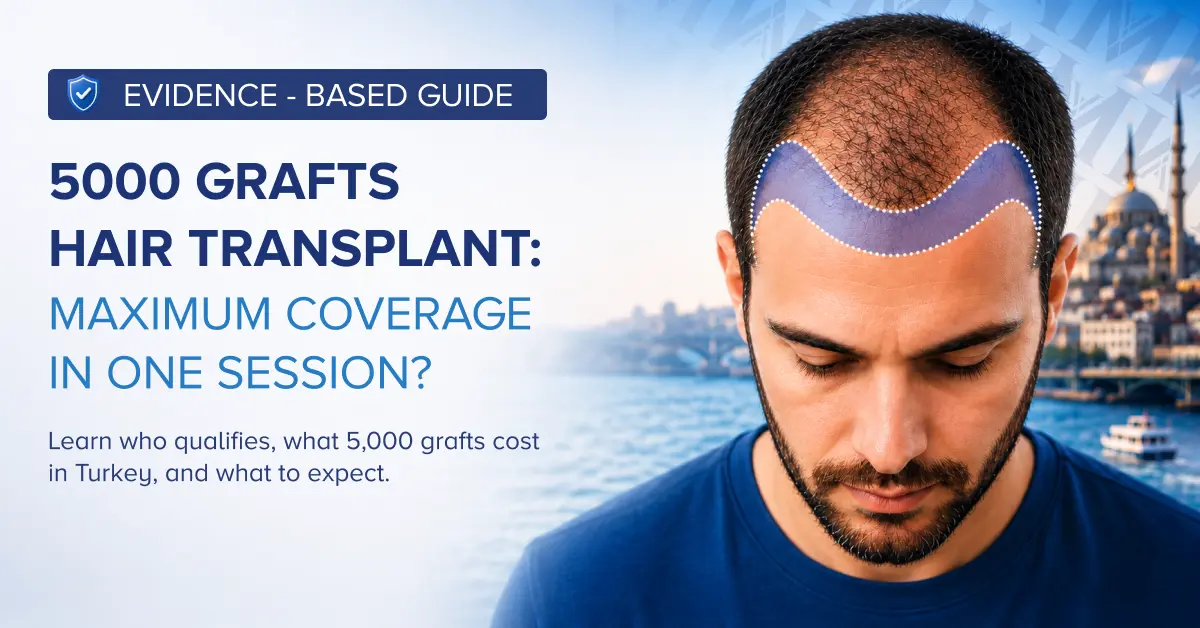
In hair transplantation, bigger is not always better. Chasing a 5,000-graft session because you saw a flashy YouTube result is one of the fastest ways to exhaust your donor area without ever achieving natural-looking density. At Medart Hair Transplant in Istanbul, many men arrive asking for "5,000 grafts in one go." Our first job is often to slow things down and protect their future options.
A 5,000-graft hair transplant can be life-changing when the numbers match your scalp, your Norwood scale stage, and your lifetime donor capacity. The sections below explain how to decide whether that applies to you.
Is a 5000-Graft Hair Transplant in One Session Right for You?
A 5,000-graft hair transplant is possible and can be safe for carefully selected patients, but only after an experienced surgeon confirms your donor area, hair loss pattern, and long-term plan.
For many men with advanced Norwood hair loss, 5,000 grafts (around 10,000–12,500 hairs) can rebuild the front and mid-scalp and give some crown coverage. Not everyone needs or should aim for this number, and in many cases a slightly smaller first session is wiser.
Quick indicators:
● Good candidates
● Norwood 5–7 male pattern baldness with a clear, stable pattern
● Strong donor density and good hair calibre
● Hair loss stable or controlled with medication
● Realistic expectations about density and coverage
● Poor candidates
● Very low donor density or previous overharvesting
● Very young age (early 20s) with rapidly progressing loss
● Uncontrolled medical conditions, heavy smoking, or very high BMI
● Expectation of teenage density across the whole scalp
According to the International Society of Hair Restoration Surgery (ISHRS), a typical follicular unit contains 1–4 hairs, often averaging about 2–2.5 hairs per graft, so 5,000 grafts represent a very large session by any standard.
Suitability for a 5,000-graft hair transplant must be assessed individually based on your medical history, donor area, and hair loss pattern.
Next, let's look at what "5,000 grafts" actually means in terms of hair count and scalp coverage.
What Does "5000 Grafts" Actually Mean?
Five thousand grafts usually means transplanting around 10,000 to 12,500 individual hairs, depending on how many hairs each graft naturally contains.
A hair graft, also called a follicular unit, is a natural bundle of 1–4 hairs that grows from the scalp as a unit. In most men, the average is roughly 2–2.5 hairs per graft, as described in educational materials from the American Academy of Dermatology (AAD) and the ISHRS.
Grafts vs Hairs: Why the Difference Matters
Grafts and hairs are not the same thing.
● A graft / follicular unit is the "root bundle" moved in hair transplant surgery.
● A hair is the visible strand that grows out of that bundle.
If your grafts average 2 hairs each, then 5,000 grafts give about 10,000 hairs. If they average 2.5, you may reach 12,500. Patients with naturally higher hairs-per-graft counts often achieve better scalp coverage from the same graft number.
Visual density also depends on:
● Hair thickness (coarse vs fine)
● Curl or wave (curly hair covers better)
● Colour contrast between hair and skin
● How you style your hair (short, long, brushed forward, parted)
● How well the grafts reconnect with your scalp blood supply
So, a 5,000-graft hair transplant number on its own does not guarantee a "full head of hair." It is one variable in a much larger plan.
How 5000 Grafts Translate Into Scalp Coverage
To put 5,000 grafts in context, here is a simple approximation:
Graft Count |
Approx. Hairs (avg 2–2.5 hairs/graft) |
|---|---|
3,000 |
6,000–7,500 |
4,000 |
8,000–10,000 |
5,000 |
10,000–12,500 |
Clinical reviews in dermatologic surgery suggest that "cosmetic density" in transplanted zones is often achieved around 30–45 grafts/cm² in priority areas like the frontal scalp, compared with natural densities of roughly 60–100 grafts/cm² in many adults (summarised by the AAD and ISHRS). These are general ranges; individual numbers vary.
Here a simple analogy helps. Imagine your scalp as land and your hair as trees. A natural forest is extremely dense. A carefully planted forest with fewer, well-spaced trees can still look full from a distance, even if there are fewer trees. Hair transplant planning tries to create that illusion of fullness.
If you want to see how different numbers might apply to you, our online hair transplant graft calculator helps estimate whether you are likely to need fewer or more than 5,000 grafts.
Next, we'll look at who is — and isn't — a good candidate for using 5,000 of those "trees" in one go.
Get a Free Hair Analysis
Talk to an experienced patient coordinator for your hair transplant in Turkey.Who Is (and Isn't) a Good Candidate for 5000 Grafts?
Ideal candidates for a 5,000-graft transplant are men with advanced hair loss (often Norwood 5–7), good donor density, and a stable or medically controlled pattern of hair loss.
The Norwood scale is a standard chart used to classify male pattern baldness (androgenetic alopecia).
● Norwood 5 shows large frontal and crown loss with only a narrow bridge of hair between them.
● Norwood 6 has that bridge gone, leaving front and crown fully joined.
● Norwood 7 shows only a horseshoe of hair around the sides and back.
Norwood Stage and 5000-Graft Planning
Your Norwood stage shapes how far 5,000 grafts can go:
● Norwood 5: Around 3,500–4,500 grafts often cover the hairline and mid-scalp, with some crown work.
● Norwood 6 hair transplant: 4,000–5,000 grafts may rebuild the front and mid-scalp with partial crown coverage.
● Norwood 7: Even 5,000 grafts are usually not enough for dense coverage everywhere, so expectations must be conservative.
Guidance from the ISHRS stresses that planning for advanced Norwood stages should consider lifelong donor use and likely future loss, not only immediate coverage.
Donor Area Limits and Overharvesting Risk
The donor area is the permanent zone on the back and sides of the head where follicles are more resistant to balding. Your donor capacity is like a bank account: you can only withdraw so much over a lifetime before the bank runs dry.
Many surgeons consider a donor density above 60–70 grafts/cm² favourable for large sessions. ISHRS teaching material suggests that, over a lifetime, a meaningful proportion of follicles in the safe donor zone can often be moved without obvious thinning, but this is an estimate and varies widely between individuals.
If your donor density is low, or your scalp is already thinned by previous surgery or overharvesting, a 5,000-graft hair transplant can leave you with visible donor scarring and patchy thinning.
Candidate Checklist
Good candidates for around 5,000 grafts
● Norwood 5–7 pattern with a clear, stable progression
● Donor density typically >60–70 grafts/cm²
● Coarse or medium-thick hair and good donor capacity
● Age often mid-30s or older, or younger but stable on finasteride/minoxidil (under doctor supervision)
● Prepared to accept realistic, not "teenage," density
Not good candidates
● Norwood 2–3 with mild recession (simply do not need so many grafts)
● Very young (early 20s) with aggressive family history and fast progression
● Donor area already thin, scarred, or heavily overharvested
● Uncontrolled health issues, heavy smoking, or very high BMI
● Unrealistic expectations about a single procedure fixing everything forever
For example, in our Istanbul clinic we recently assessed a 32-year-old man with Norwood 6 hair loss, medium donor density, and a strong family history of progression. Instead of the 5,000 grafts he requested, we recommended about 3,500 grafts focused on the front and mid-scalp, with a planned second transplant later if his donor area allowed. Twelve months on, his hairline and mid-scalp framed his face very well — and we still had "money in the bank" for the future.
Suitability for a 5,000-graft hair transplant must be assessed individually based on your medical history, donor area, and hair loss pattern.
Unsure whether you truly need 5,000 grafts? Send clear photos via the WhatsApp button in the bottom-right corner of this page. A surgeon from Medart Hair Transplant will review them and give you a personalised, honest graft estimate and long-term plan, with no obligation to book.
Now, let's look at whether it is technically and medically safe to place this many grafts in one sitting.
Can You Safely Do 5000 Grafts in One Session? Maximum Grafts Explained
For many patients, the practical maximum in a single FUE session is around 3,500 to 4,500 grafts, and sessions approaching 5,000 grafts are often split over two consecutive days for safety.
A mega session usually means 3,000–5,000+ grafts planned as one procedure. An ultra-mega session is anything above that, almost always staged. The right approach depends on:
● Technique: FUE (Follicular Unit Extraction), FUT (strip surgery), or a combination
● The experience and size of the surgeon-led team
● Your health, scalp condition, and ability to tolerate long procedures
● How many grafts in one session can be safely extracted and implanted from your donor area
According to the ISHRS, longer operating times can increase patient fatigue, and if grafts stay outside the body for too long or are not stored correctly, graft survival may suffer.
One Mega Session vs Two Medium Sessions
In FUE, each graft is removed one by one from the donor area using a tiny punch, then implanted into the recipient area. In FUT strip surgery, a strip of skin is removed from the donor area and dissected into follicular units under a microscope. FUT can yield many grafts in a single day but leaves a linear scar.
Many experienced surgeons consider the maximum grafts in one session of FUE to be roughly 3,500–4,500 for a single long day. Pushing well beyond that is sometimes possible but, for 5,000 grafts, is often safer over two days — especially when the clinic insists on protecting graft survival and patient comfort.
Definition block
● Mega session: typically 3,000–5,000+ grafts in one surgical plan
● Ultra-mega session: >5,000 grafts, often over two days or with FUT + FUE combined
Very long days increase risks of:
● Patient discomfort and movement
● Bleeding and swelling
● Staff fatigue and potential errors
● Longer "out-of-body" time for grafts, which can affect survival
Dermatology sources, including the AAD, emphasise that careful management of surgery length, graft hydration, and temperature is important for maintaining high graft survival in larger sessions.
If you want more background on the technique itself, read how FUE hair transplant works in detail — it explains why the way grafts are handled and implanted matters as much as the total number.
Next, we'll look at 5000 grafts before and after in practical terms: what coverage you can realistically expect.
5000 Grafts Before and After: What Coverage Can You Expect?
A 5,000-graft transplant can usually restore a strong hairline and mid-scalp and give partial crown coverage, but it rarely recreates the density of a teenage full head of hair.
The core question is how to distribute limited grafts over a large recipient area. Most experienced hair transplant surgeons use a frontal priority strategy: concentrate higher density at the hairline and front, then gradually reduce density towards the crown/vertex.
Example 1 – Norwood 5 With 5000 Grafts
In a typical Norwood 5 case with good donor capacity:
● 2,500–3,000 grafts may be used to build a natural hairline design and a dense frontal third.
● 1,500–1,800 grafts can thicken the mid-scalp.
● The remaining 200–500 grafts might be spread thinly into the crown.
This approach creates a convincing frame to the face and good top coverage, with the crown looking thinner but not completely bald. In priority areas like the frontal third, many surgeons aim for around 30–45 grafts/cm², which clinical reviews in hair surgery describe as a typical cosmetic target rather than an attempt to recreate native density.
For example, at our clinic in Istanbul a 45-year-old man with Norwood 5 hair loss and strong donor hair received around 4,800 grafts over two days. At 12 months, his hairline and mid-scalp looked full both in photos and in person, while his crown still showed some see-through in harsh light — exactly as we had discussed before surgery. As he put it on review: "It's not perfect, but I look ten years younger in the mirror."
Example 2 – Norwood 6–7 With 5000 Grafts
In Norwood 6–7 cases, the bald area is much larger. With 5,000 grafts, you usually must choose between:
● Strong front and mid-scalp with light crown coverage, or
● Moderate density across all areas, which can look "spread thin"
Most surgeons prefer the first option, because a solid front looks more natural in daily life. Even with 5,000 grafts, the crown may remain relatively thin. Some patients later choose a secondary procedure to add more crown density if their donor capacity still allows, while others accept a thinner crown as a fair trade-off for a strong hairline.
Hair Growth Timeline After a 5000-Graft Session
The growth timeline after a 5,000-graft hair transplant is similar to smaller sessions, but the area healing is larger.
A typical pattern, consistent with information from the American Academy of Dermatology:
● Days 0–10: Scabs, redness, and mild swelling. The transplanted area looks dotted.
● Weeks 2–8: Many transplanted hairs shed (a normal "shock" phase).
● Months 3–4: Early new hairs begin to appear, often thin and soft.
● Months 6–9: Noticeable improvement in coverage and density.
● Months 9–12+: Hair thickens and matures; most of the cosmetic result is visible.
Full maturation, especially in the crown, can take up to 12–18 months. When you see "5000 grafts before and after" photos online, always check that the "after" is at least 9–12 months post-op.
If you prefer photographic examples, you can browse real before-and-after hair transplant results and compare them with the Norwood patterns described above.
Next, we'll look at what a 5,000-graft procedure involves in Turkey, especially Istanbul, and how costs compare with the UK and US.
5000 Grafts in Turkey: Costs, Techniques, and What to Look For
In Turkey, a 5,000-graft hair transplant usually costs a fraction of UK or US prices, but quality and safety vary widely between clinics.
Turkey — and especially Istanbul — has become a major hub for hair transplant tourism. Lower living and staffing costs mean that hair transplant Turkey cost is often several times lower than in Western Europe or North America, even in well-equipped hospitals. The Turkish Ministry of Health reports that hundreds of thousands of international patients visit each year for cosmetic procedures, with hair transplantation among the most popular.
Average Cost Range for 5000 Grafts in Turkey
Prices vary by clinic reputation, surgeon involvement, and what is included in packages. In very broad terms:
Location |
Typical Cost Level for 5000 Grafts* |
|---|---|
Turkey |
Low–moderate |
UK |
High |
US |
High |
For a more precise idea of budget planning, see our detailed breakdown of hair transplant costs in Turkey, which explains how package pricing works and which extras matter.
Techniques for Large Sessions: FUE, DHI, FUT
Most 5,000-graft procedures in Turkey use modern FUE techniques, often with refinements:
● Sapphire FUE: uses sapphire blades for making recipient sites.
● DHI (Direct Hair Implantation): uses implanter pens to place grafts directly, which some surgeons prefer for certain hairline areas.
Because DHI can be more time-intensive, some clinics reserve it for specific zones and use standard FUE elsewhere, especially in large sessions. FUT strip surgery is less common in Turkey but can be combined with FUE to increase graft numbers in selected advanced Norwood patterns with good scalp laxity.
Red Flags for "Cheap Unlimited Grafts" Offers
Marketing phrases like "unlimited grafts in one day" sound attractive, especially in "5000 grafts Turkey" searches — but they are also a warning sign.
Be cautious if:
● A doctor is barely involved and technicians make all key decisions
● There is no proper consultation or honest graft estimate before travel
● The clinic cannot show long-term donor photos, only close-up hairlines
● They promise very high graft numbers regardless of donor capacity
The ISHRS warns that overreliance on unlicensed technicians and high-volume "hair mills" increases the risk of complications and poor outcomes, including overharvested donors and unnatural hairlines.
How Medart Plans Large Graft Sessions
Clinics like Medart Hair Transplant in Istanbul use a surgeon-led team approach for large cases. At our centre:
● A senior surgeon designs the hairline and coverage strategy.
● The donor area is carefully mapped to preserve future donor management.
● FUE extraction and implantation are performed by a trained team under direct surgeon supervision.
● Large sessions (approaching or over 5,000 grafts) are typically split over two days to protect graft survival and patient comfort.
If you want a broader sense of why patients travel to Istanbul for hair transplant surgery, read our overview — it covers travel, accommodation, and aftercare planning.
Before comparing only headline prices, ask any clinic to show you how many grafts they recommend and why. Tap the WhatsApp button in the bottom-right corner of this page to request a no-obligation assessment from the Medart team in Istanbul.
In the next section, we'll walk through how a typical 5,000-graft day (or two days) is structured.
Procedure Day: How Long Does a 5000-Graft Session Take and What Is Recovery Like?
A 5,000-graft hair transplant typically involves 8–12 hours of surgery time, often spread over one very long day or two shorter days, with most patients able to travel home within a few days.
Large FUE sessions are divided into phases: design, extraction, and implantation. You remain awake under local anaesthesia, with breaks for food and the bathroom. The AAD notes that most patients tolerate FUE well when anaesthesia and positioning are handled correctly, although mild soreness and swelling afterwards are common.
How a Typical 5000-Graft Day Is Structured
1. Pre-op planning (1–2 hours) – Photos, discussion, and drawing of the hairline design; review of the recipient area and detailed donor area mapping.
2. Anaesthesia and extraction (3–5 hours) – Local anaesthesia is applied to the donor area, and FUE extraction begins. You usually lie face down or on your side while grafts are removed.
3. Site creation and implantation (4–6 hours) – Small incisions are made in the recipient area, then grafts are placed using forceps or DHI implanter pens. You may change position several times to stay comfortable.
4. Post-op instructions (30–60 minutes) – Your scalp is cleaned, a bandage is placed on the donor area, and you receive detailed post-op care instructions, including washing, sleeping position, and medications.
Many patients ask how many grafts in one session we can realistically complete. For larger plans close to 5,000 grafts, many experienced Istanbul clinics — ours included — prefer to divide the work into two consecutive days of around 2,500–3,000 grafts each to reduce fatigue and maintain graft quality.
Recovery and Travel Planning for International Patients
Recovery after a mega session is similar to smaller FUE operations, but the treated area is larger.
Typical timeline:
● Day 0–3: Swelling around forehead/eyes, redness, and scabs. Sleep on your back with your head elevated and avoid pressure on grafts.
● Day 4–7: Swelling improves; scabs start to loosen. Many patients feel comfortable going outside with a loose hat approved by their surgeon.
● Week 2: Most scabs have fallen; donor area looks much better.
● Week 3–4: Transplanted hairs begin to shed (normal shock loss).
● Month 1–3: Scalp looks similar to pre-surgery, but new roots are in place under the skin.
Many international patients having a 5,000-graft hair transplant in Turkey fly home 3–5 days after surgery. Airlines usually allow flying after hair transplant surgery, but you must follow your surgeon's specific advice and protect the grafted area during travel.
Now let's look at the short- and long-term risks of large sessions — especially overharvesting, and how it affects your long-term donor area capacity.
Risks, Complications, and Long-Term Donor Management
The biggest long-term risk of a 5,000-graft session is overharvesting your donor area, leaving it visibly thin and limiting your options for future procedures.
All surgery carries risk. Hair transplant complications are usually mild but can be significant if planning or technique is poor. Surveys highlighted by the ISHRS show that overharvesting and unnatural hairline design are among the most common reasons for repair surgery.
Overharvesting and Donor Exhaustion
Key short-term risks include:
● Infection of donor or recipient areas
● Excessive swelling or bleeding
● Prolonged redness or crusting
● Shock loss of existing hair around the transplant
● Numbness or altered sensation
Long-term risks, especially with very large or repeated sessions:
● Overharvesting the donor area, causing patchy thinning
● Visible donor scarring, particularly in FUT strip surgery or poorly executed FUE
● Lower graft survival if grafts were mishandled or kept out of the scalp blood supply too long
● "Pluggy" or unnatural appearance from poor hairline design
● Limited ability to have more surgery later if donor reserves are exhausted
The NHS advises that signs such as severe pain, spreading redness, pus, or fever after a hair transplant should prompt urgent medical review by your surgeon or a local doctor.
If your scalp donor is limited and more grafts are needed, some advanced cases may consider a body hair transplant (for example, from chest or beard). Body hair behaves differently and should only be used selectively by experienced surgeons, ideally as a backup rather than a first choice.
Planning Today So You Don't Run Out of Grafts Tomorrow
Donor hair functions like a limited bank account. Responsible planning looks not only at what you can do now, but at what you might need later.
Key elements of a long-term plan:
● Your likely future Norwood pattern based on age and family history
● How many grafts you may need over 10–20 years
● Whether to reserve grafts for future thickening or crown work
● Use of hair loss medications like finasteride and minoxidil, which must be prescribed or supervised by a qualified doctor, to protect native hair around the transplant
For the bigger picture, read how many hair transplants you can safely have in a lifetime, which explains lifetime donor management in more depth.
If you notice worrying signs after surgery — strong pain, pus, rapidly worsening redness, or fever — contact your surgeon or local doctor immediately rather than waiting.
Next, we'll help you decide whether a single 5,000-graft mega session or staged smaller sessions are likely to be safer for your hair transplant donor area capacity.
How to Decide: 5000 Grafts at Once or Staged Over Multiple Sessions?
Choosing between one 5,000-graft mega session and two smaller sessions should be based on your donor capacity, travel constraints, and your surgeon's safety recommendations — not convenience alone.
There is no single "right" answer. For some patients, especially medical tourists to Istanbul, one mega session hair transplant is attractive because it means one trip and one main recovery. For others, splitting into two 2,500–3,000 graft sessions allows safer donor use and more refinement once the first round of growth is visible.
Your hair transplant donor area capacity is a major factor here: if it is borderline, a staged approach may protect you from overharvesting.
Pros and Cons: One Mega Session vs Two Sessions
Option |
Pros |
Cons |
|---|---|---|
One 5,000-graft mega session |
One downtime and one trip; faster visible change |
Very long day; higher fatigue; less flexible donor use |
Two smaller sessions |
Better donor management; refine design after growth |
Two recoveries; more travel; longer overall treatment |
In our clinic, we often see borderline cases benefit from a staged approach. A 50-year-old man with Norwood 6 hair loss and modest donor density once asked us for 5,000 grafts at once. After assessing his donor capacity, we recommended 3,000 grafts first, focusing on the hairline and mid-scalp. At 12 months we re-evaluated his donor and added another 1,800 grafts mainly to the crown. The final result looked natural, and his donor area still appeared even.
As one of our surgeons puts it to patients: "In many advanced cases, a staged approach gives better long-term aesthetics, because we can refine the design once we see how the first grafts grow."
Questions to Ask Your Surgeon Before Committing
Before deciding on a 5,000-graft hair transplant in one session, ask:
● How many grafts do you recommend for me, and why?
● What is my estimated donor capacity over my lifetime?
● Will you prioritise frontal density or try to cover everything thinly?
● Will you do this in one day or two, and who will actually perform each step?
● What is your plan if my hair loss progresses further?
It is also worth seeking an independent second opinion — for example, from a local dermatologist who can perform an objective donor density measurement and discuss whether medications like finasteride or minoxidil should be part of your plan.
Want help weighing one large session against a staged plan? Send your photos and basic medical history through the WhatsApp button in the bottom-right corner. A surgeon from Medart Hair Transplant will respond with a personalised, no-pressure opinion about which option better protects your donor area.
Next, the most common questions people ask about 5,000-graft procedures.