
Every hair transplant article shows you the "after" photo — the restored hairline, the fuller crown, the confident smile. Almost none show you the back of the head.
The donor area, where every single transplanted hair originates, is arguably the most critical part of your entire procedure. It's also the part most patients know the least about. That gap in understanding isn't trivial. Your hair transplant donor area is a finite resource. It determines how many grafts are available, how natural your results look, and what options remain years down the road. Mismanage it, and you don't just risk a poor outcome today — you close doors for the future.
This guide covers the donor area in full: its anatomy, its limits, a week-by-week recovery timeline, an honest assessment of body hair transplant options, and a practical framework for evaluating whether a clinic will treat your donor area with the care it deserves. By the end, you'll understand exactly what happens before, during, and after surgery — and you'll know the right questions to ask before committing to any procedure.
What Is the Hair Transplant Donor Area and Why Does It Matter?
Before graft counts, recovery timelines, or surgical techniques enter the conversation, you need to understand a foundational concept. The donor area isn't simply where hair is taken from and forgotten. It's the biological engine that makes hair transplantation possible in the first place.
Understanding Donor Dominance
In 1959, dermatologist Norman Orentreich published research that would become the cornerstone of modern hair restoration. He demonstrated a principle called donor dominance — the discovery that hair follicles retain the genetic characteristics of their original location, even after being relocated to a different part of the scalp.
Hair from the back and sides of your head is genetically programmed to resist DHT (dihydrotestosterone), the hormone responsible for pattern hair loss. When a surgeon transplants these follicles to a thinning area, they carry that genetic programming with them. They continue behaving as though they never moved — growing, cycling, and resisting the hormonal signals that caused hair loss elsewhere.
This is why hair transplantation works. And it's why the donor area is so critical.
The "Safe Donor Zone" — Anatomy and Boundaries
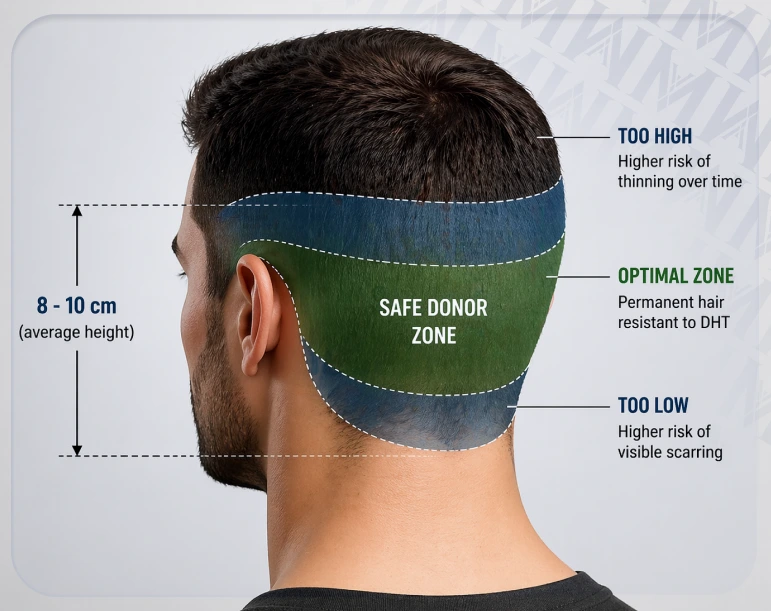
The hair transplant safe donor zone refers to the scalp region where hair is most resistant to DHT-driven miniaturization. It primarily spans the mid-occipital area — the back of your head between your ears — and extends into parts of the parietal regions on the sides. In most patients, this zone measures approximately 8–10 cm in vertical height.
The safe zone is not identical for everyone. It varies based on your hair loss pattern, genetics, and how far your hair loss has progressed. In patients with advanced loss — Norwood 6 or 7 on the Norwood scale, which classifies male pattern hair loss from stage 1 (minimal) to 7 (extensive) — the safe zone can shrink considerably as thinning encroaches from above and below.
A skilled surgeon maps this zone precisely before extracting a single graft. The donor area is a finite resource — extracted follicles do not regenerate. Think of it like a savings account. Every graft extracted is a withdrawal, and there are no deposits. A responsible surgeon manages this account carefully, ensuring you have reserves for the future.
Quick Quote in 5 Minutes
Talk to an experienced patient coordinator for your hair transplant in Turkey.How Many Grafts Can Be Safely Extracted from the Donor Area?
Understanding that the donor area is finite leads to an urgent question: how many grafts can it actually provide? The answer hinges on several individual factors — and getting it right is one of the most consequential aspects of surgical planning.
Average Donor Capacity and What Affects It
Across all ethnicities, donor density typically ranges from approximately 65–120 follicular units per square centimeter (FU/cm²). Most patients can safely yield roughly 4,000–6,000 grafts over their lifetime from the scalp donor area, though patients with exceptionally high density may support more. Individual variation is significant — some patients with naturally thin donor areas have considerably fewer grafts available.
The factors that determine your specific donor capacity include:
Native density, measured in FU/cm² across different zones of the donor area
Scalp laxity, which affects how much area is accessible for extraction
Hair caliber — thicker hair shafts provide more coverage per graft
Hair-to-skin color contrast — lower contrast makes thinning less visible
Curl pattern — curlier hair provides more volume and coverage per follicle
These figures vary by ethnicity. Caucasian patients typically have approximately 80–100 FU/cm². Asian patients tend toward lower follicular density but often compensate with thicker individual shafts. African patients generally have lower density but benefit from tightly curled hair that provides significantly more visual coverage per graft.
The following table provides a general framework:
Donor Density (FU/cm²) |
Approximate Safe Lifetime Yield |
Notes |
|---|---|---|
60–75 (low) |
2,500–4,000 grafts |
Conservative extraction essential; body hair may supplement |
80–100 (average) |
4,000–6,000 grafts |
Most common range; supports 2–3 sessions for most patients |
100–120 (high) |
5,500–7,500+ grafts |
Excellent donor potential; more flexibility for extensive restoration |
Consider a patient in their late 30s with Norwood 4 hair loss researching their first transplant in Turkey. During consultation, trichoscopy (specialized scalp imaging) reveals a donor density of 70 FU/cm² — on the lower end of average. The surgeon calculates that approximately 3,500 grafts can be safely extracted over a lifetime. That's enough for meaningful improvement, but not enough for complete coverage of every thinning area. This realistic assessment shapes every decision that follows — from how many grafts to extract in the first session to whether body hair might supplement the plan later.
A professional donor area assessment will give you accurate, personalized numbers rather than general ranges.
The Danger of Over-Harvesting
A common misconception is that you can take unlimited grafts from the donor area. In reality, safe extraction should not reduce local density below approximately 25–40 FU/cm² in any given zone. Drop below this threshold, and the consequences become visible — and permanent.
Over-harvesting creates a moth-eaten pattern: irregular patches of thinning across the back of the head that look unnatural and cannot be reversed. Instead of solving one cosmetic problem, it creates another. This is among the most serious complications in hair transplantation.
Why does it happen? Sometimes clinics marketing "mega sessions" push extraction beyond safe limits to deliver impressive graft counts. In other cases, it stems from inexperience or insufficient oversight during extraction.
So what does this mean for your specific situation? Protect yourself by asking about extraction density limits, requesting donor area photographs from previous patients at six months or longer, and questioning any clinic promising more than 5,000 grafts in a single session without a thorough assessment.
How Surgeons Assess Your Donor Area Before Surgery
A responsible surgeon evaluates your donor area using several tools before planning your procedure:
● Trichoscopy and densitometry — specialized imaging that measures follicular density per square centimeter across different zones
● Manual punch test — a small test extraction to assess graft quality and transection rates (the percentage of follicles damaged during extraction)
● Miniaturization assessment — checking whether follicles in the donor zone show early thinning, which would indicate the safe zone is smaller than it appears
● Scalp laxity evaluation — particularly relevant if Follicular Unit Transplantation (FUT) is being considered
A clinic that skips a detailed donor assessment is a red flag. This self-evaluation framework is preliminary only — a professional assessment with trichoscopy and densitometry is necessary for accurate results.

FUE vs. FUT — How Each Technique Affects the Donor Area
The extraction method your surgeon uses leaves a lasting imprint on your donor area's appearance, recovery, and future capacity. Understanding the trade-offs helps you make an informed choice — and for a deeper comparison of hair transplant techniques beyond donor area impact, our comprehensive guide covers each method from consultation to final results.
FUE (Follicular Unit Extraction) and the Donor Area
Follicular Unit Extraction (FUE) involves removing individual follicular units using a small circular punch, typically 0.7–1.0 mm in diameter. Each extraction leaves a tiny dot scar that heals to become largely invisible at hair lengths above 2–3 mm.
FUE's key advantage is distribution. Extractions spread across the entire safe zone, avoiding concentrated depletion in any single area. This versatility leaves the donor area looking natural.
The risk is real, though. If punches are placed too close together or too many grafts are taken from one region, visible thinning can occur. A common misconception is that FUE leaves no scars. It does leave tiny dot scars — typically undetectable at normal hair lengths, but they exist.
FUT (Follicular Unit Transplantation) and the Donor Area
FUT, sometimes called the strip method, involves removing a narrow strip of tissue from the mid-occipital region. Individual follicular units are then dissected from this strip under magnification.
FUT's primary advantage is efficiency. It can yield high graft counts in a single session without broadly reducing donor density across the zone. The surrounding hair closes over the extraction site.
The primary disadvantage is the scar. FUT leaves a linear scar, typically 1–2 mm wide with skilled closure technique — but potentially wider with poor technique or unfavorable healing. It limits future hairstyle options, since a short buzz cut will reveal the scar.
Which Method Preserves the Donor Area Better?
Neither method is universally superior. The better choice depends on your hair type, goals, long-term plan, and surgeon's expertise.
FUE is generally preferred globally — and particularly in Turkey — for its cosmetic donor area outcomes and flexibility. FUT may suit patients who need maximum graft yield in a single session and are comfortable wearing their hair long enough to conceal the linear scar. Some surgeons advocate a combined approach: FUT for an initial large session, FUE for subsequent refinements, maximizing lifetime graft availability.
The quality of extraction and placement matters far more than the number of grafts. Many patients believe more grafts automatically means better results. This isn't accurate. Over-extraction damages the donor area and can compromise the overall outcome. Strategic placement of a conservative number of grafts often produces a more natural result than aggressive extraction that depletes the donor zone.

Donor Area Recovery — A Complete Week-by-Week Timeline
Now that you understand what happens to the donor area during surgery, let's address the question that keeps most patients up at night: "What will recovery actually look like?"
Donor area recovery follows a predictable pattern, though individual timelines vary based on age, overall health, smoking status, and how closely you follow aftercare instructions. The timeline below reflects typical FUE recovery. FUT recovery follows a similar arc, with the addition of suture care and suture removal typically around days 10–14.
Days 1–3: Immediate Post-Operative Phase
The first three days are the most sensitive. Your donor area will show visible redness and hundreds of tiny pinpoint scabs at each extraction site. Mild swelling is common, and the area will feel tender.
Pain is typically mild — most patients rate it approximately 3–4 out of 10 — and is managed with prescribed analgesics. By day two, many patients find over-the-counter pain relief sufficient.
During this phase: don't touch the donor area directly. Avoid letting water pressure hit the area. Sleep with your head slightly elevated, ideally on your back, to minimize swelling.
What's normal: redness, mild oozing, a tight sensation. What warrants attention: significant swelling that worsens rather than improves, or any sign of fever.
Days 4–7: Early Healing Phase
Scabs begin to dry and tighten. Itching typically starts now — a sign that healing is underway. Resist the urge to scratch. Dislodging scabs prematurely increases scarring risk.
Your first gentle wash is usually permitted during this period, following your clinic's specific protocol. Redness recedes from the edges of the extraction zone inward. By day seven, most patients report that discomfort has resolved almost entirely.
Weeks 2–3: Scab Shedding and Initial Recovery
Most scabs fall off naturally between days 10 and 14. Underneath, the skin may appear pink or slightly lighter than the surrounding area. This is temporary.
Existing hair around the extraction sites begins to grow and provide natural coverage. By the end of week three, most patients return to work and social activities without anyone noticing their donor area. For the vast majority of patients, this is when anxiety about appearance begins to ease.
Weeks 4–8: Intermediate Recovery
Pinkness gradually fades to match your normal skin tone. Tiny dot scars from FUE become increasingly difficult to spot, even upon close inspection.
Some patients experience temporary numbness in the donor area during this phase. Sensation typically returns fully within this window, though it may take longer for some individuals. Hair growth around extraction sites continues to provide natural camouflage.
Months 3–6: Full Cosmetic Recovery
By month three, the donor area is cosmetically indistinguishable from its pre-surgery appearance for most patients. Any residual hypopigmentation (lighter spots where scabs were) typically resolves during this period.
Your surgeon should conduct a follow-up assessment of the donor area to evaluate density and confirm healing has progressed as expected.
Long-Term Donor Area Appearance (6–12+ Months)
At the one-year mark, donor area recovery is essentially complete. At hair lengths of 3 mm or longer, extraction sites are virtually undetectable. At a very short buzz cut, faint dot scars may be visible upon close inspection in bright light.
Set realistic expectations: the donor area will look natural, but it is not "unchanged." Density is slightly reduced from its pre-surgery level. Maintaining donor area health long-term involves good nutrition, gentle hair care, and avoiding unnecessary trauma to the area.
Time Period |
What to Expect |
Key Care Instructions |
|---|---|---|
Days 1–3 |
Redness, pinpoint scabbing, tenderness, mild swelling |
No touching, no water pressure, sleep elevated |
Days 4–7 |
Scabs drying, itching begins, redness fading at edges |
First gentle wash (per clinic protocol), do not scratch |
Weeks 2–3 |
Scabs shed, pink skin underneath, surrounding hair provides coverage |
Resume gentle daily washing, return to most social activities |
Weeks 4–8 |
Pinkness fades, dot scars becoming invisible, sensation returning |
Gradual return to exercise, continue sun protection |
Months 3–6 |
Cosmetically indistinguishable from pre-surgery for most patients |
Follow-up assessment with surgeon recommended |
Months 6–12+ |
Full maturation, minimal visible evidence of extraction |
Maintain general scalp health, nutrition, gentle care |
Recovery speed varies. Smoking, poor nutrition, diabetes, and non-compliance with aftercare slow healing. Good overall health, adequate protein intake, and meticulous adherence to your clinic's instructions support faster recovery.
Wondering how these timelines and numbers apply to your specific situation? Our surgical team offers complimentary donor area assessments using trichoscopy and densitometry — personalized answers based on your unique hair characteristics.
How to Care for Your Donor Area After a Hair Transplant
With a clear picture of what recovery looks like, the next step is understanding what you can do to support it. Proper aftercare is the single most controllable factor in your donor area recovery. Following these protocols closely can mean the difference between seamless healing and unnecessary complications.
Washing and Hygiene Protocol
Your clinic will provide specific donor area care instructions after your hair transplant, but the general protocol follows this pattern:
1. Begin gentle washing on day 3–5 (as directed by your surgeon)
2. Use lukewarm water — never hot — and a specialized post-transplant shampoo
3. Apply water and shampoo with a gentle patting motion; never rub or scrub
4. Allow water to run over the donor area without direct pressure
5. Pat dry with a clean, soft towel — no rubbing or friction
6. Continue this specialized protocol for approximately 10–14 days before transitioning to your normal routine
Activities to Avoid During Recovery
Certain activities can compromise healing or increase complication risk:
● Strenuous exercise — avoid for 2–4 weeks; increased blood pressure can cause bleeding at extraction sites
● Direct sun exposure on the donor area — protect with a loose hat or avoid for at least 4 weeks
● Swimming pools, saunas, and steam rooms — avoid for a minimum of 4 weeks due to infection risk
● Tight hats or helmets pressing directly on the donor zone — avoid for at least 2 weeks
● Alcohol consumption — limit for the first week, as it thins blood and increases swelling
● Smoking — quit at least 2 weeks before and after surgery, as smoking significantly impairs blood flow and wound healing
Signs of Complications to Watch For
Complications are uncommon when aftercare is followed carefully. Infection following FUE is rare, occurring in fewer than 1–2% of cases when proper protocols are observed. Still, recognizing warning signs early is essential:
● Excessive redness or swelling that worsens after day 5 rather than improving
● Pus or foul-smelling discharge — signs of infection requiring immediate medical attention
● Persistent numbness beyond 3 months (some temporary numbness is normal)
● Folliculitis — small, inflamed bumps around extraction sites from ingrown hairs (common and manageable, but should be treated)
If you experience any of these symptoms, contact your clinic or a medical professional immediately. Patients with bleeding disorders, uncontrolled diabetes, or autoimmune conditions affecting the skin should disclose these before the procedure, as they can significantly impact healing.
Products and Treatments That Support Healing
Several products and treatments can support optimal recovery:
● PRP (Platelet-Rich Plasma) therapy — some clinics offer PRP sessions to accelerate healing and support follicle health in the donor area
● Gentle moisturizers and biotin-based sprays — keep the scalp hydrated during the healing phase
● Nutritional support — adequate protein, zinc, iron, and vitamins A and D contribute to faster wound healing and healthier hair growth
What If You Don't Have Enough Donor Hair? Understanding Donor Limitations
Proper aftercare gives your donor area the best chance at seamless recovery. But what if the challenge isn't recovery — it's whether you have enough donor hair to begin with?
This is a real concern for many patients. It deserves an honest answer.
Factors That Limit Donor Hair Availability
Several factors can reduce the amount of donor hair available for transplantation:
● Advanced hair loss patterns (Norwood 6–7) requiring very high graft counts for meaningful coverage
● Previous transplant sessions that have already depleted the donor zone
● Naturally low donor density — some patients simply have fewer follicular units per square centimeter
● Scarring from prior FUT procedures that reduces the usable extraction area
● Diffuse thinning that extends into the donor area, shrinking the safe zone
Remember the patient we discussed earlier — late 30s, Norwood 4, donor density of 70 FU/cm²? Their surgeon calculates approximately 3,500 lifetime grafts. Enough for meaningful improvement in the hairline and frontal zone, but not enough to cover every thinning area. This is the kind of realistic assessment that separates responsible clinics from those that overpromise.
How Surgeons Work with Limited Donor Areas
Experienced surgeons have strategies for maximizing results when donor hair is limited:
● Strategic graft placement — prioritizing the hairline and frontal zone, which deliver the greatest cosmetic impact, rather than trying to cover every area equally
● Conservative extraction — taking fewer grafts now to preserve options for future sessions as hair loss progresses
● Combining surgery with medical therapy — medications like finasteride and minoxidil can stabilize existing hair, reducing total grafts needed (discuss medication options with your doctor to determine what's appropriate for your situation)
● Supplementing with body hair when appropriate — covered in the next section
If you're wondering how many hair transplants you can have over a lifetime, the answer depends largely on how conservatively the donor area is managed in each session.
When a Hair Transplant May Not Be Recommended
Not every patient is a candidate for hair transplant surgery. Transparency matters here.
A transplant may not be recommended when the donor area cannot supply enough grafts for a meaningful cosmetic improvement, when diffuse thinning has compromised the safe zone, or when expectations cannot be met with the available donor supply.
In these cases, alternative approaches may be more appropriate:
● Scalp Micropigmentation (SMP) — a non-surgical technique that creates the appearance of density through tattooed pigment dots
● High-quality hairpieces — modern hair systems are remarkably natural and can be an excellent option
● Medical therapy alone — for some patients, stabilizing existing hair with medication provides sufficient improvement
A qualified surgeon can evaluate your specific situation and recommend the most appropriate path forward — even if that path doesn't include surgery.
Body Hair Transplant (BHT) — Can Beard, Chest, or Body Hair Be Used?
For patients whose scalp donor area is limited — whether from advanced hair loss, previous surgeries, or naturally low density — body hair transplant represents a genuine option worth understanding. But it demands an honest, nuanced discussion.
What Is Body Hair Transplant (BHT)?
Body Hair Transplant (BHT) involves extracting follicular units from non-scalp donor sites — including the beard, chest, abdomen, legs, arms, and back — and transplanting them to the scalp. The procedure typically uses FUE with finer punches (0.7–0.8 mm) to accommodate the different characteristics of body hair follicles.
Once considered experimental, BHT has gained increasing acceptance as a supplementary technique. It is not a replacement for scalp donor hair. But it can be a valuable addition to a comprehensive restoration plan.
Best Body Donor Sites Ranked by Effectiveness
Not all body hair is equal. The following ranking reflects both quality and yield potential:
1. Beard hair — the best non-scalp donor source. Beard follicles are thick and robust, closest to scalp hair in caliber. A full beard can yield approximately 1,000–3,000+ grafts.
2. Chest hair — finer than beard hair but viable for adding density, particularly in crown areas. Typical yield: approximately 500–1,500 grafts.
3. Leg and arm hair — finest caliber with the shortest growth cycle. Limited utility, best suited for eyebrow transplants or very subtle density enhancement.
4. Back and abdomen hair — variable quality, generally not preferred due to inconsistent growth patterns.
Body Site |
Hair Caliber |
Approximate Yield |
Best Use |
Estimated Survival Rate |
|---|---|---|---|---|
Beard |
Thick, robust |
1,000–3,000+ grafts |
Crown density, mid-scalp |
Approximately 70–80% |
Chest |
Medium-fine |
500–1,500 grafts |
Crown density supplementation |
Approximately 60–75% |
Legs/Arms |
Fine, short |
200–500 grafts |
Eyebrows, subtle density |
Approximately 50–70% |
Back/Abdomen |
Variable |
200–800 grafts |
Rarely preferred |
Approximately 50–65% |
How Does Body Hair Differ from Scalp Hair?
A common misconception is that body hair transplant is just as good as scalp hair transplant. While BHT is a valuable tool, meaningful differences exist:
● Growth cycle — beard hair has an anagen (active growth) phase of approximately 1 year, compared to 2–6 years for scalp hair. Body hair grows to a shorter maximum length.
● Texture and caliber — body hair is often wavier or curlier than scalp hair, with thickness varying by source site
● Growth rate — body hair typically grows more slowly than scalp hair
These differences mean body hair works best for density supplementation rather than hairline creation, where texture mismatches would be most noticeable.
When Is Body Hair Transplant a Good Option?
BHT is most appropriate in specific clinical scenarios:
● Depleted scalp donor area from one or more previous transplant sessions
● Advanced hair loss (Norwood 6–7) requiring graft counts that exceed the scalp donor supply
● Scar repair or camouflage — body hair can be transplanted into scars from previous FUT procedures or injuries
● Adding density to crown or mid-scalp areas where slight texture differences are less noticeable
Consider a patient who had a previous transplant five years ago and used most of their available scalp donor grafts. Thinning persists in the crown. Their surgeon recommends a beard hair transplant to supplement the remaining scalp supply. The beard hair provides good density in the crown, though its slightly different texture means it isn't suitable for refining the hairline. This combined approach achieves meaningful improvement without over-harvesting the scalp.
For patients like the one we've followed throughout this guide — moderate donor density, progressive hair loss — body hair represents a strategic reserve that could prove valuable if loss advances beyond what the scalp donor area can cover. This is best determined through an in-person consultation with an experienced transplant specialist.
Limitations and Realistic Expectations of BHT
Honesty about limitations is essential. Research on BHT outcomes is still evolving, and published data varies:
● Survival rates are generally lower than scalp FUE — some studies suggest approximately 60–80% for body hair compared to approximately 85–95% for scalp donor grafts, depending on source site and surgeon experience
● Texture mismatch can be visible, especially at the hairline where scrutiny is highest
● Not all patients have sufficient or suitable body hair — density and quality vary enormously between individuals
● Recovery at body donor sites is typically faster than scalp recovery, but scarring patterns differ and can be more visible on areas like the chest
● BHT requires a surgeon with specific experience — not every clinic offers or performs this technique well
Body Hair Transplant Availability in Turkey
Body hair transplant in Turkey is offered by a growing number of clinics, particularly as a supplementary service for patients with limited scalp donor areas. However, availability does not equal expertise. When evaluating a Turkish clinic for BHT, ask:
● How many BHT procedures has the surgeon personally performed?
● Can they show before-and-after photos of BHT patients at 12+ months?
● Do they use BHT as part of a comprehensive plan, or as a standalone service?
BHT should always be part of a broader treatment strategy, not a standalone solution. The best outcomes come from surgeons who integrate body hair strategically with scalp donor hair and, where appropriate, medical therapy.
Donor Area Scarring — Types, Prevention, and Treatment
Whether your grafts come from the scalp or body, scarring ranks among the top concerns for patients considering a transplant. Understanding what to expect — and what you can do about it — removes much of the uncertainty.
FUE Scarring vs. FUT Scarring
The two primary techniques produce distinctly different scar patterns. FUE donor area scarring consists of tiny circular marks, each less than 1 mm in diameter, scattered across the extraction zone. At hair lengths above 2–3 mm, these scars are virtually invisible. Even at very short lengths, they're typically detectable only upon close inspection.
FUT leaves a single linear scar across the back of the head, typically 1–2 mm wide with skilled closure. With poor technique or unfavorable healing, this scar can be wider and more conspicuous. It's generally concealable at hair lengths of 2 cm or longer but visible with a very short buzz cut.
Factors That Affect Donor Area Scarring
Several variables influence how your scars heal:
● Surgeon skill and technique — precise extraction and careful wound closure are the most controllable factors
● Skin type and healing tendency — patients prone to keloid or hypertrophic scarring may develop more visible marks
● Post-operative care compliance — following aftercare instructions closely minimizes scarring risk
● Number of sessions — cumulative scarring increases with each procedure, reinforcing the importance of conservative extraction
How to Minimize and Treat Donor Area Scars
If scarring concerns you, several treatment options exist:
● Trichophytic closure — a specialized FUT closure technique where wound edges overlap slightly, allowing hair to grow through the scar line and significantly reducing visibility
● Scalp Micropigmentation (SMP) — pigment dots tattooed into scar tissue to camouflage both FUE dot scars and FUT linear scars
● Laser treatments and microneedling — improve scar texture and promote collagen remodeling over multiple sessions
● FUE into FUT scars — transplanting individual follicles directly into a linear scar to break up its appearance with growing hair
For the vast majority of patients who choose an experienced surgeon and follow aftercare protocols, donor area scarring is minimal and virtually undetectable in daily life.
How to Evaluate a Clinic's Donor Area Management (Especially in Turkey)
A persistent misconception is that all clinics in Turkey handle donor areas to the same standard. They don't. There is enormous variation in quality, and donor area management is one of the clearest differentiators between a clinic that delivers excellent results and one that leaves patients with lasting regret.
Questions to Ask Before Your Procedure
Before committing to any clinic, ask these specific questions:
● "What is your maximum extraction density per cm²?"
● "Can I see donor area photos from previous patients at 6+ months?"
● "How do you determine my safe donor zone?"
● "What is your protocol if my donor area is insufficient for my goals?"
● "Do you offer body hair transplant if supplemental grafts are needed?"
● "Will the surgeon personally oversee the extraction process?"
The answers — and how readily they're provided — reveal a great deal about a clinic's transparency and competence.
Red Flags to Watch For
Be cautious of clinics that exhibit these patterns:
● Promising extremely high graft counts (6,000+ in a single session) without a thorough donor assessment
● Showing only recipient area before-and-after photos — never the donor area
● Technician-led procedures with no surgeon oversight during extraction
● A one-size-fits-all approach with no personalized plan based on your specific donor characteristics
● Dismissing your questions about donor area management or extraction limits
What Good Donor Area Management Looks Like
A clinic that prioritizes donor area management demonstrates these practices:
● Pre-operative densitometry and mapping of the entire safe zone before extraction begins
● Even distribution of extraction across the donor area, avoiding concentrated depletion
● A conservative approach that preserves future options, especially for younger patients whose hair loss may progress
● Detailed aftercare protocols specific to the donor area, not just the recipient zone
● Follow-up assessments that evaluate the donor area alongside the transplanted hair
At our clinic, donor area assessment is the first step of every consultation — not an afterthought.
Remember the patient we've followed throughout this guide — late 30s, Norwood 4, moderate donor density? At a clinic with strong donor management, that patient receives a realistic plan: a conservative first session focused on the hairline and frontal zone, with a clear strategy for a potential second session in the future. At a clinic without these standards, that same patient might receive an aggressive extraction that looks acceptable initially but leaves them with a depleted donor area and no options for the road ahead.
The difference between these two outcomes starts with the questions you ask today.
Frequently Asked Questions About the Hair Transplant Donor Area
No — extracted follicles are permanently removed and do not regenerate. However, surrounding hair in the donor area typically grows long enough to cover extraction sites, making the area appear unchanged to the casual observer. This natural camouflage is why a well-performed extraction looks virtually undetectable, even though overall density is slightly reduced.
Most patients report mild discomfort for approximately 3–5 days following FUE, with complete resolution within 7–10 days. The initial 48 hours are typically managed with prescribed analgesics, after which over-the-counter pain medication is usually sufficient. Severe or worsening pain beyond the first week should be reported to your clinic immediately.
With a skilled surgeon and properly distributed extraction, the donor area after a hair transplant is virtually undetectable at hair lengths of 3 mm or longer. At a completely shaved or very short buzz cut, faint dot scars may be visible upon close inspection in good lighting. Most patients find their typical hairstyle provides complete concealment.
Yes, beard hair transplant is the most effective non-scalp donor source available. Beard follicles are thick and robust, making them particularly useful for adding density to the crown and mid-scalp. However, beard hair is typically used to supplement scalp donor hair rather than replace it, due to differences in growth cycle and texture that can be noticeable at the hairline.
This depends on your initial donor density and how conservatively each session is performed. Most patients can safely undergo 2–3 FUE sessions from the scalp donor area over their lifetime. Patients with exceptional density may support additional sessions. The key is ensuring no single session reduces density below the safe threshold in any zone.
Over-harvesting leads to permanent, visible thinning of the donor zone — a moth-eaten appearance with irregular patches that cannot be reversed. This is one of the most serious complications of hair transplant surgery and underscores the importance of choosing an experienced surgeon who respects extraction limits. No subsequent procedure can fully correct this damage.
When performed by a skilled surgeon who distributes extractions evenly across the safe zone, the donor area does not look bad after a hair transplant. Most patients find it appears natural and unchanged at typical hair lengths. The key is conservative extraction within safe density limits, avoiding concentrated depletion in any single area.
During the first 2–3 weeks of recovery, a loose-fitting hat can conceal the donor area in public. After scabs shed around day 10–14, surrounding hair begins providing natural coverage. By week three, most patients return to social activities without anyone noticing. Long-term, hair lengths of 3 mm or more provide complete concealment of FUE extraction sites.
Repair options for an over-harvested donor area are limited. SMP can camouflage the appearance of thinning by creating the illusion of density. In some cases, body hair can be transplanted into depleted areas to partially restore coverage. However, a severely over-harvested donor area cannot be fully reversed — which is why prevention through conservative extraction is far more effective than any repair strategy.
Your Donor Area Deserves the Same Attention as Your Hairline
The donor area is half the surgery. Understanding this — truly internalizing it — is what separates informed patients from those who focus only on the "after" photo and overlook the foundation that makes it possible.
You've now spent time learning what most patients never do: the anatomy, the limits, the recovery, and the questions that matter. That preparation isn't just research. It's the foundation of a successful outcome.
Your donor area is your most valuable resource in hair restoration. If you're considering a hair transplant in Turkey and want to ensure it's managed with the precision and care it deserves, reach out to our team for a personalized consultation and donor area assessment. The right result starts with the right evaluation.