
What Are Sapphire FUE and DHI? Plain-Language Definitions
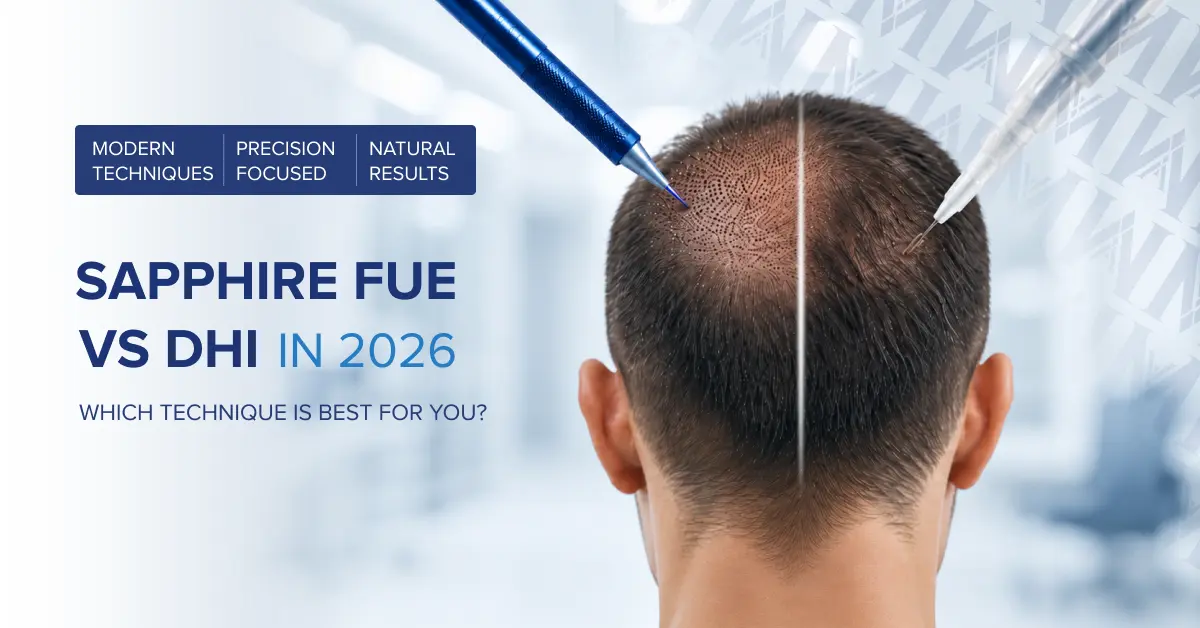
Sapphire FUE is a type of FUE hair transplant that uses very fine sapphire-tipped blades to open tiny channels for grafts, while DHI (Direct Hair Implantation) uses implanter pens to place grafts directly into the scalp without creating separate channels first.
Both methods sit inside the FUE family. In FUE, follicular units are taken one by one from the donor area (usually the back and sides of the head), not as a strip as in FUT (Follicular Unit Transplantation / strip surgery). The American Academy of Dermatology notes that FUE-based hair restoration surgery is now widely preferred because it avoids a long linear scar.
If you want a broader foundation before comparing techniques, you can read more about how hair transplant surgery works in general.

How Sapphire FUE Works
Sapphire FUE is standard FUE extraction combined with a different blade for creating recipient channels.
● Extraction: Grafts are removed one by one using a tiny cylindrical punch, often 0.7–0.9 mm in punch diameter, to minimise trauma.
● Channel creation: The surgeon uses a sapphire-tipped blade to make very fine, smooth incisions in the recipient area.
● Implantation: The team places each graft into these pre-made channels.
Think of sapphire blades as a sharper, finer knife used for smaller, cleaner cuts. Because synthetic sapphire can be honed very thin, it allows narrow incisions that support close spacing and potentially quicker healing. Dermatologic surgery literature suggests smaller incision size can reduce tissue damage and visible micro-scars when used by an experienced hair transplant surgeon.
For a deeper dive into this method, see our detailed guide to sapphire FUE hair transplant.
How DHI (Direct Hair Implantation) Works
DHI (Direct Hair Implantation) also begins with FUE extraction, but the implantation tool and sequence are different.
● Extraction: Individual grafts are taken from the donor area in the same way as FUE.
● Loading: Each graft is loaded into a Choi implanter pen, a pen-like device with a hollow needle at the tip.
● Implantation: The operator presses the pen; the needle makes a tiny opening and deposits the graft in one movement.
A Choi implanter pen works a bit like a mechanical pencil that you load with a tiny "lead" (the graft), then press to place it directly onto the "paper" (your scalp). It gives precise control over the angle and direction of implantation, especially along the frontal hairline and temples.
You can explore this method step by step in our in-depth overview of our DHI hair transplant method.
Sapphire FUE vs "Standard" FUE
Both sapphire FUE and DHI are refinements of core FUE principles, not completely different operations.
● Standard FUE: Steel blades or needles create recipient incisions; grafts are then placed.
● Sapphire FUE: Same extraction, but sapphire blades open the channels.
● DHI: Same extraction, but the Choi implanter pen creates the opening and implants the graft in a single step.
Clinical reviews in cosmetic dermatology emphasise that these variations are tools within FUE rather than separate surgeries. High-quality evidence has not proven one device — blade or pen — to have universally superior graft survival rate.
Now that the basic definitions are clear, it helps to walk through what actually happens on the day of surgery with each method.
Step-by-Step Comparison: How Each Technique Is Performed
Both sapphire FUE and DHI start with the same FUE extraction of individual grafts from the donor area. The main difference comes later: sapphire FUE uses blades to create all recipient channels before implantation, whereas DHI combines channel creation and implantation in a single step with a pen device.
Extraction Phase – Same Foundation for Both
The early stages of sapphire FUE and DHI are almost identical.
1. Consultation and planning
● Your medical history is reviewed, including medications and conditions such as diabetes or bleeding disorders.
● The surgeon examines your donor capacity and male pattern baldness stage, often using the Norwood scale.
● A customised hairline design is drawn, and estimated graft numbers are discussed by zone: frontal hairline, mid-scalp, and crown (vertex).
2. Anaesthesia
● Local anaesthesia is injected into the donor and recipient areas, sometimes with light oral sedation for anxious patients.
● The NHS explains that local anaesthesia is standard for modern hair transplant procedures and allows patients to remain awake but comfortable.
3. FUE extraction
● Using a motorised or manual punch, each follicular unit (containing 1–4 hairs) is scored and gently removed.
● The team closely monitors the transection rate (how many grafts are unintentionally cut or damaged) to keep it as low as possible.
● Extracted grafts are placed into chilled saline or dedicated graft storage solutions to preserve viability until implantation.
Up to this point, sapphire FUE and DHI are the same procedure. The real differences begin when the recipient sites are prepared.

Channel Creation vs Direct Implantation
This is where sapphire FUE vs DHI truly diverge.
Sapphire FUE:
● The surgeon first creates all recipient channels using very fine sapphire blades.
● Each incision's direction and depth are chosen to match natural growth patterns in areas such as the frontal hairline and crown.
● Once channels are complete, grafts are placed into these slits, often by a trained team working under the surgeon's supervision.
DHI:
● There is no separate "channel creation" stage.
● Grafts are loaded into Choi implanter pens, usually by assistants.
● The surgeon or experienced implanters press the pens to create an opening and place each graft in one controlled motion.
A simple analogy helps. Sapphire FUE is like drilling all the holes before you fit the wall plugs and screws. DHI is like using a self-drilling screw that makes the hole and seats itself at the same time.
Duration and Surgical Team Involvement
In real-world clinics, operative time and team structure often differ between these methods.
Sapphire FUE:
● Efficient for large sessions, commonly in the 2,500–4,000+ graft range in a single day.
● The surgeon typically handles hairline design and channel creation, while experienced technicians assist with graft placement.
● Total session length depends mainly on the number of grafts and breaks.
DHI:
● Loading each graft into a pen and placing it takes longer per graft, especially for high graft counts.
● More staff may be involved so several implanter pens can be used in rotation.
● Some clinics limit DHI sessions to small or medium cases to avoid excessively long days or multi-day surgeries.
According to ISHRS practice surveys, many high-volume centres worldwide still rely primarily on blade-based FUE for very large sessions, reserving implanter-pen techniques for specific areas or modest graft numbers. Once you understand the choreography of each operation, it becomes easier to compare their key differences side by side.
Results and Density: Which Technique Looks More Natural?
Both sapphire FUE and DHI can produce very natural, dense results. In practice, many surgeons use DHI for fine-detail areas like the hairline and rely on sapphire FUE for efficiently covering larger regions such as the mid-scalp and crown.
The quality of the result depends far more on planning and execution than on the brand name of the instrument. Key factors include:
● Realistic, age-appropriate hairline design
● Control of the angle and direction of implantation
● Smart distribution of grafts across frontal hairline, mid-scalp, and crown
● Sensible donor management to avoid future donor depletion
Reviews in aesthetic surgery literature consistently highlight that natural hairline shape and adequate density are among the strongest predictors of patient satisfaction in hair transplant surgery, regardless of tool choice.
Hairline Design and Micro-Details
In the frontal hairline and temples, a few hairs placed at the wrong angle can change the whole look.

● With DHI, the Choi implanter pen can position each graft at a very precise angle and depth, especially for single-hair grafts in the front row.
● This precision is why many surgeons favour a DHI hair transplant method for concentrated, high-density work in small frontal zones when donor quality allows.
● If your main priority is a very natural, detailed hairline in a compact area, then DHI-focused hairline work is often considered first.
Experienced surgeons can also create highly natural hairlines using sapphire FUE. The thin sapphire blade allows close spacing of incisions when handled carefully, and in our practice we see excellent hairline outcomes with both tools.
For a clearer picture of what these techniques actually achieve, you can see real before-and-after hair transplant results from our Istanbul clinic.
Crown and Large-Area Coverage
The crown (vertex) is a larger zone with a natural swirl pattern, and it can consume a surprising number of grafts.
● Sapphire FUE typically excels for crowns and broad thinning because it allows the surgeon to open many channels efficiently over a wide surface.
● Densities in the crown are often slightly lower than in the frontal hairline to preserve blood supply and reduce the risk of shock loss (temporary shedding of nearby hairs caused by surgical stress).
● If your main goal is rebuilding a thinning crown rather than ultra-dense hairline edges, sapphire FUE is usually preferred.
In our high-volume clinic at Medart Hair Transplant in Istanbul, we often use sapphire FUE to restore the crown and mid-scalp, then bring in DHI pens for the first few rows of the hairline when that framing detail is the patient's biggest concern.
Graft Survival and Scientific Evidence
Many patients ask whether DHI has a higher graft survival rate than sapphire FUE, or vice versa. Current evidence does not support a clear winner.
● ISHRS and other professional bodies report that when FUE is performed correctly, both blade-based and implanter-pen implantation can achieve high graft growth.
● High-quality comparative trials between specific blade and pen systems are limited, and no consistent survival advantage has been confirmed for one over the other.
What does matter for graft survival is:
● Gentle FUE extraction with a low transection rate
● Keeping grafts hydrated and cool during storage
● Placing grafts into incisions that are neither too tight nor too loose
● Avoiding packing so dense that scalp blood flow is compromised
In other words, if two surgeons use different tools but both handle grafts carefully, their outcomes can be similarly strong. With that in mind, most patients then want to know what they will actually feel and see during and after surgery.
Pain, Scarring, and Recovery Time: Patient Experience Compared
Patient-reported pain, small dot scarring, and recovery time are broadly similar between sapphire FUE and DHI, because both are minimally invasive FUE-based techniques performed under local anaesthesia.
During the Procedure – What You Feel
For both sapphire FUE and DHI procedures:
● The least pleasant part is usually the local anaesthetic injections in the donor area and recipient area.
● Once the scalp is numb, patients feel pressure, vibration from the punch, and some pulling during implantation — but not sharp pain.
● Some clinics offer mild sedation tablets to help you relax, but most people manage comfortably without them.
The American Academy of Dermatology notes that most patients describe FUE discomfort as mild to moderate, manageable with simple pain relief afterwards.
First Week After Surgery
The initial recovery course is similar for sapphire FUE and DHI.
1. Day 0–3
● Mild soreness or tightness in the donor area.
● Swelling on the forehead, sometimes around the eyes if the hairline was treated.
● Small crusts form around each implanted graft.
2. Day 4–7
● Swelling usually settles.
● Crusts soften with gentle washing following your clinic's protocol.
● Many patients feel fine returning to light activities and non-physical work.
3. Week 2–4
● Most crusts fall off.
● Transplanted hairs often shed; this "shedding phase" is expected.
● Redness gradually fades, though it can persist longer in lighter skin types.

You can follow our detailed aftercare instructions after hair transplant for a day-by-day care outline we apply to both sapphire FUE and DHI patients. Always follow the specific aftercare plan from your own clinic, as protocols vary slightly.
Guidance from health systems such as the NHS suggests many FUE patients can return to desk work within about a week, depending on visibility of redness and crusts and the nature of their job.
Long-Term Scarring and Visibility
Both sapphire FUE and DHI leave tiny, round micro-scars where each FUE punch removed grafts from the donor area. These are not noticeable unless the hair is shaved very short.
● Recipient area:
● Sapphire FUE produces fine slit scars from the sapphire incisions.
● DHI produces small pen-entry scars where the needle entered.
● Over months, both blend into the scalp and are generally not visible to casual observers.
Scarring patterns depend more on punch size, spacing, and total number of grafts than on whether a sapphire blade or pen was used. Factors like smoking, uncontrolled diabetes, and immune or bleeding disorders can also slow healing, so your surgeon needs your full medical history to plan safely.
Once recovery makes sense, people naturally ask how these methods differ in cost — especially anyone weighing up FUE vs DHI Turkey options.
Cost and Session Size: When Does Each Technique Make Sense Financially?
DHI is usually priced higher per graft and is less efficient for very large sessions, while sapphire FUE often offers a better cost–benefit ratio for patients who need extensive coverage in a single procedure.
Why DHI Usually Costs More
In many hair transplant clinics, DHI is positioned as a premium technique because:
● It requires specialised Choi implanter pens and disposable components.
● Implantation is slower per graft, extending operative time.
● More staff may be needed at the implantation stage.
International hair transplant surveys, including those discussed by ISHRS, indicate that implanter-pen variants typically sit at the higher end of FUE pricing structures. This pattern shows up across several medical tourism destinations, including Turkey.
Large Sessions and Graft Limits
For patients needing 3,000–4,000 grafts or more, sapphire FUE is frequently the more practical choice.
● Many clinics in Istanbul, Turkey perform large single-day sapphire FUE sessions in the 2,500–4,000+ graft range.
● Pure DHI with this graft count is possible but may require a very long day, multiple days, or careful compromises in coverage.
● If you need a major transformation in one visit, sapphire FUE — or a sapphire FUE–dominant hybrid — is usually favoured for efficiency.

If someone needs 3,000–4,000 grafts and chooses pure DHI, they should expect either a longer session, a higher budget, or a staged approach. When patients ask "which hair transplant method is best" for a large session, we often lean toward sapphire FUE for coverage and add DHI only where fine detail truly matters.
How We Discuss Cost at Medart
At Medart Hair Transplant in Istanbul, we focus on what's right for your case, not on which brand sounds more impressive. Specifically, we:
● Estimate graft numbers per zone (hairline, mid-scalp, crown) based on your androgenetic alopecia pattern.
● Decide where ultra-precise work (often DHI) will actually change the outcome, and where good sapphire FUE is enough.
● Use sapphire FUE for broad coverage when it gives a better balance of result, operative time, and long-term donor management.
Hair transplant costs in Turkey are typically a fraction of UK or US prices — largely because of lower overheads, not lower quality. If you are arranging surgery abroad, our guide to planning a hair transplant trip to Istanbul explains typical timelines, hotel stays, and recovery travel tips.
As cost and session size become clearer, the key question becomes candidacy: for your age, pattern, and donor hair, which approach is more suitable?
Who Is a Better Candidate for Sapphire FUE vs DHI?
DHI tends to suit patients who need very detailed, high-density work in smaller areas, while sapphire FUE is often the better option for those needing many grafts to restore large regions like the mid-scalp and crown. A personalised assessment is essential either way.
Your ideal technique depends on several variables:
● Age and Norwood stage (or female pattern equivalent)
● Donor hair density and thickness
● Hair type (straight, wavy, curly, Afro-textured)
● Main goals (dense hairline, crown coverage, or full transformation)
● Previous surgery and any existing scarring or donor depletion
Professional bodies such as ISHRS emphasise that patient selection and long-term planning have more influence on satisfaction than the choice between sapphire blades and implanter pens.
Quick decision guide: goals vs techniques
● Goal: refine hairline and temples only → usually consider DHI focus or hybrid.
● Goal: rebuild crown or large mid-scalp area → usually consider sapphire FUE focus.
● Goal: full transformation (hairline plus crown) → usually consider hybrid sapphire FUE + DHI.
If your main goal is a dense hairline in a small area, DHI is usually considered first, often supported by sapphire FUE behind it to build volume.
Best Technique for Hairline and Temples
For early recession or limited frontal thinning:
● DHI is often preferred for the first few hairline rows, thanks to fine control over angle and direction.
● It can help achieve very strong hairline density DHI-style results when the donor area has thick, healthy hair.
● Finer sapphire FUE incisions can then be used just behind, blending density and optimising donor use.
Mini case example 1:
A 32-year-old man with Norwood 2–3 recession and strong donor hair came to Medart Hair Transplant in Istanbul. His crown was intact; he mainly disliked his receding temples. We designed a conservative hairline and used DHI for the front two or three rows, with sapphire FUE behind them. At 12 months, his hairline looked natural and dense — and we had preserved donor capacity for any future needs.
Best Technique for Crown and Large Areas
When the crown and mid-scalp are thin or bald, and the hairline is also affected:
● Sapphire FUE usually becomes the backbone of the plan.
● It allows efficient placement of large numbers of grafts over both crown and frontal regions.
● If your pattern is Norwood 4–6 and you want a major visible change, sapphire FUE-focused surgery is typically safer for donor management than aggressively dense DHI across large zones.

Mini case example 2:
A 45-year-old man with Norwood 5 hair loss and thinning from hairline through crown visited our high-volume centre. He needed about 3,500 grafts to rebuild his hairline, mid-scalp, and crown. We planned a sapphire FUE session for broad coverage and used especially fine sapphire blades around the hairline to mimic natural growth. One year later, he had a much fuller look — without overharvesting the donor.
Special Cases: Curly Hair, Previous Transplants, Female Patients
Certain situations need extra nuance.
Curly or Afro-textured hair:
● Follicles can curve under the skin, making FUE extraction trickier.
● Both sapphire FUE and DHI are possible, but surgeon experience with your hair type matters more than tool choice.
Previous transplants or scars:
● The donor capacity may be limited, so conservative planning is crucial.
● If your main concern is improving a pluggy old hairline, DHI for refinement plus limited sapphire FUE for gaps can be helpful.
Female patients and reduced shaving:
● Some clinics offer DHI with minimal shaving in the recipient area, which can be attractive for women or men who cannot shave fully.
● The decision still revolves around donor quality and goals, not only shaving preferences.
If you have widespread thinning but a limited donor supply, sapphire FUE with moderate density is generally safer than aggressive DHI packing that risks exhausting your donor.
If you're unsure where you fit, tap the WhatsApp button in the bottom-right corner of this page and send us clear photos of your hair. A Medart surgeon will review them and suggest whether sapphire FUE, DHI, or a hybrid plan makes the most sense — an honest opinion, no pressure to book.
Once you know which category you probably fall into, it's worth separating the real risks from the marketing myths.