
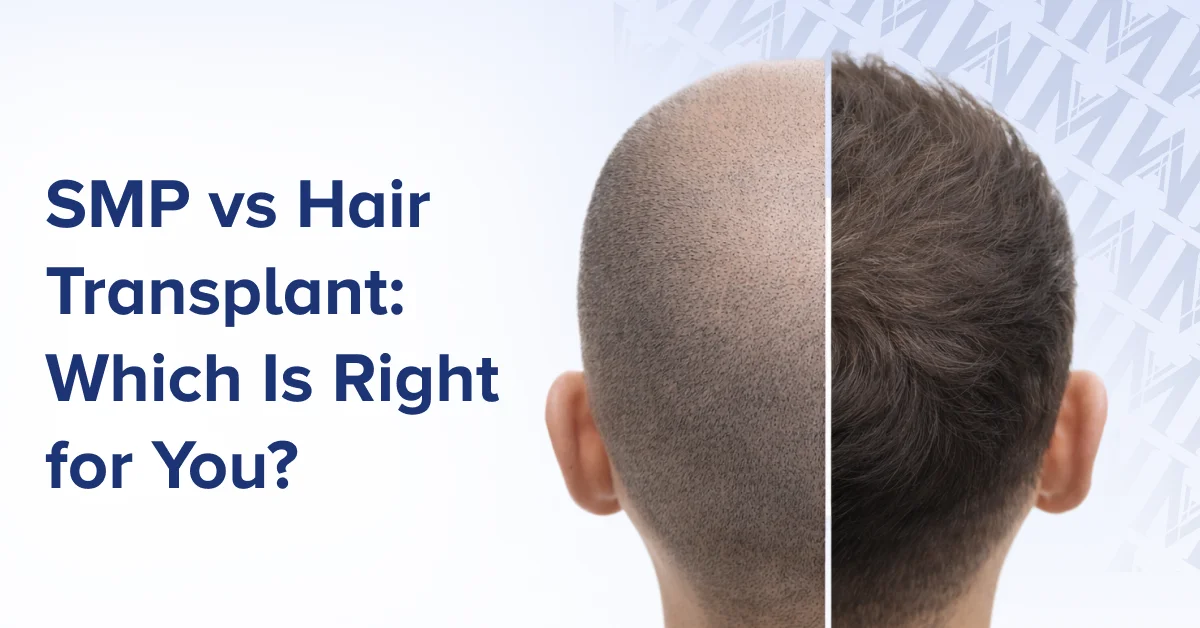
SMP vs Hair Transplant: Which Is Better?

A clear comparison between SMP (Scalp Micropigmentation) and hair transplant, explaining how each treatment works, their key differences, and which option is better depending on hair loss stage, expectations, and desired results.
SMP vs Hair Transplant_ Which Is Right for You

Table of Contents

Over a 10-year period, scalp micropigmentation can actually cost more than a hair transplant. That's not a typo. When you factor in Turkey's pricing — where world-class transplant results come at a fraction of Western costs — the procedure most people assume is the "budget option" quietly becomes the more expensive one. If that surprises you, keep reading. The real differences between scalp micropigmentation vs hair transplant run far deeper than most articles will tell you.

You've done the research. You've scrolled through before-and-after galleries, read conflicting opinions, and narrowed your hair restoration options down to two leading contenders. One promises quick cosmetic results without surgery. The other restores real, growing hair you can run your fingers through.

Here's what matters: hair loss isn't just about appearance. It affects your confidence, your daily routine, the way you feel when you catch your reflection. You deserve a clear, honest answer — not another vague listicle.

This guide compares everything that matters: results, costs, recovery, longevity, pain, and risks. You'll also discover a strategy most articles ignore entirely — combining both procedures for an optimal outcome. By the end, you'll know exactly which option fits your situation, your budget, and your life.

**Medical Disclaimer:** This article is for informational purposes only and does not constitute medical advice. Hair loss treatment outcomes vary based on individual factors including hair loss pattern, donor hair availability, overall health, and provider expertise. Always consult with a qualified medical professional before making any treatment decisions.

What Is Scalp Micropigmentation (SMP)?

Before you can compare these two procedures, you need to understand what each one actually does — because the differences start at the most fundamental level. Let's begin with the non-surgical option that's gained serious traction in recent years.

Scalp micropigmentation (SMP) is a cosmetic procedure that uses specialized micro-needles to deposit pigment into the dermal layer (the second layer of skin, below the surface) of your scalp. Think of it as a highly skilled cosmetic pigment application that mimics the look of a fresh buzz cut — thousands of tiny, precise dots replicating the appearance of real hair follicles.

It's worth noting that both SMP and hair transplants are also available to women experiencing hair loss, though this guide focuses primarily on male pattern baldness — the most common reason people research these procedures.

Scalp micropigmentation procedure showing micro-needle depositing pigment dots into the scalp's dermal layer

How SMP Works

During an SMP session, a trained practitioner uses a fine needle to place thousands of small pigment deposits across your scalp. Each dot is carefully matched to your natural hair color and placed at a specific depth and density to create a convincing illusion of closely shaved hair.

The process typically requires 2–4 sessions, spaced about 7–10 days apart. Each session lasts between 2 and 5 hours, depending on the extent of coverage needed. Results are visible almost immediately after the first session, with each subsequent appointment building density and refining the overall look.

Who Is SMP Best Suited For?

SMP isn't for everyone — but it's a genuinely strong solution in specific situations:

  • ●  Buzz-cut preference: You already wear or are comfortable with a shaved or very short hairstyle

  • ●  Limited donor hair: Your hair loss is too extensive for a transplant due to insufficient donor supply

  • ●  Scar camouflage: You want to conceal scars from previous surgeries, injuries, or earlier transplant procedures

  • ●  Non-surgical preference: Medical conditions or personal choice make surgery inadvisable

  • ●  Alopecia areata: Conditions causing unpredictable patchy hair loss make transplantation risky

  • ●  Quick timeline: You need cosmetic improvement within weeks rather than months

Limitations of SMP

Honest assessment of SMP's constraints is essential for a well-informed decision:

  • ●  No real hair growth: SMP creates the appearance of hair follicles, but no actual hair grows — it's a cosmetic illusion, though an effective one for the right candidate

  • ●  Ongoing maintenance required: Pigment typically fades over 3–5 years, requiring periodic touch-up sessions indefinitely

  • ●  Pigment quality matters: Inferior pigments can shift to a blue or green tint over time, creating an unnatural appearance

  • ●  Hairstyle restrictions: SMP works best with very short hair — growing it longer reveals that the dots are pigment, not real follicles

  • ●  Practitioner dependent: Results vary dramatically based on the skill and experience of the SMP technician

  • ●  Removal is complex: Laser treatments can remove SMP, but the process is costly, time-consuming, and may cause temporary skin discoloration

Get a Free Hair Analysis

Talk to an experienced patient coordinator for your hair transplant in Turkey.
Please enter a valid phone number.

What Is a Hair Transplant?

Now let's look at the procedure that takes a fundamentally different approach. A hair transplant procedure doesn't simulate hair — it restores it. Within this comparison, it's the only option that gives you real, growing hair in areas where you've experienced thinning or balding.

Understanding the mechanics helps explain why the results are so different from SMP.

How Hair Transplants Work

The principle behind a hair transplant is elegant in its simplicity. Hair follicles on the back and sides of your head — the donor area — are naturally resistant to DHT (the hormone responsible for pattern baldness). By relocating these follicles to thinning or balding zones, they continue growing healthy hair in their new location. For most patients, that growth lasts a lifetime.

Two main hair transplant techniques like FUE and FUT dominate the field. Follicular unit extraction (FUE) is widely considered the modern gold standard. During FUE, individual follicular units (natural groupings of 1–4 hair follicles) are extracted one by one using a micro-punch tool, then carefully implanted into tiny channels created in the recipient area.

Follicular unit transplantation (FUT), also known as the strip method, involves removing a thin strip of tissue from the donor area and dissecting it into individual grafts. While still effective, FUE has largely replaced FUT due to its minimal scarring and faster recovery.

A typical FUE session takes 6–8 hours and is completed in a single day. Local anesthesia keeps you comfortable throughout.
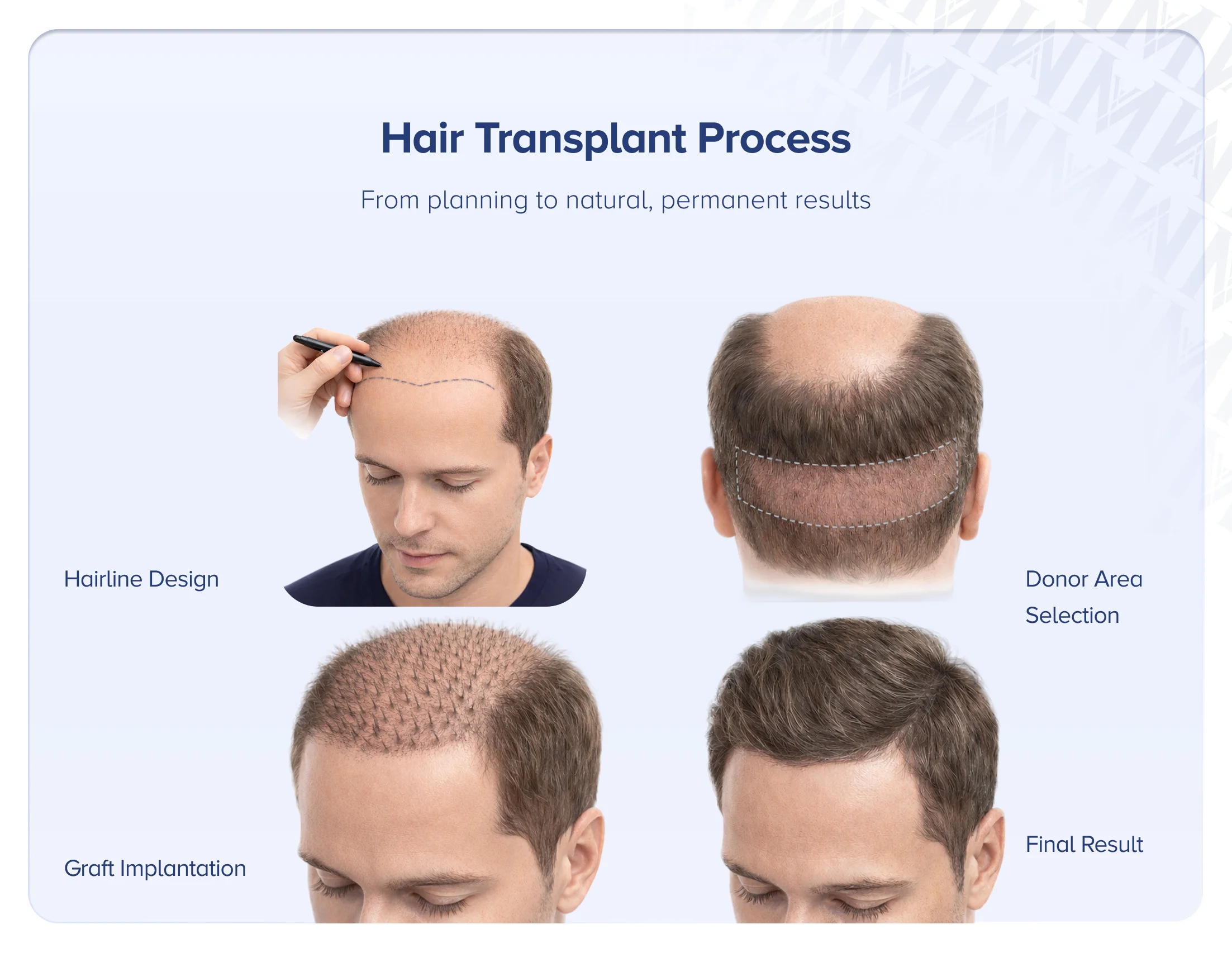
Step-by-step illustration of the FUE hair transplant process from follicle extraction to implantation

Who Is a Hair Transplant Best Suited For?

Transplants deliver the strongest results for candidates who meet certain criteria:

  • ●  Adequate donor supply: You have sufficient healthy hair on the back and sides of your head

  • ●  Pattern baldness: You're experiencing male pattern hair loss, typically Norwood 2–5 on the Norwood scale (a classification system that measures the stages of male pattern baldness)

  • ●  Desire for real hair: You want hair you can grow, style, cut, and color freely

  • ●  Permanent solution seekers: You prefer a one-time procedure over ongoing maintenance

  • ●  Patience for results: You're willing to wait 12–18 months for the full outcome

Limitations of Hair Transplants

No procedure is perfect. Transplants have their own constraints:

  • ●  Donor dependency: If your donor area is depleted — common in very advanced baldness (Norwood 6–7) — there may not be enough follicles for meaningful coverage

  • ●  Extended results timeline: Initial healing takes 7–14 days, but full results typically aren't visible until 12–18 months post-procedure

  • ●  Surgical risks: Though minimal with FUE, risks include infection (rare), temporary numbness in the donor area, and shock loss (temporary shedding of existing hair that sometimes occurs after a transplant)

  • ●  Higher upfront cost in Western countries: Transplants carry a significantly higher price tag than SMP in the US and UK — though this gap narrows dramatically when performed in Turkey

  • ●  Gradual transformation: Unlike SMP's immediate cosmetic result, transplanted hair goes through a natural growth cycle before achieving its final density

Results from either procedure can also vary based on your skin tone, hair color, and hair texture. A consultation with a qualified hair restoration specialist helps you understand what to expect based on your individual characteristics.

SMP vs Hair Transplant: A Detailed Side-by-Side Comparison

Knowing how each procedure works is step one. Knowing how they stack up against each other on the factors that actually drive your decision — that's where this gets useful. This section puts scalp micropigmentation vs hair transplant head-to-head across every category that matters.

Here's a quick-reference comparison before we dive deeper:

Feature

SMP

Hair Transplant

Results Type

Cosmetic illusion of hair

Real, growing hair

Procedure Time

2–5 hours per session

6–8 hours (single session)

Sessions Required

2–4 sessions

1 session (for most patients)

Recovery Time

1–3 days per session

7–14 days initial healing

Upfront Cost

$1,500–$4,000

$2,000–$5,000 (Turkey)

10-Year Cost

$3,000–$7,000+

$2,000–$5,000 (one-time)

Longevity

3–5 years before fading

Permanent for most patients

Pain Level

Mild (topical numbing)

Minimal (local anesthesia)

Hairstyle Flexibility

Buzz cut only

Any style, length, or color

Candidacy

Nearly anyone

Requires adequate donor hair

Risk Level

Low

Low (with experienced surgeon)

Close-up comparison of scalp micropigmentation pigment dots versus real hair growth from a hair transplant

Now let's unpack the rows that matter most.

Results — Cosmetic Illusion vs Real Hair Growth

This is the most fundamental difference — and it shapes everything else. SMP creates the appearance of hair follicles on your scalp. A hair transplant restores actual hair that grows from your head.

The difference is like comparing a photograph of a garden to an actual garden you can walk through and tend. Both can look impressive. Only one is real.

Consider this scenario: two men — let's call them James and Marco — both 36, both dealing with Norwood 3 hair loss and solid donor areas. James chooses SMP at a reputable clinic near his home. Marco flies to Istanbul for an FUE hair transplant.

At the one-year mark, James has a convincing shaved-head look that draws compliments. But he buzzes his head every other day to maintain the illusion. Marco has just watched his new hairline fill in completely, and he's styling his hair with a side part for the first time in years.

Fast forward to year five. James is scheduling his first touch-up session — the pigment has started fading noticeably around his temples. Marco hasn't thought about his procedure in years. He just washes, styles, and lives. Neither man made a wrong choice. They had different priorities, and those priorities led to very different daily realities.

What does daily life actually look like two years after each procedure? A transplant patient wakes up, showers, and styles their hair however they like — a trim every few weeks, maybe some product for texture. Their morning routine takes five minutes. No one has any idea they had a procedure. An SMP patient at the same point maintains a closely buzzed look, shaving every one to two days to keep the pigment dots consistent with surrounding hair length. Both routines become second nature — but they represent fundamentally different lifestyles and levels of hairstyle freedom.

Procedure and Recovery Time

If speed and convenience top your priority list, SMP holds a clear advantage here.

SMP sessions are shorter, spread across multiple appointments, and involve minimal downtime. Most patients return to work the next day. The entire process wraps up within a few weeks, and the cosmetic result is visible almost immediately.

A hair transplant demands more upfront. The procedure itself takes a full day, and you'll need 7–14 days for initial healing — during which redness, scabbing, and some swelling are normal. Activity restrictions apply for roughly two weeks. The trade-off? Your results are permanent for most patients, and once the growth cycle completes at 12–18 months, you're done. No follow-up sessions. No maintenance appointments. Just hair.

SMP wins on convenience. Transplants win on permanence. Your priorities determine which trade-off makes sense.

Recovery and results timeline comparing scalp micropigmentation versus hair transplant milestones over 18 months

Cost Comparison — Including Long-Term Investment

Cost is often the deciding factor — and this is where the comparison gets genuinely interesting. Most people only look at the upfront number. The full picture tells a very different story.

SMP upfront costs range from $1,500 to $4,000, depending on the extent of treatment and your provider's location (based on current market averages as of 2025). That's the initial investment. But because pigment fades over time, you'll need touch-up sessions every 3–5 years, costing approximately $800–$1,500 per cycle.

Over a decade, your total scalp micropigmentation cost adds up to roughly $3,000–$7,000+ — and that investment continues for as long as you want to maintain the look.

Hair transplant costs in the US or UK typically range from $8,000 to $20,000+ (based on industry surveys and current market averages as of 2025). That gap understandably makes many people view SMP as the budget-friendly alternative. But this hair transplant cost comparison changes dramatically when Turkey enters the equation.

A hair transplant in Turkey costs approximately $2,000–$5,000, with many clinics offering all-inclusive packages covering the procedure, hotel accommodation, airport transfers, and aftercare. Over 10 years, that cost remains exactly the same — because a transplant is a one-time procedure for the vast majority of patients.

**Key Insight:** When performed in Turkey, a hair transplant can cost *less* than SMP over a 10-year period — while delivering permanent, real hair instead of a cosmetic illusion requiring indefinite maintenance.

Most people assume a hair transplant is always the more expensive option. But when you factor in Turkey's pricing and SMP's ongoing touch-ups, the math flips. The micropigmentation vs hair transplant cost comparison shifts significantly when you think in decades rather than dollars today.

10-year cumulative cost comparison infographic showing SMP touch-up costs exceeding a one-time hair transplant in Turkey

Not sure which option fits your budget and goals? Get a free, personalized hair loss assessment from our team — no obligation, no pressure.

Longevity and Maintenance

SMP fades. That's not a flaw — it's simply how pigment in skin behaves over time, similar to how a tattoo gradually lightens over the years. Most SMP treatments begin noticeably fading after 3–5 years, requiring maintenance sessions to refresh the color and density. This is an indefinite commitment for as long as you want to keep the look.

Transplanted hair, by contrast, is permanent for most patients. Because the relocated follicles are DHT-resistant, they typically continue growing healthy hair for life. Some patients may benefit from medications like finasteride or minoxidil to protect their remaining non-transplanted native hair from further thinning — but the transplanted hair itself doesn't require ongoing procedures or touch-ups.

Pain and Comfort

Neither procedure is described as severely painful by most patients — which is reassuring if discomfort is a concern.

SMP feels similar to getting a detailed tattoo. Practitioners apply topical numbing cream to minimize sensation, and most patients report mild to moderate discomfort that's easily tolerable. Individual experiences vary, but sessions are generally described as more tedious than painful.

Hair transplants use local anesthesia, so the procedure itself involves minimal pain once numbing takes effect. The initial anesthesia injections cause brief stinging, but after that, most patients feel only pressure and mild tugging. Post-procedure soreness and tightness in the donor area typically last a few days and respond well to prescribed medication.

Risks and Side Effects

Both procedures carry low risk profiles when performed by qualified professionals. Choosing your provider carefully is the single most important factor in minimizing complications — for either option.

SMP risks include:

  • ●  Allergic reaction: Rare sensitivity to pigment ingredients

  • ●  Infection: Uncommon with proper aftercare and sterile technique

  • ●  Unnatural appearance: The most common issue, caused by inexperienced practitioners, wrong pigment color, or improper dot placement

  • ●  Pigment migration: Dots can blur or spread slightly over time, especially with low-quality pigments

Hair transplant risks include:

  • ●  Infection: Rare with proper surgical protocols and aftercare

  • ●  Scarring: Minimal with FUE — tiny dot scars in the donor area that are virtually invisible

  • ●  Shock loss: Temporary shedding of existing hair around the transplant area, which typically resolves within a few months

  • ●  Numbness: Temporary reduced sensation in the donor area, usually resolving within weeks to months

  • ●  Suboptimal growth: The most significant risk, typically caused by choosing an unqualified or inexperienced surgeon

If results from either procedure fall short of expectations, options exist. SMP can be adjusted with additional sessions or removed through laser treatments. Transplant results can sometimes be enhanced with a follow-up session to add density. In both cases, choosing an experienced provider from the start dramatically reduces the likelihood of needing corrections.

The bottom line for both SMP vs hair transplant: your results depend heavily on who performs the procedure. For SMP, research your practitioner's portfolio extensively. For a transplant, verify your surgeon's credentials, experience, and before-and-after documentation.

Can You Combine SMP with a Hair Transplant?

Here's something most comparison articles overlook entirely: you don't always have to choose one or the other. Can you combine SMP and hair transplant procedures? Absolutely — and it's becoming an increasingly sophisticated strategy that delivers remarkable results in the right situations.

This combination approach uses a hair transplant as the foundation (restoring real, growing hair) and SMP as a finishing touch (enhancing the overall appearance of density and coverage). It's particularly effective in these scenarios:

  • ●  Density enhancement: When your donor supply limits the number of grafts available, SMP fills in visual gaps between transplanted follicles — creating the illusion of thicker coverage without additional surgery

  • ●  Donor area scar camouflage: Even though FUE scarring is minimal, some patients prefer to conceal the tiny dot scars in their donor area — SMP blends them seamlessly into surrounding hair

  • ●  Hairline refinement: SMP can create a sharper, more defined hairline edge that complements the natural growth pattern of transplanted hair

  • ●  Fine or light hair compensation: Patients with very fine or light-colored hair sometimes find that transplanted density alone doesn't create the visual fullness they want — SMP adds perceived depth and contrast

Timing matters. SMP is typically performed 12 or more months after a transplant, once the transplanted hair has fully grown in and the final results are visible. This allows the SMP practitioner to work precisely around the existing growth pattern.

For example, imagine a patient named Robert — 45 years old, Norwood 5, with a moderate donor area. His transplant restores solid coverage to the frontal zone and midscalp, but the crown remains slightly thin. Rather than pushing his donor supply to its limit with a second surgical session, strategic SMP in the crown area completes the picture — real hair in front, expertly enhanced density in back.

This combination strategy is something the most knowledgeable clinics discuss during consultations. If you're considering it, consult with a qualified hair restoration specialist who has experience with both procedures.

Why Turkey Has Become the Top Destination for Hair Transplants

Those cost differences become even more striking when you consider where you get your transplant done. For many people comparing SMP vs FUE, the assumption is that a transplant is always the premium-priced option. Turkey has fundamentally rewritten that equation.

Leading Clinics at Accessible Prices

Turkey performs over 500,000 hair transplant procedures annually, according to the Turkish Healthcare Travel Council — more than any other country on earth. That extraordinary volume has created something rare in medicine: an environment where deep specialization meets genuinely accessible pricing.

Decades of focused experience mean Turkish surgeons and their teams have refined their techniques across hundreds of thousands of cases. The concentration of expertise is unmatched globally. Many clinics operate within JCI-certified hospitals (Joint Commission International — the gold standard for international healthcare accreditation), maintaining the same safety and quality protocols you'd find in top Western medical facilities.

The cost savings are substantial: a hair transplant in Turkey typically costs 60–80% less than the same procedure in the US, UK, or Western Europe. This isn't because of lower quality. It's driven by favorable exchange rates, lower operating costs, and the sheer volume of procedures that allows clinics to operate efficiently at scale.

Most reputable Turkish clinics offer all-inclusive packages covering the procedure, pre-operative blood tests, hotel accommodation, airport transfers, and comprehensive aftercare — all within that $2,000–$5,000 range, depending on the number of grafts needed.

How Turkey Changes the Cost Equation

This is the insight that reshapes the entire decision for many patients. If you live in the US or UK, comparing a $2,000 SMP treatment to a $15,000 hair transplant makes SMP look like the sensible choice. The gap feels enormous.

But compare that same SMP treatment to a $3,000–$4,000 all-inclusive hair transplant in Turkey, and the calculation flips entirely. You're now comparing a cosmetic treatment that fades and requires ongoing investment to a permanent surgical solution that restores real hair — at a similar or lower price point.

For most candidates with adequate donor hair, this pricing shift makes a compelling case for choosing permanent restoration over a cosmetic alternative that requires indefinite maintenance.

Traveling abroad for a medical procedure requires planning — particularly around follow-up care and communication with your surgical team. Reputable Turkish clinics address this with comprehensive aftercare programs, remote consultations, and detailed post-operative instructions you can follow from home.

To learn more about getting a hair transplant in Turkey, including what to expect from the process, aftercare, and clinic selection, explore our comprehensive guide.

The key is choosing wisely. Look for clinics with verifiable before-and-after results, transparent pricing, experienced surgeons with documented credentials, and internationally recognized accreditation. Avoid any provider — whether for SMP or transplants — whose pricing seems too good to be true.

Which Option Is Best for Your Specific Situation?

You now have the knowledge. This section helps you apply it to your life. Whether scalp micropigmentation is worth it depends entirely on your hair loss profile, lifestyle preferences, and goals — and the same holds true for a transplant. Here's a clear framework to guide your decision.

Choose SMP If…

  • ●  You prefer a permanently shaved or buzzed hairstyle and have no interest in growing longer hair

  • ●  Your hair loss is very advanced (Norwood 6–7) with a severely depleted donor area, making transplantation impractical

  • ●  A medical condition makes surgical procedures inadvisable

  • ●  You want to camouflage scarring from a previous procedure or injury

  • ●  You need cosmetic improvement within weeks and cannot accommodate a longer recovery

  • ●  Your current circumstances — whether budget, schedule, or travel limitations — make a non-surgical, locally available option the most practical path forward

For example, imagine a man named Paul — 52, Norwood 6, who has kept a shaved head for years and has very limited donor hair remaining. A transplant wouldn't provide enough coverage to be worthwhile. For Paul, SMP creates a natural-looking shaved appearance that restores a youthful, defined look — and it's genuinely the better option for his situation.

Choose a Hair Transplant If…

  • ●  You want real, growing hair you can style, cut, and color however you choose

  • ●  You have sufficient donor hair (a consultation with a qualified hair restoration specialist can confirm this)

  • ●  You're seeking a permanent, one-time solution rather than ongoing maintenance

  • ●  You're willing to invest in a short recovery period for lifelong results

  • ●  You want the most natural-looking outcome possible — undetectable even up close

  • ●  You're open to traveling to Turkey for accessible, world-class care

Consider this scenario: a 34-year-old marketing director named Daniel, who had stopped turning on his camera during video meetings because of his receding Norwood 3 hairline. He wants to keep his hair at a medium length and style it for work. SMP would require him to buzz his head permanently — a look that doesn't fit his professional image or personal preference. A transplant restores his hairline with real hair, and within 12–18 months, he's styling it exactly as he did before his hair loss began. Five years later, that hair is still growing. No touch-ups. No maintenance appointments. Just confidence.

Consider Combining Both If…

  • ●  Your donor supply is adequate but limited, and you want maximum visual density

  • ●  You'd like to enhance transplant results without undergoing a second surgical session

  • ●  Scarring from a previous procedure needs camouflaging alongside new hair growth

  • ●  Your surgeon recommends a combination approach based on your specific hair loss pattern and goals

**Pro Tip:** The single best way to determine which approach fits your situation is a professional consultation. An experienced specialist can assess your donor area, classify your hair loss stage, and build a personalized plan.

To explore the latest transplant techniques and understand which method aligns with your specific case, visit our detailed techniques guide.

Frequently Asked Questions

Even after a thorough comparison, specific questions tend to linger. Here are direct answers to what patients most frequently ask when weighing these two procedures.

Is scalp micropigmentation better than a hair transplant?

Neither is universally "better" — the right choice depends on your individual situation. For most candidates with adequate donor hair, a hair transplant delivers superior results because it restores real, permanent hair growth. SMP is the stronger option for patients who prefer a shaved look, lack sufficient donor hair, or cannot undergo surgery.

Does SMP look real?

At very short hair lengths, quality SMP performed by a skilled practitioner can look convincing from a normal conversational distance. However, it cannot replicate the look, feel, or texture of actual hair. Up close or at longer hair lengths, the pigment dots become more apparent. Results depend heavily on practitioner skill and pigment quality.

How long does scalp micropigmentation last compared to a hair transplant?

SMP typically lasts 3–5 years before the pigment fades noticeably, requiring touch-up sessions to maintain the appearance. A hair transplant produces permanent results for most patients — transplanted follicles continue growing for life because they're resistant to the hormone that causes pattern baldness.

Can you get SMP after a hair transplant?

Yes, and it's an increasingly popular combination strategy. SMP is typically performed 12 or more months after a transplant, once full results are visible. It can enhance density between transplanted follicles, camouflage donor-area scars, and refine the hairline for a more complete appearance.

Is a hair transplant in Turkey safe?

Yes, when performed at accredited clinics by experienced surgeons. Turkey is the world's leading destination for hair transplants, performing over 500,000 procedures annually (per the Turkish Healthcare Travel Council). Top clinics operate within JCI-certified hospitals with rigorous safety standards. The key is thorough research — verify credentials, review before-and-after documentation, and choose a reputable provider.

Which is more painful: SMP or a hair transplant?

Both involve manageable discomfort, and most patients report that neither is severely painful. SMP uses topical numbing cream and feels similar to a detailed tattoo. Hair transplants use local anesthesia, so you feel minimal pain during the procedure itself. Post-transplant soreness in the donor area typically lasts a few days and responds well to prescribed medication. Individual experiences vary.

How much does SMP cost compared to a hair transplant in Turkey?

SMP costs approximately $1,500–$4,000 upfront, with touch-ups of $800–$1,500 every 3–5 years. A hair transplant in Turkey ranges from $2,000–$5,000 as a one-time investment. Over 10 years, SMP can total $3,000–$7,000+, while a Turkish transplant remains at its original price — making the transplant more cost-effective long-term for most patients. All costs are approximate and vary by provider and extent of treatment.

Can scalp micropigmentation be removed?

Yes, SMP can be removed through laser treatments, though the process requires multiple sessions and can be costly. Laser removal works by breaking down pigment particles so your body absorbs them naturally. Some patients experience temporary skin discoloration during the process. If you're considering SMP, it's worth knowing that reversal is possible but considerably more involved than the original application.

Final Verdict — Making Your Decision with Confidence

You've seen both procedures from every angle — results, costs, recovery, longevity, risks, and candidacy. A clear pattern has emerged, even though the "right" answer ultimately depends on who you are and what you need.

Scalp micropigmentation is a legitimate cosmetic solution. For patients who prefer a shaved aesthetic, lack donor hair for transplantation, or need a non-surgical approach, SMP delivers meaningful improvement and real confidence. It deserves recognition as a valid option — and for certain profiles, it's genuinely the smarter choice.

For the majority of candidates with adequate donor hair, though, a hair transplant is the superior long-term investment. It's the only procedure in this comparison that restores real, growing hair — hair you can style, touch, and live with naturally for the rest of your life. Reported graft survival rates of 90–95% when performed by experienced surgeons (according to ISHRS Practice Census data) reflect a procedure refined over decades into something remarkably dependable.

The cost barrier that once put transplants out of reach has been dramatically reduced by Turkey's emergence as the global leader in hair restoration. When a permanent, life-changing procedure costs roughly the same as — or less than — a cosmetic treatment that fades every few years, the value proposition speaks for itself.

Hair loss is deeply personal. It shapes how you see yourself, how you carry yourself, how you move through the world. Whatever path you choose, the fact that you've researched this thoroughly says something important: you're ready to take control of your story.

The smartest next step is a professional assessment tailored to your specific hair loss pattern, donor availability, and goals. Book a free consultation with our hair restoration specialists — we'll evaluate your situation honestly, walk you through your options, and help you make the decision that fits your life.

Your hair restoration journey starts with a single, informed step — and you've already taken it.

Contact with Us!

Please enter a valid phone number.
WhatsApp
Graft Calculator WhatsApp WhatsApp