
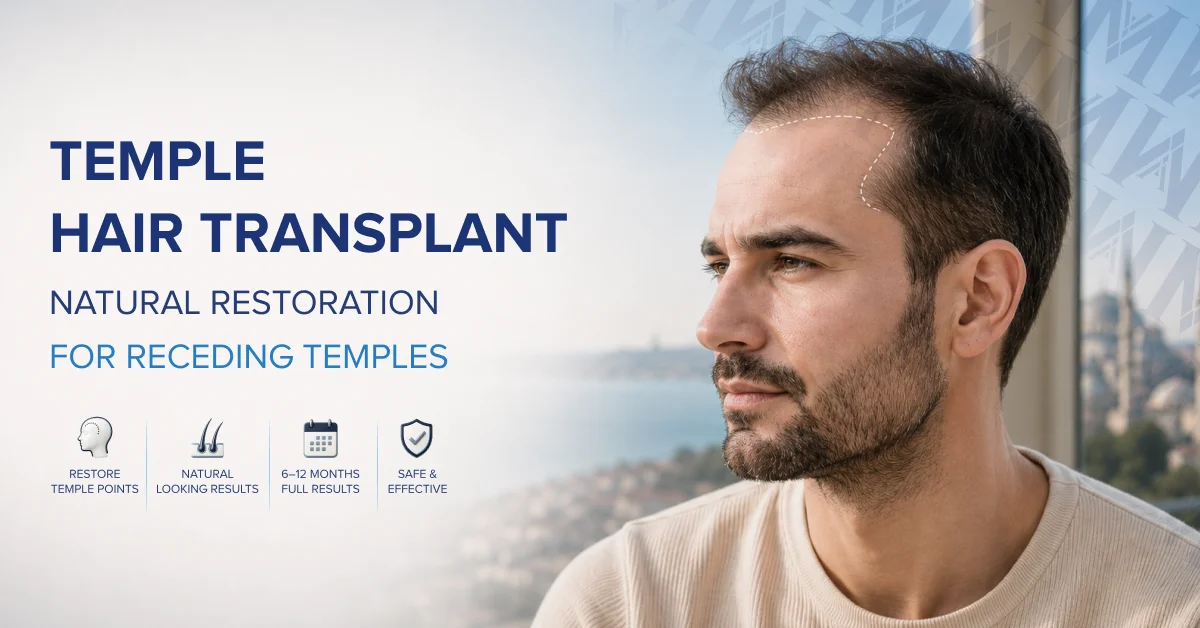
Temple Hair Transplant: Natural Restoration for Receding Temples

Temple hair transplant, or temple point restoration, uses a small number of grafts from the back of your head to rebuild receding temple corners and frame your face more naturally. It suits people with relatively stable hair loss, gives subtle but noticeable improvement, and usually takes 6–12 months to fully show results.
Temple Hair Transplant: Natural Restoration for Receding Temples

Table of Contents

Key Takeaways

  • Temple hair transplant restores the receding "corners" that frame your face.

  • Best for people with stable Norwood II–III recession and good donor hair.

  • Typical use: roughly 200–800 grafts per side, depending on loss and hair type.

  • Results develop gradually, with most cosmetic change between 6–12 months.

  • Conservative, natural-looking design is critical to match your age and future hair loss.

Written by Dr. Busra Yakupoglu, Hair Transplant Surgeon, Medart Hair Transplant, Istanbul

Last updated: June 1, 2026

Most people assume hair loss begins with a bald spot or a soaring forehead. Usually, the first change is quieter: the temple corners creeping back, the forehead widening, the face slowly losing its definition. You may still "have hair," but side and three-quarter photos tell a different story.

At Medart Hair Transplant in Istanbul, we see many men and women whose only concern is exactly this early temple recession. They are not ready for a full hairline transplant, but they miss the way their hair used to frame your face. A temple hair transplant can be a precise way to rebuild that frame, provided it is planned with the long term in mind. This article is for general information only and does not replace a consultation with a qualified doctor.

Medical illustration comparing youthful and receding temple hairlines in Norwood II–III patterns.

Get a Free Hair Analysis

Talk to an experienced patient coordinator for your hair transplant in Turkey.
Please enter a valid phone number.

Can a Temple Hair Transplant Fix Receding Temples?

Yes — a temple hair transplant can restore receding temple points in suitable candidates using a relatively small number of grafts placed in a careful, conservative pattern. The procedure rebuilds the "corners" that frame your face, uses fewer grafts than a full hairline, follows the standard 6–12 month growth timeline, and carries small-scale versions of the usual hair-transplant risks.

For patients with early temple recession and a stable pattern, it is one of the highest-impact, lowest-volume procedures available. You still need good donor hair, realistic expectations about density, and a surgeon with real experience in temple design. To see whether it fits your case, it helps to understand exactly what a temple hair transplant involves.

What Is a Temple Hair Transplant?

A temple hair transplant is a focused hair restoration procedure that rebuilds the receding corners and temple points of your hairline using grafts taken from the permanent donor area.

In temple point restoration, the hair transplant surgeon concentrates on the small but visually powerful zone where your frontal hairline turns into the side of your head. These temple points and corners frame your face in the same way a picture frame shapes how you see an image: the frame is small, but it changes everything.

Unlike a general frontal hairline transplant, which covers a wide band across the front, temple work targets narrow, triangular or wing-shaped areas. These are often the first to recede in early male pattern baldness (androgenetic alopecia), especially in men with Norwood II–III patterns on the Norwood scale for male pattern baldness.

In this area, angle, direction, and density must mimic the original fine, swept-back hairs. The goal is an age-appropriate hairline, not a dramatic lowering that looks "too perfect" for your age and future hair loss.

Temple work can be done on its own or combined with central hairline refinement. In our Istanbul clinic, we often pair modest temple point work with subtle frontal adjustments for patients in their late 30s or 40s whose overall pattern has settled.

Temple vs Frontal Hairline Transplant

Comparison: temple hair transplant vs frontal hairline transplant

Aspect

Temple hair transplant

Frontal hairline transplant

Main goal

Restore corners and temple points to frame the face

Rebuild or lower the central frontal hairline

Area size

Small, triangular or wing-shaped areas at the sides

Wider band across the entire forehead

Typical density

Slightly lower, more feathered edge

Higher density for a "solid" hairline band

Graft type at leading edge

Mostly single-hair grafts at precise angles

Single-hair grafts at front, multi-hair grafts behind

Typical graft count

Roughly 200–800 grafts per side in many cases

Often 1,500–3,000+ grafts across the front (varies widely)

Design focus

Angle and direction blending with side hair

Overall height, shape, and symmetry of hairline

The International Society of Hair Restoration Surgery (ISHRS) notes that modern Follicular Unit Extraction (FUE) can achieve high graft survival when grafts are handled gently and placed at correct angles, and temples are no exception when technique is meticulous. Temples are technically demanding because any error in angle or density shows up more obviously than in flatter areas.

To see whether this kind of targeted work is right for you, it helps to understand why temples so often recede first.

Why Do Temple Points Recede First?

Temple points often recede first because the hair follicles in this area are more genetically sensitive to androgens, the hormones involved in male and female pattern hair loss.

The most common cause is androgenetic alopecia, also called male pattern baldness or female pattern hair loss. According to the American Academy of Dermatology (AAD), up to half of men and many women develop some degree of androgenetic alopecia by age 50. The pattern is predictable, and it is mapped by tools like the Norwood scale.

At the temples, hair follicles typically carry more androgen receptors. They respond more strongly to dihydrotestosterone (DHT), the hormone that drives miniaturisation — the slow shrinking of healthy hairs into thinner, shorter, weaker versions of themselves before they disappear.

Some degree of temple recession is also part of normal hairline maturation, especially in men. A juvenile hairline sits low and flat. An adult hairline usually moves slightly back at the corners, even in men who never go bald, often resembling Norwood 2 temples. The challenge is distinguishing normal maturation from a progressive balding pattern.

Other contributors can include:

  • ● Long-term tight hairstyles that pull on the temples

  • ● Smoking, which can impair circulation

  • ● Scalp problems such as severe dandruff or seborrheic dermatitis, which inflame the skin

These factors usually play a smaller role than genetics but can speed things up.

Main reasons temples recede:

  • ● Genetic androgen sensitivity in temple follicles

  • ● Natural hairline maturation from juvenile to adult pattern

  • ● Underlying androgenetic alopecia following a Norwood scale pattern

  • ● Styling tension or poor scalp health in some people

Understanding whether your recession is stable or rapidly progressing, and where you fall on the Norwood scale, is one of the first steps in deciding whether a receding temples transplant is sensible now or whether you should first treat the underlying pattern. That leads straight to the question of candidacy.

Who Is a Good Candidate for Temple Hair Transplant?

You are generally a good candidate for temple hair transplant if your hair loss is relatively stable, your donor hair is strong, and you want subtle restoration of receding corners rather than a dramatically lower hairline.

Candidacy depends more on pattern, stability, and expectations than on age alone. The Norwood scale grades male hairline recession from I (no loss) to VII (advanced). Temple transplants are most commonly considered in:

  • ● Men with Norwood II–III patterns whose main issue is temple recession

  • ● People with good donor area density and adequate hair calibre (thickness)

  • ● Patients who accept that the result should be conservative and future-proof

The AAD and many hair restoration specialists advise caution about surgery in very young adults, because hair loss patterns often change in the early 20s. If you restore temples too aggressively at 22, the mid-scalp and crown may later thin, leaving strong temples that no longer match the rest of the hairline.

Good vs Not-ideal Candidates

Temple hair transplant candidacy overview

Good candidate

Not ideal candidate yet

Mid-20s or older with a stable pattern

Under 25 with a rapidly changing hairline

Norwood II–III focused on receding temples

Diffuse thinning across the whole scalp, unclear pattern

Strong donor density at back and sides

Weak donor hair or low density

Realistic goals: refine corners, not lower hairline

Wants dense, low "teenage" hairline and full coverage

On or open to medical therapy to stabilise loss

Refuses medical therapy despite clear progression

Understands future hair loss may need planning

Expects a "one-time fix" that prevents all future balding

Female patients with temple thinning can also be candidates, especially with traction alopecia from tight hairstyles or persistent thinning around childbirth. Planning differs because women often have more diffuse patterns and different styling needs, so we usually transplant fewer grafts with very soft density at the edges.

Certain medical situations require extra care. People with uncontrolled diabetes, active scalp infections, bleeding disorders, or those on blood-thinning medication may not be suitable for surgery until these issues are optimised with their own doctors.

Important: Temple work and future hair loss

Young patients and those with unstable or rapidly progressing hair loss must be carefully evaluated by a hair restoration specialist before surgery. Aggressive temple transplants done too early can look unnatural later if the rest of the hairline, mid-scalp or crown continue to recede.

We often advise waiting or focusing first on medical therapy such as finasteride (a prescription tablet that reduces DHT) or minoxidil (a topical lotion or foam). Both are well-established treatments for androgenetic alopecia, but each can cause side effects, so you should only start them after discussing risks and benefits with a doctor.

For example, a 23-year-old man with fast-changing Norwood 2 temples and a strong family history of baldness might be guided toward medical therapy and follow-up rather than immediate surgery. A 32-year-old with stable Norwood III recession for five years, good donor hair, and realistic goals is often an excellent candidate.

Once we know you are a good candidate, the next step is detailed planning of temple design, graft numbers, and how to keep the result looking natural for decades.

Planning Temple Point Restoration: Design, Grafts, and Naturalness

Planning temple point restoration involves carefully designing the angle, direction, and density of each graft so the temples blend naturally with your existing hair and your likely future hair loss pattern.

Temple design is less about "filling a gap" and more about rebuilding a three-dimensional structure. The temporal peak (the point where temple hair sweeps back) and the temple point (the front tip of this area) must both flow into the side hair and the frontal hairline.

Key Elements of Natural Temple Design

  • ● Use single-hair grafts at the very leading edge of the temple

  • ● Keep slightly lower density than the central hairline for a feathered, natural look

  • ● Match hair direction to side hair and hairline flow, often sweeping back and slightly down

  • ● Plan graft numbers using your Norwood pattern, donor capacity, and an online graft calculator

At Medart, planning starts with high-resolution before and after photos and assessment from multiple angles. We map your Norwood pattern, examine donor density under magnification, and look at hair calibre. Fine, straight hair often requires more grafts to achieve coverage than thick, curly hair, because each hair covers less visual area.

Graft Numbers: How Many Grafts for the Temples?

In our clinical experience, temple-only restorations often use roughly 200–800 grafts per side, depending on the degree of recession, skull shape, and hair characteristics. This is a range, not a promise. Some patients need fewer, some need more.

We also think about density in grafts per cm². Temples are usually planned with lower density than the central hairline, which keeps the look soft and age-appropriate:

  • ● Leading few millimetres: only single-hair follicular units

  • ● Just behind: a mix of single- and small multi-hair grafts

  • ● Further back: more multi-hair grafts, still following the natural sweep

Think of your donor hair as a limited savings account. You do not want to "spend" too many grafts on very low, dense temple points now if you are likely to need a crown/vertex hair transplant or more frontal work later as your hair loss progresses. This balance is the heart of your long-term hair loss plan.

Tools like our graft calculator can help you see how different designs affect the number of grafts and how much donor hair you keep in reserve for the future.

Infographic of graft distribution and density planning for temple hair transplant.

Face Shape and Hair Type

Face shape and hair type strongly influence temple point design:

  • Round or wider faces: very low, thick temples can make the face look boxy, so we usually keep the design more conservative and slightly higher.

  • Long, narrow faces: gentle restoration of temple points can soften the face and make the forehead look more balanced.

  • Straight, fine hair: needs very careful angling and layering, because every misdirected hair stands out.

  • Curly or wavy hair: can give excellent coverage with fewer grafts, but curl direction must be respected.

For example, a 28-year-old man with Norwood 2 temples, an oval face, and thick, wavy hair might need 250–300 grafts per side for a subtle but meaningful improvement. A 40-year-old man with finer hair and broader temple recession might need closer to 500–600 grafts per side combined with modest frontal hairline work.

Want a personalised estimate of how many grafts your temples might need? Tap the WhatsApp button in the bottom-right corner and send a few clear photos. A Medart surgeon will review them and outline a tailored plan, instead of quoting a generic number.

Once a design is agreed, the next step is to understand what actually happens on the day of a temple hair transplant.

Temple Hair Transplant Procedure Step by Step

A temple hair transplant usually takes a few hours and follows the same steps as an FUE procedure — donor extraction, recipient site creation, and graft placement — with extra attention to the sharp angles and fine hairs of the temple points.

Most modern temple work uses Follicular Unit Extraction (FUE), where individual follicular units are taken from the donor area at the back and sides of the head. In some cases, Direct Hair Implantation (DHI), a variation of FUE that uses implanter pens, is used for placement, especially in small, detailed areas like temples.

Here is how a typical temple hair transplant day looks in our Istanbul clinic:

  • 1. Pre-operative assessment and design. You meet your hair transplant surgeon to finalise the hairline design and temple points with a marker. We review photos, your Norwood pattern, and confirm graft targets for your temple point hair transplant.

  • 2. Local anaesthesia. The donor area and temple recipient area are numbed with local anaesthetic injections. You stay awake but should feel no pain, only pressure and touch.

  • 3. Donor harvesting (FUE stage). Using very small punches, usually around 0.8–0.9 mm, follicular units are extracted from the donor area. The punches leave tiny dot scars that typically heal well and are covered by surrounding hair.

  • 4. Graft preparation. The extracted hair follicles are sorted under magnification into single-hair and multi-hair grafts. Temple cases need a high proportion of single-hair grafts for the leading edge.

  • 5. Recipient site creation (temple-specific). The surgeon makes very fine incisions in the temple recipient area, carefully controlling direction, angle and density. Temple angles often lie almost flat to the skin, sweeping backward and slightly downward to follow natural flow.

  • 6. Graft placement (often DHI or fine forceps). The team places grafts into the prepared sites, putting single hairs at the very front and multi-hair units further back to create a gradual density increase without a harsh line.

  • 7. Post-procedure check and instructions. The team reviews aftercare, dresses the donor if needed, and ensures you understand washing, sleeping and follow-up steps before you leave.

For a temple-only FUE procedure, many patients in our Istanbul clinic finish within half a day. Compared with FUT/strip surgery, which removes a strip of skin and leaves a linear scar, FUE temple work is less invasive and better suited to small, detailed areas.

Diagram of FUE steps with emphasis on temple hair transplant incision angles and graft placement.

Once you know what happens during surgery, the next concern is usually what you will look and feel like in the days, weeks, and months afterward.

Recovery, Results Timeline, and What to Expect in the Mirror

Recovery after a temple hair transplant is usually mild. Most patients return to desk work within a few days, and visible hair growth starts around 3–4 months.

The healing process follows a similar pattern to other FUE procedures, but it can be more visible at the sides if you wear very short hair. The NHS explains that common short-term effects after a hair transplant include redness, swelling, small crusts, and temporary shedding of transplanted hairs.

Typical Recovery Timeline

Day 1–7

  • ● Redness and tiny scabs (crusts) in the temple area

  • ● Mild swelling around temples or forehead for a few days

  • ● Donor area may feel tight or sore but usually settles quickly

Weeks 2–4

  • ● Most scabs fall off during gentle washing as instructed

  • ● Transplanted hairs often shed — this is the normal "shedding phase"

  • ● Appearance may look similar to pre-op or slightly thinner for a while

Months 3–6

  • ● New hairs start to grow; at first they are thin and soft

  • ● Temples can look a bit patchy early as different follicles wake up at different times

  • ● Many people notice clear improvement by 4–6 months

Months 6–12 (and beyond)

  • ● Hairs thicken, curl pattern appears, and density improves

  • ● Reviews in journals such as Dermatologic Surgery describe most patients seeing the bulk of their cosmetic change by around 9–12 months, with further subtle maturation after that

  • ● Temple areas remain slightly less dense than the central hairline by design

Because temples are intentionally transplanted with lower density and very fine, angled hairs, they can look light early on. As the hairs thicken, the outline of your face usually softens and balances.

Post-op instructions often include sleeping with your head elevated for the first few nights, avoiding direct pressure on the temples, and skipping tight hats or helmets for a couple of weeks. Gentle washing and no scratching are important while the tiny scabs heal.

Recovery and hair growth timeline chart after temple hair transplant from day 1 to 12 months.

Many of our patients send photos over WhatsApp during the first weeks so we can reassure them about healing and timing. Once you are comfortable with the recovery process, it is important to understand the potential risks and the most common aesthetic mistakes specific to temples.

Risks, Limitations, and Common Mistakes in Temple Transplants

Temple hair transplants are generally safe. The main risks are aesthetic — unnatural angles or overly strong temples — rather than medical, when the procedure is done in a reputable clinic.

Like any surgery, both medical and aesthetic risks exist. The ISHRS notes that serious complications after modern FUE are uncommon when procedures are performed by experienced teams, but no operation is risk-free.

Medical Risks

  • Infection: uncommon but possible; usually managed with antibiotics if caught early

  • Excessive bleeding or prolonged redness: typically mild and temporary

  • Scarring: FUE leaves small dot scars in the donor area, visible mainly with very short hair

  • Shock loss: temporary shedding of neighbouring non-transplanted hairs, which usually regrow over a few months

  • Poor growth: some grafts may not survive, leading to reduced density and possible need for touch-up work

Aesthetic Risks and Limitations

  • Unnatural angles: hairs pointing the wrong way are very noticeable at the temples

  • "Pluggy" look: using multi-hair grafts at the very front can create a doll-like hairline

  • Temples too low or too strong: overbuilding can round or square the face unnaturally and may not fit future hair loss

  • Mismatch with Norwood pattern: aggressive temple filling in someone who later becomes Norwood V–VI can leave isolated "islands" of hair

In our Istanbul clinic, we regularly perform temple point restoration and often adjust patients' initial requests. A common scenario: a young man brings an old photo and asks for very low, dense temples like he had at 17. We usually recommend a conservative, natural-looking design that matches an adult pattern, frames the face well, and preserves donor hair for potential future work.

Remember that results vary between individuals; no specific result or graft number is guaranteed. All surgical procedures carry risks; discuss your medical history and medications with your surgeon before deciding on a temple hair transplant.

Once you are clear on risks and limitations, cost is usually the next question — especially if you are considering a temple hair transplant in Turkey.

Cost of Temple Hair Transplant (Including Turkey/Istanbul)

The cost of a temple hair transplant is usually lower than a full hairline procedure because it uses fewer grafts, and prices in Istanbul, Turkey are often significantly more affordable than in Western Europe or North America.

Temple-only procedures typically involve fewer grafts, less operating time, and a smaller team than large full-front or combined front-and-crown surgeries. Even so, cost varies a lot between clinics and countries.

Main Cost Drivers

  • Graft number: more grafts usually mean a higher overall price

  • Surgeon experience: surgeon-led clinics with strong track records may charge more

  • Clinic location: costs differ between countries and even within the same city

  • Included services: accommodation, transfers, interpreters, and aftercare all affect packages

Health tourism reports frequently list Turkey, and especially Istanbul, among the top destinations for hair transplant surgery, including temple work. Lower living and staffing costs allow many clinics to offer lower prices than the UK or US, while still working with highly experienced teams.

Low cost alone is not enough, though. Be cautious with "all-inclusive" package deals that focus on volume rather than individual design, especially for a delicate area like the temples. You should always know which surgeon is planning and supervising your surgery — not just the brand on the website.

At Medart Hair Transplant in Istanbul, we provide personalised quotes only after reviewing your photos and hair loss pattern, rather than giving a single flat price for everyone. A short WhatsApp consultation with photos is usually enough information for a tailored estimate.

Understanding what drives cost helps, but choosing the right clinic for temple point restoration is just as important.

How to Choose a Clinic for Temple Point Restoration

When choosing a clinic for temple point restoration, prioritise surgeons who can show many natural-looking temple cases and who personally design your hairline and temple points.

Temples are one of the most technically and aesthetically demanding areas to transplant. A clinic that is excellent at dense crown work may still have limited experience reshaping temple points, which require fine artistry and a sharp eye for facial proportions.

Checklist for Choosing a Temple Specialist Clinic

Surgeon involvement and experience

  • ● Is a qualified hair transplant surgeon planning and drawing your temples?

  • ● Do they regularly perform temple restorations, not just large hairline cases?

Temple-specific before and after photos

  • ● Ask for clear images focused on temples and temple points, from several angles.

  • ● Look for variety in age, hair type and styles, not just one ideal case.

Clear long-term planning

  • ● Do they discuss your Norwood scale pattern and likely progression over the next decade?

  • ● Do they explain how they will manage your donor "savings account" for possible future procedures?

Transparent communication and aftercare

  • ● Are aftercare instructions detailed and realistic, especially about travel and work?

  • ● Is there easy contact (such as WhatsApp support) if you have questions once you are home?

Professional groups such as the ISHRS and several national dermatology societies emphasise that complex hairline design, including temples, should be planned and overseen by an experienced hair restoration surgeon rather than left entirely to technicians.

Comparing clinics and unsure whether temple work should be your first step? Send a few photos through the WhatsApp button in the bottom-right corner for a free, no-obligation opinion. Our team will tell you honestly whether a small temple procedure, medical therapy alone, or a different priority area makes more sense for your case.

Once you know how to choose a clinic, it becomes easier to focus on what you can realistically expect from temple restoration in the long run.

Realistic Expectations and Next Steps

A temple hair transplant can change how your face is framed, but the change is usually subtle — and most powerful when combined with a long-term plan for managing future hair loss.

Temple restoration is about refining and rebalancing, not about creating a brand-new head of hair. You should expect:

  • ● Improved facial framing, especially in side and three-quarter views

  • ● A softer, more youthful outline rather than a sudden, dramatic change

  • ● A result that looks "quietly natural" instead of obviously transplanted

What Temple Transplant Can and Cannot Do

What it can do

  • ● Restore lost temple points and corners to better frame your face

  • ● Make your forehead look less wide without obviously lowering the hairline

  • ● Support self-confidence in photos and social situations

What it cannot do

  • ● Stop androgenetic alopecia elsewhere on the scalp

  • ● Guarantee that your hairline will never recede again

  • ● Replace medical therapy or future planning if you have a strong family history of baldness

Studies of hair transplant patients reported in journals such as the Journal of Cutaneous and Aesthetic Surgery describe meaningful improvements in self-esteem and quality of life for many people, especially when expectations are realistic and underlying hair loss is managed.

For example, a 27-year-old man with Norwood 2 temples and strong donor hair might choose a small, conservative temple transplant plus finasteride and/or minoxidil — started after a detailed risk discussion with his doctor. A 42-year-old man with a stable Norwood III hairline might combine temple work with modest frontal refinement to match his age and pattern. A woman with temple thinning after years of tight hairstyles might benefit from limited grafting plus advice on looser styles to prevent further traction.

Not sure whether a small temple hair transplant or medical treatment alone is best for you right now? Tap the WhatsApp button in the bottom-right corner and share a few photos. You will receive honest feedback and a personalised roadmap — no hard sell.

You can also review our Norwood scale guide to better understand your current pattern before speaking with a specialist.

FAQs About Temple Hair Transplants

Is a temple hair transplant worth it if only my corners are receding?
A temple hair transplant can be very worthwhile if your main concern is receding corners and your hair loss pattern is relatively stable. Because temples frame the face, even a small number of grafts can create noticeable improvement in side and three-quarter photos. The key is conservative planning that respects your age, donor reserves, and likely future pattern.
Can a temple transplant stop my hairline from receding further?
A temple transplant does not stop the biological process of androgenetic alopecia. It replaces hair in a specific area, but it does not change what happens elsewhere on your scalp. To slow further recession, many patients use medical therapy such as finasteride or minoxidil after discussing side effects with a doctor. Your surgeon should design temples that still look right if other areas thin later.
Will people notice I had a temple hair transplant?
Once healed and grown, most well-done temple transplants look very natural — people usually notice you "look fresher" rather than spotting surgery. In the first couple of weeks, redness and scabs may be visible, so you may want some time off or a hairstyle that covers the area. When angles and density are designed correctly, even hairdressers often cannot tell a transplant was done.
How many grafts are usually needed for temple points?
In many clinical cases, temple point restoration uses roughly 200–800 grafts per side, depending on how far the temples have receded and your hair type. Fine, straight hair often needs more grafts than coarse, curly hair to achieve similar visual coverage. Your surgeon should examine your donor area and may use an online graft calculator to estimate a personalised graft count.
Can I get temple restoration if I'm under 25?
Temple restoration is possible under 25, but it must be approached very cautiously. Younger patients often have unstable hair loss, and aggressive temple work can look odd later if the mid-scalp and crown thin significantly. Most surgeons prefer to stabilise hair loss with medical therapy first and then reassess once your pattern is clearer, after a full consultation with a hair restoration specialist.
Does a temple hair transplant hurt during or after the procedure?
During the procedure, local anaesthesia numbs the area, so you should not feel pain, only pressure or touch. You may feel brief stinging during the injections. Afterward, mild soreness or tightness in the donor and temple area is common for a few days and is usually controlled with simple pain medication. Most patients describe discomfort as mild and short-lived.
Will the transplanted hairs in my temples fall out again?
Transplanted hairs come from the "permanent" donor zone at the back and sides of the head, which is typically resistant to androgenetic alopecia. These hairs usually keep their original characteristics and tend to last many years, often for life. Non-transplanted hairs around them can still thin over time, however, which is why long-term planning and possible medical therapy matter.
Can women have temple hair transplants for thinning at the sides?
Yes. Some women are good candidates for temple hair transplants, especially if they have localised thinning from traction (tight hairstyles) or mild pattern thinning at the sides. Planning is more delicate because women may have diffuse thinning and different styling goals. Careful evaluation of donor density, hormonal status, and underlying causes is essential before deciding on surgery.
What happens if I lose more hair after my temple transplant?
If you lose more non-transplanted hair later, the temples may remain strong while areas behind or above them thin out. This can look unbalanced if it was not anticipated at the planning stage. A good surgeon designs temples conservatively to fit your likely future Norwood pattern and may suggest future procedures or medical therapy to keep everything in harmony as things change.
How soon can I travel home after a temple hair transplant in Istanbul?
Most international patients can travel home one to two days after a temple hair transplant in Istanbul. The procedure itself is usually completed within half a day, and an initial check is often done the next morning. Avoid heavy lifting and protect your temples from bumps or pressure during travel. Many clinics, including ours, provide WhatsApp follow-up so you can share photos and get advice once you are home.

Contact Us!

Please enter a valid phone number.
Greft Hesapla WhatsApp