
What Is the "Turkey Hair Transplant Plane" Trend?
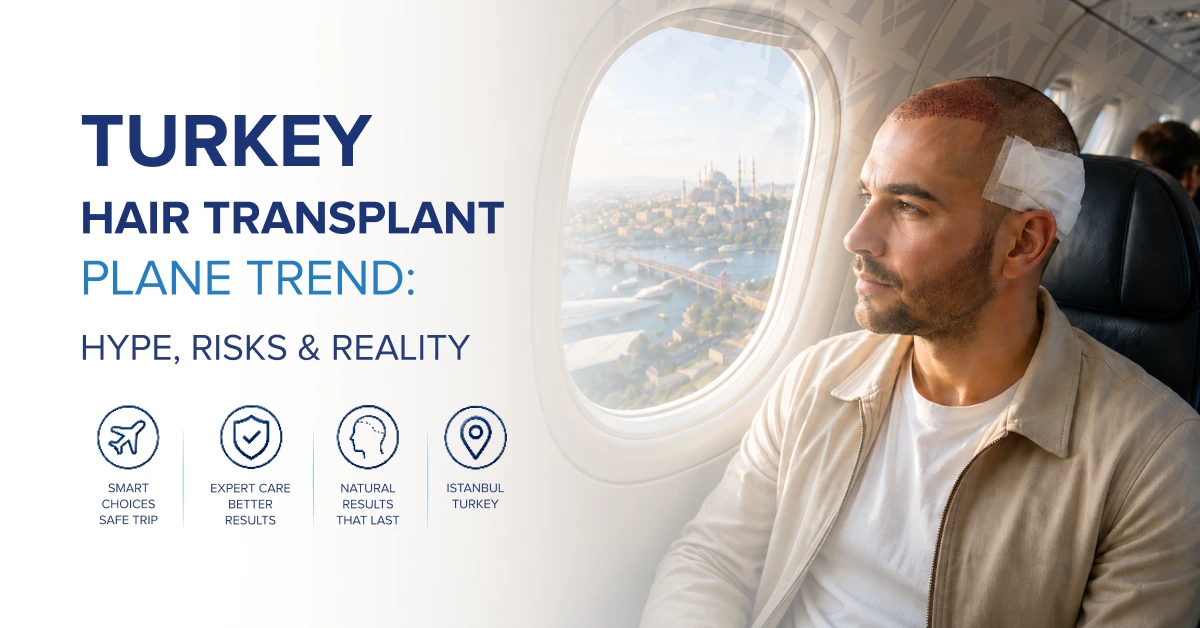
The "Turkey hair transplant plane" trend refers to viral videos showing flights leaving Istanbul packed with men wearing head bandages after low-cost hair transplant surgery in Turkey — a sign of how common, but not always how safe, this form of medical tourism has become.
According to the International Society of Hair Restoration Surgery (ISHRS), Turkey is one of the leading destinations worldwide for hair transplant medical tourism, with industry estimates pointing to hundreds of thousands of international patients per year. On busy routes back from Istanbul, seeing several post-op patients on one flight is normal.
● The trend is real: Turkey performs very high volumes of hair transplant procedures, so several post-op patients on the same plane is common.
● It becomes risky when surgery is squeezed into a "hair transplant weekend" with minimal assessment, very short stays, and high-volume factory clinics.
● In reputable, surgeon-led clinics with a safe travel plan, outcomes and patient satisfaction are generally high.
This article separates the viral joke from the medical reality, so you can decide whether to join that plane safely.
How the Turkey Hair Transplant Plane Went Viral
The Turkey hair transplant plane meme took off when social media users started posting photos and videos of rows of bandaged men on flights from Istanbul, turning a routine medical journey into a global inside joke.
Early news stories showed images of men with shaved donor areas and white bandages queueing at boarding gates in Istanbul. Travellers began sharing phone videos from inside cabins where you could count several post-op patients in nearby rows. Clips that focused on one section of the cabin made it look as if the entire plane was full of bandaged heads.
On TikTok, Instagram Reels, YouTube Shorts, and X (Twitter), these clips were edited with jokes, captions, and music. Hashtags such as #turkeyhairtransplant and #hairtransplantplane have attracted millions of views on TikTok alone (platform search, accessed 2024), turning a niche sight into a shared reference point.
Some content is exaggerated or staged. Creators film only the cluster of seats where patients are sitting, or gather friends to pose. Other videos are completely candid and match what many of our international patients describe: looking around the cabin and realising they're far from alone on a hair transplant flight Turkey visitors take home.
There's a psychological side too. Joking about the shared experience has helped some men feel less ashamed about hair loss and cosmetic surgery. The American Academy of Dermatology (AAD) notes that more men are openly seeking aesthetic treatments as stigma around appearance shifts.
Memes simplify decisions that, in reality, involve surgery, anaesthesia, and travel risks. The viral hair transplant meme shows a row of bandages. It doesn't show your medical history, your donor area limits, or the long-term consequences of a rushed choice.
"Turkish Hairlines" and Internet Jokes
"Turkish hairlines" are another running joke online. Sometimes the term is used as a compliment for dense, sharp hairlines; other times it's criticism for cookie-cutter, low, straight hairlines that look "cloned."
From a medical and artistic perspective, a good hairline design should be individual. It must match:
● Your age and expected future hair loss pattern
● Your facial shape and natural muscle movement
● The limits of your donor area — a finite "hair bank" you should spend carefully
Natural hairlines usually include micro-irregularities and a soft transition zone. They are not perfectly straight or unnaturally low. The ISHRS and other professional bodies emphasise that a personalised plan based on long-term donor management is safer than a trend-driven, ultra-dense "helmet."
A well-planned Turkish hairline can be excellent. A row of identical hairlines on different faces, all very low and very straight, is a warning sign that the clinic relies on templates and speed rather than thoughtful design.
Later, in the clinic-selection section, you'll see how to read before-and-after photos so you can tell a natural hairline from a "too Turkish" one.

Why So Many People Fly to Turkey for Hair Transplants
People fly to Turkey for hair transplants because experienced surgeons can often offer modern FUE procedures at a fraction of UK or US prices, with dedicated clinics and full travel packages making the trip easy to book.
Several factors explain why Istanbul has become a global hub for hair transplant flights to Turkey.
Cost differences: Turkey vs UK vs US
Lower staff and facility costs, plus exchange rate and cost-of-living differences, mean a typical procedure in Turkey often costs significantly less than in Western Europe or North America. The ISHRS consistently cites Turkey as a high-volume, lower-cost destination in its global surveys.
To keep this article non-promotional, we won't quote specific clinic prices. In broad terms, many patients find that a full trip to Turkey — including surgery, hotel, and flights — can cost less than surgery alone in their home country. These are approximate, region-level patterns, not individual quotes.
The table below gives a sense of broad price differences. Treat it as orientation, not as a quote for your case.
Approximate hair transplant cost ranges by region
Region |
Typical price range (FUE, full session) |
Notes |
|---|---|---|
Turkey (Istanbul) |
Lowest of the three |
Lower overheads and exchange-rate effects; quality varies by clinic. |
United Kingdom |
Mid–high |
Strong regulation, fewer dedicated hair-only centres. |
United States |
Highest |
Premium pricing; long surgeon waitlists in major cities. |
For a deeper explanation of techniques, candidacy, and what influences pricing, see this how hair transplants in Turkey work in detail guide.
High case volume and expertise
Reputable Istanbul hair transplant clinics perform large numbers of FUE and FUT procedures each year. As with other technical surgeries, higher case volume can sharpen a surgeon's skills — but only when the surgeon stays directly involved.
High volume becomes dangerous when a clinic turns into a high-volume factory clinic: one team working on ten or more patients a day, with limited surgeon oversight and heavy reliance on unlicensed technicians. The ISHRS has repeatedly warned about the risks of unlicensed technicians performing critical steps of surgery in several countries, including Turkey.
Infrastructure for medical tourism
Istanbul has built extensive infrastructure around hair transplant medical tourism:
● Two large international airports with frequent flights from Europe, the UK, the Gulf, and North America
● English-speaking coordinators and medical staff in many clinics
● Hotels and Airbnb options close to clinics
● Airport–hotel transfers and local drivers familiar with medical tourists
At Medart Hair Transplant in Istanbul, for example, we routinely treat both local and international patients in the same week. Many visitors are on their first medical trip abroad and need clear guidance on travel, recovery, and realistic expectations.
Marketing and all-inclusive packages
You'll see ads for an all-inclusive hair transplant package Turkey agencies promote: transfers, hotel, and surgery organised together, sometimes flights too. Some of these packages are run by reputable, surgeon-led centres. Others function more like cosmetic tourism agencies than medical practices, focused on volume and price rather than safety.
When people talk about "hair transplant Turkey risks" online, they're usually referring to the dangers tied to this kind of cosmetic tourism: limited medical assessment, high daily patient volume, and weak aftercare once you're back home.

What Actually Happens on a Hair Transplant Trip to Turkey
A safe hair transplant trip to Turkey usually involves arriving at least a day before surgery, undergoing your procedure, resting for 24–48 hours while you learn aftercare, and only then flying home with your grafts protected.
Typical stages of a hair transplant trip
1. Pre-trip online consultation
2. Arrival and in-person assessment
3. Surgery day (FUE/FUT)
4. Rest and first hair wash at the clinic
5. Return flight with a clear aftercare plan
The ISHRS notes that modern hair transplant procedures are almost always FUE or FUT, and both require structured post-operative care to protect graft survival and reduce complications.
Before you board the plane to Turkey
Most patients start with an online consultation. You send photos or a short video of your scalp. The hair transplant surgeon then assesses:
● Your pattern of male pattern baldness, often described by the Norwood scale — a simple classification from Stage 1 (minimal recession) to Stage 7 (advanced loss across the top)
● The quality and density of your donor area at the back and sides of the scalp
● Your general health, medications, and previous procedures
At Medart, we use this step to give an initial graft estimate, discuss realistic density, and rule out people who aren't ready or medically suitable. It's also when we talk about treatments like minoxidil and finasteride, which the AAD states can help slow further loss in many men when used under medical supervision.
Surgery day: what happens in FUE and FUT
FUE, or Follicular Unit Extraction, removes individual hair follicles from the donor area one by one using tiny punches and implants them into the recipient area. It leaves dot-like scars that are usually hard to see, even with short hair.
FUT, or Follicular Unit Transplantation, removes a narrow strip of scalp from the donor area, dissects it into grafts under a microscope, and closes the strip site with stitches. This method leaves a linear scar, which can be hidden under longer hair.
According to professional hair restoration literature reviewed by societies such as the ISHRS, both techniques can achieve high graft survival rates when done correctly and when post-op care is followed. FUE is now more common in hair transplant in Turkey, especially for international patients, because of its more flexible scarring pattern.
On surgery day:
● You receive local anaesthesia to numb the scalp; some clinics also offer light sedation in addition to local anaesthesia to reduce anxiety.
● The surgeon designs your hairline and plans how many grafts to place in each area to achieve appropriate hair density while protecting the donor "hair bank."
● The team extracts follicles from the donor area and carefully implants them into the recipient area along the agreed hairline design and pattern of loss.
The donor area is bandaged. The recipient area, where follicles are implanted, usually stays uncovered so the grafts are not compressed.

The first 24–72 hours in Istanbul
Right after surgery, expect:
● Swelling of the forehead and sometimes around the eyes
● Mild pain or tightness in the donor area
● Scabbing in the recipient area as tiny crusts form around each graft
● A need to sleep semi-upright to avoid rubbing the grafts
Most clinics provide painkillers, antibiotics to reduce infection risk, and sometimes anti-swelling medication. Following the wound-care and medication instructions given by your surgeon reduces the risk of complications such as infection or poor graft survival.
The next day, you usually return for your first hair wash. The team gently rinses the scalp, softens scabs, and shows you how to wash at home from day 2 or 3 onwards. This step is crucial in the early recovery timeline (day 0–7) and helps many patients feel more relaxed about caring for their grafts.
Most patients feel tired but can walk around the hotel and nearby streets. Avoid crowded indoor spaces, intense exercise, and strong sun exposure in those early days — they can worsen swelling or infection risk. In our experience at Medart, international patients appreciate having at least one quiet day to rest in the hotel and practise post-op care before dealing with security checks and overhead bins.

The flight home: what it really feels like
On the plane, you'll likely experience:
● Sensitivity or soreness where grafts were implanted and the donor area was treated
● Swelling that sometimes worsens slightly because of cabin pressure
● Difficulty finding a comfortable sleeping position without touching the recipient area
● Self-consciousness about bandages or visible scabbing
Hydration and movement are essential. Health authorities such as the NHS and the US Centers for Disease Control and Prevention (CDC) explain that sitting still for long periods can increase the risk of deep vein thrombosis (DVT), a blood clot in a leg vein. In rare cases, a clot can travel to the lungs and cause a pulmonary embolism (PE) — a medical emergency.
Think of your blood like a slow river. When it flows sluggishly because you haven't moved for hours, especially after surgery, conditions favour clots forming. That analogy is simplified, but the practical advice is clear: drink water regularly, flex and extend your ankles, walk the aisle every hour or so on long flights, and wear compression stockings if your doctor or surgeon recommends them.
For short-haul flights within Europe or the Middle East, discomfort is usually manageable with these precautions. For long-haul flights to North America, Asia, or Australia, the combination of fatigue, swelling, and prolonged immobility makes timing and planning especially important.
Same-Day or Next-Day Flights: How Safe Is It?
Same-day or very next-morning flights after surgery are not ideal, and can be unsafe for some patients — especially on long-haul routes or in people with known clotting risks.
General NHS and CDC guidance on flying after surgery advises allowing some recovery time before air travel and emphasises DVT prevention on flights. Hair transplant is considered minor surgery, but it still creates hundreds or thousands of small wounds and usually involves local anaesthesia. Combined with immobility, these factors can contribute to a short-term increase in clot risk.
There are limited published data specifically on DVT or PE after hair transplant tourism. Even so, principles from broader surgical and air-travel guidance still apply, particularly for longer flights and higher-risk patients.
Risks of flying too soon include:
● Bleeding or graft trauma if you bump your head in crowded airports or can't protect the recipient area
● Worsening swelling, which can spread to the eyelids and forehead and feel alarming
● Increased DVT/PE risk, especially on long-haul flights with limited movement
● Less time for the clinic to recognise early complications such as infection or excessive bleeding
A responsible clinic will tailor advice to your health, surgery length, and flight distance. In our clinical practice at Medart, in line with general postoperative flying recommendations, we usually suggest:
● For short-haul flights within Europe or the Middle East: at least 24 hours after surgery, and ideally 48 hours.
● For long-haul flights: at least 48 hours, and sometimes longer in patients with risk factors such as previous DVT, major recent surgery, or significant obesity.
If you develop severe chest pain, sudden shortness of breath, or coughing up blood after flying home, seek emergency medical care immediately. Don't rely on contacting the clinic alone — these can be signs of PE.
The meme focuses on the plane full of bandages, but the real safety story is about when you take that flight and how your trip is structured. The next section looks more directly at the medical benefits, risks, and red flags behind the Turkey hair transplant plane.
The Medical Reality Behind the Meme: Benefits, Risks & Red Flags
The Turkey hair transplant plane may look funny online, but from a medical standpoint the real story is a mix of excellent results in reputable clinics and serious complications in cut-price factory centres that rush patients in and out.
Real benefits of a well-planned trip to Turkey
When patients pick accredited, surgeon-led clinics and follow a safe travel plan, satisfaction is often very high. ISHRS global surveys report that properly selected patients having FUE or FUT, with appropriate donor management and post-op care, frequently achieve strong cosmetic improvements.
Key advantages of a well-run Istanbul hair transplant clinic include:
● Access to surgeons who perform FUE and FUT weekly and are familiar with different Norwood patterns
● More affordable pricing than in the UK or US, mainly because of cost-of-living differences — not because of shortcuts in good centres
● Modern facilities that may be inspected by the Ministry of Health, Türkiye and, in some cases, accredited by organisations such as JCI (Joint Commission International)
● The option to combine treatment with a short, gentle stay in Istanbul, as long as recovery comes first
When FUE is performed correctly, professional hair restoration societies and peer-reviewed reviews describe high graft survival rates, provided that extraction is careful, grafts are kept hydrated and cool out of the body, and the recipient area is protected afterwards.
Real risks: not all clinics are the same
The ISHRS has issued specific warnings about unlicensed technicians performing hair transplantation and about high-volume factory clinics in several countries. These risks are very relevant to hair transplant medical tourism in Turkey.
Main dangers in low-quality settings include:
● Unqualified operators doing most or all of the surgery instead of a trained hair transplant surgeon
● Poor hygiene and sterilisation, which raise the chance of infection and serious complications
● Overharvesting of the donor area, leaving patchy thinning or visible scarring that may be impossible to fully correct
● Unnatural hairlines, especially stereotypical ultra-low "Turkish hairlines" that ignore age, facial shape, and future loss
● Inadequate post-op care, with few instructions and little help if problems appear once you're home
From a health-system perspective, the World Health Organization (WHO) and various national health services have highlighted that complications from cosmetic tourism — including hair transplant trips — can burden hospitals in patients' home countries, which then have to treat infections, scarring, or failed grafts they didn't create.
Hair transplant package red flags
Hair transplant package red flags include:
● No direct consultation with a named surgeon before booking or paying a deposit
● One team operating on 10+ patients per day, signalling a high-volume factory model
● Vague or hidden costs, cash-only deals, or promises of "unlimited grafts" for one low fee
● No clear plan for complications or follow-up once you return home, beyond basic WhatsApp replies
In our clinic at Medart, we regularly see international patients who had bargain procedures elsewhere and now need revision surgery to correct pluggy hairlines, visible donor depletion, or scarring. Revision cases are more complex and limited by what remains in the donor area, which is why careful long-term donor management and realistic planning the first time around matter so much.

Myth vs Reality – Quick Comparison Table
Below is a summary of common myths from the Turkey hair transplant plane meme compared with medical realities.
Myth vs Reality of the Turkey Hair Transplant Plane
Myth |
Reality |
|---|---|
Everyone on the plane gets a perfect result. |
Outcomes vary widely; quality depends on surgeon skill, donor area, and post-op care. |
All Turkish hairlines are low and identical. |
Reputable clinics design personalised hairlines; identical, ultra-low designs suggest templates and poor planning. |
If a package includes flights and hotel, it's safer. |
All-inclusive packages can be convenient, but some prioritise volume and cost over medical standards. |
Same-day flight home is standard and harmless. |
Very short stays increase discomfort and, in some patients, DVT and complication risk — especially on long-haul flights. |
More grafts always mean better density. |
Overharvesting can permanently damage the donor area; long-term donor management matters more than one dense session. |
Any clinic in Turkey will give similar results. |
Quality ranges from world-class to unsafe; judge each hair transplant clinic individually, not by country average. |
The Turkey hair transplant plane meme hides this range of outcomes. The next section shows how to choose a clinic and travel plan so you end up on the positive side of that reality, not the cautionary one.