
Get a Free Consultation
Talk to an experienced patient coordinator for your beard transplant in Turkey.Key Takeaways
● Eyebrow transplantation creates growing hair rather than pigment.
● Compare price by inclusions, surgeon involvement, and aftercare, not headline cost alone.
● Direction, angle, hair caliber, and design shape natural-looking results.
● Unexplained or active eyebrow loss needs medical assessment before surgery.
● Transplanted scalp hairs may keep growing and need regular trimming.
The device used to implant eyebrow hairs matters far less than the adverts suggest. What actually decides your result is why the eyebrow was lost, which hairs are selected, and the angle each graft is placed. An eyebrow transplant Turkey provider can offer a tempting package on paper. Yet two near-identical quotes can hide very different levels of medical care. This guide walks the decisions that genuinely protect your outcome: cost, candidacy, procedure quality, recovery, risks, clinic checks, travel, and your next steps.
How Much Does an Eyebrow Transplant Cost in Turkey?
The cost of an eyebrow transplant in Turkey depends on required grafts, case complexity, surgeon involvement and package inclusions, so compare written like-for-like quotes. Headline prices swing widely between clinics, and a very low quote often strips out screening, medication, or proper follow-up care.
At Medart Hair Transplant, an eyebrow transplant Turkey package is priced from £1,400 to £2,200 (GBP) as checked in August 2026. This is a package rate, not a per-graft charge. All applicable Turkish taxes are included in the figures shown. The final quote may change after an in-person assessment of your grafts, design, and donor-area condition.
Prices are dated examples and may change after in-person assessment.
This dated table shows what a Medart eyebrow transplant package typically covers and excludes (August 2026).
Item |
Included in package |
Excluded / extra |
|---|---|---|
Package price range |
£1,400–£2,200 (GBP) |
— |
Surgeon consultation and design |
Yes |
— |
Local anesthesia and procedure |
Yes |
— |
Graft harvesting and implantation |
Yes |
— |
Post-procedure starter medication |
Yes |
Long-term products |
Airport transfers in Istanbul |
Yes |
International flights |
Hotel nights (clinic-specified) |
Yes |
Extra nights |
Follow-up guidance after return |
Yes |
Local emergency care abroad |
Revision or touch-up |
Reviewed case by case |
May carry an added fee |
What is normally included?
A credible package lists its contents in writing before you pay.
● Surgeon-led consultation and eyebrow design
● Local anesthesia and the procedure itself
● Graft harvesting, sorting, and implantation
● Starter medication and aftercare instructions
● Airport transfers and clinic-specified hotel nights
● Structured follow-up after you return home
What can increase the final quote?
Several factors push the price beyond a base package.
● Higher graft requirement for sparse or fully absent brows
● Case complexity, such as scar tissue or asymmetry correction
● Revision or touch-up work on a previous transplant
● Greater surgeon involvement across each stage
● Extra accommodation or a longer stay
● Additional aftercare or repeat reviews
For wider context on graft-based pricing, see how hair transplant pricing in Turkey is calculated.
Turkey versus UK, US, and Europe
This comparison uses market sampling collected in August 2026, converted to GBP at that month's rates, and notes whether each figure is package or procedure-only. We sampled published eyebrow-transplant prices from clinic and directory listings across four markets. Because inclusions differ, treat these as broad ranges rather than exact quotes, and never set a Turkish hotel-and-transfer package against a surgery-only fee elsewhere.
Market |
Typical basis |
Sampled range (GBP, August 2026) |
|---|---|---|
Turkey |
Package (procedure + transfers + hotel) |
£1,400–£2,600 |
UK |
Procedure-only, often per graft |
£2,500–£5,000 |
US |
Procedure-only, often per graft |
£3,500–£7,500 |
Germany |
Procedure-only |
£3,000–£6,000 |
Lower Turkish prices reflect lower clinic overheads and high procedure volume, not automatically lower quality. Verify the surgeon and inclusions before you compare any numbers, because a package figure and a surgery-only figure are simply not the same thing.
Unsure what your quote should include? Tap the WhatsApp button in the bottom-right corner to send clear eyebrow and donor-area photos. Medart can give a free preliminary read on likely case complexity, package inclusions, and questions to raise with the surgeon.
A photo review is preliminary and is not a final diagnosis or guaranteed graft estimate.
A written quote only helps once you understand what the procedure achieves. The next section explains how transplanted follicles grow and why grooming stays part of long-term care.
What Is an Eyebrow Transplant, and Is It Permanent?
An eyebrow transplant relocates viable hair follicles into the eyebrow area, where successful grafts can produce long-term hair growth. It is a form of hair transplantation adapted to the fine, delicate anatomy of the brow.
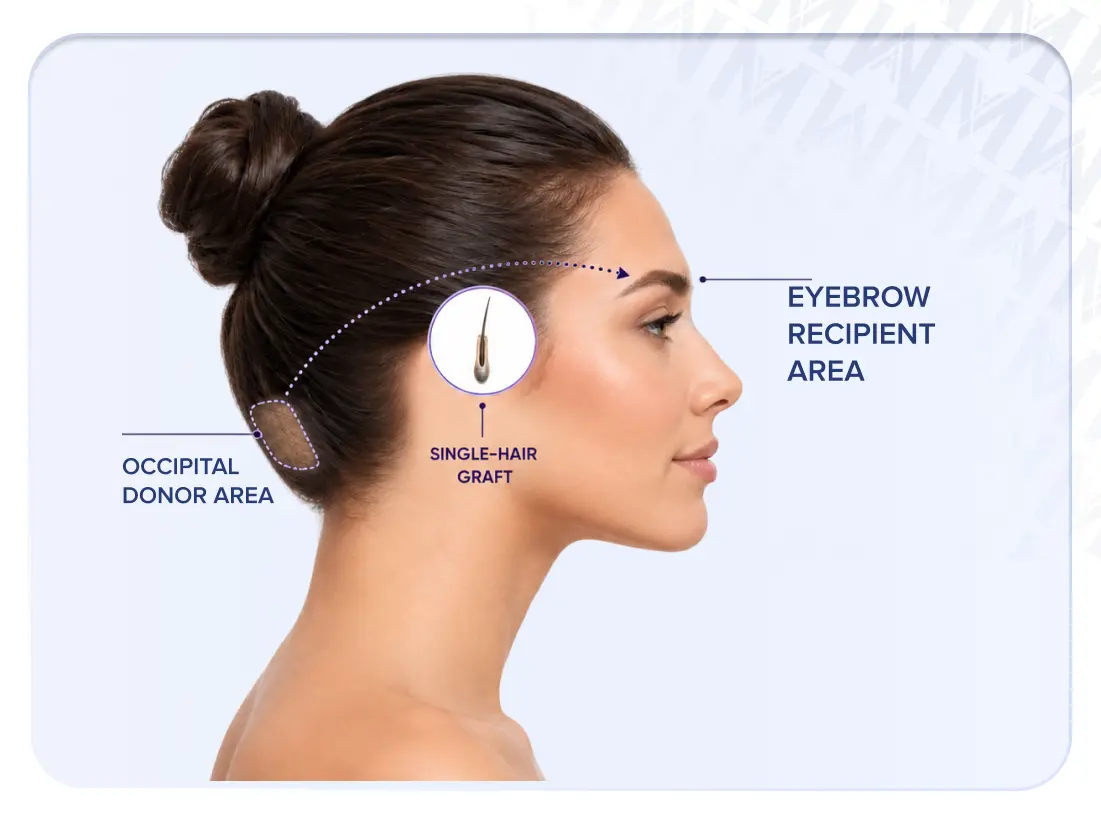
Individual follicles are harvested from a donor area and placed into the recipient area, the eyebrow skin where grafts are positioned. Surviving scalp-derived follicles can keep producing hair long term, though graft survival and final density vary by individual. According to the American Academy of Dermatology, transplanted follicles tend to keep the characteristics of the site they came from, which is why donor selection matters so much.
Where does the donor hair come from?
Donor hair follicles usually come from the occipital scalp, the lower back of the head. Surgeons often prefer fine-caliber donor hair from here, because thick scalp hair can look coarse in a brow. A hair graft is a small unit containing one or more hair follicles. For eyebrows, a single-hair graft is often the key to a soft, natural edge.
Clinical observation from Dr. Busra Yakupoglu: I select fine single-hair grafts along the front third of the brow because thicker two- and three-hair units read as tufts up close. The finest available donor hair gives the most convincing edge.
Why might transplanted eyebrows need trimming?
Transplanted scalp hairs often keep growing at a scalp-like pace. They can grow longer than native eyebrow hair and need regular trimming.
Clinical observation from Dr. Busra Yakupoglu: Scalp-derived brow hairs commonly need trimming, though the interval varies with donor hair and personal grooming. I always explain this before surgery so patients plan for long-term maintenance.
An eyebrow is not simply a scalp transplant in miniature. Direction, hair thickness, curl, and spacing can matter more than a high graft count. Because permanence rests on healthy follicles and realistic expectations, the next section explains who is actually a good candidate.
Who Is a Good Candidate?
Good candidates generally have stable eyebrow loss, adequate donor hair, realistic expectations and no untreated condition likely to cause continued loss. Suitability is a medical decision, not a marketing one.
A proper medical consultation assesses candidacy, donor supply, and the cause of loss. Stable hair loss from cosmetic overplucking, old trauma or burn scars, or congenital eyebrow thinning may be treatable. Active or unexplained loss usually needs investigation first.
Common reasons people seek eyebrow restoration
● Years of over-tweezing that thinned the brow
● Scars from injury, surgery, or burns
● Naturally sparse brows present since youth
● Selected, stable medical conditions after treatment
Consented Medart case — overplucking. A woman in her forties came in with stable thinning after decades of tweezing. We kept her existing brow hairs and blended them into the design, placing fine single-hair grafts along the front edge for softness. Design objective: a fuller shape without a harsh line, matching her natural arch and hair direction. Full case-card fields appear in the results section.
Tell the clinician before booking
Some health factors do not rule out surgery but need individual assessment first. Raise these at consultation so the surgeon can plan safely.
● Diabetes or any impaired-healing concern
● Anticoagulants or other blood-thinning medication
● Keloid tendency or a history of poor wound healing
● Significant smoking exposure, which can affect healing
● Any allergy to local anesthetic, antiseptics, or dressings
● Severe distress about appearance or unrealistic expectations
Do not start, stop, or change any medication without advice from your prescribing clinician.
When surgery should be postponed
Surgery should wait when loss is still progressing. Alopecia areata, an autoimmune condition causing patchy loss, and uncontrolled trichotillomania, which is compulsive hair-pulling, can both make a transplant premature. Progressive scarring alopecia is another reason to hold off. Scarring alopecia is hair loss that can permanently damage follicles through inflammation and scar formation. Frontal fibrosing alopecia, a scarring hair loss condition, also needs specialist review first.
Clinical scenario reviewed by Dr. Busra Yakupoglu — unexplained patchy loss. A patient asked for more density but had sudden, patchy, recent loss. Rather than operate, we referred him for dermatologist assessment and trichoscopy, a scalp-and-skin imaging test. Surgery was postponed until a diagnosis and stability were confirmed. Operating on active loss risks wasted grafts and disappointment, so ethical selection sometimes means saying not yet.
Medical red flags that need investigation
The NHS advises that sudden or unexplained hair loss should be medically assessed. Seek review if eyebrow loss is sudden, progressive, patchy, itchy, painful, red, scaling, or shows signs of scarring. Also seek review if loss arrives with fatigue, weight change, systemic illness, or possible thyroid disease or nutritional deficiency.
This table separates who may be suitable from who needs assessment first.
May be suitable |
Needs medical assessment or stabilization |
Often unsuitable or premature |
|---|---|---|
Stable overplucking |
Suspected thyroid disease |
Active alopecia areata |
Old trauma or burn scars |
Nutritional deficiency |
Uncontrolled trichotillomania |
Congenital thinning |
Unexplained recent loss |
Progressive scarring alopecia |
Adequate donor hair |
Borderline donor supply |
Severe donor limitations |
Realistic expectations |
Uncertain goals |
Unrealistic expectations |
You can estimate hair-transplant graft requirements for general context, though a general calculator cannot give a definitive eyebrow graft estimate. Eyebrow planning always needs clinician review.
With suitability settled, many readers still weigh surgery against a non-surgical option. The next section compares transplantation with microblading.
Eyebrow Transplant vs Microblading: Which Is Better?
An eyebrow transplant grows real hair, whereas microblading creates the appearance of hair with implanted pigment. Neither is universally better; the right choice depends on your skin, existing hair, goals, and willingness to have surgery.
Microblading and powder brows are forms of cosmetic tattooing, sometimes called permanent makeup, that place pigment in the skin. According to the American Academy of Dermatology, cosmetic tattooing fades over time and carries risks such as infection, allergic reaction, and colour change. A transplant is surgical, and surviving follicles can provide long-term hair growth, though results vary.
This table compares the two options across seven practical factors.
Factor |
Eyebrow transplant |
Microblading |
|---|---|---|
What it creates |
Real growing hair |
Pigment in the skin |
Longevity |
Long-lasting if grafts survive |
Fades, needs top-ups |
Maintenance |
Regular trimming |
Periodic re-inking |
Recovery |
Healing and shedding phase |
Shorter healing, with temporary redness, tenderness, or flaking |
Main risks |
Infection, scarring, poor growth |
Fading, infection, colour change |
Best suited for |
Stable loss wanting real texture |
Those avoiding surgery |
Limitations |
Cost, surgical risk |
No real hair, ongoing upkeep |
Sometimes the two can complement each other, but timing needs professional advice. Prior pigment can also affect design and make before-and-after photos harder to read, so tell the surgeon if you have had any brow tattooing.
Once you understand what a transplant delivers, the next question is how it is done, and by whom.
How Is an Eyebrow Transplant Performed?
A natural eyebrow transplant requires carefully selected grafts placed at shallow angles that follow the changing direction of native eyebrow hairs. The result depends on eyebrow design, implantation angle, and hair direction, not the equipment brand.
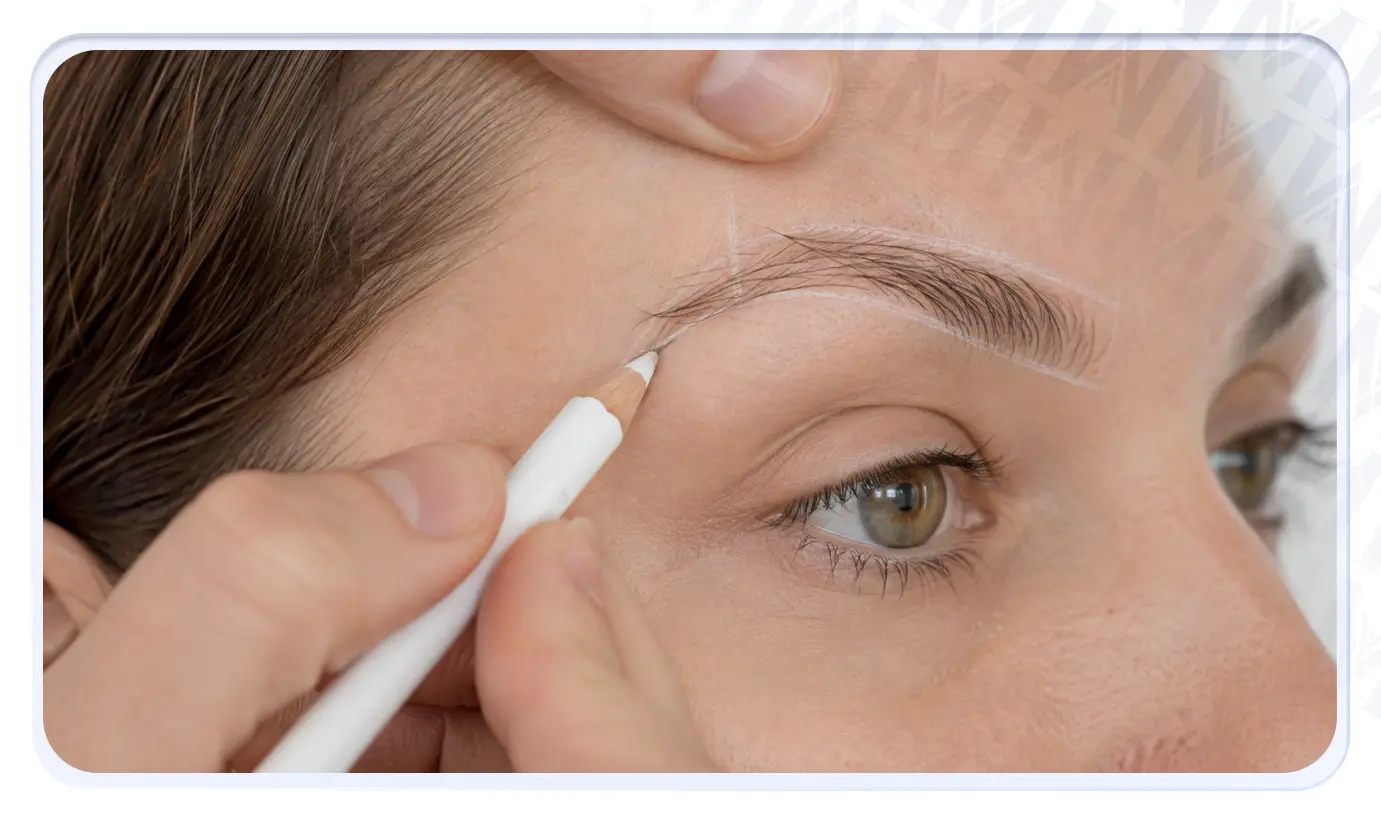
The procedure is usually performed under local anesthesia, medication that numbs the area while you stay awake. The surgeon assesses the cause of loss, agrees the design, and controls the fine detail that makes a brow look convincing.
These six steps outline a typical eyebrow transplant at Medart Hair Transplant:
1. Medical consultation and cause-of-loss assessment — the surgeon reviews history and donor supply.
2. Eyebrow mapping and design agreement — the shape is drawn against your facial proportions and existing hair.
3. Donor-area preparation and local anesthesia — the occipital scalp is prepared and numbed.
4. Donor-hair extraction — follicular units are removed by follicular unit extraction (FUE), a method of removing individual follicular units from the donor area.
5. Graft sorting and recipient-site creation — grafts are sorted, and recipient-site creation sets the angle and direction of each site.
6. Implantation and immediate aftercare instructions — grafts are placed and aftercare is explained.
Implantation angle is the shallow direction at which a graft enters the skin. In eyebrows it must sit very close to the surface.
Who performs each stage at Medart
This table states who is responsible for each clinical stage.
Stage |
Responsible person |
|---|---|
Candidacy assessment |
Dr. Busra Yakupoglu (performs) |
Design approval |
Dr. Busra Yakupoglu (performs) |
Donor-hair extraction |
Dr. Yakupoglu performs or directly supervises |
Graft sorting |
Trained clinical technicians (assist, supervised) |
Recipient-site creation |
Dr. Yakupoglu (performs) |
Implantation |
Dr. Yakupoglu implants front-edge single-hair grafts; supervised technicians place remaining grafts |
Postoperative instructions |
Nursing staff, on the surgeon's protocol |
Follow-up |
Dr. Yakupoglu reviews, with nursing support |
Clinical observation from Dr. Busra Yakupoglu: Eyebrow grafts need to lie close to the skin, more like shingles on a roof than hairs standing upright. The angle at the front edge is the difference between a natural brow and an obvious one.
Clinical observation from Dr. Busra Yakupoglu: The eyebrow head, body, arch, and tail each need a changing implantation direction. Hairs point upward and slightly inward at the head, then sweep sideways toward the tail. Where native hair remains, I angle new grafts to blend with it and preserve symmetry and density without overcrowding.
Peer-reviewed surgical reviews of eyebrow restoration describe the same principle: shallow angles and changing direction across the brow drive a natural appearance. Technique names, meanwhile, are everywhere in adverts. The next section explains what FUE, DHI, and Sapphire really mean.
FUE, DHI or Sapphire: Does the Technique Matter?
FUE describes follicle extraction, while DHI and Sapphire terminology mainly describe tools or implantation steps and do not guarantee a better result. These labels describe parts of the process, not a guaranteed level of design skill or graft survival.
According to the International Society of Hair Restoration Surgery (ISHRS), FUE defines how follicular units are harvested. DHI commonly refers to implantation using an implanter pen, a device that places grafts directly. DHI is a marketing and procedural term used inconsistently across clinics, and it is not a different source of follicles.
This table clarifies what each term describes and what it does not promise.
Term |
What it describes |
What it does not guarantee |
|---|---|---|
FUE |
Method of extracting follicular units |
Better design or survival |
DHI |
Implantation using an implanter pen |
Superior eyebrow results |
Implanter pen |
Tool for placing grafts |
Higher graft survival |
Sapphire FUE / Sapphire blade |
Blade material for recipient incisions |
Faster healing or fuller brows |
Direct comparative evidence showing that one implantation device produces superior eyebrow results is limited. A DHI eyebrow transplant and a FUE eyebrow transplant can both produce good results when graft selection, site creation, handling, and direction are appropriate. To understand the terminology further, see what Sapphire FUE means; note that Sapphire terminology does not guarantee better eyebrow results.
Whichever method is chosen, recovery follows a fairly predictable pattern. The next section maps it month by month.
Recovery and Results: What Happens Month by Month?
Most patients experience early healing and temporary shedding before new growth becomes visible gradually over several months. Patience matters, because early appearance does not predict the final result.
According to NHS guidance on hair transplants, mild swelling and crusting are common early on. The visible hair shaft can shed while a viable transplanted follicle stays under the skin and later resumes growth.
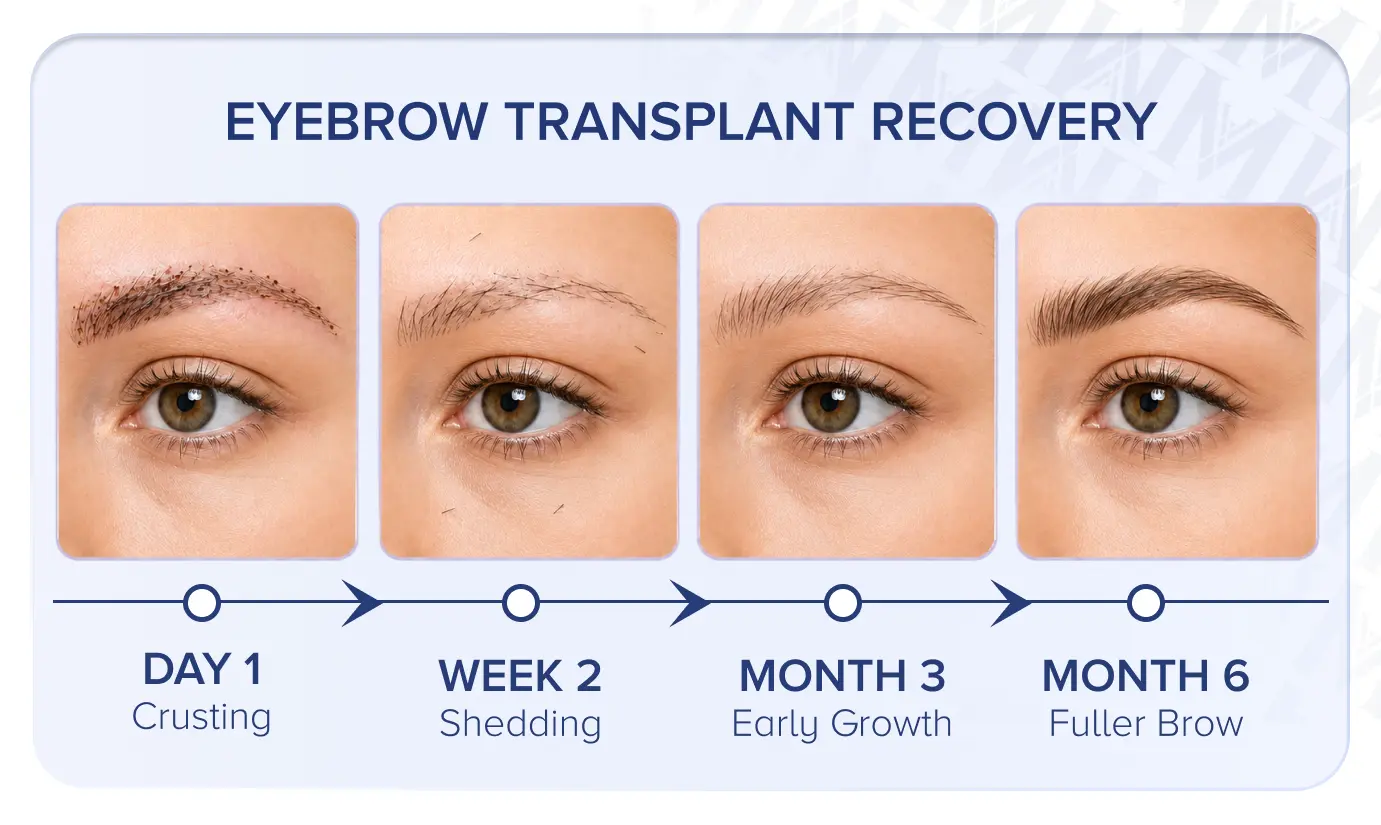
First 48 hours
Expect redness, mild swelling, and tenderness. Tiny crusts form around each graft. Follow your clinic's washing and sleeping instructions closely, because early care protects graft survival.
Days 3–10
Crusting peels away gradually. Do not pick at the scabs. Gentle washing as instructed helps the grafts settle. A common early mistake is scrubbing too hard, which can dislodge a graft before it anchors.
Weeks 2–8
The shedding phase begins, and transplanted shafts commonly fall out. Viable follicles stay beneath the skin. Brows may look sparse and uneven for a time. This is expected, not failure.
Months 3–6
New transplanted hair growth appears gradually. Early growth can look patchy before it fills in and evens out.
Months 6–12 and beyond
Coverage and cosmetic appearance keep developing. Final timing varies between patients and cannot be promised for a fixed date.
Long-term trimming and grooming
Scalp-derived hairs may keep growing and need regular trimming and light grooming to sit naturally. Many patients trim every one to two weeks and brush the brow into shape, though the interval varies with donor hair. Protect the healing area from strong sun for the first months, as your clinic advises.
This table sets realistic expectations for each recovery stage.
Time period |
Expected appearance |
Common symptoms |
Care priorities |
When to contact the clinic |
|---|---|---|---|---|
First 48 hours |
Red, slightly swollen, tiny crusts |
Tenderness, mild swelling |
Follow washing/sleeping rules |
Heavy bleeding, severe pain |
Days 3–10 |
Crusts fading |
Mild itching |
Gentle cleansing, no picking |
Spreading redness, pus, fever |
Weeks 2–8 |
Sparse, shedding |
Minimal |
Protect skin, avoid trauma |
Signs of infection |
Months 3–6 |
Early patchy growth |
None expected |
Sun protection per clinic advice |
Urgent: pus or pain. Non-urgent: slow growth |
6–12+ months |
Fuller, maturing |
None expected |
Regular trimming |
New unexplained loss |
Recovery is mostly smooth, but every surgery carries risk. The next section explains what is normal and what is not.
Risks, Side Effects and Warning Signs
Eyebrow transplantation is surgery, and risks include infection, folliculitis, scarring, poor growth, asymmetry and unnatural hair direction. No clinic should call the procedure risk-free or guarantee graft survival.
Common short-term effects
Expected effects include temporary redness, swelling, crusting, itching, and tenderness. According to NHS guidance, these effects usually settle within a couple of weeks, though timing varies.
Less common complications
According to NHS hair-transplant safety information, possible complications include infection, scarring, and folliculitis, which is inflammation or infection around hair follicles. Other risks include ingrown hairs, poor growth, asymmetry, and unnatural hair direction. Overharvesting the donor area can thin it. Existing brow hairs can suffer shock loss, which is temporary shedding of nearby existing hair after a procedure. Poor technique may produce an upright, plug-like, or mismatched brow that later needs correction.
When to seek urgent medical advice
Seek prompt local medical care if you develop worsening pain, spreading redness, pus or discharge, fever, significant bleeding, or any visual symptoms or eye pain. Urgent symptoms should be assessed locally rather than waiting for an overseas clinic reply.
Possibility of revision or touch-up surgery
Some patients later choose a revision or touch-up procedure to add density or refine shape.
Clinical observation from Dr. Busra Yakupoglu: The most common reasons patients request revision are a wish for more density and occasional asymmetry as growth matures. Scar tissue can have altered blood supply and firmness, so planning may need lower initial density, test grafting, or staged treatment in selected cases.
Consented Medart case — trauma scar. A patient with a brow scar from injury wanted restoration. We assessed the scar's blood supply and firmness and set conservative expectations. Around 90 grafts were placed at first, with a planned review before any second stage. This protected graft survival over a fragile area. Full case-card fields appear in the results section.
This table separates normal healing from warning signs.
Expected healing effects |
Warning signs needing prompt review |
|---|---|
Mild redness, swelling |
Spreading redness |
Light crusting |
Pus or discharge |
Itching, tenderness |
Worsening pain, fever |
Temporary shedding |
Significant bleeding |
Minor tightness |
Visual symptoms or eye pain |
Surgery carries risks, and results cannot be guaranteed. Because outcomes hinge so heavily on the clinic, the next section gives you a verification framework for Turkey.
How to Choose a Safe Eyebrow Transplant Clinic in Turkey
A safe clinic should identify the treating surgeon, explain who performs every procedural stage and provide verifiable eyebrow-specific results and aftercare. In medical tourism, this transparency is how you find accountable providers.
Verify the clinic's legal identity and treatment address. The Turkish Ministry of Health authorises clinics and licenses physicians, and its health-tourism platform HealthTürkiye lists accredited providers. Ask for the clinic's legal facility name, treatment address, the physician's name, and their authorisation, then check these against the official listings before you pay a deposit.
Ten questions to ask before booking
1. What is the clinic's legal identity and treatment address?
2. Who is the named surgeon, and what are their credentials?
3. Who performs each clinical stage: extraction, recipient sites, implantation?
4. Can you show eyebrow-specific case experience, not only scalp cases?
5. What is my estimated graft range and design approach?
6. How was my donor area assessed?
7. What exactly is included and excluded in the package?
8. What aftercare and emergency contact do you provide?
9. What is your revision or touch-up policy?
10. What is the informed consent and complication plan after I return home?
How to assess before-and-after photos
Compare the same patient, lighting, distance, expression, and angle. Require a stated follow-up month. Study before-and-after photographs for direction and softness, not only density.
Red flags
● Guaranteed results or "risk-free" promises
● Pressure selling or a hidden surgeon identity
● Copied or inconsistent photographs
● No clear aftercare or emergency plan
What informed consent should cover
Consent should cover risks, realistic outcomes, operator roles, and the plan if complications arise. According to CDC medical-tourism guidance, travellers should confirm provider credentials and aftercare arrangements before treatment abroad. Clinic verification cannot remove surgical risk, but it does help you identify accountable providers and clarify who is responsible for follow-up.
Not sure whether your eyebrow loss should be checked before surgery? Message the Medart team through the WhatsApp button in the bottom-right corner for a free preliminary review and guidance on whether an in-person or dermatology assessment may be appropriate.
With a clinic verified, the next step is planning the practical side of your trip to Istanbul.
Planning Your Eyebrow Transplant Trip to Istanbul
Travel plans should follow the clinic's medical schedule, including consultation, procedure, early review and a clear plan for follow-up after returning home. Book your stay around medical timing, not the other way round.
Stay length for an eyebrow transplant Istanbul trip is set by your consultation, procedure, first wash, early review, and individual travel clearance. Your clinic should confirm arrival, procedure, check-up, and departure dates.
Suggested appointment sequence
1. Arrival and in-person consultation
2. Procedure day under local anesthesia
3. First wash and early review
4. Departure once cleared by the surgeon
What to pack
● Loose, button-front clothing for the first days
● Clinic-recommended sun protection that avoids pressure on the grafts
● Your medication list and any prescriptions
● Written aftercare instructions and your procedure summary
● Clinic contact details and travel insurance documents
Follow clinic advice on medication, sun exposure, exercise, alcohol, smoking, and flying. Smoking can impair wound healing, and anticoagulants may need review by your prescribing doctor before the procedure, not only before travel.
Do not start, stop, or change medication without advice from the prescribing clinician.
Follow-up after returning home
Agree a follow-up care plan before you fly. Know who to contact and how, carry your procedure details for any local clinician, and arrange local care for any urgent issue. According to CDC medical-tourism guidance, keeping copies of your medical records and a plan for aftercare at home is an important safeguard.
Do not travel if the treating clinician identifies a medical contraindication.
To weigh accommodation and transfers, see what a Turkey hair transplant package may include; inclusions differ by clinic, so always get written confirmation. Flight and accommodation planning should be finalised only after your medical schedule is set.
Before you commit, learn how to judge whether the results you see are genuine and relevant to you.
Realistic Results: How to Evaluate Case Examples
Eyebrow transplant photographs are meaningful only when the patient, timing, lighting, styling and image conditions are clearly disclosed. Results shown without context are hard to trust.
Compare the same patient at consistent camera distance, expression, and angle. Check whether makeup, tint, microblading, or styling is present. A clearly stated follow-up month is essential, because early photos overstate final coverage.
Audited cohort data not yet available
Audited cohort data are not yet available, so Medart is not publishing internal outcome, revision, or adverse-event rates on this page. A defined cohort with inclusion criteria, follow-up definitions, missing-data rate, and limitations is being compiled, and verified figures will be added here once they meet our internal standard.
Two annotated patient cases
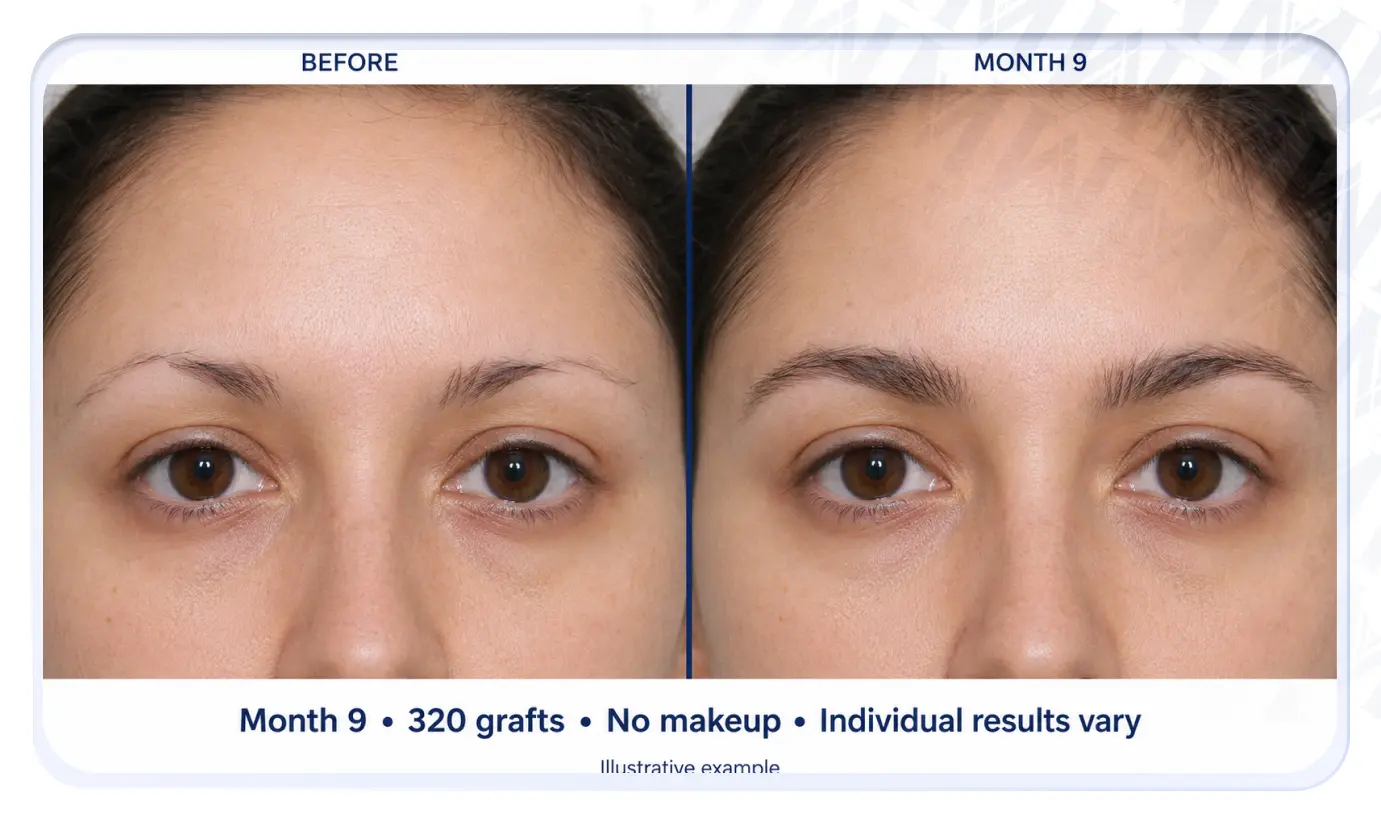
The two consented cases described earlier are documented below using standardized fields, photographed at a labelled follow-up month with consistent lighting and angle. Results from one patient cannot guarantee another patient's outcome.
Case card 1 — overplucking
Field |
Detail |
|---|---|
Initial concern |
Stable thinning after decades of tweezing |
Documented cause |
Cosmetic overplucking |
Grafts implanted |
320 |
Design objective |
Fuller shape, soft front edge, natural arch |
Donor area |
Occipital scalp |
Technique |
FUE with single-hair grafts at the front edge |
Follow-up month |
Month 9 |
Touch-up required |
No |
Makeup/tint/styling in photo |
None; brows undyed |
Case card 2 — trauma scar
Field |
Detail |
|---|---|
Initial concern |
Gap from an injury scar |
Documented cause |
Trauma scar |
Grafts implanted |
90 (first stage) |
Design objective |
Blend the gap; conservative density |
Donor area |
Occipital scalp |
Technique |
FUE, staged plan |
Follow-up month |
Month 12 |
Touch-up required |
Second stage under review |
Makeup/tint/styling in photo |
None disclosed |
Questions to ask about photographs
● Is it the same patient and angle?
● What is the follow-up month?
● Was makeup, tint, or styling used?
● Does the direction look soft and natural?
To practise critical viewing, see how to assess hair transplant before-and-after results; note that scalp-hair galleries do not replace eyebrow-specific evidence.
With results in perspective, here are direct answers to the questions readers ask most.
Frequently Asked Questions
These answers address the most common cost, safety, recovery and travel questions about eyebrow transplantation in Turkey.
Is an Eyebrow Transplant in Turkey Right for You?
This article provides general educational information and does not replace an individual medical examination, diagnosis, or treatment plan. Suitability, graft requirements, recovery and results vary. Seek assessment from a qualified clinician, especially if eyebrow loss is sudden, progressive, patchy, itchy, painful or associated with other symptoms.
Choosing an eyebrow transplant Turkey provider takes more than a price comparison. Your decision should rest on five things. First, the cause of your eyebrow loss. Second, your donor-hair quality. Third, a design with natural direction. Fourth, a named surgeon with clear operator roles. Fifth, a written cost and aftercare plan. A remote photo review is preliminary and does not replace an in-person medical consultation. Medart Hair Transplant can walk you through each of these before you commit.
The best eyebrow transplant is not the one with the most grafts or the cheapest package; it is the one that creates natural direction and density while protecting your health and donor area.
Request a personalized eyebrow-restoration plan. Tap the WhatsApp button in the bottom-right corner to share your goals, medical history and photographs for a free preliminary consultation. Ask for the proposed design, estimated graft range, named surgeon, full inclusions and aftercare plan.
References
- American Academy of Dermatology — "Hair loss: Diagnosis and treatment." https://www.aad.org/public/diseases/hair-loss/treatment/diagnosis-treat (accessed August 2026).
- American Academy of Dermatology — "Tattoos: 7 unexpected skin reactions and what to do about them." https://www.aad.org/public/everyday-care/skin-care-secrets/tattoos (accessed August 2026).
- NHS — "Cosmetic procedures: Hair transplant." https://www.nhs.uk/conditions/cosmetic-procedures/hair-transplant/ (accessed August 2026).
- NHS — "Hair loss." https://www.nhs.uk/conditions/hair-loss/ (accessed August 2026).
- Centers for Disease Control and Prevention — "Medical Tourism," CDC Yellow Book (Travelers' Health). https://wwwnc.cdc.gov/travel/yellowbook/2024/preparing-international-travelers/medical-tourism (accessed August 2026).
- International Society of Hair Restoration Surgery (ISHRS) — "Follicular Unit Excision/Extraction (FUE)" patient information. https://ishrs.org/patients/treatments-for-hair-loss/hair-transplantation/ (accessed August 2026).
- Kim JC et al. — peer-reviewed review of eyebrow transplantation technique and design principles, Facial Plastic Surgery Clinics of North America (PubMed-indexed). https://pubmed.ncbi.nlm.nih.gov/ (search: eyebrow transplantation technique).
- Peer-reviewed review of follicular unit extraction and graft survival, indexed in PubMed. https://pubmed.ncbi.nlm.nih.gov/ (search: follicular unit extraction graft survival).
- Peer-reviewed review of alopecia areata and cicatricial (scarring) alopecia, indexed in PubMed. https://pubmed.ncbi.nlm.nih.gov/ (search: alopecia areata scarring alopecia review).
- Republic of Türkiye Ministry of Health — HealthTürkiye (Health Tourism) accredited provider information. https://www.saglik.gov.tr and https://healthturkiye.com (accessed August 2026).