
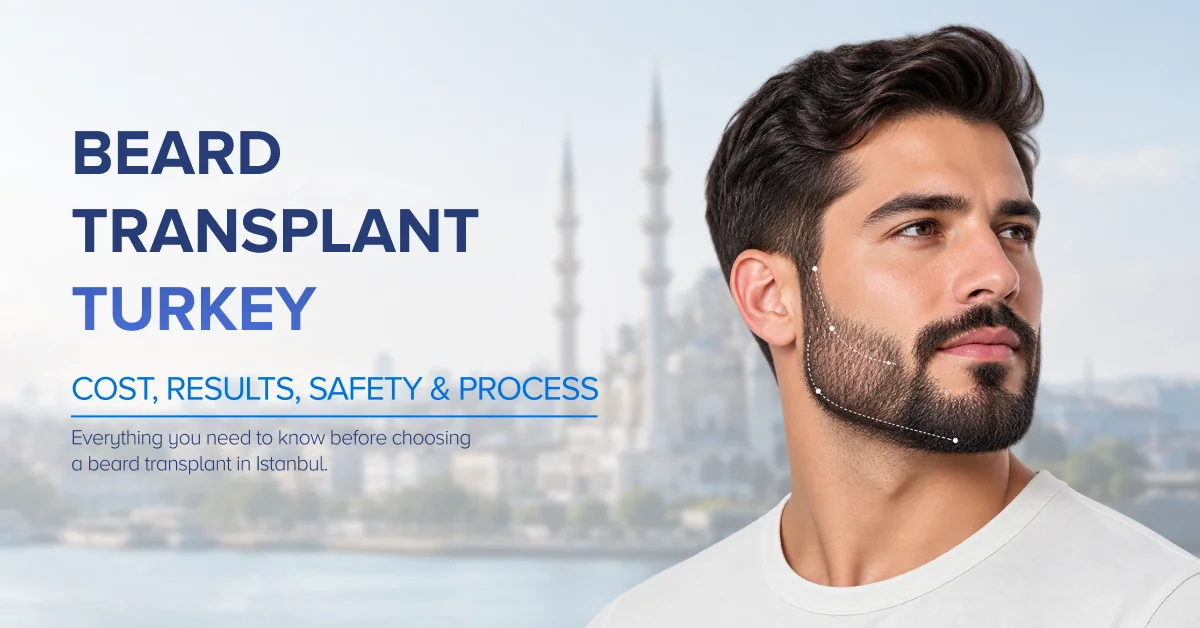
Beard Transplant Turkey: Cost, Results, Safety & Process

A beard transplant in Turkey moves suitable donor follicles—usually from the scalp—to sparse facial areas. Turkey may offer lower costs and convenient packages, but results depend on candidacy, beard design, hair direction, donor management and who performs the procedure. Compare the total trip cost, verified long-term cases, risks and aftercare before choosing a clinic.
Beard Transplant Turkey

Table of Contents

Dr. Busra Yakupoglu

Reviewed by Dr. Busra Yakupoglu, Hair Transplant Surgeon, Medart Hair Transplant, Istanbul

Key Takeaways

  • ● FUE is an extraction method, not a guarantee of quality.

  • ● Natural angle and direction are critical in facial hair transplantation.

  • ● Cost comparisons must include travel, medication, aftercare, and possible revisions.

  • ● Online graft estimates are preliminary.

  • ● Verify the surgeon, facility, surgical roles, and post-travel complication plan.

Choosing between FUE, DHI and sapphire is not the most important beard-transplant decision. The harder questions are who creates the recipient sites, how the surgeon controls hair direction, and what happens if you need care after flying home.

This guide weighs treatment through four lenses: candidacy, facial design, surgical accountability and total travel cost. Cost comes first because it dominates most searches, but price should never be judged before clinical suitability. Get the four lenses right, and the technique label matters far less than the marketing suggests.

Terms used in this guide: A hair follicle is the small structure in the skin from which a hair grows. A follicular unit is a naturally occurring group of one or more hairs. A graft is transplanted tissue containing one follicular unit, so it is not automatically equal to one hair. FUE (follicular unit extraction) is a method of removing individual follicular units from a donor area. Recipient-site creation means making the small openings where grafts are placed. The donor area is where follicular units are removed, usually the scalp, and the recipient area is the beard region receiving them.

Illustrative scenario, not a patient case: A reader asks for "2,500 grafts and a sharp cheek line." On examination, his cheeks are patchy but his moustache and chin already grow well. His scalp donor hair is straighter and finer than his beard. A softer cheek transition and a more conservative plan would suit his face better than maximum density. The lesson is simple. Matching the face and donor supply matters more than chasing a big graft number.

Get a Free Consultation

Talk to an experienced patient coordinator for your beard transplant in Turkey.
Please enter a valid phone number.

Is Turkey a good choice for a beard transplant?

Turkey can be a practical location for beard transplantation, but the safety and quality of treatment depend on the individual surgeon, facility, clinical team and aftercare—not the country alone.

Turkey, and Istanbul in particular, draws thousands of international patients each year for hair restoration and medical tourism. That scale can bring convenience and competitive pricing. It does not, by itself, prove that any single provider will plan your beard well. A beard transplant Istanbul search returns hundreds of clinics, and standards genuinely vary between them.

Why people travel to Istanbul

Demand is driven by clinic choice, bundled logistics, and lower operating costs than in the UK, US, or Western Europe. Many providers bundle the procedure with accommodation, airport transfers, and an interpreter. For an overseas patient, that convenience is real. It simplifies a trip that would otherwise mean arranging everything separately in an unfamiliar city.

Potential advantages

  • ● A wide selection of clinics and surgical teams.

  • ● Bundled hotel, airport transfers, and translation support.

  • ● Lower overheads that can reduce the treatment cost, not necessarily the quality.

Important trade-offs of treatment abroad

Convenience does not settle the medical questions. Weigh these trade-offs before you commit:

  • ● Quality varies widely between providers, so you must assess each one individually.

  • Package inclusions describe logistics, not proof of medical quality.

  • ● If complications develop after you fly home, follow-up can be harder to arrange locally.

This article provides general educational information and does not replace an individual medical assessment. Suitability, graft requirements, risks, recovery and results vary. Seek advice from an appropriately qualified clinician, especially if facial hair loss is sudden, progressive, inflamed or associated with other symptoms.

Potential benefit

Trade-off to weigh

Lower advertised treatment price

A very low quote warrants closer scrutiny of surgeon involvement, facility authorisation and exclusions

Bundled hotel, transfers, interpreter

Package convenience is not a quality guarantee

Large choice of clinics in Istanbul

Standards and surgeon involvement vary widely

High case volume at some providers

Volume can mean technician-led, assembly-line care

The Turkish Ministry of Health runs an authorisation system for international health-tourism providers through its Health Tourism department (saglikturizmi.saglik.gov.tr). Checking a clinic's status is a sensible first step, though authorisation confirms regulatory permission to treat international patients. It does not guarantee cosmetic quality or your individual result.

Istanbul as an international beard transplant travel destination with inbound routes from Europe and the UK.

How much does a beard transplant cost in Turkey?

The cost of a beard transplant in Turkey varies by graft requirement, surgeon involvement, treatment complexity and package inclusions, so readers should compare total trip cost rather than the headline price.

Once you accept that location does not determine quality, the next decision is whether a quoted price reflects your full commitment. A clear breakdown helps you compare offers without mistaking a headline fee for the real total.

Verified 2026 treatment range

Do not treat any single advertised price as representative. Beard transplant cost Turkey figures are commonly lower than equivalent UK or US quotes, and where that gap exists it usually reflects lower overheads. It tells you nothing, on its own, about a specific clinic's standards.

What normally affects the quote

  • ● Graft requirement and the number of beard zones treated.

  • ● How much of the surgery the qualified surgeon personally performs.

  • ● Case complexity, scar tissue, or previous procedures.

  • ● Facility standards, anaesthesia depth, and the depth of aftercare.

For broader context, see how hair transplant costs in Turkey are calculated, which follows similar principles for scalp work.

What beard transplant packages may include

Packages differ. Before comparing prices, confirm exactly what a Turkey hair transplant package may include, because two "all-inclusive" offers can cover very different things.

Hidden or separate expenses

A headline package price is rarely your total. Budget separately for:

  • ● Flights and any change fees.

  • ● Extra hotel nights beyond the package.

  • ● Medication, meals, and travel insurance.

  • ● Any revision or touch-up procedure, which is often excluded.

  • ● Currency fluctuation between deposit and balance.

Cost item

Often included?

Questions to ask

Consultation

Varies

Is it with the operating surgeon?

Procedure

Usually

Who performs each stage?

Anaesthesia

Usually

What type and who administers it?

Medication

Varies

Which medicines and how many days?

Hotel/transfers

Package-dependent

How many nights and which transfers?

Flights

Usually excluded

Are changes covered?

Follow-up care

Varies

How long and by what method?

Revision/touch-up

Often excluded

What policy applies?

Turkey versus UK, Europe, and US costs

Turkish prices are generally lower than UK, European, or US equivalents, but the honest comparison is total trip cost against total trip cost. A cheaper package with weak aftercare, no interpreter, and no clear complication pathway can cost more in the long run, especially if you need follow-up back home. Regulation, ease of reaching your surgeon after travel, and the burden of a second trip all matter. Always ask about deposits, cancellation terms, and revision policy in writing.

Beard transplant Turkey total trip cost chart comparing advertised package price with flights, hotel, medication and revision.

Who is a suitable candidate?

A suitable candidate generally has a stable area to restore, adequate donor hair, realistic expectations and no untreated condition causing active facial hair loss.

Now that you can compare costs sensibly, the more important question is whether you should have the procedure at all. Candidacy is decided by your hair, your health, and your goals—not by a photograph or a price.

Reasons people seek beard restoration

  • ● Congenital sparse facial hair or a naturally patchy beard.

  • ● Patchiness that has stayed stable, which a clinician should confirm rather than assume from a duration.

  • ● Selected mature scars where transplanted hair can provide scar camouflage.

Signs that medical assessment should come first

Some facial hair loss needs a diagnosis before any cosmetic surgery. See a dermatologist or qualified clinician first if you notice any of the following:

A consultation may be reasonable

Seek medical assessment first

Congenital sparse growth

Sudden or progressive bald patches

Stable, unchanging patchiness

Inflamed, itchy, painful or scaly skin

A mature, stable scar

Suspected alopecia areata

Adequate donor supply

Active infection, dermatitis or severe acne

Realistic goals

A keloid tendency or complex illness

A photograph cannot diagnose these conditions, and we do not attempt to diagnose them from images. Some situations need particular care: burns, traumatic scars, a history of hypertrophic or keloid scarring, poorly controlled diabetes, bleeding disorders, immune suppression, previous hair-transplant complications, and complex medication use should all be discussed with a clinician before surgery is considered. If facial hair loss is causing distress that seems out of proportion to the visible concern, a sensitive, unhurried assessment matters before any procedure. We do not diagnose body-image conditions from photographs.

Donor hair and expectation assessment

Adequate donor density on the scalp is essential. Your scalp donor hair must be reasonably compatible in hair calibre, curl pattern, and colour contrast with your existing beard. Realistic expectations matter as much as anatomy. A consultation should set both.

Who may need to postpone or avoid treatment

  • ● People with active inflammatory or autoimmune facial hair loss.

  • ● Those with poorly controlled diabetes, bleeding disorders, or immune suppression.

  • ● Anyone using anticoagulants. Do not stop them without your prescriber's advice.

  • ● Anyone whose distress seems disproportionate to the physical concern, who deserves a careful, supportive assessment before surgery.

Beard transplant candidacy checklist comparing suitable cases with hair loss needing medical assessment first.

How is a natural-looking beard designed?

A natural beard transplant must reproduce the changing angle, direction and density of facial hair across the cheeks, jawline, moustache and transition zones.

With suitability confirmed, design becomes the difference between a beard that looks grown and one that looks placed. This is where surgical judgement, not the technique name, earns the result.

Facial proportions and beard-line planning

Beard-line design should follow your facial structure and existing growth. A cheek line drawn too high or too straight looks artificial. Facial symmetry is a goal, but perfect symmetry is rarely natural, since most faces are slightly uneven. The plan should respect jawline shape, sideburns, moustache, goatee, and the connectors between them.

Angle and direction by facial zone

Hair direction and hair angle change across the face. Beard hairs do not grow straight out like bristles on a brush. They lie close to the skin and change direction across the cheeks, jawline, moustache and chin. Get the angle or direction wrong, and the result looks visibly artificial no matter how many grafts are placed.

Surgeon's note (Medart clinical observation): "In my planning, angle and direction come first because small errors stay visible on an exposed face. I place single-hair follicular units along visible borders, reserve multi-hair follicular units for deeper fill, and limit the design when donor supply cannot support the requested density. Where scalp hair is straighter or finer than the native beard, I set expectations honestly about texture matching. Online estimates cannot judge any of this. They are a starting point, not a plan." — Dr. Busra Yakupoglu, MD, Hair Transplant Surgeon

Choosing follicular units

Single-hair follicular units usually sit at borders and transition zones for a soft edge, while multi-hair follicular units add density deeper in the beard. Careful graft handling aims to minimise avoidable follicle damage during the move.

Texture matching and grooming implications

Because scalp-derived hair can differ in calibre, curl, and growth length, transplanted beard hair may need regular trimming. Discussing beard density targets and grooming habits during planning avoids disappointment later.

Not sure how many grafts you'd need, or whether your goal is realistic? Tap the WhatsApp button in the bottom-right corner to send the Medart team clear photos. You'll get an honest preliminary opinion, not a hard sell. A final plan still requires clinical evaluation.

Labelled beard-design map showing cheek, jawline, moustache, goatee and sideburn transition zones with hair direction

FUE, DHI and sapphire: what do the technique names mean?

FUE describes how follicular units are removed, while DHI and sapphire usually describe tools or approaches used during implantation and recipient-site creation.

After design, patients often fixate on technique branding. Understanding what each term actually describes stops you paying a premium for a label rather than a result. A graft is more like a small natural bundle than a single strand: one follicular unit can contain one or more hairs.

What FUE means

FUE removes follicular units one at a time using a small punch, whose size the surgeon selects case by case. It is an extraction method, and punch size alone does not independently determine scarring or quality. Careful extraction aims to reduce transection (accidental cutting or damage to follicles), but the label does not guarantee natural design or graft survival.

What clinics usually mean by DHI

DHI is commonly used as a marketing term for implanter-assisted placement. Depending on the device and workflow, an implanter pen may place grafts into pre-made sites or create an opening during placement. It can offer control during implantation, but it is not a distinct biological procedure and is not automatically superior for every patient. Any provider offering a DHI beard transplant Turkey package should explain who operates the implanter and why it suits your case.

What "sapphire FUE" means

Sapphire describes the material of a sapphire blade used in recipient-site creation. It does not make surgery scar-free, painless, or risk-free. To understand the terminology in more depth, read what sapphire FUE means in practice.

Which decision factors matter more than the label

Ask who performs extraction, recipient-site creation, and placement. A skilled FUE beard transplant depends on planning, practitioner skill, graft handling and accountability far more than the marketing label.

Term

What it describes

Possible role

What it does not guarantee

FUE

Extraction method

Individual graft harvesting

Natural design or graft survival

DHI/implanter

Placement method/device

Control during implantation

Superior results for every patient

Sapphire

Blade material

Recipient-site creation

Scar-free or risk-free surgery

How many grafts are needed for a beard transplant?

There is no universal graft number for a beard transplant because coverage depends on the treatment area, existing hair, calibre, curl, target density and donor supply.

With the technique demystified, the natural next question is scale. Be cautious of any provider who quotes a firm number from photos alone.

Patch filling

A small area of patchy beard usually needs the fewest grafts, since you are filling gaps rather than building from scratch.

Beard-line definition

Sharpening or lowering a cheek line, or defining the beard border, is a targeted job. It often uses single-hair units for a soft edge.

Moustache or goatee restoration

Restoring a sparse moustache or goatee is a focused zone. These areas sit in high-visibility, high-movement parts of the face and demand careful angle control.

Wider beard reconstruction

Broad reconstruction of a very sparse beard needs the most grafts and may exceed what a single session and your donor density can safely supply. Donor depletion is a real limit, so more grafts are not automatically better.

Why estimates change after examination

A graft count is not a hair count, and a final plan requires in-person examination and design measurements. The categories below show relative scope, not a personal estimate.

Goal

Treatment zones

Planning considerations

Why an online number may change

Patch filling

Localised cheek or chin gaps

Existing hair, blending, single-hair edges

Depends on gap size and existing density

Beard-line definition

Cheek line, jaw border

Soft transitions, symmetry, angle

Design length and curve alter the count

Moustache/goatee

Upper lip, chin

High-visibility zone, direction control

Angle demands may change placement density

Wider reconstruction

Multiple zones

Donor supply limits, possible staging

Donor capacity may require staging

What happens before, during and after the procedure?

A beard transplant usually involves consultation, donor harvesting, preparation of follicular units, recipient-site planning, implantation and structured aftercare.

Now that you know roughly how many grafts you might need, the next thing patients want is a clear map of the journey from first message to flying home.

Online assessment

A remote consultation should collect clear photographs, medical history, current medications, goals, and any prior procedures. This shapes an initial plan.

Arrival and in-person examination

Final candidacy and design must be confirmed in person. At Medart Hair Transplant in Istanbul, the responsible clinician reviews your donor area and beard zones on the day, before anything is agreed.

Design and informed consent

The surgeon marks the beard-line design and directional plan, walks you through the risks, and confirms informed consent in writing. Trimming requirements are explained honestly. We do not promise a universal "no-shave" approach, because the right shaving plan depends on your case and donor area.

Extraction and implantation

Treatment is performed under local anaesthesia. The stages are removing donor follicles from the scalp, preparing the follicular units, creating the small recipient-site openings at the correct angle, and placing the grafts.

Immediate aftercare

You receive written discharge instructions, medication guidance, and a named emergency contact. Treatment duration varies with case complexity.

When patients typically travel home

Most patients stay a short period for a first wash and check before flying home, but the plan depends on your procedure, your symptoms, and airline fit-to-fly requirements. Confirm the recommended stay in advance, and plan access to local follow-up once you return.

Journey timeline:

  • 1. Remote consultation

  • 2. Arrival and in-person examination

  • 3. Facial design and informed consent

  • 4. Donor harvesting and graft preparation

  • 5. Recipient-site creation and implantation

  • 6. First wash, departure, and remote follow-up

Six-step beard transplant patient journey timeline from remote consultation to remote follow-up

What is beard transplant recovery like?

Early crusting and shedding can occur after a beard transplant, while visible growth develops gradually over several months.

Having walked through the procedure, you'll want to know when you can wash, shave, work, and finally see results. Recovery follows a broad pattern, but timings vary, and your written protocol always takes priority over any general table.

First 72 hours

Expect redness, mild swelling, tenderness, and small crusting around each graft. Some numbness or altered sensation is common and usually temporary.

Days 4–14

Crusts settle and gently clear with the washing routine your clinician sets. Follow the protocol precisely and do not pick at crusts.

Weeks 2–8

Transplanted hairs often shed during this period. Early shedding commonly involves the visible hair shafts rather than the follicles beneath, but unexpected loss, bleeding or inflammation should be reviewed by the treating clinician. Temporary shedding of nearby native hairs, sometimes called shock loss, can also occur in broader hair-transplant practice; facial-specific evidence is limited.

Months 3–6

New growth begins, patchy and uneven at first. Early appearance is not the final result.

Months 6–12 and beyond

Density and texture keep maturing. The growth timeline and final maturation run on different schedules, so judge results later rather than early.

When to contact the clinic urgently

Washing, shaving, exercise, sun exposure, smoking and nicotine instructions must follow your treating clinician's protocol. Severe or worsening symptoms need medical advice, not online reassurance.

Time period

Common changes

Care instructions

Warning signs

First 72 hours

Redness, swelling, crusting, numbness

Sleep as advised, gentle handling, prescribed medication

Fever, spreading redness, heavy bleeding

Days 4–14

Crusts clearing

Follow washing protocol, avoid picking

Pus, worsening pain

Weeks 2–8

Shedding of transplanted hairs

Resume activity as cleared by clinician

Spreading infection signs

Months 3–6

Early, uneven growth

Trim as advised, protect from strong sun

New pain, inflammation or drainage

Months 6–12+

Maturing density and texture

Normal grooming and trimming

Progressive scarring or new inflamed lesions

Your written protocol should give specific dates for the first wash, gentle trimming, razor shaving, strenuous exercise, sun exposure, smoking and nicotine, return to work, and flying. Because published evidence specific to facial hair transplantation is limited, the timings above draw on general postoperative hair-transplant guidance and must be confirmed by your treating clinician. Where a date cannot be individualised, follow the written protocol rather than assuming a universal timeline. Beard transplant recovery varies by individual.

Are beard transplant results permanent?

Transplanted follicles are intended to provide long-term growth, but no ethical clinic should guarantee that every graft will survive or that one session will achieve the desired density.

Recovery leads naturally to the question everyone asks: will it last? The honest answer involves donor biology, texture, and grooming.

What long-term means: Established transplanted follicles are intended to keep producing hair. Individual graft growth, density, ageing, grooming needs, and whether further treatment is wanted cannot be guaranteed.

How transplanted scalp hair behaves

Transplanted scalp donor hair generally keeps its donor characteristics, a principle described in the hair-restoration literature as donor dominance. Because that evidence comes largely from scalp restoration, its application to facial hair transplantation should be individualised. In practice, scalp-derived beard hair may grow longer than native facial hair and need regular trimming.

When results can be evaluated

Judge the outcome after several months of maturation, not in the early weeks. Beard density can look different depending on calibre, curl, skin-hair contrast, and styling.

Why a second session may be discussed

Some patients have a second session for reasons that include staged planning, limited donor supply, natural growth variability, a preference for higher density, or border refinement. If a revision is discussed, ask whether its cost is included or excluded before you agree.

What are the risks and possible complications?

Beard transplantation can cause both medical complications, such as infection or folliculitis, and cosmetic complications, such as asymmetry or unnatural hair direction.

Long-term results are only worth pursuing when you understand what can go wrong. No procedure is risk-free, and a good clinic discusses this openly. The table below separates normal healing from complications that need assessment.

Expected short-term effect

Possible complication

Action

Mild redness or crusting

Spreading redness, pus, fever

Seek prompt local assessment

Mild swelling

Swelling affecting vision or breathing

Urgent local care

Temporary tenderness

Worsening or severe pain

Contact a clinician promptly

Minor pinpoint bleeding

Significant or persistent bleeding

Urgent assessment

Temporary altered sensation

Persistent or progressive neurological symptoms

Clinical review

Short-term effects such as pain, swelling, bleeding, crusting, itching, redness and temporary numbness are common in hair-transplant practice and generally settle within days. Medical complications are less common but real. Infection and folliculitis (inflamed or infected hair follicles) can develop, along with ingrown hairs, pigment changes, and scarring, with higher risk in those with a keloid tendency. Some grafts may grow poorly.

Cosmetic complications matter just as much on a visible face. Asymmetry, an unnatural growth direction, excessive density, or a visible row pattern can all follow weak planning or execution. A poor texture match between scalp and beard hair is another risk when donor characteristics differ. In the donor area, overharvesting can cause donor depletion, leaving visible thinning or scarring. Careful donor management limits this but cannot remove the risk.

Anaesthesia and medication carry their own risks, including allergic reaction, adverse medication reaction, and, rarely, local-anaesthetic toxicity. A full medication review before treatment reduces avoidable problems. Overall risk depends on your health, skin, procedure extent, sterility, planning, execution, and aftercare.

Urgent warning: Fever, spreading redness, pus, worsening pain, significant bleeding, facial swelling affecting breathing or vision, or signs of an allergic reaction require prompt medical evaluation. Seek local medical care immediately rather than waiting for an overseas clinic to respond.

Good candidacy, careful design, an authorised facility, sterile single-use technique, and clear aftercare all reduce risk. None of them remove it. According to the International Society of Hair Restoration Surgery (ISHRS), choosing an experienced, appropriately credentialed provider is central to patient safety.

Comparison of expected beard transplant side effects versus complications like infection and asymmetry

How to choose a beard transplant clinic in Turkey

Choose a beard transplant provider by verifying the surgeon, facility, surgical responsibilities, comparable results and aftercare plan—not by price or technique name alone.

You now understand the risks, so vetting a clinic becomes a checklist rather than a leap of faith. The questions below protect you before any deposit changes hands.

Surgeon and team credentials

Verify the surgeon's full name, qualifications, registration, and specific facial hair transplantation experience. Ask how many comparable long-term cases they have documented, what their exact role is on the day, and how donor and recipient areas are recorded.

Facility and infection-control questions

Confirm the operating medical clinic or hospital and its authorisation. Make infection-control questions operational: authorised facility, sterile single-use items, documented instrument sterilisation, on-site emergency equipment, and a defined complication-escalation route. The Turkish Ministry of Health authorises international health-tourism providers, so ask to see that status and check it against the Ministry's Health Tourism portal.

How to assess before-and-after photos

Before you trust any gallery, run through this checklist:

  • ● Same patient and treatment zone.

  • ● Exact follow-up date stated.

  • ● Matched angle, lighting, distance, expression, and beard length.

  • ● Graft count and treated zones disclosed.

  • ● Product or fibre use disclosed.

  • ● Donor-area view shown where consent allows.

  • ● No density-changing edits.

  • ● Confirmation that the operating practitioner was involved in the case.

You can view documented hair transplant before-and-after cases to see what dated, disclosed documentation looks like.

Package and consent questions

Read the package terms, refund policy, follow-up, and complication pathway before paying.

Package and consent questions

Read the package terms, refund policy, follow-up, and complication pathway before paying.

Aftercare and complication planning

Ask specifically how the clinic handles medical concerns after you return home, and who your emergency contact will be.

Red flags

Avoid guarantees, pressure selling, unexplained discounts, and promises based only on photographs.

12 questions to ask before paying a deposit:

  • 1. Who is the named surgeon, and what are their qualifications and registration?

  • 2. What is their specific beard transplant experience, and how many long-term cases can they show?

  • 3. Who performs extraction, recipient-site creation, and implantation?

  • 4. Is the operating facility an authorised medical clinic or hospital?

  • 5. What infection-control and sterilisation standards are in place?

  • 6. Can I see long-term, comparable before-and-after photographs with disclosed timelines?

  • 7. What exactly is included and excluded in the package?

  • 8. What is the deposit, cancellation, and refund policy?

  • 9. What is the revision or touch-up policy, and its cost?

  • 10. What written aftercare and follow-up will I receive?

  • 11. Who do I contact for a complication after I return home?

  • 12. Will I receive a written treatment plan and informed consent document?

Clinic checklist for choosing a beard transplant provider in Turkey covering surgeon credentials, facility authorisation, photos and aftercare

Want to compare these questions against a real clinic's answers? Tap the WhatsApp button in the bottom-right corner to ask the Medart team for the surgeon's details, package inclusions, and a free personalised assessment before you decide.

Realistic before-and-after examples

Before-and-after photographs are useful only when the timeline, lighting, beard length, treatment area and number of grafts are disclosed.

Having vetted the clinic, you'll want to see what change is realistic for a case like yours. One patient's outcome never predicts another's, which is why any honest gallery discloses its conditions.

Alternatives to a beard transplant

A beard transplant is not the only option, and unexplained facial hair loss should be medically assessed before cosmetic treatment is chosen.

Surgery suits some goals but not all. Before committing, weigh the alternatives honestly, grouped by what your situation actually needs.

Medical assessment first — for active or unexplained loss: A dermatologist should assess unexplained or changing facial hair loss, especially if alopecia areata or a scarring condition is possible. This is a prerequisite, not merely an option, because operating on undiagnosed loss can be inappropriate.

Non-surgical cosmetic options — for stable sparseness:

  • Minoxidil: Using minoxidil for beard growth is not an approved indication in many jurisdictions and is often off-label. Evidence specific to beard use is limited. Seek advice from a qualified clinician, and never start or stop any medication without your prescriber's guidance.

  • Beard micropigmentation: Changes visual contrast to disguise sparseness but does not create hair. It needs maintenance and can carry risks such as pigment change, colour mismatch, and infection.

  • Grooming and camouflage: May be enough for minor asymmetry or small gaps.

No treatment: A valid, low-risk choice for many people.

Option

What it does

Best suited to

Key limitation

Beard transplant

Moves real follicles

Stable sparseness, mature scars, adequate donor

Surgical risks, cost, donor limits

Dermatology review

Diagnoses cause

Unexplained or active loss

Not a cosmetic fix by itself

Minoxidil

May support growth in some cases

Selected cases, under advice

Often off-label; results vary

Micropigmentation

Adds visual density

Contrast, shadowing

Creates no actual hair; needs upkeep

Grooming/camouflage

Disguises gaps

Minor asymmetry

Temporary, cosmetic only

Surgery should never be offered as treatment for an undiagnosed medical disorder.

Frequently Asked Questions

How much is a beard transplant in Turkey in 2026?
Costs vary by graft requirement, surgeon involvement, complexity, and package inclusions, so compare total trip cost, not the headline fee. Turkish prices are commonly lower than UK or US equivalents. Before trusting any figure, confirm it against a dated 2026 provider audit, and always add flights, medication, extra nights, and possible revisions.
How many grafts do I need for a full beard?
There is no universal number, because it depends on the treatment area, existing hair, calibre, curl, target density, and donor supply. A graft can contain one or more hairs, so a graft count is not a hair count. Patch filling needs far fewer grafts than broad reconstruction. Only in-person examination and design measurements give a reliable figure.
Does a beard transplant look natural when it grows out?
It can look natural when angle, direction, and follicular-unit selection are planned carefully by an experienced surgeon. Single-hair units at the borders matter more than maximum density. Because scalp hair often differs in texture, some regular trimming is usually needed, and results should be judged after several months of maturation rather than in the first weeks.
Is a beard transplant permanent, or can the hair fall out again?
Transplanted follicles are intended to provide long-term growth, and scalp-derived hair generally keeps its donor characteristics. However, not every graft is guaranteed to survive, and no ethical clinic promises a fixed density for life. Many transplanted hairs shed in the first weeks before regrowing, which is expected. A second session is sometimes discussed for added density.
How painful is a beard transplant?
Local anaesthesia is intended to reduce procedural pain, so most patients feel pressure rather than sharp pain during surgery, though the anaesthetic injections and parts of the procedure can still be uncomfortable. Mild soreness and temporary altered sensation are common afterwards. Pain varies between individuals. Follow your clinician's medication guidance and report worsening or severe pain promptly.
How long do I need to stay in Istanbul after the procedure?
Most patients stay a short period for a first wash and check before flying home, but the plan depends on your case, your symptoms, and airline fit-to-fly requirements. Confirm the recommended length of stay with your clinic in advance so you can book flights and accommodation. Also arrange access to local follow-up once you return home.
Can I shave normally after a beard transplant?
Not immediately. Follow your clinician's specific timeline, because grafts need time to settle before shaving or trimming. Shaving too early can disturb healing grafts or irritate the skin. Your written aftercare plan will state when gentle trimming and then normal shaving are safe. Timings vary by case, so never assume a universal date.
What are the biggest red flags when choosing a clinic in Turkey?
Watch for guaranteed results, pressure selling, unexplained discounts, and promises based only on photographs. Be cautious if a clinic will not name the operating surgeon, explain who performs each stage, or show long-term before-and-after cases with disclosed timelines. A missing complication pathway for after you return home is a serious warning. Verify facility authorisation before paying any deposit.
Will transplanted scalp hair grow like normal beard hair?
Mostly, but not identically. Transplanted scalp donor hair tends to keep its original characteristics, so it may be finer, straighter, or grow longer than your native beard, meaning regular trimming is often needed. Evidence specific to facial hair transplantation is limited, so this is partly based on broader hair-transplant literature and should be individualised during your assessment.
Can I get a beard transplant if I have alopecia areata or facial scars?
Mature, stable facial scars can sometimes be treated for scar camouflage, though scar age, blood supply, and cause affect how predictably hair grows. Active alopecia areata usually needs medical assessment and stabilisation first. We do not diagnose these conditions from photographs. If your loss is sudden, patchy, inflamed, or unexplained, see a dermatologist before considering surgery.

Making an informed decision

The next step is a personalised clinical assessment that considers your donor hair, facial design, health history and expectations before providing a graft or cost estimate.

Decision checklist:

  • ● Confirm candidacy before focusing on price.

  • ● Verify the named surgeon and who performs each surgical stage.

  • ● Review the facial design and directional plan.

  • ● Check that your donor supply supports the goal.

  • ● Compare total trip cost, including exclusions and possible revisions.

  • ● Secure a clear complication and follow-up pathway for after you fly home.

Work through that sequence in order. Compare named surgeons and delivery models, not just packages, and leave time to reflect before paying, so a decision about a beard transplant in Turkey rests on solid ground.

No procedure is risk-free and results cannot be guaranteed. Do not stop anticoagulants, minoxidil, supplements or prescribed medication without advice from the prescribing clinician. Urgent symptoms require local medical care rather than waiting for an overseas clinic response. Travel planning should include access to follow-up care after you return home.

For an honest, personalised review of your beard pattern, donor area and goals, tap the WhatsApp button in the bottom-right corner to contact Medart Hair Transplant. You'll get a clear sense of suitability, likely scope, total cost, and alternatives — without a guaranteed-result sales pitch.

A natural-looking beard transplant is planned on a face, not sold as a package.

Conflict-of-interest disclosure: This article is published by Medart Hair Transplant, an Istanbul clinic that provides hair-restoration procedures. Medical and cost information should therefore be assessed alongside independent sources and consultations.

References

  1. Turkish Ministry of Health — International Health Tourism authorisation framework. saglikturizmi.saglik.gov.tr
  2. International Society of Hair Restoration Surgery (ISHRS) — guidance on choosing a qualified provider. ishrs.org
  3. American Academy of Dermatology (AAD) — hair loss and alopecia areata. aad.org
  4. British Association of Dermatologists — alopecia areata and scarring hair loss leaflets. bad.org.uk
  5. NHS — hair loss and when to seek medical assessment. nhs.uk
  6. Follicular unit extraction as a minimally invasive method, Dermatologic Surgery (scalp-focused; applied to facial hair with qualification).
  7. Review of hair-transplant complications: infection, folliculitis, scarring, and cosmetic outcomes.
  8. Beard and moustache reconstruction / facial hair transplantation — angle, direction, and follicular-unit selection (PubMed).
  9. Donor dominance and long-term characteristics of transplanted scalp hair (PubMed).
  10. NCBI Bookshelf / Cochrane Library — hair-transplantation techniques and postoperative care.

Contact Us!

Please enter a valid phone number.
Greft Hesapla WhatsApp