DHI Hair Transplant in Turkey: 2026 Guide

DHI hair transplantation in Turkey usually combines FUE graft extraction with implanter-assisted placement. Istanbul may offer lower prices and package care, but DHI is not automatically better than other FUE approaches. Suitability depends on diagnosis, donor supply, hair-loss pattern, clinical planning, and the responsible clinical team.
DHI hair transplant turkey

Table of Contents

Dr. Busra Yakupoglu

Reviewed by Dr. Busra Yakupoglu, Hair Transplant Surgeon, Medart Hair Transplant, Istanbul

Your 3-Day Hair Restoration Experience

From free consultation to professional aftercare, we guide you through every step of your transformation. Hotels, transfers, and 24/7 support included.
Please enter a valid phone number.

This article provides general educational information and does not replace an individual medical assessment. Hair loss can have different causes, and not every patient is suitable for transplantation. Procedure recommendations, graft estimates, recovery, risks, and results vary by patient.

Diagram showing FUE extraction and implanter placement for DHI Hair Transplant in Turkey patient education.

DHI is often marketed as a more advanced alternative to FUE, but that comparison is incomplete because most DHI procedures still use FUE to extract grafts. The label sounds premium. The reality is more useful: technique names alone tell you nothing about clinical quality or whether you are even a suitable candidate. This guide helps you decide whether a DHI Hair Transplant in Turkey genuinely fits your situation, covering suitability, cost, safety, recovery, and how to choose a clinic you can trust.

This guide is published by Medart Hair Transplant, a clinic based in Istanbul, Turkey, and it is written to inform your decision rather than sell you a technique. Hold onto one idea throughout: DHI can be useful for selected patients, but treatment planning, donor management, and the clinical team matter more than the technique name.

The same graft count can produce very different visual coverage, because donor density, hair calibre, curl, colour contrast, recipient area, and future loss all differ between patients. According to the American Academy of Dermatology (2024), androgenetic alopecia is progressive, so a good plan considers today's coverage and tomorrow's thinning at the same time. Keep that in mind as you weigh every "DHI vs FUE" claim you meet.
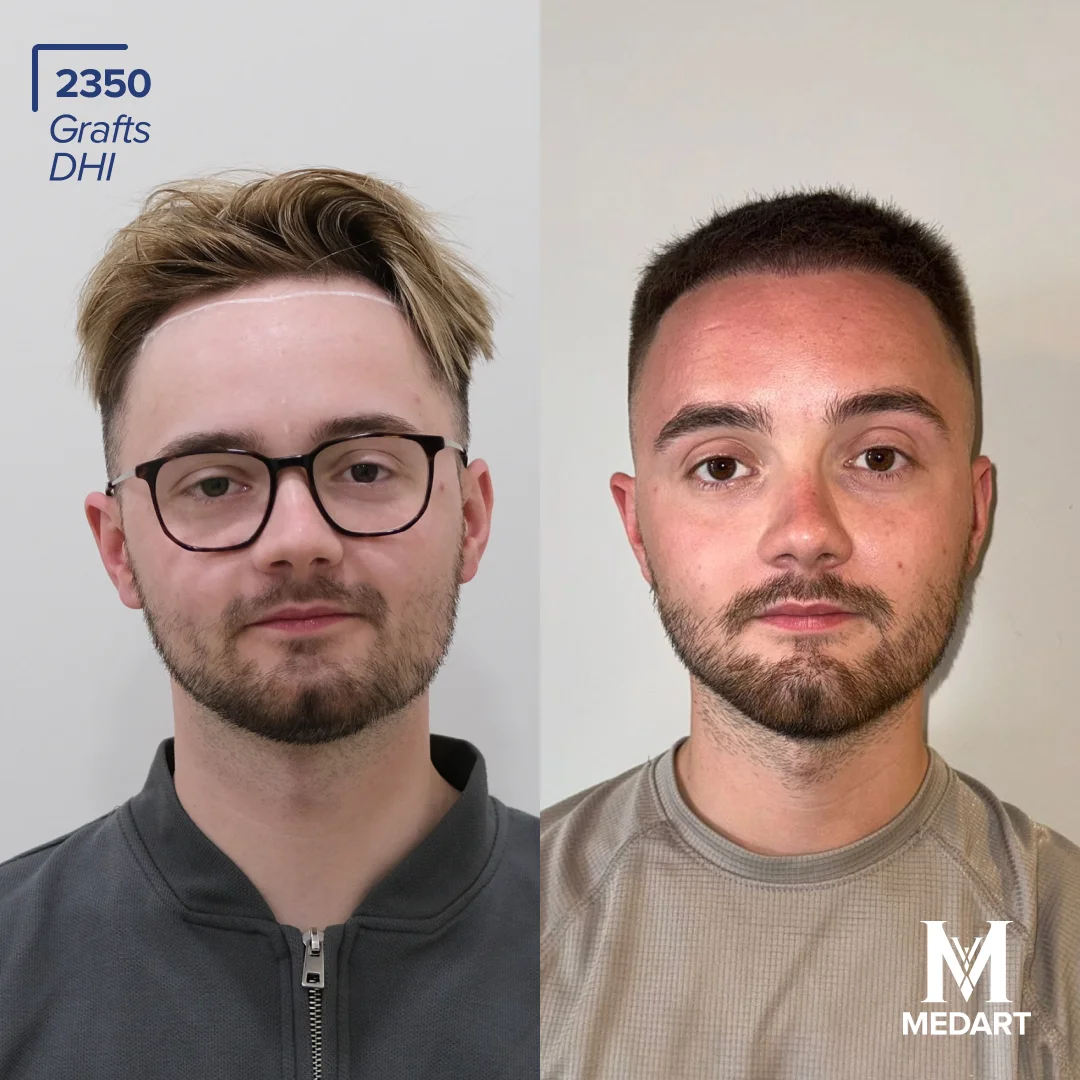
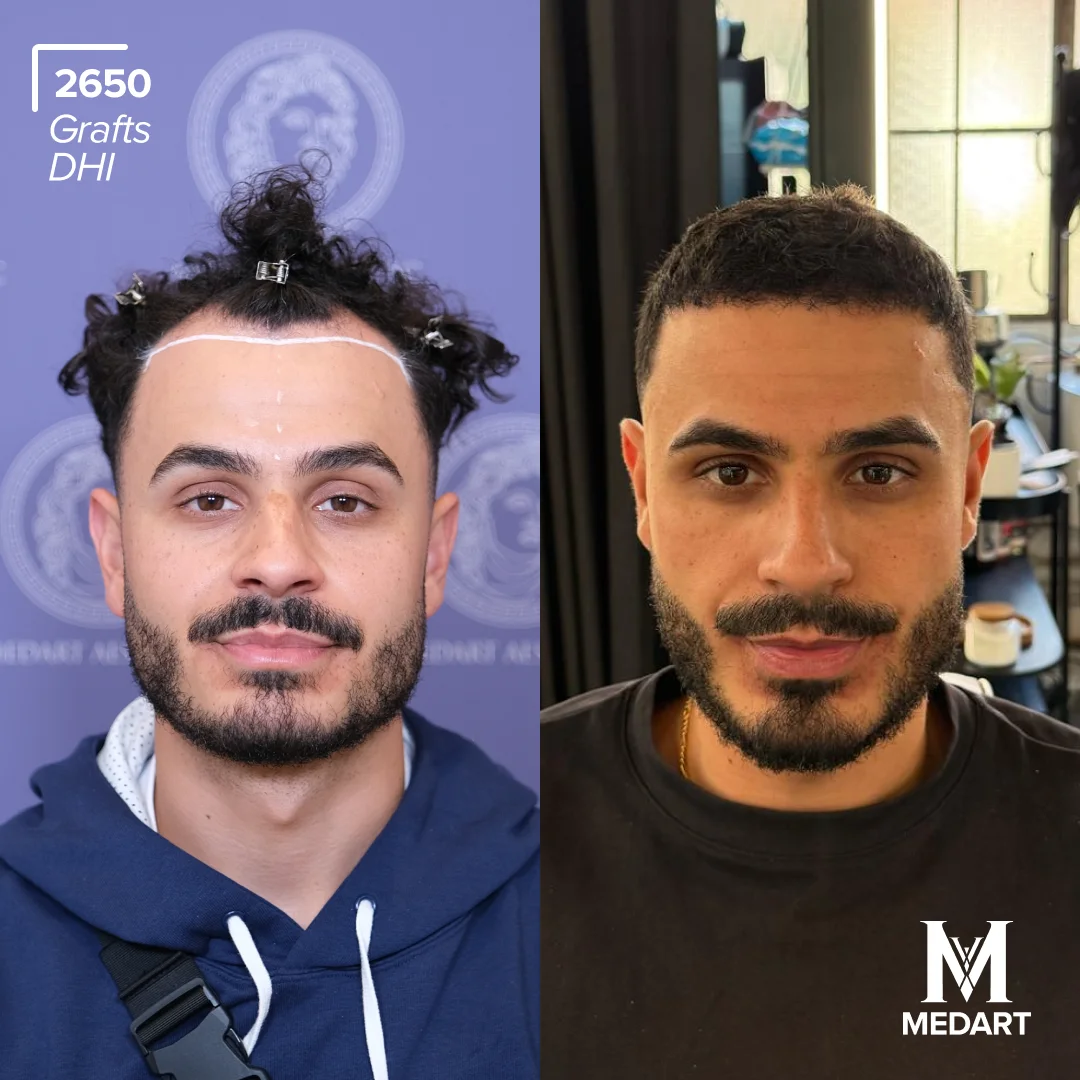
DHI Hair Transplant Turkey, Before & After

What Is a DHI Hair Transplant?

DHI, or direct hair implantation, is an implantation approach in which follicular-unit grafts, usually extracted by FUE, are placed into the recipient area with an implanter device. In plain terms: FUE describes taking the graft out; DHI describes one way of putting the graft back in.

A follicular-unit graft is a naturally occurring bundle of one or more hairs. It is not the same as a single hair. Think of a graft as a small natural bundle, and the number of hairs inside that bundle varies. This one distinction shapes almost everything else, from graft counts to price.

According to a StatPearls hair-transplantation review on NCBI Bookshelf (Zito & Raggio, updated 2023), DHI relies on a handheld implanter that holds a graft and places it into the recipient area. This can help the clinician control the placement workflow, including implantation angle, direction, and depth. The result still depends on accurate diagnosis, careful planning, and skilled execution.

Definition block

- DHI (direct hair implantation): placing follicular-unit grafts using an implanter device.

- FUE (follicular unit extraction): removing individual follicular units from the donor area.

- Graft: a natural bundle of one or more hairs (not the same as a single hair).

How the implanter pen works

The implanter pen is a device used to hold and place a graft. A common example is the Choi-type implanter, a pen-style tool with a hollow needle. Not all pen systems work identically, so "Choi-type" describes a broad category rather than one fixed standard.

Is DHI a type of FUE?

No. DHI is not a separate extraction method. DHI describes the graft implantation stage, while FUE describes the graft extraction stage. Most DHI cases use FUE to harvest the follicles first.

What does "direct" implantation mean?

"Direct" means grafts are placed without a separately completed channel-opening stage. In many DHI workflows, a sharp implanter creates a small recipient opening as the graft is inserted. Other implanter-assisted workflows may use pre-made sites, so clinics should explain the exact device and sequence they use.

Read our complete DHI hair transplant guide for the full technique breakdown.

Why Do Patients Choose Turkey and Istanbul for DHI?

Istanbul attracts patients through market scale, international access, and comparatively affordable package care, though standards vary widely between individual providers. Turkey has become one of the world's busiest centres for hair transplantation and medical tourism, and Istanbul sits at the heart of that activity.

Several factors, not just labour costs, tend to lower quoted prices. Exchange rates, package-based pricing, facility overheads, and fierce local competition all contribute. A lower price does not prove lower quality. It does not prove higher quality either.

High clinic volume can build genuine experience. But volume without physician oversight is not a safety guarantee. Physician participation, graft-handling standards, and aftercare differ significantly from one Istanbul clinic to the next.

Why patients consider Istanbul

What still requires independent verification

Direct international flight access

Facility licence and health-tourism authorisation

Package-based logistics and interpreting

Who performs each surgical stage

Lower quoted prices in some comparisons

Written inclusions, exclusions, and aftercare

Large provider market and clinic volume

Variation in standards and daily patient load

Infographic on why patients choose Istanbul for hair transplants and why clinic standards vary.

Why Istanbul is a major hair-transplant destination

The city offers many clinics, direct flights from Europe and the Middle East, and packages that bundle accommodation and transfers. This convenience is real. It should still come second to clinical suitability.

Affordability versus clinical value

Affordability is a legitimate reason to research Turkey. Clinical value is what you actually pay for. Compare written treatment scopes, not headline prices.

The risks of choosing by destination or price alone

Choosing on location or cost alone is risky, so verify current licensing and health-tourism authorisation yourself. Turkey's Ministry of Health runs a health-tourism authorisation system for facilities treating international patients. Ask any clinic for its authorisation details and confirm them against official Ministry of Health resources before you travel.

Who Is—and Is Not—a Good Candidate for DHI?

A suitable DHI candidate needs an accurate hair-loss diagnosis, adequate donor supply, realistic expectations, and a plan for future loss. Patient selection should always come before technique selection.

Most transplant candidates have androgenetic alopecia, the pattern loss also called male-pattern hair loss or female-pattern hair loss. According to the American Academy of Dermatology (2024), androgenetic alopecia tends to progress over time, which means native hair can keep thinning even after a successful transplant.

Your donor area is the region, usually at the back and sides of the scalp, where follicles are taken. Its capacity is finite. Donor density, follicular unit density, hair caliber (individual hair thickness), hair curl, and hair-to-scalp color contrast all influence how much visible coverage a given graft count can achieve.

Features that often support candidacy:

  • ● A confirmed diagnosis and a reasonably predictable rate of loss

  • ● Adequate donor density and reserve

  • ● Realistic coverage goals for the recipient area

  • ● Willingness to plan for future loss, especially at a younger age

Reasons to investigate, treat, or postpone first:

  • ● Active alopecia areata, uncontrolled scalp disease, or some scarring alopecias

  • ● Sudden, patchy, or diffuse shedding without an established diagnosis

  • ● Suspected traction alopecia or telogen effluvium

  • ● Pregnancy, breastfeeding, or suspected medication-related hair loss

  • ● An itchy, painful, bleeding, inflamed, or scaling scalp

  • ● Uncontrolled diabetes or conditions affecting bleeding, healing, or anaesthesia

  • ● Significant body-image distress or possible body dysmorphic disorder

A photo-based remote review cannot reliably diagnose inflammatory or scarring scalp disease, so an in-person examination matters where any of these features are present.

Medication safety note: Do not start, stop, or change finasteride, minoxidil, or any other medication solely because of this article. Discuss treatment decisions with a qualified clinician.

Donor-area requirements

Good candidates have enough donor supply to cover the recipient area now and to allow for future loss. A weak donor zone, or diffuse donor miniaturisation, limits what any technique, including DHI, can safely deliver.

Hair-loss patterns that may respond to transplantation

Stable pattern loss along the hairline, frontal zone, mid-scalp, or crown can be suitable for redistribution. Clinicians grade male loss on the Norwood-Hamilton scale (a staging chart for male pattern balding) and female loss on the Ludwig or Sinclair scale (charts for female thinning severity).

Reasons a clinician may postpone or decline surgery

Some conditions make surgery premature or inappropriate. Active inflammatory or scarring scalp disease may need treatment first, and unexplained shedding needs a diagnosis before any transplant is planned.

Illustrative composite scenario. This is an illustrative composite scenario, not an individual patient result. A woman in her late 20s reports rapid diffuse shedding, scalp tenderness, and a widening parting after a recent illness. Donor density appears reduced in her photographs, but the cause is not established. The clinician does not provide a graft quote and instead recommends in-person assessment, scalp examination, and investigation for telogen effluvium, inflammatory disease, or diffuse pattern loss. Decision point: surgery postponed until the diagnosis and stability of loss are clear.

Can women have DHI?

Yes. Women can be candidates when they have a clear diagnosis and suitable donor supply. Female-pattern hair loss often involves diffuse thinning, and diffuse donor miniaturisation can limit candidacy, so planning and expectations must be individualised.

Illustrative composite scenario. This is an illustrative composite scenario, not an individual patient result. A man in his early 30s presents with stable frontal recession, a strong donor area, and fine-to-medium hair caliber. He wants a low, dense hairline. Because androgenetic alopecia may progress with age, the clinician recommends a more conservative hairline, DHI for the limited frontal zone, and a discussion about medical therapy to help protect native hair. Decision point: DHI selected, with donor conservation built into the design.

Not sure whether DHI fits your hair-loss pattern? Tap the WhatsApp button in the bottom-right corner to share clear photos for a free initial suitability assessment. An online review is a starting point and does not replace an in-person medical examination.

DHI vs FUE vs Sapphire FUE

DHI and Sapphire FUE often share the same FUE extraction method but differ mainly in how recipient sites are prepared and how grafts are implanted. Grasp this one point and most "which technique is best" debates dissolve.

Standard DHI and Sapphire FUE commonly use FUE to extract grafts. If you want to research the main alternative in depth, see our detailed guide to a Sapphire FUE hair transplant in Turkey. Sapphire FUE generally refers to the recipient-site blade material, not a separate extraction method. Sapphire blades create pre-made recipient channels before grafts are placed.

DHI uses an implanter to place grafts without a separately completed channel-opening stage. The most appropriate workflow depends on recipient area, graft number, hair characteristics, team workflow, and surgeon judgement.

High-quality head-to-head studies comparing DHI with other FUE implantation workflows remain limited, so no technique can be called universally superior. DHI vs FUE and DHI vs Sapphire FUE are workflow comparisons, not quality rankings.

Feature

DHI

Conventional FUE

Sapphire FUE

Extraction method

FUE punch extraction

FUE punch extraction

FUE punch extraction

Recipient-site preparation

Implanter often creates the site as the graft is placed

Channels opened, then grafts placed

Sapphire blades create channels, then grafts placed

Implantation method

Implanter pen (Choi-type)

Forceps into pre-made channels

Forceps into sapphire-made channels

Shaving requirements

Partial-shave possible in selected cases

Usually shaved

Usually shaved

Typical use cases

Hairline detail and smaller zones; some unshaven cases

Broad range, including large areas

Broad range, channel precision emphasised

Workflow considerations

Loading and placement need training

Established and flexible for large sessions

Blade size can influence channel dimensions

Potential limitations

Session pace depends on team, loading, and graft count

Depends on team skill and planning

Depends on team skill and planning

Evidence of superiority

Not proven universally superior

Not proven universally superior

Not proven universally superior

Questions to ask the clinic

Who loads and implants the grafts?

Who opens the channels?

Who selects blade size and opens sites?

No robust evidence establishes DHI as consistently better for hairlines, crown restoration, or dense packing. Hairline outcomes depend on design and angle control. Crown work depends heavily on donor conservation and whorl planning. Dense packing must account for scalp blood supply and available donor follicles, so more density is not automatically safe.

Unshaven or partial-shave DHI may be possible for selected patients, but it adds complexity and is not suitable for everyone. Shaved DHI and fully unshaven DHI sit at opposite ends of that spectrum, with partial-shave in between.

Comparison infographic of DHI, FUE, and Sapphire FUE hair transplant methods

Illustrative composite scenario. This is an illustrative composite scenario, not an individual patient result. A man in his mid-40s has advanced frontal and mid-scalp thinning, a moderate donor reserve, and coarse hair caliber with low colour contrast. He needs a high graft count. The clinician compares DHI and Sapphire FUE and selects the approach based on workflow efficiency and donor preservation for a large session, not on "premium" branding. Decision point: technique chosen for the case, not the label.

How Is a DHI Hair Transplant Performed?

A DHI procedure normally includes diagnosis, hairline planning, FUE extraction, graft preparation, implanter loading, and graft placement. Knowing who performs each stage is every bit as important as knowing the steps themselves.

The consultation should include your history, a scalp examination, a diagnosis, a donor assessment, and long-term planning. Your proposed hairline design and graft distribution should be explained before surgery, not improvised during it.

Here is the general sequence, with the clinical role and one question to ask at each stage:

  • 1. Medical assessment and hairline design. The surgeon or physician diagnoses the cause of loss, evaluates donor supply, and designs the hairline with future loss in mind. Ask: which physician performs my assessment and design?

  • 2. Donor preparation and local anaesthesia. Donor hair is usually trimmed, and local anaesthesia (numbing medication injected into the scalp) is administered. Ask: who administers and monitors anaesthesia?

  • 3. FUE graft extraction. Follicular units are removed individually with small FUE punches, aiming to minimise graft transection (accidental cutting of follicles). Ask: who performs extraction, and how experienced is that person?

  • 4. Graft sorting and storage. Grafts are counted and inspected. Careful graft handling and graft storage limit time outside the body, which supports follicle survival. Ask: how is graft viability protected?

  • 5. Implanter loading and placement. Grafts are loaded into the implanter and placed at a controlled angle, direction, and depth across the recipient area. Ask: who loads and who implants?

  • 6. Immediate post-operative checks. The team reviews graft placement, cleans the area, and gives written aftercare instructions. Ask: who supervises this stage and signs off?

According to ISHRS patient-safety guidance for the public, a qualified physician should be responsible for the surgical plan and directly involved in the procedure, with clearly defined roles for any assisting staff. The duration of surgery varies with graft count, hair characteristics, and team workflow.

According to Medart's clinical protocol (verified 12 January 2026), a qualified physician leads the diagnosis and hairline design, oversees anaesthesia, and supervises the operation, while trained clinical technicians assist with extraction, graft handling, loading, and placement under that supervision. Ask every clinic you compare to put its equivalent role breakdown in writing.

Six-step diagram of a DHI hair transplant procedure from assessment to graft placement.

How Much Does a DHI Hair Transplant in Turkey Cost in 2026?

The cost of a DHI Hair Transplant in Turkey depends on treatment scope, graft requirement, clinician involvement, and written package inclusions. Package contents matter far more than the headline price, and there is no honest single "market average" without a stated sample and method.

Cost is usually structured per session or as a package rather than strictly per graft. For a broader breakdown across techniques, see our guide to hair transplant costs in Turkey.

The main DHI hair transplant Turkey cost factors include graft requirement, case complexity, and physician involvement. Accommodation, transfers, medication, and aftercare also shift the total. A low advertised price may exclude clinically or logistically important items, and currency movements make cross-country comparisons unstable.

How individual written quotes are prepared

Rather than publishing one headline figure, a responsible clinic provides a written treatment scope for each patient. Two packages advertised at the same price can differ enormously in what they include.

A trustworthy written quote states:

  • ● The effective date and how long the quote is valid

  • ● The graft or session scope, and what happens above that scope

  • ● The level of physician involvement

  • ● Accommodation nights and airport and clinic transfers

  • ● Medication, blood tests, and aftercare products

  • ● Interpreting, follow-up, and the corrective-treatment policy

  • ● Currency, taxes, and any payment fees

If you compare Turkey with the UK or the United States, ask each clinic to quote a comparable treatment scope, note the collection date, and record the exchange-rate date, because these variables move over time.

Main factors affecting DHI cost

Graft number, hair characteristics, recipient-area size, and surgeon time all move the price. More complex cases generally cost more.

What a Turkey hair-transplant package may include

A treatment package may bundle the procedure, medication, aftercare products, accommodation and airport transfers, and interpreting. To understand what should be inside a bundle, read what a Turkey hair transplant package includes.

Hidden or commonly excluded costs

Watch for excluded blood tests, add-on graft fees above a "base" number, corrective-treatment policies, and follow-up costs. Low headline prices often leave these gaps unstated.

How to compare quotes fairly

Compare written scopes side by side. Ask each clinic the same questions and record the answers in the same table.

Turkey versus UK, Europe, and US pricing

Turkey is frequently quoted below prices in the UK and the United States, largely because of lower overheads and exchange-rate effects. A lower price does not prove higher or lower quality on its own.

Cost component

Included in a written quote?

Questions to ask

Possible extra cost

Consultation

Confirm in the written quote

Is assessment by a physician?

Sometimes charged separately elsewhere

Blood tests

Confirm in the written quote

Are pre-operative tests included?

May be added

Procedure

Defined by a stated graft or session scope

What scope is covered?

Grafts above the stated scope

Anaesthesia

Confirm in the written quote

Is local anaesthesia included?

Rarely extra

Medication

Confirm in the written quote

Which medicines are provided?

Extra prescriptions

Aftercare products

Confirm in the written quote

Shampoo, spray, lotions?

Top-up kits

Accommodation

Confirm nights in the written quote

How many nights, and what standard?

Extra nights

Airport and clinic transfers

Confirm in the written quote

Airport, hotel, and clinic covered?

Extra journeys

Interpreter

Confirm in the written quote

Which languages?

Rare

Follow-up

Confirm in the written quote

Is remote follow-up after travel included?

In-person revisits

Corrective-treatment policy

Confirm in the written quote

What applies if growth is poor?

Depends on policy

Prices and package inclusions can change. Readers should request a current written treatment plan and confirm all inclusions before arranging travel.

Chart showing DHI hair transplant package cost components and common exclusions.

Recovery and Results Timeline

Most visible recovery happens before the transplanted hair has grown, and meaningful cosmetic growth develops gradually over several months. DHI hair transplant recovery and DHI hair transplant results therefore run on two different clocks.

Early on, expect redness, tenderness, edema (swelling), and scab formation (crusting) around the grafts. Then comes a phase that surprises many patients.

Transplanted shafts often shed within the first weeks while the follicles stay alive beneath the skin. This is post-operative shedding, and it is usually expected. Shock loss is a related but distinct event: it refers mainly to temporary shedding of existing native hair around the recipient or donor area, and it usually recovers.

Hair grows in cycles. According to the American Academy of Dermatology (2024), follicles move between the anagen phase (active growth) and the telogen phase (resting), which is why regrowth is gradual and initially uneven along the hair growth timeline.

Time after surgery

What may be normal

Care priority

Warning signs

First 72 hours

Redness, tightness, mild swelling

Gentle handling, follow washing instructions

Heavy bleeding, spreading swelling

Days 4–14

Scabbing, itching, crust shedding

Careful washing, no picking

Pus, fever, worsening pain

Weeks 2–8

Shedding of transplanted shafts

Patience; follicles remain

Painful lumps, spreading redness

Months 3–6

Early, uneven new growth

Continue aftercare guidance

Sudden new patchy loss elsewhere

Months 6–12+

Thickening and maturation

Photograph progress

Signs of infection at any stage

Crown results commonly mature more slowly than frontal-area results, partly because of the crown's surface area and whorl pattern. Final timing varies by patient, so no honest clinic will promise an exact result date. Remember that progressive hair loss in native follicles can change your overall appearance even after transplanted follicles grow.

To review outcomes while applying honest photo standards, see our gallery of hair transplant before-and-after results. Standardised photography means the same camera distance, scalp angle, lighting, dry-or-wet state, hair length, and styling at each visit, with no edits that alter apparent density.

Clinical observation from Dr. Busra Yakupoglu, Hair Transplant Surgeon: "In clinical consultations, the early shedding phase often causes concern, because visible healing appears well before cosmetic growth does. We explain that growth timing varies by recipient area, hair cycle, and individual healing." This reflects clinical experience and does not predict an individual result.

When to contact the clinic urgently

Contact your clinic or a local doctor promptly for fever, spreading redness, pus, severe pain, or persistent bleeding. The safety section below lists the full set of urgent symptoms.

Benefits and Limitations of DHI

DHI may support controlled graft placement in selected cases, but it cannot overcome poor donor supply or poor planning. A balanced view protects you from marketing that lists only the upside.

Potential workflow advantages:

  • ● Controlled placement workflow, including implantation angle and direction.

  • ● Possible usefulness for hairline detail or smaller recipient zones.

  • ● Reduced shaving in carefully selected patients, when the recipient area is limited, the hairstyle allows it, the graft count is manageable, and the clinic offers it.

  • ● No linear strip scar, because extraction is usually performed with FUE rather than a strip.

These are procedural features, not guaranteed outcomes, and high-quality evidence does not establish them as consistently superior. Note too that "no visible linear scar" is not the same as "scarless," because FUE still leaves tiny dot marks in the donor area.

Limitations:

  • ● The technique can be labour-intensive, and session pace depends on graft count, device, loading, and team.

  • ● Implanter loading and placement require specific training.

  • ● DHI cannot overcome poor donor density or a limited donor reserve.

  • ● It does not stop progressive hair loss in native follicles.

  • ● It is not proven universally superior to other properly performed methods.

DHI redistributes existing follicles. It does not create new ones. That is true of every transplant technique.

Risks, Side Effects, and Safety

A DHI hair transplant is surgery performed under local anaesthesia, and it can cause temporary effects or, less often, complications that need medical attention. Hair transplantation is surgery even when only local anaesthesia is used, and no technique is risk-free.

Common short-term effects may include soreness, swelling, redness, crusting, itching, and temporary numbness. Redness and swelling often settle within days, while numbness can linger longer before it resolves.

Potential risks and complications include infection, bleeding, folliculitis (inflammation of hair follicles), scarring, poor growth, unnatural growth direction, overharvesting of the donor area (removing too many follicles and leaving visible thinning), donor depletion, and shock loss. Rare but serious problems, such as skin necrosis (tissue death from poor blood supply), are uncommon but real. According to the ISHRS and dermatological surgery reviews, serious complications are infrequent when care is physician-led and prompt, though this cannot be guaranteed for any individual.

Usually expected during early recovery

Contact the clinic promptly

Seek urgent medical assessment

Mild tenderness, limited swelling, crusting

Increasing redness, painful pustules, worsening swelling

Fever, severe pain, or persistent bleeding

Temporary numbness or itching

Discharge or delayed healing

Dark, blistered, or damaged-looking scalp skin

Gradual settling over days to weeks

Symptoms that do not improve as expected

Facial swelling with breathing or vision symptoms

Expected short-term effects

Mild pain, swelling, and crusting are typical. Temporary numbness in the donor or recipient area can also occur and may take longer to fade than redness.

Possible complications

More significant problems include infection, folliculitis, an unnatural hairline from poor design, and overharvesting that leaves the donor area visibly thin. Careful planning and graft handling reduce these risks.

Red-flag symptoms requiring medical attention

Seek urgent medical advice for:

- Worsening or spreading redness

- Fever or systemic illness

- Pus or foul-smelling discharge

- Severe or escalating pain

- Persistent bleeding

- Dark, blistered, or damaged-looking scalp skin

- Facial swelling associated with breathing or vision symptoms

How risk can be reduced

Smoking and nicotine, uncontrolled health conditions, and certain medicines can raise risk. Tell your clinician about anticoagulants, antiplatelet drugs, immunosuppressants, or any medicine affecting bleeding or healing, and let a clinician decide on any changes rather than adjusting doses yourself. Choosing a physician-led clinic, disclosing your full medical history, and following written aftercare all reduce avoidable problems. DHI should never be described as painless, scarless, non-surgical, or guaranteed.

How to Choose a Safe DHI Clinic in Turkey

A safer clinic clearly identifies the responsible physician, documents who performs each procedural role, and explains how follow-up works after you travel home. The newest-sounding technique matters far less than clear clinical accountability.

Verify the clinic, facility, physician, and current authorisation through official sources where available. Turkey's Ministry of Health runs a health-tourism authorisation system for facilities treating international patients, which you can confirm before booking.

A practical verification routine:

  • 1. Search for the facility name and its listed address.

  • 2. Confirm the address matches the operating clinic.

  • 3. Confirm the facility holds international health-tourism authorisation.

  • 4. Verify the named physician's qualification independently.

  • 5. Save a dated copy of what you confirmed before paying any deposit.

Credentials and authorisation to verify

Confirm the physician's qualification, the facility's licence, and current health-tourism authorisation. Ask for these in writing.

Who performs each stage?

Ask the clinic to confirm, in writing:

  • ● Who diagnoses the hair loss?

  • ● Who designs the hairline?

  • ● Who administers local anaesthesia?

  • ● Who performs FUE extraction?

  • ● Who handles and stores the grafts?

  • ● Who loads the implanter and places the grafts?

  • ● Who supervises the whole procedure?

  • ● Who manages follow-up and complications?

A trustworthy clinic answers each of these with a named, qualified person. Vague or evasive answers are a warning in themselves.

How to evaluate before-and-after photos

Look for standardised photos with matching angles, lighting, hair length, graft counts, and dated follow-up. Be sceptical of dramatic images with no context.

Questions to ask before paying a deposit

Use a written checklist so every clinic answers the same questions.

Twelve questions to ask before you commit:

  • 1. What is my diagnosis?

  • 2. Is my hair loss stable?

  • 3. Who will perform the medical assessment?

  • 4. Who will design the hairline?

  • 5. Who will administer anaesthesia?

  • 6. Who will extract and implant the grafts?

  • 7. How many patients does the team treat that day?

  • 8. What graft number is proposed, and why?

  • 9. How will my donor area be preserved?

  • 10. What happens if I develop a complication at home?

  • 11. What exactly is included in writing?

  • 12. Can I review comparable, consented cases?

Red flags that should make you walk away

  • ● Guarantees of density, permanence, or "100% success."

  • ● Countdown timers, pressure selling, or "limited offer" discounts.

  • ● "Unlimited grafts" claims, which ignore safe donor limits.

  • ● No named physician responsible for your care.

  • ● Refusal to explain who performs each step.

  • ● No clear plan for complications after you return home.

Remember, "maximum grafts" is not the same as a safe graft count. Dense packing is not automatically appropriate for every scalp or donor supply, so a responsible clinic puts donor preservation ahead of graft-count marketing.

Planning Your DHI Trip to Istanbul

A DHI trip to Istanbul should prioritise medical assessment, early recovery, and accessible follow-up rather than the shortest possible stay. Build your itinerary around your care, not around sightseeing.

Confirm your required arrival date and minimum stay with the treating team. Avoid assuming a universal flight timeline, because the right timing depends on your recovery and your clinician's assessment.

Before departure

Complete your remote consultation, share clear photos, and disclose your full medical history. Confirm what is included in writing.

What to pack

Take with you:

  • ● Medications in their original packaging, checked against airline and border rules

  • ● A loose, button-front top for the journey home

  • ● A soft, loose hat only if and when your clinician advises it, for later sun exposure protection

  • ● Copies of your treatment plan and emergency contact details

Prescription-medication transport rules differ between countries, so check official government and airline guidance before you fly.

How long to stay

Plan for the minimum stay your treating team recommends, so the clinic can perform the first wash and a post-operative check. Do not book the earliest possible return flight without clinical agreement.

Flying home

Discuss sleeping position, hat use, and comfort measures for the flight. Ask when you can resume exercise, swimming, alcohol, and work, because this advice is individualised.

Remote follow-up after Turkey

Ask the treating clinician to confirm, in writing, your arrival date, procedure date, first review or wash, earliest advised departure, and emergency contact arrangements. Confirm how post-operative follow-up works once you return home and how to reach the clinic if a complication develops locally. Nicotine can impair healing, so ask specifically how long to avoid smoking and vaping around your procedure. Appropriate travel insurance is wise, although elective procedures are often excluded, so read the policy carefully.

How Many Grafts Might You Need?

The number of grafts required depends on the recipient area, existing hair, donor capacity, and long-term conservation plan. Your graft count cannot be finalised from a photo or an online calculator alone.

A graft may contain one or several hairs, so "grafts" and "hairs" are not interchangeable. This is exactly why two people with the same graft number can look quite different.

Online tools are educational, not surgical plans. For a preliminary starting point before a clinical assessment, you can estimate your possible hair graft requirements with our graft calculator.

Grafts versus hairs (definition box): A graft is like a small natural bundle; the number of hairs inside that bundle varies. The donor area is a limited reserve, so using more grafts today can reduce your options for future loss.

Grafts versus individual hairs

One follicular-unit graft may hold one, two, three, or more hairs. Hair count therefore exceeds graft count, which is why comparing offers by hair number can mislead you.

Factors that change the estimate

Recipient-area size, existing hair, donor density, desired coverage, and your long-term plan all move the number. More grafts are not automatically better.

Why donor preservation matters

Crown restoration can require many grafts, because the area may be broad and its whorl distributes hairs in several directions, yet donor limits still govern the plan. Protecting the donor reserve keeps options open if native loss continues.

Want a more personalised graft estimate? Tap the WhatsApp button in the bottom-right corner to send front, side, top, crown, and donor-area photos. The Medart team can explain what additional information is needed for an initial assessment.

Is a DHI Hair Transplant in Turkey Right for You?

A DHI Hair Transplant in Turkey is appropriate only when the implantation method supports your diagnosis, donor capacity, coverage goals, and long-term treatment plan. Choose it for clinical fit, not because it is marketed as "premium."

Compare the treatment plan, practitioner roles, evidence, aftercare, and total cost. A clinician may reasonably recommend conventional FUE or Sapphire FUE instead, and your consultation should end with a diagnosis and a rationale, not just a graft quote.

The best DHI candidate is not defined by age or graft count alone. Diagnosis, donor capacity, recipient area, future loss, and team accountability all matter. Use the matrix below to frame your own decision.

Decision factor

What to check

Factors supporting consideration

Reasons for further assessment or caution

Diagnosis

Cause and stability of loss confirmed

Stable, diagnosed pattern loss

Active or unexplained shedding

Donor capacity

Density and reserve assessed

Strong donor area

Limited or miniaturised donor

Recipient area

Size and goals defined

Realistic coverage goal

Whole-scalp dense-pack demand

Long-term loss pattern

Future loss planned for

Conservative, future-proof design

Age-inappropriate low hairline

Clinical team

Responsible physician identified

Physician-led, transparent roles

No named surgeon, vague roles

Frequently Asked Questions

Is DHI really better than a regular FUE hair transplant?
Not automatically. DHI describes how grafts are placed, while FUE describes how they are extracted, and most DHI cases use FUE first. High-quality head-to-head studies comparing DHI with other FUE implantation workflows remain limited, so no technique is universally superior. The right choice depends on your recipient area, graft number, hair characteristics, and the clinical team's judgement, not the label.
How much does a DHI hair transplant cost in Turkey in 2026?
There is no single 2026 price, because the graft requirement, physician involvement, procedure scope, and package inclusions all differ. Costs in Turkey are often quoted below UK and US prices, largely because of lower overheads and exchange-rate effects, according to broad market observation. Always request a current, dated written quote listing inclusions and exclusions, and compare written scopes side by side rather than trusting the lowest advertised figure.
How many grafts can be implanted with DHI in one session?
There is no fixed universal number, because it depends on your donor capacity, scalp, hair characteristics, and clinical judgement. "Maximum grafts" is not the same as a safe graft count, and overharvesting can deplete your donor area for years. According to ISHRS patient-safety guidance, a physician should set a limit that protects your long-term donor reserve. Photographs and an in-person assessment are needed before any responsible session size is confirmed.
Do I have to shave my whole head for DHI?
Not always. Shaved DHI is common, but partial-shave DHI and unshaven DHI are possible for selected patients, usually with smaller recipient areas. Unshaven approaches add complexity and are not suitable for everyone. Whether you can avoid shaving depends on your graft number, recipient zone, and the clinic's workflow. Ask the treating team during your assessment, because this advice is individualised.
Is a DHI hair transplant painful?
Local anaesthesia is intended to reduce procedural pain, but the numbing injections can sting briefly and prolonged positioning can still cause discomfort. Afterwards, mild soreness, tightness, and swelling are common for a few days. DHI should never be described as painless, because it is still surgery. If pain becomes severe or escalating, contact your clinic or a local doctor, since this can signal a complication.
How long should I stay in Istanbul after the procedure?
Plan for the minimum stay your clinic recommends, so the team can perform the first wash and a post-operative check. Do not book the earliest possible return flight without clinical agreement, because the right timing depends on your recovery. Confirm the required arrival date, minimum stay, and how remote follow-up works before you travel, so support is accessible once you return home.
When can I go back to work after DHI?
It depends on your role, your recovery, and how quickly crusting and swelling settle. Many people with desk jobs return sooner than those in physical or dusty work, but there is no universal timeline. Your clinic should give specific guidance on exercise, swimming, sun exposure, hats, alcohol, and nicotine. Follow their written aftercare rather than a generic rule, and contact them if you notice warning signs such as spreading redness or pus.
Are DHI results permanent?
Transplanted hair is often long-lasting, because donor follicles tend to resist the process behind pattern loss, though no follicle is biologically guaranteed to remain unchanged for life. A transplant redistributes existing follicles and does not stop progressive native hair loss. Your surrounding native hair can keep thinning, which may change your overall appearance over time. This is why hairline design and donor conservation must account for future loss, especially in younger patients wanting a low, dense hairline.
What happens if I keep losing my natural hair?
Ongoing androgenetic alopecia can continue after a transplant, since surgery does not create new follicles or halt future loss. According to the American Academy of Dermatology (2024), this pattern loss is progressive, so native thinning around transplanted hair may create an uneven look over the years. A good plan anticipates this with conservative design and donor preservation. Some patients discuss medical therapy with their clinician, but do not start or change any medication based on this article alone.
How do I know whether a Turkish hair transplant clinic is safe?
Look for clear clinical accountability, not the newest-sounding technique. Verify the physician's qualifications, the facility's licence, and current Turkish health-tourism authorisation. Ask who performs each step, how the donor area will be preserved, and what happens if you develop a complication at home. Review standardised, consented before-and-after photos. Treat guarantees, "unlimited grafts," pressure selling, and countdown discounts as red flags.

Key Takeaways

  • DHI means direct hair implantation and describes placement, not extraction.

  • ● Most DHI cases still use FUE to extract the grafts.

  • ● No implantation workflow is universally superior; individual suitability decides the choice.

  • ● Cost reflects treatment scope and written inclusions, not just a headline price.

  • ● Visible growth develops gradually, and maturation can continue beyond early recovery.

  • ● Donor preservation and a named responsible physician matter most.

  • ● Native hair loss can continue, so plan for the long term.

Conclusion

DHI can be useful for selected patients, but treatment planning, donor management, and the responsible clinical team matter more than the technique name. Device and workflow choices still count, yet they cannot rescue an incorrect diagnosis, poor donor planning, weak graft handling, or unclear clinical accountability. What deserves your attention is a clear diagnosis, careful donor preservation, honest clinical roles, and a plan that accounts for years of future hair loss, not just today's mirror.

If you are weighing up a DHI Hair Transplant in Turkey, judge the plan and the people before the technique name.

Choose the plan and clinical team first; choose the technique name second.

Compare your options before choosing a technique. Tap the WhatsApp button in the bottom-right corner to request a free consultation and written assessment covering possible suitability, graft planning, technique options, and package inclusions.

References

  1. American Academy of Dermatology. "Hair loss: Diagnosis and treatment" and "Hair loss: Who gets and causes" (androgenetic alopecia; hair growth cycle). aad.org. Accessed January 2026.
  2. International Society of Hair Restoration Surgery (ISHRS). Consumer alerts and patient safety information for the public. ishrs.org. Accessed January 2026.
  3. International Society of Hair Restoration Surgery (ISHRS). Practice Census reports on hair restoration procedures. ishrs.org. Accessed January 2026.
  4. Zito PM, Raggio BS. "Hair Transplantation." StatPearls. NCBI Bookshelf, updated 2023. ncbi.nlm.nih.gov/books/NBK547740. Accessed January 2026.
  5. National Health Service (NHS). "Hair loss" overview and treatment guidance. nhs.uk. Accessed January 2026.
  6. British Association of Dermatologists (BAD). Patient information leaflets on hair loss and alopecia. bad.org.uk. Accessed January 2026.
  7. National Institutes of Health / NCBI Bookshelf (StatPearls). "Androgenetic Alopecia." ncbi.nlm.nih.gov. Accessed January 2026.
  8. Republic of Türkiye Ministry of Health. International health tourism authorisation information for accredited facilities. saglik.gov.tr. Accessed January 2026.
  9. American Academy of Dermatology. Guidance on the hair growth cycle (anagen and telogen phases). aad.org. Accessed January 2026.
  10. NHS. Guidance on cosmetic and elective procedures and travelling abroad for treatment. nhs.uk. Accessed January 2026.
  11. GOV.UK. Guidance on carrying medicines when travelling abroad. gov.uk. Accessed January 2026.
  12. International Society of Hair Restoration Surgery (ISHRS). Information on hair restoration complications and choosing a qualified surgeon. ishrs.org. Accessed January 2026.

Contact Us!

Please enter a valid phone number.
Greft Hesapla WhatsApp