

Key Takeaways
● There is no universal Black hairline template.
● Height, curve, temple points and exit angle must be planned together.
● The first 5–10 mm should have a soft, irregular transition.
● Male and female patterns are useful references, not rules.
● Graft counts depend on the area created by the design.
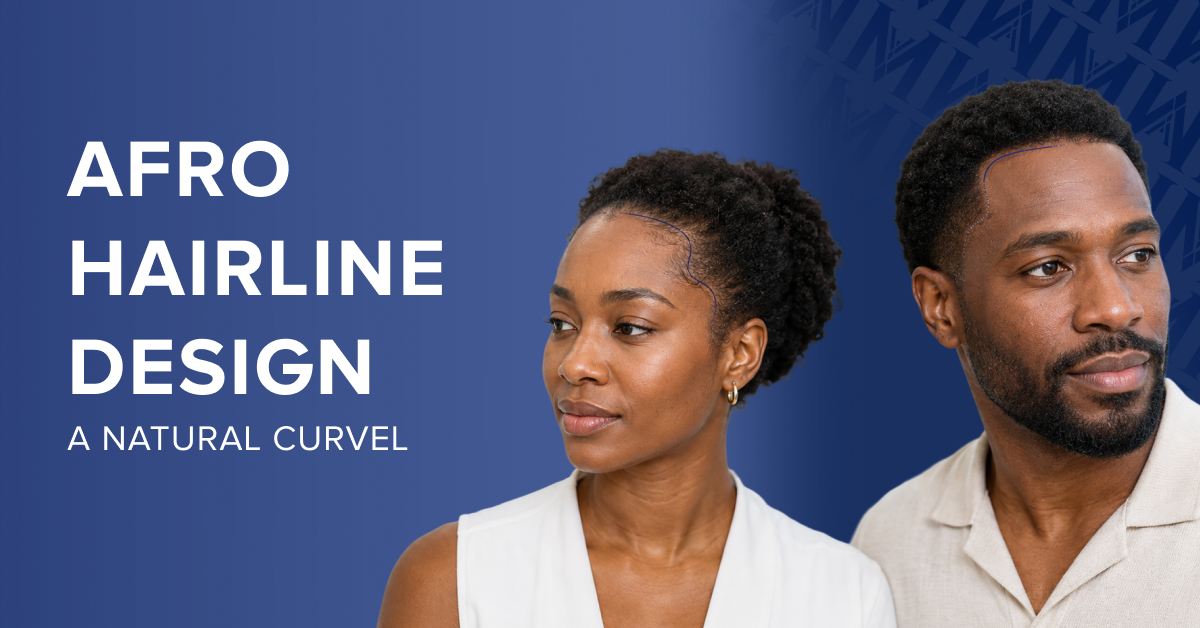
The most natural Afro transplant hairline is not necessarily the straightest one, even when a sharp barber line-up is part of the patient's preferred style. A line-up grows out and gets refreshed every few weeks. An implanted border keeps the exact shape it was given, for decades. That gap between temporary and permanent is where afro hairline design hair transplant planning is won or lost. Black and Afro-descended people do not share one hairline shape, one forehead height or one curl pattern, so a racial template is a weak place to start. This article covers four connected design variables: hairline height, frontal curve, temple points and follicle exit angle. It is about aesthetics only, so procedure type, candidacy, recovery, cost and travel sit on separate pages. By the end, you should be able to look at a proposed drawing and judge whether its height, curve, corners and graft direction genuinely suit your face and your hair.

What Makes an Afro Hairline Different From Other Hairlines?
An Afro hairline is planned around the visual behavior of tightly curled hair, but its height and outline must still be individualized rather than taken from a single ethnic template.
Tightly curled or coiled hair changes how the eye reads three things: density, direction and the drawn outline. Curls overlap and hide the scalp behind the leading edge. The front rows have nowhere to hide, so they carry almost all of the visible detail.
Three properties get confused constantly. They are related, but they are not interchangeable:
● Hair shaft curl: the shape visible above the scalp.
● Follicle curvature: the path of the follicle beneath the skin.
● Exit angle: the direction in which the hair emerges from the scalp.
Franbourg and colleagues, writing in the Journal of the American Academy of Dermatology (2003), described the curved follicle and elliptical shaft typical of Afro-textured hair. Khumalo and colleagues, in the same journal (2000), documented how widely Black African hair morphology varies between individuals. Curl above the skin tells you nothing reliable about the angle at the surface.

Curl also builds strong visual density behind the leading edge. Coverage can look full at moderate graft numbers, which makes it tempting to under-plan the hairline transition zone. That shortcut is expensive to undo later.
Ancestry across the African diaspora, sex, age, forehead height and existing anatomy all vary widely. A crisp barber line-up is a temporary edge, so it should not be transferred onto the scalp as a permanent implanted border. Natural asymmetry and small edge irregularities are worth preserving rather than erasing.
Candidacy, donor assessment, extraction safety and procedural risk sit outside this article. Those topics are covered in how Afro-textured hair transplantation is planned and performed.
How Do Surgeons Design a Natural Curve for Afro-Textured Hair?
Surgeons design a natural Afro hairline by setting a face-appropriate midfrontal height, connecting it to conservative temple points and softening the resulting curve with a 5–10 mm irregular transition zone.
Once the curl and angle distinction is clear, the next question is geometry. Searches for "hairline curve black hair" tend to surface one template image, repeated everywhere. No single curve answers every forehead, brow and profile.
Planning starts with what is already there. Existing stable hairs, forehead proportions, the side profile and your stated preference come before any stencil. The midfrontal point, the central point where the new frontal hairline is planned, is marked first, and the lateral curve is finalised afterwards.
Two separate layers are then built. The macro-curve is the overall large-scale shape, like the outline of a shoreline on a map. Micro-irregularity is the small variation along that shoreline's edge. The marker line sets the border; individual leading grafts should sit slightly in front of and behind it rather than lining up like fence posts.
The design sequence usually runs in this order:
1. Assess existing anatomy.
2. Mark the midfrontal point.
3. Set frontotemporal corners.
4. Evaluate temple points.
5. Draw the macro-curve.
6. Add micro-irregularity.
7. Review upright from multiple angles.
Hairstyle belongs in this conversation from the start. Short haircuts expose every millimetre of the border, and pulled-back styles expose the temporal edges. Say clearly whether you want a visually sharper or softer frame, then review the drawing from the front, both oblique views and the profile before anything is agreed.
Key Measurements: Hairline Height, Temple Points and Frontal Curve
Two landmarks anchor the measurement. The glabella is the smooth area between the eyebrows. The trichion is the point where the hairline meets the forehead in the midline.
Craniofacial anthropometry, catalogued in Farkas's reference work on anthropometry of the head and face, uses the glabella-to-trichion distance and the facial thirds as proportional references. Brow to nose base and nose base to chin are the other two. These are planning tools for an afro hairline design hair transplant, not prescriptions.
Medart's clinician-reviewed planning reference is approximately 7–9 cm from the glabella to the midfrontal hairline in many men, and roughly 5.5–7 cm in many women. This is an internal planning norm rather than a validated population standard. Sex, forehead anatomy, age, existing hairs and personal goals can all make another height more natural for an Afro-textured hairline.
The frontotemporal corners are the points where the frontal hairline turns back toward the temple. Temple points, the forward points of hair growth at the temple area, are assessed independently. Lowering the centre does not justify advancing the temples, and temple-point advancement should be assessed by a qualified hair-restoration clinician.
The first 5–10 mm behind the front edge is a transition zone where density builds gradually. It is not a dense, ruler-straight wall.
Four-finger rules and fixed racial templates are not reliable substitutes for facial measurement. In our Istanbul clinic, the patient-surgeon hairline drawing is reviewed with the patient sitting upright, because a supine position shifts how forehead height and curve are perceived.
Not sure whether a proposed hairline is too high, too low or too straight for your face? Use the WhatsApp button in the bottom-right corner to request a free personalized hairline assessment from Medart's clinical team.

Why Does Curl and Follicle Angle Change Hairline Planning for Black Hair?
In Afro-textured hair, the implanted hair must leave the scalp at a low angle that follows nearby growth, because tightly curled shafts make inconsistent direction and crossing hairs especially visible.
Measurements settle the outline. Direction settles whether that outline looks grown or placed, which is why a Black hair transplant hairline is judged as much on flow as on shape.
Hair-growth direction here means the direction the hair leaves the scalp, not the direction the curl bends afterwards. Follicle exit angle is the angle at which hair emerges from the surface. Central frontal hairs generally need a low, forward visible direction, while temporal hairs usually lie flatter and turn laterally or downward.
Bernstein and Rassman, whose work in Dermatologic Surgery helped define modern follicular unit transplantation aesthetics, have long emphasised low-angle frontal placement that copies surrounding native growth.
Direction shifts gradually across the front. The table below summarises what each zone usually needs.
Zone |
Typical visible direction |
Aesthetic purpose |
|---|---|---|
Central front |
Low and forward |
Soft frontal framing |
Lateral front |
Forward with gradual outward turn |
Connects center to corners |
Frontotemporal corner |
Flatter and lateral |
Avoids an upright wall |
Temple point |
Flat, lateral or downward |
Recreates natural temporal flow |
A practical frontal Afro hair graft angle of roughly 10–20 degrees relative to the scalp surface is Medart's clinician-reviewed planning range, not a biological constant. It is adjusted during clinician-led planning to match nearby stable hairs.
Abrupt changes in angle cause crossing curls, small clumps and an untidy leading edge. When adjacent curls emerge in conflicting directions, that crossing stays visible even after the hair gains length. Where native hairs remain, their curl orientation guides the plan.
A follicular unit graft is a naturally occurring group of one or more hairs transplanted together. Single-hair grafts are generally used in the visible leading rows, with larger follicular units placed behind them for support and coverage. Curl diameter and hair caliber influence how quickly that support becomes visible.

How Is Hairline Design Different for Black Women vs Black Men?
Black male hairlines often retain more frontotemporal recession, while female designs are commonly rounder and softer, but facial anatomy and the patient's preferred presentation should override gender templates.
Direction and angle apply to everyone. Shape expectations are where male and female planning genuinely diverge, and where stereotypes do the most damage.
In black men hairline design, some temporal recession is usually preserved, and a subtly squared hairline or mature male hairline can read as more credible than a low juvenile line. Reading about understanding male-pattern recession on the Norwood scale helps when a design must hold up over years, not months.
A feminine hairline commonly keeps a rounded contour, softer temporal transitions and less visible recession. Female Afro hairline restoration often prioritises temporal triangles and edge styling areas rather than lowering the whole central line.
Edge loss has several causes, including tension from tight or heavy styling. The American Academy of Dermatology describes traction alopecia in that context. Any uncertain edge loss should be assessed by a qualified hair-restoration clinician before a design is drawn.
Illustrative composite. A woman who wears her hair pulled back wants softer framing at the sides. Her central height already sits well for her face, so the design rebuilds thin temporal triangles and the edge in front of the ears. Lowering the whole frontal line would have added area and grafts without solving what she actually came in for.
Male vs Female Afro Hairline Design at a Glance
Use this table as a starting reference for a patient-surgeon hairline drawing. Every row can be overruled by existing anatomy, age and stated hairstyle preferences.
Design factor |
Common male tendency |
Common female tendency |
Individualization note |
|---|---|---|---|
Overall outline |
Subtly squared, flat-curved or mature |
Rounded or oval |
Neither is mandatory |
Midfrontal height |
Commonly higher |
Commonly lower |
Use facial proportions |
Frontotemporal corners |
More visible |
Usually softer |
Existing anatomy controls |
Temple points |
Conservative reconstruction |
May be important for edge framing |
Avoid automatic advancement |
Leading edge |
Irregular and age-appropriate |
Fine and softly feathered |
Both require transition |
Hairstyle consideration |
Short cuts expose the line |
Pulled-back styles expose edges |
Ask how hair is usually worn |
These columns describe tendencies, not tests of masculinity or femininity. Nusbaum and Fuentefria, publishing in Dermatologic Surgery, documented that naturally occurring female hairlines vary considerably in shape rather than following one rounded ideal.
How you want to be seen matters as much as the label attached to a shape. Some men prefer a softer curve. Some women want a flatter, more defined frame for braided or pulled-back styles.
Two constraints apply to everyone. A very low or very broad outline enlarges the recipient area and can increase graft demand, and it may become less age-appropriate over time. Existing stable hairs remain the primary guide, and altering an already transplanted hairline should be assessed by a qualified hair-restoration clinician.

What Hairline Shapes Look Most Natural on Afro Hair?
Soft-rounded, subtly squared and mature frontotemporal hairlines can all look natural on Afro-textured hair when the outline matches the face and the implanted edge is not perfectly uniform.
Male and female tendencies narrow the field. A natural Afro hairline transplant still has to choose one afro hairline shape from several credible options, and each one has its own failure mode when it is pushed too far.
Soft-rounded. May suit many female designs and rounder or shorter foreheads. Exaggerated, it becomes a domed, helmet-like frame that ages poorly.
Flat-curved. May suit men with broad foreheads who want definition. Exaggerated, it drifts toward a ruler line when micro-irregularity is skipped.
Subtly squared. May suit men whose native pattern already shows squared corners. Exaggerated, the corners look drawn on rather than grown.
Mature frontotemporal. May suit adults whose age, recession pattern and existing anatomy support a more mature outline. Exaggerated, the corners recede further than intended and add apparent years.
Optional widow's peak. Retain or recreate one only where existing anatomy supports it. Without supporting frontal density behind it, an isolated peak looks placed rather than inherited.
"Straight" describes the macro-shape only. Native leading edges almost always contain small irregularities, even when the overall outline reads as straight from across a room.
Small left-right asymmetry is normal in native hairlines, and a design that mirrors perfectly often reads as artificial. The profile view matters too, because a curve that looks balanced from the front can sit too flat above the brow in three-quarter view.
Illustrative composite. A man in his early thirties wears a close crop and wants a defined outline. The design keeps a flat-curved macro-shape, so the border still reads as sharp from a few feet away. At the edge itself, single hairs are scattered unevenly across 6 mm.
"Ancestry does not draw a hairline. The forehead, the brow, the profile and the hairs that are still there do. I plan from those, then check that the patient agrees."
— Dr. Busra Yakupoglu, Hair Transplant Surgeon, Medart Hair Transplant

What Are the Common Afro Hairline Design Mistakes to Avoid?
The most common Afro hairline design mistakes are an overly straight border, excessive lowering, incorrect temple geometry, uniform density and grafts that emerge at visibly inconsistent angles.
Graft numbers follow the design, so a flawed drawing costs coverage as well as appearance. The table below pairs each warning sign in an afro hairline design hair transplant plan with a better approach.
Red flag |
Better approach |
|---|---|
Ruler-straight front edge |
Irregular 5–10 mm transition zone |
Same density from the first row backward |
Gradual density increase |
Upright frontal hairs |
Low angle matching native direction |
Stock ethnic template |
Individual facial measurements |
Aggressive temple advancement |
Conservative, anatomy-led temple points |
Design viewed only from the front |
Review front, oblique and profile views |
Four further errors deserve naming. Copying a temporary barber line-up as a permanent border strips out the natural asymmetry that makes an edge believable. Applying one "Black male" or "Black female" template ignores the diversity within Afro-descended populations.
Placing multi-hair grafts in the first visible rows creates small tufts that curl cannot hide. Ignoring how you actually wear your hair produces a line that only works in one photograph.
A line placed too low commits grafts to a larger recipient area and may become less age-appropriate over time. Major lowering, a very broad design or any change to an existing surgical hairline should be assessed by a qualified hair-restoration clinician.
In our Istanbul clinic, borders approved from a single frontal view often change once the mirror is rotated to the oblique and profile positions. The corners are usually what moves. The International Society of Hair Restoration Surgery emphasises that hairline design should be individualised and agreed with the patient before surgery.
Questions to ask about your design:
● Where is my midfrontal point, and why that height?
● How much micro-irregularity is planned in the first 5–10 mm?
● Are the temple points being advanced, and on what basis?
● What direction and angle will the front rows grow in?
● Will single-hair grafts form the entire leading edge?
● How would this design be revised if recession continues?
● Can I see the drawing upright, from the side and at an angle?
If you already have a preferred hairline shape, use the WhatsApp button in the bottom-right corner to share it with Medart Hair Transplant. The team can help assess whether its height, curve and temple points suit your facial proportions and Afro-textured hair.
