

Alopecia Areata and Hair Transplant: Can It Really Help?

Hair transplant is not a first-line solution for alopecia areata, because the autoimmune process can attack transplanted follicles and cause them to fall out again. Surgery is a cautious option only for very small, long-stable patches after medical treatment, and even then results are not guaranteed. This article is for general information only and is not a substitute for personal medical advice.
Alopecia Areata and Hair Transplant: Can It Really Help?

Table of Contents

Dr. Busra Yakupoglu

Reviewed by Dr. Busra Yakupoglu, Hair Transplant Surgeon, Medart Hair Transplant, Istanbul

Get a Free Consultation

Talk to an experienced patient coordinator for your hair transplant in Turkey.
Please enter a valid phone number.

This article is for general information only and is not a substitute for personal medical advice.

A coin-sized bald patch can appear almost overnight. One morning the mirror looks normal; the next, a smooth round circle stares back at you, and your first thought is, "Can I just fix this with a hair transplant?"

Up to 2 in 100 people will experience alopecia areata at some point in their lives, an autoimmune form of hair loss that behaves nothing like pattern baldness, according to the American Academy of Dermatology (AAD). Yet almost every "permanent hair restoration" advert you see is built around male or female pattern baldness, not autoimmune disease. That mismatch leads to confusion, false hope, and sometimes surgery that was never going to work.

This guide explains, in plain medical language, when an alopecia areata hair transplant can help, why it usually cannot, and which evidence-based alternatives are likely to serve you better.

Key Takeaways

  • ● Hair transplant is not first-line treatment for alopecia areata.

  • ● Alopecia areata is autoimmune and unpredictable; pattern baldness is hormonal and patterned.

  • ● Surgery is only considered after long disease stability or remission, in small localized patches.

  • Medical treatments and cosmetic options usually offer safer, more reliable benefit.

  • ● A dermatologist should guide diagnosis and treatment before surgery is ever discussed.

What Is Alopecia Areata and How Is It Different From Pattern Baldness?

Alopecia areata is an autoimmune disease in which your immune system suddenly attacks hair follicles, causing patchy bald spots that come and go unpredictably, unlike the gradual, hormone-driven thinning of male or female pattern baldness.

That single difference shapes everything that follows. In alopecia areata, immune cells mistakenly treat hair follicles as if they were an infection — a friendly-fire reaction inside your own scalp. The AAD describes alopecia areata as a classic non-scarring alopecia, meaning the follicles are not permanently destroyed and can often regrow hair if the immune attack settles down.

There are four variants worth knowing:

  • Patchy alopecia areata: One or more round or oval bald patches on the scalp, beard, or other hair-bearing areas.

  • Alopecia totalis: Complete loss of scalp hair.

  • Alopecia universalis: Loss of all body hair, including brows and lashes.

  • Ophiasis pattern alopecia: A band-like loss along the sides and back of the scalp.

These forms can shift over time. Many people cycle through relapse (new patches) and remission (regrowth), and some also develop nail changes or other autoimmune conditions such as thyroid disease or vitiligo.

Androgenetic alopecia (male or female pattern baldness) tells a different story. It is driven by hormones and genetics, particularly dihydrotestosterone (DHT). Hair thins in predictable patterns — a receding hairline or balding crown in men, a widening part in women — and follicles gradually miniaturize rather than being attacked. The pattern is usually stable over years, according to the NHS and Mayo Clinic.

  • Key difference: Alopecia areata is autoimmune and unpredictable, while androgenetic alopecia is hormonal and usually stable in pattern.

Because androgenetic alopecia has reliable "safe zones" at the back and sides of the scalp, it is generally well-suited to transplant. Alopecia areata, with its scattered and changeable nature, simply does not offer the same certainty.

If you want more about causes and types of alopecia areata, our dedicated overview goes deeper. You can also read how male pattern baldness differs from autoimmune hair loss for context on transplant candidacy.
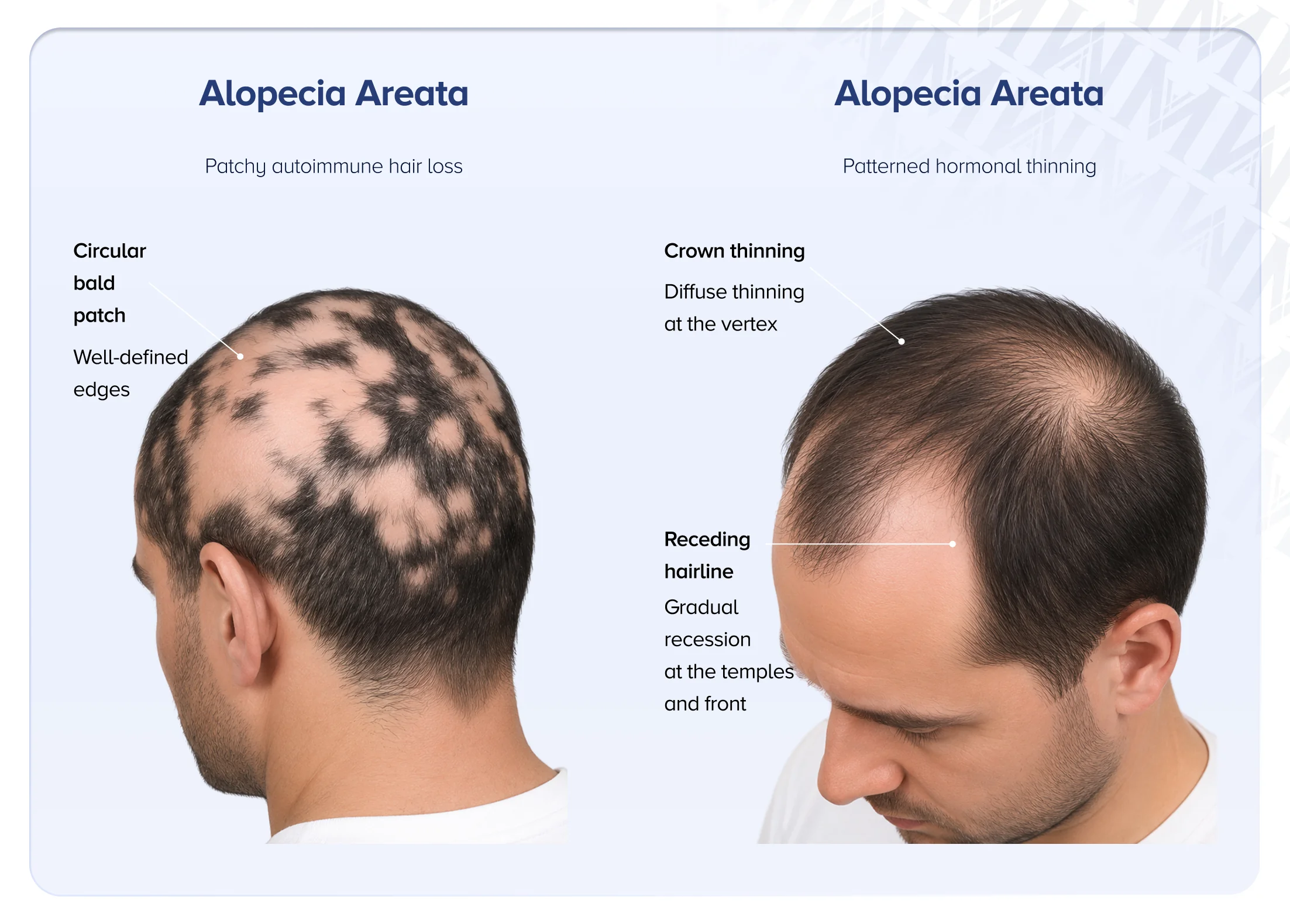
Diagram comparing alopecia areata patch with patterned thinning from androgenetic alopecia for transplant decisions.

Alopecia Areata vs Androgenetic Alopecia for Hair Transplant

Feature

Alopecia areata

Androgenetic alopecia

Cause

Autoimmune attack on hair follicles

Hormonal and genetic (DHT-related)

Typical pattern

Sudden patches, totalis, universalis, ophiasis

Gradual receding hairline or crown thinning

Predictability of course

Unpredictable flares and remissions

Slowly progressive and patterned

Typical transplant suitability

Only rare, long-stable, localized cases

Commonly suitable once pattern is stable

Relapse / graft loss risk

Higher risk of new patches and graft failure

Lower if donor area is stable

Dermatology bodies including the AAD and the British Association of Dermatologists (BAD) point to this biological difference as the central reason surgery is standard for one condition and used only cautiously for the other.

How Does Hair Transplant Surgery Work in General?

A hair transplant works by moving healthy hair follicles from a stable "donor" area, usually the back of the scalp, into thinning or bald areas where they can continue to grow.

Understanding how transplants normally succeed makes it clearer why autoimmune disease complicates the picture. In pattern baldness, surgeons rely on donor dominance: follicles from a region resistant to balding tend to keep that resistance after being moved.

The two main techniques are:

  • Follicular unit extraction (FUE): Individual follicular units (natural groupings of 1–4 hairs) are removed one by one from the donor site using small punches and placed into tiny incisions in the recipient site.

  • Follicular unit transplantation (FUT/strip): A thin strip of scalp is removed from the donor site, then dissected under a microscope into follicular units that are implanted into the recipient area. This leaves a linear scar at the donor site.

Either way, success depends on three things:

  • ● Healthy follicles in the donor area.

  • ● Good blood supply and healing in the recipient area.

  • ● A scalp environment that stays stable, without ongoing immune activity.

In androgenetic alopecia, long-term graft survival can be very high in experienced hands, according to educational materials from the International Society of Hair Restoration Surgery (ISHRS). Typical candidates include people with stable pattern baldness, certain cases of traction alopecia once pulling has stopped, and a few carefully selected scarring alopecias such as lichen planopilaris when the disease has been inactive for years.

Scarring alopecias differ from alopecia areata in an important way: they involve inflammation that destroys follicles and leaves permanent scars on the scalp. Once the inflammation has fully burned out, the damage is no longer spreading, and transplant may sometimes be considered. Alopecia areata has no such "burned-out" guarantee.

  • Basic principle of hair transplant: donor follicles are assumed to be permanently resistant to the cause of hair loss in the recipient area.

That assumption falls apart in an autoimmune hair loss transplant scenario, because the immune system can target hair almost anywhere on the body.

For a deeper walkthrough of the procedure itself, our page on how hair transplant surgery works explains techniques, recovery, and typical outcomes.

Illustration of FUE and FUT hair transplant methods showing donor and recipient areas

Why Hair Transplant Is Usually Not the First Choice for Alopecia Areata

Hair transplant is rarely recommended as a first-line treatment for alopecia areata because the same autoimmune process that caused your original hair loss can also destroy transplanted follicles.

The immune system does not care which hairs are "original" and which are grafts. New patches can appear with little warning, and areas that regrew once can shed again years later, as the AAD notes in its alopecia areata patient information. That unpredictability makes long-term graft survival far less certain than in straightforward pattern baldness.

Main reasons transplant is risky in alopecia areata:

  • Ongoing risk of autoimmune attack on grafts: The immune system can target transplanted follicles, leading to graft failure and a wasted procedure.

  • Unpredictable flares in donor and recipient areas: Flares may affect the donor site itself, shrinking the pool of healthy hair and damaging previously stable zones.

  • Surgical trauma may trigger new patches: Trauma to the scalp can sometimes provoke fresh lesions, a reaction similar to the Koebner phenomenon, described in inflammatory skin diseases such as psoriasis and vitiligo.

Warning: Surgery during active alopecia areata can lead to poor graft survival, new patches in both donor and recipient sites, and a high chance of disappointment.

Published evidence here is thin. Most of what we know comes from individual case reports and small case series, not large trials. Some reports describe people with long-inactive, localized patches achieving reasonable coverage for several years. Others describe patients losing a meaningful portion of their grafts when the disease reactivated. One small review of patchy cases reported roughly a third of transplanted grafts being lost after relapse, despite careful patient selection.

Beyond the biology, there are ethical realities:

  • ● Hair transplant is expensive and time-consuming.

  • ● Losing transplanted hair a second time can be emotionally crushing.

  • Complications such as poor growth, visible scarring, and shock loss (temporary shedding of existing hair after surgical trauma) can happen even in textbook candidates.

Recent guidance from the BAD and AAD lists medical and immunomodulating therapies as the standard of care for alopecia areata, and mentions hair restoration surgery only as a highly selective option in long-standing, inactive disease. In everyday clinical practice, many dermatologists never recommend transplant for alopecia areata at all.

Are There Any Situations Where an Alopecia Areata Hair Transplant Can Help?

Hair transplant may be considered in very carefully selected people with alopecia areata who have had a small, well-defined area of hair loss that has remained completely stable for several years, and who fully understand that grafts could still be lost if the disease returns.

This is where nuance matters. In our clinic, and in many others, we apply an informal but strict checklist around disease stability and remission before even discussing surgery seriously. Reviews in specialist hair-research literature note that hair transplant in alopecia areata "should only be considered in long-standing, inactive disease" — and even then, with caution.

Typical "minimum" conditions before considering an alopecia areata hair transplant:

  • ● A confirmed diagnosis by a dermatologist.

  • ● No new patches or expansion of existing patches for at least 1–2 years, often longer.

  • ● A small, localized area of loss that has stayed unchanged for years.

  • ● Realistic expectations about density, relapse risk, and cosmetic goals, documented through informed consent.

Who might be considered?

Two anonymized scenarios show why the answer is sometimes "maybe" and often "no."

Patient A, a man in his early 40s, has one coin-sized bald patch on the side of his scalp that appeared five years ago. He received intralesional corticosteroid injections (steroid shots into the patch) in the first year, but the patch never fully regrew. It has stayed the same size for four years, and no new patches have developed. He also has mild male pattern thinning at the temples. After reviewing clinic photos and confirming no signs of active disease on trichoscopy (a scalp examination using a magnifying device), his dermatologist and hair surgeon discussed a small FUE procedure to fill that single patch — with clear counseling that the disease could still relapse and that transplanted hair might be lost in the future.

Patient B, a woman in her mid-30s, has had several patches over three years. Some regrew, others appeared elsewhere, and a new patch developed in the last six months. She has mild nail pitting and a family history of autoimmune disease. Trichoscopy shows broken hairs and "exclamation mark" hairs suggesting ongoing activity. Even if one patch has looked quiet for a year, the broader pattern of frequent recurrence and new lesions makes transplant a poor bet. Her team advised against surgery and focused instead on medical therapy and cosmetic options.

Who is usually not a candidate?

Transplant is generally not advised in these situations:

  • Alopecia totalis and alopecia universalis, where there is complete loss of scalp or body hair and little or no reliable donor hair.

  • ● Active, relapsing, or widespread disease with new patches in the last 12–24 months.

  • ● Children and adolescents, whose disease course, immune system, and scalp are still developing.

  • ● Extensive ophiasis pattern alopecia, where hair loss runs along the sides and back and donor reserves are already limited.

Even in "ideal" candidates, outcomes are less predictable than in pattern baldness. Some people gain useful coverage; others see partial growth that fades when the immune system reactivates. Because the margin for disappointment is wide, any conversation about hair transplant and alopecia areata should involve both a dermatologist and a conservative, transparent hair transplant surgeon who refuses to over-promise.

How Do Doctors Decide if You're a Candidate? A Stepwise Framework

Doctors decide whether you may be a candidate for hair transplant with alopecia areata by confirming the diagnosis, assessing how active and widespread the disease is, maximizing medical treatment, and only then weighing surgery if your hair loss has been stable for a long time.

Turning that clinical reasoning into clear steps helps you see where you fit and what to expect at appointments.

Candidacy checklist for transplant in alopecia areata

1. Confirm the diagnosis and type of alopecia.

A dermatologist first checks that you truly have alopecia areata and not another non-scarring alopecia or a scarring alopecia such as lichen planopilaris. They examine your scalp, often using trichoscopy (a magnifying scalp examination), and sometimes a small biopsy. AAD patient information stresses that an accurate diagnosis is the starting point for any treatment plan.

2. Assess disease activity and pattern.

Your doctor will ask when patches appeared, whether they regrew, and whether new ones have formed recently. They look for nail changes, brow or lash loss, and signs of other autoimmune disease. Rapidly changing patches, fresh shedding, or a history of frequent flares all weaken hair loss surgery candidacy.

3. Optimize and exhaust medical therapy first.

Standard alopecia areata treatment options come well before any conversation about surgery. For limited patchy disease, many dermatologists use intralesional corticosteroid injections, topical corticosteroids, and sometimes minoxidil lotion or foam. More extensive disease may be treated with topical immunotherapy — agents applied by specialists to provoke a controlled allergic reaction that redirects the immune response — or systemic immunomodulators, including JAK inhibitors in selected cases. Both BAD and AAD guidance describe these therapies as the standard of care.

4. Evaluate duration of remission and psychological readiness.

Many clinicians prefer at least 1–2 years of clear remission, with no new patches or expansion of existing ones, before they will even discuss an alopecia areata hair transplant. Some aim for longer if previous disease has been aggressive. They also explore your expectations, current self-esteem, and how you might cope if transplanted hair were lost in a future flare.

5. Assess the donor area.

A hair transplant surgeon examines the back and sides of your scalp — the potential donor site — for density, hair quality, and any sign of alopecia areata activity. If there is patchy thinning, unusual patterns, or inflammation, the donor area is considered unreliable. ISHRS educational material emphasizes that donor stability is essential in every transplant, and the bar is even higher in a hair transplant autoimmune disease setting.

6. Shared decision-making and informed consent.

If you clear every step above, your team will discuss realistic goals, likely graft numbers, potential complications (including poor growth, scarring, and shock loss), costs, and the chance of relapse with new patches or graft loss. Proper informed consent means you understand that the evidence for transplant in alopecia areata is limited, graft survival is less predictable, and surgery does not cure the underlying autoimmune process.

In our clinic, we only move ahead with surgery in alopecia areata when patches have been unchanged for several years, standard medical treatments have been tried, and the person clearly accepts the uncertainties.

If you are unsure where you fall in this framework, consider booking an assessment with a dermatologist or hair specialist who can confirm your diagnosis, document disease activity, and talk through your options safely.

Evidence and Expert Opinions: What Do Studies Show?

Existing studies on hair transplant in alopecia areata are small and mixed: some patients with long-stable patches do reasonably well, while others lose transplanted hair the moment the disease flares again.

Most published information is made up of case reports and small case series, not controlled trials. In these reports, some people with long-inactive, localized patchy alopecia areata achieved decent density for 1–3 years after transplant. A noticeable proportion, however, developed new patches in the transplanted or donor areas, losing grafts partially or completely when the autoimmune process reactivated.

Current evidence summary:

  • ● Evidence is based mainly on case reports and small patient series.

  • ● There are no large randomized controlled trials of hair transplant in alopecia areata.

  • ● Relapse and graft loss remain significant concerns even in carefully selected cases.

Professional organizations including the BAD and AAD do not list transplant as a standard treatment in their alopecia areata guidance and patient materials. They focus instead on immunomodulating therapies, supportive care, and cosmetic solutions. Expert commentaries in dermatology journals echo the same caution: surgery should only be considered in exceptional cases of long-standing, inactive disease, and only after detailed counseling.

Because the evidence base is so thin, many dermatologists treat alopecia areata hair transplant as an exception, not part of routine care.

Chart illustrating that evidence for alopecia areata hair transplant comes mostly from small case reports and series.

First-Line Treatments and Alternatives to Hair Transplant in Alopecia Areata

For most people with alopecia areata, first-line treatment focuses on calming the immune attack with medications, then layering on cosmetic options such as wigs, hair fibers, or scalp micropigmentation rather than jumping straight to surgery.

Shifting your focus from surgery to disease control and appearance often brings more reliable, more flexible benefit, with far less risk. Recent guidance from the AAD, BAD, and other dermatology societies maps a range of medical therapies tailored to how extensive and active the disease is.

Common medical treatments

Intralesional corticosteroid injections:

  • Steroid injections into bald patches are a workhorse treatment for limited, patchy alopecia areata on the scalp. Many patients see partial regrowth over several months, especially when treatment starts early, though not everyone responds and repeat sessions are usually needed.

Topical corticosteroids and minoxidil:

  • Potent topical corticosteroids (creams, lotions, or foams) and minoxidil solutions are often used for small patches or as follow-up after injections. They can encourage regrowth and help hairs stay in the growing phase, with side effects that are generally manageable under dermatologist supervision.

Topical immunotherapy:

  • Topical immunotherapy uses agents such as diphenylcyclopropenone or squaric acid to trigger a controlled allergic-type reaction on the scalp, redirecting the immune response away from hair follicles. BAD guidance describes it as an option for more extensive scalp involvement. It requires regular specialist visits and patience — results can take months.

Systemic therapies, including JAK inhibitors:

  • In severe or widespread disease, dermatologists may consider systemic immunosuppressants, including JAK inhibitors. These drugs target specific immune pathways involved in alopecia areata and, in clinical trials, have produced substantial regrowth in many patients with alopecia totalis or universalis. They require careful monitoring, long-term safety data are still maturing, and access and cost vary widely by country.

Every one of these treatments has potential side effects and is not suitable for everyone. You and your dermatologist should weigh benefits, risks, and your overall health before starting or changing systemic therapy.

Infographic summarizing key medical treatment options for alopecia areata before hair transplant.

Non-surgical cosmetic options

Wigs, hair systems, hairpieces, toppers:

  • High-quality wigs and hair systems can look remarkably natural and let you change styles in minutes. Many people with alopecia totalis or universalis rely on them long-term, and some health systems or charities help with costs.

Hair fibers and concealers:

  • Colored keratin hair fibers and spray concealers can disguise small patches or diffuse thinning between medical treatments, particularly in darker hair. They work best when there is surrounding hair for the fibers to cling to.

Scalp micropigmentation (SMP):

  • Scalp micropigmentation (SMP) uses tiny dots of pigment tattooed onto the scalp to mimic hair stubble or soften the contrast between hair and skin. It can create the look of a closely shaved style or fill in the appearance of density. You can read more about scalp micropigmentation as a non-surgical option in our dedicated section.

Some clinics also offer platelet-rich plasma (PRP) injections or mesotherapy as an adjunctive hair loss treatment. Evidence for PRP and mesotherapy in alopecia areata is limited and based on small, early studies. Major dermatology guidelines do not treat them as proven primary therapies, so they should be viewed — if at all — as adjuncts to standard medical care, not replacements for it.

The psychosocial impact of alopecia areata is genuine. Many people experience anxiety, low mood, or shaken self-esteem, especially when hair loss is rapid or extensive. Patient organizations such as the National Alopecia Areata Foundation, alongside national dermatology societies, highlight the value of counseling, peer support groups, and honest conversations with friends, family, and employers.

Red Flags and Questions to Ask Before Any Surgery Offer

If a clinic offers you a hair transplant for alopecia areata without confirming your diagnosis, discussing disease activity, or warning about relapse, that is a major red flag.

Because alopecia areata involves an unpredictable autoimmune process, any hair surgery must be approached with real caution. The ISHRS and other professional groups treat transparent counseling and realistic expectations as ethical essentials, not optional extras.

Red flags for surgery in alopecia areata:

  • ● Promises to "cure" alopecia areata with transplant, or claims of a "permanent fix."

  • ● No dermatologist or hair-loss specialist involved in confirming your diagnosis.

  • ● No discussion of disease activity, stability, or how long you have been in remission.

  • ● High-pressure sales tactics, time-limited discounts, or large non-refundable deposits.

  • ● Refusal to discuss evidence, risks, or show similar alopecia areata cases with long follow-up.

Essential questions to ask before agreeing to surgery:

  • ● "How many patients with alopecia areata have you treated surgically, and what were their outcomes?"

  • ● "What are your exact criteria for disease stability or remission before surgery?"

  • ● "What is your plan if my disease relapses and transplanted hair is lost?"

  • ● "What complications should I be aware of, including poor growth, scarring, and shock loss?"

If the answers feel vague, dismissive, or unrealistically optimistic, ask for written information and then seek a second opinion from an independent dermatologist or hair transplant surgeon who is not financially tied to that clinic.

Living With Alopecia Areata: Setting Expectations and Next Steps

Living well with alopecia areata usually means combining medical care, realistic cosmetic solutions, and emotional support — rather than relying on a single procedure to "fix" everything.

Over time, many people find that controlling disease activity and feeling comfortable with how they look day to day matters more than any single treatment choice. In clinical practice, patients who grasp the changeable nature of alopecia areata early tend to cope better with flares and treatment decisions later.

Practical next steps:

  • ● Book a review with a dermatologist to confirm your diagnosis, screen for other autoimmune issues, and plan treatment.

  • ● Take regular photos of your scalp and eyebrows so you can track patches, flares, and stretches of remission.

  • ● Explore cosmetic options such as wigs, fibers, or SMP, even while you are trying medical therapies.

  • ● Reach out for support from friends, family, online communities, or a counselor if hair loss is affecting your self-esteem or daily life.

Patient C, a man in his late 20s with alopecia universalis since his teens, wears a high-quality wig at work and uses SMP on his beard area. His dermatologist started a systemic treatment, and he has had partial regrowth on the scalp and brows. After learning that his disease is diffuse and his donor sites are not reliably stable, he decided against hair transplant. He focused instead on combining medical therapy with cosmetic solutions, career goals, and his relationships. For him, success meant feeling in control of his options, not chasing a risky procedure.

If the emotional side feels especially heavy, our resources on coping with the emotional impact of hair loss may help you feel less alone and better prepared for conversations with your care team.

Patient with alopecia areata reviewing scalp photos and treatment options with a dermatologist.

FAQs About Alopecia Areata and Hair Transplant

Can I get a hair transplant if I have alopecia areata?
You can sometimes have a hair transplant if you have alopecia areata, but only in highly selective, long-stable cases. Most people with active or recently active disease are not good candidates, because the immune system can still attack transplanted hair. Dermatology guidance and clinical experience treat hair transplant and alopecia areata as an unusual combination, not a routine option.
How long should my alopecia areata be in remission before considering a hair transplant?
Many clinicians prefer at least 1–2 years of clear remission, with no new patches or expansion, before they will discuss transplant. Some surgeons ask for longer stability if your disease has been severe or rapidly changing in the past. There is no universal rule, so you need individualized advice from a dermatologist and a hair transplant surgeon who understand alopecia areata remission hair transplant risks.
Will a hair transplant stop my alopecia areata from coming back?
A hair transplant will not stop alopecia areata from coming back or cure the underlying autoimmune disease. Surgery simply moves hair from one area to another; it does nothing to change how your immune system behaves. If your disease relapses, the immune system can attack both native and transplanted follicles, which may cause new patches and graft loss.
Is hair transplant ever recommended for alopecia totalis or universalis?
Hair transplant is generally not recommended for alopecia totalis or alopecia universalis. In these conditions there is little or no stable donor hair, and a high risk of widespread relapse. Most expert opinions and dermatology guidelines focus on medical treatments and cosmetic options such as wigs or SMP, rather than surgery, in these severe forms.
Are JAK inhibitors better than hair transplant for alopecia areata?
JAK inhibitors are medications that target immune pathways involved in alopecia areata, and clinical trials have shown substantial regrowth in many patients with severe disease. They are usually more appropriate than surgery for active, widespread alopecia areata, because they treat the underlying immune process rather than just moving hair around. They do carry potential side effects and need careful monitoring, so any decision is made with a dermatologist.
Can surgery make my alopecia areata worse?
Surgery can appear to make alopecia areata worse if it triggers new patches at incision sites or nearby areas. This reaction is similar to the Koebner phenomenon, in which trauma leads to new lesions in certain skin diseases, and has been described in alopecia areata. That is why experts recommend avoiding transplant during active disease and only considering it after clear stability and detailed risk discussions.
What's the difference between autoimmune hair loss and male pattern baldness for transplant?
Autoimmune hair loss like alopecia areata involves the immune system attacking hair follicles unpredictably across the scalp or body. Male pattern baldness has a stable, hormone-driven pattern with reliable "safe" donor zones at the back and sides of the head. So transplant in androgenetic alopecia usually offers dependable donor hair and long-term graft survival, while autoimmune hair loss transplant carries a higher risk of relapse and graft failure.
Is mesotherapy or PRP helpful for alopecia areata instead of transplant?
Some clinics offer platelet-rich plasma (PRP) and mesotherapy injections for hair loss. The evidence for these treatments in alopecia areata is limited and based mainly on small, early studies, not large, high-quality trials. They may be discussed only as experimental adjuncts, and should never be presented as proven cures or replacements for standard medical therapies.
What are the safest cosmetic options if I can't have a transplant?
If transplant is not suitable, you still have plenty of cosmetic options. High-quality wigs, hairpieces, or toppers can give full coverage, while hair fibers and spray concealers can disguise smaller patches or diffuse thinning. Scalp micropigmentation (SMP) can mimic fuller density or a closely shaved style. A dermatologist or hair specialist can help you combine the options that fit your lifestyle.
Which type of doctor should I see first about alopecia areata?
You should see a dermatologist first. Dermatologists specialize in hair and scalp diseases and can confirm your diagnosis with the right tests. If surgery ever becomes a possibility, your dermatologist can then coordinate with a reputable hair transplant surgeon to decide whether you are a suitable candidate. Walking straight into a surgical clinic without a firm medical diagnosis raises the risk of mis-treatment and unrealistic expectations.

Key Takeaways

  • ● Alopecia areata is autoimmune and unpredictable, while androgenetic alopecia is hormonal and patterned, which shapes every transplant decision.

  • ● An alopecia areata hair transplant is not a first-line treatment and is only considered after prolonged stability or remission in very small, localized patches.

  • ● Even in selected cases, there is a real risk of relapse and graft loss, because the immune system can attack transplanted hair.

  • ● Evidence for hair transplant in alopecia areata is limited to small case reports and series, not large controlled trials.

  • ● Most people do best by combining medical treatments with cosmetic solutions such as wigs, fibers, and SMP — not by relying on surgery alone.

What to Do Next

Your most helpful next move is to seek a clear diagnosis and a personalized plan, not a quick surgical fix.

  • ● Book an appointment with a dermatologist to confirm that you have alopecia areata, check for related autoimmune conditions, and discuss evidence-based treatment options.

  • ● Keep a simple photo diary, with short notes about when patches appear, regrow, or stay stable. This documents your remission and flares far better than memory.

  • ● Explore non-surgical options first. Discuss an alopecia areata hair transplant only if your disease has been stable for a long time and both your dermatologist and a cautious hair transplant surgeon agree the potential benefits outweigh the risks.

If you would like a tailored opinion on your hair loss and whether any form of surgery is appropriate, consider a consultation with a dermatology and hair restoration team that puts diagnosis and disease control ahead of selling a procedure.

Always consult a qualified dermatologist or hair specialist before making decisions about treatment or surgery. For most people with alopecia areata, lasting confidence comes from controlling the disease, protecting your wellbeing, and choosing smart cosmetic strategies — not from asking a single surgery to carry the entire weight.

Contact Us!

Please enter a valid phone number.
Greft Hesapla WhatsApp