
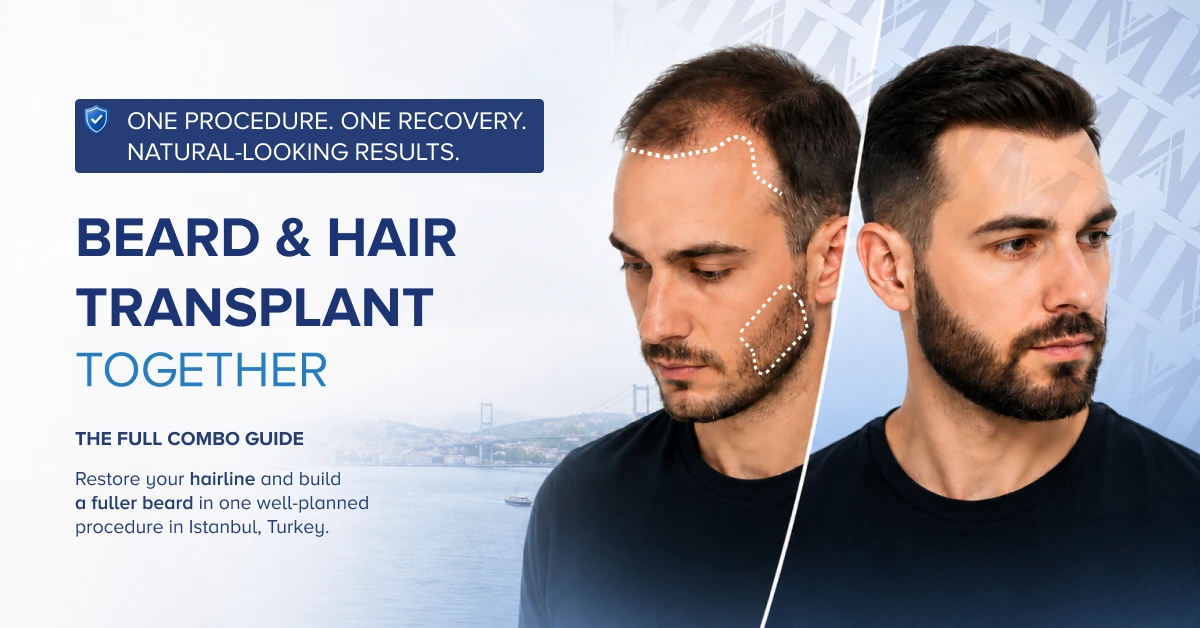
More men now fly to Istanbul wanting to fix a receding hairline and a patchy beard in the same visit. At Medart Hair Transplant, requests for a combined beard and hair transplant have grown from occasional to a weekly routine. Done well, this is one integrated surgical strategy — not two random add-ons stitched onto the same day.
This guide explains how a combo procedure actually works: who it suits, what happens on the day, how recovery feels, the real risks, and what to look for in a safe Turkish clinic.
Medical disclaimer: This article is for general information only and does not replace a consultation with a qualified doctor. Any decision about surgery must be made with a hair transplant surgeon after a personal assessment.
Get a Free Consultation
Talk to an experienced patient coordinator for your beard transplant in Turkey.Can You Get a Beard and Hair Transplant Together?
Yes — you can safely have a beard and hair transplant together in one carefully planned procedure if your donor area and overall health are suitable.
Combined procedures are now common in experienced Istanbul clinics, including Medart, especially for international patients who prefer one medical-tourism trip rather than two. According to the International Society of Hair Restoration Surgery (ISHRS, 2022 Practice Census), FUE (Follicular Unit Extraction) is now the dominant hair transplant technique worldwide. FUE suits combo work because it allows flexible graft numbers from the occipital scalp and sides of scalp without a long linear scar.
Benefits of a combo transplant include:
● One anaesthesia session and one surgical trip
● One main recovery and one window of social downtime
● Coordinated hairline design and beard design
● Often more cost-effective than two separate surgeries, especially within structured hair transplant packages Turkey clinics offer
In our experience at Medart, we see a steadily increasing number of patients choosing some form of combined facial hair transplant and scalp restoration — in a single session, or spread over two consecutive days.
Key Takeaways
● Beard and hair transplant together is safe when donor supply and health are assessed carefully.
● Planning focuses on protecting your donor supply, not chasing "maximum grafts."
● Most international patients stay 4–7 days in Istanbul for a combo procedure.
● Recovery is usually uncomfortable rather than truly painful, with swelling peaking on days 1–3.
● Advanced baldness or weak donors are often better managed with staged procedures.
● Honest, conservative planning and clear before and after photos matter more than cheap "unlimited graft" offers.
What Is a Combo Beard + Hair Transplant?
A combo beard and hair transplant is a single treatment plan where we restore scalp density and create or thicken a beard in the same session using FUE.
In practical terms, a combined beard and hair transplant means we harvest hair follicles (also called grafts) from your donor area — usually the occipital scalp (back of the head) and sides of scalp — and implant them into both:
● Recipient scalp areas: hairline, frontal and mid-scalp, and sometimes the crown
● Recipient beard region: cheeks, jawline, chin, and moustache
A beard transplant, also called a facial hair transplant, uses the same basic principle: we move follicles from a permanent donor area to the beard region. The goal is for these hairs to behave like natural beard hair in growth, direction, and styling.
According to the ISHRS 2022 Practice Census, FUE has overtaken strip surgery as the most commonly performed hair transplant technique worldwide. In FUE (Follicular Unit Extraction), we remove individual follicular units with tiny punches, leaving many small dot scars instead of one long line.
FUT (Follicular Unit Transplantation), by contrast, involves removing a strip of skin from the donor area and dissecting it into grafts. FUT still has its place in selected cases, but for beard and hair transplant together, FUE is usually preferred because it:
● Allows more flexible and dispersed harvesting patterns
● Avoids a long linear scar that might limit short hairstyles
● Makes it easier to combine larger scalp and beard work in one plan
Combo beard + hair transplant (definition)
● Combo beard + hair transplant: a procedure in which hair follicles are harvested from a donor area (usually the back and sides of the scalp) and implanted into both thinning scalp and beard regions during one coordinated operation.
Some clinics also offer adjuncts such as PRP (Platelet-Rich Plasma) injections during surgery. PRP uses a concentrate from your own blood and may support healing and graft survival rate, though the evidence remains mixed. Treat it as an adjunct, not a guarantee.
If you want deeper technical detail about facial hair surgery alone, our detailed beard transplant guide explains exactly how a beard transplant works and how different beard designs are tailored.
To understand the scalp side in more depth, you can also read more about our hair transplant techniques and standalone procedures.
How It Differs from Two Separate Surgeries
When you have both procedures together, we do not simply "add" a beard transplant on top of a scalp plan.
Key differences when you combine them:
● Planning complexity: Your donor supply is a fixed "savings account" you can only spend once. We divide it intelligently between scalp and beard rather than treating each area in isolation.
● Time efficiency: One set of blood tests, one surgical preparation, one main recovery — instead of two full cycles.
● Cost efficiencies: In Turkey, clinic overheads and travel costs are shared across one trip, so combo cases are often more economical than two fully separate visits.
● Operative time: Total surgery is longer (often 6–10 hours, or split over two days), which makes patient comfort, breaks, and monitoring even more important.
Next, let's look at who is — and isn't — a good candidate for combining both procedures in one plan.
Who Is (and Isn't) a Good Candidate?
You're a good candidate for a combined beard and hair transplant if your donor area is strong, your hair loss is reasonably predictable, and you accept realistic expectations about what your existing follicles can achieve.
The main factors we assess are:
● Donor density and quality: Enough healthy grafts in the occipital scalp and sides of scalp, with good hair thickness, calibre, and texture.
● Hair loss pattern: We classify male pattern baldness (androgenetic alopecia) using the Norwood scale and consider likely future progression. The American Academy of Dermatology notes that androgenetic alopecia is typically gradual and progressive, so long-term planning is essential.
● Age and stability: Hair loss that has slowed, or is medically stabilised with treatments such as minoxidil and finasteride, when appropriate and prescribed by your own doctor.
● General health: Non-smoker or light smoker, no uncontrolled diabetes, no major cardiovascular disease, and no unmonitored use of blood thinners. Very high or very low body mass index (BMI) can also increase anaesthetic risk and needs individual assessment.
● Psychological goals: A desire for improved self-esteem and facial framing — paired with realistic expectations, not a goal to recreate "teenage density everywhere."
If you have a history of significant anxiety, depression, or body-dysmorphic symptoms, we may suggest discussing surgery with your usual doctor or a mental health professional as well. Surgery can boost confidence, but it shouldn't be the only tool used to treat deeper psychological distress.
Assessing Your Donor Area for Combo Procedures
We assess your donor area in detail during a pre-op assessment, which often begins as an online consultation with photos or video.
We look at:
● Hair calibre: Thicker hair covers more scalp and beard area per graft.
● Density: How many follicular units per cm² we can see and safely remove.
● Distribution: How well grafts are spread across occipital and lateral scalp, to avoid visible donor overharvesting.
● Existing scarring: Previous FUE or FUT scars may limit how much more we can safely take.
Many surgeons estimate that a typical man might safely use roughly 5,000–7,000 grafts from the scalp donor region across his lifetime, though individual variation is wide. Think of this like a fixed savings account: every withdrawal you make for today's hairline or beard reduces what's available if hair loss progresses later.
We sometimes also use under-jaw or neck beard hair as an additional donor source for the beard or even the scalp. Even so, we still need to protect overall appearance — long-term donor preservation always outranks short-term density.
When We Recommend Doing Procedures in Stages Instead
You may not be an ideal candidate for beard and hair transplant together if:
● Your donor area is already very thin or previously overharvested
● You're very young (for example, in your early 20s) with rapidly progressing hair loss
● You have uncontrolled medical conditions like poorly regulated diabetes or heavy smoking
● You expect "full teenage density" on the scalp and a very thick beard from a limited donor supply
In such cases, we often suggest a staged approach:
● Hair first, beard later:
● For advanced Norwood 5–7 with limited donor hair.
● When framing the face with the frontal hairline and mid-scalp matters more than beard styling.
● Beard first, hair later:
● For patients with strong scalp hair but a very patchy beard that significantly affects self-image.
● For men whose scalp hair loss is still evolving and needs more time to declare its final pattern.
If your donor capacity is borderline, or you have medical issues, this decision should always be made with a hair transplant surgeon or other qualified doctor. Next, we'll see how surgeons plan graft distribution when you're a suitable candidate for a combined approach.
How Surgeons Plan a Combined Beard + Hair Transplant
Planning a combo transplant is about allocating your finite donor grafts to the areas that most strongly frame your face — while still leaving reserves for possible future hair loss.
This is where the idea of an integrated surgical strategy really matters. We don't simply bolt a beard transplant onto a scalp plan; we treat your donor hair like a limited savings account you can withdraw from only once.
The ISHRS and many hair-restoration texts emphasise that restoring the frontal third of the scalp and a natural hairline design delivers the greatest visual impact for most patients. The beard — especially cheek and jawline density — also strongly frames the lower face.
So we usually:
● Prioritise frontal hairline and mid-scalp density over the crown in younger or still-progressing hair loss.
● Design a beard that suits your face shape and ethnicity, without chasing maximal density in every zone.
● Plan for the future: if your crown thins more later, will you still have grafts left?
Donor Management Priority Framework
At Medart Hair Transplant, we apply a simple donor management priority framework whenever we plan a beard and hair transplant together:
1. Protect the donor:
● Set a safe lifetime extraction limit based on density and hair calibre.
● Avoid any plan that risks a visibly thin or "moth-eaten" donor area.
2. Frame the face first:
● Allocate grafts initially to the frontal scalp hairline and mid-scalp.
● Next, allocate to moustache and the visible cheek and jawline beard zones.
3. Plan for the future:
● Keep a reserve for likely future hair loss, especially the crown.
● Avoid low-value uses of grafts (for example, chasing high-density crown coverage in very young men).
4. Adjust in real time:
● Be ready to revise the plan mid-surgery based on graft yield, tissue quality, or patient tolerance. We might reduce low-priority crown work if the donor proves slightly weaker than expected, or shift a few hundred grafts toward the beard if the cheeks need it.
A warning on donor safety: Conservative, ethical planning is essential. The ISHRS has repeatedly warned about black-market clinics that overharvest donors and advertise "unlimited grafts" — leaving permanent damage that's very hard to correct.
Example Graft Plans (Scenarios)
These examples are illustrative only — not prescriptions. Actual numbers depend on donor capacity, hair texture, and your goals.
Scenario |
Scalp grafts |
Beard grafts |
Total grafts |
Notes |
|---|---|---|---|---|
Norwood 3 + patchy cheeks |
2,500 |
1,000 |
3,500 |
Focus on hairline and cheek density |
Norwood 4–5 + minimal beard |
3,000 |
600 |
3,600 |
Prioritise frontal scalp; modest beard |
Strong donor + mild crown loss |
3,200 |
1,200 |
4,400 |
Hairline, mid-scalp, light crown + full beard outline |
Clinical reviews suggest that restoring the frontal third of the scalp often needs around 1,500–3,000 grafts, depending on area size and hair characteristics. A "full" beard can require more than 2,500 grafts, but many men only need 800–1,500 to fix a patchy beard focused on cheeks and jawline.
Example case 1 (moderate hair loss + patchy beard)
A man in his early 30s from the UK, Norwood 3, with a patchy beard and sparse cheeks, came to our Istanbul clinic. We planned around 3,200 total grafts: roughly 2,200 to the hairline and frontal scalp, 1,000 to the beard (cheeks and jawline). We chose a 2-day FUE beard and hair transplant to keep each day comfortable. At 12 months, his hairline framed his face well and he could wear a short, defined beard without obvious "transplanted" lines.
Example case 2 (more advanced hair loss, strong beard goals)
A mid-40s man from Germany, Norwood 5 with a sparse beard, wanted a full beard and crown coverage. Donor evaluation showed a safe lifetime budget of around 5,000–5,500 grafts. We advised conservative, ethical planning: about 3,000 grafts to rebuild the frontal hairline and mid-scalp, and 800–1,000 for moustache and beard outline. We agreed to leave the crown for possible future work. The result gave him stronger facial framing and kept some donor reserve for later.
Hairline and Beard Design Principles
Natural design matters as much as graft numbers.
For hairline design, we:
● Avoid very low or razor-straight hairlines that will look unnatural as you age.
● Use soft, irregular micro-zigzags at the front with varied angles.
● Place finer single-hair grafts at the front and multi-hair grafts behind to mimic natural density gradients (measured in grafts per cm²).
For beard design, we:
● Respect your ethnicity, existing pattern, and desired style.
● Create slightly irregular, feathered edges along the cheeks rather than ruler-straight lines.
● Angle grafts to follow natural beard direction: downward on cheeks, more horizontal along the jawline and chin.
Small clinical series on beard transplantation report that patients often rate natural direction and contour as even more important than absolute density for satisfaction.
Want to know how many grafts might realistically be available for your scalp and beard? Send clear photos via the WhatsApp button in the bottom-right corner for a free, no-obligation assessment. You'll get an honest opinion from our surgeons — not a hard sell.
Next, we'll walk through what a typical combined procedure day actually looks like.
What the Combo Procedure Day Looks Like (Step-by-Step)
Most combined beard and hair transplant procedures take between 6 and 10 hours of active surgery, typically split into donor extraction in the morning and implantation into the scalp and beard in the afternoon.
For larger graft numbers, we sometimes split the work across two consecutive days to keep you comfortable and to protect graft quality. The American Society of Anesthesiologists notes that prolonged outpatient procedures can be safe in healthy patients when appropriate monitoring and local anaesthesia are used.
A typical one-day combo procedure using FUE looks like this:
1. Arrival and pre-op consultation
We review your medical history, medications (including any blood thinners), allergies, and recent labs. We recheck your donor area and hair loss pattern, confirm goals, and agree a realistic graft range.
2. Design and photos
We draw your hairline and beard outline with a marker while you look in a mirror. You can request adjustments before we commit. We then take pre-operative photos from different angles.
3. Shaving and preparation
In most FUE cases, the donor area is shaved short; sometimes the whole scalp is trimmed. Beard recipient areas may be left longer or trimmed depending on the design.
4. Local anaesthesia and optional sedation
We inject local anaesthesia with fine needles into the donor and recipient areas. Some clinics and patients choose light sedation, but many men manage well with local anaesthesia alone.
5. FUE donor extraction
You lie face-down or on your side. Using tiny punches, we extract individual follicular units from the occipital and sides of scalp — and, if planned, from under-jaw beard. Grafts are counted and stored in chilled solution to help maintain a good graft survival rate.
6. Breaks, lunch, and re-planning
We schedule regular breaks, bathroom visits, and a light lunch. If graft yield is higher or lower than expected, we may adjust the plan mid-surgery — for example, slightly increasing beard density or trimming low-value crown work.
7. Creation of recipient sites
We make tiny slits or channels in the scalp and beard regions with fine blades or needles. Direction, angle, and density are carefully set to match natural patterns.
8. Graft implantation
We usually implant the scalp first, then the beard, although the sequence can vary. Technicians working under direct surgeon supervision place grafts using forceps or implanter pens.
9. Final check and instructions
We inspect all areas, clean your scalp and beard, apply a dressing to the donor area, and walk you through your aftercare plan. You then return to your hotel the same day.
One-Day vs Two-Day Combo Procedures
Splitting a one session hair and beard transplant into two days can be safer and more comfortable for some patients.
Comparison: One-day vs Two-day combo
Aspect |
One-day combo |
Two-day combo |
|---|---|---|
Total time in clinic |
6–10 hours |
4–6 hours per day |
Comfort |
More tiring, one longer day |
Less fatigue, easier rest |
Travel logistics |
Fits tight schedules |
Needs an extra hotel night |
Graft numbers |
Best for small–moderate totals |
Suits larger total graft counts |
We often recommend a 2-day approach for:
● Very large planned graft counts
● Patients with back problems or anxiety about long procedures
● Those who prefer shorter days with more rest and less swelling per day
Next, we'll look at how recovery feels when both your scalp and beard are treated at the same time.
Recovery, Pain, and Aftercare When You Treat Both Areas
Most patients describe recovery from a combined beard and hair transplant as uncomfortable rather than truly painful, with tightness and swelling peaking in the first few days and then settling quickly.
The NHS and Mayo Clinic both note that FUE hair transplant recovery is usually rapid, and many patients can return to desk work within a few days. Adding beard areas increases visible redness and swelling on the face, but doesn't usually increase pain intensity.
Recovery snapshot:
● Day 1–3: Swelling, redness, and tightness in scalp and beard
● Day 4–7: Crusts begin to fall off; discomfort fades
● Week 2–3: Most social redness clears; appearance becomes more discreet
● Month 3–4: Shedding has occurred; first new hairs start to appear
● Month 9–12: Final density and texture become visible
Pain is usually managed with simple painkillers prescribed by your doctor. We don't give specific medication advice in this article; your own surgeon will tailor a pain-management plan to you.
Swelling, Sleeping, and Daily Care
When both areas are transplanted:
● Swelling can drift from the forehead down toward the eyes and cheeks, especially on days 2–3.
● You may look puffier because both upper and lower face are involved.
● We usually recommend sleeping slightly upright for the first few nights to reduce swelling.
You'll receive detailed washing instructions, but in general:
● Gentle rinsing starts after the first day or two, depending on clinic protocol.
● Avoid rubbing or scratching recipient areas until crusts fall off naturally.
● Shaving the beard is usually delayed for a few weeks; trimming with scissors can start earlier, once your surgeon confirms it's safe.
If you're travelling home from Istanbul, we plan your first hair wash and bandage removal around your flights. Many medical-tourism patients feel comfortable flying home around day 2–4 after surgery.
Shedding Phase and Hair Growth Timeline
All transplanted hairs follow the normal hair growth cycle of anagen (growth) and telogen (rest). After surgery, most transplanted hairs shed within the first 2–8 weeks. It looks alarming. It's also completely expected.
Think of it like a garden through the seasons: plants drop their leaves and look bare in winter, then push new growth in spring. Transplanted follicles rest before starting a fresh cycle in the same way.
According to Mayo Clinic and multiple peer-reviewed series on hair transplant outcomes, new visible growth usually begins around months 3–4 and continues to mature over 9–12 months or longer. Many patients also experience temporary thinning of nearby native hairs (shock loss), especially where we placed grafts between existing hairs. This usually recovers over a few months.
Timeline: Week 1 to Month 12
● Days 1–3:
● Redness, swelling, and tightness in donor and recipient areas.
● Sleep slightly upright; avoid pressure on grafts.
● Days 4–7:
● Swelling fades; scabs start to loosen.
● Beard and scalp look dotted but less inflamed.
● Weeks 2–3:
● Most crusts fall away if aftercare is followed.
● You can often return to office work; the beard looks like a short, trimmed style.
● Months 1–2:
● Many transplanted hairs shed.
● Areas may look thinner again. This is expected.
● Months 3–4:
● Early new hairs sprout, thin and soft at first.
● Beard and hairline slowly fill in.
● Months 6–9:
● Noticeable improvement; density increases and texture coarsens.
● Most patients feel confident socially without mentioning surgery.
● Months 9–12 (sometimes up to 18):
● Final density and natural-looking blending emerge.
● You can fully style, cut, and shape your beard and hair.
Next, we'll discuss the risks and limits of doing both areas in the same plan — including how to avoid overharvesting.
Risks, Limits, and How to Avoid Overharvesting
The main extra risk with doing beard and hair transplants together is the temptation to take too many grafts from your donor area — which can leave the back of your head looking thin or patchy in the long term.
General hair transplant risks include:
● Infection, bleeding, or delayed healing (uncommon when proper sterile technique is used)
● Visible scarring in donor or recipient areas
● Poor growth of transplanted grafts
● An unnatural hairline or beard design when done by inexperienced teams
Combo-specific concerns include:
● Longer surgery time: More fatigue for you and the team — which is why breaks and careful planning matter.
● Wider swelling: Both scalp and beard regions are involved.
● Donor overharvesting: Removing too many grafts in one ambitious session.
The ISHRS has highlighted cases where aggressive overharvesting by untrained or unethical operators caused visible grid-like scarring and see-through donor areas that are extremely difficult to repair.
Specific combo risks to discuss with your surgeon:
● Excessive donor extraction (overharvesting)
● Longer time under local anaesthesia
● Higher chance of swelling and temporary numbness in more than one area
● Overly aggressive designs that ignore future hair loss progression
To reduce these risks, you should:
● Choose a clinic that clearly explains donor limits and refuses unsafe graft numbers.
● Be cautious of marketing promises like "unlimited grafts" or prices that seem unrealistically low.
● Ask who will actually perform each step — qualified doctor or unsupervised technicians?
● Check that the clinic follows proper infection-control and sterile operating standards consistent with guidance from bodies such as the World Health Organization (WHO).
Next, we'll look at why so many men travel specifically to Turkey for a combo hair transplant, and what to check before choosing a clinic.
Why Many Patients Choose a Beard and Hair Transplant Together in Turkey
Turkey — and especially Istanbul — has become a leading destination for combined beard and hair transplants thanks to experienced teams, high case volumes, and more affordable package costs compared with many Western countries.
Reports on global health tourism note that Turkey attracts a significant share of international hair transplant patients each year, with Istanbul as the main hub. Lower living and staffing costs mean hair transplant Turkey prices are typically much lower than in the UK, Europe, or the US, even when clinics maintain high standards.
For a beard and hair transplant together, this can be especially attractive because:
● Travel and accommodation costs are incurred once, not twice.
● Many clinics, including Medart Hair Transplant, offer structured hair transplant packages Turkey visitors value, often including airport transfers, hotel stays, and translation support.
● Surgeons in Istanbul regularly treat complex hair and beard transplant Istanbul cases, which builds genuine experience with planning and donor management.
High volume is only a benefit, however, when it sits alongside conservative, ethical planning and clear surgeon involvement.
What to check before choosing a Turkish clinic:
● Who actually performs the surgery (degree of surgeon involvement vs "technician-only" operations)
● The clinic's registration, hygiene, and infection-control standards
● Real, unedited before and after photos of combined beard + hair cases
● Clear communication about aftercare and remote follow-up once you fly home
● Whether our hair transplant Turkey packages might suit your trip if you prefer an all-inclusive structure.
Most international patients coming to Istanbul for a combo procedure stay around 4–7 days:
● Day 0: Arrival and in-person consultation
● Day 1–2: Surgery (one or two days)
● Day 3–5: Early checks, first wash, and rest
● Day 4–7: Flight home and early recovery
How Medart Hair Transplant Handles Combo Procedures in Istanbul
At Medart Hair Transplant in Istanbul, we structure combined procedures around three priorities: safety, long-term donor preservation, and realistic expectations.
Our process typically includes:
● Detailed pre-assessment:
● Online review of your photos, medical history, and sometimes a video call.
● Rough graft ranges and donor limits explained in advance.
● In-person confirmation:
● Final Norwood classification and beard assessment.
● Review of your BMI and general health — including smoking and diabetes status — with referrals to your usual doctors when needed.
● Integrated planning:
● The same surgeon designs both hairline and beard in one coherent plan.
● We apply the donor management priority framework described earlier.
● High sterile standards:
● Procedures are carried out in dedicated operating rooms following strict sterilisation and infection-control protocols based on international guidance from organisations such as the WHO.
● Follow-up:
● After you return home, we review healing and growth through photos and messages.
● Adjustments to long-term care (for example, whether to continue or start minoxidil or finasteride under your own doctor's supervision) can be discussed.
You can read more about our surgical team's experience and training on our about page.
Next, we'll look at what realistic results actually look like — and how to interpret before-and-after galleries.
Realistic Results and Before/After Expectations
A well-planned combo transplant should make your hairline and beard look naturally fuller and better framed — not obviously "transplanted" or unnaturally dense in straight lines.
Realistic expectations are vital. Even with a strong donor area for a beard hair transplant Turkey procedure, you can rarely achieve maximum density everywhere on the scalp AND a very thick beard if your donor supply is average.
Realistic expectations include:
● Good coverage and density in priority areas — not perfection in every zone.
● Slight variations in density and angle, to mimic natural growth.
● A need for grooming and styling to get your best look.
● Results that continue to soften and thicken for up to a year or more.
Studies of both hair and beard transplant outcomes report high satisfaction rates when patients are counselled about these limits in advance, and when designs prioritise natural-looking patterns rather than density alone.
After a beard transplant, you can usually:
● Trim, shave, and re-shape your beard once healing is complete.
● Choose different styles (stubble, short boxed, fuller beard) according to where grafts were placed.
● Enjoy more style freedom — though you can't move grafts to a completely different area later.
During consultation, we normally show you before and after photos of similar cases. You can also see real before and after photos of our patients in our gallery .
Next, let's help you decide whether a combo procedure is right for you — or whether a staged approach might be safer.
How to Decide: Is a Combo Procedure Right for You?
A combined beard and hair transplant is usually best for patients who want a significant change in a single trip and are willing to accept planned compromises in how their donor hair is distributed.
Here's a simple checklist.
You might be ready for a combo procedure if:
● You can take at least 7–10 days off work and social activities.
● You're comfortable with a shaved or partially shaved look during healing.
● You understand donor hair is finite and must be protected for the long term.
● You're open to your surgeon's guidance on where grafts will be most effective.
● Your health is stable and you're not on unmonitored blood thinners.
You may do better with a staged approach if:
● Your donor area is limited and hair loss is advanced.
● You have significant medical issues (for example, uncontrolled diabetes or heavy smoking) that increase risks.
● You're unsure about your ideal beard style and prefer to secure your scalp first.
● You feel anxious about long surgical days, or prefer shorter operations.
Safety disclaimer: Individual suitability for combined beard and hair transplant must be assessed by a surgeon after reviewing your medical history and detailed scalp and beard photos. This article cannot promise specific graft numbers or results, and no honest clinic will guarantee outcomes in writing here.
If you're weighing a beard and hair transplant together, the choice between combining and staging should be made with a hair transplant surgeon — especially if you have chronic medical conditions or limited donor supply.
Still unsure whether to combine both procedures or stage them? Tap the WhatsApp button in the bottom-right corner and send clear photos for a free, no-obligation review. Our surgeons at Medart will tell you honestly which approach fits your case.
Next, we'll answer some common FAQs about having beard transplant and hair transplant same time.
FAQs About Beard and Hair Transplant Together
Conclusion: Using Your Donor Hair Wisely
Choosing to have a beard and hair transplant together isn't just about doing "more" in one go. It's about using your limited donor supply intelligently — to frame your face today and protect your options for years, without burning through grafts you might need later.
If you're considering a combo hair transplant Turkey trip and want to know whether your donor area can safely support both scalp and beard work, our team at Medart Hair Transplant can review your photos and outline a realistic plan. Tap the WhatsApp button in the bottom-right corner to send us your images and questions for a free, no-obligation assessment — no booking pressure, no surprise quotes.
A successful combined beard and head transplant depends less on how many grafts you move, and more on how wisely your surgeon spends each one.