
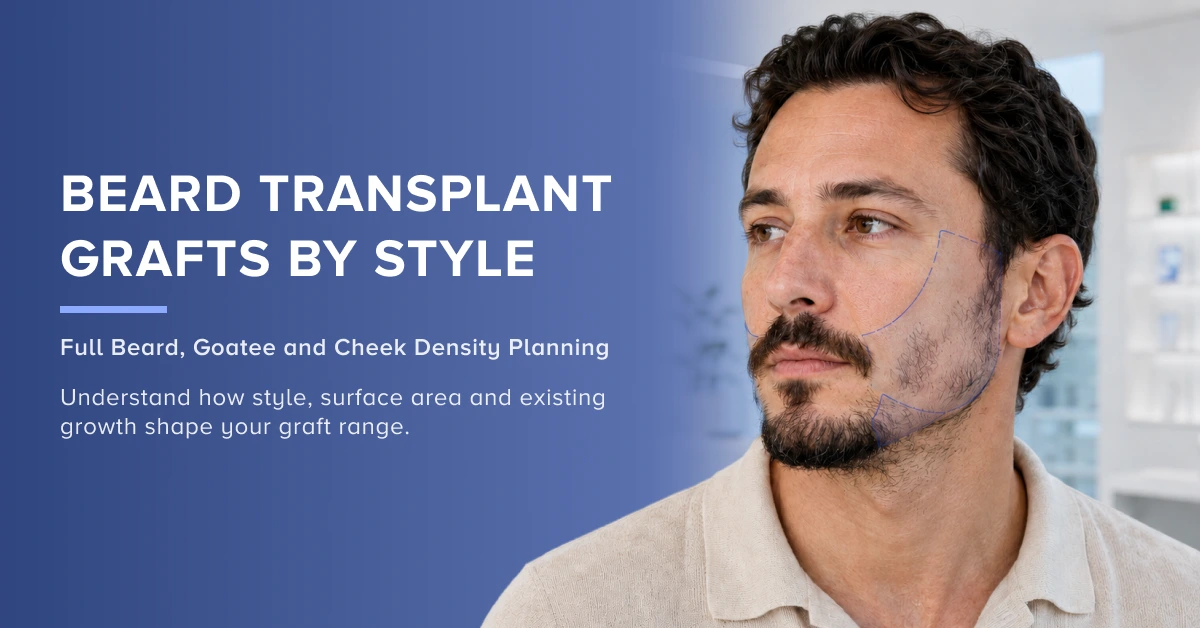
How Many Grafts Does a Beard Transplant Need by Style?
Beard transplant graft counts typically range from about 300–600 for a moustache to 2,500–4,500 for a full beard built from scratch, with goatees, cheeks and sideburns falling between those ranges. The table below compares beard transplant grafts by style and treated zone. Read it as a starting frame, then adjust for whatever already grows on your face.
Style or zone |
What the plan includes |
Typical total graft range |
Lower range fits |
Higher range fits |
|---|---|---|---|---|
Full beard from scratch |
Cheeks, jawline, chin, moustache, connectors, sideburn transitions |
~2,500–4,500 grafts (total) |
Compact borders, lower added density |
High cheek line, bare skin, dense target |
Goatee |
Chin plus moustache, often with connectors |
~800–1,500 grafts (total) |
Compact central design |
Wide circle beard, dense centre |
Chin-only beard |
Central chin pad, from below the lower lip to the chin edge |
~400–800 grafts (total) |
Small area, partial existing hair |
Broad chin, bare skin, high density |
Patchy cheeks |
Gap-filling across both cheeks |
~600–1,500 grafts (bilateral total) |
Small isolated gaps |
Large bare areas, raised cheek line |
Moustache |
Upper lip and philtrum edges |
~300–600 grafts (total) |
Narrow width, useful existing hair |
Full width, bare skin, dense target |
Sideburns |
Both sideburns and their transitions |
~300–700 grafts (bilateral total) |
Short, defined shape |
Long, wide, rebuilt from scratch |
Beard connectors |
Moustache-to-beard and chin-to-jaw links |
~100–300 grafts (total) |
Narrow gaps |
Wide gaps on both sides |
Footnote: clinical definitions of "full beard" and "goatee" differ between designs and clinics, so published figures vary widely. Always ask which zones a quoted number covers.

At Medart Hair Transplant, graft estimates are treated as design ranges until the recipient zones and donor area have been assessed. This page does not calculate price. Readers weighing up treatment in Turkey can review beard transplant cost and pricing factors separately.
Not sure whether your target style sits at the lower or the higher end of these ranges? Send clear front, side and donor-area photographs through the WhatsApp button in the bottom-right corner for a free initial assessment.
Graft Ranges for Full Beard, Goatee, Cheeks, Moustache and Sideburns
The most expensive planning mistake is adding rows together. Full beard grafts already cover the cheeks, jawline, chin, moustache, connectors and sideburns, and a goatee range already covers the moustache and usually the connectors. Standalone sideburn transplant grafts are quoted here as a bilateral total, as are cheek figures. Some clinics quote per-side numbers instead, which is how two honest estimates end up looking wildly different.
Building a beard from scratch is a different job from adding density to one that already exists. Sparse growth across half a cheek can cut the added grafts needed in that zone substantially, which is why native beard density is measured rather than eyeballed. A photo-based figure stays an initial estimate until surface-area measurement and donor assessment are complete. The International Society of Hair Restoration Surgery (ISHRS) advises that surgical hair restoration should follow evaluation by a qualified physician.
How Many Grafts for a Full Beard From Scratch?
A full beard transplant from scratch commonly requires about 2,500–4,500 grafts, although the final number depends on the cheek borders, jaw coverage, moustache, connectors, sideburns and target density. The table gives you a starting band. This section shows which design choices push a plan toward the top or the bottom of it.
The question of how many grafts for a full beard is really a question about surface area. A high, wide cheek line adds several square centimetres per side. Full jaw coverage and long sideburn transitions add more again. Published reviews of facial hair restoration make the same point consistently: recipient design, hair direction and donor characteristics have to be individualised before any number carries meaning.
"Before I assign a graft figure, I mark the upper cheek border, the jaw edge, the lower-lip zone and the sideburn transition, then measure each area. A 'full beard' drawn high on the cheekbone is a different surface area from one drawn two centimetres lower." — Dr. Busra Yakupoglu
Illustrative allocation only — not a prescription. One 3,200-graft full-beard design might be divided as:
● Moustache and connectors: 500 grafts
● Chin and lower-lip area, including the soul patch: 600 grafts
● Right and left cheeks combined: 1,400 grafts
● Jawline: 500 grafts
● Sideburn transitions: 200 grafts
That 200-graft sideburn figure covers transitions inside a combined design, not complete bilateral sideburn reconstruction as a standalone zone. The rest of the distribution shifts with native growth, cheek-line height, face shape and donor supply.
A dense look does not require identical density everywhere. Single-hair grafts may be selected for visible borders such as the cheek line and lip edge, where recipient sites must follow the natural angle and direction of nearby facial hair. Multi-hair grafts sit in the beard's core, where individual hairs are harder to pick out.
Most men who ask for maximum density are really asking for one thing: a beard that nobody reads as transplanted. Soft, slightly irregular borders achieve that far more reliably than a packed straight line. Results and graft survival vary with individual healing, hair characteristics, graft handling and technique, so plans are drawn conservatively rather than at maximum density.
Illustrative composite scenario — not an individual patient result. A man in his late twenties has thin moustache hair, almost no cheek growth and a bare jawline. He wants a broad, high cheek line with full jaw coverage, so all five zones need building. His planning band sits near the top of the range, around 3,800–4,500 grafts. Any request near 4,500 grafts needs formal recipient measurement and donor assessment before narrowing or staging is considered.

How Many Grafts for a Goatee or Chin-Only Beard?
A goatee usually needs about 800–1,500 grafts when it includes the chin and moustache, while chin-only coverage often falls around 400–800 grafts. Full-beard totals are driven by cheek area. Goatee totals are driven by shape and width around the mouth, which is why the numbers drop so sharply.
Chin-only: the central chin pad, from just below the lower lip to the lower chin edge, without the moustache or jaw.
Goatee: the chin plus the moustache, frequently with connectors linking the two.
Circle beard: a connected moustache-and-chin design forming a continuous ring around the mouth.
Goatee transplant grafts are quoted as one combined total. If a quote already covers the moustache, do not bolt a separate 300–600 moustache figure on top. That single error inflates both the plan and your donor calculation.
A wider circle beard uses more grafts than a compact central design, simply because the ring around the mouth covers more skin. Dense central chin coverage can also demand more grafts than its small footprint suggests. Fine single-hair grafts are usually preferred near the visible lip border, with the direction and angle of implantation matched to your own native pattern rather than a generic template.
Illustrative composite scenario — not an individual patient result. A man with an established moustache but a thin, uneven chin wants a compact goatee rather than full cheeks. Only the chin and connectors need work, at balanced density, so this is enhancement rather than construction. His planning band lands around 800–1,000 added grafts. Widening the design into a circle beard later would raise the count.

How Many Grafts to Fill Patchy Cheeks and Connect the Beard?
Filling patchy cheeks commonly takes about 600–1,500 grafts across both sides, but small isolated gaps may require substantially fewer grafts. A goatee plan treats a defined shape. Cheek work adds density into skin that already carries scattered growth, and mapping that growth is what keeps the count honest.
Cheek beard density grafts are planned around the gaps, not the whole cheek. Bilateral cheek treatment therefore begins with mapping the size and distribution of existing facial hair, because only the missing added density is calculated. Complete construction of two bare cheeks can exceed this range and usually belongs inside a wider full-beard design.
Count increases when:
● The planned cheek line sits higher on the face
● Bilateral gaps are large or the skin is fully bare
● The target added density is high
● One cheek is far sparser and symmetry work is needed
Count decreases when:
● Existing coverage is strong and evenly distributed
● Gaps are small and isolated
● The cheek line is kept low and close to the jaw
● Connector gaps are narrow
Moustache-to-beard connectors and the chin-to-jaw transition typically take roughly 100–300 grafts in total. Build them into the overall plan rather than adding them again on top of a full-beard or goatee figure. Direction and angle should match the surrounding hairs, because poor alignment disrupts visual coverage even when the numerical density is perfectly adequate.

Illustrative composite scenario — not an individual patient result. A man has a strong chin and moustache but sparse, patchy cheeks on both sides. He wants continuity rather than a heavy beard, at balanced density. His plan sits around 900–1,200 grafts bilaterally, well below any full-beard figure. Raising the cheek line at consultation would push it higher.
How Do Density Goals Change Your Graft Count?
Density changes the graft count by multiplying the measured treatment area by the planned number of added grafts per cm², then adjusting for existing hair and visual coverage. Cheek planning showed why existing growth matters so much. Here is the arithmetic sitting underneath it.
Grafts per cm² means the number of grafts planned within one square centimetre of recipient skin, and beard density per cm² is the working unit in most surgical plans. Hair calibre describes the thickness of each hair shaft. Visual coverage describes how full the beard looks, which can differ sharply from the raw graft total.
Planning tier |
Added graft density |
Best used for |
Important limitation |
|---|---|---|---|
Light enhancement |
~15–20 added grafts/cm² |
Thin but present growth, stubble effect, soft borders |
Illustrative planning band; can read as sparse on bare skin |
Balanced coverage |
~20–30 added grafts/cm² |
Most cheek, chin and jaw work |
Illustrative planning band; adjusted for calibre and curl |
Higher-density or focal |
~30–40 added grafts/cm² |
Small central zones, only where clinically appropriate |
Illustrative planning band; raises donor demand, needs clinical assessment |
Illustrative only — not a surgical plan. A 20 cm² combined cheek-gap area × 20–30 added grafts/cm² = approximately 400–600 added grafts, before adjustment for existing hairs, hair calibre and distribution. A larger bare area, wider gaps or a denser target moves the same cheeks toward the 600–1,500 bilateral planning range.
Hair characteristics change what each graft delivers. Coarse, curly or wavy hair may produce stronger visual coverage per graft, though hair-to-skin contrast cuts both ways: high contrast makes individual hairs more visible, and it makes any remaining gaps more obvious too. Fine, low-calibre hair may call for a revised density, distribution or design rather than simply tighter spacing.
Maximum possible density is not automatically advisable. Dense packing is a recognised concern for blood supply and graft survival, and the ISHRS emphasises that recipient-site planning belongs with a qualified surgeon. Excessive recipient-site density, like excessive donor harvesting, can raise clinical risk rather than improve the result.
Distribution, direction and graft selection often matter more than the raw total. You can estimate your starting graft range , with an online tool though no calculator can measure your recipient area or confirm donor suitability.

Can Your Donor Area Supply the Beard Style You Want?
Your beard design is feasible only if the donor area can supply the planned grafts without creating visible depletion or compromising future hair-restoration options. Density goals set the demand. The donor area sets the ceiling, and the requested graft count is never automatically the safe harvest count.
Occipital scalp hair is commonly assessed first, usually with follicular unit extraction (FUE) in mind. Other potential donor sources require individual compatibility and safety assessment rather than routine use. Overharvesting is a well-documented cause of visible donor thinning, patchiness and scarring, which is exactly why safe donor supply is calculated before a beard design is approved.
Donor feasibility checklist:
● Available safe donor supply across the whole donor zone
● Follicular unit density, sometimes assessed with trichoscopy
● Hair calibre and shaft thickness
● The ratio of single-hair grafts to multi-hair grafts
● Hair-to-skin contrast and how donor hair will blend with facial hair
● Future scalp hair-loss risk, including likely Norwood progression
● The size of the beard recipient area you are asking to cover
Book a clinical assessment rather than planning alone if you can see scalp through the donor area, if measured donor density is low, or if future scalp hair loss worries you. Long-term reservation of donor hair is a clinician-led decision, not a calculator output. Scarring, active facial skin disease or unexplained facial-hair loss should be medically assessed before any beard design is drawn.
Come prepared. Unedited front, side and three-quarter photographs in natural light, a clear photo of the back and sides of your scalp, a short note on your medical history and medications, and any family history of hair loss will make a first assessment far more useful than photos alone.
At Medart Hair Transplant, assessment weighs the requested beard design against safe donor availability. A large full-beard plan may be narrowed, prioritised or staged instead of harvested in one session. If you are unsure about your own capacity, read how the donor area is assessed. The American Academy of Dermatology (AAD) notes that hair transplantation is surgery and requires evaluation by a qualified doctor.
If you know the beard style you want but are unsure whether your donor area can support it, use the WhatsApp button in the bottom-right corner. Our team will run a personalised graft-range review with you.

How Do You Match Your Graft Plan to Your Face Shape?
Face shape affects graft count indirectly because changing the cheek-line height, beard width, jaw coverage or chin length changes the total recipient surface area. Donor supply sets your upper limit. Face shape only influences how that supply is best spent, and the table below shows how design emphasis moves the treated area.
Face shape |
Possible design emphasis |
Potential graft-count effect |
|---|---|---|
Oval |
A range of cheek and chin proportions may be considered |
Effect depends mainly on the chosen boundaries |
Round |
Compact cheek width with controlled chin emphasis may suit |
May decrease if cheek width is narrowed |
Square |
Jaw corners and a clean cheek line may take more emphasis |
May shift allocation toward the jawline zone |
Oblong |
Cheek width may be emphasised while chin length is limited |
May increase if broader cheeks are selected |
These are design considerations, not medical rules. Personal preference, native growth and anatomy carry far more weight than any face-shape chart.
"Patients arrive with a face-shape rule they read online, and it rarely survives the mirror. I plan around three measurable things: what already grows, how much surface area the requested borders create, and what the donor area can safely give." — Dr. Busra Yakupoglu
Facial symmetry deserves surface-area measurement rather than guesswork. Most faces are slightly asymmetric, and one cheek usually carries more native hair than the other. Adding indiscriminate density to both sides can exaggerate that difference instead of balancing it.
A personalised clinical assessment brings the three variables together: measured recipient area, mapped existing facial hair and verified safe donor supply. The NHS (nhs.uk) advises checking the qualifications and registration of any surgeon before cosmetic surgery, at home or abroad.
Recipient surface area, existing growth and donor supply matter far more than any generic face-shape rule, which is why beard transplant grafts by style should be read as a starting frame rather than a quote. A photo estimate stays provisional. It is not a surgical plan.
For a style-specific estimate based on your existing beard, face shape and density goal, contact Medart Hair Transplant through the WhatsApp button in the bottom-right corner for a free consultation. You will get an honest planning range, not a sales pitch.
Measure the zones first; only then does a graft total become meaningful.
