
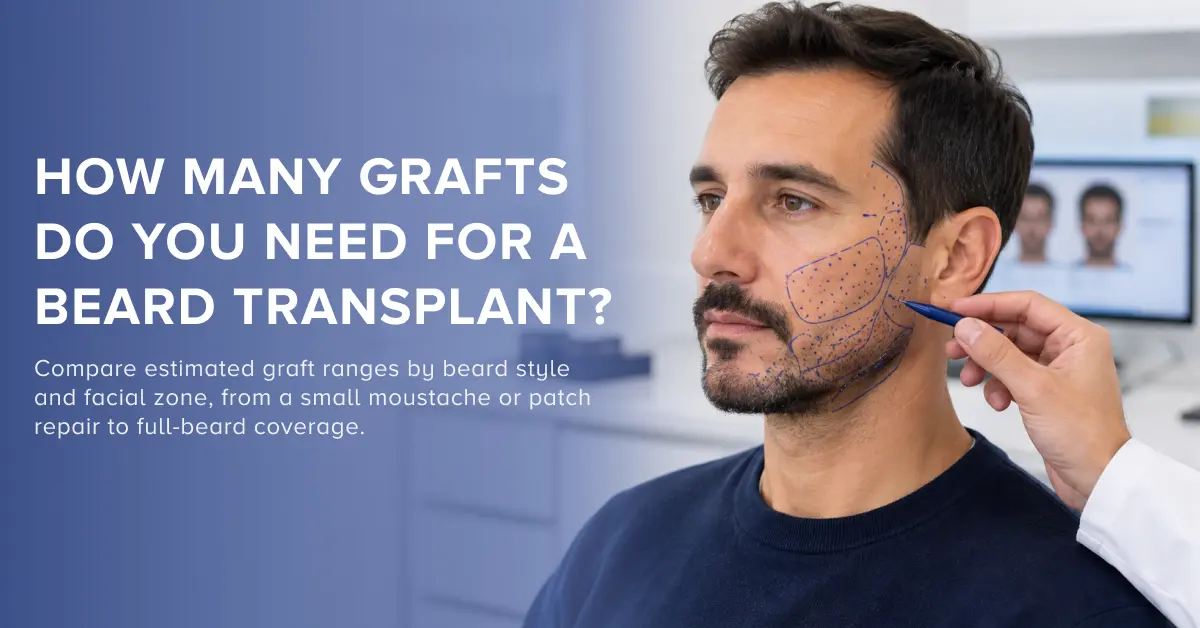
"Full beard" is not a graft number. Two men can walk in asking for the same style and leave with plans that differ by 2,000 grafts. One is filling narrow gaps between hairs that already grow; the other is building cheeks, jawline, chin and moustache from sparse growth. That is why the beard transplant grafts needed vary so widely, and why a style name tells a surgeon almost nothing. This article splits the face into zones, gives surgeon-reviewed planning ranges for each, and shows how to turn measurements into a preliminary estimate before you request a quote.
Key Takeaways
● Local repairs can use a few hundred grafts; a broad full beard often needs a few thousand.
● A graft is a follicular unit, not necessarily one hair.
● Style ranges must be adjusted for area, existing hair, and donor capacity.
● Only a surgeon can confirm the final graft plan after evaluating the face and donor area.

How Are Beard Grafts Counted Compared to Scalp Grafts?
Beard and scalp transplants both count follicular-unit grafts, but one graft can contain one or several hairs, so graft count and hair count are not interchangeable. Those three tiers only make sense once grafts and hairs are separated. Get this distinction right and you can compare two quotes that show identical numbers but describe different amounts of hair on your face.
Definitions:
● Graft: one transplanted follicular unit, placed into the recipient area, which is the facial skin receiving the grafts.
● Hair: an individual hair shaft growing from a follicular unit.
● Follicular unit: a naturally occurring grouping of follicles that can contain one or more hairs.
Put plainly, a graft is like a small naturally grouped hair unit, while the hairs are the individual strands growing from that unit.
Rassman and colleagues, writing in Dermatologic Surgery in 2002, defined follicular unit extraction (FUE) as the removal of individual follicular units directly from the donor area. FUE is one of the harvesting methods commonly used for facial hair work today.
Selection matters as much as the total. In my practice, single-hair grafts are prioritised along the visible beard outline and at transitions, because a two-hair graft at the border can create a harder edge where hair meets bare skin. Selected two-hair grafts then add bulk in central zones such as the moustache and chin.
Two clinics can therefore quote the same graft number while planning different hair counts and a different graft distribution. Never convert a graft quote into a hair count without the clinic's own graft-composition data. For procedural background, see our guide to how a beard transplant is planned and performed.

How Many Grafts for Each Beard Style?
Typical planning ranges vary from roughly 300–500 grafts for a moustache and 700–1,200 for a moustache-and-chin goatee to approximately 2,000–3,500+ grafts for a full beard. Once grafts and hairs are separated, the next question is where the grafts go. The table below sets out the beard transplant grafts needed by facial zone, so you can build an estimate instead of guessing from a style name.
Read three details carefully. Sideburn figures are quoted per side, while cheek and jawline figures cover both sides. Each goatee row states whether the moustache is included, because that single detail can shift an estimate by several hundred grafts. Medart Hair Transplant's Istanbul clinical team reviewed and approved every range below before publication.
Full Beard, Goatee, Cheeks, Moustache and Sideburns Graft Table
Beard style or zone |
Anatomical coverage |
Preliminary planning range |
Existing/patchy coverage adjustment |
Counting note |
|---|---|---|---|---|
Small isolated patch |
One limited gap, thin spot or scar |
100–300 grafts |
Base the figure on the measured patch area |
Per treated patch |
Moustache |
Upper lip only |
300–500 grafts |
Often lower when native growth remains |
Total |
Chin/soul patch |
Central chin and lower-lip area |
300–600 grafts |
Reduce for retained central growth |
Total |
Goatee without moustache |
Chin plus central lower-lip region |
400–800 grafts |
Depends on width and existing chin hair |
Total |
Goatee with moustache |
Moustache, both connectors and chin |
700–1,200 grafts |
Connector gaps may add to the estimate |
Total |
Sideburns |
Temple-to-ear facial strip |
200–350 grafts per side |
Existing sideburn borders reduce the need |
Per side |
Both cheeks |
Bilateral cheek coverage |
800–1,500 grafts |
Patch filling may need far fewer |
Both sides |
Jawline |
Bilateral mandibular border, the lower jaw edge |
600–1,200 grafts |
Depends on width and neck boundary |
Both sides |
Patchy existing beard |
Selected gaps across one or more zones |
200–1,000 grafts |
Measure only the under-covered areas |
Total varies |
Full beard |
Moustache, chin, jawline and both cheeks |
2,000–3,500+ grafts |
Lower when strengthening existing growth |
Both sides, defined zones |
"Full beard" includes moustache, chin/goatee region, jawline, and bilateral cheek coverage in this article. Sideburns may be included or planned separately. Ranges are surgeon-reviewed planning estimates, not guaranteed surgical recommendations.
The ranges overlap on purpose. Faces differ in size, and two men who both say "goatee" may draw borders 2 cm apart. Do not calculate a full-beard total by adding every maximum in the table, because the zones share boundaries and adding maximums double counts the same skin.
Existing facial hair pulls estimates down, sometimes sharply, since grafts are placed only where coverage is missing. A broad, densely planned design on a large face with little native growth can exceed the listed full-beard range. Every figure still requires surgeon confirmation once the face and donor area have been examined. The moustache row shows the moustache transplant grafts range for the upper lip alone; the bilateral row covers cheek beard transplant grafts across both sides.
Compare two cheek plans. A man with scattered cheek hairs may need grafts only in the thin strips between them. A man with almost no cheek growth needs the whole recipient area covered plus a designed border, so his estimate sits nearer the upper end.
Scenario one. A patient has a dense moustache and solid chin growth, but the connectors between them are thin on both sides. Only those two narrow strips are under-covered, so the measured recipient area is small. His planning range sits far below that of a man building a complete goatee from bare skin, even though both request the same style name. This example is illustrative and is not a guaranteed graft plan or result; individual plans differ after donor and recipient assessment.
Not sure whether your goal counts as a goatee, cheek fill, or full beard? Use the WhatsApp button in the bottom-right corner to share clear front and side photos for a free personalized assessment.

What Affects Your Beard Graft Count?
Beard graft count is driven by the uncovered surface area, existing hair, desired outline and density, hair characteristics, symmetry, and any scarring in the recipient skin. The table gives a starting range, not a final number. These factors decide which end of that range applies to you.
Fewer grafts are usually needed when:
● Treatment area: small, clearly bounded under-covered zones.
● Existing facial-hair density: good, with only gaps to fill.
● Border width and style: a narrow, conservative beard outline.
● Hair caliber: coarse hair shades more skin per graft.
● Hair curl: moderate curl adds apparent volume.
● Hair-to-skin contrast: low contrast softens thin areas.
● Scars or skin changes: healthy skin with no textural change.
● Facial symmetry: even sides needing little corrective blending.
More grafts are usually needed when:
● Treatment area: wide cheeks reaching high toward the eye.
● Existing facial-hair density: sparse or absent across whole zones.
● Border width and style: a wide, sharply defined beard outline.
● Hair caliber: fine hair covers less skin per graft.
● Hair curl: straight hair lying flat against the skin.
● Hair-to-skin contrast: dark hair against pale skin.
● Scars or skin changes: recipient scarring or altered skin texture.
● Facial symmetry: noticeably uneven growth needing blending.

"Two men can ask for the same goatee and need very different numbers. I map each facial zone, measure the under-covered skin, then check what the donor area can safely supply. The style label is the last input, not the first." — Dr. Busra Yakupoglu, Hair Transplant Surgeon
Before any final count is confirmed, I mark the moustache, cheeks, chin, jawline and sideburns separately, with the patient sitting upright in normal light. At Medart Hair Transplant in Istanbul, that mapped surgeon design drives the number, not the style name.
Safety note: Patchy beard growth can have medical causes and should not automatically be treated surgically. Sudden, circular, inflamed, itchy, painful, scarred or worsening facial-hair loss needs assessment by a dermatologist or another qualified clinician. The NHS advises seeing a doctor when hair loss is sudden, patchy, or comes with skin symptoms.
The American Academy of Dermatology describes alopecia areata as causing round, well-defined patches of hair loss, including in the beard. Suspected alopecia areata or active inflammatory or scarring disease may make transplantation unsuitable until the condition is diagnosed and stable.
Can Your Donor Area Supply Enough Beard Grafts?
A safe beard plan cannot use more grafts than the donor area can provide without creating unacceptable thinning or compromising future scalp restoration. Density targets only work if supply allows. These are the constraints that quietly shape most beard designs.
Suitable scalp donor hair is commonly used for beard transplantation, often from the occipital donor area at the back of the head. Donor capacity is never assumed. Density, caliber, thinning, previous extraction and the planned harvesting pattern are all assessed first.
Donor assessment checklist:
● Donor density: follicular units available in each cm² of donor scalp.
● Hair caliber: finer donor hair covers less skin per graft.
● Prior surgery: a previous hair transplant reduces remaining capacity.
● Extraction pattern: grafts spread evenly to keep the area uniform.
● Future scalp needs: progressive scalp loss may require grafts later.
● Style priority: a large beard design can mean a smaller scalp plan.
The International Society of Hair Restoration Surgery treats donor supply as finite and stresses managing it across a patient's lifetime. Overharvesting can leave donor-area thinning or a moth-eaten appearance that is difficult to correct. Safe harvesting therefore caps the number of beard grafts available, whatever the design asks for.
Some patients are advised to reduce the design or stage the work across sessions. Body hair may be discussed in selected cases, but it is not universally interchangeable with scalp donor hair and needs specialist evaluation. Graft survival and final density cannot be guaranteed in any plan.
If both goals matter to you, read our guide to planning a combined beard and scalp transplant. For the technical side, see how donor-area capacity is assessed.
If you are considering both beard and scalp restoration, a clinician should assess how to prioritize your donor supply. Send your photos through the bottom-right WhatsApp button for a free initial review.

How Do You Estimate Your Own Beard Graft Number?
To estimate beard grafts, measure only the under-covered parts of each facial zone, multiply the area by a provisional planning density, and adjust for existing hair and hair characteristics. Cost follows scope, and scope follows measurement. This method gives you a defensible range before any consultation, and a way to question any quote that looks odd.
This beard graft calculator method works from facial zones, not from scalp hair-loss stages. If you also want an estimate for the head, use our separate scalp hair graft calculator.
Quick version: measure the under-covered zones, apply a planning-density range, then send photos for clinical confirmation.
1. Choose your target beard style and draw its intended borders on a photograph.
2. Divide the design into moustache, chin, cheeks, jawline and sideburn zones.
3. Measure or approximate each under-covered zone in cm².
4. Separate bare skin from areas that already hold usable native beard hair.
5. Apply a surgeon-reviewed provisional planning-density range to each zone.
6. Add the zone totals, avoiding double counting where zones overlap.
7. Apply a correction factor for hair caliber, curl, contrast, scars and asymmetry.
8. Submit clear front, both-side and under-chin photos for a clinical estimate.
Estimated grafts = under-covered area in cm² × provisional graft density, adjusted for existing hair and hair characteristics.
Illustrative calculation only. A fictional patient measures four under-covered zones: right cheek 18 cm², left cheek 16 cm², jawline 12 cm² and chin connectors 4 cm². The total under-covered area is 50 cm². At an illustrative planning density of 20–25 grafts per cm², the raw estimate is 1,000–1,250 grafts.
His hair is fine and straight, so a surgeon may adjust that range upward at assessment. The size of any correction factor is a clinical judgement, not a fixed percentage. Those density figures are illustrative rather than a medical standard, and a clinical team must supply or validate the density input for your face, skin and hair type.
For a personalized surgical assessment, share front, both-side and under-chin photos in natural light, plus one reference image of the beard style you want.
A medical consultation is required before you rely on a self-estimate in several situations. Those include scars, active or painful skin symptoms, unexplained patchiness, and a previous hair transplant. They also include limited donor hair, a large full-beard goal with little native growth, uncertainty about beard boundaries or facial symmetry, and plans for future scalp restoration.
"Photographs and area measurements give me a preliminary range. They cannot replace direct assessment of the donor area and recipient skin, which is where the final graft plan is confirmed." — Dr. Busra Yakupoglu, Hair Transplant Surgeon
Graft survival and final density cannot be guaranteed, whatever the number on the page.
