
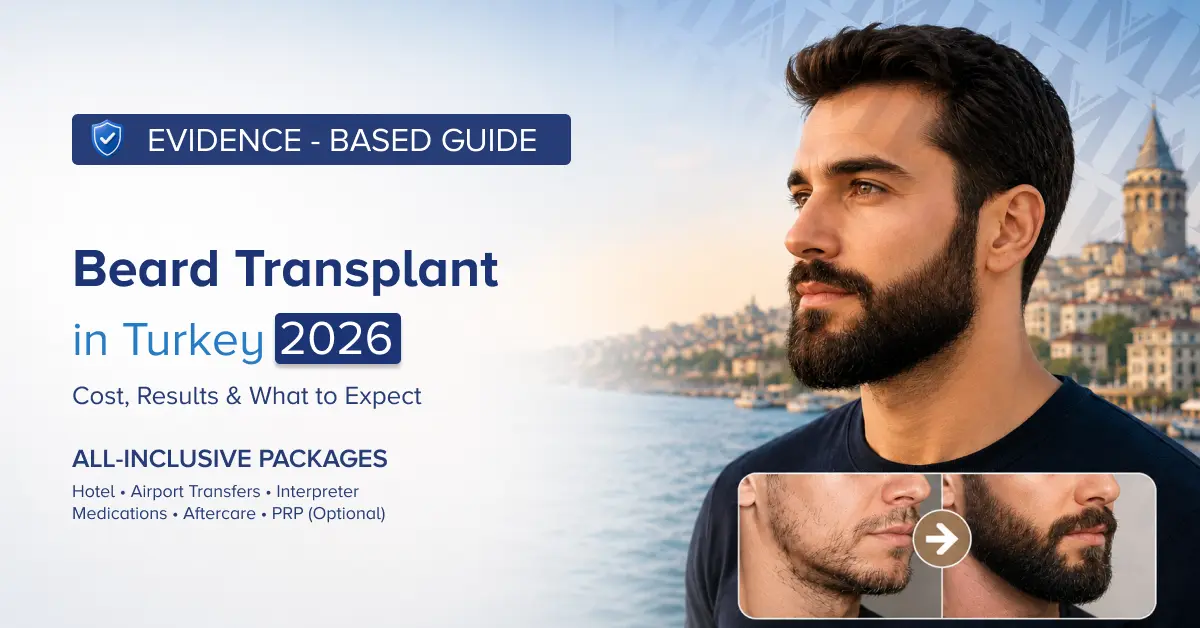
What Is a Beard Transplant and Why Turkey Leads in 2026?
A beard transplant is a minimally invasive procedure that moves hair follicles from a donor area, usually the back of the scalp, into the beard region to create fuller, lasting facial hair. In 2026, Turkey remains one of the world's leading destinations for this treatment thanks to its experienced surgeons and competitive package pricing.
A beard transplant takes individual hair roots (hair follicles) from the back or sides of the scalp and implants them into the mustache, cheeks, jawline, goatee, or sideburns. Each tiny group of 1–4 hairs is called a graft — picture a small plug of soil with a healthy plant that can be moved from the back garden to the front.
● Beard transplant = transplanting scalp hair follicles into the beard area under local anesthesia to restore or enhance facial hair.
Modern beard transplants are usually performed with one of two techniques:
● Follicular Unit Extraction (FUE): Individual follicular units are punched out from the donor area, leaving tiny dot micro-scars that are usually hidden by surrounding hair once healed.
● Direct Hair Implantation (DHI): A variation of FUE where follicles are loaded into an implanter pen and placed directly, which helps with precise angle and density, especially in smaller or detailed areas.
Both FUE and DHI are minimally invasive and done under local anesthesia. You are awake, but the skin is numbed throughout.
Turkey, and Istanbul in particular, has become a central hub for hair and beard transplantation as part of global medical tourism. The International Society of Hair Restoration Surgery (ISHRS) lists Turkey among the countries performing the highest volumes of hair restoration procedures worldwide, reflecting both demand and surgeon experience. Lower operating costs than in Western Europe or North America allow accredited Istanbul clinics to offer surgeon-led care at a lower price point, without that automatically meaning lower quality.
Once the transplanted grafts have healed and started to grow, results are generally permanent once the grafts have taken, provided your donor hair is stable and no new medical condition develops that affects hair growth.
For a more technical description of the surgery itself, you can also read our detailed beard transplant overview.

How Much Does a Beard Transplant Cost in Turkey in 2026?
In 2026, most reputable clinics in Turkey charge in the low- to mid-four-figure EUR equivalent range for a beard transplant, with the final price depending mainly on how many grafts you need, the technique used, and what is included in your treatment package.
Cost is a primary reason many international patients look at Istanbul, so it helps to understand how beard transplant Turkey cost is usually structured rather than fixating on one exact number. Analyses of international health spending by bodies such as the OECD and WHO consistently show hair restoration procedures in Turkey costing significantly less than in the UK, Western Europe, or the US, largely because of lower staff and facility overheads — not lower clinical standards. Similar beard procedures in the UK or US often cost several times more than typical Turkish package prices, especially when priced strictly per graft.
Clinics in Istanbul usually structure beard transplant Turkey cost in two main ways:
● Per-graft pricing: A set fee per graft, sometimes with a minimum. More common for local patients or very small cases.
● Package pricing: A fixed price covering a graft range plus hotel, transfers, translator, medications, and sometimes PRP.
A simple way to think about pricing is to look at what drives it:
Factor |
How It Affects Cost |
|---|---|
Graft count |
More grafts mean longer surgery time and a higher price within a package range. |
Technique (FUE vs DHI) |
DHI and complex designs can be slightly more expensive than standard FUE. |
Surgeon experience |
Highly experienced, board-certified surgeons usually charge more than newer providers. |
Clinic reputation |
Accredited Istanbul clinics with strong reviews often sit at the higher end of ranges. |
Package inclusions |
A 4–5* hotel, VIP airport transfers, translator, and PRP can lift the package price. |
Typical package inclusions for international beard transplant patients in Istanbul often include:
● 2–3 nights in a partner hotel.
● Airport–hotel–clinic transfers.
● A translator or English-speaking coordinator.
● Pre-op blood tests and the procedure itself under local anesthesia.
● Basic post-op medications such as antibiotics, painkillers, and anti-swelling drugs.
● The first hair wash and follow-up check.
● Sometimes PRP (Platelet-Rich Plasma) treatment to support graft health.
You should also budget for:
● Flights, which vary widely by country and season.
● Extra nights in Turkey if you prefer more recovery time before flying.
● Currency fluctuations between TRY, USD, EUR, and GBP.
● Any follow-up care at home if needed.
You can read more about general transplant pricing logic in how hair transplant costs in Turkey are calculated , which applies in a similar way to beard procedures.
If you'd like a personalised estimate based on your photos and goals, message the Medart medical team through the WhatsApp button in the bottom-right corner of this page for a no-obligation graft estimate and cost range.

Beard Transplant Before and After: What Results to Expect
After a beard transplant in Turkey, most patients see transplanted hairs shed within the first month, early regrowth from around three months, and their final before-and-after result with stable, permanent-looking density between 9 and 12 months.
Once you have a sense of graft numbers, the next question is usually what kind of visible change you can realistically expect.
Before a beard transplant, common starting patterns include:
● A thin, "broken" mustache that doesn't connect at the centre or sides.
● An uneven goatee with a gap under the lower lip.
● Patchy beard coverage on the cheeks, especially along the jawline.
● Localised facial hair loss from acne scars or trauma.
After a well-planned FUE or DHI beard transplant, the typical "after" picture looks like:
● A continuous mustache that can connect to the beard if you choose that style.
● Even coverage along the jawline and around the corners of the mouth.
● Filled patches on the cheeks and sideburns, so the face is better framed.
● In scar cases, hair that softens and camouflages the scar's appearance.
Surgeons pay close attention to hair direction and angle when creating channels and placing grafts. Beard hair grows at shallow angles, and the direction shifts around the chin, jaw, and sideburns — unlike the more vertical pattern on the scalp. Matching those angles is the difference between a natural beard and a "planted" look.
The growth and recovery timeline usually follows this pattern:
● 0–7 days: Redness, mild swelling, and small crusts around each graft in the beard area. The donor area shows tiny red dots that darken and start to heal.
● 2–4 weeks: Most transplanted hairs shed. This phase affects hairs, not the follicles — the roots remain under the skin.
● 3–6 months: New hairs begin to push through. The beard looks uneven at first, then gradually fills, much like grass slowly thickening in a newly seeded lawn.
● 9–12+ months: Final density and shape are usually visible. Individual hairs continue to thicken and mature in texture.
Clinical reviews published in journals such as Dermatologic Surgery describe high patient satisfaction and good graft survival in FUE beard transplantation when procedures are done by trained hair transplant surgeons using established protocols and sterile technique. Exact percentages vary between studies, but most patients who follow aftercare instructions enjoy substantial and natural-looking improvement.
Once healed, the transplanted hair behaves like scalp hair growing in the beard region and is generally permanent once the grafts have taken, assuming your donor hair remains stable. You can trim, shape, or shave it like a natural beard, and it will grow back according to its new pattern.
To complement these written descriptions, see beard transplant before and after photos in clinic galleries — they help set realistic expectations for density based on your starting point.

Recovery, Pain, and Risks: Is a Beard Transplant in Turkey Safe?
For most healthy patients, a beard transplant done in an accredited Turkish clinic is a low-risk procedure with modest pain, a few days of visible redness and swelling, and small but real risks such as infection, poor growth, or unnatural angles if it isn't performed properly.
Knowing what recovery and risks truly look like helps you set realistic expectations and choose a safe provider. National health services such as the NHS describe FUE hair transplantation as a minor surgical procedure, noting that serious complications are uncommon when it is performed in licensed facilities by trained professionals under appropriate hygiene standards.
Pain and discomfort. During surgery, local anesthesia numbs the donor and beard areas. Most patients report mild pressure or tugging rather than strong pain. Once the anesthetic wears off, expect soreness in the donor area and a tight feeling in the beard region for a few days. Standard painkillers prescribed by the clinic usually control this discomfort.
Typical recovery course. In the first 3–5 days, you can expect redness, swelling (sometimes around the cheeks and eyes), tightness, and small crusts around each graft. By days 5–7, swelling subsides and crusts begin to fall off with proper washing. Many patients feel "socially normal" enough for non-physical desk work after about 5–7 days, especially if they're comfortable with some residual redness. People with lighter skin phototypes often notice redness for slightly longer; darker skin types may show more subtle colour changes.
Possible issues and how they are handled:
Possible issue |
How common |
How it is managed |
|---|---|---|
Swelling around cheeks/eyes |
Very common, temporary |
Head elevation, anti-swelling meds; resolves in a few days. |
Redness and itching |
Common |
Soothing sprays, proper washing; settles over 1–2 weeks. |
Folliculitis (inflamed follicles) |
Occasional |
Warm compresses, topical or oral antibiotics if needed. |
Infection |
Rare in accredited clinics |
Prompt antibiotics and wound care; prevented by sterile technique. |
Shock loss of nearby hairs |
Occasional |
Usually temporary; regrowth over several months. |
Poor growth or patchiness |
Uncommon in experienced hands |
Often improves with time; occasionally a small touch-up. |
Noticeable scarring |
Rare with FUE/DHI |
FUE leaves tiny dot micro-scars hidden by surrounding hair. |
Dermatology and plastic surgery societies, including the American Academy of Dermatology, note that serious adverse events after FUE-type hair restoration are rare when procedures are carried out in properly equipped, licensed clinics with trained surgeons and teams.
Some people require extra caution:
● Patients with uncontrolled diabetes, bleeding disorders, or very high BMI.
● Heavy smokers or those on blood-thinning medication.
● People with a history of hypertrophic scars or keloids.
● Individuals with significant heart, lung, or blood pressure problems.
These conditions don't automatically exclude you, but they must be discussed openly with your surgeon and, ideally, your own doctor. In some cases, you may be advised to delay or avoid surgery.
This information is for general education only and cannot replace a consultation with a qualified physician who knows your medical history. If you have chronic health conditions or take regular medication, discuss them with your own doctor and your Turkish surgeon before booking a beard transplant.

How to Choose a Reputable Beard Transplant Clinic in Turkey
To choose a safe beard transplant clinic in Turkey, focus on named surgeon experience, clinic licensing and hygiene, realistic communication about graft numbers and results, and verified before-and-after cases — rather than simply chasing the lowest price.
Because Turkey and Istanbul are so popular for hair restoration, you'll see a wide spectrum of clinics, from surgeon-led centres to high-volume "hair mills" where unqualified technicians may perform most of the work. The ISHRS has warned globally about black-market hair transplant operations in several countries, including Turkey, where non-physicians sometimes perform surgery without adequate supervision.
Use this clinic selection checklist when comparing Istanbul providers:
● Named, experienced surgeon: Look for a doctor whose name, qualifications, and board-certified specialty (often dermatology or plastic surgery) are clearly stated.
● Licensed, accredited clinic: The facility should be registered with the Turkish Ministry of Health and operate in a hygienic environment with proper operating rooms.
● Surgeon involvement and planning: A proper pre-op consultation, medical history review, and surgeon-led beard design — not just a quick sales call.
● Transparent plan and pricing: Clear discussion of estimated grafts, technique (FUE or DHI), realistic outcomes, and possible complications. Avoid clinics that promise flawless results or use pressure tactics.
● Realistic before/after evidence: High-quality photos showing consistent, natural beard transplant results across different skin types and beard patterns.
● Independent reviews: Feedback on external platforms or patient forums, not only testimonials on the clinic's own website.
Medart Hair Transplant in Istanbul aims to sit on the surgeon-led side of this spectrum, with emphasis on medical assessment, conservative donor management, and long-term follow-up with international patients via WhatsApp. Whichever clinic you ultimately choose, applying the same safety and transparency criteria will help you avoid unsafe or overly commercial providers.
