
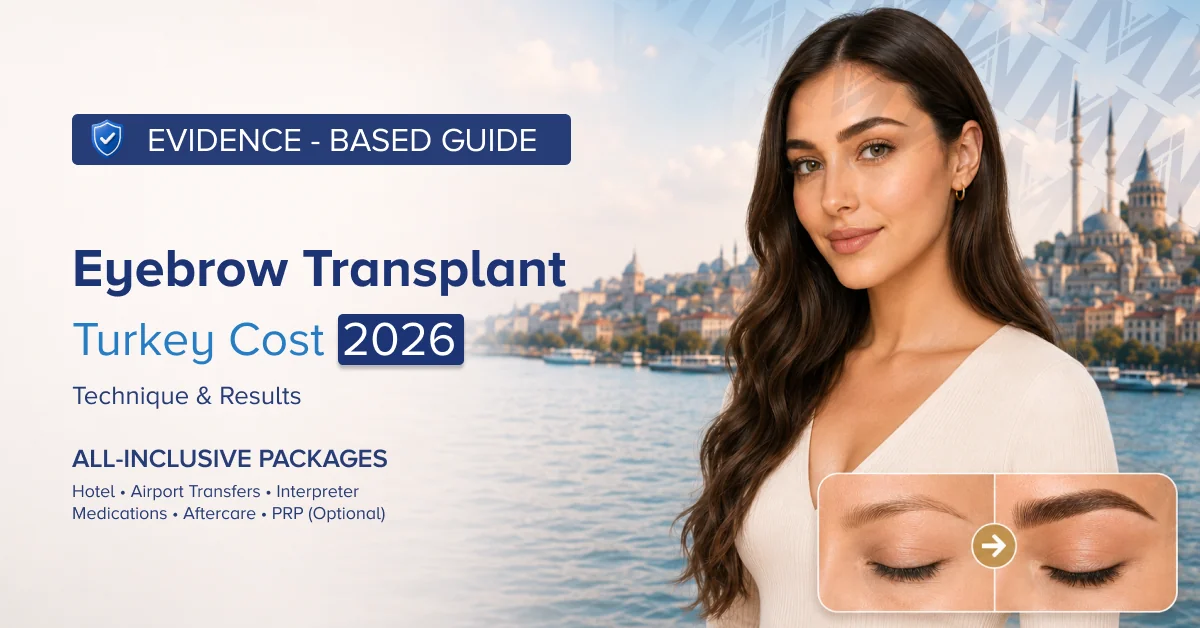
What Is an Eyebrow Transplant and How Does It Work?
An eyebrow transplant is a minor surgical procedure where individual hair follicles are taken from a donor area, usually the back of the scalp, and carefully implanted into the eyebrows to restore or enhance their shape and density.
Eyebrow transplant differs from a general hair transplant because the area is smaller, more visible, and the aesthetic demands are higher. Each hair must be placed at the correct angle and direction to mimic natural eyebrow growth and facial expression rather than scalp patterns.
According to the American Academy of Dermatology, hair transplantation is a well-established technique that moves your own follicles from one part of the body to another to restore hair growth. In Istanbul hair transplant clinics, this principle is adapted to the delicate eyebrow area with smaller grafts and more detailed design work.
Eyebrow transplant (definition):
A follicular unit hair restoration procedure for the eyebrows using scalp hair as donor, performed under local anesthesia, in which individual hair follicles are implanted into the brow area to improve density, shape, and symmetry.
During an eyebrow restoration, the hair transplant surgeon typically:
● Designs the eyebrow shape to match your face, including arch, length, and symmetry.
● Selects thin hairs from the donor area, usually the back or sides of the scalp, where hair tends to be permanent.
● Extracts follicular units (small groups of 1–4 hairs) and chooses mainly single-hair grafts for a soft, natural brow line.
● Implants each follicle at a very shallow angle to follow the natural growth angle and direction of eyebrow hair.
This process includes a consultation, design and planning, harvesting the grafts, implanting them, and structured aftercare during the recovery period. For more photos and clinic-specific details, you can visit our full eyebrow transplant service page.

How Much Does an Eyebrow Transplant Cost in Turkey in 2026?
In 2026, a full eyebrow transplant for both brows in Turkey typically falls within a mid-range cosmetic price band, with most packages in the mid three-figure to low four-figure euro or pound equivalent range depending on graft number, surgeon expertise, and what is included.
Now that you understand the basic procedure, the next question is usually eyebrow transplant Turkey cost and what you actually receive for the money. Turkey remains one of the most affordable destinations for hair restoration, including eyebrow procedures, without automatically sacrificing quality.
International health tourism reports and global hair transplant surveys, including those from the ISHRS, indicate that Turkey can be roughly 50–70% cheaper than many Western countries for hair transplant procedures. This difference mainly reflects lower clinic overheads and labour costs, not lower medical standards, provided you choose a reputable centre.
For eyebrow transplants, this usually means a typical 2026 cost range for both brows equivalent to about €800–€2,000. Exact figures vary by clinic, exchange rate, and package structure, so any online quote should be treated as approximate until a doctor assesses your photos or examines you in person.
Cost Factors Specific to Eyebrow Transplants
Several factors influence the price you pay for an eyebrow transplant in Turkey:
● Number of grafts: More extensive thinning or full reconstruction needs more grafts, which raises the fee.
● Surgeon's experience and reputation: A board-certified, eyebrow-focused surgeon usually charges more than a generalist.
● Clinic standards and location: Central Istanbul clinics with high-end facilities and strong clinic accreditation may charge more than small centres.
● Package vs. bare procedure: Some offers include accommodation, airport transfers, and translation services, while others cover only the surgery.
● Additional treatments: Extras such as PRP (Platelet-Rich Plasma) therapy sessions or combined procedures, like scalp or beard transplant, can add to the total.
In Turkey, many hair transplant clinics offer medical tourism packages that bundle:
● Surgery fee and clinic services.
● Local anesthesia and basic medications.
● Airport transfers and sometimes a set number of hotel nights.
● Translation or patient coordinator support.
● Follow-up advice via WhatsApp or email.
What is often extra includes:
● Flights to and from Istanbul.
● Hotel nights beyond what the package covers.
● Additional treatments like PRP, skin care, or cosmetic dentistry.
● Long-term medications for unrelated health conditions.
Turkey vs. Other Countries: Is It Really Cheaper?
Turkey is usually significantly cheaper than the UK, US, and much of the EU for eyebrow transplant, while still offering experienced surgeons and high surgical volume. That doesn't mean every cheap offer is safe, so look beyond price.
Public information from the NHS and major US centres such as the Mayo Clinic and Cleveland Clinic shows that cosmetic hair restoration is almost always self-funded and can reach several thousand pounds or dollars. By comparison, eyebrow transplant in Turkey generally costs a fraction of that, especially for international patients who take advantage of medical tourism packages.
Here is an approximate comparison for a full eyebrow transplant for both brows:
Location |
Typical price range for eyebrow transplant |
What's usually included |
|---|---|---|
Turkey |
Mid three-figures to low four-figures (euros/GBP equivalent) |
Surgery, local anesthesia, basic meds, many include transfers and 1–3 hotel nights |
UK |
Often low to mid four-figures (GBP) |
Surgery only; consultations, tests, and medications sometimes extra |
US |
Often mid to high four-figures (USD) |
Surgery and basic meds; travel and accommodation at patient's expense |
EU (avg.) |
Often low to mid four-figures (euros) |
Surgery and day-clinic services; travel, hotel, and interpreters usually not included |
According to international hair transplant practice surveys, cosmetic transplant procedures in Turkey are frequently 40–70% lower in price than in many UK, US, or Western European clinics for comparable graft counts. That cost advantage is one reason "eyebrow transplant price Turkey" is such a common search among international patients.
Not sure how many grafts you might need or what your personal eyebrow transplant Turkey cost would be? Tap the WhatsApp button in the bottom-right corner to send our team clear photos of your brows for a free, personalised estimate and an honest opinion.
For a broader comparison that includes scalp procedures and pricing models, you can also read our detailed guide to hair transplant costs in Turkey .
A final note of caution: extremely low offers that seem "too good to be true" can signal corners cut on surgeon involvement, hygiene, or informed consent. Choosing solely on price is one of the biggest risk factors for poor outcomes or unsafe care.

Techniques Used for Eyebrow Transplants in Turkey
Most reputable clinics in Turkey perform eyebrow transplants using FUE-based techniques, often with implanter pens (DHI) to control the angle and direction of each hair for a natural brow shape.
Now that cost makes more sense, it helps to understand what you're actually paying for when you book an eyebrow restoration in Istanbul. The technique influences scarring, precision, and how naturally your hairs sit in the skin, especially in a highly visible area like the brows.
The ISHRS reports that FUE (Follicular Unit Extraction) has become the dominant hair transplant method worldwide because it allows harvesting individual follicles with small punches and minimal scarring. This method is especially suitable for eyebrow restoration, where the number of grafts is modest but precision is critical.
FUE for Eyebrows
FUE involves removing individual follicular units from the donor area using a tiny punch device under magnification. For brows, the surgeon usually selects the finest hairs to avoid overly thick, coarse strands that would look unnatural above the eyes.
Advantages of FUE for eyebrows include:
● Tiny dot scars in the donor area rather than a long line.
● Good control over which follicles (single-hair units) are taken.
● Faster healing and less discomfort in the donor region.
Disadvantages include:
● The technique requires skill and time; if rushed, graft damage can occur.
● Careful planning is needed to avoid over-harvesting visible donor zones.
DHI / Implanter Pen for Precision
DHI (Direct Hair Implantation), often using an implanter pen, is widely used in Istanbul for eyebrow transplants. With this method, follicles are loaded into a pen-like device and placed directly into the skin, allowing tight control of depth, angle, and direction.
Pros and cons for brows:
● Pros:
● Very precise control of angle and direction, essential for natural brows.
● Allows dense packing where more density is desired.
● Can reduce trauma to surrounding skin when executed correctly.
● Cons:
● Requires an experienced team; the learning curve is significant.
● Can be more time-intensive, which may increase overall procedure cost.
Many hair transplant surgeons note that DHI is particularly helpful in small, high-visibility areas such as eyebrows and frontal hairlines. In our clinical experience at Medart Hair Transplant in Istanbul, most eyebrow procedures now use FUE with implanter pens because this combination lets us closely mimic the natural angle of existing brow hairs.

FUT and Why Technique Matters Less Than Surgeon Skill
FUT (Follicular Unit Transplantation), also known as strip surgery, removes a narrow strip of scalp, then dissects it into grafts under a microscope. It often leaves a linear scar, which is why it's rarely used today for small areas like eyebrows in Turkey.
For eyebrows, FUT offers no real advantage, and the linear scar is usually unnecessary when only a few hundred grafts are needed. Most modern eyebrow transplant clinics in Istanbul therefore rely on FUE-based methods for donor harvesting.
The chosen technique is only part of the picture. The surgeon's eye and hands matter even more. A meticulous, eyebrow-focused surgeon using FUE or DHI usually delivers better eyebrow transplant results than a less experienced practitioner using the same tools without attention to design, angle, and density.
What Results Can You Expect? (Before & After Timeline)
Most patients see their transplanted eyebrow hairs shed in the first few weeks and then gradually regrow from around three months, with the full "before and after" transformation usually visible between 9 and 12 months after surgery.
Once you understand how the procedure works, it helps to know what realistic eyebrow transplant before after changes look like over time. Early shedding and slow regrowth can be worrying if you don't know that they're part of the normal healing process.
Dermatology sources explain that transplanted hairs follow the standard hair growth cycle, which includes a resting and shedding phase before new growth starts. In eyebrow transplantation, this biological cycle unfolds over roughly a year, with visible milestones along the way.
Typical Healing and Shedding Stages
For most healthy adults, the eyebrow transplant healing time follows a pattern like this:
● Day 1–7:
● Mild swelling, redness, and small scabs in the brow area.
● Donor area may feel tender, with tiny dot marks from FUE.
● You usually use saline sprays and gentle washing as instructed.
● Weeks 2–6:
● The transplanted eyebrow hairs often fall out in a shedding phase, sometimes called shock loss.
● This is normal because the follicles enter a temporary resting stage after the stress of surgery.
● Months 3–6:
● New hairs start to regrow as follicles enter the active growth phase.
● Brows may look uneven or "patchy" at times as different follicles wake up at different speeds.
● Months 9–12+:
● Most patients see their final eyebrow density and shape.
● Some refinement in thickness and texture can continue for up to 18 months.
Think of this process like planting seeds that drop their first leaves before new, stronger ones appear. The root (follicle) stays alive under the skin while the old hair shaft sheds and is replaced by a new one.
A 30-year-old woman from Germany we treated in Istanbul had almost no visible brow tails after years of overplucking. By month 4, she had fine new hairs, and by month 12, her before and after photos showed soft, full arches that needed just occasional trimming.

How Many Grafts and What Density Is Realistic?
Most full eyebrow transplants use 150–300 grafts per eyebrow, depending on your natural brow size, gender, and desired fullness. Reconstructing brows after burns or extensive trauma may require more grafts and more than one session.
Hair restoration societies report that, when modern techniques are used correctly, the majority of transplanted grafts survive and grow in their new location. In practice, this means most patients achieve a noticeable and lasting improvement, even if ultra-dense "Instagram brows" aren't realistic for every face or donor type.
Extremely sharp, blocky shapes are generally avoided in medical eyebrow design because they age poorly and look artificial in real life. A qualified hair transplant surgeon will usually recommend a shape that looks natural both bare and with makeup, while still giving you more definition.
Long-Term Maintenance and Trimming
Transplanted eyebrow hairs keep the growth behaviour of scalp hair rather than the behaviour of native brow hairs. That means they often grow longer and faster than your original brow hairs.
You typically need to:
● Trim the new hairs every 1–2 weeks.
● Brush them into place, especially in the first year.
● Occasionally remove any particularly coarse hairs if advised by your doctor.
A 42-year-old man from France who had a scar cutting through his right eyebrow found that after a year, his scar was largely camouflaged. He now uses small scissors every couple of weeks to maintain length, which he considers a small trade-off for having permanent, three-dimensional hairs instead of pigment alone.

Safety, Risks, and How to Choose a Clinic in Turkey
Eyebrow transplant in Turkey is generally safe when performed by a qualified surgeon in a regulated clinic, but like any procedure it carries risks such as infection, scarring, or unnatural hair direction if not done correctly.
Once you know what kind of results to expect, the key question becomes how to achieve them safely as an international patient. Safety depends heavily on the clinic, the surgeon, and how closely you follow aftercare instructions during recovery.
The NHS and major US centres such as the Mayo Clinic and Cleveland Clinic emphasise that all surgical procedures carry some risk of infection, bleeding, and scarring, although rates are low when proper protocols are followed. Eyebrow transplant is usually performed under local anesthesia and is considered low risk in otherwise healthy adults when done in an appropriate setting.
Common Side Effects vs. Complications
Common, usually mild side effects after eyebrow transplantation include:
● Redness and swelling around the brows and donor area for a few days.
● Mild discomfort or tightness, controlled with simple pain medication.
● Itchiness as the skin heals and scabs fall away.
Less common but more serious complications can include:
● Infection if hygiene is poor, aftercare is ignored, or wounds aren't kept clean.
● Noticeable scarring in the donor area, especially if too many grafts are removed or if you're prone to keloids.
● Unnatural angle or direction, giving a "spiky" or constantly surprised look.
● Asymmetry or patchy growth that may need a touch-up procedure.
Guidance from professional hair restoration societies notes that complication rates in experienced hands are low, but they aren't zero, so informed consent is essential. In our clinical practice, we always discuss these possibilities in detail so patients can weigh benefits and risks honestly before deciding.
Clinic Checklist for International Patients
To lower your risk, use this checklist when choosing a hair transplant clinic in Istanbul or elsewhere in Turkey:
● Verify surgeon's qualifications: Look for a board-certified dermatologist, plastic surgeon, or hair transplant surgeon with eyebrow experience.
● Ask who does what: The surgeon should design the brows and perform or closely supervise critical steps, not delegate everything to technicians.
● Review unedited before/after photos: Ask to see healed eyebrow transplant before after cases, preferably similar to yours.
● Check clinic accreditation and hygiene standards: The facility should be licensed and follow infection control protocols similar to those described by international health authorities.
● Ensure proper consultation and medical history: They should ask about smoking, blood thinners, and underlying health conditions, not just quote a price.
● Confirm aftercare and follow-up plan: You should receive clear, written aftercare instructions and contact options for questions once you return home.
Reputable centres in Istanbul, such as Medart Hair Transplant, make sure a qualified doctor designs your brows, reviews your medical history, and oversees the key stages of the procedure. Red flags include very low prices, no direct conversation with the surgeon, no mention of risks, or aggressive sales tactics that pressure you to book quickly.
Always discuss your personal risk profile with a doctor, especially if you have conditions like diabetes, bleeding disorders, or autoimmune diseases. Results, recovery times, and costs vary between individuals; always discuss your medical history and expectations with a qualified surgeon before deciding on eyebrow transplant.

The Eyebrow Transplant Journey in Istanbul: Step by Step
For international patients, an eyebrow transplant in Istanbul typically involves an online photo consultation, a one-day procedure under local anesthesia, a short stay of one to three days in the city, and remote follow-up via messaging apps once you return home.
Understanding the patient journey helps you plan time off work, flights, and accommodation realistically. Most medical tourism patients coming to Turkey for eyebrow transplants want to minimise their days away while still allowing safe early follow-up.
At Medart Hair Transplant in Istanbul, most international patients start with a photo consultation via WhatsApp before booking flights, which is similar to the process at many reputable clinics. This kind of online photo or video assessment lets the team estimate graft needs and check basic candidate suitability in advance.
The Typical 6-Step Journey
Here's how a typical eyebrow transplant journey in Istanbul looks for international patients:
1. Online consultation and medical history
You send clear photos of your brows and donor area, plus details of your medical history, medications, and goals. The doctor assesses whether transplant is likely to help and may request additional information or dermatologist reports in complex cases.
2. Preliminary plan and cost estimate
The clinic outlines an approximate graft count, proposed technique (usually FUE with or without DHI), and a cost band based on your photos. Some clinics also use simple digital graft calculation tools to plan how many follicles each eyebrow will need for a realistic density.
3. Travel planning and arrival in Istanbul
You choose dates for the procedure and arrange flights; many clinics offer to coordinate accommodation and airport transfers as part of a medical tourism package. On arrival, you usually meet a patient coordinator or translator who guides you to your hotel and confirms your surgery schedule.
4. In-person assessment and eyebrow design
On the day of surgery or the day before, you meet the surgeon, discuss your desired eyebrow design, and agree on a shape and density. The outline is drawn on your face, and you have time to see it in a mirror and make adjustments so both brows are symmetric and suit your features.
5. Procedure under local anesthesia and early aftercare
The donor area and brows are numbed with local anesthesia, sometimes with light oral sedation in selected cases for extra comfort. The eyebrow transplant procedure then begins and usually lasts 2–4 hours, during which follicles are harvested and implanted. After surgery, you receive instructions about washing, sleeping position, and early care; your doctor may prescribe a short course of antibiotics and pain medication to reduce infection risk and discomfort.
6. Short stay in Istanbul and long-term remote follow-up
Most patients stay in Istanbul 1–3 days after surgery for early check-ups and the first wash before flying home. Over the next 12 months, you typically send progress photos at around 1 week, 3 months, 6 months, and 12 months via WhatsApp or email so the clinic can monitor your recovery and healing and answer any concerns from a distance.
During the first two weeks, you're usually asked to avoid heavy exercise, swimming, sauna, direct sun, and eyebrow makeup to protect the grafts. Many patients with desk-based jobs return to work within 2–5 days, sometimes using glasses or a fringe to disguise temporary redness.
Not sure how this timeline would work with your job or travel schedule? Use the WhatsApp button in the bottom-right corner to ask our team for a no-obligation opinion on planning your trip and recovery days.
