
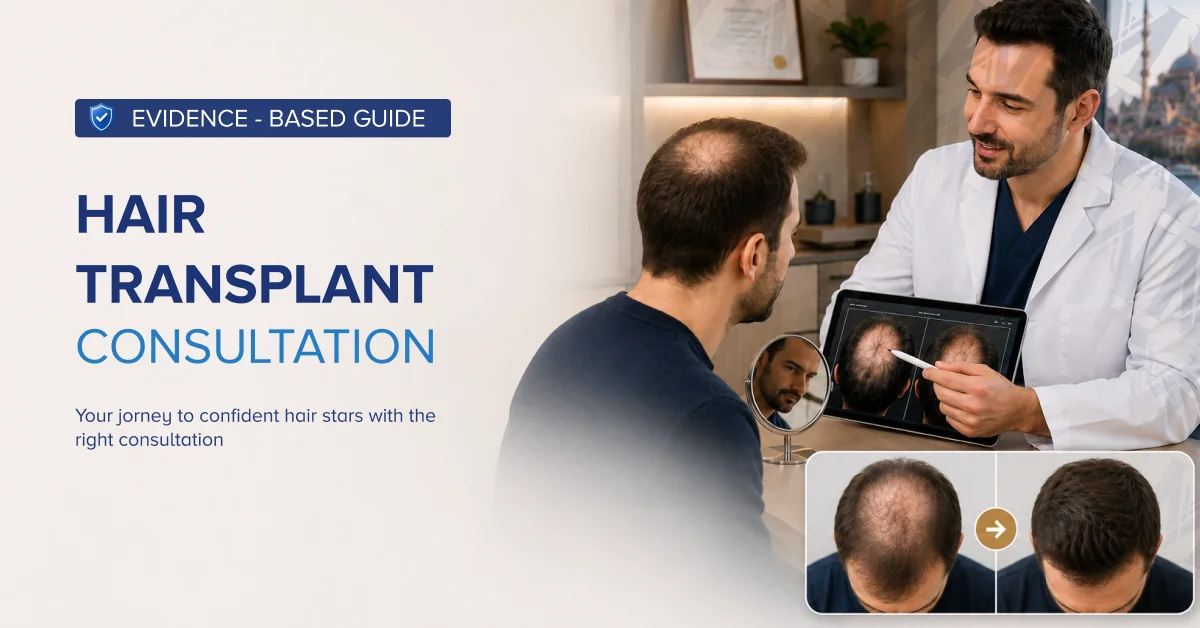
The most important part of your hair transplant is not the day of surgery. It is the consultation that happens before anyone touches a single hair. That first meeting is where safety is checked, expectations are aligned, and a long-term plan is built. At Medart Hair Transplant in Istanbul, we see daily how the right consultation can change a patient's entire journey.
This article is for general information only and does not replace a consultation with a qualified doctor. Always discuss your own situation, risks, medications, and options with a registered medical professional before deciding on a hair transplant.
Hair loss can quietly erode self-esteem, so it is normal to feel hopeful and worried at the same time. This guide walks you through what to expect from a hair transplant consultation, how to prepare, and how to recognise an ethical, patient-centred clinic — whether you are planning surgery locally or travelling to Turkey.

Key Takeaways
● A hair transplant consultation is a medical assessment, not a sales chat.
● Your candidacy depends on health, donor hair, and hair loss pattern — not only on budget.
● Free and online consultations are useful first screens, but in-person exams are essential before surgery.
● Preparing your medical history, photos, and questions makes advice more accurate and personalised.
● Ethical clinics explain risks, limits, and alternatives, and never pressure you to book.
● After the consultation you should get a clear written plan and time to decide.
Step-by-Step: What Actually Happens During Your Consultation
During a hair transplant consultation, your surgeon will move step by step from your medical history to a hands-on scalp exam, then to designing a personalised plan and explaining the procedure, risks, and costs. After learning about the different formats, it helps to see how a typical visit actually unfolds from start to finish.
A common structure in a surgeon-led hair transplant consultation looks like this:
1. Registration and intake questionnaire — you provide basic details and complete forms about your health and hair loss.
2. Medical and hair loss history discussion — you talk through when hair loss started, how it has changed, and your general health.
3. Scalp examination and donor assessment — the surgeon examines your recipient areas and donor area in detail.
4. Designing your hairline and coverage priorities — you discuss goals, review reference images, and sketch a proposed hairline design.
5. Choosing the technique and estimating graft range — the surgeon explains FUE versus FUT and outlines a safe graft count range.
6. Reviewing risks, recovery, and informed consent — you hear about possible complications, recovery steps, and long-term planning.
7. Discussing costs and answering questions — you receive a cost estimate, logistical information, and time for your own questions.
Many surgeons use standard scales such as the Norwood or Ludwig classification during consultation to document the severity of hair loss and track changes over time, as described in dermatology textbooks and AAD educational material. Below are the main parts of this process in more detail.
Medical and Hair Loss History
The consultation usually begins with a focused conversation about your health and your hair loss journey. It builds on the intake forms but adds important nuance.
Your hair transplant surgeon will often ask:
● When you first noticed thinning or recession, and whether it has been stable or rapidly worsening
● Whether there is a family history of hair loss on either side of your family
● What treatments you currently use, including topical minoxidil, oral finasteride, PRP (platelet-rich plasma) injections, or non-surgical options such as SMP (scalp micropigmentation) or hair systems
Information from the medical history helps the surgeon distinguish common androgenetic alopecia from less typical causes, such as scarring alopecias or telogen effluvium. According to the AAD, some forms of hair loss are better managed with medications alone, and some require biopsy and medical treatment rather than surgery.
You will also be asked about general illnesses, past operations, and medications such as blood thinners or anticoagulants, antidepressants, and hormone treatments. The NHS notes that drugs affecting blood clotting can increase surgical bleeding risk and may need careful management before procedures. Never stop or change a prescribed medication without your doctor's advice.
Scalp Examination and Donor Assessment
The next stage is a detailed scalp examination. In an online consultation this is partly done using clear, close-up photos, but a full assessment is always repeated in person before surgery.
The surgeon assesses:
● The recipient area (thinning or bald zones), noting the pattern on the Norwood or Ludwig scale
● The donor area at the back and sides, looking at density, hair characteristics such as thickness and curl, and any existing scarring
● Scalp skin health, checking for conditions like psoriasis, dermatitis, or scarring that might affect graft survival rate or healing
The ISHRS highlights that donor density and scalp laxity are key when deciding how many grafts can be safely harvested without obvious scarring or a "moth-eaten" look in the donor zone. In our Istanbul clinic, we use magnification to count follicular units per square centimetre — this gives a realistic ceiling for graft numbers and prevents over-promising.
Your surgeon also considers your general fitness for local anesthesia, often using simple systems such as the ASA (American Society of Anesthesiologists) classification to judge whether day-case surgery is appropriate.

Designing Your Hairline and Coverage Plan
Once your donor "budget" is understood, the discussion turns to what is realistically achievable in terms of hairline and coverage. This is where medical science and aesthetics meet.
You and your surgeon will usually:
● Decide which zones matter most to you: hairline and temples, frontal mid-scalp, or crown
● Look at reference photos or before/after images of people with similar hair characteristics and ages
● Sketch a proposed hairline design directly on your forehead, respecting natural proportions and likely future hair loss
The ISHRS encourages surgeons to design conservative, age-appropriate hairlines that will still look natural in later decades — not chase a teenage hairline at any cost. In our clinic, we frequently advise against very low, dense hairlines in younger patients, because they can look strange as the hair behind them keeps thinning.
You will also talk about density and coverage priorities. For many patients, solid density across the frontal and mid-scalp region is more satisfying than spreading grafts thinly across the whole scalp, which can leave everything looking see-through.

Discussing Techniques, Risks, and Costs
The final part of the consultation focuses on how the surgery would actually be done — and what it involves in everyday terms. This is also where informed consent is built.
Your surgeon will typically:
● Compare FUE and FUT, and possibly variants such as DHI (Direct Hair Implantation), explaining scar patterns, recovery times, and when each method may be more suitable
● Give an estimated graft count range required to reach your agreed goals, rather than a single fixed number
● Outline the expected duration of surgery, use of local anesthesia, and whether one or more sessions are likely
You should also hear a clear explanation of risks, recovery, and long-term expectations. Surgery always carries risks such as infection, bleeding, scarring, numbness, shock loss of existing hair, and less-than-expected growth. Dermatology sources and the AAD stress that setting realistic expectations — and discussing limitations openly — is central to patient satisfaction. No clinic can guarantee a specific result.
Costs are usually covered towards the end, once medical suitability and a realistic plan are clear. Reputable clinics in Turkey and elsewhere base fees on hair transplant cost factors such as technique (FUE versus FUT), graft numbers, and whether adjuncts like PRP are added — rather than simply quoting a flat "unlimited grafts" package.
From our experience with international patients, we regularly meet people who were promised "unlimited grafts" by high-volume centres without any serious donor assessment. After examining their donor area in detail, we may recommend a lower graft number across two stages instead, to avoid overharvesting and visible scarring.
No procedure is normally performed on consultation day, unless this has been clearly organised in advance as a same-day surgery pathway with the full preoperative assessment already done.

How to Prepare for Your Hair Transplant Consultation
You can get much more value from your hair transplant consultation by coming prepared with your medical history, good-quality photos, clear goals, and a written list of questions. Now that you know the steps, preparation helps your surgeon give precise, personalised advice.
According to preoperative guidance from national health services such as the NHS, an accurate list of your medications and supplements is essential, because drugs like blood thinners or some herbal products can affect bleeding risk during surgery. The more detail you bring, the safer and more focused the consultation will be. Always confirm any pre-surgery medication changes with a qualified clinician.
Medical and Hair Loss Information to Bring
Bring organised information about your health and hair loss, so you do not forget important details under pressure. This makes the consultation smoother and the candidacy assessment more accurate.
Bring this to your consultation:
● List of current medications and supplements
● Details of past operations and ongoing health conditions
● Previous hair loss treatments you've tried
● Recent photos of your hair from multiple angles
● Written questions and concerns
You should also note:
● Any allergies, especially to local anesthetics or antibiotics
● Any history of keloid or problematic scarring
● Smoking and alcohol habits, which can affect healing and graft survival
If you are already using finasteride, minoxidil, or have had PRP sessions, write down how long you have been using them and what effects you noticed. All this information supports a balanced discussion about whether surgery, medications alone, or a combination makes most sense for you. These options should always be reviewed with a qualified clinician.
Taking Good Photos for an Online Consultation
For an online consultation hair transplant screening, your photos are essentially the surgeon's eyes. Clear images allow a more accurate virtual hair transplant consultation — and help decide whether travelling is worthwhile.
Use these tips:
● Stand in bright, even lighting — daylight near a window or a well-lit room is ideal
● Take photos from the front, both sides, top, crown, and back (donor area)
● Include one set with your hair dry and styled normally, and another with hair flattened or slightly damp to show true density
Avoid heavy styling products that clump the hair or create glare. Asking a friend to take the crown and donor pictures is often easier than trying to capture them yourself. From our experience with international patients coming to Istanbul, good photos before you travel make in-person planning smoother and reduce surprises about what is achievable.
Questions to Ask Your Surgeon
A consultation is not a lecture; it is a conversation. Preparing specific hair transplant consultation questions helps you understand your options and assess the clinic's honesty.
Useful examples include:
● "Am I a good candidate for a hair transplant now, or would medications alone or waiting be better for me?"
● "How many grafts do you recommend, which areas will you prioritise, and why?"
● "Will you, as the hair transplant surgeon, personally design my hairline and make the key incisions?"
● "What are the main risks in my case, and what does recovery and post-operative care involve?"
● "How do you think my hair loss could progress, and what is our long-term plan?"
If you'd like personalised guidance based on your own situation, you're welcome to tap the WhatsApp button in the bottom-right corner of this page and send our team your photos, medical history, and questions — for a free, no-obligation online assessment.

Signs of a Good (and Bad) Hair Transplant Consultation
A good hair transplant consultation feels unrushed, transparent, and focused on your long-term hair health, while a bad one feels pressured, vague, and ignores your medical details. Now that you know how to prepare, it is just as important to judge whether the clinic you meet is truly acting in your best interest.
The International Society of Hair Restoration Surgery advises patients to be cautious of clinics that prioritise volume and discounts over detailed evaluation and safety, especially in popular medical tourism hubs such as Istanbul. Standards vary widely, so the consultation is your opportunity to spot both reassuring and worrying behaviours. When in doubt, ask another qualified surgeon or dermatologist for a second opinion.
Green Flags in a Professional Consultation
Green flags:
● The surgeon takes a full medical and hair loss history, rather than jumping straight to prices
● Your scalp and donor area are examined carefully, often with magnification — not just a quick glance
● Risks, limitations, and alternatives such as medications, PRP, SMP, or hair systems are explained honestly
Additional good signs include:
● The consultation is surgeon-led, or the hair transplant surgeon clearly reviews your case and is involved in hairline design and graft planning
● The clinic openly states that outcomes vary, no result is guaranteed, and some patients are not suitable for hair transplant surgery
● They show before/after photo documentation of patients with similar hair characteristics and ages, and explain who performed those operations
In our clinic, we usually provide a written summary by email or messaging app after the consultation and encourage patients to take their time — sometimes days or weeks — to review the plan and compare with other centres before deciding.
Red Flags and Warning Signs to Avoid
Red flags:
● No real medical questions are asked, and you receive quick price quotes based only on a few photos
● You are promised "guaranteed" results or "unlimited grafts" without any serious donor assessment
● You are pressured to book immediately or pay large deposits during the consultation itself
Other warning signs that should make you cautious:
● Unclear answers about who will actually perform the surgery, with only vague references to "our team" instead of a named surgeon
● Little or no mention of complications such as infection, scarring, or shock loss — as if risks do not exist
● The clinic dismisses the need for an in-person scalp examination, even if you are already in Turkey or Istanbul and able to attend
If several of these red flags appear, walk away. Seek a second opinion from an ethical clinic that offers honest, personalised advice and genuine shared decision-making — your scalp only has one donor area, and you only get one chance to plan it well.

What Happens After the Consultation?
After your hair transplant consultation, you should receive a clear written summary of the recommended plan, time to think it over, and the option to ask follow-up questions before committing. Once you have evaluated the consultation itself, understanding the next steps helps you make a calm, informed decision.
A typical post-consultation process includes:
● You receive a proposed technique and graft range
● You receive an estimated cost and rough timeline
● You are given pre-operative instructions if you choose to proceed
● You can contact the clinic with additional questions
Shared decision-making — where patients have time and information to weigh options — is associated with higher satisfaction and lower regret after elective surgeries, according to research supported by bodies such as the US National Institutes of Health. Ethical clinics respect this process and never rush you into a decision.
If you decide to go ahead with surgery, the clinic will usually:
● Confirm the planned technique (FUE, FUT, or a combination) and session structure
● Give you a realistic graft range rather than a single exact number
● Provide written instructions about which medications to stop or adjust, how to limit smoking and alcohol, and how to manage your hair in the days before surgery
For those travelling for surgery, especially to Istanbul, the clinic should help organise a schedule that includes arrival, in-person consultation, surgery, and an early post-operative review before you fly home. Ongoing follow-up is often done via secure messaging such as WhatsApp, where you can share photos of healing and ask about post-operative care.
Sometimes the outcome of a consultation is that you are not a suitable candidate for a hair transplant. Reasons can include unstable or very early hair loss, insufficient donor area, scarring alopecia, or medical conditions that make anesthesia unsafe. A responsible clinic will explain this clearly and suggest alternatives, such as:
● Medical therapies like minoxidil or finasteride, under doctor supervision
● PRP injections to support existing hairs in some situations
● Non-surgical solutions such as SMP or modern hair systems
Each of these alternatives still requires individual medical assessment — none is right for everyone.
When you are ready to look ahead to the pre-surgery period, our guide on what to do before a hair transplant explains preparation in more detail.
