
Hair Transplant in Istanbul: Why Patients Choose the City

Istanbul attracts hair-transplant patients because it combines a large choice of clinics, international flight access, established medical-tourism support, and competitive treatment options. However, the city itself does not guarantee quality. The safest decision depends on the named physician, donor-area planning, clinical standards, realistic expectations, and long-term aftercare.
Hair Transplant in Istanbul: Why Patients Choose the City

Table of Contents

Dr. Busra Yakupoglu

Reviewed by Dr. Busra Yakupoglu, Hair Transplant Surgeon, Medart Hair Transplant, Istanbul

Get a Free Consultation

Talk to an experienced patient coordinator for your beard transplant in Turkey.
Please enter a valid phone number.
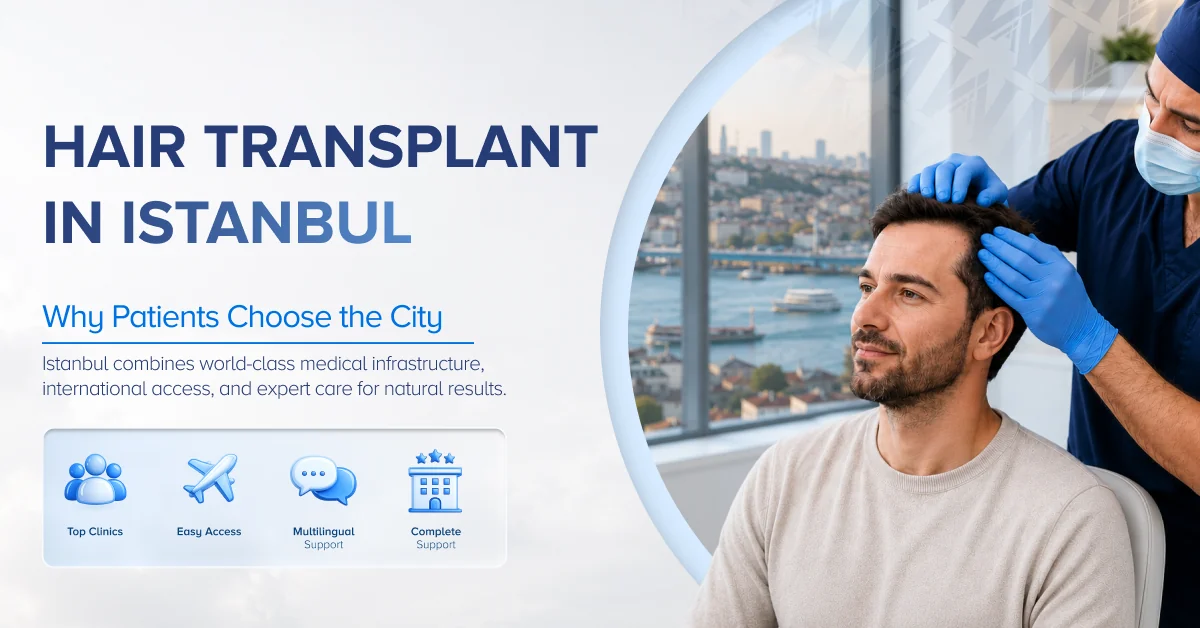
Istanbul skyline across the Bosphorus showing the city as a major medical-travel hub

Key Takeaways

  • ● Istanbul's main advantages are clinic choice, flight access, and medical-travel infrastructure.

  • ● A popular destination is not automatically a safe clinic.

  • ● Compare who performs each surgical step, not only technique names or graft counts.

  • ● Verify credentials, facility status, risks, and aftercare before paying.

  • ● Treat an unreferenced "90%" claim as promotional rather than established fact.

"Ninety percent of patients choose Istanbul" is a powerful marketing line, but it means nothing until you know which patients were counted, over what period, and by whom. Istanbul is genuinely prominent in Turkey's hair-transplant market. The city holds a dense concentration of clinics, extensive international air links, and mature support for medical travellers.

Prominence is not the same as clinical quality, though. Istanbul offers more choice and easier medical-travel logistics, yet the physician, clinical protocol, and aftercare plan matter more than the city itself.

Most people arrive at this decision carrying a mix of hope and anxiety: hope for a fuller hairline, worry about paying a stranger abroad and hoping for the best. This guide answers both. It compares Istanbul with other Turkish cities, tests whether treatment there is genuinely safe, maps the full patient journey, and hands you a practical clinic checklist. Because Istanbul is one part of a wider decision, read it alongside our complete guide to having a hair transplant in Turkey .

Hair Transplant Istanbul: Why Is the City So Popular?

Istanbul is popular for hair transplantation because it combines a high concentration of providers with direct international access and an established system for supporting medical travellers.

The city hosts a dense cluster of hair-restoration providers, from small physician practices to large surgical centres. That density lets patients compare many options in one place. It also means quality varies enormously, so the city name alone tells you very little.

Two major airports serve Istanbul. According to İGA Istanbul Airport, Istanbul Airport ranks among Europe's busiest hubs by passenger traffic, and Sabiha Gökçen International Airport on the Asian side adds further capacity. That connectivity makes direct international flights easy to find. It does not, however, measure hair-transplant demand.

Many clinics bundle multilingual coordination, hotel packages, and airport transfers into a single arrangement, which lowers the friction of travelling abroad for surgery. The questions international patients most often ask the Medart Hair Transplant team in Istanbul are revealing: who does the surgery, how much donor hair do I have, how long until I recover, and what happens after I fly home.

Istanbul's four practical advantages:

  • Provider choice — a large number of clinics and surgical teams in one city.

  • Flight access — two international airports with direct routes to many countries.

  • Multilingual support — patient coordinators who speak English and other languages.

  • Consolidated logistics — travel, hotel, and transfers organised around treatment.

More choice also creates more risk. A crowded market makes it harder to tell a physician-led clinic from a technician-heavy operation. The International Society of Hair Restoration Surgery (ISHRS) warns patients specifically about clinics where the surgical role is unclear.

Istanbul's larger provider market explains its visibility. Visibility does not verify a marketing statistic, which raises the obvious next question: does the widely repeated 90% claim have a reliable source?

Does Istanbul Really Receive 90% of Hair-Transplant Patients?

There is no defensible basis for saying that 90% of all hair-transplant patients choose Istanbul unless the claim is tied to a clearly defined and independently verifiable dataset.

The problem is the denominator. Ninety percent of which patients? Turkish patients, international patients, or both? Over what period, and choosing among which destinations? Without those answers, the figure is a slogan, not a statistic.

National medical-tourism reporting from Turkey's Health Services General Directorate (USHAŞ / HealthTürkiye) tracks overall international patient volumes rather than isolating hair transplantation by city. As of May 2026, the reviewed official source did not publish a city-level share for hair-transplant patients. The Turkish Ministry of Health authorises facilities, but an authorisation record is not a market-share census. Clinic-level data describe one clinic's patients and cannot be stretched to cover the whole country.

Istanbul's prominence is plausible given its provider density and flight access. But "prominent" and "verified 90% share" are different claims. Where authoritative city-specific data do not exist, we say so plainly rather than repeat an unsourced number.

Five checks to evaluate a percentage claim before trusting a hair-transplant statistic

How to evaluate a percentage claim. Before trusting any figure, ask five questions. What is the denominator (which patients)? What is the sample size? What is the date range? What is the geographic scope? And what is the named source? If any answer is missing, treat the percentage as promotional.

The absence of a defensible 90% figure does not erase Istanbul's practical advantages. It simply means the four cities deserve comparison on travel and provider factors, not on an invented market share.

Istanbul vs Antalya, Izmir, and Ankara

Istanbul generally offers the broadest clinic choice and international access, while Antalya, Izmir, and Ankara may suit different travel preferences or provider priorities.

No city guarantees better outcomes. The surgeon, team, facility standards, clinical protocol, and aftercare are the decisive variables, not the destination on your boarding pass. Use the comparison below to match a city to your practical priorities, then evaluate the individual clinic separately.

Comparison of Istanbul, Antalya, Izmir and Ankara for hair transplant travel and clinic choice

Criterion

Istanbul

Antalya

Izmir

Ankara

International flight access

Two major airports, wide direct-route network

Strong seasonal resort routes

Fewer direct long-haul routes

Capital-city connections

Range of clinic options

Large number of providers

Moderate, tourism-linked

Smaller pool

Hospital-focused pool

Medical infrastructure

Extensive hospitals and clinics

Tourism-linked facilities

Coastal-city facilities

University and state hospitals

Typical travel style

Urban, treatment-focused

Resort atmosphere

Relaxed coastal city

Administrative, less tourism-led

Ease of comparing providers

Many providers to compare

Moderate

Fewer to compare

Less patient-facing marketing

Potential disadvantages

Choice can feel overwhelming

Holiday plans may need adjusting around postoperative restrictions

Fewer providers to shortlist

Less patient-facing coordination

Best suited to

Choice and direct travel access

Combining care with a quiet stay

Smaller-city preference

Patients prioritising hospital settings

You can compare Istanbul, Antalya, Izmir, and Ankara in more detail in our dedicated destination guide.

Composite example — the city-comparison patient. A reader first favoured Antalya for its resort atmosphere. After learning that sun exposure and swimming are limited during early healing, and finding a preferred physician reachable by direct flight to Istanbul, they chose Istanbul. This was their individual decision, not a universal recommendation.

When Istanbul is the practical choice

Istanbul suits patients who value maximum provider choice, direct international flights, and a large pool of teams to compare in one place.

When another Turkish city may suit you better

Another city may fit better if you prefer a quieter setting, have already found a specific physician elsewhere, or want a hospital-led environment. Travel style matters, but it should never override clinical due diligence.

A city comparison narrows the travel choice. It cannot tell you whether a specific procedure is safe, which depends on the clinic, the team, and the patient assessment.

Hair Transplant Istanbul Safety: Is Treatment Safe?

A hair transplant in Istanbul can be performed safely, but safety depends on patient selection, physician oversight, facility standards, sterile technique, and appropriate follow-up — not the destination alone.

Hair transplantation is surgery, even under local anaesthesia. According to the American Academy of Dermatology (AAD), hair restoration surgery carries genuine risks that require an experienced medical team and proper aftercare. The ISHRS has warned patients about clinics where non-physicians perform surgical steps without adequate oversight. Two fears come up again and again in consultations: an overharvested donor area that looks patchy from behind, and confusion over who actually holds the tools. Both are legitimate, and both are addressed below.

Common and less common risks

Reported risks and complications, described by the AAD and in peer-reviewed reviews of hair-transplant surgery indexed on PubMed , include bleeding, infection, scarring, swelling, folliculitis (inflammation around the follicles), temporary shedding, poor graft growth, overharvesting of the donor area, and an unnatural hairline.

Postoperative shedding can affect transplanted shafts and, in some cases, nearby existing hair. This existing-hair loss is often called shock loss, meaning temporary shedding of existing or transplanted hair after surgery. The pattern and recovery vary between patients, so unexpected or persistent loss should be reviewed by the treating clinician.

Necrosis is rare but serious and requires urgent clinical assessment. Necrosis, tissue damage caused by reduced blood supply, is uncommon but must never be minimised.

Seek urgent medical help for any of the following after surgery:

  • ● Severe or worsening pain.

  • ● Significant bleeding.

  • ● Breathing difficulty.

  • ● Fever.

  • ● Rapidly spreading redness.

  • ● Any other rapidly worsening or concerning symptom.

Who performs each part of the procedure?

Ask directly who performs diagnosis, hairline design, anaesthesia, extraction, recipient-site creation, and implantation into the recipient area. In many clinics, trained team members assist with parts of the work. Per ISHRS guidance, team members may assist according to local law and clinic protocol, but the clinic should name the physician responsible and state who performs every surgical stage. Physician-led care and physician oversight matter for both safety and results.

You can check a facility's authorisation and a physician's status through the Turkish Ministry of Health, though authorisation is a minimum legal check and does not prove outcome quality. A remote assessment is preliminary and does not replace an in-person examination.

How to verify a clinic in four steps:

  • 1. Note the exact clinic and facility name from its official page.

  • 2. Confirm the named physician responsible for your treatment.

  • 3. Check facility authorisation via the Turkish Ministry of Health.

  • 4. Ask the clinic, in writing, who performs each surgical stage.

Red flags when evaluating an Istanbul clinic

Reassuring signs

Red flags

A named physician you can verify

No named physician

Full medical-history review

No medical-history review

Realistic graft estimate after assessment

A fixed graft count before adequate assessment

Clear division of doctor and technician roles

Unclear division of work between doctor and technicians

Written risks and informed consent

Guaranteed results or guaranteed graft survival

Aftercare plan for when you return home

No plan for complications after you return home

Comparable, dated before-and-after photos

Heavily edited or unverifiable before-and-after photos

Honest donor-area analysis

Unlimited-graft or "maximum graft" marketing without donor analysis

Unhurried decision-making

Pressure to pay immediately

Not sure whether your donor area is suitable? Tap the WhatsApp button in the bottom-right corner to send Medart's Istanbul team a photo of your hairline. You'll get an honest preliminary opinion, not a hard sell. A remote review is an initial step and does not replace an in-person examination.

Verifying a clinic tells you who should be involved. The next section shows how a well-run journey actually unfolds, step by step.

What Does the Istanbul Patient Journey Look Like?

A responsible Istanbul hair-transplant journey begins with medical screening and donor assessment, continues through a clearly supervised procedure, and includes follow-up after the patient returns home.

A few terms first. A follicular unit is a natural grouping of one to four hairs. FUE, follicular unit extraction, is a method of removing individual follicular units from the donor area. DHI, direct hair implantation, generally describes an implantation method or workflow, often using an implanter pen. Sapphire FUE usually refers to the recipient-site blade material, not a separate extraction science. Older FUT (follicular unit transplantation) removes a strip of scalp and leaves a linear scar, so most Istanbul clinics now favour FUE.

The timeline below reflects a well-run process. Timelines vary by patient and technique, so treat this as a map, not a promise.

  • 1. Consultation (remote). You share your hair-loss pattern, donor-area photos, medical history, medication, and expectations. This first review is preliminary.

  • 2. Pre-travel preparation. You receive guidance on smoking, a medication review, and what to bring. Patients should disclose medical conditions, allergies, smoking, and medication or supplement use.

  • 3. In-person examination. A physician examines your scalp and may adjust the plan. Exact graft requirements should not be confirmed without adequate evaluation.

  • 4. Procedure day. Hairline design, local anaesthesia, extraction, recipient-site creation, and implantation take place.

  • 5. First wash. The clinic may schedule or supervise the first wash according to its protocol, then provide written aftercare instructions and an emergency contact.

  • 6. Travel home. You depart with medication and follow-up guidance. Travel arrangements should accommodate clinical follow-up and potential complications.

  • 7. Months 1–12. Transplanted hair usually sheds first, then new growth follows. According to the AAD, visible growth typically develops over several months, with fuller results after roughly a year. Maturation varies, and results cannot be guaranteed.

Medart example. At Medart Hair Transplant, a coordinator gathers your photos and history, a physician leads the in-person scalp examination and hairline design, trained team members assist with extraction and implantation under that physician's supervision, and remote follow-up continues after you fly home. Protocols vary between clinics, so confirm each clinic's own process.

Seven-stage hair-transplant journey from remote consultation to twelve-month follow-up

A clear journey shows what care should happen. The package quote decides which parts are actually included, and who is responsible for them.

Cost vs Value: What Should an Istanbul Package Include?

The value of an Istanbul hair-transplant package depends less on the headline price than on physician involvement, donor planning, clinical safeguards, and the aftercare included.

A package is a logistics arrangement, not a measure of clinical quality. Think of it this way: a package can organise a hotel and a transfer, but it cannot prove who performs the surgery or how carefully the donor area is planned. Ask for a written breakdown before you commit.

Composite example — the price-led patient. A reader first ranked clinics by package price and graft count. Then they started asking better questions: who designs the hairline, who performs extraction and recipient-site creation, whether the graft estimate matched their donor capacity, and what aftercare followed them home. The cheapest quote slid down the list. Clinical transparency moved to the top.

May be included

May be excluded

Ask the clinic (confirm in writing)

Procedure fee, if stated in writing

Additional hotel nights or tests

Which clinician performs each surgical stage?

Hotel nights

Revision surgery costs

Is the graft estimate matched to my donor area?

Airport transfers

Local complication treatment

What changes if the in-person plan differs?

First wash

Travel insurance

What is your revision and complication policy?

Post-op medication

Additional sessions

Who prescribes and supplies my medication, and how is it reviewed?

The lowest quote may exclude meaningful physician involvement or long-term support. A graft estimate depends on donor supply, recipient needs, and long-term planning, so a high graft count is not automatically superior and should never outrank donor-area analysis. Clarify revision and complication policies before you travel, not after.

A simple way to compare two shortlisted clinics. Score each on five factors, one to five, and total them:

  • Physician involvement — is a named doctor leading and overseeing surgery?

  • Donor-plan quality — is the graft estimate matched to your actual donor supply?

  • Aftercare — is there real support once you fly home?

  • Transparency — are inclusions, exclusions, and risks in writing?

  • Complication policy — what happens, and who pays, if something goes wrong?

The higher total usually points to better value, even when it is not the lowest price.

A transparent quote narrows your shortlist. Verifying the team behind it is the final step.

How to Choose a Hair-Transplant Clinic in Istanbul

Choose an Istanbul clinic by verifying the physician, facility, surgical roles, donor-management plan, documented results, and follow-up process.

Star ratings and adverts offer limited context. They do not verify who holds the implanter pen. The ISHRS advises patients to confirm that a licensed physician leads the procedure and to avoid clinics where the surgical role is vague.

Dr. Busra Yakupoglu of Medart Hair Transplant recommends working through these ten checks before paying a deposit.

  • 1. Named physician with verifiable credentials.

  • 2. Licensed or authorised clinical setting, checkable via the Turkish Ministry of Health.

  • 3. Clear diagnosis and candidacy assessment, not a sales script.

  • 4. Realistic graft estimate based on your donor area.

  • 5. Explicit division of physician and technician responsibilities.

  • 6. Written risks and informed consent process.

  • 7. Transparent package details, with inclusions and exclusions listed.

  • 8. Long-term aftercare, including support once you return home.

  • 9. Unedited, comparable patient results with consistent lighting and time points.

  • 10. No pressure and no outcome guarantees.

Dr. Yakupoglu adds a practical warning from consultations: "A common mistake international patients make is fixating on the promised graft number before asking whether the donor area can actually support it." A transplant redistributes existing follicles; it does not create an unlimited new supply. The team that plans your donor area carefully is worth more than the one promising the highest number.

You can also read a destination-by-destination comparison of Turkish hair-transplant cities to sense-check your shortlist.

Want help applying this checklist to your own case? Message the Medart team on WhatsApp (button, bottom-right corner) for a free initial consultation on physician involvement, donor planning, and aftercare. A remote review is preliminary.

Hair transplant Istanbul scalp diagram showing donor area, recipient area and planned hairline

Verifying a clinic answers who. The next question is more personal: are you a suitable candidate at all?

Who Is—and Is Not—a Good Candidate?

A good hair-transplant candidate has a suitable diagnosis, adequate donor hair, realistic expectations, and no unresolved condition likely to compromise treatment or healing.

Androgenetic alopecia, the common pattern of progressive hair thinning, is one condition that may be treated surgically after diagnosis. The Norwood scale describes the extent of common male-pattern hair loss, but a scale grade alone does not establish candidacy. Adequate hair density in the donor area matters too, because donor supply is limited. Female pattern hair loss and diffuse thinning often need extra assessment before surgery is considered.

Potential candidate

Needs further assessment

May not currently be suitable

Stable androgenetic alopecia

Diffuse or active hair loss

Untreated scalp infection or inflammation

Adequate donor density

Uncertain diagnosis

Suspected scarring alopecia

Realistic density expectations

Prior hair-transplant surgery

Alopecia areata (autoimmune) needing specialist care

No unresolved health conditions

Female pattern hair loss

Very limited donor supply

Some patients benefit from medical treatment before or alongside surgery. According to the AAD, finasteride and minoxidil can help slow hair loss and support retention, but both should be used only under clinician supervision. Medication should not be started or stopped solely because of this article.

See a qualified clinician before pursuing surgery if you have rapid or active shedding, alopecia areata, suspected scarring alopecia, scalp inflammation or infection, prior hair-transplant surgery, unrealistic density expectations, significant medical conditions, or any medication, allergy, or supplement concern. A transplant redistributes existing follicles; it does not create an unlimited new supply.

With suitability settled, the remaining uncertainties are usually practical. The FAQs cover what patients ask most.

Frequently Asked Questions About Istanbul Hair Transplants

The best city is the one where you can verify the clinical team, treatment plan, safety standards, and follow-up — not simply the city with the most advertising.

Why is Istanbul so famous for hair transplants?
Istanbul is famous because it concentrates many clinics, two international airports, and organised medical-travel support in one city. That combination makes comparison and travel easier than elsewhere in Turkey. Fame reflects market size and logistics, not a guarantee that every clinic is safe or physician-led, so evaluate each provider individually before booking.
Is Istanbul better than Antalya for a hair transplant?
Istanbul generally offers wider clinic choice and stronger direct-flight access, while Antalya suits patients wanting a quieter, resort-style stay. Neither city guarantees a better medical outcome. Antalya's holiday atmosphere can conflict with recovery, since the AAD advises limiting sun exposure during early healing. Choose the clinical team first, then the setting that fits your recovery.
Are hair transplants in Istanbul safe?
They can be safe when performed by a qualified physician in an authorised facility with sterile technique and proper aftercare. According to the ISHRS, safety depends heavily on physician oversight of each surgical stage. Risks include bleeding, infection, scarring, and folliculitis. Verify credentials through the Turkish Ministry of Health, and confirm who performs the surgery.
How do I know if an Istanbul clinic is legitimate?
Confirm the clinic holds Turkish Ministry of Health authorisation and that a named physician with verifiable credentials leads the procedure. Authorisation is a minimum legal check, not proof of quality. Ask who performs each surgical stage, request dated and comparable before-and-after photos, and read the written consent and aftercare policy. Avoid clinics that guarantee results or pressure fast payment.
Does a doctor perform the whole hair transplant in Turkey?
Not always. In many Turkish clinics, trained team members perform parts of extraction and implantation under a physician's supervision. The ISHRS advises confirming that a licensed physician leads diagnosis, hairline design, and oversight. Ask directly who does each step. Physician-led care with clear surgical roles is a key safety marker, whichever city you choose.
How many days should I stay in Istanbul after a hair transplant?
There is no universal number that suits every patient. A stay usually covers the procedure and a supervised first wash, but the ideal length depends on your plan and recovery. Travel arrangements should accommodate clinical follow-up and potential complications. Confirm the recommended stay with your specific clinic before booking flights.
Can I fly home soon after the procedure?
Many patients fly within a few days, but timing depends on your procedure, comfort, and clinic advice. The NHS notes that air travel after surgery is generally possible once you are stable and cleared, though swelling and discomfort are common early on. Arrange flexible travel that accommodates follow-up, and follow your clinic's specific post-op instructions.
Is DHI better than FUE for an Istanbul hair transplant?
Neither is categorically better. FUE (follicular unit extraction) removes individual follicular units from the donor area. DHI (direct hair implantation) generally describes an implantation workflow, often using an implanter pen. Sapphire FUE usually refers to the recipient-site blade material, not a separate extraction science. The right approach depends on your case, not on marketing labels. The FAQs settle common uncertainties. The final decision still comes down to one thing: whether the individual team and plan can be verified.

Is Istanbul the Right Choice for You?

Istanbul can suit patients who value provider choice and direct international access. For readers weighing up hair transplant Istanbul options, though, the physician, clinical protocol, donor planning, and aftercare matter far more than city branding. Another Turkish city may suit your travel preferences or your chosen surgeon just as well, because a city can never substitute for the right medical team.

Before you decide, get a personalised candidacy and donor-area assessment, and read our guide to hair transplant in Turkey for the wider picture.

If Istanbul suits your priorities, tap the WhatsApp button in the bottom-right corner to ask Medart about candidacy, travel timing, and follow-up before you commit.

Choose the medical team first; choose the city second.

This article provides general information and does not replace an individual medical consultation. Hair transplantation is a surgical procedure with potential risks, and suitability, graft numbers, technique, recovery, and results vary. A qualified clinician should assess your diagnosis, donor area, medical history, medications, and expectations before treatment.

Contact Us!

Please enter a valid phone number.
Greft Hesapla WhatsApp