
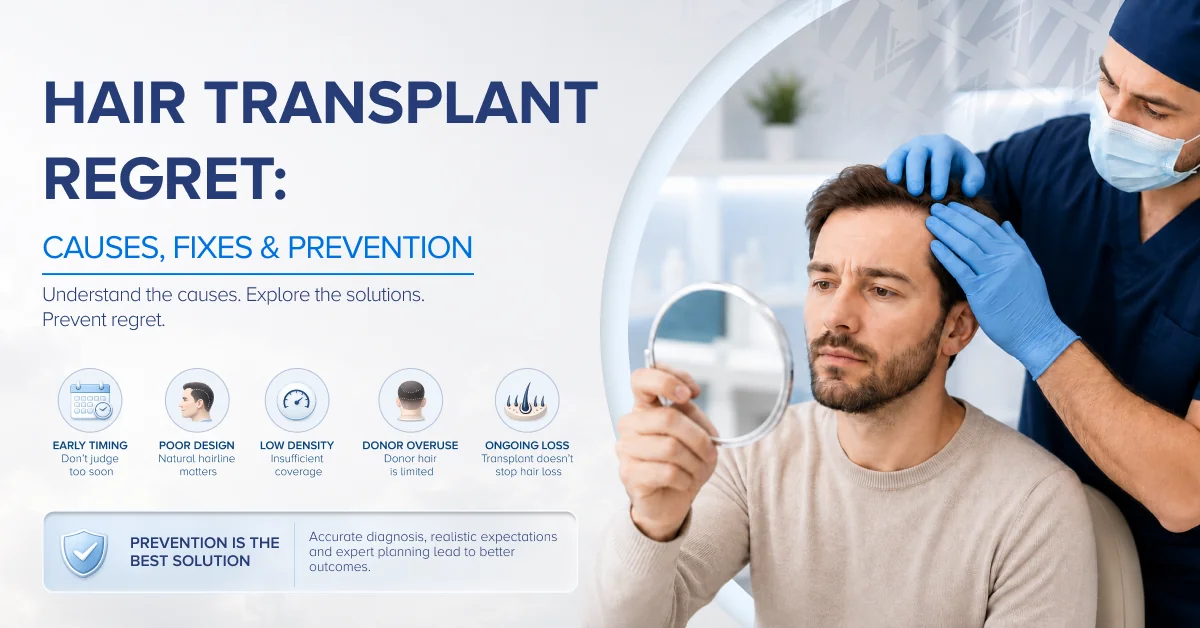
Hair Transplant Regret Assessment Framework
Assess an unsatisfactory result through four separate questions rather than appearance alone: timing, diagnosis, donor reserve, and repairability. Each one changes the next step, and none can be answered from a single photograph.
Four distinct ideas run through this whole article, and they are not interchangeable. Normal early recovery or maturation is one. Cosmetic dissatisfaction is another. A medical complication is a third. A confirmed or suspected hair transplant failure is the fourth. Keeping them separate is what turns panic into a plan.

1. Timing — how long has it been since surgery?
● Patient question: How many months since my procedure?
● Clinician consideration: Whether the result has reached its expected maturation stage.
● Possible next action: Continue documented follow-up if recovery is still early.
● Remote-review limit: Photos cannot confirm the true stage of regrowth.
2. Diagnosis — what type and pattern of hair loss do you have?
● Patient question: Is my hair loss stable, or still progressing?
● Clinician consideration: Pattern via the Norwood–Hamilton scale (men) or Ludwig scale (women), plus signs of scarring alopecia.
● Possible next action: Trichoscopy, and dermatologic examination or biopsy only when clinically indicated.
● Remote-review limit: Inflammatory scalp disease cannot be diagnosed from an image.
3. Donor reserve — how many usable follicular units may remain without unsafe harvesting?
● Patient question: Do I have enough safe donor hair for repair?
● Clinician consideration: Donor density, miniaturization, and prior extraction damage.
● Possible next action: Conservative planning that protects remaining reserve.
● Remote-review limit: True donor capacity requires in-person measurement.
4. Repairability — what can realistically be improved?
● Patient question: Can this be observed, treated, camouflaged, or revised?
● Clinician consideration: Balancing benefit against further scarring and donor loss.
● Possible next action: A staged, honest plan or non-surgical options.
● Remote-review limit: Repairability cannot be promised from photos alone.
The best way to avoid hair-transplant regret is to protect the finite donor area (the region, usually the back and sides of the scalp, from which follicles are taken), choose a medically led plan for lifelong hair loss, and avoid judging the result before it has matured. An unsatisfactory appearance does not automatically mean failure.
First, take a breath: the feelings are normal too
Before the clinical steps, one honest note. Panic, shame, and obsessive mirror-checking are common in the weeks after a transplant, especially during shedding. Feeling foolish or fearing you have wasted your money does not mean you have. It means you are human and the change is visible daily.
For the first 48 hours after worry sets in, do three calm things. Write down your surgery date and what specifically bothers you. Take one clear, well-lit set of photos so you stop scrutinising your scalp minute by minute. Then wait for a scheduled review rather than booking a second surgery on impulse. Anxiety shrinks when it has a plan.
Is It Too Early to Judge the Result?
A hair transplant often looks worse before it looks better, and the final cosmetic result usually cannot be judged during the early shedding and regrowth stages. Transplanted shafts commonly fall out within the first weeks, which alarms patients who expect steady growth. This postoperative shedding is expected, not a failure.
Visible density then builds gradually. According to NHS guidance on hair transplants, transplanted hair often falls out before new growth appears, and final results generally take up to around 12 months and sometimes longer. That window is a typical range, not a guarantee, and individual recovery varies.
Typical recovery and growth timeline
This table shows what is often normal versus what warrants a clinic review. It compares stages only; it cannot diagnose your specific scalp, so treat it as a guide.
Time after surgery |
What may be normal |
What warrants a clinic review |
|---|---|---|
First 10–14 days |
Crusting, redness, swelling, mild soreness, tiny scabs around grafts |
Spreading redness, pus, fever, severe pain, uncontrolled bleeding |
Weeks 2–8 |
Shedding of transplanted shafts, itching, pink skin |
Widening bald patches in donor, persistent heavy bleeding, worsening pain |
Months 3–4 |
Little visible growth, sparse or uneven early sprouting |
New pustules, sudden patchy thinning, spreading inflammation |
Months 5–8 |
Thin, fine hairs thickening slowly, uneven coverage |
No growth at all across the whole area, ongoing severe redness |
Months 9–12 |
Density filling in, texture normalising |
Clearly patchy survival in a well-grown surrounding area |
Months 12–18 |
Final maturation, especially in the crown |
Persistent thin zones, visible scarring concerns, unnatural angles |
Source note: recovery and complication timing here reflect NHS hair-transplant guidance and general hair-restoration clinical experience. Expected durations vary between individuals and skin types.
In-person examination, trichoscopy, and standardized serial photographs can help estimate likely growth and identify complications. Exact graft survival may still remain uncertain, and online images cannot determine it reliably.

Before rushing to conclusions, it helps to see how normal early doubt actually plays out.
Scenario one — the early worrier. Composite educational scenario; not a specific patient. A man is four months out from FUE (Follicular Unit Extraction, in which follicles are removed one by one). He sees sparse, uneven growth across his frontal zone, with no pain, pus, or fever.
What needs examining is whether growth matches the expected stage, supported by a standardized photograph comparison over time. A plausible next step is to document with dated photos and continue scheduled follow-up. This scenario cannot confirm any individual's diagnosis online.
Why the crown may take longer
The crown (the swirl at the back of the head, also called the vertex) may appear to mature later than a frontal hairline. Its whorled hair direction and circular geometry make thin coverage more obvious to the eye. Growth timing here is variable, and coverage often builds more slowly than at the front.
Why Are Some Patients Unhappy With Their Hair Transplant?
The most common sources of dissatisfaction are poor planning, unnatural design, inadequate apparent density, donor damage, ongoing native-hair loss, and mismatched expectations. Technique labels alone do not decide quality. Diagnosis, design, extraction, graft handling, implantation, and aftercare all matter.
Timing separates normal recovery from a genuine concern. Once the result has matured, the next task is identifying which of these six factors created the problem, since each points to a different fix.
Unnatural hairline design
An unnatural hairline can come from poor height, shape, irregularity, angle, direction, graft selection, or a failure to plan for future loss. This is exactly what people mean by an unnatural hairline after transplant. A low or rigid frontal hairline may become less age-appropriate as native hair recedes behind it. A natural leading edge uses single-hair follicular units (natural groupings of one to four hairs) with a soft, slightly irregular border, and the implantation angle and direction should follow how hair naturally grows.

Poor density or uneven growth
Low apparent hair density is not proof of poor graft survival. Visual density depends on several separate factors, not just graft count.
● Hair caliber: coarse hair covers scalp better than fine hair.
● Curl and texture: curly or wavy hair shades more skin than straight hair.
● Hair-to-skin color contrast: dark hair on pale scalp creates high contrast, which can make any gaps look more obvious.
● Distribution, length, and styling: how grafts are spread and how hair is worn changes perceived fullness.
This is also why a graft and a hair are not the same. A graft is a piece of transplanted tissue containing one or more follicular units, and a single follicular unit can hold several hair shafts. Donor density limits how much can be moved in the first place.
Poor growth can also have technical roots. Follicular-unit transection (accidental cutting of follicles during extraction), graft desiccation (grafts drying out), and prolonged out-of-body time (grafts spending too long outside the scalp) can each reduce survival. None of these is usually the sole explanation, and biological variation between patients matters too.
Overharvested or scarred donor area
Donor hair is finite and cannot simply be replaced after removal. Think of your donor reserve as a limited savings account. Once you withdraw follicles, you cannot deposit new ones, and no fixed graft number is safe for every patient. Safe planning depends on donor density, miniaturization, scalp visibility, hair characteristics, and how extraction is distributed.
Overharvesting means taking so many follicles from one region that it thins visibly. An overharvested donor area shows as loss of donor-area homogeneity and patchy extraction. FUE dot scars or a linear FUT scar can also become noticeable. Removed follicles do not regrow, though some early donor thinning may reflect temporary shock loss (sudden shedding of existing hairs after the trauma of surgery) and can improve.

Progressive native-hair loss
A hair transplant redistributes hair; it does not stop androgenetic alopecia (genetic pattern hair loss) or future native-hair loss. A transplant is like moving existing hair to a new spot. It does nothing to protect the untreated hair thinning around it. A tidy result at 32 can look unbalanced by the early 40s as native hair recedes behind a fixed transplanted line. This progressive hair loss is one of the most under-explained causes of later regret.
Wrong diagnosis or poor candidacy
Active scarring alopecia (permanent hair loss from follicle destruction, such as lichen planopilaris), diffuse unpatterned alopecia, unstable hair loss, and inadequate donor supply can all affect candidacy. Operating on an inflamed or unstable scalp risks poor growth, disease reactivation, and further scarring. A proper hair-loss diagnosis, sometimes using trichoscopy (magnified scalp examination), must come before any surgical plan. Suspected inflammatory or scarring alopecia should be assessed by a dermatologist before surgery is considered.
Communication and expectation failures
Edited before-and-after photographs and "guaranteed density" claims are not substitutes for diagnosis and informed consent. Misleading graft estimates set patients up to feel cheated. Honest planning means discussing what surgery can and cannot achieve, and what happens if fewer grafts survive than hoped. This is where many bad hair transplant results actually begin.
How to Avoid Hair Transplant Regret Before Surgery
The strongest protection against regret is a medically appropriate diagnosis and a conservative long-term plan, not a large graft quote or a branded technique. This is really the whole answer to "how to avoid a bad hair transplant." Prevention starts before you pay a deposit.
If you are travelling abroad for medical tourism, plan your follow-up before you go, not after. Many international patients only realise their aftercare gap once they are already home.
The 12-question clinic checklist
Ask a prospective clinic these twelve questions and listen for specific, honest answers.
1. What is my diagnosis? You want a real assessment, not a sales screening.
2. Is my hair loss stable, or still actively progressing?
3. What is my measured donor density and miniaturization? (Miniaturization means follicles shrinking and producing finer hair.)
4. Who performs each surgical step — extraction, site creation, and implantation?
5. Why is this hairline appropriate as I age?
6. How will future native-hair loss be managed?
7. What graft growth or survival range is realistic in my case, and how do you explain the uncertainty?
8. What complications have you managed, and how?
9. Can I see comparable, unedited results at 12 months or later?
10. What follow-up is provided after I return home?
11. Is a second procedure likely, and why?
12. What non-surgical alternatives should I consider?
On surgeon qualifications, four things are separate and all worth checking: physician identity (the named doctor responsible for your case), legal license (permission to practise in that jurisdiction), specialty training (relevant experience in hair restoration or dermatology), and actual operative role (which steps the physician personally performs). A famous name who never touches your scalp is not the same as a physician-led procedure.
Red flags that should make a patient pause
● Pressure to pay immediately.
● Diagnosis based only on sales photographs.
● Guaranteed growth or "scarless" claims.
● Extremely high graft numbers without donor measurements.
● No clear physician identity.
● Assembly-line scheduling with little physician contact.
● Heavy emphasis on technique branding over medical planning.
● Refusal to discuss complications or long-term loss.
Do not simply "choose a reputable clinic." Verify three concrete things: the physician's licence, their direct involvement in surgery, and unedited long-term results in patients like you.

Hair Transplant Regret in Turkey: What International Patients Should Check
A clinic's location or price does not determine its quality; international patients should verify licensing, physician involvement, donor planning, and aftercare. Turkey, and Istanbul in particular, is a major hub for hair restoration, home to both experienced physician-led practices and high-volume operations.
Technique labels cannot substitute for that verification, and neither can a low headline price. Country-level generalisations are unhelpful. A low price should never override donor safety or medical suitability.
Questions for an Istanbul clinic before paying a deposit
● Is the clinic a licensed clinic with a verifiable legal identity?
● Is the facility licensed under Turkey's Ministry of Health, which sets health-facility and international-patient standards? Ask for the licence details and verify them on the ministry's official channels before you pay.
● Which named physician is responsible for my case?
● Is my surgery physician-led, and which steps are legally delegated to trained staff versus performed by the doctor?
● How many procedures does the clinic perform each day?
● Which steps are technician-performed, within the limits allowed in Turkey?
● Is language support available throughout my stay?
● Will I receive written postoperative care instructions?
● What is your remote protocol if a complication appears after I fly home?
● Will I receive full operative documentation?
Plan for care after returning home
Keep these documents before you leave Turkey:
● Operative notes.
● The stated graft count.
● Donor and recipient distribution details, if available.
● Medication instructions.
● The clinic's contact route for follow-up.
● Dated postoperative photographs.
A written follow-up plan matters most for patients travelling home to another country, because a complication may appear when the treating clinic is thousands of miles away. Agree in advance who reviews your progress and how.

Considering a hair transplant in Istanbul? Tap the WhatsApp button in the bottom-right corner to request a free assessment and ask who performs each stage, how your donor area will be evaluated, and what follow-up is available after you return home. Photographs may support an initial review, but they cannot establish a diagnosis or replace an in-person examination.
What Should You Do If You Already Regret Your Hair Transplant?
If you regret your transplant, first check the timeline and warning signs, document the result, and obtain a clinical assessment before considering more surgery. Another procedure can consume donor reserve before the cause of dissatisfaction is understood, so speed is rarely your friend here.
The Turkey checklist protects future patients. For anyone already unhappy today, the sequence below is the practical starting point.
1. Record surgery date and procedure details.
2. Take standardized photographs in consistent lighting and angles.
3. Contact the treating clinic with specific, written concerns.
4. Seek local medical care immediately for any warning signs.
5. Avoid rushing into more surgery before the result matures.
6. Seek an independent assessment if concerns remain unresolved.
7. Gather operative notes, graft counts, photographs, and medication history.
The regret triage framework
This table matches your situation to a sensible next step. It guides direction only; it cannot replace examination.
Situation |
Likely next step |
|---|---|
Early recovery with no warning signs |
Monitor and attend scheduled review |
Slow or uneven growth after expected milestones |
Assessment by the treating clinic or an independent hair-restoration clinician, with standardized comparison |
Unnatural design or donor damage after maturation |
Independent repair consultation |
Pain, pus, fever, spreading redness, skin breakdown |
Prompt in-person medical care |
