
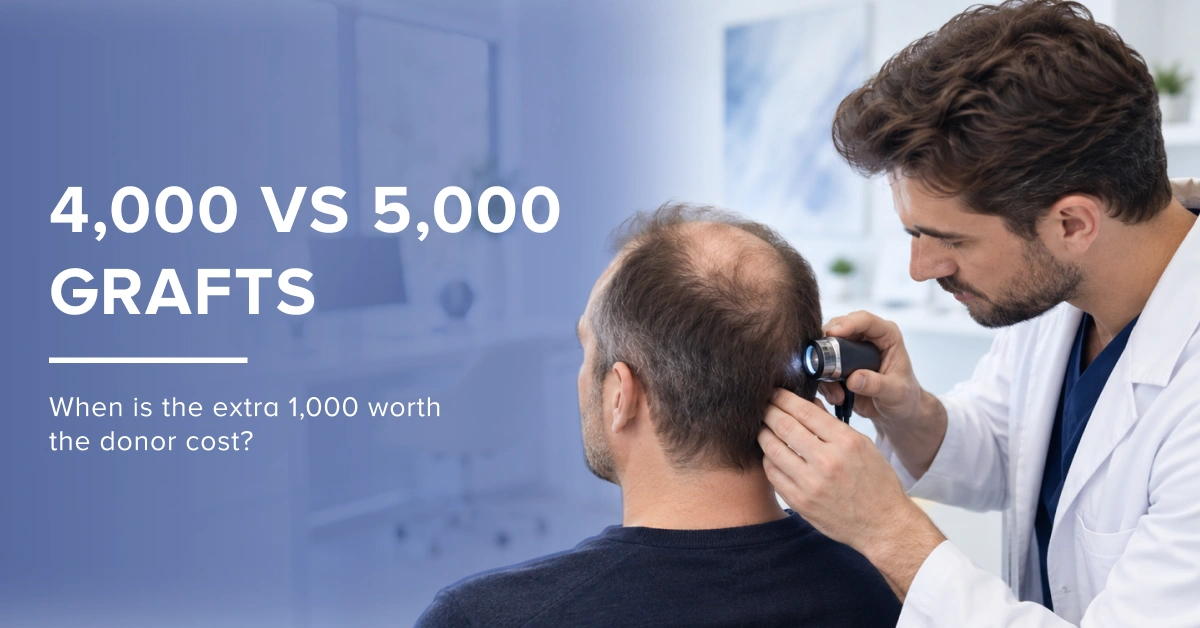
4000 vs 5000 Grafts: Which Should You Choose?
Choose 5,000 over 4,000 grafts only if the additional 1,000 has a defined placement goal and your donor assessment shows that adequate lifetime reserve will remain. Neither number is correct on its own.
In advanced loss, a 4,000-graft plan usually concentrates on the priority zone: the frontal hairline, the frontal third, and the mid-scalp. A 5,000-graft plan can extend coverage backwards when the recipient map identifies an untreated transition band and the donor assessment supports the extra extraction.
The test is practical. Ask where the fifth thousand sits on the surgical map, by zone and by planned density. If the surgeon cannot show that allocation, the quote is not documented well enough to compare.
Decision factor |
4,000 grafts |
5,000 grafts |
|---|---|---|
Immediate coverage |
More selective |
Broader or denser |
Donor used now |
Lower |
1,000 more |
Future reserve |
Higher |
Lower |
Best fit |
Prioritised front and mid-scalp |
Large area with strong mapped donor |
Main risk |
Insufficient coverage |
Overharvesting or fewer future options |
Table note: these are planning tendencies, not outcomes. More grafts do not automatically produce a better result. When both plans are expected to meet the same priority-zone goal, preserving 1,000 grafts gives you more room to respond to later loss or repair.
"I reduce or reject a 5,000-graft request when the mapped safe donor zone is small, when I can see donor miniaturisation on trichoscopy, or when a young patient's loss is still unstable. A larger graft count is only a better plan when the donor area can spare it." — Dr. Busra Yakupoglu, hair transplant surgeon

What Does the Extra 1000 Grafts Actually Add in Coverage and Density?
An extra 1,000 grafts can cover approximately 25–50 cm², depending on whether they are placed at about 40 or 20 grafts per cm². The arithmetic is simple enough to check yourself.
Planning arithmetic: area equals graft count divided by planned recipient-site density. Recipient-site density is the number of grafts placed per square centimetre in the receiving area. Divide 1,000 by that figure and you have the coverable area.
Planned recipient density |
Approximate area covered by 1,000 grafts |
|---|---|
20 grafts/cm² |
50 cm² |
25 grafts/cm² |
40 cm² |
30 grafts/cm² |
33 cm² |
35 grafts/cm² |
29 cm² |
40 grafts/cm² |
25 cm² |
These are arithmetic planning estimates, not promises of cosmetic outcome.
The same 1,000 grafts cover more scalp when spread out, but visual density drops. It behaves like paint: one tin covers more wall when applied more thinly, and you can see the wall through it.
Two definitions matter before you compare quotes. A hair transplant graft is a follicular unit, meaning a natural group of one or more hairs moved as a single piece. So 5,000 grafts is not 5,000 hairs.
Count definitions matter just as much. Extracted grafts, implanted grafts, and surviving grafts are three different numbers. Some units are transected during extraction or judged unsuitable, so the implanted count can sit below the extracted count.

Hair characteristics change what those numbers look like on a head. Greater shaft diameter and curl can increase the visual coverage produced by a given graft count. Lower hair-to-scalp colour contrast makes scalp show-through less obvious.
In my planning at our Istanbul clinic, coarse or wavy hair and a high proportion of three-hair follicular units usually reduce the graft count needed for the same visual objective. Fine, straight hair on a light scalp calls for a more conservative coverage promise instead.
Outcomes also depend partly on graft handling, implantation, healing, and survival. The American Academy of Dermatology notes that transplant results are limited by how much donor hair a person actually has, which is why sound planning starts with supply rather than with a target number.
How Much of Your Safe Donor Zone Does Each Option Use?
The move from 4,000 to 5,000 grafts consumes another 1,000 donor follicular units and reduces the remaining reserve by the same amount. Coverage arithmetic explains what the fifth thousand can add; the question now is whether your donor area can spare it.
Lifetime donor reserve: The estimated number of follicular units that can still be removed without creating unacceptable thinning, after accounting for previous and planned extraction.
Donor density, measured in FU/cm² (follicular units per square centimetre), is not the same as harvestable reserve. Reserve depends on density plus the mapped area of the safe donor zone. It also depends on the proportion a surgeon is willing to remove across a lifetime.
Walter Unger's work delineating the safe donor area, published in the American Journal of Cosmetic Surgery in 1994, remains a common reference for deciding which occipital and temporal hair is likely to stay stable. As androgenetic alopecia progresses, thinning can reveal that hair near an assumed boundary was never stable enough to include. One high reading from the mid-occiput must therefore never be stretched across the whole donor area.
Follicular unit extraction was described by Rassman and colleagues in Dermatologic Surgery in 2002. FUE removes individual units across a wide field, so extraction distribution decides whether the donor area later looks even or moth-eaten. Overharvesting may cause visible donor thinning and can limit repair options when extraction intensity or spacing exceeds what the mapped area tolerates.
Donor miniaturisation means thinning of hairs inside the area expected to provide stable supply. Where it is present, a technically achievable extraction count may still be a poor lifetime plan. A depleted donor pattern is hard to disguise, and lost supply cannot be restored.

For the underlying boundaries and assessment method, read how the safe donor area is measured.
Safe Donor Zone Capacity by Density: Remaining Reserves After 4000 vs 5000
Two patients with the same 5,000-graft quote can have very different remaining reserves because average density, safe-zone size, miniaturisation, and previous extraction all change the donor budget.
Stated planning assumptions. The table below is modelled, not measured. It uses the disclosed formula: estimated harvestable reserve = mapped safe-zone area × average FU/cm² × lifetime extraction fraction. The model sets the mapped safe donor zone at 130–160 cm² and the lifetime extraction fraction at 45%. It assumes no significant miniaturisation and no previous surgery. Medart Hair Transplant plans from each patient's measured donor characteristics rather than from a generic table, so substitute your own mapped figures.
Average mapped donor density |
Grafts left after 4,000 |
Grafts left after 5,000 |
|---|---|---|
50–59 FU/cm² |
Approximately 0–250 |
0; 5,000 exceeds the modelled budget |
60–69 FU/cm² |
Approximately 0–950 |
Approximately 0 |
70–79 FU/cm² |
Approximately 100–1,700 |
Approximately 0–700 |
80–89 FU/cm² |
Approximately 700–2,400 |
Approximately 0–1,400 |
90–100 FU/cm² |
Approximately 1,250–3,200 |
Approximately 250–2,200 |
Table note: figures are modelled estimates from the stated assumptions, floored at zero. Density alone does not determine lifetime reserve. No density band alone proves that 5,000 grafts is safe, and the 45% fraction is a planning convention rather than a biological limit.
Change one assumption and the whole row moves. A mapped zone of 130 cm² at 70 FU/cm² models about 4,095 harvestable units. The same density across 160 cm² models about 5,040. That gap is why the common search "donor area 5000 grafts" has no universal answer.
"Identical density readings can produce very different usable capacity. Scarring, a narrow safe zone, retrograde thinning above the ears, or early miniaturisation all shrink the real budget. I plan extraction distribution before I plan graft numbers, because uneven harvesting is what makes a donor area look depleted." — Dr. Busra Yakupoglu, hair transplant surgeon

What Does Choosing 5000 Now Cost You in a Future Crown or Repair Session?
Using 5,000 instead of 4,000 grafts now leaves exactly 1,000 fewer scalp grafts available for future crown loss, progression, or repair. That is the part of the quote nobody prices.
Think of scalp donor grafts as a lifetime budget rather than a refillable account. Grafts used in the first procedure are unavailable for later crown loss or repair. A graft removed from the scalp donor area does not regenerate there, so today's extraction permanently reduces the unharvested reserve.
Progressive androgenetic alopecia makes later needs realistic rather than hypothetical. They include crown or vertex progression, added density behind an existing transplant, hairline softening, scar correction, and repair of a session that grew poorly.
Illustrative planning example — not a universal safe limit. A Norwood 5–6 patient has a surgeon-estimated lifetime scalp FUE budget of 6,500 grafts. A 4,000-graft procedure leaves approximately 2,500 grafts. A 5,000-graft procedure leaves approximately 1,500. If future crown progression later requires an estimated 2,000 grafts, the 4,000 plan preserves enough scalp reserve. The 5,000 plan falls short by roughly 500 grafts, before counting any repair need or further loss.
Picture that same man at 34, framing his face beautifully after one session, and again at 44 with a widening crown and 1,500 grafts left in the bank. The first year feels like a win. The tenth is where the arithmetic answers back.
The crown is where this bites hardest. It can swallow a large allocation because its surface area and whorl pattern demand coverage in several directions at once.
In my experience the crown gives a lower cosmetic return per graft than the frontal third. The frontal third frames the face and appears in every mirror and photograph. A wide crown can absorb thousands of grafts and still read as thin, which is why I would rather protect that reserve than spend it early.

Beard or body hair is sometimes floated as a backup. It can help in selected repair cases, but it is not a guaranteed equivalent replacement for scalp donor hair. Texture, calibre, and growth behaviour differ, and suitability must be assessed individually.
Aiming to spend every theoretically harvestable graft in one mega-session also removes your ability to respond to whatever your scalp does over the next twenty years.
How Do You Decide the Right Number With Your Surgeon?
The correct graft count is the lowest number that can achieve the agreed priority-zone result without compromising a safe extraction pattern or the patient's future donor reserve. Measurements decide that number, not marketing.
A 4000 vs 5000 grafts quote can be compared meaningfully only when the clinic discloses the measurements and assumptions behind it. Ask your surgeon to document the following in writing before you accept either plan.
1. Average donor density across several mapped donor zones, in FU/cm².
2. The surface area of the safe donor zone, in cm².
3. Any miniaturisation or instability inside the proposed donor area.
4. Previous extraction count and where those grafts were taken from.
5. Estimated hairs per follicular unit in your donor hair.
6. The exact recipient area, in cm².
7. Planned recipient-site density for frontal third, mid-scalp, and crown separately.
8. Whether the quote counts extracted grafts or implanted grafts.
9. Your estimated lifetime scalp donor budget.
10. How many grafts are being reserved for future loss or repair.
11. Who performs extraction, channel creation, and implantation.
12. What happens if fewer safe grafts are available on the day of surgery.
The International Society of Hair Restoration Surgery has campaigned specifically on question 11. Its patient guidance urges people to establish who performs each surgical step and under whose supervision. That question matters as much as the graft number.
Book a surgeon-led assessment before committing if you have Norwood 5–6 loss and are weighing 5,000 grafts. Do the same if you have already had a transplant, since previous extraction changes the remaining budget.
Get assessed too if your donor area looks thin, uneven, moth-eaten, or scarred. A photograph alone cannot show whether the hair there is stable.
Suspected diffuse unpatterned alopecia, retrograde thinning above the ears, or donor miniaturisation deserves particular caution. Extraction planning may need to wait until a surgeon or dermatologist confirms donor stability. The same applies whenever a clinic quotes a number without donor mapping, safe-zone measurement, and a future-loss plan.
Compare your two quotes in five steps. Run both proposals through this before you choose.
● Confirm mapped donor density in FU/cm² and the safe-zone area in cm², measured in more than one spot.
● Subtract each graft count from your estimated lifetime budget and write down what is left.
● Check the planned recipient-site density for the frontal third, mid-scalp, and crown separately.
● Find the assigned zone for the fifth thousand. No zone, no justification.
● Decide whether the reserve left over covers realistic future crown or repair needs.

The decision rule. Choose 4,000 when it meets the priority-zone objective and meaningfully preserves reserve. Consider 5,000 only when the extra 1,000 has a mapped purpose, the donor can support it, and acceptable future options remain.