
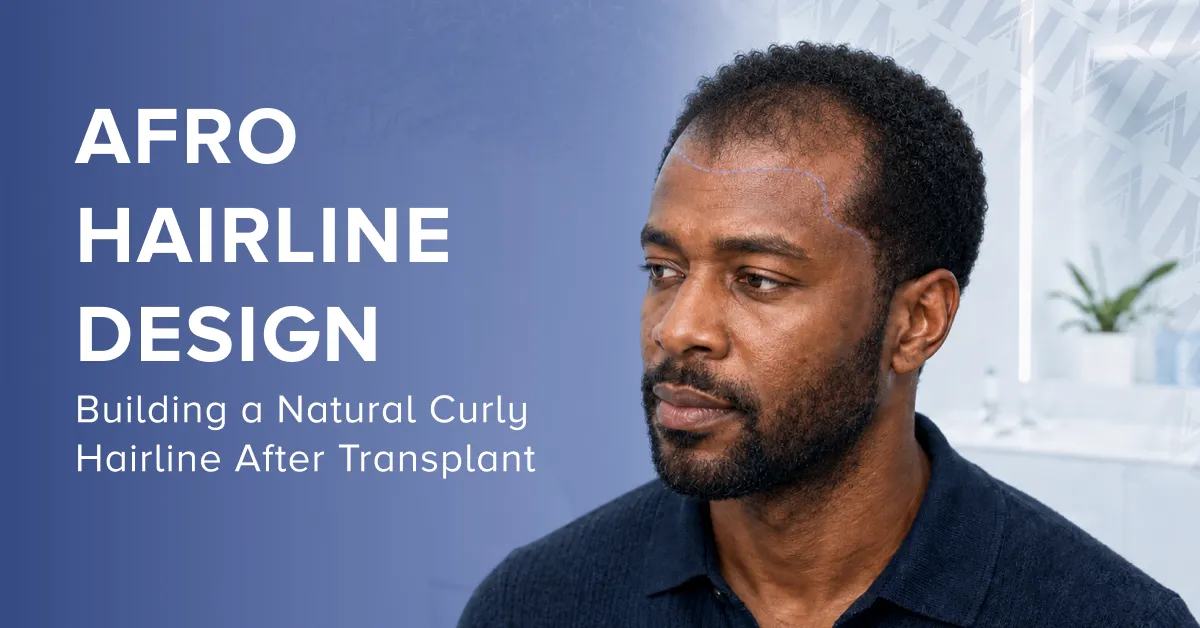
Afro Hairline Transplant: Natural Design for Curly Hair

An afro hairline transplant looks natural when its shape fits the patient's face, age, original pattern, and future hair loss, while individual grafts follow the existing curl direction. A soft front edge should use predominantly single-hair grafts, controlled irregularity, and density that increases gradually behind the hairline.
Afro Hairline Transplant: Natural Design for Curly Hair

Table of Contents

Dr. Busra Yakupoglu

Reviewed by Dr. Busra Yakupoglu, Hair Transplant Surgeon, Medart Hair Transplant, Istanbul

Get a Free Consultation

Talk to an experienced patient coordinator for your beard transplant in Turkey.
Please enter a valid phone number.

Key Takeaways

  • ● There is no single correct Afro hairline shape; ancestry does not decide the outline.

  • ● Curl direction changes where the visible border appears once hair grows.

  • ● The leading edge should use predominantly single-hair follicular units.

  • ● Density should rise gradually from the front edge backwards.

  • ● Approve the design upright, dry, and from several angles before surgery.

A ruler-straight hairline is not automatically wrong for a Black patient—but a ruler-straight row of grafts usually is. The difference lies in the shape's relationship to the face, the softness of its front edge, and the direction in which each curl emerges. This article is about design: hairline shape, hairline height, curl direction, graft selection and density in an afro hairline transplant, not the whole procedure. Ancestry alone does not determine the correct outline. A natural Afro hairline is not defined by one "Black" shape. It combines an age-appropriate design with your own curl direction, fine front-edge irregularity, single-hair grafts, and a gradual density transition.

What Makes an Afro Hairline Different to Design?

An Afro hairline must be designed around the patient's actual curl pattern, hair calibre, growth direction, facial proportions, and future hair loss—not around a racial template.

Two features get confused in curly hairline design. Franbourg and colleagues, writing in the Journal of the American Academy of Dermatology (2003), described African hair as growing from a curved follicle with an elliptical shaft. Follicle curvature below the skin contributes to how a hair emerges. Shaft shape and structure influence the visible curl above it. They are related, but one is not a substitute for assessing the other.

Follicle curvature: the shape of the follicle beneath the skin.

Hair-shaft curl: the visible curvature of hair after it emerges.

Exit direction: the direction in which the hair initially leaves the scalp.

Scalp cross-section distinguishing follicle curvature below the skin, visible hair-shaft curl above it, and initial exit direction.

Each coiled shaft occupies more visible space, so coily hair can give greater apparent coverage than fine straight hair at a similar graft count. That helps behind the frontal hairline. It does not excuse a hard front edge, which still has to look soft at conversational distance.

Planning an Afro-textured hairline starts with observation. At Medart Hair Transplant, curl pattern, hair calibre and native-hair direction are assessed dry, unstretched and styled as the patient normally wears it, because combed-out hair hides how the coil sits. Age, facial proportions, donor reserve and likely future hair loss are recorded at the same visit. Candidacy, technique and recovery sit in our complete guide to Afro hair transplantation.

Which Hairline Shapes Suit Afro-Textured Hair?

Rounded, straight, and widow's-peak hairlines can all look natural with Afro-textured hair when the shape fits the patient's original pattern, facial structure, age, and expected future loss. Curl behaviour sets the texture of the edge; shape sets the outline that texture sits on.

Design from evidence, not fashion: old photographs, the remaining native pattern, temporal recessions, facial proportions, age and styling preferences. A line-up or shape-up hairstyle is temporary styling that changes as the trimmed edge grows, so it should not become a permanent surgical border.

"Ancestry does not tell me where to draw a line. I design from the patient's own pre-loss pattern, their corners, and how the scalp is likely to change with age." — Dr. Busra Yakupoglu

Corners carry the design as loss continues, so they matter as much as the centre point. If recession behind the line is likely, ask how the plan survives it; readers weighing timing can review broader options for restoring a receding hairline.

Shape

Visual effect

May suit

Main design risk

Rounded

Softens the forehead and reduces the visual weight of the corners

Angular foreheads, or a genuinely rounded pre-loss pattern

Reads as juvenile if corners come too far forward and down

Straight or gently horizontal

A defined, groomed silhouette that suits short, sharp styles

Squarer native corners with limited temporal recession

A geometric graft-by-graft edge, and corners the face outgrows

Widow's peak

Adds a central point and breaks strict symmetry

Patients whose native pattern or old photographs show a peak

Looks decorative when the native pattern does not support it

Rounded vs Straight vs Widow's-Peak Hairlines for Black Men

There is no single natural hairline for Black men, and a mature outline usually sits higher with softer corners than an adolescent one. A straight overall silhouette is not the same as a straight leading edge. The eye reads the silhouette from two metres, and the individual hairs from thirty centimetres.

Illustrative scenario. A 24-year-old asks for the low, sharp line-up his barber creates. The surgeon keeps the central outline familiar but leaves more recession at the corners, because early temporal recession and a family pattern of progressive loss could leave a low, closed design isolated later.

Illustrative scenario. A 41-year-old brings photographs from his twenties showing a rounded hairline. The rounded character is kept, but the height is raised, so the old pattern informs the plan instead of recreating an adolescent line his face has outgrown.

Illustrative scenario. A mixed-heritage patient has looser curl at the temples than in the central forelock, plus a faint native widow's peak. The peak is kept because it is his own, and temple transitions are planned separately from the centre.

Judge any proposal from profile and both oblique views. Front-facing photographs alone hide corner height, temple points, and how far forward the line actually sits.

Unsure which outline fits you? If you cannot tell whether a rounded, straighter, or more recessed outline suits your face and curl pattern, use the WhatsApp button in the bottom-right corner to request a personalised design assessment from Medart Hair Transplant.

How Does Curl and Coil Angle Affect Hairline Placement?

Curl pattern changes the visible position of a hairline because a graft's exit direction and the way its shaft bends determine where the hair appears after it grows. Shape sets the outline; direction decides where that outline shows up once hair emerges.

A recipient site is the small opening made to hold a graft. Its recipient-site angle is how shallow that opening is and which way it points, and it strongly influences the hair exit angle and how the hair lies.

  • 1. Assess native exit direction. Where native hairs remain, sites should follow their direction and their acute, forward-lying angle.

  • 2. Anticipate how the shaft will curve after emergence. A coil may bend forward over the forehead, rise away from the scalp, or sweep sideways, so the visible edge may not match the marker line.

  • 3. Adjust placement by scalp zone rather than using one angle everywhere. No single degree value fits every patient or every scalp region.

In coily hair transplant hairline planning, exit direction matters as much as the drawn outline. Assess hair dry and unstretched, because wet or freshly combed hair flattens the curl and hides how tightly it contracts as it dries. Loussouarn and colleagues, in the International Journal of Dermatology (2007), documented how widely hair-shaft curvature varies between individuals.

Curl tightness also varies within one scalp. The frontal hairline, central forelock and temples are planned as separate zones, each with its own native-hair direction.

Incorrect direction produces crossing, splaying, or a stiff brush-like look even when the outline on the skin seems fine. Bernstein and Rassman, writing on follicular transplantation planning in Dermatologic Surgery (1997), described site angle and direction as central to a natural result. Curly hairline design is therefore thousands of small directional decisions.

Diagram contrasting correct and incorrect recipient-site direction and the resulting curl behaviour at the frontal hairline.

How Do Surgeons Recreate a Natural Irregular Front Edge?

A natural front edge is created with predominantly single-hair grafts, small non-repeating irregularities, and density that rises gradually behind the first visible hairs. Direction decides where hairs appear; graft selection decides whether that appearance is soft or blunt.

A follicular unit is a naturally occurring group of one to four hairs that grow together. Multi-hair follicular units placed in the first rows emerge as small tufts, and that shows under bright light or a close cut.

Natural edges combine hairline macro-irregularity, larger contour changes across the whole line, with hairline micro-irregularity, tiny variation between neighbouring hairs. Bernstein and Rassman described this soft, irregular frontal zone in Dermatologic Surgery (1997).

"We confirm hair count under magnification before placement, and keep verified single-hair units for the visible edge rather than using them further back." — Dr. Busra Yakupoglu

Single-Hair Grafts, Density Gradient, and Zig-Zag Placement

A true single-hair follicular unit contains exactly one hair, confirmed under magnification rather than assumed. Reserving these for the first rows produces a feathered front edge instead of a solid ink line.

The frontal transition zone works in three bands. The soft irregular leading edge is deliberately sparse and slightly ragged, with scalp visible on close inspection. Behind it, the transition zone blends, mixing single-hair units with occasional two-hair units where calibre and direction suit.

The frontal support zone carries the visible weight, using suitable multi-hair units placed along the same native direction. Put simply: the edge provides softness, the transition blends, and the support zone provides most of the visible fullness.

Controlled asymmetry means deliberate, non-repeating variation: small clusters, tiny gaps, sentinel hairs sitting slightly forward. It is not careless placement, and it is not strict symmetry either. A repeated saw-tooth or evenly spaced zig-zag is simply another artificial pattern, because the eye finds the repeat.

The front must not become a wall of equal-density grafts. A hairline density gradient that rises gradually backwards stops the eye finding a starting line. Sorting under magnification decides which unit goes where, so the plan follows the grafts rather than the reverse.

Three-zone hairline diagram showing soft irregular leading edge, transition zone and frontal support zone with density rising backwards.

How Much Density Does an Afro Hairline Actually Need?

An Afro hairline does not have one required graft density because visible fullness depends on curl, calibre, colour contrast, scalp visibility, graft survival, and the density of each hairline zone. Graft selection sets the character of the edge; density decides how much shade sits behind it.

Three ideas get blurred together. Numerical graft density counts grafts per square centimetre. Hair count per follicular unit describes how many hairs each graft carries. Visual density is how full the hair looks, closer to the amount of shade cast over the scalp than to any number on a plan.

Coily hair may create substantial visual coverage at a lower numerical density than fine, straight hair. That is a tendency, not a guarantee. Planning density for an afro textured hairline starts with scalp visibility, colour contrast between hair and skin, hair calibre, hairstyle and existing miniaturised hair.

Planned site density must also account for scalp vascularity, tissue characteristics, graft survival, donor reserve and the future hair loss that may still need covering. The International Society of Hair Restoration Surgery advises planning around long-term donor supply rather than maximum first-session coverage. Packing the first row hard spends donor hair a later procedure may need.

Hairline zone

Aesthetic purpose

Relative density

Graft-selection principle

Irregular leading edge

Softness and light penetration, with scalp visible close up

Lowest of the three zones

Predominantly true single-hair units, finer calibre where available

Transition zone

Blends softness into fullness without a visible step

Intermediate, rising rearwards

Mostly single-hair units, with occasional two-hair units behind the first rows

Frontal support zone

Carries visual weight and shade behind the hairline

Highest of the three zones

Suitable multi-hair units, angled with native direction

A fixed graft count cannot guarantee natural-looking density, because treated area, follicular-unit composition, hair characteristics, donor reserve and growth all vary. Any figure quoted for an afro hairline transplant before an in-person examination is an estimate, not a plan.

What Hairline Mistakes Should Afro Patients Avoid?

The most common artificial-looking Afro hairlines are too low, too geometrically straight, too dense at the first row, or inconsistent with the patient's natural curl direction. Nearly all of these are decided before the first incision, which is why Afro hairline design deserves more scrutiny than the technique label.

Hairline height is the error with the longest tail. Lowering a hairline today makes later thinning behind it more obvious, because the transplanted line stays put while native hair recedes away from it.

Red flag

Why it looks unnatural

Better design principle

Low juvenile line

Recreates an adolescent height and becomes isolated as loss continues

Set height from facial proportions, age and expected future hair loss

Ruler-straight edge

A perfectly uniform graft edge can look drawn on, even when the silhouette is naturally horizontal

Keep the silhouette that suits you, but break the edge with micro-irregularity

Repetitive zig-zag

An evenly repeated saw-tooth is a pattern itself, and the eye finds the repeat

Use non-repeating variation of differing size and depth

Multi-hair grafts at the front

Two- and three-hair units emerge as small tufts under bright light

Reserve confirmed single-hair follicular units for the first rows

Abrupt density

A sudden dense wall creates a visible starting line rather than a fade

Build a density gradient that rises gradually behind the leading edge

Incorrect direction

Grafts that ignore native-hair direction cross, splay or stand up like a brush

Match recipient-site angle and direction to nearby native hairs, zone by zone

Unsupported temple corners

Corners that do not relate to existing temple contours appear disconnected

Keep temporal recessions credible and plan temple transitions against donor reserve

Copying a celebrity image, a template, or a barber-created line-up without adapting it to your anatomy causes several of these at once. So does judging a design only from the front.

A technique label is not an aesthetic plan. Follicular unit excision (FUE) and direct hair implantation (DHI) describe how grafts are removed and placed, not where the line sits or which way each hair points. Readers curious about the method can read how DHI implantation works.

"In repair consultations, the pattern I see is rarely the technique. It is a line drawn low and flat, two-hair grafts in the first row, and corners never planned for future hair loss." — Dr. Busra Yakupoglu

How Do You Approve Your Hairline Design Before Surgery?

Before surgery, approve the hairline only after seeing it upright from several angles and hearing the operating surgeon explain its height, shape, direction, irregularity, and long-term plan. Knowing the red flags only helps if you inspect the drawing properly.

Most people are not frightened of the surgery. They are frightened of walking out with a hairline that does not look like theirs, or of losing the freedom to wear their hair short. That worry is answered at the marker stage, because an afro hairline transplant is largely decided while the ink is still wet.

Review the marked design standing or sitting upright, not reclined on the operating table. Look from the front, both profiles and both oblique views, at normal conversational distance rather than in a magnifying mirror. Your hair should be dry, unstretched and in its usual curl state, because wet versus dry hair assessment gives two different borders.

Ask the operating surgeon to explain hairline height at the centre and corners, temporal recessions, temple transitions, irregularity, direction, density zones, and the plan if loss progresses behind the line. Old photographs are useful evidence, but recreating a teenage line is not the aim.

Patient-surgeon design approval is shared decision-making, and you can request revisions before any recipient sites are created. The UK General Medical Council guidance on decision making and consent (2020) sets out that patients need enough information and time to weigh options and ask questions.

At Medart Hair Transplant, the marked design is reviewed with the patient upright, revised where requested, then recorded with preoperative photography from front, profile and oblique views before site creation begins. If you are travelling for surgery in Istanbul, confirm before you fly that the operating surgeon, not only a coordinator, will assess your curl direction and approve the final line. Destination questions belong with planning an Afro hair transplant in Turkey.

  • ● [ ] Age appropriate.

  • ● [ ] Works in front and side views.

  • ● [ ] Matches native direction and curl behaviour.

  • ● [ ] Contains a soft irregular edge.

  • ● [ ] Has realistic corner and temple transitions.

  • ● [ ] Preserves a credible plan for future loss.

  • ● [ ] Reflects the patient's grooming preferences.

  • ● [ ] Has been explained by the operating surgeon.

  • ● [ ] Has been photographed after final approval.

This article provides general information about hairline design and does not determine whether you are medically suitable for surgery. Hair loss cause, scalp health, donor supply, scarring risk, medications, and long-term loss should be assessed by a qualified clinician before a transplant plan is agreed.

Progressive androgenetic alopecia and inflammatory hair loss may require diagnosis and medical stabilisation of hair loss before an age-appropriate design for an Afro-textured hairline is finalised. A history of keloid or abnormal scarring should be discussed with the operating clinician. Painful, inflamed, rapidly progressive, unexplained, or scarring hair loss needs dermatological assessment first. The American Academy of Dermatology advises diagnosing inflammatory and scarring alopecia before cosmetic restoration is planned. No article, photograph, or remote review can determine a personalised surgical plan.

Send photographs for a first look. You can send clear front, profile, and oblique photographs through the WhatsApp button in the bottom-right corner for an initial assessment of hairline shape and curl direction. A photo review is preliminary and does not replace an in-person medical examination.

Marked afro hairline transplant design shown from front, oblique and profile views before surgical approval.

Common patient questions

Should a Black man's transplanted hairline be completely straight?
Not necessarily. A straight overall silhouette can look natural if it suits your face and pre-loss pattern, but the graft-by-graft edge should not be ruler-straight. Softened corners, micro-irregularity and single-hair grafts keep a straight-looking design from reading as a drawn line.
Can I ask for the same sharp line-up my barber gives me?
You can ask, but a line-up is temporary styling, while a transplanted border is intended to last. Many surgeons will keep your preferred shape and soften the actual edge and corners, so the design still works as the hair grows out.
Does coily hair need fewer grafts to look dense?
Sometimes, though this is not guaranteed. Coily hair can give more apparent coverage because each shaft occupies more visible space. Density planning still depends on hair calibre, colour contrast, scalp visibility, donor reserve and hairstyle, so no fixed graft number can be promised.
Why do surgeons use single-hair grafts at the front?
Because the first visible hairs decide whether a hairline looks soft or tufted. A true single-hair follicular unit contains one hair, so it mimics the fine, irregular hairs of a natural front edge. Multi-hair follicular units placed there can look like small clumps.
How low should an afro hairline transplant be placed?
Lower is not better. Height should suit your facial proportions, age and likely future hair loss, and the design should not automatically recreate your lowest adolescent line. Lowering the hairline today can make later thinning behind it more obvious.
Will my curls grow in the same direction after a transplant?
Direction is largely a surgical decision, because transplanted hair typically follows the recipient site it is placed into. Sites should copy your native-hair direction zone by zone. Transplanted hairs generally keep donor characteristics, though visible curl varies with length, moisture and grooming.
Can a widow's peak look natural with Afro-textured hair?
Yes, when it reflects your own pre-loss pattern or suits your facial proportions. A widow's peak added purely as decoration tends to look drawn on. Old photographs, native-hair direction and the shape of your temporal recessions should guide that decision.
What if I dislike the hairline drawing on surgery day?
Say so before any recipient sites are created. The drawing is a proposal, and surgical marker can be wiped off and redrawn. Ask the operating surgeon to explain the reasoning, request changes, and approve only a design you understand.
How can I tell whether a surgeon understands curly hairline design?
Ask how they assess curl direction dry and unstretched, how they identify single-hair grafts for the leading edge, and how the plan allows for future hair loss. Specific answers and close-up photographs of front edges matter more than a technique label.
Does DHI automatically create a more natural Afro hairline?
No. Direct hair implantation is a placement method, not an aesthetic plan. Recipient-site angle, direction, graft sorting and the density gradient decide whether a black male hairline transplant looks natural. Any implantation method can disappoint if the design is wrong.

Contact Us!

Please enter a valid phone number.
Greft Hesapla WhatsApp