
Get a Free Consultation
Talk to an experienced patient coordinator for your hair transplant in Turkey.Key Takeaways
● Treat a hair transplant in Turkey as surgery, not a cheap deal.
● Only consider clinics with a named, qualified hair transplant surgeon.
● Avoid high-volume hair mill clinics with many patients per day.
● Check licensing, real before-and-after photos, and independent reviews.
● Demand a personalised treatment plan and clear graft strategy.
● Insist on transparent package details and written aftercare.
Tens of thousands of men and women fly to Istanbul for a hair transplant every year, and many achieve excellent results. Others end up in unlicensed hair mills where rushed work and unsafe practices cause scars, patchy growth, and permanent regret.
This guide explains how to choose hair transplant clinic Turkey patients can genuinely trust. It gives you evidence-based, Turkey-specific criteria so you can choose safely, avoid black-market clinics, and compare real options side by side.
Quick Checklist for Choosing a Clinic in Turkey
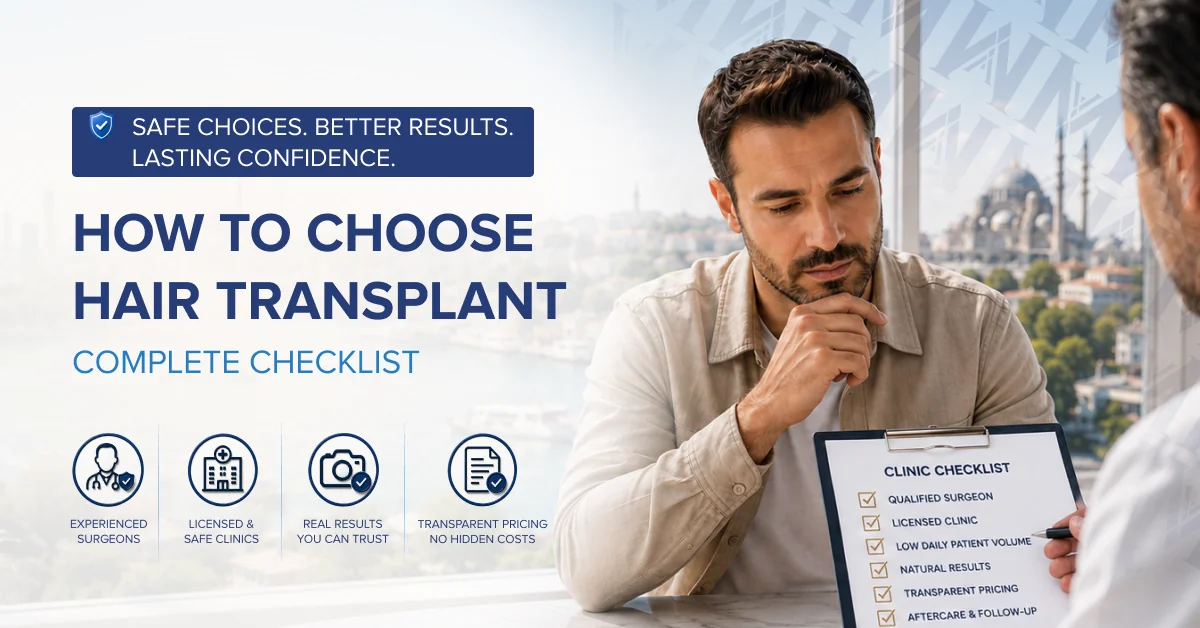
To choose a safe hair transplant clinic in Turkey, focus on a named surgeon, licensing, safety, results, and long-term follow-up — not just price.
Here is a simple best clinic Turkey checklist you can use:
● Named, qualified surgeon: Full name, medical degree, specialty (dermatology, plastic surgery, etc.), and verifiable years of experience as a hair transplant surgeon.
● Licensed medical facility: Clearly registered clinic or hospital under the Turkish Ministry of Health, not a hotel room or rented apartment.
● Low daily patient volume: Typically 1–4 patients per day per surgical team, not 10–20 cases that signal an assembly-line hair mill.
● Clear medical supervision: The doctor designs the hairline, plans graft count, and performs or directly oversees key steps.
● Real before-and-after photos: Consistent lighting and angles, close-ups of hairline and crown, and cases similar to your own.
● Transparent pricing: Written package describing what surgery, hotel, transfers, and medications include, with no surprise extras.
● Written aftercare and follow-up: Clear post-op instructions, medication plan, and WhatsApp or video support for at least 6–12 months.
● Real Turkey hair transplant reviews: Independent reviews on Google Maps, forums, and YouTube, not only on the clinic's own website.
The International Society of Hair Restoration Surgery (ISHRS) reports that serious complications worldwide often come from unlicensed or "black-market" clinics where unqualified technicians perform most of the surgery without proper physician supervision.
The rest of this article unpacks each point so you can confidently shortlist clinics.
Why Choosing the Right Clinic in Turkey Matters
Choosing the right hair transplant clinic in Turkey matters because donor hair is finite, and a poor surgeon can permanently damage it.
Turkey is a major hub for medical tourism, especially hair restoration. Istanbul alone hosts hundreds of clinics. Among them are world-class centers with strict standards — and black-market clinics operating with almost no oversight.
A hair transplant is not "just cosmetic." It is a microsurgical procedure that involves:
● Removing permanent hairs from a donor area (usually the back and sides of the scalp).
● Implanting them into the thinning recipient area under local anesthesia.
When this is done badly, the consequences are serious:
● Unnatural hairline design that looks "pluggy" or too low for your age.
● Scarring in donor or recipient areas, especially with poor sterilization and infection control.
● Infections that may need antibiotics, drainage, or hospital care, as outlined in NHS guidance on hair transplantation.
● Overharvesting the donor area, leaving it visibly thin and limiting options for future repair — a problem the ISHRS warns cannot always be corrected later.
Think of donor hair as a limited bank account. Every graft you spend is gone forever. If a clinic withdraws too many, or distributes them poorly, there is no way to refill the balance.
At Medart Hair Transplant in Istanbul, we regularly see repair cases from patients who had procedures in high-volume clinics where technicians did most of the work with minimal medical oversight. Many need multiple corrective sessions. Sometimes we can only partially improve the situation, because donor hair has already been overused.
If you want a safe hair transplant Turkey experience, think like a patient choosing surgery — not a shopper chasing discounts. Once you understand why the choice of clinic is so critical, the next step is checking the surgeon who will actually operate on you.
For broader background on travel, candidacy, and techniques, see our comprehensive guide to hair transplant in Turkey .
Step 1 – Verify the Surgeon's Qualifications and Experience
Only choose a Turkish hair transplant clinic that clearly names the lead surgeon, proves their qualifications, and explains which parts of the surgery they personally perform.
In Turkey, a hair transplant surgeon must be a licensed medical doctor. Under current Turkish Ministry of Health licensing rules, clinics must be authorised, and doctors — not unlicensed technicians — are responsible for supervising and performing key surgical steps. The ISHRS has repeatedly highlighted the risks when this responsibility is delegated to non-physicians.
Look for the following:
● Named surgeon. The clinic should display the doctor's full name, photo, and biography on its website and in your communication. If you only see a brand or "our team," be cautious.
● Medical degree and specialty. A strong background is usually in dermatology, plastic surgery, or a related field. Check whether the surgeon is registered with Turkish medical authorities or their country's medical council.
● Years of experience and procedure volume. Ask how many years they have been performing hair transplantation and roughly how many cases they have managed. Experience should be measured in hundreds or thousands of procedures, not "a few."
● Professional memberships. Membership in organisations such as the International Society of Hair Restoration Surgery (ISHRS) or respected national societies signals commitment to standards and continuing education. Membership alone does not guarantee skill, but it is a positive sign.
● Defined role vs technicians. Technicians and nurses can play an important role — for example, preparing grafts — but the surgeon should:
● Take your medical history and obtain a signed consent form.
● Design your hairline and overall treatment plan.
● Perform or directly supervise graft extraction and implantation.
Surgeon responsibility, in one line: A clinic that refuses to name a surgeon, or claims "our technicians do everything," is running a technician-led model — not a doctor-led medical service.
The ISHRS notes that many adverse events globally are linked to surgery performed mostly or entirely by unlicensed technicians without proper doctor involvement. Ensuring a named, qualified doctor is in charge is one of the most important parts of choosing hair transplant clinic Turkey safely.
Once you are sure the surgeon is real and qualified, clarify their specific involvement in your case.
Questions to Ask About the Surgeon
You should ask direct questions about who will touch your scalp, because this is how to choose hair transplant clinic Turkey patients can genuinely trust.
Here are practical questions:
1. "What is your full name and medical specialty, and where did you train?"
2. "Are you registered with the Turkish Ministry of Health or a national medical council?"
3. "How many hair transplant procedures have you personally performed?"
4. "Will you design my hairline yourself on the day of surgery?"
5. "Which steps will you personally perform, and which will technicians handle?"
6. "How many patients do you operate on per day?"
7. "If complications occur, will you be the doctor managing them?"
For more ideas, see our guide to the key questions to ask any hair transplant clinic in Turkey . Once your surgeon checks out, verify that the clinic environment and licensing are safe.
Step 2 – Check Clinic Licensing, Safety Standards, and Patient Volume
A safe hair transplant clinic in Turkey is formally licensed, operates in a medical facility, and limits the number of patients each team treats per day.
Clinic licensing and accreditation
● Look for explicit mention that the clinic is registered with the Turkish Ministry of Health.
● You should see a real physical address in Istanbul or another Turkish city — not just a mobile number or WhatsApp contact.
● Ask whether the procedure is done in a hospital or day-surgery center that meets operating theater standards: proper ventilation, sterile field, and appropriate emergency equipment.
Environment and infection control
The World Health Organization (WHO) notes that proper infection-prevention measures in surgical facilities significantly reduce complications. In a hair transplant setting, this means:
● Clean, medical-grade rooms with surgical lights, not hotel bedrooms.
● Use of disposable consumables where appropriate.
● Visible sterilization and infection control practices, such as autoclaving instruments and staff wearing gloves, masks, and gowns.
Reasonable daily patient volume
A major issue in some parts of Turkey is high-volume clinics cramming many surgeries into a single day. For a safe, personalised procedure:
● A well-run team typically handles about 1–4 patients per day.
● If one surgeon claims to perform 10–20 cases daily, it is almost impossible for them to be meaningfully involved in each.
Ask directly:
● "How many hair transplant patients do you treat per day per surgeon?"
● "Will there be a dedicated team for me, or do they move between multiple rooms?"
Definition: What is a "hair mill"?
A hair mill is a high-volume clinic that treats many patients per day with minimal doctor involvement, often in non-medical settings, prioritising speed and profit over safety and personalised care.
At Medart Hair Transplant, we keep daily patient numbers low so each person gets an unhurried procedure and proper follow-up. Once you know the facility is real and safe, learn to spot the red flags that often signal a hair mill.
Red Flags That Suggest a "Hair Mill"
Certain patterns strongly suggest a high-risk or illegal setup rather than a safe hair transplant Turkey clinic. Watch for these hair transplant Turkey red flags:
● No clear clinic address, or only a hotel listed as the operating site.
● Only WhatsApp contact, no landline or reception, and no mention of Ministry of Health oversight.
● Photos showing hotel-style rooms instead of proper operating rooms.
● Claims like "one surgeon, 20 patients per day" or "massive group operations."
● Promises of "unlimited grafts" for a flat fee, with no donor analysis.
● No consultation with a doctor before you pay a deposit.
● No mention of a consent form or your medical history.
● Pressure tactics: "limited-time discount if you book today."
If several of these appear together, choose a different clinic. After ruling out unsafe facilities, examine the clinic's actual results and patient feedback.
Step 3 – Evaluate Before-and-After Photos and Real Patient Reviews
Trust a Turkish clinic only if its before-and-after photos show natural results and are supported by independent reviews.
Before-and-after photos
Look for:
● Consistent angles and lighting in the before and after photos.
● Close-ups of the hairline, crown, and mid-scalp so you can see density and direction.
● A variety of cases: different ages, Norwood scale stages of baldness, and hair types.
● A visible watermark or logo of the clinic on images.
Natural results usually feature:
● A soft, irregular hairline (not a straight line of thick grafts).
● Hair direction matching surrounding native hair.
● Density appropriate to donor capacity — not unrealistically thick in every case.
Patient reviews and testimonials
Do not rely only on testimonials hosted on the clinic's own website. Search:
● Google Maps reviews for the clinic name and address.
● Independent platforms such as Trustpilot or RealSelf.
● YouTube or forums with patient diaries and vlogs.
Surveys of healthcare consumers, including reports from Software Advice, consistently show that a majority of patients read online reviews before choosing a provider. Look for patterns: many detailed, balanced reviews over time are more trustworthy than a handful of very short five-star comments.
Tip: Search "[clinic name] reviews" and "[clinic name] bad results" in English and your own language to see the full picture of Turkey hair transplant reviews.
Once you can judge photos and reviews, learn to detect misleading or fake results.
How to Spot Fake or Misleading Results
You can catch many fake or misleading before-and-after images used by some hair transplant clinics in Turkey with a few quick checks.
Try these steps:
● Reverse image search. Upload a photo to Google Images or a similar tool. If the same result appears on multiple unrelated clinic websites, it is likely stolen or stock.
● Over-editing and filters. Be wary of photos with heavy blurring, artificial lighting, or strong filters. Authentic medical photos usually show clear skin texture.
● Missing close-ups. If you only see distant, low-resolution images, the clinic may be hiding poor density or scarring.
● Only influencer or celebrity cases. Real clinics show everyday patients too, not just sponsored influencers.
If the visuals and reviews pass your checks, the next big question is whether the clinic offers a personalised technical plan — or just sells buzzwords like FUE and DHI.
Step 4 – Understand Techniques, Graft Planning, and Personalized Treatment
A trustworthy Turkish clinic does not just sell FUE or DHI — it explains why a specific technique and graft number fit your hair, your donor area, and your long-term pattern of loss.
FUE vs DHI and beyond
● Follicular Unit Extraction (FUE) removes individual grafts from the donor area with small punches and implants them into tiny incisions in the recipient area. It usually leaves dot-like scars and is now the most common technique.
● Direct Hair Implantation (DHI) is a variation where grafts are implanted using special implanter pens, which can allow more precise control over angle in some cases.
Both FUE and DHI can give excellent results when done well. No technique guarantees quality on its own; surgeon skill, planning, and respect for the donor area matter more than the acronym on the brochure.
Personalised graft planning
A genuine treatment plan should consider:
● Your age and Norwood scale pattern of baldness.
● Donor area capacity — how many grafts can safely be taken now, and in future.
● Hair characteristics: thickness, curl, colour contrast with skin.
● Future hair loss progression, and medications like finasteride or minoxidil if appropriate (discuss these with your own doctor).
The dangers of "unlimited grafts":
● Overharvesting can leave the donor area patchy and moth-eaten.
● Cramming too many grafts into one session can stress the scalp and reduce graft survival.
Hairline design and realistic expectations
A safe clinic will create an age-appropriate hairline design. A 40-year-old man is usually better served by a slightly higher, mature hairline than a low "teenage" line that may look odd as he ages. Think of it like choosing glasses: what suits you at 20 rarely suits you at 50.
The surgeon should discuss:
● Expected density in the transplanted area.
● Which zones will be treated now and which may need work later.
● Adjunct options like scalp micropigmentation that can enhance the look of density in some cases.
Definition: Personalised treatment plan
A personalised treatment plan includes a donor analysis, a tailored hairline design, a clear graft range (as an estimate), and a long-term strategy for future hair loss.
If your consultation feels like a quick sales script — "You need a huge number of grafts, free PRP, book now" — that is a warning sign.
You can also learn more about techniques like FUE and DHI used in Turkey for deeper technical detail.
Signs of a Genuine Medical Assessment
A real assessment from a qualified hair transplant surgeon Turkey patients can rely on has several hallmarks.
Look for:
● The doctor or medical team reviewing clear photos or conducting a video consultation before confirming suitability.
● Questions about your medical history, medications (such as blood thinners), smoking, and family history of hair loss.
● A clear explanation of sedation vs local anesthesia and whether you are a good candidate. Most hair transplants are done under local anesthesia with light oral sedation, which the National Institutes of Health regards as safe for most healthy adults when performed correctly.
● Discussion of long-term management, including possible future sessions or non-surgical treatments.
If the clinic does not ask about your health or medications, walk away. Always discuss your individual situation with your own doctor and the operating surgeon before deciding.
Want a second opinion before you fly? Tap the WhatsApp button in the bottom-right corner of this page to send clear photos of your scalp to the Medart team. You'll get an honest opinion on candidacy and a realistic graft estimate — not a hard sell.
Once you have a solid sense of the technique and plan, compare what is actually included in the price — and stay alert to hidden extras.
Step 5 – Clarify Total Cost, Inclusions, and Hidden Extras
A good hair transplant package in Turkey is transparent about what is included, avoids "too-good-to-be-true" prices, and never adds surprise fees on the day of surgery.
Many Istanbul clinics offer package deals that combine:
● Surgery (FUE or DHI).
● Hotel accommodation for a set number of nights.
● Airport and clinic transfers.
● Translation services if you do not speak Turkish or English, easing the language barrier.
● Post-op antibiotics, pain medication, and a basic aftercare kit (shampoo, foam, etc.).
When doing a hair transplant clinic comparison, separate medical costs from tourism extras:
● Surgical fee covers the doctor's and team's work, medical supplies, and facility.
● Tourism extras include hotel, transfers, and sometimes sightseeing or additional services.
Possible hidden extras to ask about:
● Extra charges for higher graft counts above a "package" limit.
● Additional fee for DHI instead of FUE.
● Paid add-ons such as PRP (platelet-rich plasma) injections, which may have modest supportive benefit for healing but are not essential for every patient.
● Extra nights at the hotel, late changes, or upgraded rooms.
Also check payment methods and policies:
● Whether you can pay by card or bank transfer rather than cash only.
● Whether there is a written refund or revision policy in case expectations are not met or a touch-up is needed. A clear, realistic policy is another sign the clinic takes long-term responsibility seriously.
The ISHRS and other professional groups caution that extremely low prices often go hand in hand with high-volume, technician-led clinics and a higher risk of complications. If an offer is far below the typical range reported by reputable medical tourism sources, ask how they maintain safety, surgeon involvement, and aftercare.
Remember: Value is safe surgery, natural results, and strong aftercare — not simply the lowest number on a quote.
Sample Comparison Table Template
Use this simple table to compare offers from different clinics in Turkey.
Item |
Question |
Clinic A |
Clinic B |
|---|---|---|---|
Surgeon involvement |
Named surgeon? Which steps performed? |
||
Daily patient limit |
Patients per day per surgeon/team |
||
Graft range |
Example only: 2,000–3,000 estimated |
||
Aftercare |
Written instructions and 12-month support? |
||
Total cost |
Surgery + hotel + transfers? |
||
Extras |
PRP, extra nights, upgrades? |
Print or save a similar table and fill it in during your research. For travel timing, hotel logistics, and what to do in the city around your surgery, you can also read our practical information on planning your hair transplant trip to Istanbul .
Once costs are clear, consider how each clinic will support you after you go home.
Step 6 – Assess Communication, Aftercare, and Long-Distance Support
Choose a Turkish clinic that offers clear communication before surgery and reliable aftercare once you return home.
Pre-op communication
Signs of strong communication:
● Prompt, clear responses that address your specific questions.
● A named coordinator or patient advisor.
● Honest discussion of what a hair transplant can and cannot achieve (realistic expectations).
Avoid clinics that send only generic, copy-paste messages or push for quick deposits without clarifying medical details.
Written aftercare and follow-up
The American Academy of Dermatology notes that proper post-operative care reduces complications and improves satisfaction after hair transplant surgery. Before you book, request sample post-op instructions. These should cover:
● How to wash and dry your scalp in the first two weeks.
● How to sleep to avoid pressure on the grafts.
● When you can return to work, exercise, and wearing hats.
● The schedule for antibiotics and pain medication, if prescribed.
● What is normal (mild swelling, scabbing) versus when to contact the clinic.
Long-distance support
For international patients, strong aftercare and follow-up typically includes:
● Direct WhatsApp contact with a coordinator or nurse.
● Scheduled requests for photo updates at set intervals.
● The option for photo or telemedicine follow-up with the surgeon if concerns arise.
Poor aftercare is the hidden problem with many very cheap packages. Ask specifically what happens if you have questions or complications after you fly home, and how long remote support continues.
What Good Aftercare from a Turkish Clinic Looks Like
Good aftercare from a reputable Istanbul clinic follows a predictable pattern.
Typical steps:
● Day 0–1: In-person instructions on washing, sleeping, and medications, plus a printed or digital aftercare sheet.
● Day 2–10: Daily or near-daily WhatsApp contact if needed, with photo checks of the donor and recipient areas.
● 1 month: Review of early shedding and healing.
● 3–6 months: Check-ins to monitor early growth and address questions.
● 12 months: Final evaluation of density and hairline, often with before-and-after photo comparison.
At Medart Hair Transplant, we provide structured WhatsApp support for international patients for at least 12 months, which helps us catch and address issues early.
Once you know what good aftercare looks like, formalise your comparison with a structured checklist.
Step 7 – Use This Printable Checklist to Choose Hair Transplant Clinic Turkey Safely
Use this simple scoring checklist to compare hair transplant clinics in Turkey side by side before deciding.
Give each clinic 0–2 points per item:
● 0 = No / unclear / red flag
● 1 = Partly / not ideal
● 2 = Clear yes / strong evidence
Area |
Question |
Score (0–2) |
|---|---|---|
Surgeon |
Named, qualified surgeon with verifiable experience? |
|
Surgeon |
Surgeon designs hairline and leads key steps? |
|
Safety |
Licensed clinic under Turkish Ministry of Health? |
|
Safety |
Medical-grade operating rooms and visible infection control? |
|
Safety |
Reasonable daily volume (1–4 patients per team)? |
|
Technique |
Personalised plan considering donor area and Norwood stage? |
|
Technique |
Realistic graft range, no "unlimited grafts" promises? |
|
Results |
Natural-looking, consistent before-and-after photos? |
|
Results |
Independent Turkey hair transplant reviews available? |
|
Cost |
Transparent package with clear inclusions and extras? |
|
Aftercare |
Written post-op instructions and 6–12 month support? |
|
Red flags |
No major red flags (hotel surgery, no doctor contact)? |
How to use this checklist:
1. Shortlist 2–4 clinics in Turkey you are seriously considering.
2. Score each clinic honestly for every item in the table.
3. Prioritise clinics with higher scores, and pay special attention to any zeros in safety-related rows.
Medart uses essentially this same internal checklist when auditing our own processes. Adapt it freely to your needs.
After seeing what a good clinic should meet, it helps to view a real-world example of how a reputable Istanbul clinic works in practice.
Example: How a Reputable Istanbul Clinic Meets These Standards
A trustworthy hair transplant clinic in Istanbul typically has a named surgeon, limited daily volume, structured assessments, and year-long aftercare for international patients.
At Medart Hair Transplant in Istanbul, our approach follows the principles in this checklist:
● A named surgeon with substantial experience leads each case and designs the hairline personally.
● We keep the number of patients per team per day low to keep procedures unhurried.
● Every patient receives a remote photo or video consultation before travelling to Turkey, in which we assess the donor area, recipient area, and long-term goals.
● We provide written treatment plans, sample post-op instructions, and clear explanations of FUE and DHI.
Case vignette: repair after a high-volume clinic
A 32-year-old man came to us after buying an "unlimited grafts" package at a very cheap clinic in another part of Turkey. He had never met a doctor. Technicians extracted aggressively from his donor area and packed grafts densely into the front only. Within months, he developed visible donor thinning and a harsh, straight hairline. At Medart, we used a smaller number of carefully planned grafts to soften the hairline and partially fill the patchy zones. Because of the prior overharvesting, we could not fully restore density — but we achieved a more natural appearance and helped him understand the realistic limits of his remaining donor supply.
Case vignette: smooth journey with a reputable Istanbul clinic
Another patient, a 38-year-old man from the UK, contacted us via WhatsApp with photos. We assessed his Norwood stage, donor capacity, and medical history, then recommended a single FUE session with a realistic graft range and a mature hairline. On arrival in Istanbul, he met the surgeon, finalised the design, and had surgery under local anesthesia with light sedation. He stayed in an arranged hotel for two nights, received clear washing instructions, and sent photos at 1 week, 1 month, 6 months, and 12 months. His donor area remained strong, and the result looked natural at work and in photos.
Want us to walk you through this checklist for your own case? Tap the WhatsApp button in the bottom-right corner of this page and send your scalp photos. The Medart team will give you an honest, no-pressure opinion — including whether we think you should wait, try medical treatment first, or consider surgery.
Frequently Asked Questions About Choosing a Clinic in Turkey
Conclusion: Make a Safe, Informed Choice for Your Hair and Health
Choosing a hair transplant clinic in Turkey is a medical decision, not a bargain hunt. When you think about how to choose hair transplant clinic Turkey offers, treat this checklist as your minimum safety standard. Your donor hair is finite. A rushed or unsafe procedure can permanently limit your options, while a carefully planned surgery can deliver natural, long-lasting improvement.
Use the checklist in this article to compare clinics fairly, ask hard questions, and walk away from any provider that cannot be fully transparent. For a personalised, honest opinion on your own case, send your photos and questions via the WhatsApp button in the bottom-right corner of this page — you'll get a free, no-obligation assessment from the Medart team.
If a clinic cannot clearly show you who the surgeon is, how many patients they treat per day, and exactly what aftercare you'll receive, walk away.
Disclaimer
This article is for general information only and does not replace a personalised consultation with a qualified doctor. Every surgical procedure carries risks; always discuss your individual health situation and medications with your surgeon before deciding on a hair transplant. Results vary between individuals and cannot be guaranteed. Regulations and standards may change; always verify the current licensing and requirements of any clinic you are considering.