
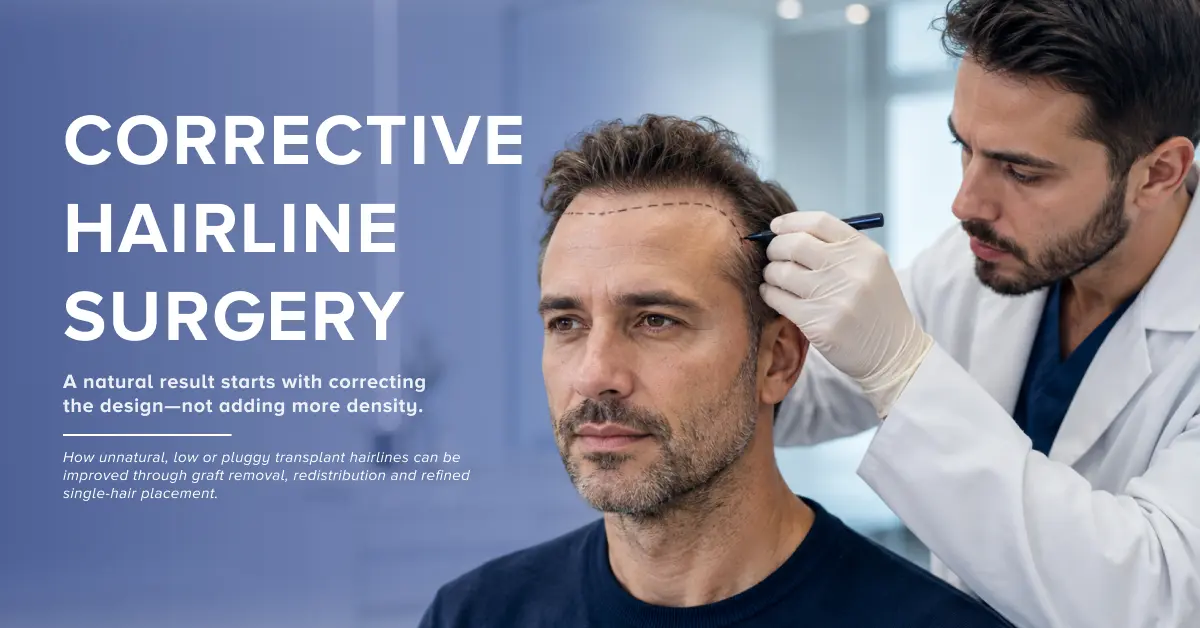
What Makes a Transplanted Hairline Look Unnatural?
An existing transplanted hairline usually looks unnatural because of its position or shape, the caliber and spacing of its grafts, their exit angle, or a combination of these factors. Having defined what revision treats, the next job is naming your own defect, because the classification decides the procedure.
This page addresses a scalp that has already been transplanted. If your hairline has never been operated on, the planning logic differs, and first-time treatment for a receding hairline is the better guide.
Defect category |
What you tend to see |
Correction direction |
|---|---|---|
Position / shape |
Border sits low on the forehead; flat or ruler-straight outline |
Removal, often staged |
Graft distribution |
Repetitive spacing, visible rows, uneven left-right density |
Selective removal, selective addition, or both |
Graft type / caliber |
Coarse multi-hair units at the front edge |
Removal, fine single-hair camouflage, or both |
Angle / direction |
Shafts stand upright or point sideways against surrounding hair |
Extraction of the most conspicuous grafts |
Source note: editorial synthesis of published follicular-unit and hairline-design literature with established clinical planning principles.
Common Hairline Design Mistakes (Too Low, Too Straight, Pluggy)
Common visible patterns include a too-low hairline sitting below the border a surgeon would plan today, often with the frontotemporal corners filled in rather than showing normal temporal recession. A ruler-straight border lacks macro-irregularity, the gentle side-to-side waviness of a natural outline. Coarse multi-hair grafts at the leading edge produce the pluggy look, repetitive spacing creates visible rows, and uneven sides break hairline symmetry.
Position and angle problems generally need removal or permanent hair reduction. Caliber and spacing problems may respond to selective addition. Mixed defects usually need both, in a planned order.
Wrong Angle, Direction, and Single-Hair Placement Errors
Grafts placed at the wrong angle emerge too upright, or point across the flow of surrounding hair. That is why a result can look acceptable from the front and obviously surgical in profile. Wrongly angled hair grafts cannot be redirected by placing more grafts around them, because graft angle and direction are set by the follicle already sitting in the skin.
The transition zone is the softened front edge where finer single-hair grafts normally sit, giving the micro-irregularity that makes a border look scattered rather than drawn. When coarse or misdirected units occupy that zone, the most conspicuous ones usually need extraction before anything new is added.

What Techniques Are Used to Correct a Hairline?
Hairline correction generally uses selective graft removal, reimplantation of viable follicles, strategic addition of fine single-hair grafts, or a staged combination of these methods. Having separated the correctable from the stubborn, the technique now follows the defect.
Three pathways carry most revision plans. Graft removal takes conspicuous units out. Graft redistribution reuses viable extracted follicles elsewhere. Camouflage adds fine single hairs to soften an edge that already sits in the right place.
Problem |
Removal |
Redistribution |
Adding density |
Likely staging |
|---|---|---|---|---|
Too-low hairline |
Primary treatment |
If grafts survive extraction |
Avoid at the low border |
Commonly staged |
Pluggy front edge, position acceptable |
Selective, for coarse units |
Possible |
Fine singles after removal |
Often considered in stages |
Wrongly angled grafts |
Primary treatment |
If units come out intact |
Only after extraction |
Commonly staged |
Mild asymmetry |
Selective, on the fuller side |
Sometimes to the thinner side |
Selective, on the thinner side |
May be possible in one session |
Thin but well-positioned edge |
Rarely needed |
Not required |
Primary treatment, single hairs |
May be possible in one session |
Source note: editorial synthesis of published FUE and repair literature with medically reviewed planning principles; staging is decided after examination.
Not sure whether your hairline needs graft removal or camouflage? Send clear front, side, top, and donor-area photographs through the WhatsApp button in the bottom-right corner for a free preliminary assessment from Medart Hair Transplant. A photo review does not replace a physical scalp examination.
Graft Removal, Redistribution, and Adding Density
Selective graft removal extracts individual conspicuous units with small-diameter punches, the same extraction principle Rassman and colleagues described when they published on follicular unit extraction in Dermatologic Surgery in 2002. Peer-reviewed FUE reviews in the Journal of Cutaneous and Aesthetic Surgery identify punch diameter and transection as the core technical variables.
Recipient fibrosis is firm, scar-like tissue in the implanted area that can make extraction or reimplantation more difficult. Our clinical team observes that extraction from fibrotic or previously implanted skin needs greater punch control, and can make preserving an intact follicular unit harder. That is a clinical observation, not published evidence.
Trade-offs include graft transection, incomplete removal, pigment change, small extraction marks, and temporary redness. A surgeon may divide extensive removal across sessions to limit concentrated recipient-area trauma and to reassess pigment and texture before continuing.

Graft redistribution means reusing what comes out. A second observation from the same team: every extracted graft is inspected under magnification for follicular integrity and handling quality before reimplantation is considered. Reimplantation viability is judged on the day, not promised in advance.
Viable follicles may be moved to the midscalp or crown, where they are less conspicuous. The destination depends on hair caliber, recipient need, and long-term hair loss planning. Not every removed follicle survives or can be reused.
Adding density places fine single-hair grafts in the transition zone to break up repetitive spacing and reduce the visual weight of larger units. Careful recipient-site creation sets their angle and direction. Camouflage is the wrong tool where it would preserve a too-low border, because filling space does not move an existing front edge backward.
Laser hair removal and electrolysis are sometimes used for a small number of unwanted hairs. Laser typically depends on pigment contrast and may reduce hair rather than clear it permanently; electrolysis is operator-dependent and carries its own pigment and scarring risk. Neither replaces surgical graft removal when whole units must go.
Technique labels settle very little. FUE describes extraction, while DHI describes an implantation workflow, and how DHI implantation works explains that distinction. Extraction control, graft selection, and recipient-site direction predict revision quality. The acronym on a price list does not.
Case scenario: too low. A patient asked for more density at a hairline sitting well below the border a surgeon would plan today. Density was rejected, because it would have locked in the low position and spent donor reserve needed later. Staged removal of the lowest rows was planned across two sessions to limit concentrated trauma. Donor reserve was already reduced by the first surgery, so reimplantation was restricted to intact units, and fine extraction marks were expected to stay visible at close range.
Case scenario: pluggy edge. Another patient had an acceptable hairline position, but coarse three-hair units sat in the front row with repetitive spacing behind them. Raising the line was unnecessary, so the plan combined removal of the most conspicuous units with fine single-hair camouflage several months later. Staging this pluggy hairline correction let the skin settle before new grafts were placed. Limited donor reserve capped how many single hairs could be committed, so some spacing irregularity was accepted in advance.
How Long Should You Wait Before Corrective Hairline Surgery?
Although an early consultation is appropriate, surgeons commonly wait about 12 months—and sometimes longer—before final corrective planning so growth and scalp healing can mature. Technique selection depends on seeing the finished result of the first procedure. What looks markedly unnatural at month four may simply reflect an incomplete hair growth cycle.
These intervals are approximate and vary between patients.
Approximate time after the original transplant |
What is usually happening |
|---|---|
0–2 weeks |
Wound healing and graft anchoring |
2–8 weeks |
Postoperative shedding may occur; shock loss of native hair is possible |
3–6 months |
Early regrowth, often fine and lighter than final hair |
6–9 months |
Increasing coverage, with caliber and density still maturing |
Around 12 months |
Common point for mature revision assessment |
12–18 months |
Later maturation in selected cases, including slower regrowth or persistent redness |
Source note: sequence summarized from published post-transplant clinical reviews; individual timing varies.
Book the consultation early even if surgery should wait. A surgeon can classify the defect, record baseline medical photography, and explain which findings would change the plan later. Occasionally a clearly misplaced single graft or a medical concern justifies earlier action, but only after direct assessment.
Hair restoration literature describes grafts becoming securely anchored during the first week. That describes wound stability, not readiness for cosmetic revision. A StatPearls clinical summary on hair transplantation, hosted by the NIH National Library of Medicine, sets out the months-long shedding and regrowth sequence that actually governs appearance.
Warning: Increasing pain, pus, fever, spreading redness, tissue discoloration, or other urgent postoperative symptoms require prompt contact with the treating surgeon. Do not wait for a cosmetic revision consultation.

Are You a Candidate for Hairline Revision? (Donor & Scalp Check)
A suitable hairline-revision candidate has a correctable design problem, adequate lifetime donor reserves, an acceptably healed recipient scalp, and realistic expectations about staged improvement. Timing tells you when to plan. Candidacy tells you whether the plan is safe to carry out, and it sets the graft budget.
Donor assessment goes well beyond counting what could be harvested today. A surgeon measures donor density, looks for miniaturization (progressive thinning of individual shafts that signals unstable hair), inspects the previous harvesting pattern for over-thinned zones, and judges how many suitable single-hair units the donor area can actually supply. Cumulative donor use matters because donor hair is a limited lifetime resource that does not replenish between procedures.
Recipient assessment covers scar tissue, firmness, scalp laxity and mobility, discoloration, and signs of poor healing. Fibrotic tissue affects both extraction difficulty and graft survival. Repeat work in one small area also relies on scalp vascularity, the blood supply feeding newly placed grafts, which heavy scarring can reduce. Trichoscopy, magnified scalp examination used to assess hair and skin characteristics, adds detail that photographs cannot show.
Two further factors shape the plan. Native hair loss behind the transplanted line may still be progressing, and the American Academy of Dermatology describes androgenetic alopecia as a progressive condition. Hair caliber, curl, and hair-to-skin color contrast decide how effectively single-hair grafts can camouflage.
Arrange direct assessment rather than relying on photographs if you have had multiple prior procedures, do not know your previous graft count or harvesting method, show donor miniaturization or ongoing native loss, have firm, scarred or discolored recipient skin, or hope to reuse extracted grafts. The same applies to questions about finasteride or minoxidil.
Candidate checklist:
● Mature original result.
● Clear, correctable aesthetic defect.
● Adequate donor reserve.
● Acceptable recipient-skin condition.
● Stable or managed ongoing hair loss.
● Realistic expectations.
● No untreated scalp disorder or medical contraindication.

For a preliminary revision assessment, prepare:
1. Front, left-profile, right-profile, top, and donor-area photographs in even lighting.
2. Current hair length and styling kept similar across images.
3. The original procedure date and clinic, if known.
4. Previous graft count and harvesting method, if known.
5. Any operative report, medication list, and history of ongoing hair loss.
Patients traveling to Istanbul, or anywhere else in Turkey, should allow time for in-person scalp examination before surgery, since a photo-based plan can change once donor density and skin condition are checked directly. The NHS publishes general guidance on planning cosmetic procedures abroad and arranging aftercare.
Include your previous graft count or operative report, if available, with photographs through the WhatsApp button in the bottom-right corner. That information supports a preliminary donor and revision assessment, though it cannot confirm candidacy remotely.
What Results and Timeline Can You Expect After Correction?
Visible healing occurs before the final cosmetic result, and transplanted correction grafts generally require several months of growth before the hairline can be meaningfully assessed. Candidacy establishes what is possible; recovery decides when you will see it. Removal and reimplantation follow different visible timelines.
Time after correction |
What may happen |
What not to judge yet |
|---|---|---|
Days 1–10 |
Small crusts, redness, mild swelling |
Final skin color or graft placement |
Weeks 2–8 |
Crusts resolve; added or reimplanted grafts may shed |
Density of new grafts |
Months 3–6 |
Early regrowth; extraction marks fade gradually |
Edge softness and texture |
Months 9–12 |
Grafts mature; transition zone settles |
Whether further elective refinement is needed |
Source note: sequence summarized from published post-transplant clinical reviews and routine follow-up practice; timing varies by skin and procedure.
Removal-only results can be judged sooner, though skin color and texture may keep settling for months. Further elective refinement should generally wait until the first correction has matured, unless a medical concern needs attention. If you traveled for surgery, agree on a follow-up route before flying home, including photo review intervals.
Case scenario: wrong angle. A third patient's hairline looked reasonable in front-facing photographs and obviously surgical in profile, because a band of grafts emerged almost vertically. Camouflage was rejected: added density cannot redirect a shaft already anchored in the skin. The most conspicuous misdirected grafts were extracted first, with correctly angled replacement planned for a later stage. Donor reserve allowed only partial replacement, so some residual irregularity remained after the first session.
