
Get a Free Consultation
Talk to an experienced patient coordinator for your hair transplant in Turkey.Key Takeaways
● Many uncomplicated patients travel after one to three days, subject to surgeon clearance.
● Cabin pressure is not usually the principal risk to fresh grafts.
● Same-day travel after surgery is not the preferred default.
● Long-haul flights need added mobility and individual clot-risk assessment.
● Bleeding, worsening wound signs, severe swelling, chest pain, or breathlessness need medical assessment.
Cabin pressure is not usually the biggest risk to a new hair transplant. The real concerns sit closer to home: accidental graft contact, unresolved bleeding or swelling, medication effects, and hours of immobility on a long flight. Most patients spend their worry on the altitude and none of it on the armrest. Medart Hair Transplant treats many international patients in Istanbul and coordinates their postoperative check with the journey home. This guide explains when flying after hair transplant surgery is usually reasonable, how to protect the grafts in transit, and which symptoms mean you should delay departure and get medical advice first.
When to delay travel — the short version
Delay your flight and speak to your clinic first if any of these apply: bleeding that will not settle, a rising fever with worsening scalp pain or spreading redness, swelling that keeps increasing, unresolved sedation effects, or a long-haul flight combined with clot risk factors such as a previous DVT. Chest pain, sudden breathlessness, fainting, or severe allergic symptoms are emergencies. Call local emergency services, not the clinic.
How Soon Can You Fly After a Hair Transplant?
Many uncomplicated patients can fly one to three days after a hair transplant, but only their treating surgeon can confirm that they are fit to travel. This range is a clinical planning window, not a universal medical guarantee. Your surgeon's postoperative check carries more weight than any fixed online number, airline policy, or clinic marketing claim.
Two ideas run through this whole article, so it helps to separate them now. Graft protection concerns the implanted scalp and the fragile healing sites there. Fitness to fly concerns your overall medical stability and your travel-related risks. They are related, but they are not the same decision.
Same-day flying is generally not the preferred default. If sedation was used, its effects need time to clear. If bleeding is still settling, a same-day airport transfer leaves little room for postoperative review and management.
A longer wait may suit follicular unit transplantation (FUT), extensive procedures, unresolved symptoms, long-haul travel, or relevant medical risk factors. Flight length affects general travel precautions more than graft anchoring alone. Airline fitness-to-fly rules can also vary between carriers.
The table below shows how soon can you fly after hair transplant surgery in common situations. Read it as a prompt for discussion with your surgeon, not a rulebook.
Situation |
Typical planning window |
Main concern |
Required action before departure |
|---|---|---|---|
Same-day flight |
Generally not preferred |
Sedation effects and early bleeding |
Confirm surgeon clearance and controlled bleeding |
Uncomplicated short-haul flight |
Often one to three days |
Accidental graft contact |
Complete the postoperative check |
Long-haul flight |
Individualized; may need a longer wait |
Immobility and clot risk |
Assess medical history with the clinic |
FUT with sutures or staples |
May need longer |
Donor incision comfort and wound care |
Clarify wound-care and follow-up plan |
Persistent bleeding or marked swelling |
Delay until reviewed |
Uncontrolled symptoms |
Obtain medical assessment first |
Sedation not fully worn off |
Delay until resolved |
Drowsiness and unsteadiness |
Wait until alert and stable |
Your technique and your symptoms shift the timing far more than the calendar does. So where does the one-to-three-day range come from? It reflects clinic-informed planning built around postoperative review, not a fixed interval published by a health authority.
Already have a return flight in mind? Tap the WhatsApp button in the bottom-right corner to share your route, flight duration, medical history, and planned procedure date for a free personalized travel assessment.
WhatsApp is not an emergency service. Seek immediate local medical care for chest pain, sudden breathlessness, fainting, severe allergic symptoms, or uncontrolled bleeding.
Clinical observation (Medart clinical workflow):
"Before an international patient leaves Istanbul, I check the recipient and donor areas, confirm that bleeding is controlled, and review how the person is coping with medication. Clearance is about the patient in front of me, not a fixed day count. This observation does not replace individualized assessment." — Dr. Busra Yakupoglu, Hair Transplant Surgeon, Medart Hair Transplant
Can Cabin Pressure or Flying Damage the Grafts?
Normal aircraft cabin pressure is not expected to dislodge transplanted grafts; direct rubbing, scratching, impact, and unassessed postoperative complications are more practical concerns. The timing question sits behind us. What actually threatens fresh grafts is the next thing worth understanding, because it shapes how you behave in every airport and on every flight.
Newly implanted hair grafts stay physically vulnerable during early healing. Picture them less as anchored objects and more as delicate healing wounds. Normal cabin pressure is not generally expected to dislodge them, but direct contact can disrupt that early healing.
Low aircraft cabin humidity can contribute to dryness and discomfort, and it can add to dehydration on longer flights. It is not a proven cause of graft failure. Postoperative swelling can develop during the first days whether you fly or stay on the ground. Use saline spray, dressings, or topical products only if provided or approved by your clinic.
What can threaten fresh grafts?
● Friction against a seat, headrest, or pillow
● Scratching or picking at the recipient area
● Direct impact from luggage or a crowded aircraft aisle
● Tight contact from hats, collars, or pull-over clothing dragging across the scalp
● Non-adherence to your clinic's aftercare instructions
When do transplanted grafts become secure?
Graft vulnerability decreases as healing progresses, but no single day makes grafts "fully secure" for every patient. Anchoring is gradual, not a switch that flips. Peer-reviewed research in Dermatologic Surgery has measured how graft grip strengthens over the days after implantation, and the practical takeaway is a trend, not a fixed safe date. Read any such finding alongside your surgeon's protocol rather than as a guarantee.
Individual healing varies. Scalp sensitivity, procedure size, and how carefully you avoid contact all shape how the first week feels. For a fuller view of the weeks ahead, our hair transplant recovery timeline sets out what changes and when.
What Determines Whether You Are Fit to Fly?
Fitness to fly depends on your symptoms, medication or sedation effects, procedure type, flight duration, mobility, medical history, and postoperative examination. Protecting grafts from contact solves one part of travel safety. Whether you, as a whole person, are ready to sit through a flight is the separate question this section answers.
A treating clinician will generally assess whether you are alert, medically stable, mobile, and free from uncontrolled bleeding. Effects of sedation must have resolved. If sedation was used, an escort may be sensible for the journey.
Significant pain, dizziness, vomiting, allergic symptoms, or rapidly increasing swelling needs review before departure. Long-haul travellers also need a clot-risk conversation. According to NHS guidance on travel and blood clots, and CDC guidance in the current CDC Yellow Book, prolonged sitting is one contributor to travel-associated clots, especially alongside other factors. Previous deep vein thrombosis (DVT), recent major surgery, cancer, pregnancy, obesity, thrombophilia (a condition that raises the tendency to form clots), and limited mobility each require individual assessment.
Composite example — not a real patient:
A man has an uncomplicated follicular unit extraction (FUE) procedure, feels alert with no sedation effects, and passes his postoperative check with a two-hour short-haul flight booked. His symptoms are expected and controlled. He confirms clearance with his surgeon and travels with help for his bag.
FUT patients may need extra consideration because of the donor incision and its sutures or staples. A fit-to-fly letter may be required if your airline requests medical documentation.
Medart Fit-to-Fly Checklist
This green/amber/red framework sits within the Medart Hair Transplant clinical workflow to help organise the decision. It supports, but does not replace, your surgeon's clearance.
Green — generally ready to travel
● Surgeon has checked the scalp
● Bleeding is controlled
● You can walk normally and feel steady
● Symptoms are expected and manageable
Amber — contact the clinic before leaving
● Marked forehead or facial swelling
● Medication side effects you are unsure about
● Uncertain dressing or wound care
● Long-haul flight combined with clot risk factors
● Concern about FUT sutures, wound tension, or donor comfort
Red — do not fly; act now
● Active, uncontrolled bleeding: contact the clinic and delay travel
● Fever with worsening scalp symptoms or rapidly spreading redness: seek medical review before flying
● Chest pain, sudden breathlessness, coughing blood, or fainting: call local emergency services now
● Severe allergic symptoms, meaning breathing difficulty, facial or tongue swelling, or collapse: call local emergency services now
Amber symptoms need a clinic conversation before you commit to travel. Red symptoms need medical assessment or emergency care before any flight.
Clinical observation (Medart clinical workflow):
"The single most useful thing an international patient can do before their flight is complete the postoperative check. In that check I am looking at graft placement, bleeding, swelling, and how the patient tolerates medication before I confirm they are fit to fly. This observation does not replace individualized assessment." — Dr. Busra Yakupoglu, Hair Transplant Surgeon, Medart Hair Transplant
Do FUE, DHI and FUT Have Different Travel Timelines?
FUE and DHI usually involve small extraction sites, while FUT adds a closed donor incision, so technique can affect comfort and wound-care needs even when the flight itself is permitted. Passing the fitness-to-fly assessment is one step. Your procedure type shapes the practical details of comfort and follow-up in the days after.
FUE removes individual follicular units through tiny openings in the donor area. Direct hair implantation (DHI) describes an implantation approach that commonly uses an implanter tool after graft extraction; the extraction method used alongside it determines the donor wounds, so DHI is a method within FUE-based treatment rather than a separate healing category. FUT removes a narrow strip of donor scalp, which is then closed with sutures or staples.
That FUT incision creates added considerations around wound comfort, tension, care, and suture removal. Wound tension or any sign of wound separation is a reason to contact your treating clinic before you travel. Procedure size, duration, medication effects, recovery, and medical history often matter more than the marketing label on a technique. No technique removes the need for surgeon clearance.
The table below compares the three approaches.
Technique |
Donor area |
Travel consideration |
Follow-up consideration |
|---|---|---|---|
FUE |
Small punch openings |
Protect grafts from contact |
Follow the clinic's donor and recipient-area protocol |
DHI |
Small punch openings |
Same precautions as FUE |
Follow the clinic's donor and recipient-area protocol |
FUT |
Linear incision with sutures or staples |
Incision comfort and tension |
May need suture or staple removal |
The flight may be permitted for any technique, yet FUT usually adds wound-care planning. This is where good hair transplant travel aftercare earns its keep.
How to Prepare Before Leaving for the Airport
Before leaving for the airport, complete your scheduled postoperative check, place medication and instructions in hand luggage, and arrange help with bags. Knowing your technique's needs is useful. Turning that knowledge into a calm departure plan is what actually protects the grafts on the day you leave.
Complete the planned postoperative check and first hair wash when these are part of the clinic protocol. Keep prescribed pain medication, any antibiotics, if prescribed, and your written aftercare instructions in your hand luggage. Carry medicines in their original packaging where possible.
Check current airport security liquid restrictions and airline rules before departure, since hand-luggage medication rules change over time and vary by airport. Turkish airport security and airline medical pages set out what documentation and quantities they allow, so confirm the details for your route. Wear loose, front-opening clothing so nothing drags over the recipient area.
Arrange help with heavy luggage and avoid reaching into overhead lockers. Save the clinic's aftercare contact method and know what to do after you land. Do not start aspirin, anticoagulants, sedatives, or extra doses for travel, and do not stop prescribed medication without medical advice.
What to pack in hand luggage
● Prescribed medication in original packaging
● Written aftercare instructions
● Fit-to-fly documentation, if the airline needs it
● Water bought after security where airport rules allow, for hydration
● Loose, front-opening travel clothing
● A neck pillow, only if it avoids touching the recipient area
● Saline or care products, only if provided or approved by your clinic
Departure-day plan: from hotel to aircraft
Follow your surgeon's instructions alongside these general steps:
1. Complete the scheduled clinic check, or confirm the clinic's instructions, so your grafts and symptoms are reviewed before you commit to the journey.
2. Pack approved medication and your aftercare documents into hand luggage, keeping everything within easy reach at security and boarding.
3. Wear loose, front-opening clothing and keep your hands away from the recipient area throughout the transfer and terminal.
4. Use a planned airport transfer with enough time for Istanbul traffic and airport security, so you are never rushing near crowds.
5. Ask for help with luggage and protect your scalp during boarding and seating, especially in crowded boarding areas.
How to Protect Your Scalp During the Flight
During the flight, protect the grafts from contact, stay hydrated, and move regularly on longer journeys unless your clinician has told you otherwise. Packing well gets you to the gate. In-flight habits are what protect the grafts once you are seated for hours.
Do not touch, scratch, press, or rub the recipient area against the seat or a pillow. Use a neck pillow only if it supports your neck without touching the implanted area. Follow your clinic's head-elevation and sleep-position instructions rather than a fixed position.
Ask crew or fellow passengers for help with overhead luggage. Stay hydrated and limit alcohol, which adds to dehydration and can interfere with sensible medication use. Avoid smoking, which is discouraged around surgery because it can impair wound healing.
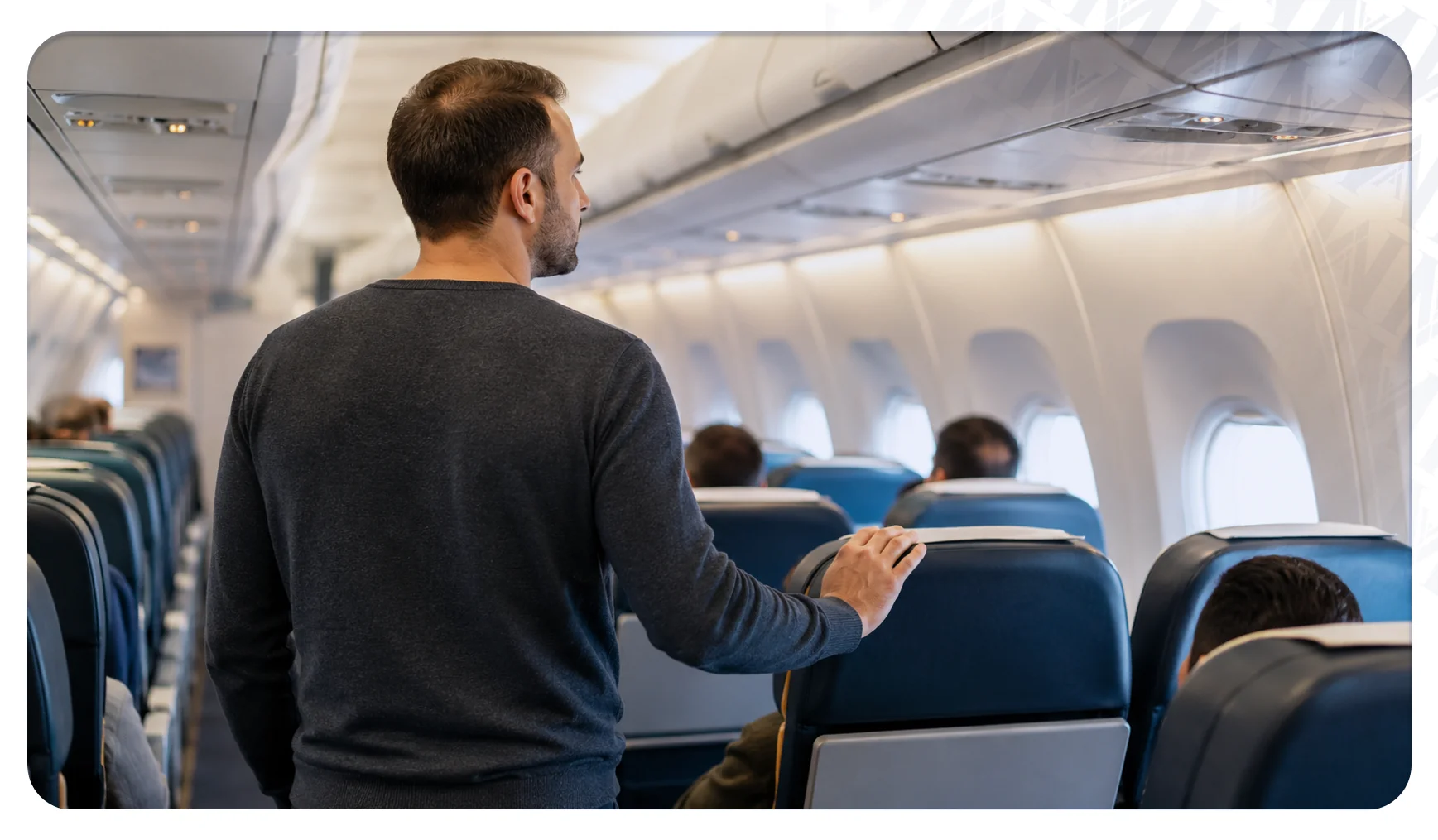
On longer journeys, walk periodically and perform calf or ankle movements when it is safe. The concern with a long-haul flight is not that the aircraft causes clots. It is that long periods of sitting can matter for people with certain risk factors. Compression stockings and anticoagulants are not prescribed here; they require individual medical advice.
Short-haul versus long-haul precautions
Precaution |
Short-haul flight |
Long-haul flight |
|---|---|---|
Movement |
Usually straightforward |
Walk and move the calves periodically |
Hydration |
Sip water for comfort |
Drink water steadily for comfort |
Medication timing |
Follow the clinic schedule |
Follow a dosing plan agreed with your clinician |
Sleep |
Brief, avoid graft contact |
Follow clinic-approved positioning, avoid pressing the scalp |
Clot-risk assessment |
Assess individually if risk factors are present |
Requires individual assessment |
Follow-up planning |
Standard |
Confirm remote follow-up before travel |
The longer the flight, the more mobility and clot-risk planning matter. For safe positioning at home and in the air, our guide on
how to sleep after a hair transplant
explains head elevation in detail.
Composite example — not a real patient:
A traveller faces a ten-hour flight home and has a history of previous DVT and limited mobility. Because immobility and prior clots each need individual assessment, he contacts his surgeon and his own doctor before travel. He discusses his personal risk and follows their tailored advice rather than a generic online tip.
What to Expect After Landing
After landing, continue the exact washing, medication, sleeping, and activity plan supplied by your clinic and report worsening symptoms promptly. Protecting grafts in transit only pays off if you keep the routine going once you are home and tired. Jet lag and a broken night make it easy to slip, which is exactly when a simple written plan helps.
For medication, do not simply switch to local time on your own. Before you travel, ask the prescribing clinician or pharmacist how to handle dose timing across time zones, so you never shorten or repeat a dose interval by accident. Then resume your washing, sleep, and activity schedule as directed.
Mild crusting or scabs, tenderness, scalp numbness, and expected postoperative swelling can continue after travel. These are common early features of recovery, but they should settle rather than worsen; tell your clinic if they intensify. Do not pick scabs or crusts.
Your first day home is easier with a short plan:
● Confirm your medication timing with the clinic and take doses as agreed
● Sleep with your head elevated as your clinic directed, avoiding scalp contact
● Photograph the recipient and donor areas in bright, even light
● Note where your nearest local urgent care is, in case symptoms escalate
Avoid strenuous exercise, swimming, direct sun exposure, helmets, and tight headwear for the period your surgeon specifies. Our full hair transplant aftercare instructions cover washing, medication, and activity week by week.
Clinical observation (Medart clinical workflow):
"For remote follow-up, I ask patients to photograph the recipient and donor areas in bright, even light, from the front, top, and back. Good images help the team assess visible changes and decide whether an in-person review may be needed. Photographs support triage; they cannot exclude infection or other complications on their own." — Dr. Busra Yakupoglu, Hair Transplant Surgeon, Medart Hair Transplant
When Should You Postpone the Flight or Seek Medical Help?
Postpone travel and obtain medical advice if you have uncontrolled bleeding, symptoms that could indicate a worsening wound problem, severe medication effects, or rapidly increasing swelling. Knowing normal recovery is helpful. Recognising the warning signs, and acting on them, is what keeps a routine flight from becoming a genuine emergency.
The table below identifies symptoms that need review before travel or immediate emergency care. It does not diagnose you; it tells you what action to take.
Symptom |
Recommended action |
Emergency level |
|---|---|---|
Active or recurrent bleeding not stopping with clinic-directed measures |
Contact the clinic and delay travel |
Urgent |
Fever with worsening pain, warmth, discharge, or spreading redness |
Seek medical review before flying |
Urgent |
Rapidly worsening swelling around the eyes |
Get medical assessment before travel |
Urgent |
Swelling with breathing difficulty |
Call local emergency services |
Emergency |
Severe dizziness, fainting, persistent vomiting, or confusion |
Call local emergency services |
Emergency |
Severe allergic symptoms: airway swelling, breathing difficulty, or collapse |
Call local emergency services |
Emergency |
New calf pain or swelling, chest pain, coughing blood, or sudden breathlessness |
Call local emergency services |
Emergency |
According to NHS guidance on surgical wounds and infection, fever with increasing pain, warmth, discharge, or spreading redness can signal a wound problem that needs review. According to NHS guidance on DVT and pulmonary embolism (a blood clot that travels to the lungs), new calf pain or swelling, chest pain, coughing blood, and sudden breathlessness are warning signs that need urgent attention.
Emergency: Chest pain, sudden breathlessness, coughing blood, fainting, or severe allergic symptoms require immediate local emergency care. Do not wait for a WhatsApp reply during an emergency.
Composite example — not a real patient:
Before her airport transfer, a patient notices recurrent bleeding, spreading redness around the donor area, a rising fever, and worsening dizziness. Rather than risk a flight, she contacts her clinic, delays travel, and seeks a local medical assessment so her symptoms can be reviewed properly before she considers rebooking.
How Long Should You Stay in Istanbul After the Procedure?
Your Istanbul itinerary should allow time for surgery, recovery, the clinic's postoperative check, and surgeon clearance before the airport transfer. That single principle turns clinical advice into a realistic travel plan you can book around.
Plan around the clinic's actual surgery, postoperative examination, and first wash schedule. A buffer after surgery is preferable for completing review and managing slower-than-expected recovery, which is why a rushed same-day airport transfer is not the preferred default. Flexible or changeable flights protect you if recovery takes longer than planned.
Long-haul travellers, or patients with additional medical risks, may benefit from a longer stay. Build in airport-transfer time, allowing for Istanbul, Turkey traffic, which can add significantly to your journey. Confirm the final itinerary with your treating team before you buy flights. If you are still mapping out the trip itself, our guide to planning a hair transplant trip to Turkey covers flights, hotels, and consultations. Deciding how long to stay in Turkey after hair transplant surgery is a shared plan, not a guess.
Example departure timeline
Example only — not a universal prescription. Timing varies by Medart protocol and individual recovery.
● Arrival and consultation: meet the team, review your plan, and prepare for surgery.
● Procedure day: FUE, DHI, or FUT performed under local anaesthesia, with recovery time afterwards.
● Hotel recovery: rest, follow aftercare, and protect the recipient area.
● Next scheduled clinic day — postoperative check and first wash: the clinic reviews the grafts and performs the first wash where this is part of protocol.
● Surgeon-cleared departure: travel only once your surgeon confirms you are fit to fly.
● After arrival home — remote follow-up: send photos and continue aftercare, with telehealth support as arranged.
This illustrates a common workflow, not a promise about your personal timing.
Planning treatment in Istanbul? Tap the WhatsApp button in the bottom-right corner before booking your return flight. Share your procedure date, flight duration, and medical history for a free assessment, and the Medart team can help you build enough recovery time into the itinerary.
WhatsApp is not an emergency service. Seek immediate local medical care for chest pain, sudden breathlessness, fainting, severe allergic symptoms, or uncontrolled bleeding.
Clinical observation (Medart clinical workflow):
"Our postoperative workflow for international patients follows the same shape: procedure, a recovery buffer at the hotel, then a clinic review and first wash before I clear anyone to fly. I would rather move a flight than send a patient to the airport before that review is done. This observation does not replace individualized assessment." — Dr. Busra Yakupoglu, Hair Transplant Surgeon, Medart Hair Transplant
Frequently Asked Questions
There is no single flight schedule that is safe for every hair transplant patient, so each answer must be read alongside the operating surgeon's instructions. The answers below stand on their own, and each points back to the fuller explanation earlier in this guide.
The Bottom Line on Traveling Home
For many uncomplicated patients, flying after hair transplant surgery is a one-to-three-day planning question, but that range is a conditional window rather than a countdown. Your surgeon's in-person check matters more than any number online. Cabin pressure is not usually the main issue; graft protection, controlled bleeding, settled sedation, and long-flight mobility are what count. Give yourself the buffer, and the journey home becomes the easy part.
For advice based on your procedure, health history, and route home, tap the WhatsApp button in the bottom-right corner to request a free personalized assessment from Medart Hair Transplant.
WhatsApp is not an emergency service. Seek immediate local medical care for chest pain, sudden breathlessness, fainting, severe allergic symptoms, or uncontrolled bleeding.
The safest flight home is the one your surgeon clears after checking both your grafts and your overall recovery.