
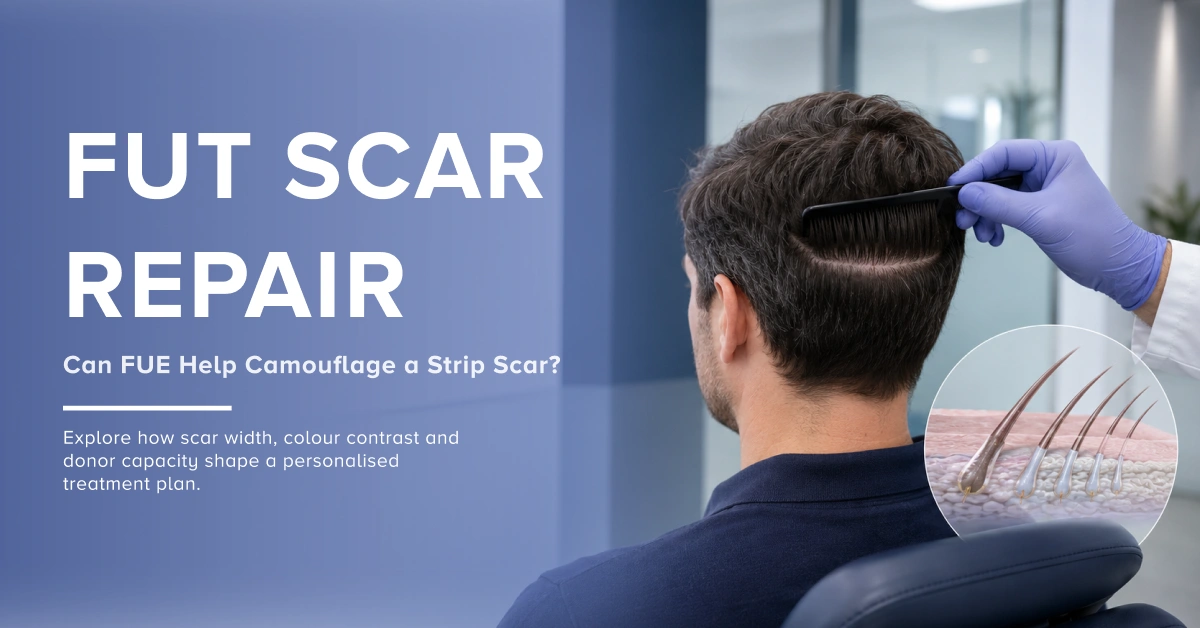

Can You Fix a FUT Strip Scar?
Yes, FUE can often camouflage a mature FUT strip scar, but it cannot remove the scar or guarantee invisibility at every hair length.
Follicular unit transplantation (FUT), also called strip surgery, removes a band of scalp from the back of the head and leaves a linear donor scar. Follicular unit extraction (FUE) removes follicular units one at a time, which is why FUE grafts can be replanted into that old line. That is what FUT scar repair means in practice.
Repair means reducing visibility, not restoring unscarred skin. The scar tissue stays in the scalp. What changes is how easily the eye separates a pale line from the hair around it.
Peer-reviewed case series indexed in PubMed, the US National Library of Medicine's database, describe follicular unit grafts (naturally grouped sets of one or more hairs) growing inside stable scars from surgery, burns, and cicatricial alopecia. The evidence is limited: small case series and clinical experience, not randomized trials. Growth inside a scar is less predictable than in untouched scalp.
Four routes can help fix linear hair transplant scar visibility, and none of them restores untouched skin: FUE grafting into the scar, surgical scar revision, scalp micropigmentation (SMP), and combined treatment. Candidacy depends on your scar, your donor reserve, and your hairstyle goal. Donor reserve is the finite supply of usable follicles you have left.
One question comes before all four. Is the scar mature and stable? During a scar-repair assessment, our clinicians document color change over time, persistent redness, thickening, itch, pain, breakdown, tethering, and any history of radiotherapy or repeated surgery. That is clinic-specific clinical experience, not trial evidence.
Seek medical assessment before cosmetic scar repair if your scar is raised, worsening, painful, itchy, inflamed, changing, bleeding, discharging, repeatedly breaking down, previously irradiated, or suspected to be hypertrophic or keloid.
Progressive thickening or any sign of infection needs a doctor's opinion first. A suspected hypertrophic scar, or keloid tendency in your history, may call for review by a dermatologist or plastic surgeon before anyone discusses camouflage.

How Does FUE Into a Strip Scar Work?
FUE scar repair places individually harvested follicular units into and around the linear scar to grow hair across the visible line. Now that you can name the feature exposing your scar, the practical question is what happens when the missing feature is hair. The sequence below also explains why density is often kept deliberately modest.
In this article, FUE is a repair tool for a scar you already have, not a first-transplant choice. Readers who want that background can read how FUT and FUE differ as transplant techniques.
Repairing a FUT strip scar with FUE follows four stages:
1. Assess the scar and your goals: measure length and average width, judge maturity and symptoms, check donor density and reserve, and record your target hairstyle.
2. Harvest follicular units: extract them individually from a suitable donor area, using the same principle described in our guide to FUE as a transplant method.
3. Create recipient sites: make tiny openings in the scar and, where useful, immediately above and below it.
4. Place grafts and reassess: implant the grafts, then review growth before deciding on a second session, SMP, or nothing further.
Mature scar tissue can differ from unaffected scalp in blood supply, firmness, and thickness, so site creation is harder and graft survival is harder to forecast. Case series in the hair-restoration literature report growth in stable scars. No clinic can honestly quote a survival percentage for FUE into FUT scar tissue before examining it.
Angle matters as much as number. The surgeon follows the surrounding hair direction and angle, with slight variation, so the placement breaks up the straight edge instead of tracing it. The aim is to interrupt a straight visible line with real hairs and reduce contrast, not to turn scar tissue back into untouched skin.
Two practical limits shape the plan. Each extraction leaves a small donor wound and spends part of a finite reserve. In our clinic's experience, crowding recipient sites into a poorly supplied strip can reduce yield across the whole line, so a lower-density first pass or a small test session is often the opening move. That is clinical experience, not evidence from a controlled trial.

FUT Scar Repair Options Compared
Option |
Best suited to |
Main benefit |
Main limitation |
Hair-length implications |
May require multiple sessions? |
|---|---|---|---|---|---|
FUE into scar |
Mature, stable scars with adequate donor supply |
Real hair grows through and across the scar |
Growth is less predictable in scar tissue, and donor follicles are finite |
May allow shorter hair, but skin-close shaving is not guaranteed |
Yes |
Surgical revision |
Wide scars that can be re-excised and closed under low tension |
Can reduce scar width before camouflage begins |
Creates a new surgical closure that can widen again |
Depends on the final scar and surrounding hair density |
Sometimes |
SMP |
Flat, stable scars where color contrast is the main problem |
Reduces scar-to-hair contrast without using grafts |
Adds no real hair, density, or texture, and pigment may fade |
Often helpful for short styles, but not invisible at close range |
Touch-ups likely |
Combined treatment |
Wide, pale, low-density, or previously revised scars |
Addresses more than one cause of visibility at once |
Requires more planning, healing time, and treatment stages |
Depends on the final scar, coverage, and contrast achieved |
Often, and usually staged |
Illustrative composite scenario 1. A 41-year-old has a narrow, flat, pale line from strip surgery a decade ago, with strong donor density above and below it. He wants a number three clipper cut, not a shave. Modest-density FUE into the line, with SMP later if pale patches remain, is a reasonable plan to discuss. This example does not predict an individual outcome.
Illustrative composite scenario 2. A 47-year-old has a stretched scar that widened twice after his original closure, with low hair density immediately around it. A large graft commitment into a wide, tethered band may spend donor reserve without solving width. Assessing strip scar revision first is an illustrative planning consideration, not a rule. This example does not predict an individual outcome.
Scar Revision, SMP, and Combined Approaches: What Fits You?
FUE adds real hair, revision may reduce scar width, and SMP reduces color contrast, so the best option depends on which feature makes the scar visible. The table above shows what each tool does. This section shows how clinicians match tool to scar, and why the order of treatment is not interchangeable.
Sort your options by the dominant problem. If width dominates, discuss revision first. If contrast dominates, pigment may do more than extra grafts. If the line simply has no hair over it, grafts carry the work, and when two problems overlap, plan staged treatment.
Surgical scar revision means removing or re-closing part of a scar to improve its width or position. The American Society of Plastic Surgeons describes revision as an attempt to improve appearance rather than a way to eliminate a scar, and low closure tension is central to that. Revision cannot promise the new line will stay narrow, and it must heal and mature before anyone judges what camouflage is still needed.
Scalp micropigmentation for FUT scar work deposits pigment in the scalp to soften the difference between a pale scar and the surrounding hair. It grows nothing. The American Academy of Dermatology treats tattoo-based camouflage as a cosmetic contrast technique, and the US Food and Drug Administration notes that tattoo inks can cause allergic reactions and infections. Discuss pigment choice, skin tone, allergy history, and operator qualifications before booking.
Matching scar type to treatment:
● Flat, mature, and stable scar: usually the most straightforward candidate for FUE, alone or with pigment.
● Wide or stretched scar: consider a revision assessment before committing a large number of grafts.
● Pale scar with high scar-to-hair contrast: SMP may help when color is the main visibility factor, though it corrects neither texture nor missing hair.
● Low donor reserve: pigment-led or combined planning protects the follicles you have left.
● Raised, painful, itchy, inflamed, or suspected keloid scar: needs medical evaluation first, not cosmetic implantation.
● Previously revised or repeatedly operated scar: expect cautious density and a staged procedure.
Sometimes the right answer is to wait or decline: when the scar is active or unstable, when donor reserve is inadequate, when only invisibility under a skin-close shave would satisfy you, or when follow-up cannot be arranged.
As Dr. Busra Yakupoglu puts it: "The scar tells you which tool to reach for. If the problem is width, grafts alone rarely solve it. If the problem is contrast, pigment may do more than additional grafts." That is clinical opinion from individualized assessment, not trial evidence.
Tell your clinician about smoking or nicotine use, diabetes or impaired wound healing, bleeding disorders or anticoagulant medication, keloid tendency or previous hypertrophic scars, and any earlier scalp surgery, trauma, infection, or radiotherapy. The British Association of Dermatologists and the NHS both note that keloid-prone skin can react unpredictably to further surgery.

How Many Grafts Does FUT Scar Camouflage Need?
The graft requirement is calculated from scar area and planned density, not from scar length alone. Choosing an approach is only half of FUT scar repair planning. The other half is quantity, and numbers quoted before measurement are guesses dressed as estimates.
Scar area is length multiplied by average width, in centimeters. Length alone is like measuring a room by one wall. Width changes how much area needs coverage.
Estimated grafts = measured scar area in cm² × planned grafts per cm²
This is a planning framework, not a treatment quote or guarantee.
Graft count and follicle count are not the same thing. One follicular unit graft may carry one hair or several, so the same number of grafts can deliver very different visual weight in two patients.
Planned density is a clinical judgment, not a fixed figure. Hair caliber, curl, scar-to-hair contrast, scar texture, blood supply, and your shortest desired haircut all move it. In our clinic's experience, thick, wavy, low-contrast hair can camouflage a line at a density that would leave fine, high-contrast hair looking sparse.
Wide scars can require hundreds of grafts, and some need more than one session. Blending into the hair immediately around the scar sometimes adds to the total. Our surgeons also find that two scars with the same surface area may need different plans, because texture, blood supply, contrast, and surrounding density differ. Both observations reflect clinic experience rather than published outcome data.
Medart FUT Scar Repair Planning Matrix
Assessment field |
What is recorded |
|---|---|
Scar dimensions |
Length and average width in centimeters |
Scar surface area |
Length × average width |
Scar profile |
Flat, depressed, raised, or stretched |
Color and contrast |
Scar color and scar-to-hair contrast |
Hairstyle goal |
Current hairstyle and shortest desired haircut |
Donor status |
Donor density and available graft reserve |
History |
Previous repair attempts, revisions, or SMP |
Density plan |
Proposed graft-density range for this scar |
Test session |
Whether a small test session is recommended first |
Pathway |
Staged FUE, revision, SMP, or combination treatment |
Medart clinical planning tool; not a universal treatment standard. The matrix records the variables used for preliminary planning. It is not a validated scoring system.
Free initial assessment: Unsure how wide your scar is or how many grafts it may require? Use the WhatsApp button in the bottom-right corner to send clear photographs for a free, personalized initial assessment from Medart Hair Transplant. A photo review is preliminary and does not replace an examination.

Frequently Asked Questions

How Do You Choose a Clinic for Strip Scar Repair?
Choose a clinic that can show comparable scar-repair cases, assess donor reserve, and explain the limits of FUE, revision, and SMP without guaranteeing scar removal. You now know what each treatment achieves and how results should be judged. The last variable is who does the work, and who supports you afterwards.
Strip scar repair is corrective work, not a routine transplant. A gallery full of dense hairlines tells you nothing about grafting into firm, fibrous tissue. If you also have pluggy grafts or a depleted donor area, options for correcting other hair transplant problems are covered separately.
Ask every clinic these questions:
● Does a licensed physician examine the scar and own the treatment plan?
● Can I verify that physician's current registration with the relevant medical regulator?
● Who extracts the grafts, who creates the recipient sites, and who places them?
● Can you show scar-repair cases with similar width, color, and hair type to mine?
● Are those photographs matched for lighting, angle, hair length, and follow-up time?
● How is my donor reserve measured and protected for the future?
● Which alternatives were considered: revision, SMP, staged FUE, or no treatment?
● What is the plan if growth in the scar turns out patchy, and who manages complications?
The International Society of Hair Restoration Surgery warns patients about unlicensed personnel performing surgical steps, and the General Medical Council states that consent discussions must cover uncertainties and limitations, not benefits alone. Walk away from any promise of a scar-free result, or any fixed survival percentage offered before an examination.
Photographs to send for an initial review:
● The full scar with the hair parted
● A close-up of the scar
● The wider donor area
● One wet-hair photo
● One dry-hair photo
● One photo showing the shortest hairstyle you want to wear
Photographs show dimensions, color, hair length, and visible texture. They cannot reliably show blood supply, firmness, scalp laxity, or keloid risk, which is why a remote review stays preliminary.
Our clinic is based in Istanbul, and travelling patients should have three things confirmed in writing before they fly: who reviews the case in advance, how long to stay for post-operative review, and who manages concerns after you return home.
Compare your options: If you want to compare FUE, scar revision, and SMP for your specific scar, use the WhatsApp button in the bottom-right corner to request a free assessment. Share your scar history, preferred hairstyle, and donor-area photographs for a more useful initial review.
