
How Accurate Is a Graft Calculator vs a Real Consultation?

How accurate is a graft calculator? It gives a useful starting range, not a surgical count. It cannot measure donor density, hair caliber, miniaturization, scalp laxity or future loss. For early budgeting, allow roughly 20–30% variation either way. That is a practical planning allowance, not a universally validated clinical error rate. Confirm the figure with an assessment.
How Accurate Is a Graft Calculator vs a Real Consultation?

Table of Contents

Dr. Busra Yakupoglu

Reviewed by Dr. Busra Yakupoglu, Hair Transplant Surgeon, Medart Hair Transplant, Istanbul

Get a Free Consultation

Talk to an experienced patient coordinator for your hair transplant in Turkey.
Please enter a valid phone number.

A graft calculator returns a number that looks exact. It isn't. The figure comes from a handful of tick-boxes and built-in assumptions, not from anyone examining your scalp. Before you build a budget around it, allow roughly 20–30% movement in either direction, and treat that range as a practical planning allowance rather than a universally validated clinical error rate.

This article, published by Medart Hair Transplant, sets out what an online hair transplant estimate can and cannot tell you, and the point at which a clinician should take over. Graft calculator accuracy depends on how much of your case a web form can actually see. This page hosts no tool of its own. You can try Medart's graft calculator for a preliminary range separately.

Key Takeaways

  • ● Calculator output is a preliminary range, not a final surgical count.

  • ● Allow roughly 20–30% uncertainty either side for early planning, not as a validated error rate.

  • ● Donor capacity cannot be confirmed from recipient-area inputs alone.

  • ● Get an assessment before you fix a budget, book travel, or set a procedure date.

How Accurate Is a Graft Calculator, Really?

An online graft calculator is useful for preliminary planning, but the result should usually be treated as a range rather than an exact surgical count. The introduction called that a planning allowance. Here is what the allowance actually covers.

So how accurate is a graft calculator once real decisions begin? Accurate enough to frame a question. Rarely accurate enough to settle one. A calculator can model how much recipient area needs covering, but it cannot confirm how many grafts your donor area can safely release.

Useful for: early expectations, broad comparisons, and a first budget range.

Not sufficient for: confirming donor capacity, candidacy, or a final surgical plan.

Replace with assessment when: money, travel, or a procedure date is involved.

Allow about 20–30% either side of the figure you were shown. A clearly photographed frontal pattern carries fewer unknowns than diffuse thinning, previous surgery, or an uncertain diagnosis. None of this establishes a validated accuracy rate. It is a working margin, nothing more.

Your goals move the number too. A conservative plan that rebuilds a framing hairline and a plan built for greater visual density are two different clinical plans drawn from the same scalp. Neither is automatically the correct one.

A proposed graft count also guarantees nothing about density, graft survival, growth, or a result identical to another patient's. It is a plan, and plans get refined. Estimates given at consultation can change after closer examination, after the hairline is marked, and sometimes on the day of surgery. Any change should be clinically justified and explained to you.
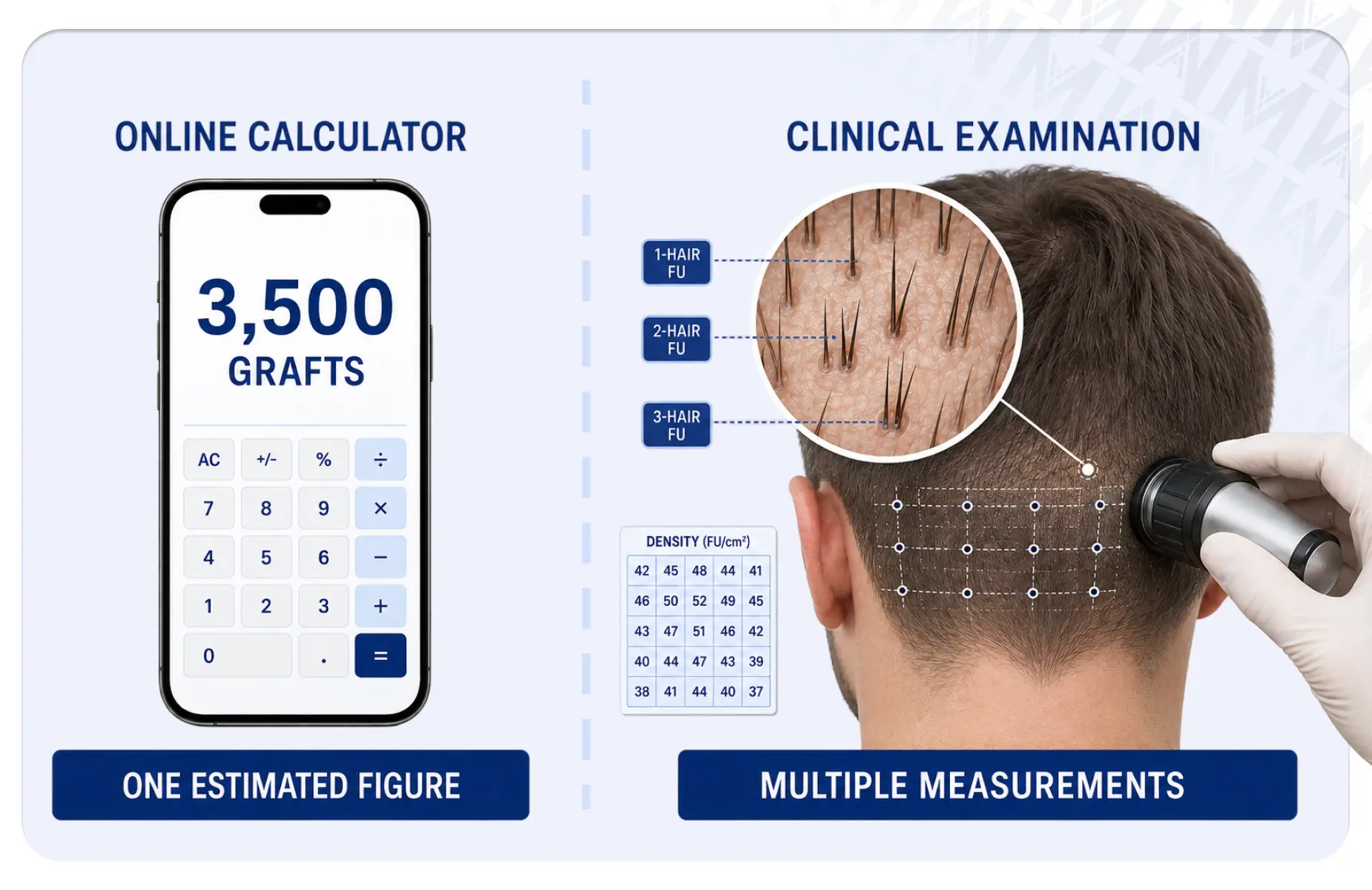
Infographic showing how accurate is a graft calculator versus clinical measurement, hair transplant assessment.

What Does an Online Graft Calculator Actually Measure?

A graft calculator mainly estimates recipient-area demand from simplified inputs; it does not physically measure how many grafts your donor area can safely provide. Knowing where the figure comes from explains most of the uncertainty around it.

Most tools work from a short list of declared inputs:

  • ● The zones you say are thinning: frontal hairline, mid-scalp, crown or vertex.

  • ● A pattern stage, usually from the Norwood scale, or the Ludwig pattern in women.

  • ● Your age, and sometimes uploaded photographs.

  • ● Your stated goal, such as broad coverage or higher desired density.

From those, the tool models recipient-area size and applies a fixed assumption about follicular units per square centimetre. Many calculators use proprietary assumptions that users never see. The output is a modelled demand figure, not a physical count of anything on your head.

Two people can classify the same scalp differently, so identical hair can produce different results. If the categories are unfamiliar, understand your Norwood hair-loss pattern first.

A hair graft usually contains one follicular unit, a naturally occurring group of one or more hairs. One graft is therefore not one hair. The International Society of Hair Restoration Surgery describes the follicular unit as the basic building block of transplantation.

If your search began with "how many grafts do I need", an estimate is only the first step. This page prescribes no counts; general graft ranges by Norwood stage sit elsewhere.

Why Do Calculator Estimates Differ From a Surgeon's Count?

A surgeon's count may differ because it incorporates donor limitations, hairline design, existing hair, future loss, and the patient's preferred balance between coverage and density. A different number does not mean the calculator failed.

The recipient area is what you want to cover. The donor area is the limited reserve from which grafts can be taken. A calculator mainly answers the first question and assumes the second.

Calculators run fixed assumptions. A clinician allocates grafts across the hairline, mid-scalp and crown according to visual priority, donor capacity, and how much loss is still likely to come.

Hairline design alone can change the transplanted area substantially. A lower hairline widens the recipient area; a conservative, age-appropriate design shrinks it.

If native hair continues to miniaturize, later loss may expose untreated zones or reshape a second procedure entirely. That is why a clinician may recommend fewer grafts now to protect the safe donor zone. Clinics also differ on density philosophy, which alone can separate two honest plans by hundreds of grafts.

Factor

Online calculator

Photo consultation

In-person assessment

Recipient-area pattern

Approximate

Better visual estimate

Directly assessed

Donor density

Usually assumed

Partly visible

Can be measured

Hair caliber

Usually not measured

Rough visual impression

Direct assessment or trichoscopy

Miniaturization

Usually unavailable

Sometimes suspected

Better assessed

Scalp laxity

Not measured

Not reliably measured

Physically assessed

Hairline design

Generic assumptions

Personalised discussion

Personalised and examined

Future loss

Limited inputs

Clinical history helps

History plus examination

Safe donor capacity

Cannot confirm

Preliminary

Best available estimate

Scalp diagram showing recipient area demand and safe donor zone supply, hair transplant assessment.

Factors a Calculator Cannot See

Some variables need magnification, palpation, or a medical history to detect at all:

  • Miniaturization, the progressive shrinking of follicles and shafts, often invisible in a phone photo.

  • ● Exact follicular-unit density and hairs per follicular unit in the donor area.

  • ● Hair shaft diameter, curl and texture.

  • ● Scarring or altered anatomy from a previous hair transplant.

  • ● Active scalp disease, or non-pattern loss such as telogen effluvium.

  • ● Your expectations, willingness to use medical treatment, and long-term donor strategy.

The American Academy of Dermatology advises identifying the cause of hair loss before treatment decisions are made. A web form cannot make that diagnosis.

What Only an In-Person or Photo Consultation Reveals

A consultation can assess visible loss, medical history, donor characteristics, and treatment goals, while an in-person examination can also measure or physically evaluate factors that photographs cannot. The table above showed where each method stops. Here is what the extra assessment buys you.

Visible remotely: standardised photographs can show your loss pattern, asymmetry, how much native hair remains, hairline shape, and a rough impression of donor coverage. A clinician can then ask about age, family history, progression, medication, previous procedures, and goals.

Measurable in person: an examination adds palpation, magnification, and direct measurement. It can also flag scalp conditions or non-pattern shedding that need medical assessment before any surgery is planned.

A photo consultation for hair transplant planning is more personalised than any calculator, yet less precise than an examination. Lighting, angle, scale, hair length and image quality all limit it. And nobody can feel a scalp through a screen. For the wider picture, read what to expect from a hair transplant consultation.

Donor Density, Scalp Laxity and Hair Caliber

Donor density should be measured, not inferred from how bald the top looks. Trichoscopy means close examination of the scalp under magnification. Densitometry measures follicular units per square centimetre. Dermatology reviews indexed in the US National Library of Medicine's PubMed database describe trichoscopy as a routine method for assessing density and miniaturization. A donor density assessment carried out this way can reveal reduced density that ordinary photographs hide.

Hair caliber changes what a graft looks like once it grows. Thicker hair shafts cast more visual coverage than fine shafts at the same graft count. Curl, texture and hair-to-scalp colour contrast also change scalp visibility, which is why two people with matching estimates can end up with different-looking results.

Scalp laxity means how freely the scalp skin moves. It matters most in FUT strip planning, because laxity affects the strip width and closure tension that can be considered safe.

For FUE, donor density, extraction distribution, scarring tendency and safe donor zone stability matter more, along with the risk of visible overharvesting. A donor area can photograph densely and still hold miniaturised hair or a limited safe extraction ceiling.

Clinician examining donor area density during hair transplant assessment.

How Much Can Estimates Vary? A Realistic Margin of Error

For early budgeting, allow roughly 20–30% variation around an online graft estimate, while recognising that complex cases can fall outside that range. The sections above explain why the figure moves. This one turns it into arithmetic.

How accurate is a graft calculator in your own case? The honest answer is conditional. Treat the displayed figure as a midpoint, then multiply by 0.7 for a lower planning scenario and by 1.3 for an upper one. That is an early budgeting heuristic, not a validated statistic.

Cases with fewer unknowns tend to produce less disagreement, though no universal accuracy range has been validated. Your graft estimate margin of error widens with diffuse thinning, crown involvement, previous surgery, weak donor supply, or goals that conflict with donor preservation. Percentages also hide scale, so check the absolute graft difference as well.

Better images and closer assessment narrow the uncertainty. They never remove it. Online graft estimate accuracy has a real ceiling, because the final number still rests on diagnosis, donor limits, hairline design and treatment goals.

In our clinic, the estimates that shift most are built on unclear donor photographs, an unrecognised diffuse component, or a hairline drawn lower than the donor supply can sustain.

Illustrative composite scenario: a reader selects frontal and crown thinning and receives a substantial estimate. His photographs raise concern for possible donor miniaturization, which examination later confirms. The recommended plan becomes more conservative, holding reserve back for later stages. Estimated demand described what he wanted covered. It never established what could safely be harvested.

Planning rule, not a guarantee: Until your donor area and hair characteristics are assessed, treat an online estimate as a midpoint with approximately 20–30% uncertainty in either direction. Some cases will fall outside this range.

If your calculator result would change your budget or travel plans, use the WhatsApp button in the bottom-right corner for a free personalised assessment. Clear photographs and a short hair-loss history make that conversation far more useful.

How to Use Your Calculator Result the Smart Way

Use the calculator number as a midpoint for questions and budget scenarios, not as a target that a surgeon must agree to. The margin you just calculated only helps if you carry it into the conversation.

  • 1. Save the result, and record which inputs, zones and photographs produced it.

  • 2. Calculate your lower and upper planning scenarios from that midpoint.

  • 3. Ask a clinician which assumptions could move the estimate in either direction.

Physiology does not change by country or city, and neither does calculator reliability. So resist the urge to book flights, accommodation or a final treatment budget from an online figure alone.

Androgenetic alopecia can progress over time, although the rate varies and medical treatment may influence the course. MedlinePlus , the patient library of the US National Library of Medicine describes the condition as gradual and continuing. Ask whether stabilisation of your existing hair belongs in the plan.

When you compare clinics, compare the reasoning rather than the graft count. Clinics commonly request clear photographs of the front, top, crown and donor area, plus a short history. At Medart Hair Transplant, we read those images against your goals and your donor reserve, not against a target number.

Put plainly, the hair transplant consultation vs calculator difference is this: one assumes, the other measures. Six questions expose the gap.

  • ● What area is included?

  • ● What density assumption was used?

  • ● Has donor capacity been measured?

  • ● Is existing hair likely to thin further?

  • ● Is the plan intended for one procedure or long-term preservation?

  • ● Could the count change after an examination?

Have your calculator result ready? Send it with your photographs through the WhatsApp button in the bottom-right corner for a free assessment of which assumptions can be checked remotely, and which still need an examination.

When Should You Stop Trusting the Number and Book an Assessment?

Stop relying on the calculator when you are making a financial or surgical decision, or when your loss is diffuse, rapidly changing, medically unexplained, or affected by previous surgery. Book an assessment before you pay a deposit, arrange travel, or fix a final procedural budget.

Ask for individual assessment, rather than another estimate, if you have:

  • ● Diffuse thinning across the scalp

  • ● Rapid or unexplained shedding

  • ● Patchy hair loss

  • ● Scalp pain, inflammation, scaling or scarring

  • ● Hair loss after illness or a medication change

  • ● A previous hair transplant, or visible donor-area thinning

  • ● A very high or unusually low calculator output

  • ● Conflicting estimates from different calculators or clinics

  • ● Fixed expectations, or pressure to pursue an extreme graft count

The NHS advises seeing a doctor about sudden, patchy or distressing hair loss, and the British Association of Dermatologists publishes similar patient guidance. Telogen effluvium and other non-pattern conditions can mimic pattern loss. When the cause is unclear, a dermatologist or other qualified medical professional should assess it before any surgical plan is drawn.

Frequently Asked Questions

Can a graft calculator tell whether I am a good hair transplant candidate?
No. A graft calculator estimates possible recipient-area demand from what you type in. Candidacy depends on diagnosis, donor stability, medical history, realistic expectations, and how much further loss is likely. Those judgements need a qualified clinician, ideally with magnified examination of the scalp.
Is a photo consultation more accurate than a graft calculator?
Usually yes. A clinician reviewing standardised photographs can judge your visible pattern, remaining native hair and approximate donor coverage, then discuss your history and goals. Photographs still cannot replace the palpation, magnification and direct measurement available in person, so treat the figure as provisional.
Can my graft estimate change on the day of surgery?
Yes. Plans are commonly refined after the hairline is marked, the donor area is shaved where applicable, and both areas are assessed directly. A graft count is a clinical plan rather than a fixed quantity, and any change should be explained and agreed with you.
Why did two clinics give me different graft counts?
Different hairline designs, density targets, included zones, donor-preservation strategies and assumptions about future loss all produce different numbers. Neither clinic is automatically wrong. Ask each one which zones the count covers, what density it assumes, and how much donor reserve it leaves behind.
Does a higher graft estimate mean better results?
No. More grafts are not automatically safer or more visually effective. Donor supply is finite and cannot be replaced, so taking too much now can compromise coverage later. A conservative strategy that protects the safe donor zone often looks better over a lifetime.
Can a calculator measure my donor density?
Most cannot. Donor density generally requires standardised imagery and, ideally, direct densitometry or trichoscopy performed by a clinician. Recipient-area inputs describe what you want covered. They say nothing about how many follicular units your donor area can safely release, now or later.
How accurate is an online estimate if I upload photos?
Photographs improve personalisation noticeably. Accuracy still depends on lighting, angles, scale, hair length, image quality and whether the donor area is clearly visible. Poor images can mislead in either direction, so send clear, well-lit shots of the front, top, crown and back.
Should I use the estimate to plan my budget?
Use it for an early range, allowing roughly 20–30% either side, and treat that as a planning allowance rather than a quote. Avoid fixing a final budget or paying a deposit until a clinician has assessed your donor area, diagnosis and long-term plan.

Once real money is involved, how accurate is a graft calculator stops being the useful question. Whether your donor area can support the plan becomes the question that matters.

Before treating the number as a surgical plan, request a free personalised assessment from Medart Hair Transplant in Istanbul using the WhatsApp button in the bottom-right corner. A calculator gives you a starting range. An assessment tells you whether that range fits your donor supply and your long-term plan.

This article provides general educational information and does not diagnose hair loss, confirm surgical candidacy, or prescribe a graft count. Calculator results and photo assessments are preliminary. A clinician must evaluate your medical history, donor area, hair-loss pattern, and goals before recommending treatment.

Contact Us!

Please enter a valid phone number.
Greft Hesapla WhatsApp