
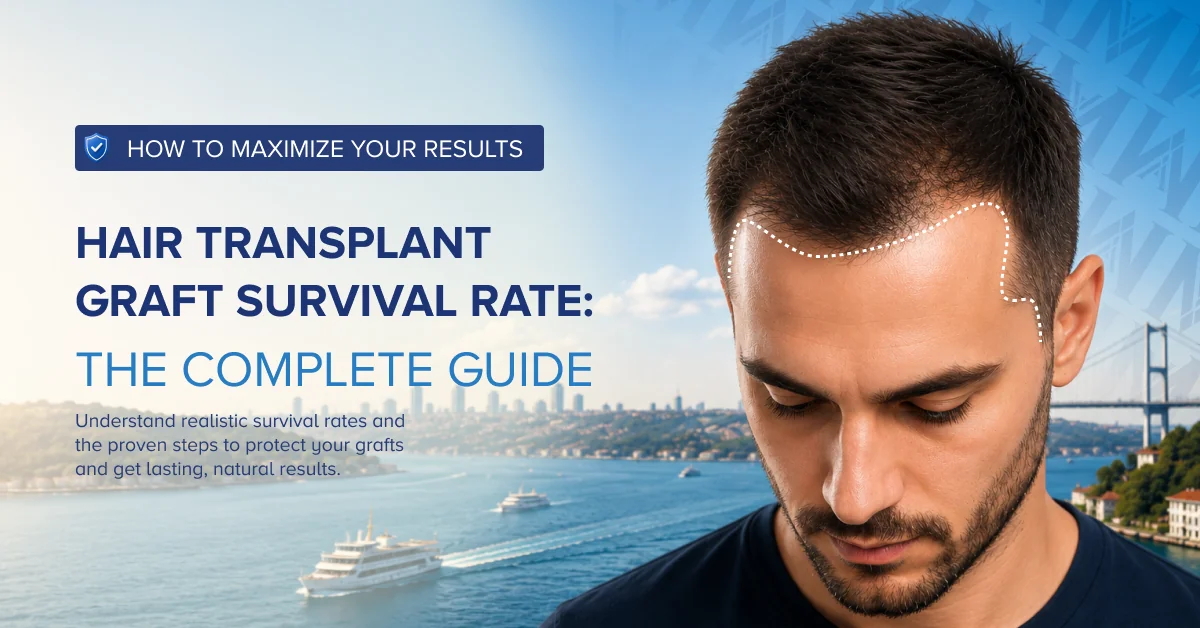
Hair Transplant Graft Survival Rate: How to Maximize Your Results

Most well-performed hair transplants achieve about 85–95% graft survival, meaning most transplanted follicles grow permanent hair. Your true hair transplant graft survival rate depends mainly on the quality of the team, the technique, and how carefully you follow aftercare.
Hair Transplant Graft Survival Rate: How to Maximize Your Results

Table of Contents

Dr. Busra Yakupoglu

Reviewed by Dr. Busra Yakupoglu, Hair Transplant Surgeon, Medart Hair Transplant, Istanbul

Get a Free Consultation

Talk to an experienced patient coordinator for your hair transplant in Turkey.
Please enter a valid phone number.

The most important number in hair transplantation isn't how many grafts a clinic can implant. It's how many of those grafts are still alive and growing a year later.

Chasing offers of "3,000" or "5,000 grafts" misses the point. What matters is how many of those grafts actually survive and produce real density on your scalp.

In a destination like Turkey, and especially Istanbul, you'll see tempting offers for huge graft counts at very low prices. If only 60–70% of those grafts live, you've paid for hundreds (or even thousands) of hair follicles that quietly died. At Medart Hair Transplant in Istanbul, we focus on protecting each graft rather than chasing the biggest headline number.

This guide explains what a realistic graft survival rate hair transplant result looks like, why some grafts die, and the specific things you and your hair transplant clinic can do together to maximize long-term, natural results.

This article is for general information only and does not replace a consultation with a qualified doctor.

How Many Hair Grafts Really Survive?

In a well-performed modern hair transplant, about 85–95% of grafts usually survive and grow permanent hair. That typical range comes from clinical experience and surveys of hair restoration surgeons, including reports from the International Society of Hair Restoration Surgery (ISHRS). Individual results always vary, and no clinic can guarantee a specific percentage.

When patients ask how many grafts survive after a transplant, the honest answer is that survival depends on the whole chain from extraction to healing, not on a single magic number.

Typical outcome ranges look like this:

  • 80% or less: often suggests significant problems with technique, clinic standards, or healing conditions.

  • 85–95%: common range in experienced, well-run clinics with careful post-operative care.

  • Above 95%: may occur in ideal cases, but no honest clinic will promise it in advance.

Your own hair transplant graft survival rate will depend on how healthy your donor area is, how gently grafts are handled, and how committed you are to protecting them in the first few weeks after surgery.

Key Takeaways

  • ● Most modern FUE and FUT procedures achieve roughly 85–95% graft survival in experienced hands.

  • ● Graft survival reflects the whole chain: extraction, storage, implantation, and healing.

  • ● Shedding of hairs is normal; true graft death means no long-term regrowth from that unit.

  • ● Clinic choice, surgeon involvement, and your aftercare are the biggest controllable factors.

  • ● Individual results vary; no clinic can guarantee a specific graft survival percentage.

What Is Hair Transplant Graft Survival Rate?

Hair transplant graft survival rate is the percentage of transplanted follicular unit grafts that successfully heal and produce long-term, growing hair in the recipient area. Now that you know the typical ranges, the basic terms below will help you interpret any numbers a clinic gives you.

A hair graft (also called a follicular unit graft) is a tiny piece of tissue containing one to four hair follicles and their supporting structures. In FUE (Follicular Unit Extraction) and FUT (Follicular Unit Transplantation, sometimes called strip surgery), these units are moved from the donor area (usually the back and sides of your scalp) to balding or thinning areas.

Definition box

  • Hair graft / follicular unit: A small natural bundle of 1–4 hair follicles plus surrounding tissue.

  • Graft survival: The transplanted unit establishes blood supply, stays alive, and grows hair long-term.

  • Graft death: The unit fails to connect to blood supply or is damaged, so it never produces lasting hair.

Right after surgery, the transplanted hairs often go through hair shedding. This is not the same as graft death. The visible hair shafts fall out, but the follicles remain under the skin, resting before new hair regrowth. The American Academy of Dermatology (AAD) explains that shedding of transplanted hairs in the first weeks is expected and not a sign that the transplant has failed.

Clinically, graft survival is not measured by counting every single follicle one by one. Instead, surgeons estimate survival by:

  • ● Comparing standardized before-and-after photos over 12–18 months.

  • ● Measuring hair density and coverage with tools like trichoscopy or densitometry.

  • ● Assessing how full each region (hairline, mid-scalp, crown) looks compared with the planned design.

Real hair transplant success isn't "we implanted 4,000 grafts." It's "what percentage of those grafts are growing healthy hair after a full growth cycle."

Diagram of a follicular unit hair graft moved from donor to recipient area in a transplant.

Typical Graft Survival Rates: What's Realistic?

Most published data and experienced surgeons report average graft survival rates in the 85–95% range in healthy scalps, though exact results depend on technique, scalp condition, and operator skill. Now that you understand what survival means, you can put realistic numbers around what "good" and "poor" outcomes look like.

In modern practice, both FUE and FUT can achieve high survival when done correctly. The ISHRS and major dermatology texts note that, in expert hands, FUE graft survival rate and FUT survival are broadly similar. What matters more is how carefully grafts are harvested, stored, and implanted, not which technique name appears on your report.

Here is a rough comparison for different scenarios:

Scenario

Typical survival range*

Standard FUE, healthy scalp

85–95%

FUT (strip), healthy scalp

85–95%

Mega-session on one long day

Slightly lower if poorly managed

Scar tissue or compromised scalp

May be lower (sometimes well below 85%)

Approximate ranges only; individual results vary and are never guaranteed.

According to the NHS, hair transplant results vary with age, blood supply, and scalp health, so these numbers are guidelines rather than promises. Areas like the hairline and frontal zone often show more visible density because they are smaller and easier to pack densely. The crown (vertex) usually needs more grafts to look full and can show slightly lower apparent survival, because hairs must follow a whorl and need more coverage.

Very large mega-sessions (high graft-count sessions, often over 3,500–4,000 grafts in a single day) can be safe when carefully planned and staffed. But if a team tries to process thousands of grafts with limited hands, ischemia time (the period grafts are out of the body without blood supply) and dehydration can increase, which may reduce survival.

To make this less abstract, consider two anonymized examples from our Istanbul practice:

  • Patient A had 2,800 grafts via FUE on a healthy scalp, did not smoke, and followed every aftercare step. At 12 months, his density counts and photos suggested survival in the high end of the typical range, with excellent hairline coverage.

  • Patient B arrived after a previous transplant elsewhere that advertised 4,000 grafts in a one-day mega-session. His photos and density at 18 months suggested survival closer to the low 70s, with patchy coverage and limited remaining donor for repair.

Marketing claims of "100% survival" are not evidence-based. Honest surgeons talk in ranges and emphasize that graft survival depends on both the operation and your healing.

If you want to compare methods in more detail, you can learn about different hair transplant techniques such as FUE and FUT .

Bar chart comparing typical hair transplant graft survival ranges across FUE, FUT, mega-sessions and scarred scalp.

Why Do Some Hair Transplant Grafts Die?

Hair transplant grafts usually die when they are mishandled, kept too long outside the body, or placed into poorly prepared recipient sites, and when trauma, infection, or poor blood supply affects healing. Now that the expected ranges are clear, it helps to see exactly where things can go wrong in the chain from extraction to regrowth.

Intra-operative causes

The main intra-operative causes of hair transplant graft death are:

  • Prolonged ischemia time: If grafts spend too long outside the body before implantation, their follicles are starved of oxygen and nutrients.

  • Dehydration of grafts: If grafts are not kept constantly moist in an appropriate storage solution, the delicate cells dry out and die.

  • Excessive mechanical trauma: Rough extraction, crushing with forceps, or forcing grafts into too-small incisions damages the follicles.

  • Improper incision angle or depth: If recipient sites are too shallow or too deep, blood supply can be compromised or grafts may not sit securely.

Research on wound healing from bodies such as the US National Institutes of Health notes that tissues deprived of oxygen and subjected to mechanical trauma are far less likely to survive reimplantation. Hair follicles are small, but they are still living organ units, and they respond the same way.

Clinic-related causes

Several factors seen in lower-quality hair transplant clinics can increase graft loss:

  • ● Inexperienced teams, with key steps delegated almost entirely to unlicensed technicians.

  • ● Rushed workflows on very high-volume days, so grafts are left out longer and handling suffers.

  • ● Poor sterilization and infection control, increasing the risk of infection and even necrosis (areas of dead skin and tissue).

  • ● Overharvesting and poor donor management, which damage blood supply in the donor area and limit your future options.

Patient-side causes

Several patient factors can also reduce survival:

  • Smoking: Nicotine narrows blood vessels and reduces oxygen delivery, which can impair wound healing and graft take. The AAD notes that smokers generally heal more slowly after surgery.

  • ● Excess alcohol use around the time of surgery can affect bleeding and inflammation.

  • Chronic conditions such as diabetes, autoimmune diseases, or vascular disease can impair healing and blood flow.

  • ● Poor post-operative care: scratching, picking at crusts, sleeping face-down, or bumping your head can physically dislodge grafts and lead to hair transplant graft death in that area.

Less common but serious problems include significant infection, allergic reactions to local anesthesia, or vascular issues that limit blood supply to the scalp. These can cause visible scarring or black, crusty areas of necrosis if not treated promptly.

Most graft loss is multifactorial. It is rarely "your fault" alone. Understanding these causes is not about blame; it's about giving you and your surgeon clear targets to improve hair transplant graft survival.

Main causes of graft loss (summary)

  • ● Prolonged out-of-body time.

  • ● Dehydration of grafts.

  • ● Trauma during extraction or implantation.

  • ● Infection, necrosis, or poor wound care.

  • ● Smoking, poor circulation, or direct trauma to grafts.

Flowchart of hair transplant steps from extraction to implantation showing handling points that affect graft survival.

Factors That Boost Graft Survival (Before, During, After Surgery)

Your graft survival improves when you optimize your health before surgery, choose a skilled, doctor-led clinic with an experienced team, and follow gentle, protective aftercare instructions in the first weeks. Knowing why grafts die makes it easier to see how you and your clinic can protect them at each stage.

1. Before surgery: set the stage

Pre-operative preparation is about giving each graft the best possible "soil." Think of your follicles like living seedlings: they need healthy ground, not dry, compacted earth.

Key steps before surgery include:

  • Stop or reduce smoking if you can. Surgical literature consistently associates smoking with poorer wound healing and higher complication rates, including reduced blood supply.

  • ● Discuss alcohol use with your surgeon and avoid heavy drinking in the days around surgery.

  • ● Make sure chronic conditions like diabetes or high blood pressure are well controlled, in cooperation with your own doctor.

  • ● Improve scalp health by treating problems like seborrheic dermatitis, infection, or obvious inflammation before your procedure.

  • ● Review all medications and supplements (including blood thinners and herbal products) with your hair transplant surgeon. Always talk to your prescribing doctor before changing or stopping any medication.

Your surgeon may also suggest starting medical treatments like minoxidil or finasteride for underlying androgenetic alopecia (male pattern baldness). Current studies suggest, but do not prove, that these can support overall hair density and help preserve non-transplanted hair. The risks and benefits should be discussed individually.

2. During surgery: what a good clinic does

During the operation, most "graft survival work" is in the hands of the hair transplant clinic. A well-organized, doctor-led clinic with an experienced team follows careful protocols to protect every graft.

Core intra-operative factors include:

  • Gentle graft handling: Using fine instruments and avoiding crushing or squeezing the follicular unit grafts.

  • ● Limiting ischemia time by coordinating extraction and implantation, and not overloading the team with huge sessions they cannot process safely.

  • ● Using an appropriate storage solution (often a chilled saline-type fluid) and maintaining controlled temperature to prevent dehydration and thermal damage.

  • ● Careful recipient site creation by the hair transplant surgeon to control angle, depth, and direction for natural hairline design and good blood supply.

  • ● Rational limits on mega-sessions, with enough staff to keep the chain moving and avoid grafts drying out on trays.

The ISHRS has publicly warned about unlicensed, technician-driven surgeries, emphasizing that qualified doctors should be responsible for diagnosis, planning, and key procedural steps. At Medart Hair Transplant in Istanbul, we keep daily patient numbers limited so the surgeon and experienced team can focus on protecting each graft instead of racing the clock.

3. After surgery: protect what you've gained

The post-operative period is when you personally have the most influence. This is where hair transplant aftercare for grafts makes a tangible difference in survival.

Key aftercare principles:

  • Sleeping: Follow your clinic's instructions about sleeping with your head elevated and avoiding pressure on the recipient area for the first several nights.

  • Washing: Use the recommended gentle washing technique and products. You'll usually start rinsing carefully after a couple of days and avoid strong water pressure or rubbing.

  • Protection from trauma: Avoid bumping your head, wearing tight hats early on, or scratching crusts. Even one hard impact can dislodge many grafts.

  • Avoid intense exercise and heavy sweating for the initial period advised by your clinic, since this can increase swelling and the risk of trauma.

  • Sun protection: Keep direct sun off the recipient area for several weeks, or follow your surgeon's instructions on when and how to use hats or shade.

  • ● Stay alert for infection signs: new swelling, spreading redness, pus, or foul smell. If you notice any of these, seek medical care promptly.

Many patients ask about adjuncts such as platelet-rich plasma (PRP). Clinical studies suggest, but do not yet prove, that PRP may support healing and hair growth in some patients. Evidence is still evolving, and PRP should be seen as a possible helper, not a guaranteed way to increase graft survival.

At Medart Hair Transplant, we use an evidence-based approach and spend time on detailed aftercare education before you leave the clinic, because the first 7–10 days are critical for graft survival.

Three-stage survival support checklist

  • 1. Pre-op: Stop smoking if possible, control chronic conditions, optimize scalp health, and review medications with your doctors.

  • 2. During surgery: Choose a doctor-led clinic with careful graft handling, proper storage, and realistic session sizes.

  • 3. Post-op: Sleep and wash as instructed, avoid trauma and sun, and contact your clinic quickly if you see worrying changes.

How to Maximize Your Own Graft Survival: A Practical Checklist

You can maximize your own graft survival by using a clear checklist that covers clinic selection, personal preparation, and strict aftercare. Now that you understand the principles, this section turns them into concrete questions and actions.

Clinic selection checklist

Before you book, ask any clinic:

Doctor involvement

  • ● Will a qualified hair transplant surgeon design my hairline and donor plan?

  • ● Who will create the recipient incisions (doctor or technicians)?

Team and workload

  • ● How many patients do you operate on per day?

  • ● Who performs extractions and implantations, and what training do these technicians have?

  • ● Do you perform doctor-led procedures, or is most of the work delegated?

Process and safety

  • ● How do you store and handle grafts between extraction and implantation?

  • ● What steps do you take to limit ischemia time and dehydration?

  • ● What infection control measures and emergency protocols are in place?

  • ● Do you hold any clinic certifications or accreditation from recognized bodies?

Results and follow-up

  • ● How do you measure your hair transplant graft survival rate and overall outcomes (photos, density counts)?

  • ● Can I see clear before-and-after photos with similar hair type and Norwood scale to mine?

  • ● What aftercare support and follow-up do you offer, especially for international medical tourism patients?

Personal preparation checklist

  • ● Discuss smoking, alcohol, and your medical history openly with your surgeon and your usual doctors.

  • ● Confirm which medications and supplements to stop or continue, after speaking with the doctor who prescribed them.

  • ● Treat any scalp issues, such as seborrheic dermatitis or obvious inflammation, before surgery.

  • ● Arrange time off work and help at home so you can rest and follow instructions carefully.

Aftercare checklist

  • ● Know exactly how to sleep, wash, and moisturize the scalp in the first 10 days.

  • ● Avoid scratching, rubbing, or wearing tight hats until your clinic says it's safe.

  • ● Stay away from heavy exercise, swimming pools, and saunas for the recommended period.

  • ● Watch for hair transplant failure signs such as spreading redness, pus, severe pain, or black patches, and seek prompt review.

  • ● Keep in touch with the clinic and send progress photos as advised.

To make this concrete, picture two patients with similar hair loss patterns. One takes time to choose a doctor-led clinic, stops smoking a month before surgery, follows every aftercare step, and ends up with strong density and a natural, balanced hairline design. The other books a bargain package without asking questions, smokes throughout, scratches crusts early, and later wonders why coverage looks thin despite a "high graft count" on paper. Same starting point. Two very different mirrors.

Want a specialist to review your photos and medical history and estimate what kind of graft survival rate is realistic in your case? Tap the WhatsApp button in the bottom-right corner to message the Medart team for a free, honest assessment.

Hair Mills, Ghost Clinics, and Graft Loss in Turkey: What to Watch For

So-called "hair mills" or ghost clinics in Turkey and elsewhere can put your graft survival at risk by rushing large numbers of patients through technician-led surgeries with minimal medical oversight. Having a checklist is helpful; now you can apply it to the reality of hair transplant in Turkey.

Hair mills are high-volume operations, often in Istanbul or other major cities, that focus on selling packages rather than individualized medical care. Typical red flags include:

  • No real consultation with a doctor before surgery — just a salesperson.

  • ● The clinic cannot clearly explain who will perform each step, or admits that technicians do most of the surgery.

  • ● Very low all-inclusive prices with "one day, thousands of grafts" marketing, without details on donor management or long-term planning.

  • ● Promises of "unlimited grafts" with no discussion of overharvesting or future needs.

These setups can harm graft survival because:

  • ● Rushed mega-sessions increase ischemia time and risk of dehydration.

  • ● Under-supervised technicians may use rough graft handling and inconsistent technique.

  • ● Poorly planned donor management can thin the donor area and leave visible scarring or patchy coverage.

  • ● Limited or generic aftercare instructions raise the risk of infection or trauma.

The ISHRS has publicly warned patients about unlicensed and technician-driven hair transplant operations in popular medical tourism destinations, including Turkey. Their guidance stresses that a qualified doctor must be responsible for your care and available during surgery.

You can still benefit safely from hair transplant in Turkey and Istanbul by asking precise questions and demanding clear answers. Look for:

  • ● A named surgeon, with credentials you can verify.

  • ● A doctor-led clinic that limits the number of patients per day.

  • ● Transparent explanations of who does extractions, incisions, and implantation.

  • ● Detailed, written aftercare plans and accessible support once you return home.

From our experience repairing low-survival transplants at Medart Hair Transplant in Istanbul, we often meet patients who were promised thousands of grafts but ended up with sparse coverage because many grafts never survived. Repair work is always more limited than getting it right the first time, because donor reserves have already been used.

For a more detailed list of warning signs, see our guide to red flags that signal hair mills or ghost clinics in Turkey .

When to Worry: Signs of Poor Graft Survival and What To Do

You should worry about graft survival if you see spreading redness, pus, foul smell, black scabs, or if a large number of grafts are dislodged early after trauma. Now that you know how to avoid problems, it helps to recognize what is normal healing versus a warning sign.

After a hair transplant, your scalp goes through several healing phases: inflammation, proliferation, and remodeling. At first, mild redness and swelling are common. Small crusts form around each graft and usually fall off within 10–14 days if you follow washing instructions.

Most transplanted hairs enter a resting phase and shed within the first month. This shock loss of transplanted hairs (and sometimes some nearby native hairs) is usually temporary. It's part of the hair growth cycle, where follicles move through anagen (growth), catagen (transition), and telogen (rest) before new growth starts. Think of it like trees dropping their leaves in autumn before fresh leaves return in spring.

Visible hair regrowth usually begins around month 3–4, with finer hairs appearing first. Density and hair shaft thickness improve between months 6 and 12, and the final result is typically assessed between 12 and 18 months. National health services such as the NHS describe similar timelines for crusting, shedding, and regrowth after hair transplantation.

Usually normal:

  • ● Mild redness and swelling in the first week or two.

  • ● Small, dry scabs around grafts that fall away over 10–14 days.

  • ● Shedding of most transplanted hairs in the first 2–6 weeks.

  • ● Gradual hair regrowth starting around month 3–4 and continuing up to 12–18 months.

  • ● Some temporary numbness (hypoesthesia) or altered sensation in donor or recipient areas.

Needs urgent review:

  • ● Spreading, hot redness with pain, pus, or foul smell (possible infection).

  • ● Large black or dark brown patches with severe pain (possible necrosis).

  • ● Heavy bleeding that does not stop with gentle pressure.

  • ● A clear episode of trauma where many grafts are physically wiped or knocked out.

  • ● Worsening pain instead of gradual improvement.

According to guidance from organizations like the NHS, signs of infection or tissue death after any cosmetic surgery should be seen by a doctor quickly. If you notice these, contact your transplant clinic immediately or seek local medical care.

The final graft survival assessment usually happens at 12–18 months, when growth and scarring have stabilized. If survival appears low, you can discuss options for a second procedure or repair with an experienced hair transplant surgeon — always weighing the remaining donor area carefully before committing to further surgery.

Timeline graphic of hair transplant healing with crusting, shedding, early regrowth and final result milestones.

Summary: Protecting Your Investment in Every Graft

Protecting your investment in every graft means focusing less on headline graft numbers and more on the quality of the team, technique, and aftercare. You've seen how graft survival — not implantation count — drives the real cosmetic outcome.

The key levers are clear:

  • ● Choose a doctor-led clinic with an experienced team that prioritizes graft handling and donor management, not just volume.

  • ● Optimize your own health, especially smoking and chronic conditions, before surgery with help from your doctors.

  • ● Follow detailed aftercare instructions to avoid trauma, sunburn, and infection in the early healing phases.

  • ● Ask clinics directly how they measure hair transplant graft survival and what factors affecting graft survival they actively control.

Understanding your graft survival rate hair transplant result matters far more than knowing how many grafts were implanted on paper. Individual graft survival and results vary; no clinic can guarantee a specific percentage for every patient.

Considering a hair transplant in Turkey and want to be sure your grafts are in safe hands? Tap the WhatsApp button in the bottom-right corner for a free, no-obligation assessment from the medical team at Medart Hair Transplant in Istanbul.

Use the checklists in this article when you speak to any clinic, wherever it is located. Your grafts are too valuable to gamble on price alone.

FAQs About Hair Transplant Graft Survival

These FAQs address the most common questions about hair transplant graft survival, expected rates, and what you can do to protect your result.

Is 80% graft survival good for a hair transplant?
An 80% graft survival rate is on the low side of what most experienced surgeons hope for. Many modern FUE and FUT procedures achieve closer to 85–95% in suitable patients, although individual results vary. If your survival is around 80%, the result can still look acceptable, but it may suggest room for improvement in technique, healing conditions, or both.
How many of my 3000 grafts will actually grow?
In a well-performed transplant with good healing, it is reasonable to hope that roughly 2,550–2,850 of 3,000 grafts (85–95%) will grow. This is an estimate, not a guarantee, because donor quality, scalp health, smoking, and clinic quality all influence survival. A careful surgeon will avoid promising a fixed number and instead discuss realistic ranges for your specific case.
Do all transplanted hairs fall out before they grow back?
Most transplanted hairs shed in the first few weeks, but not always every single one. This shedding reflects the follicles entering a resting phase, not graft death. New hair growth usually begins around three to four months as follicles re-enter the anagen (growth) phase of the hair growth cycle. Visible thickening continues for many months after that.
Can I increase my graft survival rate after the surgery, or is it already decided?
You can still influence graft survival after surgery, especially in the first 10–14 days. Gentle washing, proper sleep positioning, and avoiding scratching, bumping, or sunburn help protect fragile grafts while they connect to blood supply. You can't change how grafts were extracted or stored, but you can avoid trauma and seek prompt help if you see signs of infection.
Does FUE have a better graft survival rate than FUT?
When performed by experienced surgeons, FUE and FUT have broadly similar graft survival rates. Expert groups like the ISHRS emphasize that technique quality, graft handling, and aftercare matter more than the specific method name. Choosing a skilled team and following instructions carefully will influence your outcome more than whether you pick FUE or FUT alone.
Does smoking really kill hair grafts?
Smoking can reduce graft survival because it narrows blood vessels and lowers oxygen delivery to healing tissues. Surgical research and dermatology organizations report that smokers often have more wound-healing problems and infections in general. Quitting or significantly cutting down before and after your transplant can improve your chances of a better result, especially when combined with good aftercare.
How long until I know if my grafts have died?
You can't judge final graft survival in the first few weeks, because shedding is normal. Early warning signs of serious trouble include black patches, spreading infection, or trauma that clearly dislodges many grafts. True evaluation usually happens 12–18 months after surgery, once the full growth cycle has played out and density has stabilized across the hairline, mid-scalp, and crown.
Can a second hair transplant fix poor graft survival from the first one?
A second hair transplant can often improve density in areas where the first procedure had low survival or poor coverage. Your options depend on how much donor hair remains and whether the donor area was overharvested. An experienced hair transplant surgeon must assess your scalp carefully before any repair, to avoid further damage. If you're worried about a past transplant, you can send photos via the WhatsApp button for an expert opinion.
Do cheaper hair transplant clinics always have lower graft survival?
Cheaper clinics don't automatically mean lower survival, but very low prices can be a warning sign for high-volume hair mills. These centers may rush procedures, rely heavily on technicians, and cut corners on training or aftercare, all of which can reduce graft survival. Focus on transparent doctor involvement, realistic promises, and evidence of consistent results rather than price alone.
What should I ask a clinic about their graft survival rate before booking?
Ask how they define and measure graft survival rate hair transplant outcomes, and what typical ranges they see in similar cases. Request clear before-and-after photos, ask who performs each step of surgery, and how they minimize ischemia time and protect grafts during storage and implantation. A good clinic will welcome these questions and give specific, evidence-based answers instead of vague assurances.

Contact Us!

Please enter a valid phone number.
Greft Hesapla WhatsApp