

Topical Finasteride: Benefits, Side Effects and Results

Topical finasteride can slow male pattern hair loss and improve hair counts while producing lower blood exposure than oral finasteride in studied formulations. It is not side-effect-free: scalp irritation and systemic effects remain possible. Results usually require several months, and safe use depends on the exact concentration, volume, and application instructions.
Topical Finasteride: Benefits, Side Effects and Results

Table of Contents

Dr. Busra Yakupoglu

Reviewed by Dr. Busra Yakupoglu, Hair Transplant Surgeon, Medart Hair Transplant, Istanbul

Get a Free Consultation

Talk to an experienced patient coordinator for your hair transplant in Turkey.
Please enter a valid phone number.

Topical does not mean finasteride stays entirely in the scalp. The more accurate claim is that certain studied sprays can reduce systemic exposure compared with oral finasteride while still causing measurable serum DHT suppression. This guide covers topical finasteride spray, solution and gel formulations only: what controlled trials actually measured, how much drug reaches the blood, and which results are realistic.

Key Takeaways

  • ● Topical finasteride has controlled-trial evidence for male androgenetic alopecia.

  • ● Studied sprays produced lower plasma exposure and less serum DHT suppression than oral finasteride.

  • ● Lower absorption does not eliminate possible sexual or other systemic effects.

  • ● Concentration and application volume both determine the nominal topical dose.

  • ● Assess results after six to 12 months, not after a few weeks.

  • ● Use around a hair transplant must follow the surgeon's wound-healing protocol.

What Is Topical Finasteride and How Does It Differ From the Pill?

Topical finasteride is a prescription scalp treatment that aims to reduce DHT around hair follicles while limiting—but not preventing—the systemic exposure produced by an oral tablet. DHT means dihydrotestosterone, a hormone your body makes from testosterone. Systemic absorption means drug entering the bloodstream after it is applied to the skin.

Formulations vary far more than a shelf label suggests. A finasteride gel or solution can deliver a very different daily amount from a spray carrying the same percentage.

Definition check:

  • Spray: a pump-actuated liquid that releases a fixed volume per press.

  • Solution: a liquid applied with a dropper, pipette or applicator tip.

  • Gel: a thicker vehicle spread across the thinning area.

  • Monotherapy: finasteride as the only active ingredient.

  • Combination product: finasteride plus another active such as minoxidil, where results cannot be credited to finasteride alone.

  • Compounded medication: a preparation mixed by a pharmacy rather than manufactured as an approved finished product.

A higher percentage does not automatically mean a higher daily dose: the volume applied and the pump output also determine how much finasteride reaches the scalp. Concentration multiplied by application volume gives the nominal dose. That is the amount placed on the skin before any absorption happens.

Prescription status differs sharply between the two routes. Oral finasteride 1 mg holds long-standing approval for male pattern hair loss in many markets, and the current United States prescribing information is published through DailyMed and the FDA. Topical authorization is product-specific and country-specific, so status must be checked locally rather than assumed.

Some national regulators in Europe have assessed topical finasteride products through national procedures, while other markets rely on compounded preparations. The European Medicines Agency directory of national authorities is the place to confirm your own country. In the United States, compounded topical finasteride should not be described as an FDA-approved finished drug product. The FDA states plainly that compounded medicines are not FDA-approved and are not assessed for efficacy in the same way as manufactured products.

For oral dosing detail, minoxidil, and how the two drugs are combined, read the broader finasteride and minoxidil guide.

How Does Topical Finasteride Work on the Scalp?

Topical finasteride inhibits 5-alpha-reductase in the scalp, lowering DHT exposure around genetically susceptible follicles and helping slow progressive miniaturization. Knowing that the drug does not stay entirely on the skin makes the mechanism worth unpacking properly. The steps below separate the intended scalp effect from the measurable blood effect.

Three-step mechanism:

  • Testosterone meets the enzyme type II 5-alpha-reductase, which sits in scalp tissue and elsewhere in the body.

  • ● That enzyme converts testosterone into DHT, the androgen most closely linked to androgenetic alopecia.

  • ● DHT drives follicle miniaturization, the gradual shrinking of genetically susceptible follicles. The anagen growth phase shortens, and hairs become finer, shorter and eventually absent.

Diagram showing testosterone conversion to DHT and hair follicle miniaturization; topical finasteride mechanism.

Scalp DHT and serum DHT are not the same measurement. Scalp DHT describes DHT activity inside scalp tissue near the follicle. Serum DHT is DHT measured in the blood.

Caserini and colleagues studied a finasteride 0.25% topical solution in the International Journal of Clinical Pharmacology and Therapeutics. In small cohorts of men dosed with fixed daily volumes, that solution reduced scalp DHT while producing lower plasma finasteride concentrations than the 1 mg tablet. Pharmacokinetics describes how the body absorbs and processes a medicine. Pharmacodynamics describes what the medicine does once it is there.

Topical delivery is local-first, not local-only. Think of the scalp as a filter, not a sealed lid. Vehicle ingredients such as alcohol or propylene glycol, the applied volume, the treated surface area and skin condition all influence how much drug crosses the barrier. A broken or inflamed scalp, recent microneedling, or healing transplant wounds can change that picture.

One boundary matters clinically. Finasteride cannot regenerate scarred follicles, and long-standing, severely miniaturized areas are less likely to show visible regrowth. It also does not treat every cause of shedding.

Does Topical Finasteride Actually Work? What the Studies Show

Yes—clinical trials show that certain topical finasteride formulations can improve target-area hair counts compared with placebo, although evidence is not equally strong for every compounded spray or gel. The mechanism above predicts a scalp effect. Controlled trials tell you how large that effect was, and over what period.

What the evidence covers

The table below summarizes randomized and pharmacological studies of topical finasteride alone, not of combination products.

Study

Formulation

Comparator

Duration

Sample size

Efficacy result

Limitation

Piraccini et al., phase III randomized controlled trial (JEADV, 2022)

Finasteride 0.25% topical spray solution

Placebo spray and oral finasteride 1 mg

24 weeks

Multicentre European trial; several hundred men randomized across three arms

Target-area hair count about +20.2 hairs/cm² topical, +6.7 placebo, +21.1 oral

Short duration; one specific formulation; not designed as an equivalence test against the tablet

Caserini et al., pharmacokinetic study (Int J Clin Pharmacol Ther, 2014)

Finasteride 0.25% topical solution

Oral finasteride 1 mg

Repeat dosing over days

Small cohorts of healthy men

Much lower plasma finasteride concentrations than the tablet

Pharmacokinetic endpoints only; no hair count measured

Caserini et al., pharmacodynamic study (Int J Clin Pharmacol Ther, 2016)

Finasteride 0.25% topical solution at fixed daily volume

Oral finasteride 1 mg and placebo

About one week

Small cohort of men with androgenetic alopecia

Scalp DHT reduced, with less serum DHT suppression than oral dosing

No clinical hair endpoint; very short exposure

Gupta et al., network meta-analysis (JAMA Dermatology, 2022)

Multiple treatments, including topical finasteride 0.25%

Placebo and other active treatments

Pooled trial durations

Pooled randomized trials in men

Topical finasteride ranked among effective options for male androgenetic alopecia

Indirect comparisons; heterogeneous vehicles and outcome measures

In this 24-week trial of the finasteride 0.25% spray, target-area hair count rose by roughly 20.2 hairs/cm², against 6.7 hairs/cm² with placebo. Oral finasteride 1 mg produced a numerically similar change of about 21.1 hairs/cm² in the same study.

That similarity belongs to one studied formulation over 24 weeks. It does not prove that every compounded spray or gel matches a tablet, because vehicles, concentrations and application volumes differ.
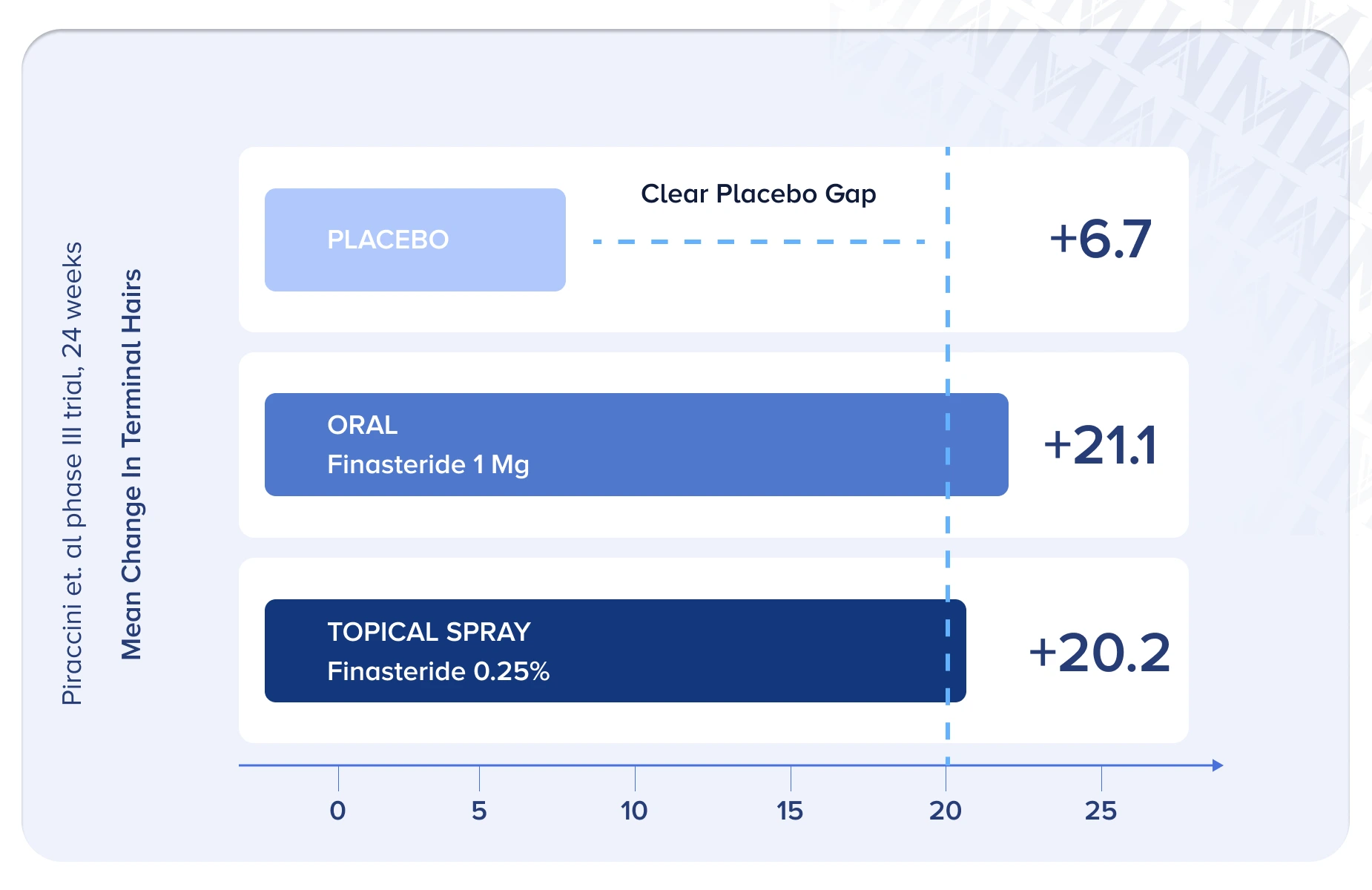
Chart comparing 24-week target-area hair-count changes for studied topical spray, oral finasteride, and placebo.

Average hair-count changes describe the study group, not a guaranteed visible result for each person. Hair density can improve modestly while the mirror looks broadly unchanged, particularly at the vertex and mid-scalp.

Stabilization counts as a genuine outcome. For progressive male pattern hair loss, slower loss or stable photographs can be clinically meaningful even without dramatic regrowth. Clinicians generally find frontal recession at the hairline less predictable than the crown, and the published trials measured defined target areas rather than the whole scalp.

Two honest limitations remain. Controlled evidence is strongest around 24 weeks, and long-term topical data are far thinner than the multi-year record behind the tablet. Compounded sprays and gels may not reproduce the studied spray's absorption or its results.

Illustrative scenario (composite, not a real patient)

A man in his early 30s notices gradual crown and mid-scalp thinning. A dermatologist confirms androgenetic alopecia using trichoscopy. He dislikes the idea of a daily tablet, so he asks about a spray, learns to read the concentration and the volume per pump, and starts standardized scalp photographs at baseline.

At six months, his photographs look almost identical to the baseline set. That disappoints him at first. His dermatologist points out that a stable crown after six months of a previously progressing pattern is a result, not a failure, and that hair counts in trials rose modestly rather than dramatically. Nobody can promise him more than that.

Topical vs Oral Finasteride: Side Effect Comparison

Topical finasteride generally produces lower systemic exposure than oral finasteride in studied doses, but it can still enter the bloodstream and cause systemic side effects. The efficacy data explain why men consider a spray. The safety data explain why it still needs a prescriber. Topical finasteride side effects split into two groups: local scalp reactions and possible systemic symptoms.

Local reactions involve the skin and the vehicle. Reported effects include pruritus (itching), erythema (redness), dryness, burning, scaling and contact dermatitis. Local scalp irritation can come from the active drug, the vehicle, an underlying dermatitis, or application technique. The pattern needs clinician review rather than guesswork.

Systemic effects remain possible because absorption occurs. Reported adverse events with finasteride include reduced libido, erectile dysfunction and ejaculatory changes. Current finasteride prescribing information also covers breast tenderness, enlargement or lumps, testicular pain, and effects on semen parameters and fertility. Some of those signals come from postmarketing reports rather than controlled trials.

Psychiatric safety has been reviewed by regulators recently. The European Medicines Agency has examined mood-related reports for finasteride-containing medicines, and current product information for finasteride includes warnings about mood changes, depressive symptoms and suicidal thoughts. Read the leaflet supplied with your exact product, because wording differs by country and formulation.

Here is the sentence worth carrying away from this whole article. Topical finasteride can reduce scalp DHT and improve male pattern hair loss with lower systemic exposure than the pill in studied formulations, but absorption and systemic side effects are reduced—not eliminated.

In this 24-week trial, Piraccini and colleagues reported treatment-related sexual adverse events in approximately 2.8% of men using the topical spray, 4.8% using oral finasteride and 3.3% using placebo. The placebo figure matters. It shows that symptom reports are not unique to active treatment, an effect sometimes described as nocebo. It does not settle the cause of any individual symptom, and trial rates are not a personal risk forecast.

Pregnancy and transfer warning: pregnant people, and those who may become pregnant, should not handle finasteride products or touch wet treated scalp skin, because finasteride can affect male fetal development. Keep every finasteride product away from children and prevent accidental skin transfer.

Transfer precautions are practical, not theoretical. Wash your hands immediately after each application, let the scalp dry fully before contact with a partner, a child, a hat or a pillow, and store the bottle out of reach. If a pregnant household member lives with you, tell your prescriber before starting.

Contact your prescribing clinician for persistent sexual symptoms, mood changes or depressive symptoms, breast lumps or nipple discharge, testicular pain, or significant scalp inflammation. Seek urgent care for signs of a severe allergic reaction, such as facial swelling or breathing difficulty. Thoughts of self-harm need immediate medical help.

Systemic Absorption and DHT Reduction Table

The topical finasteride absorption figures below come from the studied 0.25% spray formulation in the phase III trial and should not be generalized to every compounded product.

Measure

Studied topical spray

Oral finasteride

What it means

Route

Applied to scalp skin

Swallowed tablet

Topical delivery is local-first, not local-only

Mean maximum plasma finasteride concentration

More than 100-fold lower in the phase III study

Higher systemic exposure

Product- and dose-specific finding

Serum DHT reduction at week 24

Approximately 34.5%

Approximately 55.6%

Topical still produces systemic pharmacodynamic effects

Target-area hair-count change at week 24

Approximately +20.2 hairs/cm²

Approximately +21.1 hairs/cm²

Similar numerical result in this trial, not proof of universal equivalence

Local scalp reactions

Possible

Not application-related

Vehicle and skin sensitivity matter

Systemic adverse effects

Possible

Possible

Lower exposure does not mean zero risk

Regulatory status

Varies by country and product

Approved for male pattern hair loss in many markets

Verify local status

Read the serum DHT row carefully. A 34.5% fall at week 24 confirms a systemic pharmacodynamic effect in the studied spray group. That is precisely why topical finasteride systemic side effects cannot be waved away, and why a different vehicle or a larger applied volume could shift the number in either direction.

How Do You Apply Topical Finasteride and How Long Until Results?

Apply topical finasteride to the dry scalp exactly as prescribed, allow it to dry fully, and evaluate progress over six to 12 months rather than expecting visible change within weeks. The exposure figures above depend entirely on what reaches the skin, so technique is part of the pharmacology. The checklist and timeline turn that into daily practice.

Application checklist:

  • 1. Read the label and follow your prescriber's instructions, because concentration, pump output and dosing schedules differ between products.

  • 2. Start with a dry scalp rather than a wet one, unless your product states otherwise.

  • 3. Part the hair in sections and aim at scalp skin over the thinning area, not at the hair shafts.

  • 4. Keep the product away from the face, eyes, broken skin, actively inflamed scalp and unintended body areas.

  • 5. Rinse immediately with water after accidental eye or lip contact, then follow the first-aid advice printed on your product label.

  • 6. Wash your hands straight after application.

  • 7. Let the scalp dry completely before hats, pillows, or contact with a partner or child.

  • 8. Avoid showering, swimming or layering another scalp product until the prescribed waiting period has passed.

  • 9. If you miss an application, do not add extra sprays afterwards unless your prescriber tells you to.

Diagram showing topical finasteride spray applied to parted scalp skin rather than hair shafts.

Topical Dose and Exposure Check

This is a prescription-literacy list, not a calculator. It does not choose a concentration for you.

  • ● Prescribed concentration, written as a percentage on the label.

  • ● Volume delivered per spray or pump, in millilitres.

  • ● Number of sprays or pumps per application, as prescribed.

  • ● Nominal milligrams applied per day, read from or confirmed against your prescription.

  • ● Drying time and transfer precautions specific to your product.

  • ● Whether microneedling, dermatitis, open wounds or recent transplant healing could change safe use.

Confirm the product-specific dose with your prescriber or pharmacist. Do not build a new routine for yourself from this list.

Clinical observation (not trial evidence)

"Two mistakes come up again and again at Medart Hair Transplant. Men spray onto hair instead of parting down to scalp skin, so much of the dose never reaches the target. And most cannot tell me the volume their pump delivers, which means they cannot tell me their nominal daily dose. Doubling up sprays after a missed day is the third habit I ask patients to drop." — Dr. Busra Yakupoglu, Hair Transplant Surgeon

Timeline:

  • 1. 0–3 months: temporary hair shedding may occur, though its frequency with finasteride-only topical treatment is not well quantified. Expect little visible change. Treatment adherence matters more than mirror-checking.

  • 2. 3–6 months: visible progression may slow, and density at the crown and mid-scalp may improve slightly.

  • 3. 6–12 months: assess topical finasteride results properly, using standardized scalp photographs with matched lighting, distance, angle and hair length, plus clinician review.

Benefit generally depends on continuing. Finasteride is maintenance treatment, and androgen-driven miniaturization usually resumes after treatment stops. Discuss microneedling, chemical scalp treatments or any additional active scalp medicine before you start, since barrier-disrupting procedures may increase absorption or irritation. For combining routes and actives, see guidance on finasteride-minoxidil combinations.

Not sure whether your spray concentration, pump volume or routine matches your prescription? Tap the WhatsApp button in the bottom-right corner for a free personalized assessment from the Medart team.

Who Is a Good Candidate for Topical Finasteride?

The best candidates are adult men with confirmed androgenetic alopecia who want a local-first finasteride option and can follow consistent dosing and transfer precautions. Application technique only pays off once the diagnosis is right. The checklist below separates straightforward cases from those needing individualized review.

May be suitable to discuss with a clinician

Needs specialist review or extra caution

Adult men with clinician-confirmed androgenetic alopecia affecting the vertex, mid-scalp or frontal scalp

Sudden, patchy, painful, inflammatory or scarring hair loss

Men who want finasteride's potential benefit with lower systemic exposure than a tablet

Suspected alopecia areata, telogen effluvium, scalp infection or another non-androgenetic cause

Men who will apply treatment consistently and follow transfer precautions

Significant scalp dermatitis, open wounds or active infection

Men whose prescriber considers topical treatment reasonable after concerns or side effects with oral therapy

A prior serious reaction to finasteride, dutasteride or a vehicle ingredient

Men tracking progress with standardized scalp photographs

Fertility concerns, previous semen-parameter concerns, or earlier sexual or mood symptoms

Men with gradual thinning rather than a long-standing bald scalp

A pregnant household member, young children or other skin transfer risk

Men who accept maintenance treatment rather than a one-off course

Planned microneedling, chemical scalp treatments or several active topical medicines

Diagnosis comes first. The American Academy of Dermatology emphasises that hair loss has many causes and that treatment should follow an accurate diagnosis, and the NHS makes the same point about male pattern baldness. Norwood staging can help a clinician document severity, but it describes a pattern rather than delivering a diagnosis.

Pause any self-directed treatment if the loss is sudden, patchy, painful, inflamed or scarring. Those patterns need a dermatologist's assessment before any medicine starts. The wrong diagnosis costs months you cannot get back.

Expectations deserve the same honesty as the diagnosis. A long-standing bald area is unlikely to show cosmetically meaningful regrowth, particularly where follicles are no longer viable. Men sitting on the edge of these categories deserve individualized review rather than a template answer.

Anyone with persistent sexual symptoms, mood changes, breast lumps or discharge, testicular pain, or severe scalp inflammation should contact a prescribing clinician or dermatologist promptly.

Can You Use Topical Finasteride Around a Hair Transplant?

Topical finasteride may help protect susceptible native hair around a transplant, but it should not be applied to fresh grafts or healing wounds until the surgeon approves. Candidacy, as described above, is the starting point. Surgery then adds a wound-healing layer on top of it. The table covers the three phases patients ask about most.

Phase

What usually matters

Before surgery

Tell your surgeon the exact product, concentration and application volume you use. Continuing or pausing is decided case by case, not by a fixed rule.

Immediate healing period

Recipient skin is broken and the donor area is healing. Nothing goes onto grafts or wounds without the operating surgeon's approval.

Long-term native-hair maintenance

Once healing is complete and the surgeon agrees, finasteride aims at preserving DHT-sensitive native hair rather than protecting transplanted grafts.

Hair transplant healing stages showing why topical products require surgeon approval before resumption.

Illustrative scenario (composite, not a real patient)

A patient flies home after surgery and assumes his spray can go straight onto the recipient area. His surgeon explains that fresh grafts and healing skin change both absorption and irritation risk, and that preserving native hair is a separate long-term goal with its own timing.

"Transplanted grafts are usually taken from donor hair that is more resistant to DHT, but no medication guarantees graft survival. Finasteride's long-term job is protecting the native hair sitting between the grafts. In our Istanbul practice at Medart Hair Transplant, restart timing follows each patient's wound healing and formulation, so I do not give a universal restart day." — Dr. Busra Yakupoglu, Hair Transplant Surgeon

Never switch between oral and topical routes around surgery without medical guidance. For detailed aftercare, follow the full post-transplant medication protocol. Native-hair stability and graft growth are related but different outcomes, which is worth grasping before you judge your own result: see how hair transplant success is measured.

Planning surgery, or already using topical finasteride after hair transplant abroad? Tap the WhatsApp button in the bottom-right corner for a free personalized assessment and a clear list of medication details to share with your surgeon.

Topical Finasteride Frequently Asked Questions

Does topical finasteride cause sexual side effects?
Sexual side effects are possible, not inevitable. In this 24-week trial, Piraccini and colleagues recorded treatment-related sexual adverse events in about 2.8% of topical users, 4.8% of oral users and 3.3% of placebo users. Those figures describe study groups rather than your personal risk. Report persistent libido, erectile or ejaculatory changes to your prescriber.
Is topical finasteride as effective as the pill?
In this 24-week trial of the studied 0.25% spray, target-area hair count rose by roughly 20.2 hairs/cm², against about 21.1 with oral finasteride 1 mg. One numerical similarity does not make every compounded spray or gel equivalent to a tablet. Vehicles, concentrations and application volumes deliver different nominal doses, so equivalence should never be assumed.
How much topical finasteride gets into the bloodstream?
Enough to measure, and the amount is product-specific. In this 24-week phase III trial, maximum plasma finasteride concentrations were more than 100-fold lower with the studied spray than with oral finasteride 1 mg. Serum DHT still fell by about 34.5%. That result belongs to one formulation, not to compounded products in general.
How long does topical finasteride take to work?
Give it months, not weeks. Visible change is unlikely during the first three months, and temporary shedding may occur. Between three and six months, slower progression or early improvement may appear. Judge topical finasteride results at six to 12 months, using standardized scalp photographs with matched lighting, angle and hair length, plus clinician review.
Can I use topical finasteride every other day?
Only if your prescriber has written that schedule for your specific product. Alternate-day routines circulating online were not tested with your concentration, vehicle or pump volume. Changing frequency changes the nominal dose you receive. Ask your prescribing clinician or pharmacist before adjusting anything, including after missed applications or skin irritation.
Can I combine topical finasteride with minoxidil?
Combination sprays containing both actives exist and are prescribed in some countries. Efficacy or irritation seen with those products cannot be credited to finasteride alone, because minoxidil works through a different mechanism. Broader combination guidance sits in the dedicated finasteride and minoxidil article on this site. Discuss layering scalp actives with your prescriber first.
Can women use or handle topical finasteride?
This is not a casual-use treatment for women. Pregnant people, and anyone who may become pregnant, should not handle finasteride products or touch wet treated scalp skin, because of risk to male fetal development. Any use of finasteride in women needs specialist dermatology assessment, contraception counselling, and an individualized discussion of risks and alternatives.
Should I stop topical finasteride before a hair transplant?
Follow your surgeon's formulation-specific protocol; there is no universal stop or restart date. Tell the surgical team your exact product, concentration and application volume at the pre-operative assessment. Restart timing depends on wound healing and vehicle irritancy. Detailed aftercare sits in Medart's post-transplant medication guidance.
What happens if I stop using topical finasteride?
Benefit is generally treatment-dependent. Once DHT suppression around susceptible follicles ends, androgenetic alopecia usually resumes its previous course, and gains tend to fade over the following months. Finasteride does not require tapering. If side effects prompt you to stop, contact your prescriber about alternatives and the follow-up you need.

Key Takeaways: Recap

  • ● Controlled-trial evidence supports one studied 0.25% finasteride spray for hair loss over 24 weeks.

  • ● Plasma exposure and serum DHT suppression were lower than oral finasteride, not absent.

  • ● Pruritus, erythema and contact dermatitis are the vehicle-related risks to watch.

  • ● Nominal dose depends on concentration and application volume together.

  • ● Transfer precautions protect pregnant people and children in your household.

Topical finasteride for male pattern hair loss is a trade-off: lower systemic exposure in studied formulations, but not zero risk. Confirm your diagnosis, concentration, application volume and transfer precautions with a clinician before you commit to months of daily use. For a free personalized assessment, message Medart in Istanbul using the WhatsApp button in the bottom-right corner. Lower exposure is not no exposure—and the details of the bottle matter.

Medical disclaimer

This article is educational and does not replace individualized medical advice from a qualified clinician. Where topical finasteride is prescription-only, it requires clinician oversight and follow-up. Concentrations, vehicles, pump outputs, licensed indications and approval status vary by product and by country. Do not change concentration, application volume or frequency without consulting your prescriber. Some systemic absorption occurs with topical use. Pregnant people, and people who may become pregnant, should not handle finasteride products or contact wet treated areas. Keep all finasteride products away from children and prevent accidental skin transfer. Seek urgent medical care for severe allergic symptoms such as facial swelling, rash with breathing difficulty, or collapse. Seek immediate help for suicidal thoughts or thoughts of self-harm. Contact your prescriber for persistent sexual symptoms, mood changes or depressive symptoms, breast lumps or nipple discharge, testicular pain, or significant scalp inflammation. Not all hair loss is androgenetic alopecia: alopecia areata, telogen effluvium, scalp infection and scarring alopecia require different treatment.

References

  1. Piraccini BM, Blume-Peytavi U, Scarci F, et al. Efficacy and safety of topical finasteride spray solution for male androgenetic alopecia: a phase III, randomized, controlled clinical trial. Journal of the European Academy of Dermatology and Venereology, 2022. Indexed on PubMed: https://pubmed.ncbi.nlm.nih.gov
  2. Caserini M, Radicioni M, Leuratti C, et al. A novel finasteride 0.25% topical solution for androgenetic alopecia: pharmacokinetics and effects on plasma androgen levels in healthy male volunteers. International Journal of Clinical Pharmacology and Therapeutics, 2014. Indexed on PubMed: https://pubmed.ncbi.nlm.nih.gov
  3. Caserini M, Radicioni M, Leuratti C, et al. Effects of a novel finasteride 0.25% topical solution on scalp and serum dihydrotestosterone in healthy men with androgenetic alopecia. International Journal of Clinical Pharmacology and Therapeutics, 2016. Indexed on PubMed: https://pubmed.ncbi.nlm.nih.gov
  4. Gupta AK, Venkataraman M, Talukder M, Bamimore MA. Relative efficacy of minoxidil and the 5-alpha-reductase inhibitors in androgenetic alopecia treatment of male patients: a network meta-analysis. JAMA Dermatology, 2022. Indexed on PubMed: https://pubmed.ncbi.nlm.nih.gov
  5. Lee SW, Juhasz M, Mobasher P, et al. A systematic review of topical finasteride in the treatment of androgenetic alopecia in men and women. Journal of Drugs in Dermatology, 2018. Indexed on PubMed: https://pubmed.ncbi.nlm.nih.gov
  6. U.S. Food and Drug Administration / National Library of Medicine. Finasteride 1 mg prescribing information, including pregnancy handling and adverse-reaction warnings. DailyMed label archive: https://dailymed.nlm.nih.gov
  7. U.S. Food and Drug Administration. Human drug compounding: compounded drugs are not FDA-approved. https://www.fda.gov
  8. European Medicines Agency. Medicines information, safety reviews and national authorisation procedures for finasteride-containing products. https://www.ema.europa.eu
  9. American Academy of Dermatology. Hair loss: causes, diagnosis and treatment guidance, including androgenetic alopecia. https://www.aad.org
  10. NHS. Hair loss and male pattern baldness: causes, treatment and medicine safety information. https://www.nhs.uk
  11. International Society of Hair Restoration Surgery. Patient information on hair restoration surgery, donor-hair characteristics and perioperative care. https://www.ishrs.org

Contact Us!

Please enter a valid phone number.
Greft Hesapla WhatsApp