
How Many Grafts Can DHI Do in One Session?
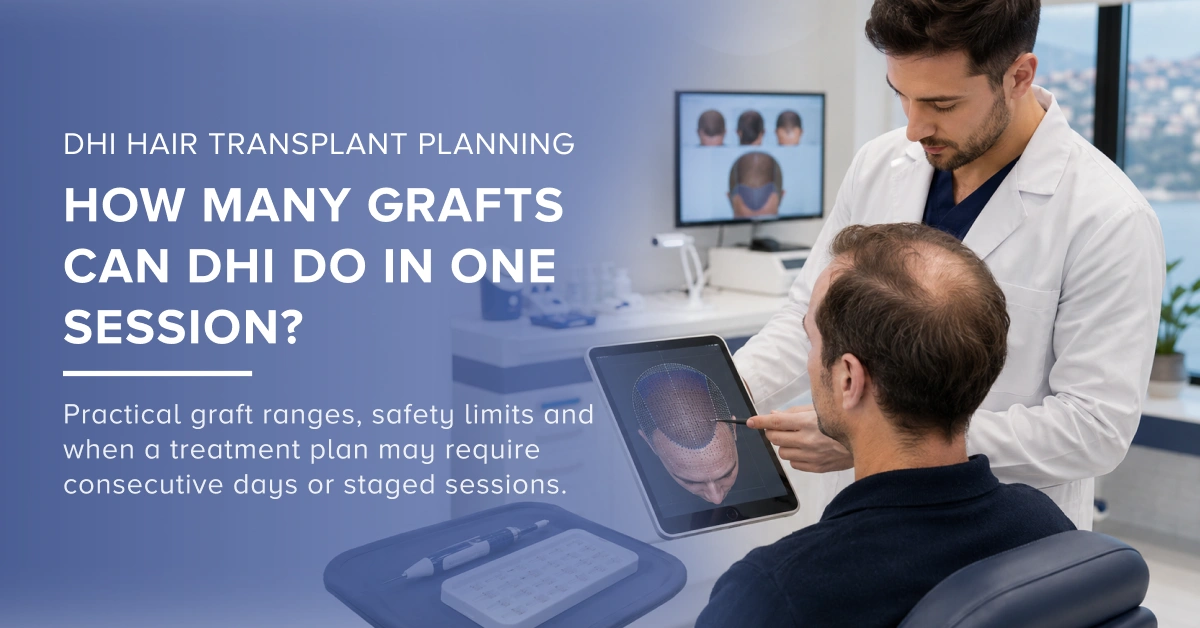
Most DHI sessions involve about 2,000–3,500 grafts, while approximately 4,000 may be possible in selected cases with favorable clinical conditions and an experienced team.
No professional body defines a universally accepted numerical DHI maximum. The International Society of Hair Restoration Surgery publishes guidance on practitioner qualifications and surgical delegation, not a graft ceiling per technique. Every published figure, including ours, is a practical clinical planning range drawn from workflow experience rather than a trial-derived threshold.
A technical possibility is not automatically a clinically advisable plan. Validated capacity rests on four things you can actually check: donor supply, recipient-area conditions, team workflow and total operating time. The DHI single session limit is set by the operating team, not by the name of the technique.
A hair graft, or follicular unit, is a naturally occurring group of one or more hairs, commonly one to four. Graft count is therefore not hair count. The operative record should report grafts extracted, grafts judged usable, and grafts implanted separately. Any gap should be documented, including transection, meaning accidental damage to a follicular unit during extraction.
Capacity and need are different questions. This page covers what a team can place in one day. To estimate how many grafts your hair-loss pattern may require, read our dedicated guide instead.
Any advertised count above 4,000 needs clarification before you accept it. Ask whether the proposal means one calendar day, two consecutive operating days, or staged treatment. A proposed count above 3,500 should follow assessment by a qualified hair-restoration professional.
DHI grafts per session: practical planning categories
Planning category |
Approximate DHI count |
Interpretation |
|---|---|---|
Common single-session range |
2,000–3,500 grafts |
Realistic for many suitable cases |
Upper-end selected case |
Approximately 4,000 grafts |
Needs favorable conditions and an experienced implantation team |
Above-usual advertised claim |
More than 4,000 grafts |
Verify one day, consecutive days or staged treatment |
Practical clinical ranges, not formal universal limits.

Medart clinical workflow (clinical experience):
"In our clinic, the proposed DHI count is checked against donor capacity, treatment area, team workflow and expected operating time. Grafts are counted in batches during extraction and reconciled against the implanted total in the operative record. Most plans sit inside the common range. A higher count is a decision we justify, not a default." — Dr. Busra Yakupoglu, Hair Transplant Surgeon, Medart Hair Transplant
Already holding a graft estimate? Tap the WhatsApp button in the bottom-right corner and ask whether that number fits a one-day DHI plan or may be safer divided. A remote review of donor and recipient-area photos is preliminary, and never replaces examination.
Why Does DHI Have a Lower Per-Session Ceiling Than FUE?
DHI can have a lower daily capacity because each graft must be loaded into an implanter pen and placed through a tightly coordinated graft-by-graft workflow. The planning ranges above come from that workflow, not from a fixed rule about the technique.
DHI still uses FUE extraction in most clinics. Placement is where the two paths separate. Implanter-pen placement grew out of the Choi-type implanter described by Choi and Kim in the Journal of Dermatologic Surgery and Oncology (1992).
Implanter systems are not identical. With sharp implanters, the instrument may create the recipient opening as the graft is placed. Some dull implanter workflows still use pre-made recipient sites.
Think of placement as a handoff rather than a speed contest. A technician loads a follicular unit into the pen in the correct orientation. The surgeon or a supervised implanter then sets angle, direction and depth for that graft, before the next loaded pen arrives.
● Graft loading: every follicular unit must be seated in the pen correctly before placement.
● Pen turnover: pens are reloaded continuously, so loading speed caps placement speed.
● Recipient-site access: bleeding, scalp thickness and existing native hair can slow controlled placement.
● Team size: extra trained loaders raise throughput, but supervision limits how many work at once.
● Fatigue: surgeon fatigue and technician fatigue rise with session duration and can reduce precision.
● Quality control: verifying angle, direction and depth takes time, and should never be traded for a graft target.
DHI is not always slower. A rehearsed implantation team with organized pen rotation can narrow the gap considerably. What no team can do is make capacity unlimited by adding staff.

In our workflow, the surgeon leads the design and directs implantation, while trained technicians extract and load under that supervision.
DHI vs FUE Maximum Grafts Per Session Compared
DHI commonly handles fewer grafts per day than high-throughput conventional FUE implantation, although clinic workflow can narrow or eliminate that difference. The loading bottleneck explains why. The table below turns it into figures you can take to a consultation.
Any DHI vs FUE graft count comparison should describe practical capacity, not an absolute medical maximum. Conventional FUE implantation may accommodate roughly 3,000–4,500 grafts in suitable workflows. That figure reflects clinic planning convention, not a finding from a capacity trial.
Peer-reviewed reviews of follicular unit extraction, such as Dua and Dua (Journal of Cutaneous and Aesthetic Surgery, 2010), describe the technique rather than a validated session ceiling. Claims of 5,000 grafts sit outside these ranges. They need separate evaluation of timing, staffing, donor safety and count verification.
DHI vs FUE maximum grafts: practical capacity comparison
Factor |
DHI implantation |
Conventional FUE implantation |
|---|---|---|
Donor extraction |
Usually FUE |
FUE |
Implantation method |
Grafts loaded into implanter pens |
Pre-made sites with forceps or similar placement |
Common practical range |
About 2,000–3,500 |
About 3,000–4,500 |
Selected-case upper end |
Around 4,000 |
May be higher in specialized mega-session workflows |
Main capacity constraint |
Pen loading and graft-by-graft placement |
Site creation, placement speed and total operating time |
Best interpretation |
Controlled implanter workflow; not an absolute cap |
Potentially higher throughput; not automatically safer or better |
Ranges vary by clinic and are not standardized professional guidelines.
FUE describes how grafts are removed. DHI describes how they are placed. Treating them as rival extraction methods hides the real variable, which is team workflow. Neither method deserves selection purely because it advertises a bigger number.

Implanter-Pen Speed, Team Size and Graft-Out-of-Body Time
More pens and more technicians raise throughput only when every loading and implantation role is trained and supervised. Several pens can be loaded in rotation while another is used for placement.
Grafts are usually extracted and implanted in batches. Individual ex vivo time, meaning the period a graft spends outside the body, therefore varies from graft to graft. Not every graft remains outside the body for the full procedure duration.
The clinic should document extraction start, implantation start and final graft placement in the operative record. Your written surgical plan should explain how those timings will be monitored on the day.
Elapsed time is only part of the picture. A peer-reviewed review of follicular graft growth and survival by Parsley and Perez-Meza (Journal of Cutaneous and Aesthetic Surgery, 2010) identifies hydration, storage solution and temperature control as key handling variables. Published literature does not establish one universal minute-by-minute ex vivo cutoff, and protocols differ between clinics.
What Happens if You Need More Grafts Than DHI Can Do in a Day?
If the planned graft count exceeds the clinic's safe one-day DHI capacity, the treatment can be split across consecutive days or staged as separate procedures. Here is what a careful clinic does when your plan sits above its validated ceiling.
● Consecutive operating days: the total is divided between adjacent days, each with documented graft allocation, roles, timing and stopping criteria.
● Staged transplant: a separate later procedure with its own healing period, its own donor assessment and its own consent.
● Prioritized treatment zones: the frontal area or another agreed zone is completed first, and remaining zones are deferred.
A split session across two days and two separate hair transplants are not the same plan. A staged transplant happens at a later date, after a new clinical assessment. There is no universal waiting interval, because healing and donor recovery differ between patients.
Donor preservation takes priority over reaching a requested count. The donor area is finite, and overharvesting it to meet a headline number reduces what remains available if hair loss continues. Our guide to how staged hair transplants affect long-term planning covers the long view.

Your written surgical plan should name each treatment zone and the grafts allocated to each phase. Choosing between consecutive days and staged surgery is a clinical decision, and it deserves assessment by a qualified hair-restoration physician.
"We divide or stop a planned DHI session when donor conditions, recipient-site bleeding, graft quality or elapsed operating time start to threaten controlled handling. Remaining grafts are rescheduled rather than rushed." — Dr. Busra Yakupoglu, Hair Transplant Surgeon, Medart Hair Transplant

Which Cases Are Best Suited to Single-Session DHI?
Single-session DHI is best suited to patients whose planned treatment area, donor supply, medical fitness and recipient-site conditions fit the clinic's validated one-day capacity. Handling quality falls when a day runs long, so candidate selection is really about keeping the case inside that capacity.
The donor area is the part of the scalp where grafts are removed, usually the back and sides. The recipient area is the zone receiving them.
● The planned treatment area fits inside the clinic's validated one-day DHI capacity.
● Donor supply is adequate and graft quality supports controlled loading.
● Recipient-area access allows steady placement without excessive bleeding.
● Placement among existing native hair is planned, subject to surgeon assessment.
● Medical fitness supports the anticipated session duration.
● Expectations center on design and coverage rather than a headline number.
Two cases show the contrast. A modest frontal refinement placed among existing native hairs may sit comfortably inside one operating day. A broad restoration across the front and mid-scalp, with a tight donor area, often reads better as a split or staged plan.
Disclose smoking or nicotine use, scalp disease, and any medicines or supplements that may affect bleeding. Do not stop prescribed medication on the basis of an article, because that decision belongs to your treating clinician. The American Academy of Dermatology advises patients to confirm that a qualified physician evaluates candidacy before hair restoration surgery.
A graft estimate given from photographs can change after in-person examination. Treat an online number as provisional.

How Should You Plan Graft Count and Sessions With Your Clinic?
A credible clinic should explain its usual DHI range, team workflow, count-verification method and contingency plan, not simply advertise its highest-ever graft number. Candidate factors tell you whether one day is plausible. These questions tell you whether the clinic can prove it.
1. How many grafts do you expect to extract, and how many do you expect to implant?
2. Is this one operating day, two consecutive days, or two separate procedures?
3. Who performs extraction, who loads the pens, and who implants the grafts?
4. How many team members and implanter pens will be used on my case?
5. How are graft counts recorded and verified during surgery?
6. What is your usual DHI range, rather than your record maximum?
7. How are grafts stored and moved through the extraction-to-implantation interval?
8. What are your stopping criteria if donor or recipient-area conditions worsen?
9. Which zone is prioritized if the full plan cannot be completed?
10. How does this plan preserve donor options for future hair loss?
A clinic should not guarantee a precise final graft count before examining the donor and recipient areas, either in person or through an adequate photographic assessment. Surgical responsibilities and staff roles should be disclosed in writing before you consent.

Traveling to Istanbul for treatment adds one more thing to confirm: whether "one session" means one calendar day or consecutive operating days. Check postoperative arrangements and washing instructions before your return flight. Medart Hair Transplant documents one-day and multi-day plans separately for this reason, and our guide to planning DHI treatment in Turkey explains the logistics.
The International Society of Hair Restoration Surgery advises patients to verify who performs each surgical task, and to confirm the physician's qualifications and involvement. The published DHI hair transplant maximum grafts figure describes a practical clinic range, not an individualized surgical plan.