
Why Does Afro Hair Change the DHI vs Sapphire FUE Decision?
Afro hair changes the DHI versus Sapphire FUE decision because the follicle may curve beneath the skin, increasing extraction complexity while the visible coil changes how density and implantation angles should be planned. The introduction described that hidden curve. Anyone weighing DHI or FUE for Afro hair needs it mapped before design begins, because it shapes both harvesting and recipient planning.
Visible curl is not the same as follicle curvature: The direction of the hair above the scalp may not reveal the full path of the follicle below it.
Surface curl does not perfectly predict what a follicle does beneath the skin. Two people with similar type 4 coils can have different curved follicle anatomy. Donor anatomy must be assessed directly, never assumed from ethnicity or from how tightly the shaft coils.
A follicle can change direction as it passes through the epidermis, the dermis and into subcutaneous tissue. The visible shaft therefore cannot map the whole donor path. Curl guides the examination. It does not replace it.
According to the American Academy of Dermatology, tightly coiled hair is structurally more fragile than straight hair and grows in a curved pattern, with bends along the shaft. Surgical case series and reviews indexed on PubMed describe donor follicles in African-descended patients that curve below the surface. Direct comparative evidence in Afro-textured populations remains limited.
Hair caliber, follicular unit composition, donor density and scalp thickness also vary widely among people with type 3 and type 4 curl patterns. Above the skin, curl works in your favour. A coily shaft can screen more visible scalp than a straight shaft at the same implanted graft count, but that advantage says nothing about how many grafts survive.
Placement must respect each graft's natural exit angle and the direction its coil turns. Hairline design that ignores curl direction looks artificial once the hair grows out, whatever instrument placed it. For candidacy, healing and the wider procedure, see our complete guide to Afro hair transplantation.

How Does the Curved Follicle Affect Extraction Risk?
Curved follicles are more vulnerable to transection when a straight or poorly directed punch fails to follow the follicle's changing path beneath the scalp. Because visible curl cannot reveal the donor path, the next question is where graft injury actually happens. It happens mainly in the donor area, during harvesting.
Transection means cutting or damaging a follicle while it is being removed, instead of lifting it out intact. It can damage part or all of a graft. The clinical effect depends on where and how the follicular unit was injured.
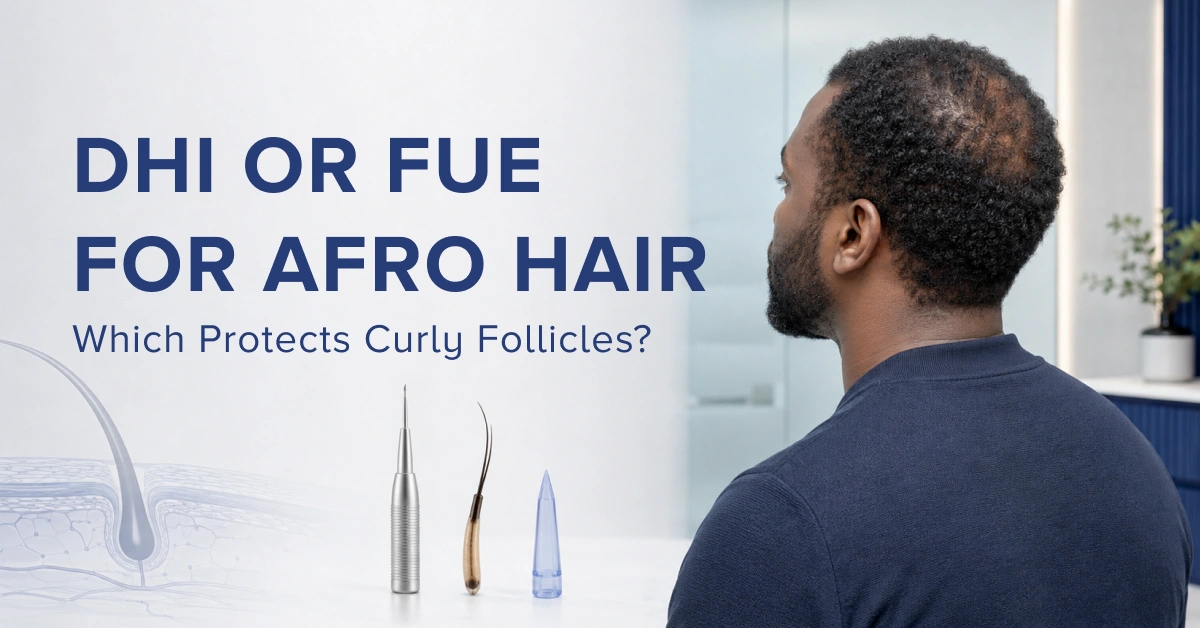
Two instruments are often confused. A sapphire blade creates recipient channels in the thinning area; it does not remove donor grafts. The extraction punch is a separate cutting tool that lifts follicular unit grafts from the donor area. Direct Hair Implantation generally follows the same Follicular Unit Excision harvesting stage, so choosing a pen over a blade does not remove curved follicle extraction risk.
Five factors that affect curved-graft extraction:
1. Punch diameter and geometry. Sharp, blunt, hybrid and flared designs behave differently around a curve, and diameter should be chosen against your donor anatomy rather than habit.
2. Entry angle. The punch should follow the follicle's true direction under the skin, which can differ noticeably from the angle the visible shaft suggests.
3. Scoring depth. Scoring is how deep the punch cuts. Too deep can sever a curving follicle; too shallow can leave the graft anchored and prone to tearing.
4. Tissue and follicle characteristics. Skin thickness, laxity, follicular unit composition and how sharply each follicle bends all change how forgiving extraction will be.
5. Surgeon feedback from inspected grafts. Early grafts show whether the plan is working, allowing punch, depth or direction to change before large numbers are harvested.
A test extraction means removing a small number of grafts early and inspecting them under magnification. Findings may change punch diameter, entry angle or scoring depth for the rest of the session.
Inspection assesses extraction damage. Graft hydration and gentle handling then protect intact grafts during storage and placement, which is a separate risk to manage. The ISHRS publishes surgeon reports in Hair Transplant Forum International on punch designs, including blunt and flared tips intended to follow curvature more forgivingly. Those are surgical rationales, not proven comparative advantages.
"The first extracted grafts tell us whether the visible shaft direction matches the path beneath the skin. When it does not, we adjust punch depth, angle and diameter rather than force a standard protocol."
— Dr. Busra Yakupoglu, Hair Transplant Surgeon, Medart Hair Transplant
No clinic can responsibly promise a fixed Afro hair transplant transection rate before surgery. Figures drawn from straight-hair cohorts should not be transferred to coily donor areas. Experience with curved follicle extraction carries more weight than the technique name.

DHI vs Sapphire FUE for Afro Hair: Side-by-Side Comparison
Neither DHI nor Sapphire FUE automatically protects curved donor follicles, because both commonly rely on FUE harvesting and differ mainly in how recipient sites are created and grafts are implanted. Extraction risk is settled in the donor area, so this comparison separates harvesting from recipient-site planning. That is what shows you which stage each label actually controls.
Direct comparative evidence in Afro-textured populations is limited. The differences below describe workflow and clinical judgment, not proven outcome advantages.
ISHRS terminology defines FUE as Follicular Unit Excision: grafts removed one at a time with a punch. DHI commonly uses a Choi-type implanter pen to create the recipient opening and deploy the graft within a single placement step, described in our guide to how DHI implantation works. Sapphire FUE creates pre-made recipient sites with sapphire-tipped blades, covered in our full Sapphire FUE technique guide. Neither recipient method eliminates donor transection.
Transection Rate, Density, Scarring and Recovery Compared
Attribute |
DHI for Afro hair |
Sapphire FUE for Afro hair |
What matters most |
|---|---|---|---|
Donor extraction |
Usually FUE-based |
FUE-based |
Curved-follicle extraction skill |
Transection risk |
Not removed by the DHI pen |
Not reduced by sapphire recipient blades |
Punch selection, depth control, test grafts, inspection |
Recipient placement |
Implanter pen |
Pre-made channels, then placement |
Natural angle, curl direction, graft handling |
Visual density |
Can be precise in selected zones |
Can cover broader zones efficiently |
Donor capacity, survival, caliber, curl |
Scarring |
Punctate donor scars still possible |
Punctate donor scars still possible |
Punch trauma, healing history, overharvesting |
Keloid considerations |
No proven blanket advantage |
No proven blanket advantage |
Personal history and medical assessment |
Existing-hair preservation |
May help in selected thinning zones |
Depends on channel planning and spacing |
Surgeon plan and hair-loss pattern |
Large-session practicality |
Can be more labour-intensive |
May suit larger open areas |
Team workflow without compromising graft care |
Recovery |
Depends on total trauma and your healing |
Depends on total trauma and your healing |
Not blade branding alone |
Best candidate |
Pattern-specific |
Pattern-specific |
Anatomy and clinic competence |
Bottom line: DHI vs Sapphire FUE Afro comparisons describe the recipient stage. The implantation label does not resolve the earlier donor-extraction challenge, although graft handling and placement also affect survival. Judge the extraction protocol first, then discuss placement.
If you are comparing DHI and Sapphire FUE for Afro hair, use the WhatsApp button in the bottom-right corner to share clear donor and recipient-area photos for an initial, no-obligation Medart review. Photos cannot fully show below-skin follicle curvature or confirm surgical suitability.

Which Technique Gives Better Density for Coily Hair?
Neither method universally produces better density in coily hair; final fullness depends more on graft survival, donor capacity, shaft caliber, curl pattern, and coil-appropriate placement. The table showed both routes sharing one harvesting stage. Fullness therefore depends on what survives, and on how it is arranged.
Visible fullness ≠ graft count alone
Visual fullness reflects surviving grafts × hairs per graft × shaft caliber × curl coverage × placement pattern.
This is a conceptual framework for discussion, not a validated clinical equation.
Four ideas get muddled in consultations. Implanted density is what is placed. Surviving density is what actually grows. Hair density counts hairs rather than grafts, because one follicular unit graft may carry one to four hairs.
Visual density is different again. It is the coverage your eye reads from a metre away. Coily shafts bend and expand outward, so they can screen more scalp than straight hair at the same graft count. Contrast between hair colour and scalp tone also changes how full an area looks, and both vary widely between individuals.
The British Association of Dermatologists notes that hair shape and thickness differ considerably between people, which influences how hair sits and how it looks. Surgeons commonly observe that very dense packing raises the stakes: more time out of storage, more trauma concentrated in one zone, and less donor capacity left for the years ahead.
There is no single best technique for curly hair transplant density. DHI for coily hair may support controlled, one-by-one placement in a defined zone such as a hairline or a thinning frontal patch. Sapphire FUE for curly follicles may support even distribution across a wider open area. A surgeon may prefer either, and both are planning decisions rather than proven universal advantages.
No afro follicle transplant method adds hair. It redistributes what your donor area can spare. Ask for a zone-by-zone plan covering hairline, frontal density, mid-scalp and crown, because a guaranteed density number is a marketing figure rather than a surgical one.

Does DHI or Sapphire FUE Leave Less Scarring on Black Skin?
There is no sound basis for promising that DHI or Sapphire FUE will universally cause less scarring on Black skin; personal keloid history, punch trauma, wound care, and individual healing are more informative. Both routes use punches in the donor area, so the scarring question begins where the last section ended. Total surgical trauma matters more than instrument branding.
Scarring terms, distinguished:
● Expected FUE scarring: Follicular Unit Excision leaves small dot-like (punctate) donor wounds where each graft was removed. They heal with scars of variable visibility, and this applies to DHI too.
● Hypertrophic scar: A raised scar that stays inside the boundary of the original wound.
● Keloid: Scar tissue that grows beyond the original wound edges into surrounding skin.
● Post-inflammatory hyperpigmentation: Darkening of skin after inflammation. It is a pigment change, not a raised scar, and it often fades slowly.
According to the American Academy of Dermatology, keloids occur more often in people with darker skin tones, and a tendency to form them can run in families. The NHS describes a keloid as scar tissue that spreads beyond the original wound, and notes that some people are more prone to them than others. Risk cannot be inferred from skin colour alone.
Published evidence does not support promising a blanket scarring advantage for either recipient method. Keloid scarring Afro hair transplant planning therefore starts with your own scar history, not your skin tone. Tell your surgeon about any raised scar on the ear, jawline, chest, shoulders or back, and about family history. Folliculitis, temporary redness and pigment change are separate problems and should not be labelled keloids.
Composite scenario (illustrative, not a real patient case): A 34-year-old man with type 4 hair has a broad open frontal zone and modest donor density. He mentions a raised, spreading scar from a childhood ear piercing. Pre-made sapphire sites might suit the open area, but the pen-versus-blade question becomes secondary. A dermatologist or surgeon experienced in abnormal scarring would need to assess whether surgery should be modified, deferred or avoided, and informed consent should record that discussion.

Which Should You Choose for Your Hair Loss Pattern?
DHI may suit selected targeted or existing-hair zones, while Sapphire FUE may be practical for broader open areas, but active scarring alopecia, donor limitations, and curved-follicle extraction risk can outweigh either preference. Scar risk framed the previous section. Your loss pattern now decides how the recipient area should be built, and when surgery should wait.
Work through it in order. Donor curvature first, because it governs how grafts come out. Loss pattern second, because it governs how they go back in. Scar and scalp-disease history third, because either can pause the whole plan.
If you have a small frontal or temple zone with existing hairs still present, DHI placement may be considered for controlled positioning between them. That assumes your donor curvature proves manageable at test extraction. If you have a larger open frontal or mid-scalp area, pre-made sapphire recipient sites may be practical for planned distribution, subject to surgeon workflow and graft-handling capacity.
Crown or vertex loss is governed by whorl direction, coil behaviour, donor demand and ongoing androgenetic alopecia. Instrument choice ranks below all four. Diffuse thinning needs assessment of miniaturisation and shock-loss risk before grafts go between existing hairs.
Traction alopecia should be stable, with the causative tension stopped, before transplantation is considered. The American Academy of Dermatology warns that traction alopecia can become permanent once follicles scar. For suspected central centrifugal cicatricial alopecia (CCCA), a dermatologist may use trichoscopy and, where indicated, a scalp biopsy. Transplanting into active cicatricial disease can fail, so surgery is generally considered only when the condition is clinically inactive or stable.
Limited donor capacity changes the whole plan. Long-term donor planning and protection from overharvesting outrank maximum density in a single session.
Composite scenario (illustrative, not a real patient case): A 29-year-old woman with type 3 coils has a receded temple and thinned frontal edge after years of tight braiding. Her stylist changed her routine two years ago and the edge has stopped receding. Test extractions show moderate follicle curvature. DHI placement among her surviving frontal hairs may be considered, provided a dermatologic assessment confirms the traction alopecia is inactive and her donor supply suits a staged plan.
The matrix below sorts patterns into planning tendencies, not proven technique indications.
Hair-loss pattern decision matrix
May favour DHI implantation |
May favour Sapphire recipient channels |
Pause for medical assessment |
|---|---|---|
Small, targeted frontal or temple zone |
Larger open frontal or mid-scalp area |
Suspected CCCA or other scarring alopecia |
Grafts placed among existing hairs |
Wide, planned distribution needed |
Unstable or active traction alopecia |
Detailed hairline design work |
Broad zone where the surgeon prefers pre-made sites |
Inflammatory scalp symptoms |
Selected existing-hair zones suiting the surgeon's workflow |
Large session with efficient team workflow |
Severe donor limitation |
Stable, well-defined loss pattern |
Stable, well-defined loss pattern |
Significant personal or family keloid history |
Medical assessment is important before surgery if you have had keloids, severe raised scars, scalp pain, burning, scaling, pustules or inflammation, rapid or unexplained hair loss, suspected CCCA, active traction alopecia, insufficient donor supply, unrealistic density expectations, an unstable medical condition, or a medicine that may affect healing. Do not stop or change prescribed medication without guidance from the prescribing clinician and surgical team.
If you have received conflicting DHI and Sapphire FUE recommendations, use the WhatsApp button in the bottom-right corner for a personalised review of your loss pattern, donor area, and treatment goals.

What Should You Ask a Clinic Before Booking Afro Surgery?
Before booking, ask for evidence that the named surgical team can extract curved follicles intact, monitor transection, plan coil-specific angles, and assess scarring or scalp-disease risks. Your pattern now points toward a likely approach. Deciding on DHI or FUE for Afro hair is finally a decision about people, so the task left is verifying that a named team can deliver it safely.
Ask these questions, then note who answers them: a surgeon, or a sales coordinator.
● How many comparable Afro-textured cases has the named surgeon personally treated in a defined recent period, and which stages did the surgeon perform?
● Who performs extraction, who creates recipient sites, who loads implanters, and who places grafts?
● How is transection monitored during surgery, and what changes if damage is seen?
● Are test extractions used when the follicle path is uncertain?
● Why is DHI or Sapphire FUE recommended for my pattern specifically?
● How are keloid history, active scalp disease, donor limits and future loss screened before consent?
● Who provides clinical advice after I return home, and how are urgent concerns escalated?
The ISHRS emphasises that informed consent should cover realistic outcomes, alternatives and risks before any surgical booking.
Afro Curved-Follicle Clinic Assessment Scorecard. Award 1 point where clear evidence is supplied, and 0 where evidence is missing, vague or refused.
Criterion |
Award 1 point when |
|---|---|
Surgeon's role in extraction |
The named surgeon performs or directly supervises extraction, rather than visiting the room |
Afro-textured case volume |
Comparable curly and coily case volume is documented, not merely claimed |
Test extraction |
Test extraction is considered where the follicle path is uncertain |
Punch selection |
Punch type and diameter are chosen for your donor anatomy and explained |
Transection monitoring |
Transection is checked during surgery and the protocol changes when damage appears |
Graft care |
Grafts are inspected, handled gently and kept hydrated between stages |
Technique rationale |
The DHI pen versus sapphire-channel choice is justified for your case |
Angle planning |
Hairline design and recipient angles account for curl direction and exit angle |
Scar screening |
Keloid and hypertrophic-scar history are screened before consent |
Result evidence |
Comparable cases are shown at 12 months or later, with donor views, consistent lighting, graft counts where known, and any fibres or concealers disclosed |
Scoring: 8–10 means strong evidence to discuss further. 5–7 means ask follow-up questions before proceeding. 0–4 means insufficient transparency for a high-stakes decision. The scorecard is a comparison tool, not a medical suitability test. At Medart Hair Transplant we encourage patients to bring this list to every consultation, including ours.
Istanbul is a major hub for medical travel, which makes continuity of care the practical issue rather than the flight. Ask for the planned review schedule, who answers if folliculitis or unexpected shedding appears, and whether local evaluation may be needed. For logistics, timing and aftercare abroad, read our guide to planning an Afro hair transplant in Turkey.
