
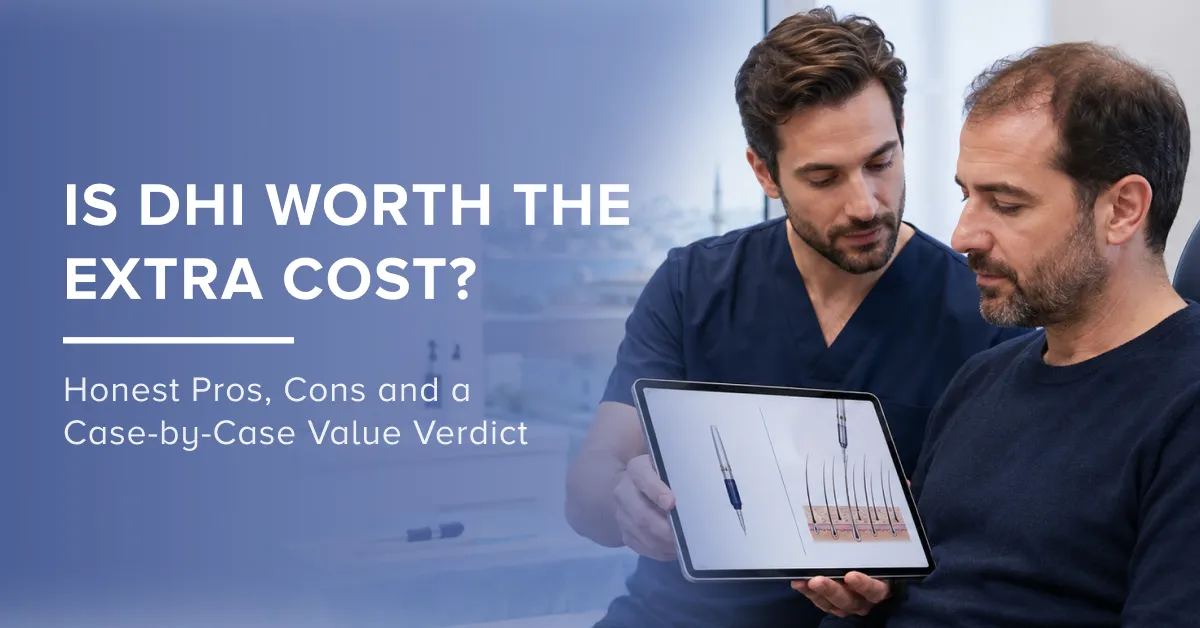
Is DHI Worth It? Honest Pros, Cons and Cost Verdict

Sometimes, but only when its implantation approach offers a clear benefit for your recipient area or existing hair. DHI does not automatically produce better density, survival, or naturalness than well-performed FUE. Compare like-for-like quotes and pay the premium only when the clinic can explain exactly what it changes in your plan.
Is DHI Worth It? Honest Pros, Cons and Cost Verdict

Table of Contents

Dr. Busra Yakupoglu

Reviewed by Dr. Busra Yakupoglu, Hair Transplant Surgeon, Medart Hair Transplant, Istanbul

Get a Free Consultation

Talk to an experienced patient coordinator for your hair transplant in Turkey.
Please enter a valid phone number.

Key Takeaways

  • ● DHI is a case-dependent premium, not an automatic upgrade.

  • ● Compare equal graft counts, medical-team involvement and package inclusions before calling a quote "more expensive".

  • ● No technique label secures better hair density or graft survival.

  • ● Standard or Sapphire FUE may be the smarter buy for broad coverage.

Two clinics quote you for the same planned graft count. One calls the procedure DHI, charges more, and leaves you to work out why. Before you pay that difference, ask what DHI changes in your case that a cheaper FUE plan cannot deliver.

So, is DHI worth it? Sometimes. This page is a buying guide, not another technique explainer. It shows you how to calculate the real price gap, which cases justify paying it, and where the marketing runs ahead of the evidence. Nobody wants to overpay for a label. Overpaying is not the only mistake, though: saving money in the wrong place costs more.

Direct Hair Implantation (DHI) commonly describes the graft-implantation stage of a hair transplant, while extraction usually still uses Follicular Unit Extraction (FUE); for the full technical picture, read how the DHI implantation method works.

Disclosure: Medart Hair Transplant provides hair-transplant services, including DHI and FUE-based procedures. This article is designed to explain how to compare those options, not to present DHI as the right choice for every patient.

Is DHI Worth Paying More For? The Short Answer

DHI is worth paying more for when it provides a case-specific implantation benefit, but it is not a universal upgrade over well-performed FUE. Your recipient area (the zone receiving grafts), your donor area (the scalp region grafts are harvested from) and the team doing the work shape your result more than the label does.

Use a three-level verdict as you read your quotes:

  • Likely worth it: a small, placement-sensitive recipient area, or work among substantial native hair, with a modest and clearly explained premium.

  • Possibly worth it: the surgeon names a specific reason, but the price gap is wide and the plan is otherwise identical.

  • Probably not worth it: broad coverage, limited donor capacity, or a large premium supported only by generic claims.

A compact view of DHI pros and cons for buyers:

  • Pro: close control over implantation angle, direction and depth in selected zones.

  • Pro: may suit placement among existing native hair when the team uses implanter pens routinely.

  • Con: no established advantage in graft survival or hair density.

  • Con: across large-area coverage, the extra labour may not produce a proportional visible benefit.

  • Con: any workflow advantage depends on the training and graft handling of the people implanting.

So is DHI worth it in your case? The test is simple. The premium earns its place only when the treatment plan itself changes.

How Much More Does DHI Actually Cost Than FUE?

The only meaningful DHI premium is the difference between two quotes with comparable graft counts, medical-team involvement, and package inclusions. Once you accept that DHI is not an automatic upgrade, the next job is testing whether the quoted difference is real or simply packaged differently.

Two formulas do the work:

`DHI premium = comparable DHI quote − comparable FUE quote`

`DHI premium % = price difference ÷ comparable FUE quote × 100`

Worked arithmetic, not a price guide: if the matched FUE quote is 100 and the matched DHI quote is 120, the premium is 20 and the premium percentage is 20%.

Both formulas collapse on unmatched quotes. A surgery-only price cannot be compared with an all-inclusive package until you strip out the hotel nights, transfers and medication bundled into it. A fixed "3,000 planned grafts" plan is not comparable with an "up to 4,000" estimate either. Check whether you are being sold price per graft or a fixed package price, and insist on quote transparency for both.

How to test whether a DHI quote is genuinely more expensive than FUE

Quote factor

DHI quote

FUE quote

Is it genuinely comparable?

Planned grafts

Record the planned count

Record the planned count

Yes, if both are fixed planned counts

Surgeon involvement

Name the physician and stages

Name the physician and stages

Yes, if the same stages are physician-led

Implantation method

Implanter pen placement

Site creation, then placement

Compare purpose, not label

Package inclusions

List hotel, transfers, medication

List hotel, transfers, medication

Yes, if the lists match item for item

Aftercare

Follow-up length and contact route

Follow-up length and contact route

Yes, if duration and access match

Total price

Full amount payable

Full amount payable

Yes, after currency and extras align

Effective premium

Formula result

Baseline figure

Meaningless if any row above is unmatched

Medart Hair Transplant has not published a verified quote audit alongside this article. No median, range or "typical" uplift appears here for that reason. Treat the table above as an illustrative quote-comparison framework and fill it with your own figures.

Istanbul quotes often arrive as travel-and-accommodation-inclusive packages, which makes like-for-like comparison harder rather than easier. If you are pricing DHI treatment in Turkey, separate the surgical fee from the hospitality element first. For the wider set of price variables, see what affects hair transplant costs in Turkey.

Quote comparison infographic: matched graft counts and team roles showing why is DHI worth it depends on comparable quotes.

Not sure whether your two quotes are actually comparable? Tap the WhatsApp button in the bottom-right corner for a free assessment of your planned graft count, treatment areas, and whether the DHI premium reflects a real plan difference or unmatched package features.

What Do You Actually Get for the Extra Money?

The DHI premium may buy a different implantation workflow and greater placement control in selected cases, but it does not buy guaranteed growth or density. With a verified premium in hand, the useful question is what that money changes at the level of your scalp.

Benefits Where the Premium Pays Off

Situations where the premium may buy meaningful value:

  • ● Small, high-visibility zones where implantation angle, direction and depth demand especially careful execution.

  • ● Placement among substantial existing native hair, when the surgeon prefers that workflow for the planned distribution.

  • ● Frontal hairline refinement, where fine control over each hair graft supports a natural-looking hairline.

  • ● A medical team with documented, repeated implanter-pen experience rather than occasional use.

  • ● Partial-shave or no-shave requests, which can influence method choice and cost without being the same thing as DHI.

Illustrative composite scenario — not a guarantee of outcome

A patient wants refinement of a limited frontal zone, with substantial native hair still present behind the hairline. Donor capacity is comfortable for the area planned. Both clinics quote 2,000 planned grafts, the same named physician involvement and identical aftercare, so the quotes are genuinely comparable. The DHI surgeon sets out in writing why an implanter-based workflow suits placement among existing hairs in that zone. The premium is modest and tied to a stated purpose. Buyer verdict: the premium is defensible.

Where DHI Offers No Real Advantage

What the DHI premium does not buy:

  • ● More donor grafts. Donor capacity is fixed by biology, not by instrument choice.

  • ● A rescue for weak candidacy. Limited donor supply and unrealistic expectations remain the limiting factors.

  • ● Certainty of higher hair density, because visual fullness also depends on hair calibre, curl and hair-to-scalp colour contrast.

  • ● An assured graft survival advantage, since survival is driven by graft handling, out-of-body graft time and follicular trauma.

  • ● Better hairline design, which comes from planning rather than from the pen.

  • ● Proportional benefit across large bald areas, where added time and cost may not create a visible gain that matches the spend.

The StatPearls hair transplantation review hosted on NCBI Bookshelf identifies graft desiccation, storage conditions and out-of-body time as recognised factors in graft survival. It also flags transection during extraction and mechanical trauma during placement. That evidence is about careful handling by any team in any workflow. It is indirect evidence here, and it does not show that the DHI label protects grafts better than well-performed FUE implantation.

When Is DHI Worth It — and When Is It a Waste?

DHI offers the strongest value in selected placement-sensitive cases and the weakest value when a clinic cannot explain how it changes the patient's treatment plan. With benefits and non-benefits separated, the decision comes down to matching your own situation to a clear value verdict.

Decision flowchart: recipient area size, native hair and donor capacity showing when the premium pays off for DHI versus FUE.

Cases Where DHI Justifies the Price

  • ● A limited, cosmetically sensitive recipient area rather than broad coverage.

  • ● Dense packing planned among substantial native hair, where the surgeon can justify the workflow after examination.

  • ● Carefully planned hairline refinement in a patient with stable, well-mapped hair loss.

  • ● A surgeon who names a patient-specific reason instead of a general claim about the method.

  • ● A modest premium sitting inside an otherwise identical quote.

  • ● A medical team whose relevant DHI experience can be described, not merely advertised.

A request for dense packing among native hair still needs in-person assessment. Native-follicle injury and shock loss are genuine concerns in that setting, and photographs alone rarely settle the question.

Cases Where Standard FUE Is the Smarter Buy

  • ● Large-area coverage where DHI does not change the achievable plan.

  • ● Advanced androgenetic alopecia with limited donor supply.

  • ● A wide premium supported only by phrases such as "denser" or "more advanced".

  • ● A cheaper FUE plan with stronger surgeon involvement or better donor protection.

  • ● Quotes with different graft counts or package contents, which make the apparent premium meaningless.

  • ● Budgets better spent on an experienced medical team, structured aftercare and long-term management.

Illustrative composite scenario — not a guarantee of outcome

A patient needs coverage across the frontal and mid-scalp areas. Donor capacity is adequate but finite, which makes graft distribution, not the implantation label, the main planning constraint. Both clinics propose 3,800 planned grafts, the same distribution and the same physician oversight, so the quotes match line by line. The DHI package carries a higher verified premium, yet neither clinician can name what changes clinically. Buyer verdict: the Sapphire FUE plan wins the cost-benefit analysis, because only the label and the invoice differ.

Worth it versus waste: matching your situation to a value verdict

Patient or quote situation

Likely value verdict

Why

Small, high-visibility recipient area

DHI may be worth it

Placement workflow may offer practical value

Implanting among native hair

Case-dependent

Depends on surgeon plan and team experience

Large bald area

FUE often offers better value

Added cost may not create proportional benefit

Weak donor supply

DHI does not solve the problem

Donor management is the limiting factor

Large premium with no case-specific reason

Probably not worth it

Technique label alone is insufficient

Similar premium and clearly explained indication

Consider DHI

The extra spend has a defined purpose

"The technique label is rarely the strongest predictor of value in the cases I see. The better question is whether the implantation plan fits the recipient area, the donor supply and the hair characteristics. It also has to fit the likely long-term pattern of loss and the team executing it." — Dr. Busra Yakupoglu, hair transplant surgeon, Medart Hair Transplant, Istanbul. This is clinical experience, not comparative scientific proof.

A technique recommendation should be specific to your case. Send clear hairline and donor-area photos through the WhatsApp button in the bottom-right corner for a free preliminary assessment of your candidacy and the method that suits it.

Does DHI Give Better Density or Survival for the Money?

Current evidence does not establish that the DHI label alone consistently produces better density or graft survival than well-executed FUE implantation. The decision matrix shows where value sits; this section tests the two claims most often used to justify the price difference.

Separate two ideas first. Implanted graft density is how many follicular units are placed per square centimetre. Visual density is how full the hair actually looks once it grows.

Visual density depends on graft survival, hair calibre, curl, hair-to-scalp colour contrast, graft distribution and total donor supply. Graft survival simply means the proportion of transplanted hair grafts that keep growing afterwards. Coarser hair, curl and lower contrast can increase the appearance of coverage, which is why two patients with identical graft counts can look very different.

Survival depends on extraction trauma and transection, hydration, storage, out-of-body time, implantation trauma and the skill of the people doing the work. An implanter pen may support controlled placement in trained hands. That is a workflow observation, not proof of universal superiority.

Claim vs evidence:

  • ● "DHI always gives denser results" → Not established.

  • ● "DHI guarantees higher survival" → Not established.

  • ● "Technique and operator skill can affect graft handling" → Plausible and clinically relevant.

  • ● "A patient-specific plan matters" → Strong practical conclusion.

Never accept a single clinic's growth percentage as proof that DHI beats FUE. Clinic-reported figures are not standardised, blinded or independently audited. The graft-handling literature described earlier is indirect evidence: it explains how grafts are damaged, not whether one commercial implantation label outperforms another. Robust head-to-head outcome trials comparing implantation approaches remain limited, and absence of proven superiority is not proof of equivalence either.

Evidence infographic: density and survival claims showing which marketing promises hold up for DHI versus FUE.

DHI vs Sapphire FUE: Which Delivers Better Value?

DHI may offer better value in selected placement-sensitive areas, while Sapphire FUE may be the more economical choice for broader coverage. Having tested the density and survival claims, the remaining comparison is between the two premium options most patients are offered.

DHI generally describes an implantation workflow. Sapphire refers to the blade material used to create recipient sites, and it does not by itself prove smaller wounds, faster healing or better growth. If you want the mechanics, read how Sapphire FUE is performed.

This page compares value rather than full technical differences. For the procedural side, see the detailed differences between DHI and FUE.

DHI vs Sapphire FUE, judged only on value for money

Value criterion

DHI

Sapphire FUE

Best-value use case

Selected, placement-sensitive areas

Broader coverage where site creation is appropriate

Automatic density advantage?

No

No

Automatic survival advantage?

No

No

Importance of operator skill

Very high

Very high

Main buying question

Why does my case need this workflow?

Is the plan and team stronger for the price?

Overall verdict

Case-dependent premium

Often a competitive-value alternative

Head-to-head outcome evidence comparing these two labels is limited, so the quote itself has to carry the argument. For Istanbul packages, compare the planned graft count, physician involvement and the technicians' roles first. Then compare accommodation, transfers, medication and aftercare before you compare totals. The better-value quote is the one with the stronger surgical plan, a graft count matched to your donor capacity and recipient goals, protected donor area, qualified oversight and inclusions you can read line by line.

How to Decide If DHI Is Worth It for Your Case

Choose DHI only when the clinic can explain what it changes in your plan and why that change is worth the verified price difference. The value table narrows your options; these seven questions turn that shortlist into a decision you can defend.

At Medart Hair Transplant, assessment starts with the recipient area, donor capacity, hair characteristics, likely future hair loss and the graft distribution needed across a long-term treatment plan. The method is chosen after that, not before. A qualified clinician may also discuss medical therapy such as finasteride or minoxidil where appropriate, particularly when future loss could undermine the surgical plan.

A justified premium changes the treatment plan. An upsell changes only the label and the price.

Seven questions to ask before you accept a DHI quote:

  • 1. Why is DHI recommended for my specific recipient area?

  • 2. What would change if I chose FUE or Sapphire FUE instead?

  • 3. Are the graft count and coverage plan identical?

  • 4. Who performs each stage?

  • 5. What evidence supports the density or survival claims being made?

  • 6. What is included in each quote?

  • 7. Would you still recommend DHI if both options cost the same?

Question four carries the most weight for medical oversight and informed consent. The International Society of Hair Restoration Surgery (ISHRS) has campaigned consistently on one point: patients should confirm which qualified physician is responsible for the surgery and which tasks are delegated to technicians. The NHS gives comparable advice for cosmetic procedures abroad, including checking practitioner qualifications and understanding what your consent covers before you travel.

Book a face-to-face or properly documented clinical assessment before choosing any technique if you have:

  • ● Limited donor capacity, advanced hair loss or diffuse thinning.

  • ● Active scalp disease, inflammation or an uncertain diagnosis, including female pattern hair loss.

  • ● Previous transplant surgery, repair surgery or visible donor depletion.

  • ● A proposal for dense packing among substantial native hair, or unpredictable future loss.

  • ● A quote that will not identify the physician and the operators for each stage.

No technique removes surgical risk. Hair transplantation can involve infection, bleeding, swelling, folliculitis, temporary or persistent shock loss, scarring, poor growth, unnatural direction or distribution, donor overharvesting, and the need for revision surgery. The American Academy of Dermatology (AAD) sets out these general risks in its patient guidance on surgical hair restoration, and the American Society for Dermatologic Surgery (ASDS) publishes similar consumer information.

Illustrative composite scenario — not a guarantee of outcome

A patient comparing quotes for frontal hairline and mid-scalp coverage receives a much cheaper FUE offer for 3,200 planned grafts. Donor capacity looks adequate on photographs, but the clinic will not say who creates recipient sites or who implants. A higher DHI quote names the physician for planning and site creation and describes donor protection, so the two quotes are not comparable at all. Buyer verdict: reject the opaque quote, then compare the transparent plan against other qualified providers before paying any premium.

Common Questions About DHI Value

Is DHI really better than FUE?
Not universally. DHI describes an implantation workflow rather than a superior operation. In selected placement-sensitive areas it may help, while broad coverage is often achievable with experienced FUE implantation for less money. Judge the surgeon's reasoning, not the acronym, and ask for the procedural comparison in writing if the answer sounds rehearsed.
How much extra should I pay for DHI?
There is no universal acceptable premium. Calculate it only from matched quotes with identical planned graft counts, the same physician involvement and identical package inclusions. A small premium with a stated indication is reasonable. A large premium with no case-specific reason is a negotiation problem, not a clinical one.
Does DHI give better hair density?
Not automatically. Visual density depends on graft survival, hair calibre, curl, hair-to-scalp colour contrast, graft distribution and total donor supply. Placing more grafts per square centimetre does not create a fuller appearance if survival or hair characteristics work against you. Design and distribution influence perceived fullness more than the implantation tool.
Do DHI grafts have a higher survival rate?
Comparative evidence does not establish a universal DHI graft survival advantage over well-performed FUE implantation. The available studies mostly examine graft handling, not commercial technique labels, and standardised head-to-head trials are scarce. Ask any clinic quoting a survival figure how it was measured, by whom, and over what follow-up period.
Is DHI worth it for a receding hairline?
It can be, particularly in a limited, high-visibility frontal zone where native hair is still present. Control over angle, direction and depth may help in that setting. Hairline design and surgeon experience still outweigh the label. A skilled team can produce a natural-looking hairline with well-performed FUE implantation too.
Is DHI worth it for a large bald area?
Usually less compelling on value. Donor supply, not implantation method, sets the ceiling on what a large recipient area can achieve, and no instrument creates additional grafts. If two plans propose the same graft count and distribution across the scalp, the cheaper competent option leaves budget for aftercare and future sessions.
Is DHI or Sapphire FUE better value in Turkey?
It depends on the quote, not the country. Compare planned graft count, named physician involvement, the technicians' roles, accommodation, transfers, medication and aftercare. Then ask why that specific method was recommended for your scalp. The best-value option is the well-explained plan from a qualified team, whichever label it carries.
How can I tell if a clinic is upselling DHI?
Watch for generic claims that DHI is simply better, promises of predictable density or survival, and premiums nobody can justify for your case. Refusal to say who performs extraction, planning and implantation is another warning sign. A clinic confident in its plan will put the indication in writing without being pushed.

This article provides general information and does not replace an examination by a qualified medical professional. Hair-transplant suitability, graft requirements, technique choice, cost, and likely results vary by donor capacity, hair-loss pattern, medical history, and treatment plan. No surgical technique can guarantee density, graft survival, or a specific cosmetic result.

Before paying extra for DHI, ask what the premium changes in your plan. Our team in Istanbul can review your hair-loss pattern in a free assessment and say honestly whether DHI or a lower-cost FUE option offers better value for you. Start with the WhatsApp button in the bottom-right corner.

Pay for a better plan, not a more expensive label.

Contact Us!

Please enter a valid phone number.
Greft Hesapla WhatsApp