
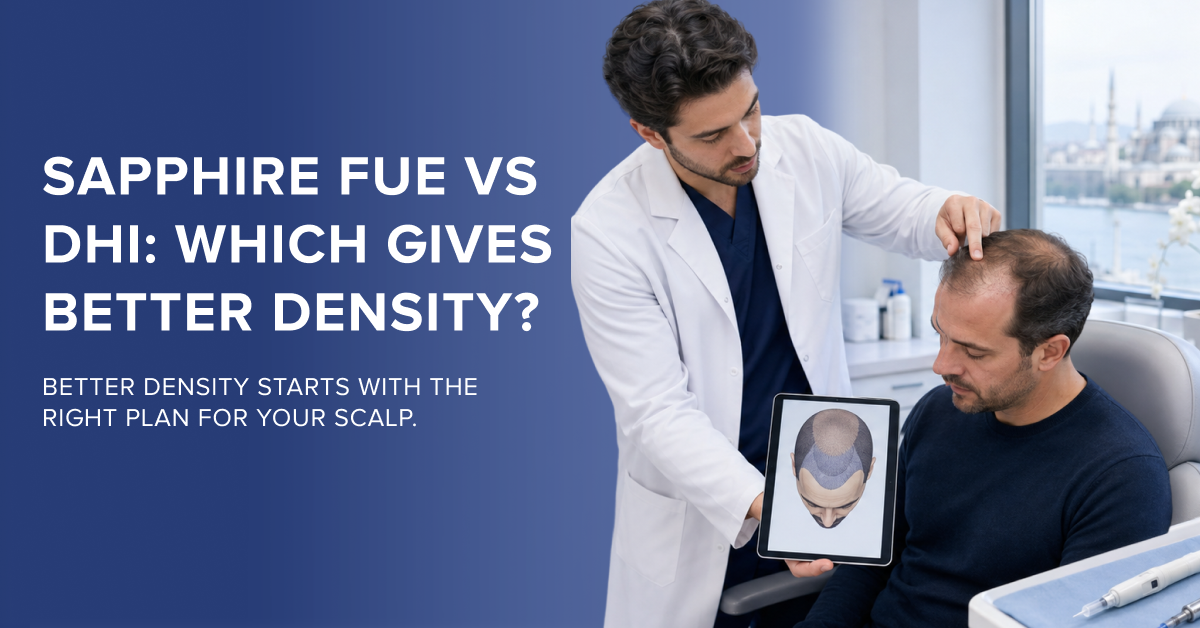
Sapphire FUE vs DHI: Which Gives Better Density?

Sapphire FUE vs DHI has no universal density winner. DHI may suit compact areas and placement between existing hairs, while Sapphire FUE can efficiently create controlled density across larger bald zones. Your safe result depends more on donor supply, graft quality, recipient-zone biology and surgeon planning than on the implantation tool alone.
Sapphire FUE vs DHI: Which Gives Better Density?

Table of Contents

Dr. Busra Yakupoglu

Reviewed by Dr. Busra Yakupoglu, Hair Transplant Surgeon, Medart Hair Transplant, Istanbul

Get a Free Consultation

Talk to an experienced patient coordinator for your hair transplant in Turkey.
Please enter a valid phone number.

DHI is often advertised as the denser technique—but the implantation pen does not create extra donor grafts, and it does not make every recipient zone equally suitable for dense packing. That is the honest starting point. This guide compares Sapphire FUE vs DHI on one question only: achievable and natural-looking density by recipient zone.

Density is never planned as a single scalp-wide number. It is planned zone by zone: hairline, frontal zone, mid-scalp, crown or vertex, and areas of diffuse thinning. Each zone carries its own objective, its own graft demand and its own tissue conditions.

Two terms run through this hair transplant density comparison. Follicular-unit density (FU/cm²) is the number of follicular units planned or placed in each square centimetre. Visual density is how full the result actually looks once hair grows, which depends on hair calibre, curl, hair-to-scalp colour contrast and how many hairs each graft carries.

If you are still choosing between procedures rather than comparing density, the broader DHI vs FUE decision guide answers that wider question. Medart Hair Transplant performs both Sapphire FUE and DHI, so this comparison can focus on case fit instead of on promoting whichever technique happens to be on offer.

Key Takeaways:

  • ● Neither method is universally denser.

  • ● DHI may help with selective placement in compact or hair-bearing zones.

  • ● Sapphire FUE may suit controlled coverage of larger bald areas.

  • ● Donor supply and hairs per graft limit achievable coverage.

  • ● Naturalness depends on distribution, direction and graft selection, not just FU/cm².

  • ● A surgeon should provide a zone-by-zone density plan.

Sapphire FUE vs DHI: Which Achieves Higher Density?

Neither Sapphire FUE nor DHI produces higher density in every patient; the practical advantage changes with the recipient zone, existing hair and the donor supply available. The label describes how grafts are placed. It does not describe how many transplantable follicular units your scalp can spare.

A follicular unit is a natural grouping of one or more hairs. A graft is the small piece of tissue containing that follicular unit. Neither instrument manufactures more of them, and neither expands the donor area.

Where each method tends to help:

  • Compact or hair-bearing zone: DHI can be useful, allowing selective site creation between existing hairs when the anatomy and the operator's visibility permit.

  • Broad bald zone: Sapphire FUE can be efficient, because channels are planned as a set and filled in a coordinated sequence.

  • Limited donor supply: the method matters far less than graft allocation, since the ceiling is set by how many grafts can be harvested safely.

Safe density is limited by scalp vascularity, graft quality, recipient-tissue condition and how the surgical team executes the plan. Peer-reviewed dermatologic surgery literature on recipient-site design links crowded, poorly sequenced sites with greater recipient-site trauma and reduced graft survival. Push past those limits and you risk patchy growth, not a fuller look.

Visible density is a separate matter again. Thick, wavy, low-contrast hair carrying two or three hairs per graft can look fuller at a modest FU/cm² than fine, straight, high-contrast hair does at a far higher one.

Clinical observation, Dr. Busra Yakupoglu, hair transplant surgeon: In practice, the DHI vs Sapphire FUE density question is usually settled by the donor area and the size of the bald zone. The pen does not overrule tissue biology. The blade does not create extra grafts.

Scalp zones for hair transplant density planning with Sapphire FUE and DHI, illustrative Medart clinical diagram.

How Does Each Technique Create Density?

Sapphire FUE creates density through pre-opened recipient channels, whereas DHI creates and fills each site with a loaded implanter pen, changing when each graft is placed. The section above established that neither label guarantees denser growth. What changes next is how site creation affects spacing, angle and work around existing hair.

One point of confusion first. FUE, or follicular unit extraction, describes how grafts are commonly harvested from the donor area. DHI describes an implantation workflow. Grafts used in a DHI case are still, in most clinics, harvested by FUE, so the two are not opposing extraction methods.

In a Sapphire FUE case, the surgeon opens recipient channels, the small sites created in the thinning or bald area to receive a graft, using a sapphire-tipped blade. Depth, width, angle and direction are set across the whole zone before placement begins.

In a DHI case, a Choi-type implanter pen (also called a DHI implanter pen) is loaded with a graft, and site creation and placement happen in one step. Peer-reviewed technique reviews of follicular unit transplantation in dermatologic surgery journals treat both blade-made incisions and implanter devices as accepted ways of creating recipient sites, with graft handling, hydration and time out of body among the modifiable factors affecting survival.

You can read how Sapphire FUE creates recipient channels on the dedicated treatment page. Neither instrument overcomes the biological limits of the recipient tissue.

Sapphire Blade Channels vs DHI Implanter Pen

Table 1. Recipient-site mechanics that influence density planning

Comparison point

Sapphire FUE

DHI

How the recipient site is created

Sapphire-tipped blade opens a channel sized to the graft

Implanter pen creates the site and releases the graft in one action

When the graft is inserted

After channels are opened, in a planned sequence

At the moment the site is created

Angle, direction and depth control

Set at channel creation across the whole zone

Set graft by graft at the point of placement

Working between native hairs

Possible, but requires careful blade placement around existing shafts

May allow selective insertion between surviving hairs

Efficiency over larger bald zones

May support efficient planning and filling across a broad open zone

Sequential placement may lengthen larger cases, depending on graft count and staffing

Dependence on surgeon and team skill

High: channel design drives the entire result

High: loading, depth control and pen handling drive the result

Both columns depend on the same variables. A channel that is too large wastes tissue, while one that is too small increases graft trauma and the risk of transection during placement. Inconsistent pen depth produces buried or elevated grafts.

The tool alone does not establish lower recipient-site trauma. Details of the pen workflow and candidacy sit on the page explaining how DHI implantation works, so this article stays with the density consequences.

Comparison of recipient site creation with Sapphire FUE channels and DHI implanter pen placement.

Which Technique Packs More Grafts Per Square Centimetre?

Neither method has a universal safe maximum in grafts per cm², because packing density must be adapted to tissue conditions, graft quality and the zone being treated. The mechanics above explained how sites are made. This section turns that into numbers you can raise at consultation.

Planning should be expressed in follicular units per square centimetre (FU/cm²), not in "hairs per cm²" alone. Grafts and hairs are not interchangeable. Fifteen hundred grafts averaging 2.4 hairs each deliver very different coverage from 1,500 single-hair grafts.

Three separate outcomes are often collapsed into one word:

Implanted density: the follicular units actually placed per square centimetre on the day of surgery.

Surviving density: the implanted units that produce growth after healing. It may be lower than implanted density, because not every graft necessarily grows.

Visual density: the fullness a viewer perceives, shaped by growing hair, calibre, curl, colour contrast, exit angle and distribution.

Headline packing figures from clinic marketing describe what was placed, not what grew. Peer-reviewed dermatologic surgery literature on dense packing reports that very high packing can increase competition for local blood supply, raise recipient-site trauma and risk mechanical damage to grafts when sites are crowded or poorly sequenced.

That is why a lower planned FU/cm² sometimes produces a better-looking result. Favourable graft composition and hair characteristics may make a modest plan appear fuller than an aggressive one on paper.

Direct head-to-head evidence comparing final density outcomes between DHI and Sapphire FUE specifically remains limited. Most published work addresses follicular unit transplantation principles that apply to both workflows.

Density Comparison Table by Zone

Table 2. Illustrative zone-by-zone density planning for Sapphire FUE and DHI

Zone

Typical objective

Illustrative planning range*

DHI density fit

Sapphire FUE density fit

Main limiting factor

Hairline

Natural transition using singles

~30–40 FU/cm²

Suited to precise, compact placement of single-hair grafts

Suited to controlled channel angle and deliberate irregularity

Naturalness and single-hair graft supply

Frontal zone

Highest visual priority

~35–50 FU/cm²

Useful in smaller or partly hair-bearing areas

Useful across larger bald areas

Donor allocation

Mid-scalp

Coverage and blending

~30–40 FU/cm²

Useful around retained native hair

Efficient across broader open areas

Existing hair and future loss

Crown/vertex

Whorl reconstruction and coverage

~25–35 FU/cm²

Useful for selective placement within the whorl

Often practical across larger crown surfaces

Area size and graft demand

Diffuse thinning

Add density without damaging native hair

Case-specific; no fixed promise

May be favoured for placement between hairs

Possible where channels can be made safely

Miniaturisation and shock-loss risk

Illustrative planning ranges, not guarantees or universal treatment standards. A clinician must adjust the plan for donor supply, scalp biology, graft composition, existing hair and long-term hair-loss progression.

These figures are clinician planning illustrations from our own practice, checked against published follicular unit transplantation principles. They are not comparative evidence for either workflow, and they are not targets to be applied to every scalp. Read them as the start of a conversation, then ask for the number planned for each of your own zones.

Not sure which row matches your hair-loss pattern? Use the WhatsApp button in the bottom-right corner to request a free initial assessment. Our team can review your photos and explain which recipient zones need in-person evaluation. A photo review is an initial assessment only, density cannot be guaranteed from photographs, and final suitability requires clinician assessment.

Which Method Suits Your Hair Loss Pattern and Zone?

DHI may be favoured in compact or hair-bearing areas, while Sapphire FUE may be more efficient across larger bald zones, but both can work when appropriately planned. The table above gave numbers by zone. This section matches those zones to real hair-loss patterns.

Table 3. Pattern-to-technique matrix for density planning

Hair-loss pattern

Density priority

Technique that may be favoured

Reason

What could change the decision

Compact hairline and frontal recession

Natural transition, strong framing

Either, with design driving the result

Small area; singles selection and exit angle matter most

Donor calibre, number of true single-hair grafts

Broad bald frontal area

Uniform coverage across a wide surface

Sapphire FUE often practical

Channel sets can be planned and filled across an open zone

Donor capacity and safe extraction limits

Diffuse thinning with miniaturised hair

Add density without harming native hair

DHI may be favoured

Selective placement between surviving hairs

Shock-loss risk, degree of miniaturisation

Crown request with frontal recession

Long-term allocation across two zones

Either; allocation decides the outcome

Crown area and whorl consume grafts quickly

Norwood progression, age, donor reserve

Technique fit is not fixed by pattern alone. It shifts with recipient-zone size, how much existing hair remains, recipient-tissue characteristics and how much donor reserve must be held back for future loss.

Illustrative clinical scenario: compact frontal recession. A man with Norwood 3 recession keeps intact hair immediately behind the receding corners. The priority is a soft, irregular transition rather than aggressive packing. Because the recipient area is small and partly hair-bearing, DHI is often considered first, so single-hair grafts can be positioned between existing hairs with controlled depth. Sapphire FUE remains a reasonable alternative in the same pattern, since an experienced team can open equally precise channels. This composite scenario illustrates planning logic. It does not prove universal technique superiority, and outcomes vary.

Illustrative clinical scenario: broad frontal-to-mid-scalp loss or crown demand. A man with Norwood 5 loss asks for crown coverage alongside a rebuilt hairline. The bald surface spans frontal and mid-scalp zones, with an open crown behind. Sapphire FUE suits the frontal and mid-scalp areas, where one coordinated channel plan supports even distribution across a wide surface. The crown is often deferred, because chasing native-level density everywhere would exhaust the donor reserve needed for later loss. This composite scenario shows allocation reasoning, not a guaranteed plan, and outcomes vary.

Editorial note: At Medart Hair Transplant, technique choice follows clinical assessment and long-term donor planning, not a sales tier.

Donor-area hair transplant density planning with Sapphire FUE, illustrative Medart clinical graft allocation diagram.

How Do Donor Limits Affect Achievable Density With Each?

The donor area, not the implantation device, usually sets the upper limit on how much of your scalp can be treated at a high planned density. The scenarios above showed allocation choices. Here is why those choices cannot be avoided.

The donor area is the scalp region, usually the back and sides, where transplantable grafts can be harvested safely. That supply is finite. Donor density, hair calibre, tissue characteristics and a safe extraction pattern together determine how many grafts you have across a lifetime, not just for one operation.

Hairs per graft matter as much as graft count. Two thousand grafts averaging 2.5 hairs cover noticeably more scalp than 2,000 grafts averaging 1.6 hairs, at an identical FU/cm².

The crown consumes grafts quickly. It is a broad surface, and hair must radiate outward around a circular whorl, so coverage cannot be produced by packing one small patch. According to the International Society of Hair Restoration Surgery, donor management and realistic long-term planning are central to responsible hair restoration. Excessive extraction can cause persistent visible thinning or a moth-eaten donor appearance.

Donor-budget example. Picture an available budget of 4,000 grafts. A front-prioritisation option might place roughly 2,600 in the hairline and frontal zone at a solid planning density, with about 1,400 blending the mid-scalp. A crown-heavy option might spread the same 4,000 across frontal, mid-scalp and crown, leaving every zone thinner and little reserve for later loss. This example demonstrates allocation logic, not a treatment recommendation or guaranteed graft plan.

In our Istanbul clinic, recipient zones are measured in square centimetres and photographed under standardised lighting, and donor density and calibre are assessed with trichoscopy before any FU/cm² figure is discussed. Androgenetic alopecia is progressive, so the plan must account for loss beyond the zones being treated today.

A graft count is only useful when it is matched to the size of each treatment zone and your donor capacity. Send clear scalp and donor-area photos through the WhatsApp button for an initial, personalised review. This is a first-look assessment rather than a diagnosis, density cannot be guaranteed from photographs, and final suitability requires clinician assessment.

Donor-area trichoscopy assessment of hair density and calibre before Sapphire FUE or DHI density planning.

Does One Technique Give a More Natural-Looking Density?

Natural-looking density depends more on graft selection, angle, direction and distribution than on whether a sapphire blade or a DHI implanter pen created the site. Donor limits set your ceiling. Design decides whether the result under that ceiling reads as natural or transplanted, and this is where the Sapphire FUE vs DHI argument usually loses its relevance.

Numerical density: the follicular units planned or placed per square centimetre, expressed in FU/cm².

Visual density: the fullness a viewer perceives, produced by hair calibre, curl or wave, hair-to-scalp colour contrast, exit angle, direction and distribution.

The leading edge of the hairline should carry single-hair grafts, placed irregularly rather than along a straight line. Multi-hair grafts belong behind that transition zone, where they build fullness without exposing blunt, uniform hair ends at the front.

Angle and direction do most of the visual work. Hair that exits at a low, forward angle lies over the scalp and shades it. Hair that exits too steeply stands up and reveals skin between shafts. In the crown, grafts must follow the whorl's spiral, or coverage looks disordered no matter how many grafts were used.

Hair characteristics substantially affect perceived coverage. Peer-reviewed reviews of hairline design and follicular unit transplantation principles identify calibre, curl and hair-to-scalp colour contrast as major determinants of how much scalp a given density conceals. Thick, wavy, low-contrast hair hides scalp far more effectively than fine, straight, dark hair on pale skin.

Natural hair transplant density is therefore not a maximisation exercise. A straight, uniformly packed, aggressively dense hairline reads as artificial, particularly under bright light and when hair is worn short. A conservative hairline with planned distribution behind it also tends to age better as androgenetic alopecia progresses.

Chart comparing visual density of thick wavy hair and fine straight hair at an equal FU/cm² planning figure.

Cost, Session Length and Recovery: How Density Trade-Offs Play Out

A more expensive or longer implantation method does not automatically produce denser growth, because graft count, recipient area and team workflow drive session length more than the device. Design decided naturalness in the section above. Operational factors quietly shape how much density is realistic in one sitting.

Table 4. How practical factors influence density planning

Factor

Potential effect on density planning

What patients should verify

Session duration

Longer cases extend graft time out of body, which storage and workflow must manage

How grafts are stored and how breaks are scheduled

Graft count

The same count spread across larger zones lowers FU/cm² per zone

The planned FU/cm² for each zone, not one scalp-wide figure

Team size and workflow

Placement pace influences how long grafts wait before insertion

Who opens sites, who loads implanters, who places grafts

Broad bald-zone coverage

Sequential pen placement over wide areas may lengthen a case

Whether the plan splits zones across separate sessions

Price transparency

A higher fee does not prove denser or better growth

What the quoted figure includes, and what it excludes

Aftercare planning

Graft disturbance, infection or missed instructions can reduce surviving density

Written instructions, wash protocol, follow-up contact

Travel logistics

Early departure limits in-person review of postoperative concerns

Minimum stay, follow-up review, remote support afterwards

Istanbul is a practical consideration here rather than a clinical one. If you are travelling, confirm which clinician performs channel creation, what the assessment includes, how long you should stay, and how aftercare is supported once you fly home. Readers weighing that side can review planning DHI treatment in Turkey.

Clinical observation, Dr. Busra Yakupoglu, hair transplant surgeon: Session length tracks graft count, recipient-area size and team workflow far more closely than the choice between a blade and a pen. Two cases of the same size can run to similar hours with either workflow.

How to Decide Which Technique Fits Your Case

Choose the method only after the clinic has mapped your recipient area in square centimetres, your donor capacity and the planned density for each zone. Cost and scheduling matter, but they follow that mapping. If you are anxious about a thin donor area, a previous transplant that never filled in, or a hairline that might look obvious, these are exactly the points a consultation should settle before any technique is named.

Your density-decision checklist:

  • ● Size of each recipient zone, measured in square centimetres.

  • ● Bald versus hair-bearing recipient area, zone by zone.

  • ● Donor density and hair calibre, assessed with trichoscopy.

  • ● Hairs per graft, and the expected split of single-, double- and multi-hair grafts.

  • ● Hairline and crown priorities, ranked for the long term.

  • ● Future-loss risk based on age, family history and current miniaturisation.

  • ● Safe planned FU/cm² by zone, not a single scalp-wide number.

  • ● The hair transplant surgeon's experience with both methods.

  • ● Medical suitability, contraindications and health history.

A photo assessment cannot replace a complete medical evaluation. Miniaturised hair, meaning existing hair that has become finer and more vulnerable to further loss, needs careful in-person assessment, because placing grafts among it carries a risk of shock loss: temporary or, less commonly, persistent shedding of existing or transplanted hair after surgery. Which is better, DHI or Sapphire FUE, for your own scalp is a question that only has an answer after measurement.

Safety note. Hair transplantation is a surgical procedure. Possible risks include infection, bleeding, swelling, scarring, altered sensation, folliculitis, poor growth, unnatural hair direction, and temporary or persistent shock loss. Excessive extraction can visibly thin the donor area. The American Academy of Dermatology describes androgenetic alopecia as a progressive condition requiring individual assessment, and the NHS notes that treatments for genetic hair loss are not always effective and are usually not funded as cosmetic care. Medical therapy, including finasteride or minoxidil where clinically relevant, must be discussed with an appropriately qualified clinician and is not suitable for everyone. No final density, graft-growth percentage or cosmetic outcome can be guaranteed.

Seek clinician assessment before committing if you have diffuse thinning, advanced Norwood-scale loss, a crown request alongside frontal recession, low donor density, active scalp disease, an uncontrolled medical condition, previous transplant scarring, or if any clinic offers you an exact FU/cm² figure from photographs alone.

Frequently Asked Questions

Is DHI always denser than Sapphire FUE?
No. Neither implantation method guarantees higher density in every patient. DHI may allow selective placement in compact or hair-bearing zones, while Sapphire FUE may suit controlled coverage across larger bald areas. Achievable density is limited by donor supply, graft composition, scalp vascularity and surgical execution. Direct head-to-head evidence comparing final density between the two workflows remains limited.
How many grafts per cm² can DHI implant?
There is no universal figure. Planning is expressed in follicular units per square centimetre and set zone by zone. As an illustration only, hairline transitions are often planned around 30–40 FU/cm² and frontal zones around 35–50 FU/cm². DHI density in your case depends on tissue condition, graft quality and how much donor supply can safely be allocated there.
How many grafts per cm² can Sapphire FUE implant?
The blade does not create a separate universal range. The plan works within the same recipient-tissue and donor constraints, so Sapphire FUE density is governed by channel spacing, depth and angle chosen against scalp vascularity and graft size. Clinic-reported packing figures describe what was placed on the day, not what grew after healing, so treat them cautiously.
Is DHI better for adding density between existing hairs?
DHI may be favoured where native or miniaturised hair remains, because grafts can be inserted selectively between surviving shafts with controlled depth. It does not eliminate shock-loss risk, and it does not protect vulnerable hair from further androgenetic loss. Sapphire FUE remains possible in thinning areas when channels can be made safely around existing hair.
Which method is better for a dense, natural hairline?
Both can build a natural hairline. The result is driven by design rather than device: single-hair grafts at the leading edge, deliberate irregularity, low exit angles and correct direction. Hair calibre and the number of true single-hair grafts available often matter more than the choice between a sapphire blade and an implanter pen.
Is Sapphire FUE or DHI better for the crown?
Neither is automatically better. The crown is a wide surface with a circular whorl, so it consumes grafts quickly and rarely reaches native density. Sapphire FUE is often practical across larger crown areas, while DHI may help with selective placement inside the whorl. Long-term donor allocation usually decides the crown outcome more than technique choice.
Can either method restore my original natural density?
Usually not across a substantial area. A transplant redistributes a finite donor supply rather than adding new follicles, so recreating original density throughout every affected zone is rarely feasible. Realistic planning creates the impression of fullness through coverage, angle, direction and graft composition. Set expectations against measurement of your donor area, not marketing claims.
Does a higher graft density reduce graft survival?
It can. Peer-reviewed dermatologic surgery literature on dense packing reports that crowding recipient sites may compromise local blood supply, increase recipient-site trauma and raise the chance of mechanical graft damage. Survival also depends on graft handling, hydration and time out of body. Higher implanted density does not reliably translate into higher surviving or visual density.
Can I combine Sapphire FUE and DHI?
Sometimes, yes. Some plans use pre-opened channels across broad bald zones and implanter placement around existing hair in thinning areas. Suitability depends on zone size, donor capacity and team workflow. Read more about combining Sapphire FUE and DHI in a hybrid procedure before assuming it fits your case.
What information does a surgeon need to recommend one method?
Each recipient zone measured in square centimetres, and whether those zones are bald or hair-bearing. Trichoscopic donor density and hair calibre, plus expected hairs per graft. Your age, family history, current miniaturisation, health history and medication use. Without those inputs, a technique recommendation is guesswork rather than a density plan.
Hairline hair transplant density planning with DHI implantation, illustrative Medart clinical measurement image.

For a case-specific Sapphire FUE vs DHI density plan, use the WhatsApp button in the bottom-right corner and ask Medart Hair Transplant in Istanbul, Turkey for an estimate by zone: planned FU/cm², donor-graft budget and the reasoning behind the recommended implantation method. The photo review is an initial assessment rather than a diagnosis, density cannot be guaranteed from images, and final suitability requires clinician assessment in person. Bring the checklist to whichever clinic you consult, and ask for the zone measurements before you ask for a price. The densest-looking plan is not the one that places the most grafts everywhere; it is the one that uses a finite donor supply where it will matter most over time.

This article provides general information and cannot determine which hair-transplant technique is medically appropriate for an individual. Achievable density and graft survival vary with donor supply, hair characteristics, scalp condition, hair-loss progression, health history and surgical execution. A qualified clinician must assess your case before recommending treatment.

Contact Us!

Please enter a valid phone number.
Greft Hesapla WhatsApp