
Looking for the best FUE hair transplant in Turkey? At MedArt Hair Clinic in Istanbul, we specialize in advanced Follicular Unit Extraction (FUE) techniques that deliver natural, permanent, and scar-free results. Our internationally accredited surgeons have helped thousands of patients from the UK, USA, Europe, and the Middle East restore their confidence with affordable, high-quality hair restoration treatments in Turkey.
FUE (Follicular Unit Extraction or Follicular Unit Excision) hair transplant is a surgical technique that extracts individual hair follicles from the donor area using a micro-punch tool without removing a strip of skin. This method has revolutionized hair restoration by eliminating linear scarring and significantly reducing recovery time for patients seeking permanent solutions to hair loss.
FUE hair transplant involves extracting follicular units containing 1-4 hairs through small circular punch (0.8-1.0mm wide), carefully preparing these grafts, and implanting them into precise incisions in the recipient area. When performed by skilled surgeons, FUE creates natural-looking results with less apparent scarring, allowing patients to wear shorter hairstyles without concern.
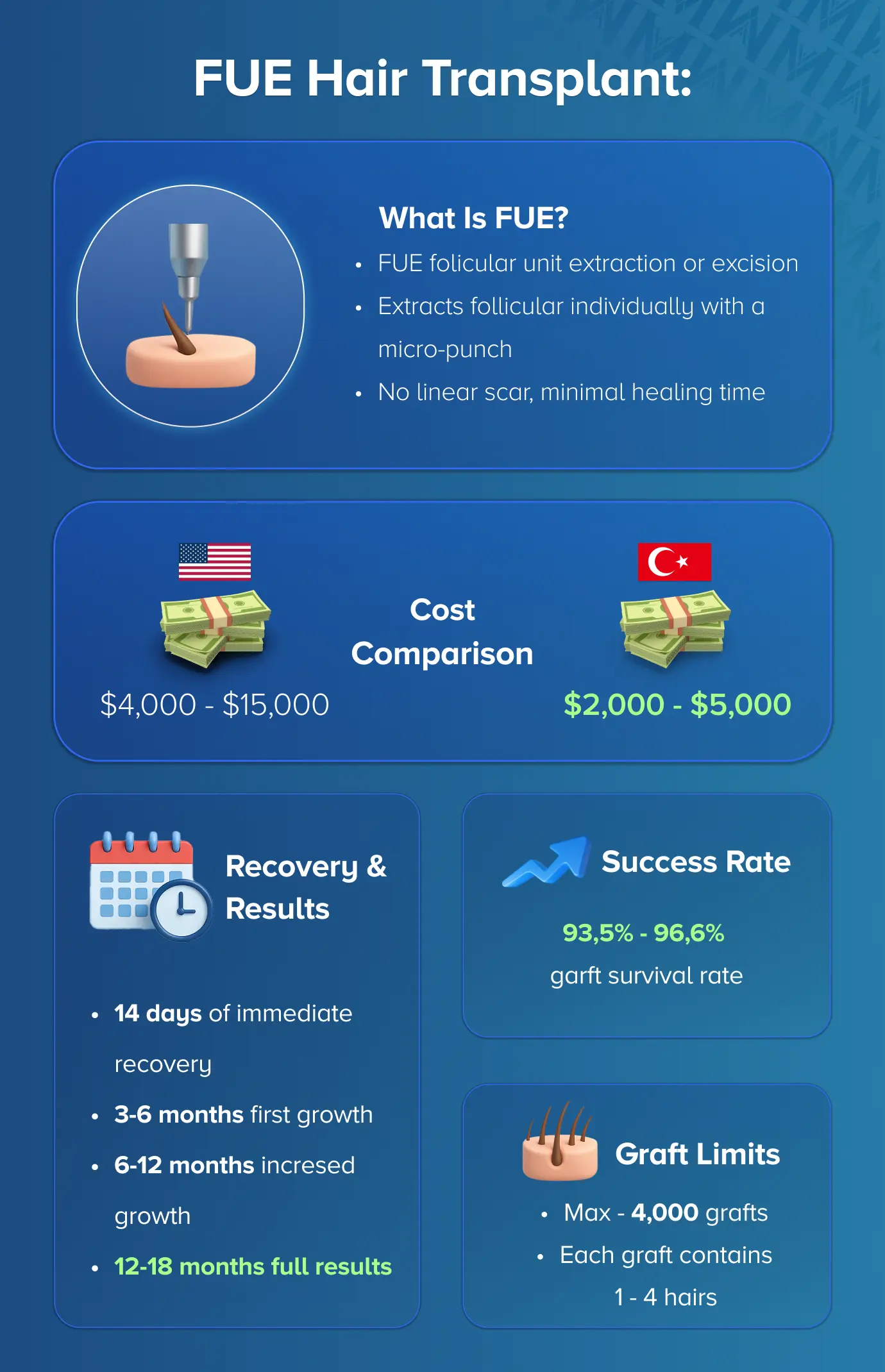
Costing between $4,000-$15,000 in the United States (with significant price variations worldwide), FUE offers impressive success rates of 93.5-96.6% graft survival. The procedure typically takes 6-7 hours and works for various types of hair loss, including pattern baldness, traction alopecia, and scarring.
Key Points:
FUE hair transplant extracts individual follicles without linear scarring
FUE hair transplant costs range from $2,000 in Turkey to $15,000 in the US
FUE hair transplant success rates are above 93% with proper technique
Allows a maximum of 4,000 grafts to be implanted in a single session
Results become visible at 5–6 months, with full results at 12–18 months
If you are considering having the procedure abroad, read our detailed guide to FUE hair transplant in Turkey.
A hair transplant is a cosmetic reconstructive plastic surgery that transfers hair follicles from the back or sides of the head (donor area) to areas that are bald or thinning (recipient area). This outpatient procedure is minimally invasive and permanently restores hair with natural-looking results that can last a lifetime when done properly.
FUE (Follicular Unit Extraction) hair transplant is a surgical technique that extracts individual hair follicles from the donor area using a micro-punch tool without removing a strip of skin.
During the procedure, circular punches (0.8-1.0mm wide) are used to remove individual follicular units, each containing 1-4 hairs. These units are then sorted, prepared, and implanted into small incisions in the recipient area.
When properly done, the FUE method leaves small, dot-like scars in the donor area, which allows the patients to wear their hair short without the appearance of a linear scar on the scalp. Fue hair transplant has a quick recovery time, and offers natural results with minimal discomfort.
FUE hair transplant costs between $4,000 and $15,000 in the United States, with the average price being around $8,000 for a standard procedure.
The cost varies significantly depending on location, with Turkey offering procedures for $2,000-$4,000, the UK charging £3,000-£8,000, and European clinics pricing between €3,000-€8,000.
FUE hair transplant is expensive because it requires specialized equipment, highly trained medical staff, and significant time investment. The micro-motor extraction tools alone can cost upwards of $25,000, and each procedure requires 6-8 hours of meticulous work by a surgeon and multiple technicians.
The surgeon must have extensive training to extract and implant each follicle without damaging it. FUE is largely manual and cannot be rushed without compromising results, making surgeon time a significant cost factor.
During FUE hair transplant, 30° to 45° angles are used to make incisions on the recipient area.
FUE incisions can be made 3mm to 5mm deep, depending on the patient’s scalp thickness.
FUE hair transplant takes about 6-8 hours on average.
Yes, FUE hair transplant, Follicular Unit Extraction, is the only way we can harvest and use body hair and facial hair.
Yes, FUE hair transplant works for beard transplants and other types of facial hair.
Yes, FUE hair transplant works for eyebrow transplants.
Yes, FUE hair transplant can be combined with other implantation techniques, such as DHI hair transplant, to create personalized results. At MedArt, we utilize the Hybrid Hair Transplant technique, using the FUE implantation method with incisions and forceps to create natural hairlines and combine it with the DHI technique to create density at the top.
FUE differs from other hair transplant techniques primarily through its extraction method and scarring pattern. Instead of removing a strip of scalp tissue like FUT, FUE extracts individual follicular units directly with micro-punches, leaving only tiny dot scars rather than a linear scar, revolutionizing the donor area appearance and significantly improving patient recovery experience.
Individual follicle extraction without linear scarring
Faster recovery time with minimal post-operative discomfort
Freedom to wear short hairstyles without linear scarring
Versatility in donor area selection beyond just scalp
Reduced tissue trauma
FUE hair transplant uses an entirely different extraction method and producing different scarring patterns compared to FUT (Follicular Unit Transplantation) hair transplant.
FUE extracts individual follicular units with micro-punches, leaving tiny dot scars, while FUT removes a linear strip of scalp, resulting in a visible line scar at the back of the head.
Recovery time differs significantly between the two techniques. FUE patients typically heal within 7-10 days with minimal discomfort, while FUT requires 2-3 weeks of recovery with more pronounced post-operative pain and restricted movement. FUT patients must also avoid strenuous activities longer to prevent stretching of the linear scar.
The techniques also differ in how they affect future styling options. FUE allows patients to wear very short hairstyles, while FUT patients typically need to maintain longer hair to cover the linear scar. This difference is particularly important for patients who prefer military-style haircuts or may want to shave their head in the future.
FUE extracts individual follicles with micro-punches and then creates separate recipient sites with steel blades before manually placing grafts, while DHI uses specialized Choi pen implanters that create the recipient site and place the graft simultaneously in one step.
The implantation technique affects both the procedure and results. DHI provides better control over the angle, depth, and direction of hair follicles using the Choi pen. In contrast, FUE requires creating recipient sites before placing grafts, which may cause more tissue trauma and longer healing times.
FUE differs from Sapphire FUE primarily in the tools used to create recipient sites. Traditional FUE uses steel blades or needles to make incisions, while Sapphire FUE employs specialized blades made from medical-grade sapphire crystal. The sapphire blades allow for smaller, smoother incisions with less trauma to surrounding tissue, resulting in faster healing times and reduced bleeding compared to standard steel instruments.
Both techniques share the same extraction method, using micro-motor punches to harvest individual follicular units from the donor area. However, the improved recipient site creation with sapphire blades allows for potentially better graft survival rates and denser packing of transplanted follicles.
The maximum number of grafts that can be transplanted with FUE in a single session is 4000 grafts.
FUE hair transplant grafts are counted as individual follicular units containing 1-4 hair follicles each. The natural groupings of hair follicles are classified based on the number of hairs they contain – single follicle grafts, double follicle grafts, triple follicle grafts, and rarely, quadruple follicle grafts. This classification is important because the total number of hairs transplanted is higher than the number of grafts.
During graft counting, technicians sort the extracted follicular units under magnification, categorizing them by the number of hair follicles they contain. Single follicle grafts are primarily used for creating natural-looking hairlines, while multi-follicular grafts are placed behind the hairline to create density and volume.
Donor area capacity for FUE hair transplant is calculated through a comprehensive hair and scalp analysis performed before the procedure. During this analysis, the surgeon examines the scalp microscopically to determine hair density, follicular unit distribution, hair thickness, and scalp laxity in the donor region.
Surgeons typically extract only 25-35% of available follicles to maintain a natural appearance in the donor area. This conservative approach ensures the donor area doesn’t appear thin after extraction.
Designing a hairline for a FUE hair transplant requires careful planning for a natural appearance. The surgeon draws the hairline on the patient’s forehead, considering facial proportions, age, gender, ethnicity, and personal preferences. This personalized approach blends artistic skill with technical expertise to achieve optimal results.
During surgery, the surgeon uses an irregular, jagged pattern to mimic a natural hairline. Single hair follicular units are placed at the hairline for a soft appearance, while denser multi-follicular units are positioned behind for depth.
You are a good candidate for a FUE hair transplant if you:
Are between the ages of 18-65
Have an established hair loss pattern (Norwood scale 2-6 for men &Ludwig scale 1-2 for women)
Have sufficient donor hair density, in good condition
Have realistic expectations about the procedure
In overall good health
Yes, you need to shave your hair for the FUE hair transplant, both in the donor area and in the recipient area. This is the standard for all hair transplant procedures, as hair follicles need to be a certain length to be transplanted.
At MedArt, we now offer a new hair transplant method called the Long FUE, with this hair transplant method, we are able to transplant long hair strands from the donor area to the recipient area, without shaving the hair at all.
The best age for a FUE hair transplant is between 25 and 60. Within this age bracket, the majority of people have a clear pattern of hair loss that makes them good candidates for hair transplants.
FUE hair transplant can work for restoring your hair if you have the following hair loss types:
Fibrosing Alopecia (depending on condition)
Alopecia Areata (if did not respond to treatment in the first year)
Traction Alopecia (if the hair loss is permanent)
Receding sideburns
Receding temples
Hair loss on the crown
Failed hair transplant
Hair transplant scarring
Scarred scalp
Yes, FUE hair transplant works for curly hair, enabling surgeons to establish recipient sites that match the patient’s curl pattern.
Yes, FUE hair transplant works for women experiencing female pattern hair loss, traction alopecia, or hair loss from trauma or surgical procedures.
It’s not recommended to get an FUE hair transplant with thinning donor hair because the hair follicles have a slim chance of survival.
The best surgical alternatives to FUE hair transplant are Sapphire FUE, DHI, and FUT methods. For patients who do not want to shave their head, Long FUE is the best surgical alternative.
Before FUE hair transplant, stop taking any medications as advised by your doctor. Avoid smoking, alcohol, and illicit substances for at least two days, though a two-week abstinence is ideal. Make sure to discontinue Finasteride for seven days and Minoxidil for ten days prior to the procedure.
Additionally, consult your doctor regarding the possibility of temporarily stopping blood thinners seven days before surgery. Following these guidelines will help facilitate a better outcome.
When selecting a FUE hair transplant clinic, start by verifying their qualifications, experience, and track record of success. Perform thorough research by exploring authentic reviews on platforms like Google, TrustPilot, and Reddit, and pay particular attention to before-and-after photos of patients who have hair loss patterns similar to yours.
Choose a clinic that is transparent with its pricing, offers comprehensive packages, and restricts the number of procedures performed daily to ensure high-quality care. The surgeon should be actively involved during the entire process, deliver detailed treatment plans, and have established protocols for emergencies and unfavorable results.
Ensure that the clinic offers sufficient aftercare support and avoid those that promote outdated techniques or unrealistic, gimmicky treatments. It could be helpful to meet with multiple providers before making your final decision.
You can ask the following questions during FUE hair transplant consultation to see if it is a good method for you:
“How many grafts can you transplant before my donor area appears thinned out?”
“Is my scalp laxity better suited for FUT or FUE?”
After an FUE hair transplant, avoid caffeine for the first two days and do not smoke for at least two weeks. Limit salty and spicy foods to reduce swelling.
For 10 days after surgery, wash your head separately from your body and avoid shaving the transplanted area. Use a neck pillow to keep your head elevated while sleeping. Wear loose clothing, such as button-up shirts, to avoid touching your scalp.
Stay out of direct sunlight for two months. Avoid exercise, heavy physical activity, gym workouts, and sweating for one month to protect your scalp.
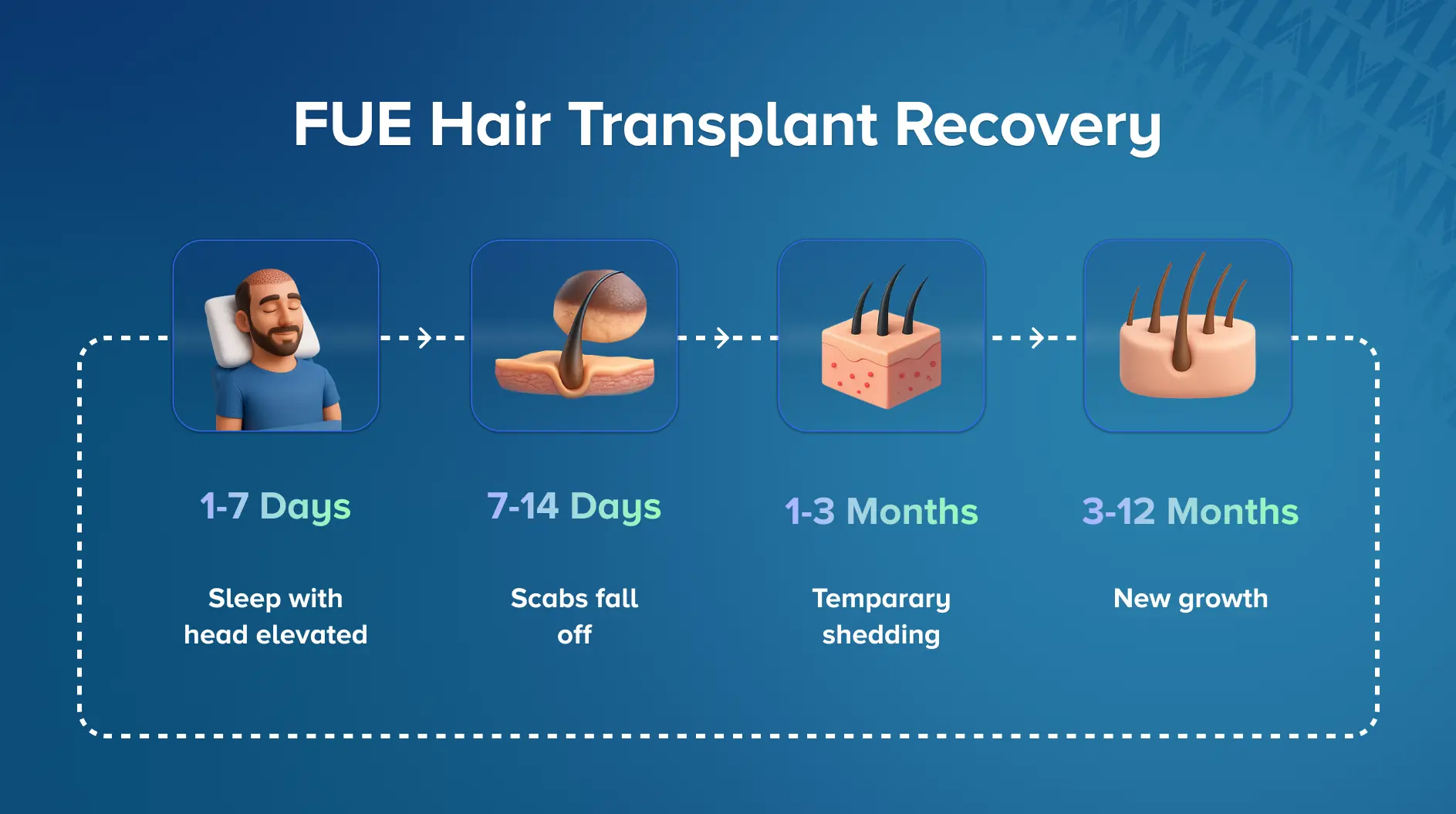
After an FUE hair transplant, limit physical activity and sleep with your head elevated for the first 24 to 48 hours. From day 3 to day 7, you can start gently washing your scalp, and scabs will form.
Between days 7 and 14, these scabs fall off, and temporary hair shedding happens. Normal activities can usually restart after 2 to 4 weeks. Hair shedding lasts from the first to the third month. New hair growth begins and improves between months 3 and 12.
The donor area takes about 7 to 10 days to heal after FUE hair transplant.
The donor area heals faster with FUE hair transplant compared to FUT hair transplant. With FUE hair transplant, the donor and the recipient areas take about 7 to 10 days.
After a FUE hair transplant, you can get a haircut in the donor area after four weeks. In the recipient area, you can only use scissors for haircuts during the first six months. After six months, you can start using clippers with guards.
The side effects of FUE hair transplant are rare but include swelling, discomfort, itchiness, and scabbing. Shock loss may occur in the recipient area. Complications such as infections, severe scarring, and poor graft survival make up 1% to 2% of all cases.
Swelling after FUE hair transplant lasts about 5 to 7 days.
FUE hair transplant does not leave a linear scar in the donor area but leaves 1mm wide, circular scars, barely visible to human eye dispersed throughout the donor area.
If an FUE hair transplant is performed by an inexperienced practitioner, the donor area may suffer from excessive overharvesting, leading to an uneven, patchy, and depleted appearance, resembling severe thinning. This defeats the entire purpose of the FUE hair transplant, which is to achieve a barely visible amount of scarring.
Yes, FUE hair transplant can cause shock loss like any other hair transplant method. When hair is transplanted from one location on the scalp to another, the hair follicles experience stress and the hair sheds, while the follicle stays healthy. It takes about 120 days for the follicle to produce new hair.
You can start seeing the results of a FUE hair transplant around 5 to 6 months after surgery, and full results will be apparent 12 to 18 months after.
No, hair transplanted with the FUE technique grows at the same rate as your native hair.
Hairs that are transplanted using the FUE technique grow with the same thickness as the hair from the donor area. Grafts that have 2-4 hair follicles may seem like a single strand growing from one root, creating the appearance of a thicker hair strand.
Yes, Transplanted hair can go grey following a FUE hair transplant or any other form of hair transplant, but the process of hair transplants does not promote graying.
Hair color pigments are produced by cells in the hair bulb, and during hair transplants this bulb remains intact. With natural aging, the bulb stops producing pigments and the hair starts to go gray.
Yes, the results of FUE hair transplant are permanent.
You can lose 5% to 10% of transplanted hair with FUE hair transplant. This amount of hair loss is normal during FUE, as grafts are more prone to damage and are accounted for during the surgery. If you’re experiencing more hair loss, you are likely losing native hair.
Yes, FUE hair transplant can be repeated if the patient experiences further hair loss and wants a second hair transplant. The possibility of a second hair transplant is accounted for when calculating the donor area capacity in the first hair transplant.
The pros and cons of FUE hair transplant are shown in the table below:
Advantages of FUE Hair Transplant |
Disadvantages of FUE Hair Transplant |
|---|---|
Minimal scarring (no linear scar) |
Can be more expensive |
Faster recovery period |
Longer procedure duration |
Natural-looking results |
Possible thinning of the donor area |
Suitable for small or large areas |
Requires shaving donor area |
Low risk of complications |
Risk of graft damage if poorly done |
Thank you! Your information has been sent successfully.